Quick Answer
Daily affirmations are short, positive statements you repeat to gently reshape how you talk to yourself.
They work best when they feel believable, when you say them with a little attention, and when you anchor them to something you already do, like your morning coffee or your phone’s lock screen.
Below are 101, sorted by mood and moment, so you can grab the one that fits the day you are actually having.
Let’s be honest about something first.
Most of us have stood in front of a mirror, muttered “I am confident and unstoppable,” and felt absolutely nothing. Maybe worse than nothing. A small, quiet voice in the back of the head going, sure you are.
That awkward gap is exactly where affirmations usually fail.
Not because affirmations are nonsense. Because we tend to reach for the loudest, shiniest ones, the kind printed on tote bags, and skip the part where the words actually have to feel true.
So this list is built differently.
It is sorted by mood, not by theme, because you do not need a “success” affirmation on a morning you can barely get out of bed. And it leans toward statements you might actually believe, which, as it turns out, is the whole ballgame.
More on why in a second. First, the part nobody tells you.
Do Daily Affirmations Actually Work?

The short answer is yes, with an asterisk worth understanding.
On the encouraging side, this is not just wishful thinking. Neuroscience research has shown that self-affirmation activates brain regions tied to reward and self-related processing, the same circuitry involved in valuing things that matter to us. Reflecting on what you care about literally lights up the brain a little.
That is real. It is also not magic.
Here is the asterisk, and it is the most useful thing in this entire article. A well-known study found that repeating grandiose affirmations like “I’m a lovable person” actually made people with low self-esteem feel worse, not better. The people who most needed the lift got the opposite.
Read that again, because it explains so much.
When an affirmation is too far from what you currently believe, your mind does not absorb it. It argues with it. You say “I am successful,” and your brain immediately files a rebuttal with twelve pieces of evidence. Now you feel further from the goal, not closer.
So the rule is simple. Make it believable.
The sweet spot is a statement that stretches you slightly without insulting your intelligence. Not “I am fearless,” but “I am learning to be braver than my fear.” Not “I have everything I want,” but “I am allowed to want more for myself.” Reachable, not fantastical.
The one rule that matters: An affirmation only works if part of you can believe it today. If it feels like a lie, soften it until it feels like a maybe. A believable “I am learning to” beats an empty “I am” every time.
How to Use Daily Affirmations Without It Feeling Like a Chore

The old advice was a mirror and a quiet room. Lovely in theory. Skipped by most people by day three.
The modern version is gentler, because it meets you where your attention already is. Which, let’s be real, is your phone.
Here is what actually sticks.
Put one on your lock screen. You look at that screen dozens of times a day. Make one of them count. A single affirmation as your wallpaper turns dead scrolling moments into tiny resets.
Anchor it to a habit you can’t skip. Say it while the coffee brews, on the commute, or right before you sleep. New habits survive when they ride on old ones.
Use a reminder or a widget. A daily notification at 8 a.m., a home-screen widget, or an affirmation app can nudge you without relying on memory. The tech is not the practice. It is just the string around your finger.
Say it slowly, once, with attention. This beats reciting twenty on autopilot. Affirmations are not a checklist. They are a moment of pointing your mind somewhere kinder.
Why It Matters: The point of a digital affirmation is not to add another task to your day. It is to interrupt the negative loop already running in the background. You are not adding noise. You are changing the channel.
The 101 Daily Affirmations
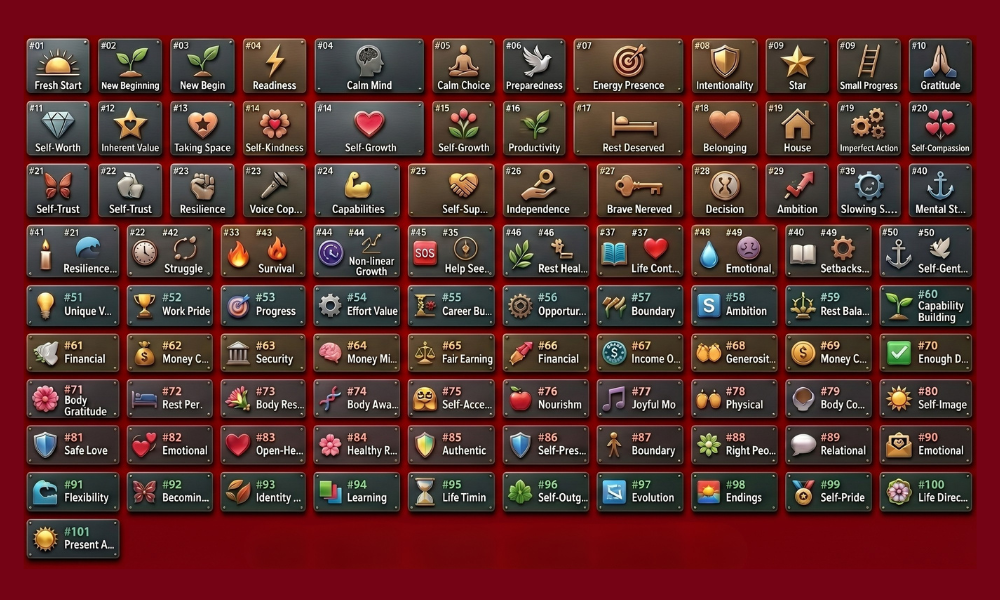
Grab what fits. Ignore what doesn’t. This is a menu, not a homework assignment.
For the morning (1 to 10)
- Today is a fresh page, and I get to write it.
- I am allowed to begin again this morning.
- I have what I need to start this day.
- I meet today with an open mind and a steady heart.
- This morning, I choose calm over rush.
- I am ready for whatever today brings.
- My energy is mine to protect today.
- I move into this day with intention, not pressure.
- Small steps today still count as progress.
- I am grateful to wake up and try again.
For knowing you are enough (11 to 20)
- I am enough, exactly as I am right now.
- My worth is not something I have to earn.
- I am allowed to take up space.
- I deserve kindness, especially from myself.
- I am learning to like the person I am becoming.
- My value does not rise and fall with my productivity.
- I am worthy of rest, not just reward.
- I belong here as much as anyone.
- I am allowed to be a work in progress.
- I treat myself the way I would treat a good friend.
For confidence and self-trust (21 to 30)
- I trust myself to figure things out.
- I have handled hard things before, and I can again.
- My voice matters, and I am allowed to use it.
- I am more capable than my fear suggests.
- I am learning to back myself.
- I do not need everyone’s approval to move forward.
- I can be nervous and brave at the same time.
- I trust the decisions I make for my life.
- I am allowed to want more for myself.
- I am building confidence one small win at a time.
For anxious moments (31 to 40)
- I am safe in this moment.
- This feeling is real, and it will also pass.
- I can do hard things slowly.
- I am allowed to take a breath before I respond.
- I release what I cannot control.
- My anxiety is not a fact about the future.
- I am learning to sit with discomfort without fixing it instantly.
- One breath at a time is enough.
- I give myself permission to slow down.
- I am steadier than my racing thoughts make me feel.
For hard days and bouncing back (41 to 50)
- A hard day is not a failed life.
- I am allowed to struggle and still be strong.
- I have survived all of my worst days so far.
- Healing is not a straight line, and that is okay.
- I can ask for help without losing my dignity.
- I am learning that rest is part of the work.
- This chapter is not the whole story.
- I am allowed to feel everything and still keep going.
- Setbacks are information, not verdicts.
- I am gentle with myself on the days that ask a lot of me.
For work, focus, and ambition (51 to 60)
- I bring something no one else can bring.
- I am allowed to be proud of my work.
- I focus on progress, not perfection.
- My effort counts, even when the outcome is uncertain.
- I am building a career on my own terms.
- I deserve to be in the rooms I worked to enter.
- I am learning to set boundaries without guilt.
- My ambition is allowed to be quiet or loud.
- I do not have to earn rest with exhaustion.
- I am capable of meaningful work.
For money and security (61 to 70)
- I am allowed to want financial peace.
- I am learning to manage money with confidence.
- I am capable of building security for myself.
- Money is a tool, and I am learning to use it well.
- I deserve to be paid fairly for what I offer.
- I release shame around past money decisions.
- I am open to new ways of earning and growing.
- I can be generous and still take care of myself.
- I am building a calmer relationship with money.
- Enough is something I am allowed to define for myself.
For your body and health (71 to 80)
- My body carries me, and I am learning to thank it.
- I am allowed to rest when my body asks.
- I treat my body as a home, not a project.
- I am learning to listen to what I actually need.
- My worth is not measured by my reflection.
- I nourish myself with patience, not punishment.
- I am allowed to move in ways that feel good.
- I am grateful for what my body lets me do today.
- I give myself permission to feel at home in my own skin.
- I am more than how I look on any given day.
For love and relationships (81 to 90)
- I am worthy of love that feels safe.
- I am allowed to need other people.
- I give and receive love with an open heart.
- I deserve relationships that feel like rest, not work.
- I am learning to let people see the real me.
- I can love others without losing myself.
- I am allowed to walk away from what hurts me.
- The right people will meet me where I am.
- I bring warmth and honesty to the people I love.
- I am surrounded by more care than my fear lets me see.
For growth, change, and letting go (91 to 101)
- I am allowed to change my mind.
- I am becoming, and that is enough.
- I release the version of me that no longer fits.
- I am learning, not failing.
- I trust the timing of my own life.
- I let go of who I thought I should be by now.
- I am allowed to outgrow things, people, and plans.
- Every ending I have feared has also made room.
- I am proud of how far I have quietly come.
- I give myself permission to want a different life.
- I am exactly where I need to be to take the next step.
How to Write Your Own

The best affirmation is often one in your own words. Three quick rules.
Keep it believable. Aim for a statement you can half-believe today. If “I am” feels like a stretch, start with “I am learning to” or “I am allowed to.” Those phrases sneak past the inner critic.
Anchor it to what you value. The research on self-affirmation is really about reconnecting with what matters to you. So write toward your values, not just your goals.
Say it in the present, gently. Present tense tells your brain this is who you are now, not a distant someday. Just keep the gentleness, or it tips into pressure.
A Gentle Note
Affirmations are a lovely tool. They are not a cure.
If a statement consistently makes you feel worse, that is not a personal failure. It is your mind telling you the gap is too wide. Soften the words, or set them down for a while.
And if you are carrying something heavy, the kind that affirmations cannot reach, please know that talking to a professional or someone you trust is a strength, not a fallback. Kind words to yourself work best alongside real support, not instead of it.
Frequently Asked Questions
What are daily affirmations?
Daily affirmations are short, positive statements you repeat to yourself to shift how you think and feel. Used consistently, they are a simple way to interrupt negative self-talk and refocus on your values, your strengths, and the kind of day you want to have.
Do daily affirmations actually work?
They can. Neuroscience research shows self-affirmation activates brain regions tied to reward and self-processing. But research also found that grandiose affirmations can backfire for people with low self-esteem. The fix is believability: affirmations work best when they feel within reach rather than like a fantasy.
How often should I say affirmations?
Most people do best with a short daily practice, often in the morning or evening, anchored to an existing habit. Quality beats quantity. One affirmation you believe and repeat with attention works better than twenty you rush through on autopilot.
What if an affirmation makes me feel worse?
That is useful information, not failure. If a statement feels like a lie, soften it. Swap “I am confident” for “I am learning to trust myself.” Process-based, believable affirmations are gentler and more effective than forced, grandiose ones.
How can I use daily affirmations on my phone?
Set one as your lock screen or wallpaper, save a few in your notes, schedule a daily reminder, or use a widget or affirmation app. The goal is to meet the affirmation where your attention already lives, so it becomes a gentle interruption rather than another task.
The Quiet Truth About Talking to Yourself
You are already running affirmations all day. Most of us just run the unkind ones.
“I always mess this up.” “I’m so behind.” “Why can’t I get it together.” That is self-talk too. It is just the version we never chose on purpose.
That is what makes this practice worth a few honest minutes.
Daily affirmations are not about lying to yourself until you believe it. They are about catching the cruel narrator, turning down the volume, and offering a line that is a little kinder and still true.
Pick one from the list. Put it where your eyes already go.
Say it like you would say it to someone you love, because, eventually, that is exactly who is listening.