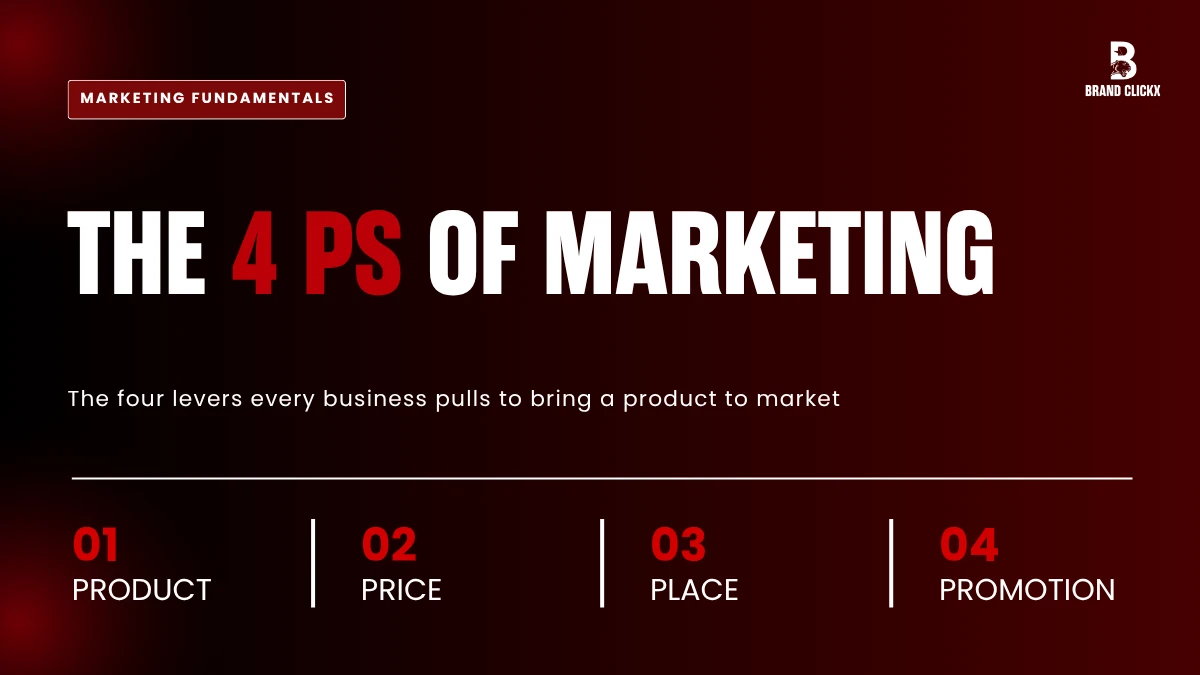
The 4 Ps of marketing are the four levers every business pulls to bring a product to market: product, price, place, and promotion. Master how they work together, and your marketing stops feeling like guesswork.
The framework is over sixty years old. It has survived the internet, social media, programmatic advertising, and now generative AI. That longevity is not nostalgia. It is proof the model captures something permanent about how businesses meet demand.
Most teams can recite the four words. Far fewer can explain how a pricing decision reshapes promotion, or how a distribution choice quietly limits the product itself. That gap is where strategy lives.
Key Takeaways
- The 4 Ps are product, price, place, and promotion, the four controllable elements of any marketing strategy.
- The framework dates to 1960 and still anchors how brands plan, even in an AI-driven market.
- The power is not in the four words. It is in the tension between them. Change one P and the others shift.
- Strong brands treat the 4 Ps as a single system, not four separate checklists.
What Are the 4 Ps of Marketing?
The 4 Ps of marketing describe the marketing mix, the set of decisions a company controls when it takes an offering to market. Marketing professor E. Jerome McCarthy introduced the model in 1960, and it spread fast because it gave scattered decisions a single, memorable structure.
The idea is simple. You control four things.
You control what you sell. You control how much it costs. You control where people can get it. And you control how you tell them it exists.
Everything else, the economy, your competitors, shifting customer taste, sits outside your hands. The 4 Ps focus your attention on the part you can actually move.
Why It Matters
A brilliant promotion cannot rescue a product priced for the wrong buyer. A perfect price cannot save a product no one can find. The 4 Ps force you to see the offering as a whole before you spend a dollar amplifying it.
Product: What Are You Actually Selling?
Product comes first for a reason. Get it wrong, and the other three Ps amplify a mistake.
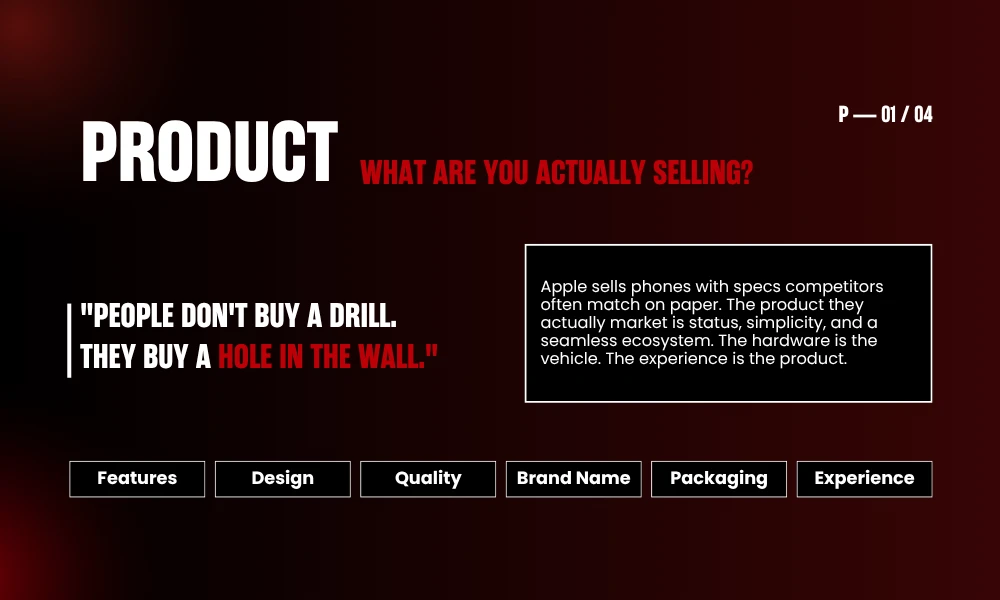
Product covers more than the physical thing in the box. It includes features, design, quality, brand name, packaging, warranty, and the experience around it. A customer rarely buys a single attribute. They buy the full bundle.
Think about what the product does for the buyer, not just what it is. People do not buy a drill. They buy a hole in the wall.
Example. Apple sells phones with specs competitors often match on paper. The product they actually market is status, simplicity, and a seamless ecosystem. The hardware is the vehicle. The experience is the product.
Strategic Breakdown
Most companies over-invest in product features and under-invest in product clarity. The market does not reward the longest spec sheet. It rewards the offering whose value a buyer can grasp in seconds. Before adding a feature, ask whether it sharpens the core promise or just blurs it.
Price: What Does It Cost, and What Does That Signal?
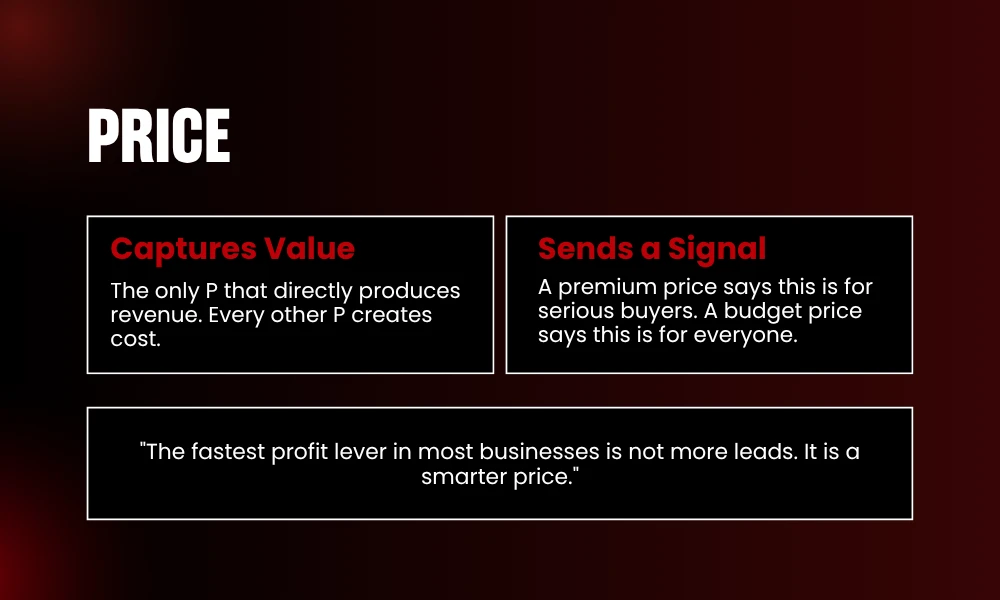
Price is the only P that directly produces revenue. The other three create cost. That makes pricing the most commercially loaded decision in the mix, and the one teams treat most casually.
Price does two jobs at once. It captures value, and it sends a signal. A premium price tells the market this is for serious buyers. A budget price tells them this is for everyone.
Example. A luxury watchmaker could manufacture far cheaper and still profit. It holds price high on purpose. The price is not a cost calculation. It is a status claim. Lower it, and the brand promise collapses.
Expert Insight
The fastest profit lever in most businesses is not more leads. It is a smarter price. A small, well-justified price increase often flows straight to the bottom line, because it costs nothing to deliver. Yet teams chase traffic for months before spending one afternoon stress-testing their pricing.
Place: Where Do Customers Find and Buy It?
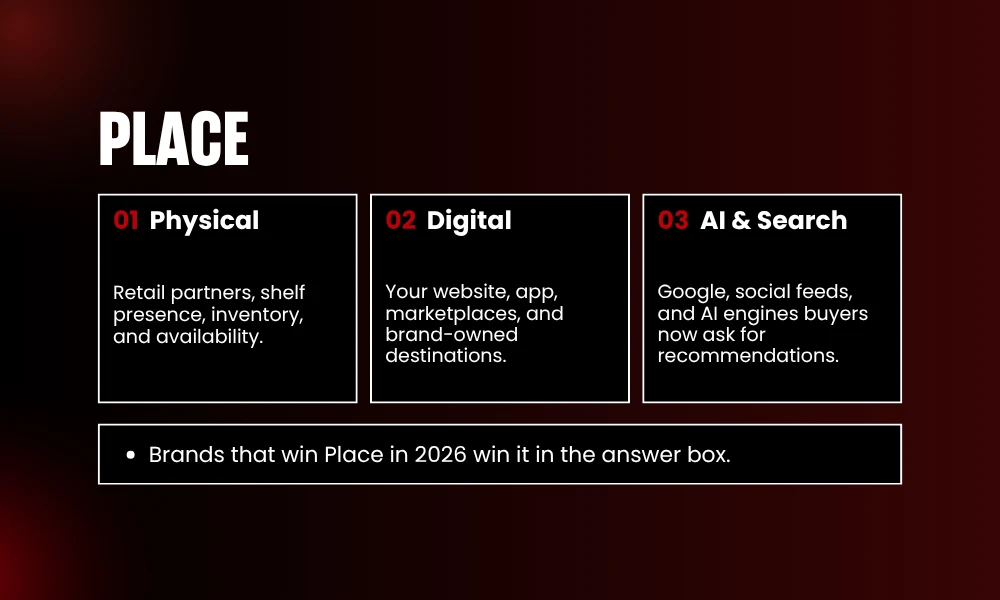
Place answers a deceptively simple question. When a buyer is ready, can they actually get your product, easily, where they already are?
Place covers distribution, channels, inventory, and availability. The modern version stretches far beyond a shelf. It includes your website, your app, marketplaces, retail partners, and increasingly the AI assistants buyers now ask for recommendations.
Example. Inbound-led brands invert traditional Place entirely. Instead of pushing product into stores, they publish content that pulls buyers to a single owned destination. The blog, the search result, and the AI citation become the new shelf.
The Bigger Shift
Place used to mean physical proximity. Now it means digital findability. The question is no longer only whether your product is in the right store.
It is whether your product shows up the moment a buyer searches Google, scrolls a feed, or asks an AI engine for the best option. Brands that win Place in 2026 win it in the answer box.
Promotion: How Do You Tell People It Exists?
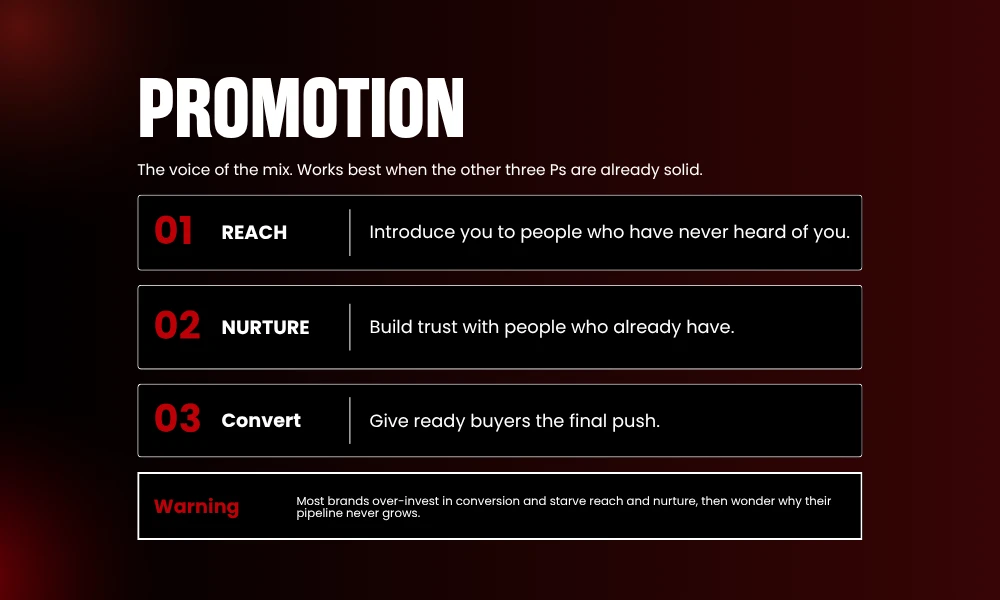
Promotion is the P most people mistake for marketing itself. It is only one quarter of the picture, and it works best when the other three are already solid.
Promotion covers advertising, content marketing, SEO, social media, email, public relations, influencer partnerships, and sales outreach. It is the voice of the mix.
The classic trap is to lead with Promotion before you have a sharp product, a defensible price, or an accessible channel. The campaign then has to compensate for weak foundations, and no amount of clever copy can do that for long.
Tactical Framework
Split Promotion into three jobs. Reach introduces you to people who have never heard of you. Nurture builds trust with people who have. Conversion gives ready buyers the final push. Most brands over-invest in conversion and starve reach and nurture, then wonder why their pipeline never grows.
How the 4 Ps Work as a System
The 4 Ps are not a checklist. They are a system under tension. Move one, and the others have to move with it.
Raise your price, and your promotion has to justify the premium, your product has to feel worth it, and your place has to match the buyer who pays more.
The brands that struggle usually have one P fighting the other three. The product says premium, the price says budget, the channel says clearance, and the ads say something else entirely. Buyers feel the dissonance even if they cannot name it.
| The P | The Core Question | What Goes Wrong When Ignored |
| Product | What are we selling, and what does it do for the buyer? | A longer feature list no buyer can summarize |
| Price | What does it cost, and what does the number signal? | A figure that contradicts the brand’s own positioning |
| Place | Where can the buyer actually get it, easily? | Demand that leaks away at the final step |
| Promotion | How do we communicate value, and where? | A campaign forced to rescue weak foundations |
Market Observation
In a market flooded with AI-generated sameness, coherence is becoming a competitive moat. When most brands ship inconsistent, machine-blended messaging, the few that align all four Ps into one clear story stand out simply by making sense.
The 4 Ps, the 7 Ps, and the 4 Cs
The original four held up well for physical products. Service and digital businesses needed more, so marketers extended the model. The 7 Ps add People, Process, and Physical Evidence. The 4 Cs reframe the same ideas from the customer’s side: Customer, Cost, Convenience, Communication.
The full comparison of all three frameworks, and a rule for picking between them, sits inside our guide to the marketing fundamentals every business needs in 2026.
How to Apply the 4 Ps to Your Business
Start with the buyer, not the product. Audit each P against your stated positioning and flag every contradiction. Find the one P that is dragging, since most underperforming marketing has one weak link, not four. Test one change at a time. Revisit the mix quarterly.
Enterprise Perspective
Large organizations often run the four Ps in four separate departments that rarely talk. The result is a mix that looks fine in each silo and incoherent to the customer. The highest-leverage move in many enterprises is not a new campaign. It is getting the four owners of the four Ps into the same room.
Frequently Asked Questions
What are the 4 Ps of marketing?
The 4 Ps are product, price, place, and promotion. Together they form the marketing mix, the four elements a business controls when bringing an offering to market.
Who created the 4 Ps of marketing?
Marketing professor E. Jerome McCarthy introduced the 4 Ps in his 1960 book, and it became the standard framework taught in business schools worldwide.
Are the 4 Ps still relevant in 2026?
Yes. The channels and tools have changed completely, but the four underlying decisions have not. AI has changed execution, not the fundamentals.
What is the difference between the 4 Ps and the 7 Ps?
The 4 Ps work for physical products. The 7 Ps add People, Process, and Physical Evidence, built for service and digital businesses where the experience itself is what the customer buys.
What are the 4 Cs of marketing?
The 4 Cs are Customer, Cost, Convenience, and Communication. They reframe the 4 Ps from the customer’s perspective rather than the company’s internal view.
The Bottom Line
The 4 Ps have outlasted every framework built to replace them, and they will outlast the current wave of AI tools too. As AI floods every channel with near-identical messaging, the brands that align all four Ps into one coherent story will pull away from the ones that do not. Machines can generate infinite promotion. They cannot manufacture coherence. That still takes human judgment.