You’re Ranking #1. So Why Is AI Ignoring You?
Something is quietly driving content teams up the wall right now, and most of them aren’t talking about it publicly because they haven’t figured out what to say.
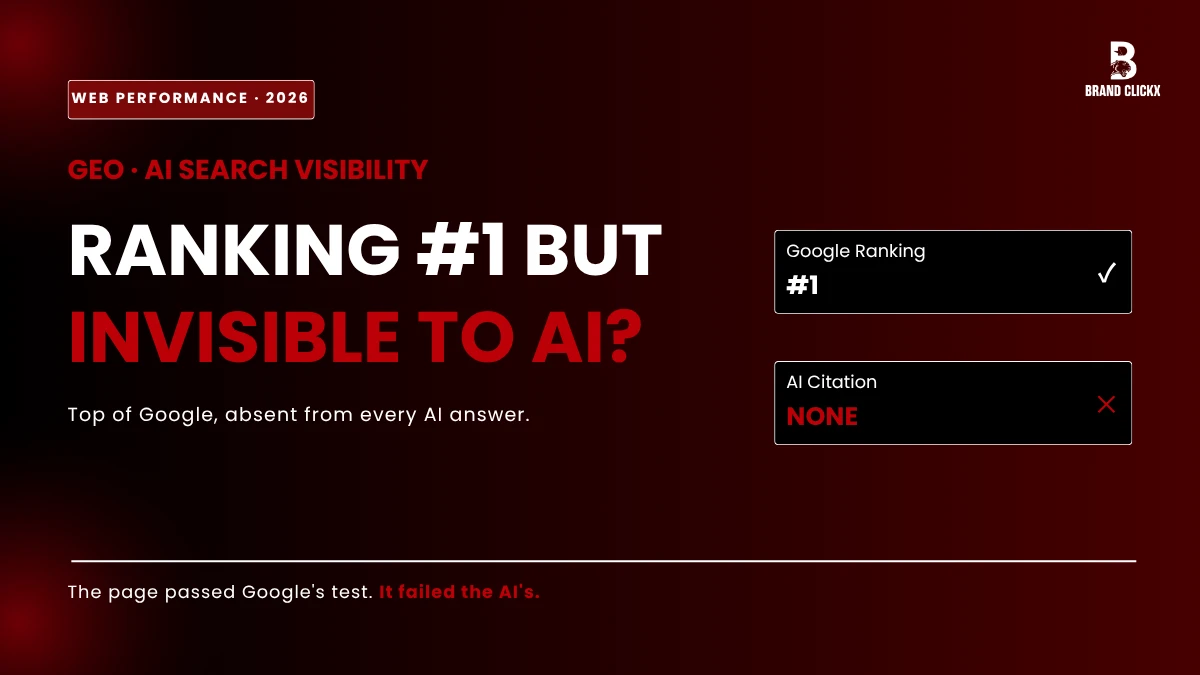
You publish a piece. It climbs to position one or two on Google. Traffic rolls in. Then someone on your team , or a client, or a curious coworker , asks ChatGPT or Perplexity the exact question your article was built to answer. The AI gives a confident, thorough response. Three sources are cited. Yours isn’t one of them.
It’s maddening, honestly. And it’s not a fluke. This is happening to sites with genuine authority, well-researched content, and years of SEO work behind them.
The instinct is to start looking for something broken , a crawl error, a penalty, a disavow file gone wrong. But pull the logs and everything checks out. The page is indexed. Search Console shows impressions. Nothing is technically wrong.
The actual problem is harder to swallow: the content was written to satisfy a system that judges pages by authority and relevance signals, and it’s now being evaluated by a system that asks a completely different question. Those two systems don’t want the same thing from your content. And for a long time, most people didn’t know they needed to think about that distinction at all.
Understanding why your content is not showing in AI results means getting clear on what AI answer engines actually need , which turns out to be pretty different from what got you to page one.
Google Sends People to Pages. AI Doesn’t.
It helps to just say this plainly, because a lot of confusion flows from not quite internalizing it.
When someone Googles something, Google finds pages. It ranks them. It sends the user to whichever one it thinks is most likely to help. The user reads the page. Done. The whole system is built around that handoff , Google’s job ends the moment the click happens.
AI answer engines don’t do any of that. Nobody gets sent anywhere. The system reads your page (along with several others), pulls what it needs, and writes a response itself. The user never visits your site. Your content is an ingredient, not a destination.
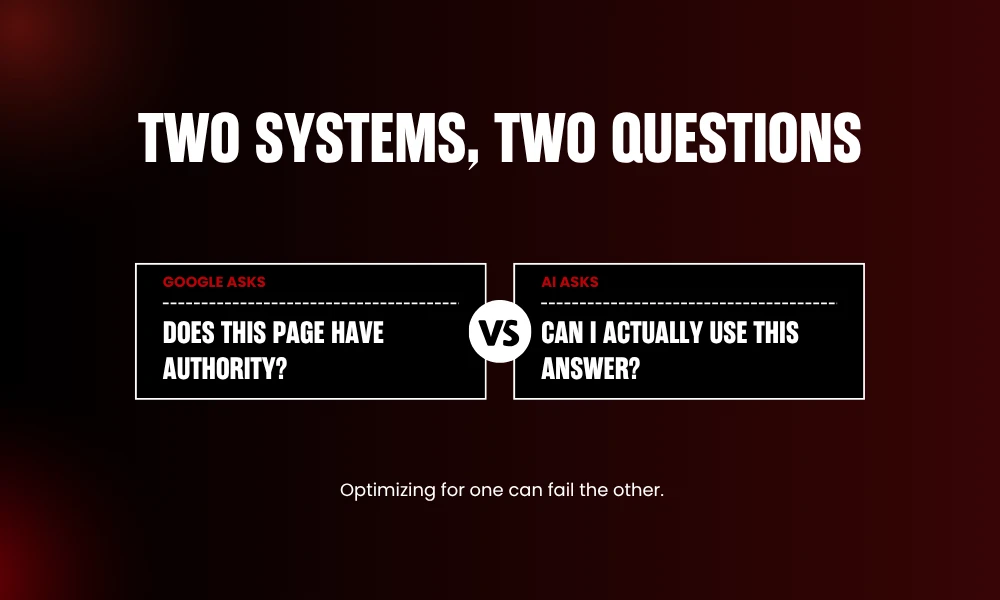
So when Google was deciding whether to rank your page, it was asking: does this page have authority? Is it relevant to the query? Does it meet technical standards? Does it have links pointing to it from credible sources? These are signals about the page as a document.
When Perplexity or an AI Overview is deciding whether to cite your page, it’s asking something much more immediate: can I actually use this? Is the answer here, and is it easy to extract? Can I quote this or paraphrase it without needing three surrounding paragraphs to make it make sense?
Those are not the same question. A page optimized thoroughly for the first set of criteria can completely fail the second set , and that’s exactly what’s happening to a lot of well-ranking content right now. The page earned its position through authority signals. But the AI looked at the actual text and moved on.
The Specific Reasons Your Content Gets Passed Over
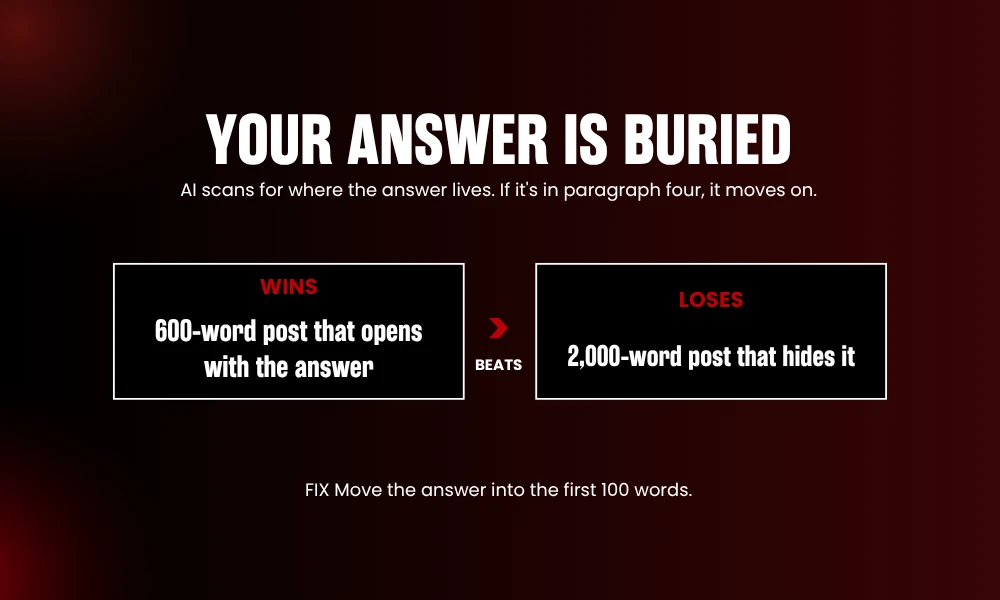
1. The Answer Doesn’t Appear Until Paragraph Four
Go look at your top-ranking articles. Pick one. Find the paragraph where it actually answers the question posed in the headline. Count how many paragraphs came before it.
If the answer shows up after 300 or 400 words of context-setting, you have a problem for AI visibility , regardless of how good the eventual answer is.
This structure made sense under old SEO logic. Word count was rewarded. Keeping readers on-page was rewarded. A long intro that eased someone into the topic and made them feel oriented before delivering the payoff was considered good user experience. So writers wrote that way, and the content performed.
AI systems don’t ease into anything. They scan for where the answer lives. If it’s not near the top, they find a page where it is. Your 2,000-word article with the perfect explanation buried in section three loses to a 600-word post that opens with the answer because the shorter piece is simply easier to use as source material.
The fix isn’t to make everything shorter. It’s to move the answer up. Give it in the first 100 words , even just a sentence or two , and then spend the rest of the piece backing it up, adding context, and addressing edge cases. The depth can stay. The delay needs to go.
2. Keyword-Optimized Prose Reads Wrong to AI Systems
This is uncomfortable to say because so much content production is built around it, but SEO writing often has a texture that’s slightly off. The keyword appears at the start of the second paragraph because that’s where it’s supposed to go.
A transition sentence gets shoehorned in so the piece can return to the target phrase. Headers use exact-match variants of the primary keyword whether or not that’s the most natural way to phrase the heading.
Human readers mostly tune this out. They’ve consumed enough web content that the mild awkwardness doesn’t register.
AI systems trained on decades of natural writing , books, journalism, academic papers, forum posts , do register it. They’ve developed a sensitivity to what informative prose actually sounds like when someone who knows a subject well is explaining it.
Content that bends its sentences around keyword requirements has a different pattern, and it tends to get ranked lower in the internal quality assessments these systems make before deciding what to cite.
Write the explanation the way you’d explain it to someone smart who just asked you about it. Get that version down first. Then check if the keywords showed up on their own , they usually do. When a keyword really doesn’t fit naturally anywhere in a sentence, that’s often a clue the sentence is solving the wrong problem.
3. The Page Answers a Keyword. The User Asked Something Else.
Here’s what actually gets typed into ChatGPT: “I run a small bakery and I want to start an email newsletter, what platform should I use if I’m not technical at all and I’m on a tight budget?”
Here’s what ranks on Google for “email marketing tools”: a roundup comparing Mailchimp, Klaviyo, ConvertKit, ActiveCampaign, Constant Contact, and seven others, with feature tables and pricing breakdowns.
That roundup is not useless. But it doesn’t answer the bakery owner’s question. Somewhere out there is a blog post , probably on a smaller site, maybe from someone who actually has bakery clients , that specifically addresses non-technical small business owners who need something cheap and simple. That post gets cited. The comprehensive roundup doesn’t, even if it outranks the smaller post by miles on Google.
AI assistants handle questions the way a knowledgeable friend handles them , they account for the context in the question, not just the topic. People don’t type keywords into AI chat boxes. They explain their situation and ask for help.
Content that’s built around actual spoken questions, specific use cases, and the kinds of qualifiers real people include (“for a small team,” “without coding,” “under $50/month”) gets picked up in those contexts.
Look at what people actually ask in subreddits related to your topic. Check the questions in Quora threads. Read the “People Also Ask” results for your keyword and notice how much more specific and conversational they are than the keyword itself.
Those are the real questions. Building content that directly answers them , not just covers the general topic , is what changes your AI citation rate.
4. Nothing on the Page Can Stand Alone
AI systems don’t use your article the way a human reader does. A reader follows the argument, builds understanding over the course of the piece, and arrives at a conclusion informed by everything that came before. The article is an experience.
For an AI, the article is a quarry. It’s looking for blocks it can cut out and use , a sentence here, a claim there, maybe a short paragraph. Whatever it takes goes into the response alongside material from other sources. The rest gets left behind.
The problem with a lot of long-form content is that nothing in it really holds up in isolation. Everything is written in relation to what came before it.
“This approach works best when combined with the method described in the previous section” , fine in context, useless as a standalone extraction. “Companies that moved to async-first communication reduced their weekly meeting hours by an average of 40 percent” , that works anywhere, with no context needed.
Go back through a piece of your content and try to identify the three or four sentences in it that could be dropped into an AI response with zero surrounding context and still make complete sense. If you can’t find them, that’s your problem. Adding them , specific numbers, named examples, concrete claims , doesn’t require a full rewrite. It’s more like adding anchors to an existing structure.
5. There’s Nothing on the Page That Proves a Real Expert Wrote It
Anonymous content from no particular author, covering a topic competently but without any sign of first-hand experience, is probably the most common type of content on the web. It ranks. It gets traffic. And AI systems are increasingly skeptical of it.
Google’s E-E-A-T guidelines , Experience, Expertise, Authoritativeness, Trustworthiness , were originally written for human quality raters. But the signals those raters look for translate fairly directly into things AI systems can also evaluate: is there an author? Can that author be verified? Does the content contain observations that could only come from someone who’s actually done this work? Is there original data that didn’t exist somewhere else first?
Content that can answer yes to those questions gets treated differently. “When we analyzed 300 landing pages across our client accounts, the ones with FAQ sections in the first scroll had 18% higher time-on-page” , that kind of claim is sticky. It’s specific, it implies real work behind it, it can’t be lifted wholesale from somewhere else because it came from this particular analysis. AI systems recognize that texture.
Author bios matter more now than they did in 2019. Not the generic “Jane is a content marketer with a passion for storytelling” version , the version that says something concrete: what she’s done, who she’s worked with, what makes her the right person to write this specific piece. That information helps establish whether the content is worth citing.
6. Schema Markup Was Never Implemented
Most content teams think about schema as a nice-to-have for getting featured snippets. It’s becoming something more fundamental than that for AI visibility.
Structured data tells crawlers, in explicit machine-readable terms, what a page is and what’s in it. FAQ schema wraps each question-answer pair in labeled tags. There’s no inference required. The AI doesn’t have to figure out which paragraph is the answer to which question , it’s labeled.
HowTo schema does the same for step-by-step content. Article schema names the author and publication date.
Pages without schema make AI systems do more interpretive work. Usually they manage, but sometimes they get it wrong, and sometimes they skip to a page that’s clearer. Pages with proper schema markup are just easier to use. That ease translates directly into higher citation rates for the pages that have it and comparable content quality to pages that don’t.
FAQ schema specifically is worth prioritizing. Most content worth optimizing has questions embedded in it somewhere , common objections, clarifying points, follow-up queries. Wrapping those in proper markup takes a developer a few hours and doesn’t need to be revisited. It’s one of the few genuinely permanent improvements available in this space.
7. AI Crawlers Can’t Get to the Page at All
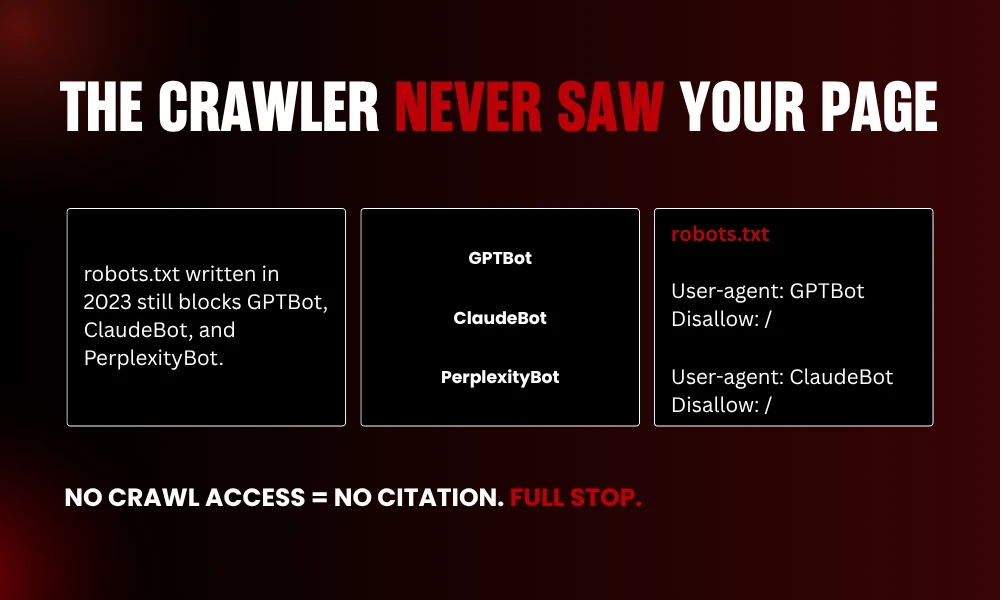
None of the content-level work matters if the crawler can’t read the page. This sounds obvious and yet it’s one of the most common explanations for why content isn’t showing in AI results on otherwise well-optimized sites.
The robots.txt files at most publishing companies were written years ago for Googlebot. They haven’t been updated to account for GPTBot, ClaudeBot, PerplexityBot, or any of the other AI-specific crawlers that have shown up since.
Some of those files have broad disallow rules that block everything except explicitly permitted bots , which means every new crawler that wasn’t on the allowlist when the file was written is effectively locked out.
Then there’s the copyright issue. A significant chunk of publishers added explicit AI crawler blocks in 2023 when the debate over LLM training data and fair use heated up. The goal was to stop content from being scraped and used to train future models without compensation.
Reasonable concern. But blocking training crawlers also blocks retrieval crawlers , the ones that power live citation in AI answers , because they often run under the same user agent strings. The result is content that’s invisible to AI systems across the board.
Check your robots.txt. Look up the current user agent strings for GPTBot, ClaudeBot, and PerplexityBot specifically. If they’re blocked, decide deliberately whether that’s still what you want , because right now it means those platforms won’t cite you, full stop.
Also worth checking: whether your content renders in plain HTML or requires JavaScript execution to display. A lot of crawlers don’t run JS. If the page looks blank without it, the crawler sees a blank page.
What a Page Actually Looks Like When It’s Set Up for AI Citations
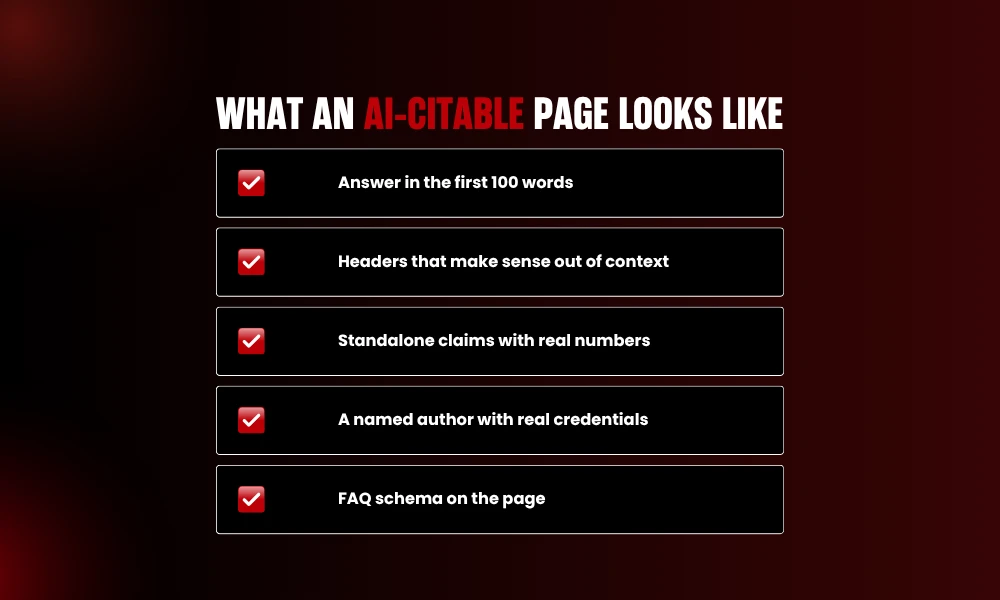
Let’s skip the abstract principles and describe a concrete page.
The headline is specific enough to match a real question someone would ask. Not “Email Marketing Guide” but “How to Start an Email Newsletter for a Service Business with No Technical Background.” The introduction , the first 100 words , answers the core question directly.
Someone could read just the first paragraph and have a usable answer. The rest of the piece adds depth, handles objections, covers edge cases.
The headers throughout the article are phrased as questions or direct statements. They’d make sense if you pulled them out of context. Under each header, within the first two sentences of that section, the central claim of that section is stated. Not hinted at , stated.
The author is named. The bio says something real: not a title and a LinkedIn URL, but a sentence about what this person has actually done that qualifies them to write this. Maybe it mentions a specific client type, a notable result, a number of years on a specific problem.
Somewhere in the piece , ideally several times , there’s a specific, standalone factual claim. A number. A comparison. A concrete outcome with a named context. The kind of sentence that works even when you pull it out and drop it into something else without the surrounding paragraphs.
And the page has FAQ schema. The questions and answers that naturally appear in the content are tagged explicitly so that a crawler knows exactly where the answer to each question lives.
That’s the whole thing. It’s not exotic. Most of it is just disciplined writing.
Why Your Brand’s Broader Reputation Also Feeds Into This
There’s a factor operating above the page level that most people aren’t accounting for, and it quietly explains why some sites get cited by AI consistently while others , with similar content quality , don’t.
Language models were trained on web text that existed before their training cutoffs. Within that text, some publications and individuals are cited frequently by others. They show up in expert roundups. Their research gets referenced. Their founders give interviews that get transcribed and indexed.
Over time, a kind of ambient credibility accumulates around these sources , and when an AI system encounters their content, it brings that prior familiarity to the evaluation.
For retrieval-augmented tools like Perplexity and AI Overviews that pull from live web content, the same dynamic plays out through inbound links and co-citation patterns. A page that’s linked to from authoritative sources, or that shares thematic territory with frequently cited experts, gets a credibility boost that pure on-page signals can’t fully replicate.
There’s no fast path to this. It comes from being genuinely present in a field over time , publishing original research that gets picked up, getting quoted in industry coverage, having an author who’s a named source in journalism rather than just a byline on blog posts.
That work serves traditional SEO simultaneously, so it’s not time spent on AI visibility at the expense of other channels. But it does need to be deliberately pursued rather than left to chance, especially for newer sites that don’t yet have that ambient reputation built up.
Frequently Asked Questions
Why is my content not showing in AI results even though it ranks on the first page of Google?
First-page rankings mean Google found your page authoritative and relevant , but that’s a judgment about the page’s credentials, not about whether the text itself is easy to extract answers from. AI systems are doing the second thing, not the first.
They need to be able to pull a usable answer from your page directly. The most common reasons they can’t: the answer doesn’t appear until deep into the article, there are no concrete standalone claims they can use, and there’s nothing on the page that signals the content comes from someone with actual expertise in the subject. A page can clear Google’s bar without clearing any of those.
Do I have to rewrite everything from scratch?
Almost never. The changes that move the needle most are surgical: add a direct answer to the opening paragraph, put some concrete factual claims into sections that currently stay vague, strengthen the author bio from generic to specific, and add FAQ schema.
For most pages, that’s a few hours of focused editing , not a rebuild. Start with whatever pages are most important to your traffic or revenue, and don’t touch the others until you can see whether the first batch of changes worked.
Which platforms should I care about most?
Depends what your audience looks like. Google’s AI Overviews touch the most people purely because of Google’s search volume , if your audience uses Google, Overviews are the most important. Perplexity skews heavily toward researchers, developers, and people who’ve actively decided to try AI-first search.
ChatGPT and Claude’s web access get used for longer research tasks and complex questions. The good news is the content qualities that help with one platform help with all of them, so you don’t need separate strategies.
Does blocking AI crawlers in robots.txt hurt my regular Google rankings?
No , Googlebot is separate from the AI-specific crawlers, and blocking GPTBot or ClaudeBot has no effect on your Google Search rankings. The only thing it affects is whether those AI platforms can read and cite your content. If you don’t care about Perplexity or ChatGPT traffic, blocking their crawlers costs you nothing.
If you do care, it’s worth going into your robots.txt and checking exactly what’s blocked, because a lot of those rules were written in 2023 under very different assumptions about what these crawlers were going to be used for.
How long until I see results?
For Perplexity and Google’s AI Overviews specifically , both of which rely on recently crawled live web content , you can sometimes see changes within a few weeks of your page being recrawled after edits. For LLMs that work from fixed training data rather than live retrieval, your edits don’t matter until the next training cycle, which you have no control over and could be many months away.
Put your energy into the retrieval-augmented platforms first. At least you can observe whether the changes are working.
Is FAQ schema actually worth doing?
Yes, and it’s probably the most underused improvement available for AI visibility. It explicitly labels questions and their answers in machine-readable markup, which removes any guesswork about what the page is communicating. A crawler doesn’t have to infer which paragraph is responding to which question , it’s tagged.
Google has dialed back FAQ rich results in regular search, so the SEO benefit there is smaller than it used to be. But for AI system parsing, it’s still genuinely useful, and it’s a one-time implementation that doesn’t need to be revisited.
Can a small site get cited by AI over a big publication?
Yes, and this happens more than people realize. Big publications often cover broad topics at surface level. A small site with a named expert, original data, and content that directly answers specific questions can outperform them in AI citations on those specific questions, even with a fraction of the domain authority.
AI systems aren’t weighting sources purely by site size. They’re looking for the clearest, most credible answer to the specific question being asked. A narrowly focused site with genuine depth on a topic has a real shot.
Does AI-written content hurt my chances of showing up in AI citations?
Not because AI systems can identify it , they mostly can’t, at least not reliably. But content generated by AI and published without meaningful editing tends to have qualities that hurt citation chances regardless of how it was produced: vague claims that don’t commit to anything specific, no original data, no first-person expertise, and a kind of generic thoroughness that covers a lot of ground without saying anything particularly precise.
Those qualities are the problem. If AI-assisted content gets edited hard , real numbers added, vague paragraphs cut, the author’s actual experience woven in , it’s competitive. Most doesn’t get that treatment.
The Bottom Line
Look, the traffic implications of AI search are real and the industry is still working out how to handle them. But the content problem underneath it isn’t mysterious.
Most pages that don’t show up in AI results have the same set of issues: the answer is too far down, the prose is built around keywords rather than explanation, nothing in the content stands alone as a citable statement, the author is either anonymous or vaguely credentialed, and schema markup was never added.
Fix those things , methodically, starting with your most important pages , and AI citation rates improve. Not overnight, and not uniformly across every platform, but measurably.
The sites making real progress on this aren’t doing anything exotic. They’re editing existing content to get answers up top, adding author credentials that mean something, implementing FAQ schema, and checking that the crawlers they care about can actually get in. That’s it.
The work is tedious rather than complicated, which is probably why so many teams keep waiting for a more sophisticated solution instead of just doing it.