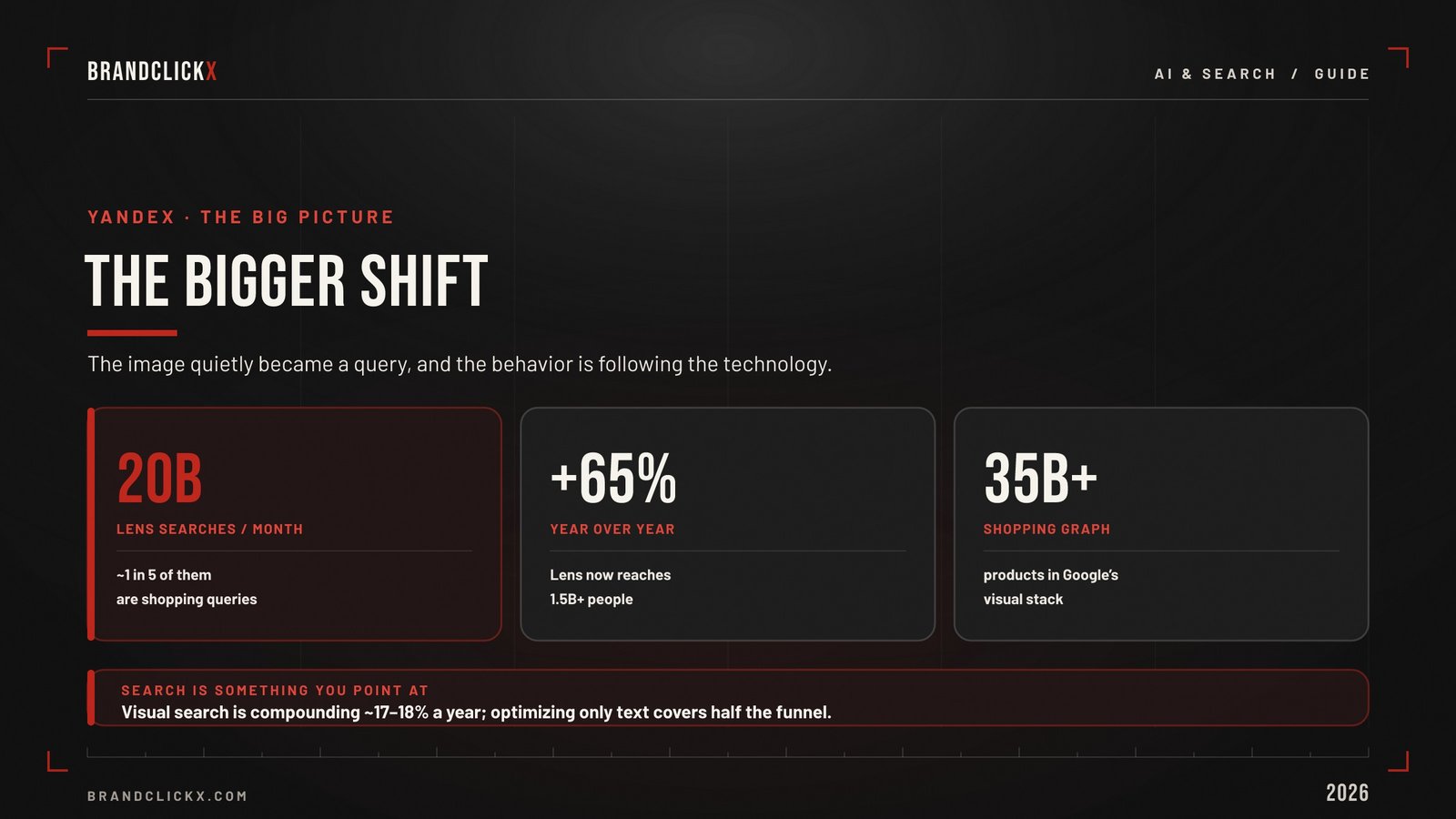
Google Lens now handles close to 20 billion visual searches every month. Roughly one in five of those is a shopping query. According to Google’s own product team, Lens grew 65% year over year and reached more than 1.5 billion people.
That is not a feature gaining traction. That is a behavior change.
The image has quietly become a query. People point a camera at a jacket, a building, a face, or a screenshot, and they expect the internet to answer. Reverse image search has graduated from a party trick into core discovery infrastructure.
And here is the part most marketing teams have not internalized.
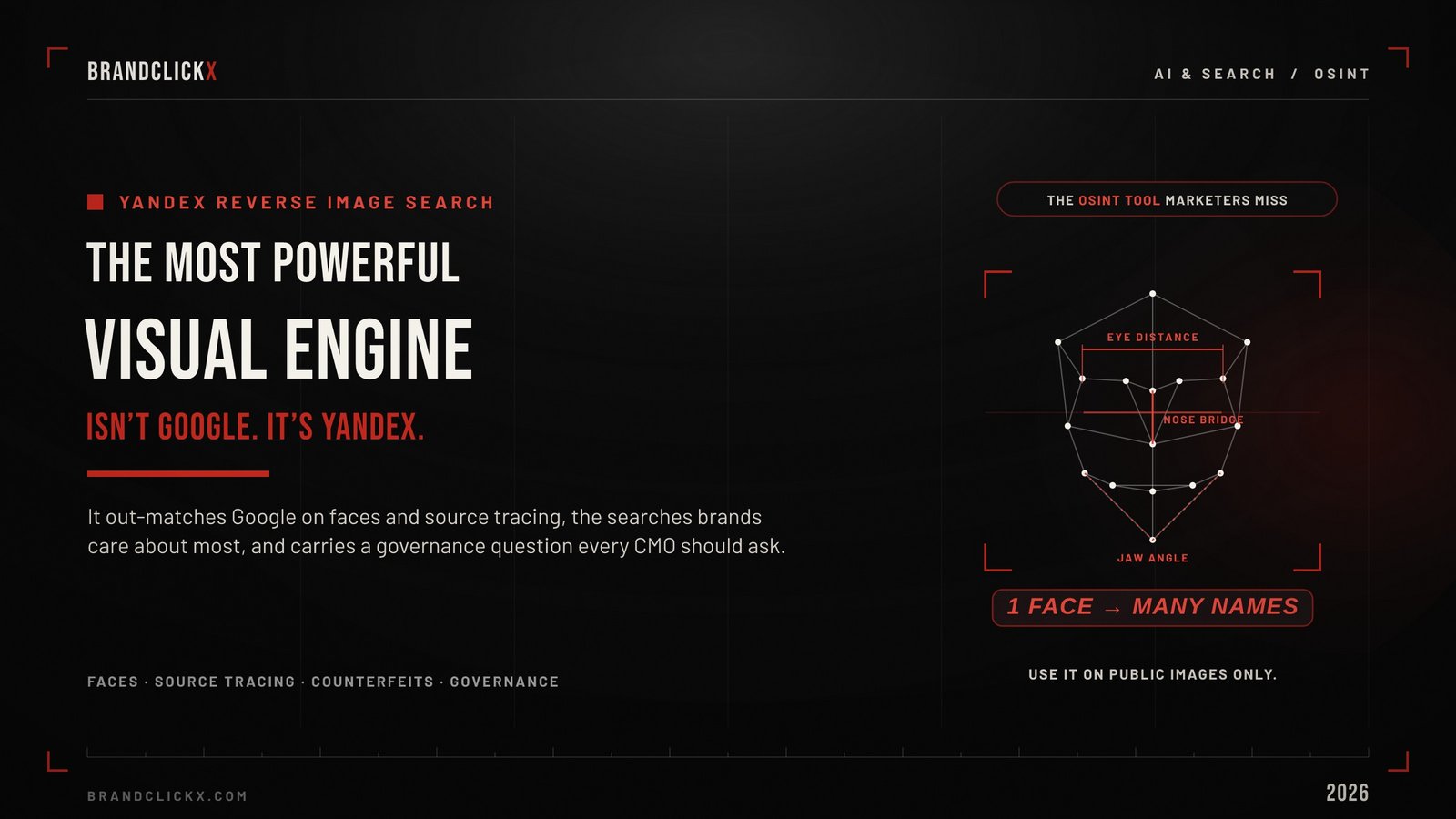
The engine that does the hardest version of this job best is not American. It is Russian. It is Yandex reverse image search, and the open-source intelligence community has been quietly relying on it for years while brand teams stuck with Google.
This is a guide to that engine. Not a how-to listicle, but a strategic read on why it works, what it exposes about your brand, how to actually use it, and the uncomfortable data-governance question that comes with it.
Key Takeaways
- Yandex reverse image search outperforms Google on the two tasks marketers care about most: matching the same face across photos and finding the true source of an image.
- The same technical edge powers serious marketing work: counterfeit detection, image-theft enforcement, influencer verification, and competitive monitoring.
- Western engines deliberately limit facial matching for privacy reasons. Yandex does not, which is both its superpower and its liability.
- Yandex’s search business is now fully Russian-owned after the 2024 Nebius split, creating a real procurement and compliance question for enterprises.
- Reverse image search is becoming table stakes as multimodal AI turns every image into a searchable input. Visual provenance is the new discipline.
Why Yandex Became the Reverse Image Engine the Rest of the World Reaches For
Most people assume Google wins every search category by default. On reverse image search, that assumption is wrong.
Google Lens is exceptional at identifying products, reading scenes, and powering shopping. For finding the same person in a different photo, or tracing where a specific image originated, Yandex is consistently stronger.
The difference is architectural.
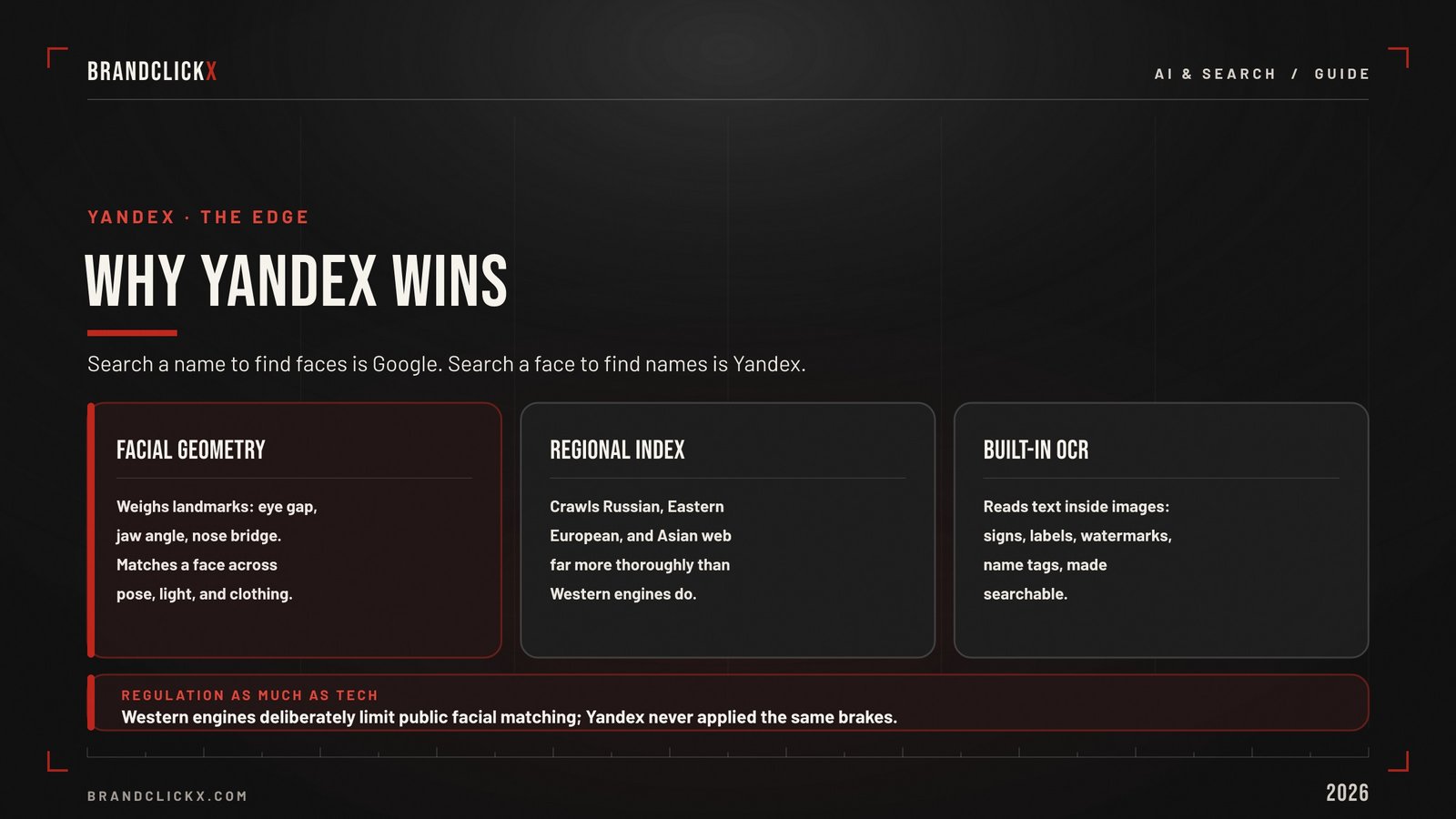
The technical breakdown. Yandex leans on content-based image retrieval that weighs facial geometry heavily. It measures the spatial relationships between facial landmarks, things like the distance between the eyes, the angle of the jaw, and the shape of the nose bridge.
Because it indexes identity rather than just surface appearance, it can match a face even when the clothing, lighting, background, and pose all change.
Google flips the logic. You can search a name to find faces. Yandex lets you search a face to find names. That single inversion is why it shows up in nearly every OSINT guide, scam investigation, and catfish exposé on the internet.
There are two more reasons it pulls ahead.
The first is index coverage. Yandex crawls Russian, Eastern European, and Asian web content far more thoroughly than Western engines do. If a stolen product photo or a fake profile lives on a regional social platform or a Cyrillic-language marketplace, Yandex is the engine most likely to surface it.
The second is built-in optical character recognition. Yandex reads text inside images. A blurry sign, a foreign-language label, a watermark, or a name tag gets highlighted and made searchable. For investigators and brand teams chasing provenance, that is a quiet superpower.
Why it matters: the gap is not marketing spin. It reflects a genuine difference in how each engine was built and which rules each one plays by.
Expert Insight: The reason Google feels weaker here is partly by design. Western platforms have intentionally restricted public facial matching for private individuals in response to privacy regulation. Yandex’s engine never imposed the same brakes. So the “Yandex is better at faces” reputation is really a story about regulation as much as technology.
The Marketing Use Cases Nobody Put in the Deck
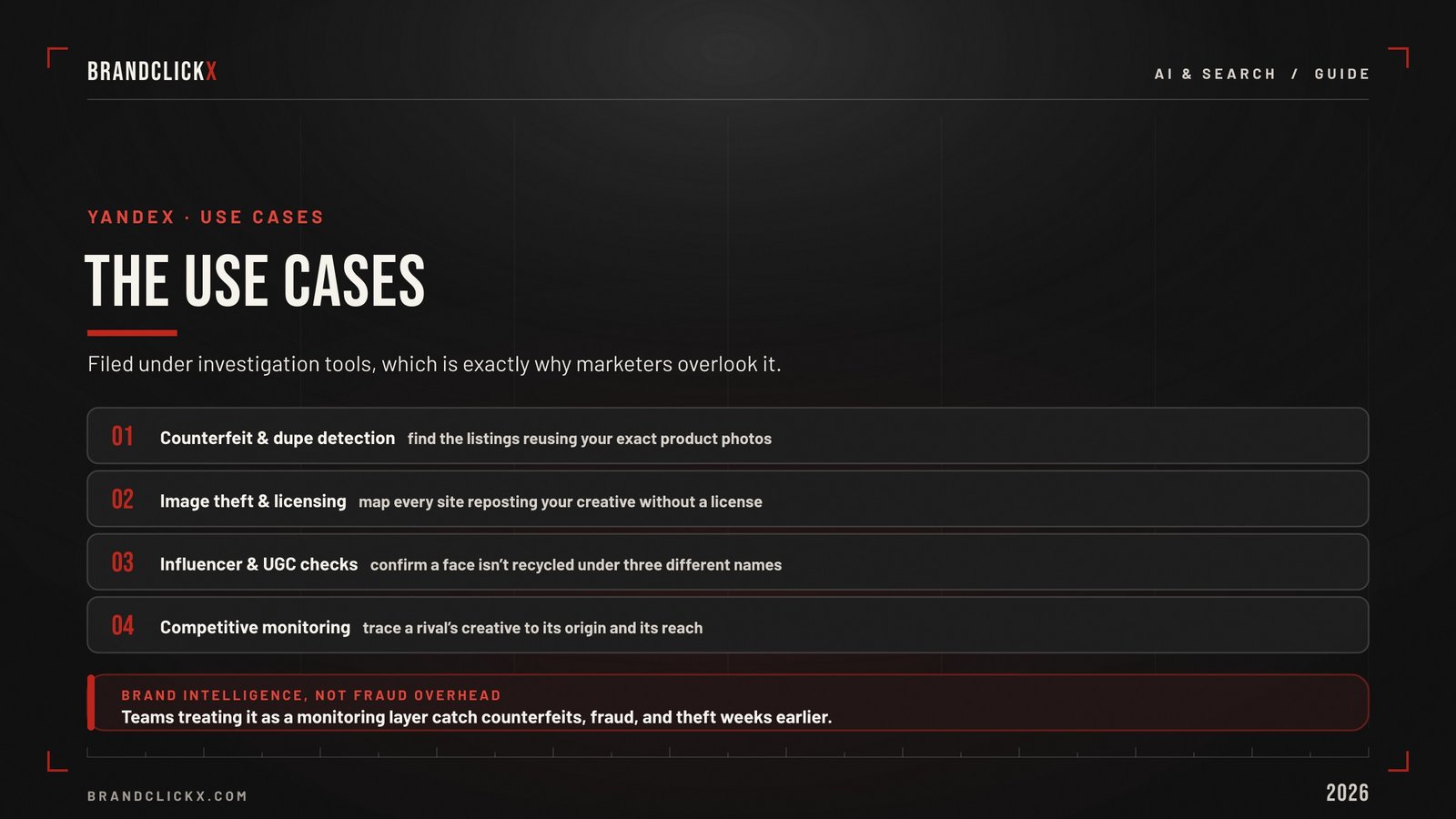
Reverse image search gets filed under “investigation tools,” which is exactly why marketers ignore it. That is a mistake.
Reframe it as a brand-intelligence instrument and the use cases get serious fast.
Counterfeit and dupe detection
Take an official product photo. Run it through Yandex reverse image search. You will often find the listings reusing your exact imagery to sell knockoffs, frequently on marketplaces that Western engines barely index.
For any brand with physical products, this is frontline IP protection. Counterfeiters rarely shoot their own photography. They steal yours. The stolen image is the thread you pull.
Image theft and licensing enforcement
Your creative team spends real money on photography and design. Where does it end up?
Reverse search a hero image and you can map every site reposting it without credit or license. Some of that is harmless reach. Some is competitors lifting your assets, affiliates misrepresenting you, or scrapers building lookalike storefronts.
You cannot enforce what you cannot see. This is how you see it.
Influencer and UGC verification
This is where Yandex earns its keep for modern marketing teams.
Before you sign an influencer, pay for a testimonial, or feature user-generated content, you can confirm the person is real.
Drop their profile photo into Yandex. If the same face surfaces under three different names on three different platforms, you have caught a fraud before it touched your campaign.
The fake-account economy runs on recycled and stolen photos. Facial matching is the cheapest fraud check you will ever run.
Competitive and trend monitoring
Spot a competitor’s product shot, an ad creative, or a viral image. Reverse search it to find the original source, the higher-resolution version, and every context it has appeared in. That tells you where a campaign started and how far it has traveled.
Industry Impact: the brands treating reverse image search as compliance overhead are leaving intelligence on the table. The ones treating it as a monitoring layer are catching counterfeits, fraud, and creative theft weeks earlier.
Reverse Image Engines Compared
| Engine | Strongest at | Facial matching | Index strength | Best fit for marketers |
| Yandex | Faces, source tracing, edited copies | Excellent | Russian, Eastern European, Asian web | Counterfeit detection, fraud checks, image theft |
| Google Lens | Product ID, shopping, scene reading | Limited for private individuals | Largest global index | Shopping discovery, product SEO |
| Bing Visual Search | Visually similar results | Limited | Strong Western web | Inspiration, similar-product surfacing |
| TinEye | Exact and modified duplicates | Not designed for faces | Smaller, image-focused | Clean copyright and duplicate tracing |
The honest read: there is no single winner. Yandex owns faces and regional reach. Google owns shopping and global scale. TinEye owns clean duplicate tracing. A mature team uses more than one.
How to Actually Run a Yandex Reverse Image Search
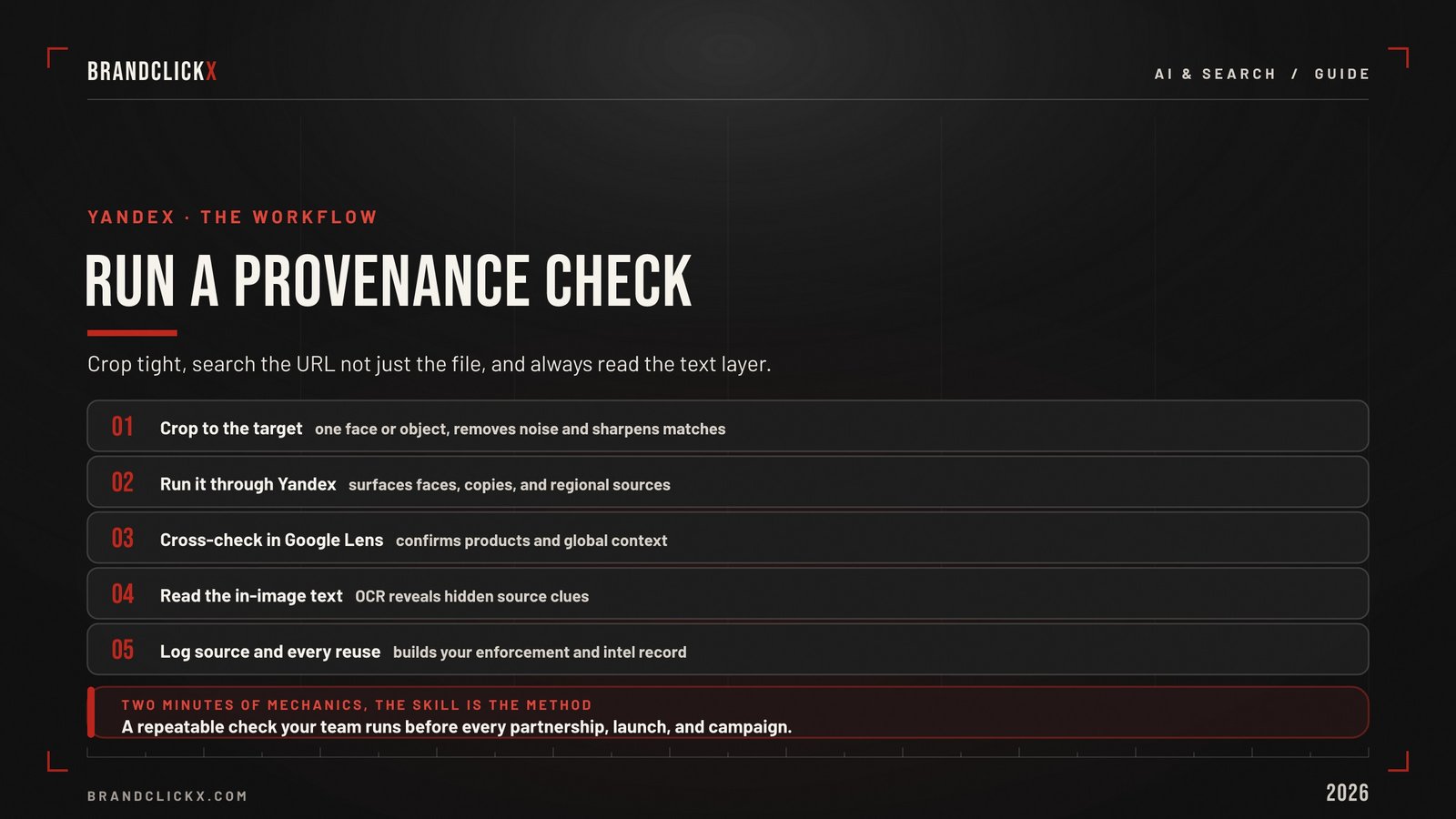
The mechanics take two minutes. The skill is in how you use them.
Go to yandex.com/images and click the camera icon in the search bar. You get three inputs: upload a file from your device, drag and drop an image, or paste a direct image URL.
Yandex returns visually similar images plus the pages that host them. The interface may default to Russian. You can switch the language in settings or simply navigate by the icons.
Three moves separate a casual search from a useful one.
Crop to the target. Do not search the whole image when you only care about one element. Crop to the face, the logo, or the product. Yandex lets you select a region, and a tighter crop returns sharper matches.
Search the URL, not just the file. If an image already lives online, pasting its URL is faster and sometimes pulls a richer result set than uploading a downloaded copy.
Read the text layer. When the image contains a label, sign, or watermark, use the OCR output. The text inside an image is often the fastest route to a source.
Tactical Framework: A Five-Minute Provenance Check
| Step | Action | What it tells you |
| 1 | Crop to the single object or face | Removes noise, sharpens matches |
| 2 | Run the crop through Yandex | Surfaces faces, copies, regional sources |
| 3 | Cross-check the top hits in Google Lens | Confirms products and global context |
| 4 | Read any in-image text via OCR | Reveals hidden source clues |
| 5 | Log the original source and every reuse | Builds your enforcement and intel record |
Strategic breakdown: the value is not a single lucky search. It is a repeatable check your team can run before every partnership, launch, and campaign.
The Contrarian Corner: The Question Your Procurement Team Will Ask
Here is the brief nobody on the marketing side wants to send to legal.
The thing that makes Yandex reverse image search uniquely powerful, its aggressive facial matching, its deep regional index, its looser privacy posture, also makes it a governance problem. And the ownership picture changed dramatically.
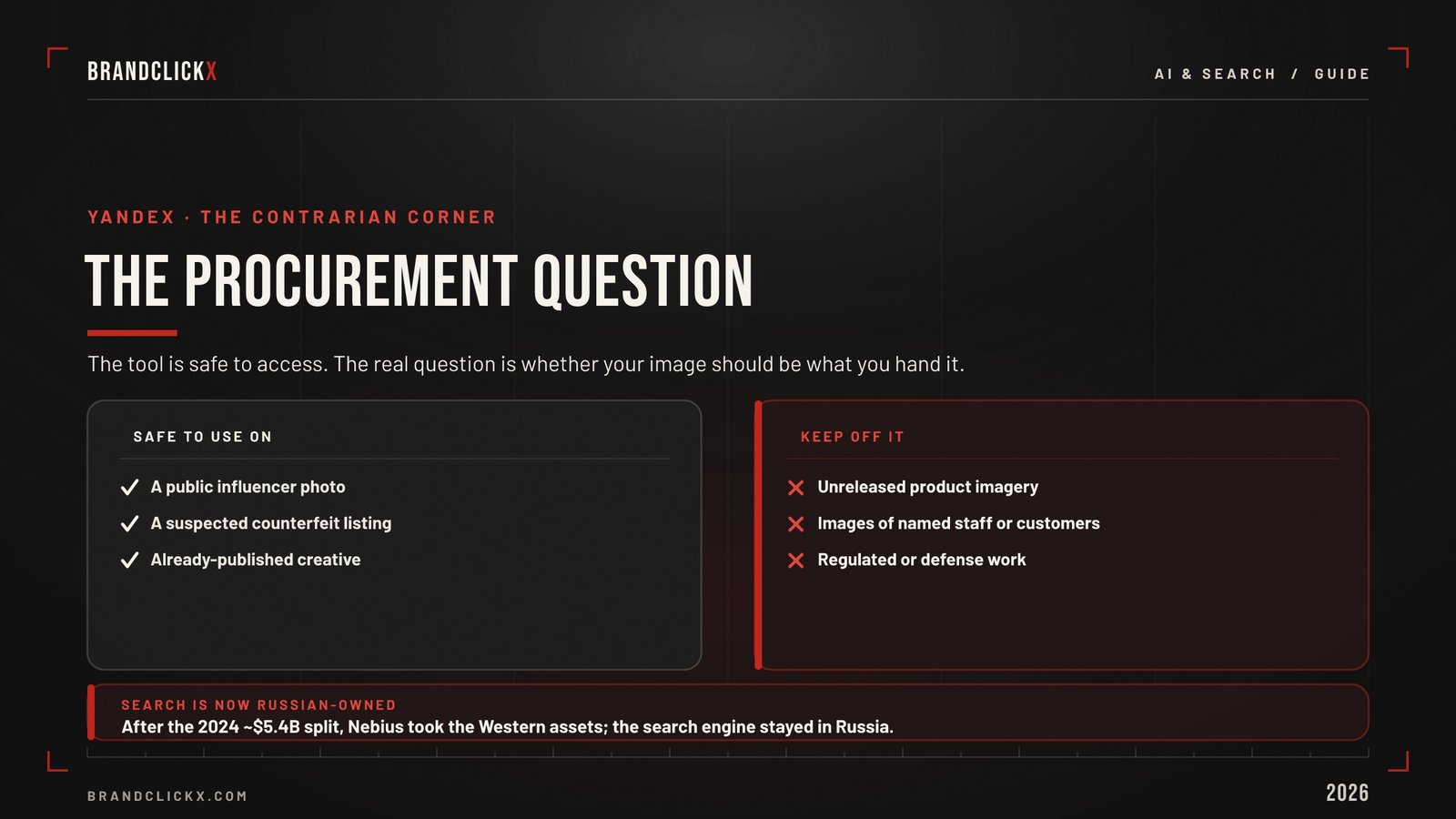
In 2024, Yandex’s Russia-based businesses were sold to a Russian consortium in a deal valued at roughly 5.4 billion dollars. Reuters reported that the former Dutch parent renamed itself Nebius Group and pivoted to AI cloud infrastructure with no ties to Russia. Search was not part of that Western entity.
Read that carefully. The Yandex search engine, including its image search, is now fully Russian-owned. The internationally facing assets walked away under a different name.
For a solo investigator chasing public images, that changes little. For a regulated enterprise, it changes a lot.
Enterprise Perspective. Uploading proprietary creative, unreleased product shots, internal screenshots, or images of identifiable employees and customers to a Russian-owned engine is a decision with sanctions optics, data-residency implications, and privacy exposure.
In some industries it is a non-starter. In most, it deserves a documented policy rather than an intern quietly using it on a laptop.
The reasonable middle path is simple.
Use Yandex for images that are already public. A competitor’s published ad, a suspected counterfeit listing, an influencer’s public profile photo. Keep anything sensitive, unreleased, or personally identifiable off it, and route that work through Western tools.
When to Use Yandex, and When to Pause
| Scenario | Yandex fit | Caution flag |
| Checking a public influencer’s photo | Strong | Low |
| Tracing a suspected counterfeit listing | Strong | Low |
| Finding reuse of already-published creative | Strong | Low |
| Searching unreleased product imagery | Avoid | High |
| Uploading images of named customers or staff | Avoid | High |
| Regulated, government, or defense-adjacent work | Avoid | High |
Market observation: most “is Yandex safe” debates skip the real issue. The tool is safe to access. The question is whether your image should be the thing you hand it.
The Bigger Shift: Every Image Is Becoming a Search Query
Step back from Yandex and the trend gets bigger than any one engine.
Visual search is no longer niche. Industry analysts size the market in the tens of billions of dollars and project growth at a compound annual rate near 17 to 18 percent through the early 2030s, driven almost entirely by retail and AI-powered recognition. Recognition accuracy now clears the mid-90s, up sharply from a few years ago.
The behavior is following the technology. Google’s Shopping Graph references more than 35 billion products. Lens shopping, virtual try-on, and AI Mode are folding image input directly into mainstream search.
You photograph something, ask a question about it out loud, and get a synthesized answer. The query is multimodal by default.
Gartner’s 2026 marketing outlook frames the next phase as ambient, context-driven discovery, where voice and visual interfaces power passive, real-time moments rather than typed searches. It also flags the obvious tension: more visual and ambient input means harder questions about privacy, tracking, and consent.
There is history here too. Gartner predicted years ago that early-adopter brands redesigning around visual and voice search would lift digital commerce revenue by 30 percent. That forecast read as speculative at the time. It reads as a description of the present now.
So what does this mean for a brand?
It means your images are no longer just creative assets. They are search inputs, ranking signals, and identity markers that live and travel without you. Visual provenance, knowing where your imagery is, what it is matched against, and who is reusing it, is becoming a discipline in its own right.
That is precisely why reverse image search belongs in the same conversation as your broader image search techniques and multimodal SEO strategy, not in a forgotten tab marked “fraud.”
The bigger shift: search stopped being something people type and started being something they point at. Brands that only optimize text are optimizing half the funnel.
A Tactical Framework for Visual Provenance Monitoring
Knowing the tools is step one. Operationalizing them is what separates a publication-grade strategy from a clever trick.
Here is a practical model marketing and brand teams can adopt without standing up a new department.
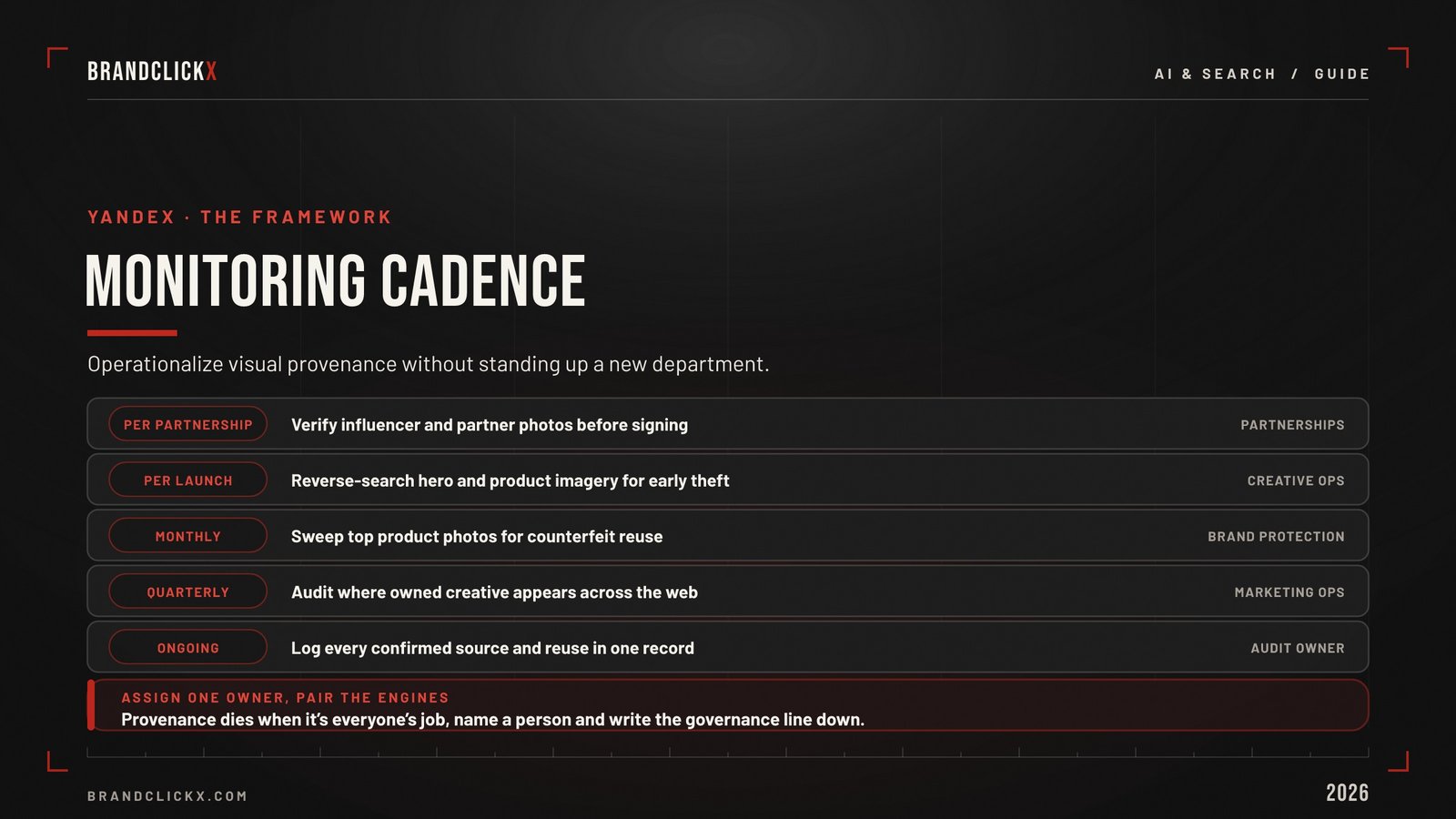
Visual Provenance Monitoring Cadence
| Frequency | Action | Owner |
| Per partnership | Verify influencer or partner photos before signing | Partnerships lead |
| Per launch | Reverse-search hero and product imagery for early theft | Brand or creative ops |
| Monthly | Sweep top product photos for counterfeit reuse | Brand protection or growth |
| Quarterly | Audit where owned creative appears across the web | Marketing operations |
| Ongoing | Log every confirmed source and reuse in one record | Whoever owns the audit |
A few principles make it stick.
Assign one owner. Visual provenance dies when it is everyone’s job and no one’s responsibility. Name a person.
Pair the engines. Yandex for faces, regional reach, and edited copies. Google Lens for products and global scale. TinEye for clean duplicate tracing. One tool gives you a partial picture.
Mind the governance line. Public images only on Yandex. Sensitive and unreleased work stays on Western tools. Write the policy down before someone improvises.
Turn findings into action. A confirmed counterfeit becomes a takedown. Stolen creative becomes a licensing or legal note. A fake influencer becomes a rejected deal. Intelligence with no workflow is just trivia.
Future Outlook: within a couple of years, expect visual provenance to sit inside brand-safety dashboards alongside the metrics teams already track. The tooling is consolidating, and the threat surface, counterfeits, deepfakes, recycled creative, is only widening.
What Happens Next
Three shifts are already underway, and none of them reverse.
Multimodal AI search keeps expanding, which means more of your customers will discover, verify, and compare using images rather than text. The brands that show up cleanly in that layer win the moments text-only competitors never see.
Facial and visual matching gets more capable and more contested at the same time. Regulation will keep pushing Western engines to restrict it for private individuals, which means the gap that made Yandex distinctive will persist, and so will the governance debate around using it.
And synthetic media raises the stakes. As deepfakes and AI-generated images flood every channel, the ability to trace an image back to its origin stops being a nice-to-have and becomes a trust requirement. Provenance is the antidote to fakery, and reverse image search is the most accessible provenance tool most teams already have.
Key Takeaways for Executives
- Add reverse image search to your brand-intelligence stack now. It is free, fast, and already catching counterfeits, fraud, and creative theft for the teams that use it. Yandex reverse image search is the strongest free option for faces and source tracing.
- Pair your engines deliberately. Yandex for facial matching and regional reach, Google Lens for products and shopping, TinEye for clean duplicate tracing. No single tool covers the field.
- Write a visual-governance policy before you scale usage. Yandex’s search business is now fully Russian-owned. Public images are fair game. Sensitive, unreleased, or personally identifiable imagery is not.
- Treat your images as search assets, not just creative. With Lens at roughly 20 billion monthly searches, your visuals are ranking signals and identity markers that travel without you.
- Operationalize provenance with an owner and a cadence. Per-partnership, per-launch, monthly, and quarterly checks turn a clever tool into a defensible monitoring layer.
- Prepare for the synthetic-media era. As deepfakes spread, image traceability becomes a trust requirement. Build the muscle before you need it.
The Bottom Line
The most capable reverse image engine in the world has been hiding in plain sight, and the marketing industry mostly missed it because it sat in the OSINT toolkit instead of the marketing one.
That era is ending. As multimodal AI turns every image into a query, visual provenance moves from investigative curiosity to core brand discipline. The teams that learn to read images the way the internet now reads them, while handling the governance questions with eyes open, will see threats and opportunities earlier than everyone still optimizing text alone.
That is the shift worth tracking. And tracking exactly these shifts, where search, AI, commerce, and brand collide, is the work BrandClickX exists to do.