Quick answer: The best small business ideas in 2026 fall into low-cost service plays that pay fast (freelancing, cleaning, AI consulting), online and product businesses that scale but cost more, and a new wave of AI-powered ventures that barely existed two years ago. Pick based on three things: how much cash you have, what skills you bring, and how soon you need the money. The 99 ideas below are grouped and cost-tagged so you can decide in minutes.
Small business ideas are everywhere. A list that helps you actually choose one is rare.
That is the gap most articles leave open. They hand you 50 ideas in a flat row, with no sense of what each costs, who it suits, or which ones still make sense now that AI rewrote half the playbook.
This guide fixes that. You get 99 ideas, sorted into 11 categories, each tagged with a realistic startup cost. Before the list, you get a simple method for narrowing it down so you do not waste a year on the wrong one.
The timing is good. There are now 36.2 million small businesses in the United States, making up 99.9 percent of all businesses and 43.5 percent of GDP. People keep filing, with 5.2 million new business applications in 2024 alone.
So the question is not whether to start. It is what to start, and how to start smart.
Why It Matters: The idea is only step one. The founders who win in 2026 pair a sensible idea with low startup costs, fast proof of demand, and the new productivity that AI tools unlock.
Why Small Business Ideas Look Different in 2026
The ground shifted. AI lowered the cost and skill barrier on dozens of businesses that used to need a team.
Adoption is already mainstream. Around 60 percent of US small businesses now use AI in their operations, and surveys put the share using AI for everyday tasks even higher. A solo founder can now produce content, handle support, and run admin at a scale that recently required several hires.
Money matters less than people assume. About 58 percent of entrepreneurs start with under $25,000, and roughly half of all small businesses run from home. You do not need a loan and an office to begin.
The Bigger Shift: The advantage moved from capital to clarity. The cheapest businesses to start have never been cheaper, so the winners are the ones who pick a real problem and prove people will pay before spending big.
How to Choose a Small Business Idea You Will Not Regret
Most failure is predictable. Studies show the top reasons businesses die are no real market need and running out of cash, not bad luck.
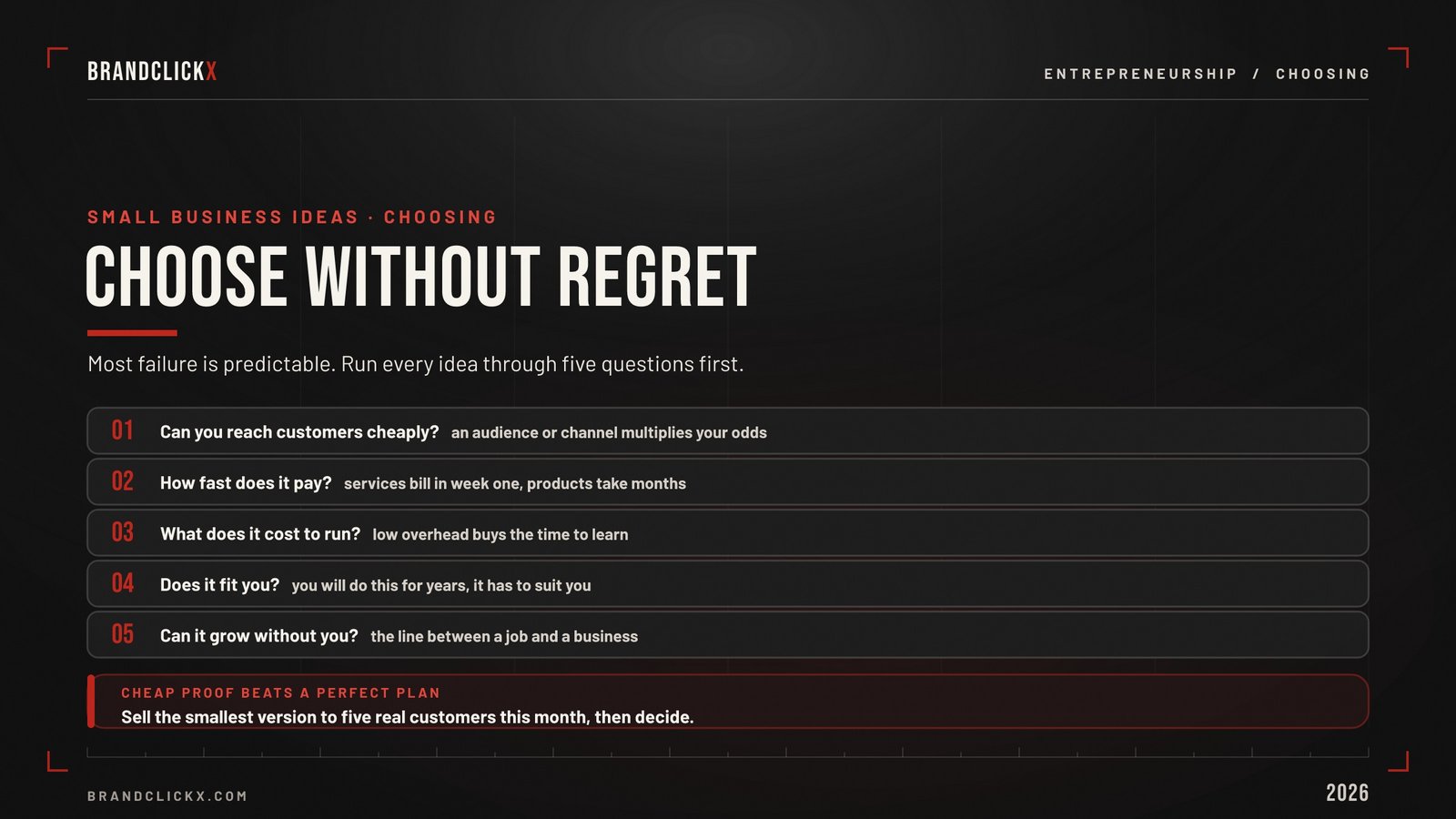
So filter every idea through five quick questions before you commit.
First, can you reach customers cheaply? If you already know the audience or have a channel, your odds jump. Second, how fast does it pay? Service businesses often bill in week one, while products and content take months. Third, what does it really cost to start and to run? Low overhead buys you time to learn. Fourth, does it fit your skills and energy? You will do this for years, so it has to suit you. Fifth, can it grow without you working more hours? That is the line between a job and a business.
Tactical Framework: Pick the smallest version of your idea, sell it to five real customers this month, and only then decide whether to invest. Cheap proof beats a perfect plan.
Business Models, Compared
| Model type | Startup cost | Time to first dollar | Scalability | Main risk |
| Service / freelance | Low | Days to weeks | Medium | Trading time for money |
| Local / home service | Low to medium | Weeks | Medium to high | Labor and scheduling |
| Online / content | Low | Months | High | Slow to monetize |
| Product / e-commerce | Medium to high | Weeks to months | High | Inventory and ad costs |
| AI / software | Low to medium | Weeks to months | Very high | Standing out, retention |
Match the row to your reality. If you need income now, start in the top two rows and use the bottom rows to build wealth later.
The 99 Small Business Ideas, by Category
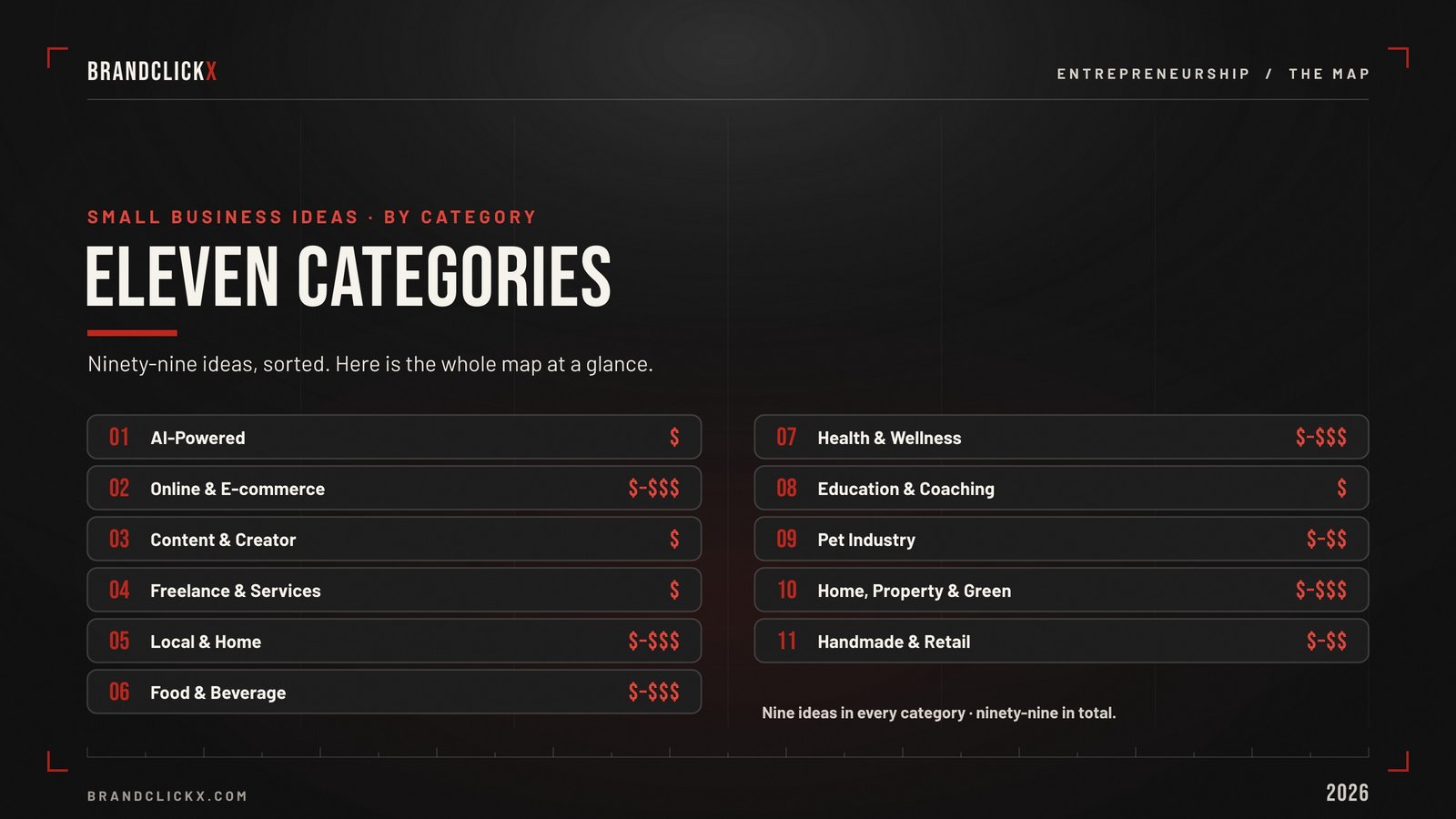
A quick key on cost. $ means under $1,000 to start. $$ means roughly $1,000 to $10,000. $$$ means $10,000 or more.
AI-Powered Businesses
The fastest-growing category, and the one Entrepreneur’s old list never had. Many of these start for the price of a subscription.
- AI consulting for small businesses. Audit a company’s workflows and recommend the right tools, with [rates often running 100 to $300 an hour](https://www.xero.com/us/guides/small-business-ideas/).
- AI content studio. Combine AI drafting with human editing to deliver blogs, scripts, and social posts at speed.
- Faceless video channel. Use AI for scripts, voiceover, and editing to run YouTube or short-form channels solo.
- AI chatbot setup agency. Build and train support bots for local businesses that cannot staff a help desk.
- Micro-SaaS tool. Ship one narrow software tool that solves a specific, annoying problem for a niche.
- AI voiceover and dubbing. Produce audio for ads, explainers, and podcasts without a recording booth.
- Prompt and workflow templates. Sell ready-made AI playbooks and automations to busy teams.
- AI headshot and product imagery. Generate clean brand visuals for people and stores on demand.
- Automation and bookkeeping bots. Set up AI workflows that handle admin, invoices, and data entry for SMBs.
Online and E-commerce
The classic path to scale, with costs that swing on whether you hold inventory.
- Niche dropshipping store. Sell a curated category with strong branding while a supplier ships.
- Print-on-demand brand. Put designs on apparel, mugs, and art with zero inventory.
- Etsy or handmade shop. Sell crafts, art, or digital downloads to a built-in marketplace.
- Amazon private label. Build a branded product line on the largest storefront in the world.
- Subscription box. Curate a monthly niche box that turns customers into recurring revenue.
- Digital products store. Sell templates, ebooks, and presets that you make once and resell forever.
- Affiliate niche site. Build helpful content and earn on the products you recommend.
- Reselling and flipping. Source thrift, sneakers, or vintage finds and sell at a markup.
- Niche online marketplace. Connect a specific group of buyers and sellers and take a cut.
Content and Creator Economy
Slow to pay, but high ceiling and very low cost to start.
- Niche blog or newsletter. Grow an audience around one topic and monetize with ads and sponsors.
- Podcast production studio. Edit and produce shows for creators who lack the time.
- Short-form video editing. Turn raw footage into Reels, TikToks, and Shorts for brands.
- Paid newsletter. Charge for premium expertise on a subject you know deeply.
- Stock media creator. License your photos, video, and audio for ongoing royalties.
- Paid community or membership. Run a private group around a shared interest or skill.
- Creator brand. Build an audience and sell your own courses, merch, and sponsorships.
- UGC creator. Make authentic branded content that companies use in their own ads.
- Micro-influencer agency. Represent and book smaller creators that brands want.
Freelance and Professional Services
The fastest route to your first paying client, and where margins run highest.
- Freelance writing and copywriting. Sell words that sell, from web copy to email campaigns.
- Graphic design studio. Create logos, brand kits, and marketing assets for businesses.
- Web design and development. Build and maintain sites for companies that need a presence.
- SEO and GEO agency. Help clients rank in search and get cited by AI answer engines.
- Social media management. Run the content and community for brands too busy to post.
- Virtual assistant business. Handle admin, inbox, and scheduling for founders and execs.
- Bookkeeping and tax prep. Keep small business finances clean and compliant.
- Grant and proposal writing. Win funding and contracts for nonprofits and firms.
- Fractional executive consulting. Serve as a part-time CMO, CFO, or COO for several companies.
Local and Home Services
Recession-resistant, hard to outsource overseas, and strong once you have repeat clients.
- House cleaning service. Steady demand, low startup cost, and easy to scale with a small crew.
- Lawn care and landscaping. Seasonal and recurring revenue from a simple route.
- Handyman service. Small repairs add up fast when you build a local reputation.
- Pressure washing. One machine, high visible results, and quick before-and-after marketing.
- Junk removal and hauling. Charge by the load for a job most people avoid.
- Mobile car detailing. Bring the wash to driveways and offices for a premium.
- Pest control. Higher barrier and licensing, but strong recurring contracts.
- Painting service. Interior and exterior work with healthy margins and word of mouth.
- Window and gutter cleaning. Simple, repeatable, and easy to bundle with other services.
Food and Beverage
Beloved and risky. Start lean before you sign a lease.
- Home bakery. Sell under cottage food rules with almost no overhead to begin.
- Food truck. A lower-cost path into food service than a full restaurant.
- Meal prep delivery. Serve busy professionals who want healthy food without cooking.
- Personal chef and private dinners. Cook in clients’ homes for events and weekly meals.
- Specialty coffee cart. Mobile espresso at markets, offices, and events.
- Catering. Scale from small gatherings to corporate and wedding work.
- Packaged specialty food. Bottle a sauce, granola, or snack and sell wholesale and online.
- Ghost kitchen brand. Run a delivery-only food brand with no dining room.
- Healthy snack vending. Place smart machines in gyms, offices, and schools.
Health, Wellness, and Fitness
A category riding strong consumer demand and a shift toward prevention.
- Personal training. Coach in person or online, with low startup cost and high trust.
- Yoga or Pilates instruction. Teach classes, privates, or online programs.
- Online fitness coaching. Sell programs and accountability to clients anywhere.
- Nutrition coaching. Guide clients on food and habits within your scope of practice.
- Massage therapy. Licensed, recurring, and easy to run solo or mobile.
- Wellness workshops and retreats. Package experiences around health and reset.
- Mental wellness content. Build meditation, journaling, or calm-focused products.
- Mobile recovery services. Offer regulated recovery and IV services where permitted.
- Senior companion care. Provide non-medical help and company to older adults.
Education, Coaching, and Courses
Knowledge sells, and AI makes it faster to package and deliver.
- Online tutoring. Teach school subjects to students across time zones.
- Test-prep coaching. Help students raise scores on high-stakes exams.
- Language instruction. Teach a language you speak fluently, live or recorded.
- Business or career coaching. Guide professionals through growth and transitions.
- Self-paced online courses. Teach a skill once and sell it on repeat.
- Kids’ enrichment classes. Run STEM, music, or art programs for families.
- Corporate training. Deliver workshops on skills companies need now, including AI.
- Resume and LinkedIn services. Help job seekers stand out in a tight market.
- Music lessons. Teach an instrument in person or over video.
Pet Industry
Spending here stays resilient even when budgets tighten.
- Dog walking. Near-zero startup cost and reliable recurring clients.
- Pet sitting and boarding. Care for animals while owners travel.
- Mobile pet grooming. Bring the spa to the driveway for a premium.
- Pet treats and bakery. Make and sell healthy treats online and at markets.
- Pet products store. Sell niche gear, food, or accessories online.
- Dog training. Teach obedience and behavior for owners who need help.
- Pet photography. Capture portraits owners happily pay for.
- Aquarium maintenance. Service tanks for homes and offices on a schedule.
- Pet waste removal. A simple recurring service that sells itself.
Home, Property, and Green
Real estate and sustainability are both expanding fast.
- Airbnb co-hosting. Manage short-term rentals for owners who lack the time.
- Rent your space or car. Turn a spare room or idle vehicle into income.
- Interior design and styling. Help clients make spaces beautiful and functional.
- Home organizing. Declutter and systematize homes for a tidy fee.
- Solar consulting and referral. Guide homeowners to the right solar setup.
- EV charger installation. Install home chargers with the right certification.
- Eco cleaning products. Build a brand around safe, sustainable supplies.
- Composting and recycling pickup. Offer green waste collection on a route.
- Real estate staging. Stage homes to sell faster and for more.
Handmade, Retail, and Personal Services
Creative, personal, and often started from a kitchen table.
- Candle and soap brand. Make and sell craft goods online and at markets.
- Jewelry making. Design and sell handmade pieces to a loyal niche.
- Custom apparel and embroidery. Personalize clothing for teams, events, and gifts.
- Event planning. Coordinate parties, corporate events, and weddings.
- Wedding and portrait photography. Capture milestone moments for a premium.
- Personal styling. Help clients build wardrobes and confidence.
- Gift basket and curation service. Assemble themed gifts for people and companies.
- Mobile bartending. Serve drinks at events with a portable bar.
- Notary and loan signing agent. Earn per signing with low startup cost and steady demand.
Strategic Breakdown: Notice the pattern. The cheapest entries cluster in services, content, and AI, where your skills and time are the main investment. The pricier ones buy speed and scale through inventory, equipment, or a brand. Both paths work. They just fit different stages of life and risk tolerance.
What the Smartest New Founders Do Differently
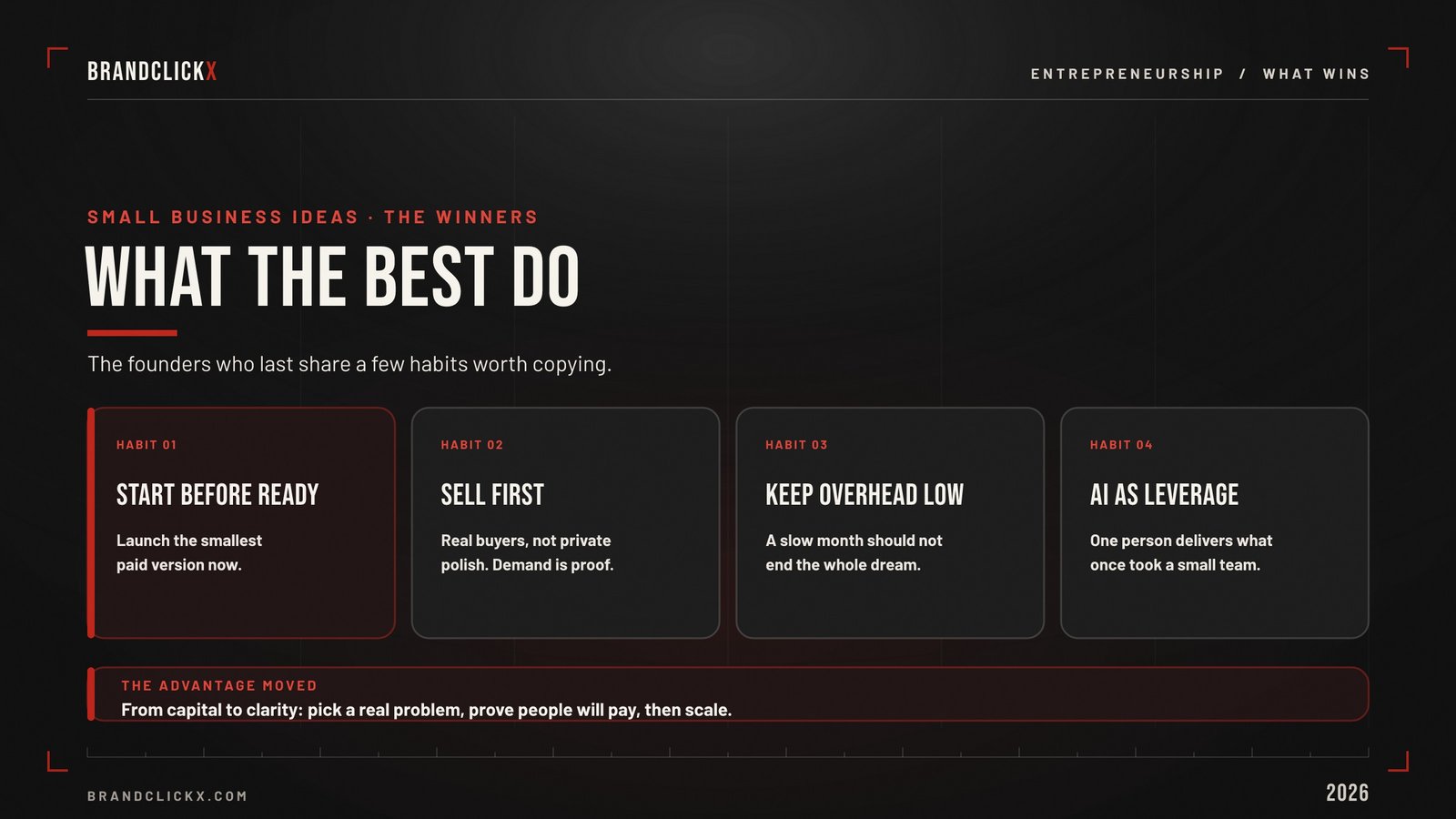
The ones who last share a few habits worth copying.
They start before they feel ready, with the smallest paid version of the idea. They sell to real people fast instead of polishing in private, since demand is the only proof that counts. They keep overhead low so a slow month does not end the dream. And they use AI as a force multiplier, letting one person deliver what used to take a team.
Market Observation: The home-based, low-cost business is no longer the consolation prize. With AI tools and online reach, a solo founder at a kitchen table can now outwork a small agency from five years ago.
Future Outlook: Expect the line between side hustle and real business to keep blurring. As AI handles more of the busywork, more people will run profitable one-person companies, and the winners will be those who pick a clear niche and serve it better than anyone.
KEY TAKEAWAYS
- Fit beats hype. The best small business idea is the one matched to your budget, skills, and timeline, not whatever topped a trending list.
- Start cheap, prove demand. Most failures come from no market need or running out of cash. Sell a small version to real customers before you invest.
- Services pay fastest. Freelancing, local services, and consulting can bill in week one with low startup costs. Use them to fund slower-building bets.
- AI opened a new lane. Consulting, content, automation, and micro-software now start for the price of a subscription and scale fast.
- Low overhead is survival. Keeping costs down buys the time you need to learn, adjust, and outlast the slow months.
- Pick a niche and own it. Broad businesses get ignored. Specific ones get chosen, remembered, and recommended.
FAQ
What is the best small business to start in 2026?
The best small business is the one that matches your budget, skills, and how fast you need income. Service businesses like cleaning, freelance work, and AI consulting pay quickly with low startup costs, while product and franchise businesses cost more but scale further. There is no single best idea, only the best fit for your situation.
What small business can I start with little or no money?
Low-cost or near-zero startups include freelance writing, virtual assistant work, social media management, dog walking, cleaning, tutoring, print-on-demand, and AI content services. These rely on your time and skills rather than inventory, so you can launch for under a few hundred dollars.
Which small businesses are most profitable?
High-margin small businesses tend to be service and knowledge based: consulting, bookkeeping, design, coaching, and software, where most revenue is profit. Local services like cleaning and landscaping also reach strong margins once routes and repeat clients are in place.
How much money do I need to start a small business?
It varies widely by type. Many service businesses start for under $1,000, most US entrepreneurs launch with under $25,000, and restaurants or franchises can require six figures. Start with the smallest viable version and reinvest early revenue instead of borrowing heavily.
Why do most small businesses fail?
The two biggest reasons are no real market need and running out of cash. Most failures trace back to building something people will not pay for, or scaling spending before revenue is proven. Testing demand cheaply before you invest heavily is the best protection.
CONCLUSION
A list of ideas is easy to find. A way to choose is what most people are missing.
That is the real value here. The 99 ideas give you range, the cost tags give you reality, and the five-question filter gives you a decision. The rest is execution, which is where every business is actually won or lost.
The numbers are on your side. Tens of millions of small businesses already run in the US, millions more launch every year, and AI just handed solo founders the leverage of a small team. The barrier to starting has rarely been lower.
So treat this as a starting line, not a reading list. Pick one idea that fits your money, your skills, and your timeline. Sell it to five real people this month. Then let what they tell you, not what any list says, guide your next move.
This is the kind of practical, market-aware guidance BrandClickX is built to deliver, because the next wave of brands will not come from boardrooms. It will come from people who picked one good idea and ran.