You set up the profile. Added photos. Chased some reviews. And then you refreshed your rankings for three weeks straight and watched your competitor, the one with the clip-art logo and no social media presence whatsoever, sit comfortably above you on page one. Frustrating doesn’t begin to cover it. Here’s the part most marketing guides skip past: your Google Business Profile, Local link building services and your website’s organic rankings are not connected the way most people assume.
Your GBP affects the map pack, those three pinned results with the star ratings. Everything below that, the actual blue links, run on a completely separate set of signals. Backlinks, domain authority, how many relevant sites across the web are pointing at yours and saying this place is legit.
GBP can’t do that work. Only local SEO backlinks can.
So when a competitor keeps outranking you in organic results despite a worse product and a worse website, it almost always comes down to one thing: their link profile is stronger than yours in ways that matter locally. That’s the gap. And that’s exactly what this article is about closing.
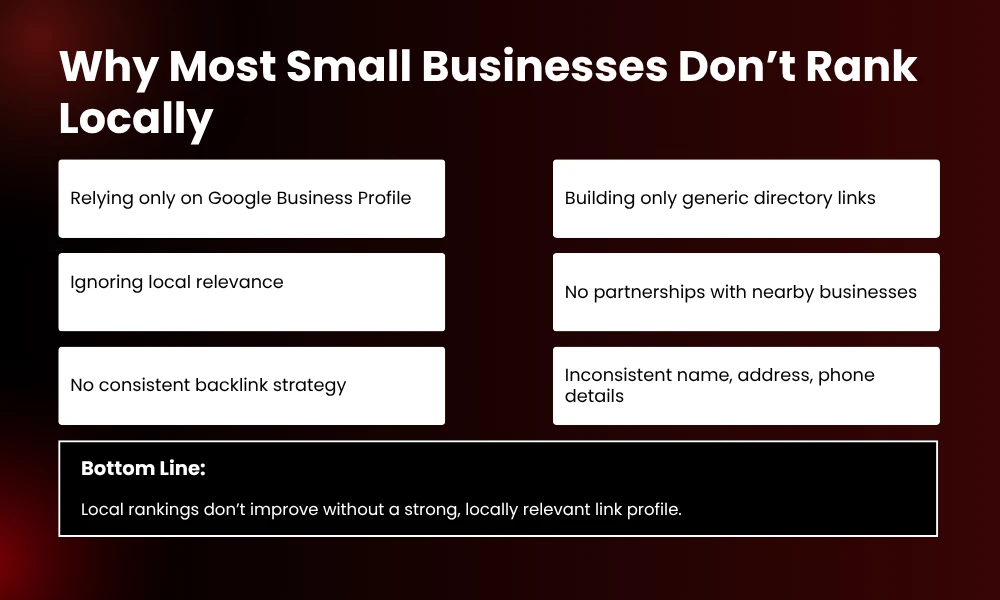
Why Google Business Profile Isn’t the Strategy, Just the Starting Line
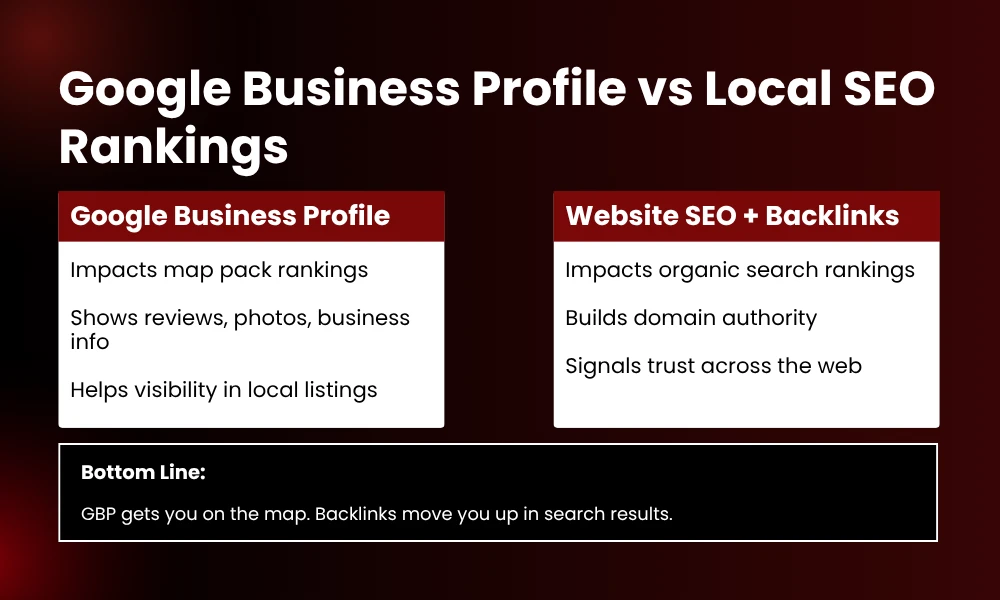
I want to be direct here because a lot of small business owners genuinely believe that getting their GBP fully filled out is what Local link building services looks like. It’s not. It’s the very beginning of what local SEO looks like.
Once you and every other business in your category all have optimized GBP profiles, the profile stops being a differentiator. Google can’t use something universal to rank you above anyone. It pivots to looking at your website, your domain authority, your backlink profile, the wider web’s opinion of your credibility as a local business.
And most small business websites have almost nothing there.
A couple of Yelp listings. Maybe Yellow Pages. The same handful of national directories that every business in the country is on, none of which give Google any useful geographic signal about where you specifically operate and who in your community actually vouches for you.
Fixing that is what local link building is. Not a complicated concept but an underinvested one.
What “Local” Actually Means in the Context of a Backlink
Local link building services from any site is technically a backlink, but they don’t all do the same job.
A link from a major general-purpose authority site builds overall domain strength, useful but not targeted. A local SEO backlink does something narrower and for local businesses, something more valuable. It carries a geographic signal. It comes from a source that Google already associates with your city, your neighborhood, or your specific industry within your market.
Think about what that signals to an algorithm trying to decide who deserves the top spot for “best HVAC company in Columbus.” A business that has links from the Columbus Dispatch, the local Chamber of Commerce site, two neighborhood association pages, and a regional contractor directory is telling a very clear story. This business is known here. People and organizations in this specific place recognize them.
That’s the picture Local link building services paint. And Google rewards it with rankings.
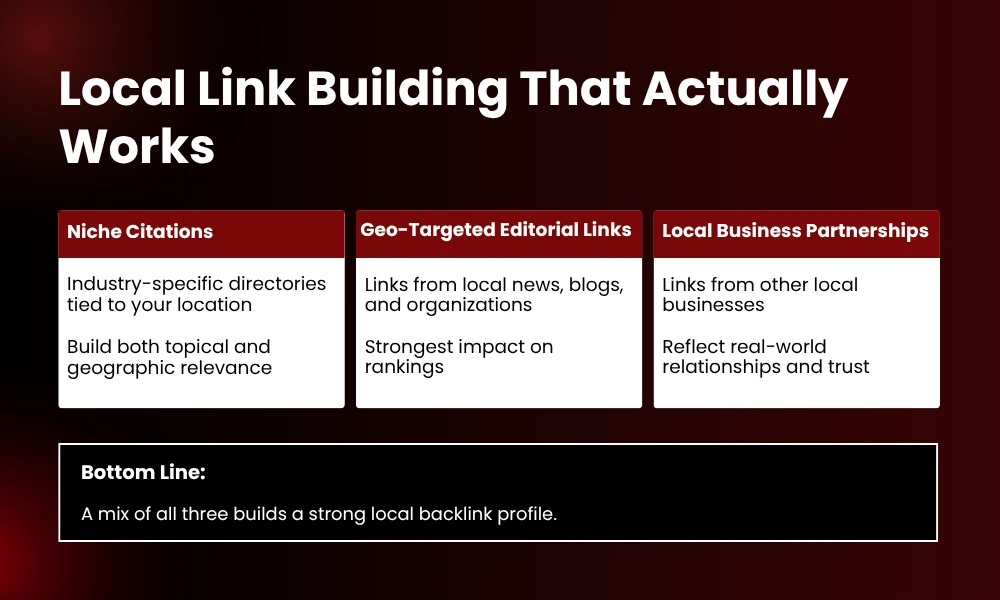
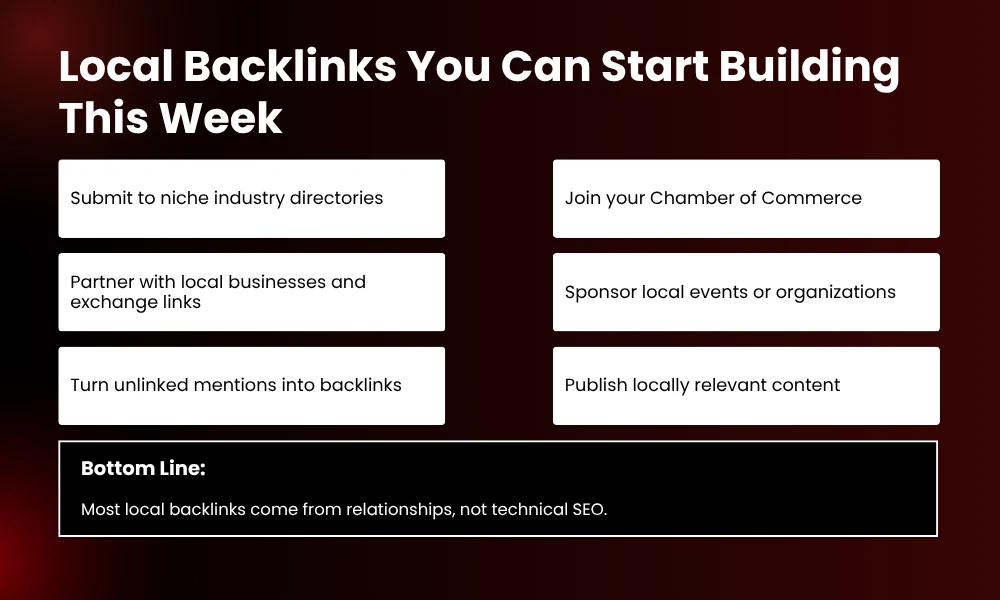
The three categories that do the heaviest lifting are niche citations (industry-specific directories tied to your location), geo-targeted editorial links (from locally recognized sources that actually editorially chose to link to you), and local business partnership links (from other real businesses in your area serving overlapping customers). Build across all three and you’ve got something most competitors genuinely haven’t built.
The Local link building services Worth Your Time
Niche Citations: Go Way Past the Obvious Directories
Yelp, sure. Google, obviously. But if those are the only citations you’ve built, you’ve done maybe 10% of the citation work that actually matters.
Niche citations are listings on platforms specific to your industry. Not generic directories that list everyone from accountants to zamboni rentals, but places that exist specifically for businesses like yours. Healthgrades and Zocdoc for healthcare providers. Avvo and FindLaw for attorneys. Houzz, Angi, and Thumbtack for contractors. TripAdvisor and OpenTable for hospitality. Your state’s professional licensing association site. Your city’s homebuilders’ association directory.
Every single one of those sends Google a double signal: here’s what this business does (topical relevance) and here’s the city they do it in (geographic relevance). When those two signals stack across your backlink profile, something starts to move in your local rankings.
This is usually the first thing a good local link building service knocks out because the ROI per hour of effort is hard to beat. Fifteen to twenty solid niche citations built in a focused week can start showing up in rankings within 60 days.
Geo-Targeted Local link building services: These Are the Ones That Actually Move Rankings
A link from your city’s main news site is worth more for local rankings than 50 more directory submissions. That’s not an exaggeration.
Geo-targeted links are editorial backlinks from sources that Google already trusts as geographically relevant to your area. Local newspapers. Neighborhood newsletters with real audiences. Regional business journals. The city’s official visitor bureau. The downtown business association. A hyperlocal blog that’s been covering your neighborhood for years.
Getting them requires showing up in the real world in ways that are worth writing about. New location opening. Hiring from the community. Partnering with a local school. Sponsoring a neighborhood event. Running a free workshop. Local journalists need stories. If you’re doing something genuinely worth covering, reaching out to local media isn’t a stretch, it’s just basic PR.
Other paths to geo-targeted links that don’t require press coverage:
- Chamber of Commerce membership pages (join and get listed)
- City and county small business directories
- Neighborhood association websites
- Regional podcast show notes after a guest appearance
- Local event sponsor listings online
- Community college or university partner pages if you offer internships or education partnerships
You don’t need all of these at once. One genuine community involvement effort per quarter that lands on a locally trusted site does more for your rankings than most people expect.
Local Business Partnerships: The Most Underused Play in Local link building services
Who do you already informally send referrals to?
The gutter company you recommend to every roofing customer. The florist you tell every wedding venue client about. The nutritionist who sends their clients your way because you run the gym down the street. Those relationships already exist. The link formalization is almost a paperwork step.
A “trusted local businesses” page on each other’s websites, a collaborative local guide you both publish, even just a paragraph on your About page saying who you work with and linking to them. Google reads that as a genuine editorial recommendation from a geographically relevant source. Because that’s exactly what it is.
White-hat, easy to execute, costs nothing but a phone call or an email, and produces locally relevant backlinks that mirror how real business communities actually operate. I don’t understand why more businesses don’t do this.
Locally Useful Content That Earns Links Without You Asking
Here’s the version of content marketing that actually works for small businesses, and it has nothing to do with chasing viral content.
Specificity is everything. “Plumbing tips” is a useless topic for a local business to write about because a million sites have already written it better. “Why water pressure drops in older homes in [Your City] and what to do before calling a plumber” is the kind of piece that gets linked by local home improvement blogs, shared in neighborhood Facebook groups, referenced in local media roundups, and bookmarked by homeowners in your exact service area.
More examples of what this looks like in practice:
- A local landscaper publishing a month-by-month planting guide specific to their county’s frost dates
- An accountant writing a free breakdown of state and city tax incentives available only to local small businesses
- A mechanic creating a guide to emissions testing for their specific metro area’s requirements
- A pediatric dentist writing a local parent’s guide to school dental screening requirements in their district
When the content is genuinely useful AND geographically specific, it earns geo-targeted links organically from local sources who found it and wanted to share it. That’s the rarest kind of backlink you can have and the kind that’s hardest to replicate or buy.
Unlinked Mentions: Quick Wins Sitting Right There
Go set up a Google Alert for your business name right now. Seriously, open a new tab while you’re reading this if you haven’t done it.
Every time someone mentions your business online without linking to your site, that’s a backlink you’ve already earned in the sense that someone likes you enough to write about you, but you haven’t collected it yet. Review roundups that name you. Community forum threads recommending you. Local blog posts listing businesses in your area. “Places I love in [city]” pieces that mention you by name.
A short, casual email asking if they’d add a link converts at a rate that surprises most people. They already like your business. They wrote about it for free. Asking them to make the mention clickable takes them about 20 seconds. Once you have monitoring set up this approach can bring in several solid backlinks per month with almost no ongoing effort.
Sponsoring Local Things With Websites
Little League teams. School fundraisers. Neighborhood 5Ks. Community theater. Local clean-up events.
Most of these have websites. Most of those websites have a sponsors page. A link from a .org or .edu domain that Google already associates with your neighborhood is genuinely valuable, and the cost of getting it is usually a few hundred dollars to sponsor the event rather than any kind of SEO expense.
The backlink doesn’t expire when the event ends the way a paid ad expires when the budget runs out. Sponsor a school fundraiser this spring and that link may still be passing authority in 2027. Hard to beat that ROI.
Picking a Local Link Building Services That’s Actually Worth Paying
The quality range in this market is genuinely wild. Here’s how to tell the difference quickly.
Where do the links come from? Ask this before anything else. Vague answers like “high-authority sites” or “our publishing network” mean PBNs or content farms. A legitimate provider can show you real examples of placements from past client campaigns without hesitation.
Relevance beats volume every time. An agency leading with “we’ll get you 150 links a month” is selling something that will either do nothing or eventually get your site penalized. Five locally relevant, editorially placed links outperform 150 irrelevant ones. If the pitch is about numbers, walk.
You need to see the actual report. Every link placed, the domain it lives on, whether it’s do-follow, what anchor text was used. If a provider can’t offer that level of transparency from day one it usually means they don’t want you seeing where the links actually go.
PBNs are a time bomb. Private blog networks look like real sites. They’re not. Google has been cracking down on them for years and getting caught in a PBN scheme means a manual penalty that can take six months or more to recover from. Not worth it.NAP consistency
NAP consistency check first. Your name, address, and phone have to be exactly identical across every listing on the web. Not approximately identical. Exactly. A good provider audits this before building anything new because inconsistent NAP dilutes local authority even when everything else is working.
A Note on Anchor Text So You Don’t Make the Common Mistake
Anchor text is the clickable wording in a hyperlink pointing to your site. Your ideal Local link building services has a mix that looks something like:
- Your business name in most links, it’s natural and expected
- Your city paired with your service type, used a few times, not 40
- Your raw URL written out, totally normal
- Generic phrases like “check them out” or “their website”, these are healthy filler
- Partial matches like “Phoenix plumbing company” rather than exact keyword every time
The penalty-triggering pattern is 40 out of 50 links all using the exact keyword anchor text you want to rank for. Real editorial links don’t work that way. Real people linking to a business use the business name, or they say “this place” or “the company I mentioned.” Keep it varied and it reads as natural because it actually is natural.
Timeline Expectations Worth Having Local link building services
Smaller market, moderate competition: you can see real organic ranking movement in 60 to 90 days from a focused effort. Not guaranteed, but common.
Major metro, competitive category like law, medicine, real estate, or finance: realistic timeline is 4 to 6 months before you see consistent upward movement in organic results. Some competitive markets take longer than that and there’s no honest way around saying so.
The compounding math is what makes this worth doing anyway. A link earned today keeps passing authority for years. A paid ad stops running the second you stop paying for it. Measured over 12 to 18 months, a well-executed local link building campaign almost always outperforms what the same budget would buy in paid local advertising. Consistency is the variable most businesses get wrong, they do two months of work, see incremental results, and quit right before the compounding kicks in.
Things to Do Starting This Week: Local link building services
- Search your business name online and audit every listing for NAP consistency, fix the mismatches
- Find 10 to 12 niche directories specific to your industry and submit this week
- Set up a Google Alert for your business name today
- Email two or three local businesses you already refer clients to about formalizing the relationship with a link
- Outline one locally specific piece of content you could publish in the next month
- Look up one local event or cause you could sponsor before end of quarter
- Check if you’re actually listed in your Chamber of Commerce member directory and get listed if not
For competitive markets where you need faster movement, bringing in a vetted provider of local link building services is genuinely worth it as long as you ask the right questions before signing. Ask where the links go. Ask to see past client examples. Ask what the NAP audit process looks like. The right answers will be obvious.
Frequently Asked Questions
What’s the actual difference between local link building services and regular link building?
Regular Local link building services is about getting authoritative sites anywhere on the web to link to you, mainly to grow overall domain authority. Local link building is narrower: it targets sites with geographic relevance to your specific business location. The signals you’re trying to send are location-based trust signals, not just general authority. A link from a local newspaper or a city business association sends Google something a general tech blog link can’t: confirmation that your business is a trusted part of a specific geographic community.
How many local backlinks does a small business need?
There’s no useful universal number. A service business in a small town might rank well with 20 to 30 solid locally relevant backlinks. A business going after competitive terms in a major city might need 3 to 4 times that. The right benchmark is your top-ranking local competitors, look at their backlink profiles and work toward matching and then exceeding what they’ve built.
Are niche citations still worth the effort in 2025?
Yes, genuinely. They’re not flashy but they’re consistent. Each one adds topical and geographic signal to your profile. They also generate direct referral traffic from people actively searching for your service type on those platforms. Build them as baseline infrastructure and move on to higher-effort tactics, but don’t skip them.
Can I do Local link building services without hiring anyone?
The foundational work, directory submissions, monitoring for unlinked mentions, local partnership outreach, community sponsorships, is all manageable without any technical expertise. Just time. The more advanced campaign work, consistent publisher outreach, citation auditing across hundreds of platforms, content-based link acquisition at scale, gets significantly more efficient with professional help. Calculate what your time is worth and where it’s best spent.
Do social media links do anything for local SEO?
Not directly. Social links are almost universally no-follow so they don’t pass link equity. What they do is drive traffic that sometimes turns into editorial links from people who discovered you through social. They also contribute to entity signals, the cross-platform consistency that helps Google confirm your business is a real, active operation in a real location. Think of it as supporting infrastructure, not a substitute for actual backlinks.
What exactly are geo-targeted Local link building services?
A backlink from a website that Google already editorially associates with a specific geographic area. Your local newspaper. A city-specific business blog. A regional trade journal. A neighborhood association site. These links carry weight specifically because the source is already trusted as a representative voice of your location, so when they link to your business they’re implicitly vouching for your local relevance in a way that a generic national directory simply cannot.
The Short Version: Local link building services
GBP puts you on the map literally. Local link building is what moves you up it.
The businesses sitting at the top of local organic results in competitive markets didn’t get there through a better GBP setup. They got there by building a backlink profile that reflects genuine local authority: citations, community links, press coverage, partnerships with other local operators, sponsorships of things people in their city actually care about. Those signals add up to something Google reads as real community credibility.
You can build that. Takes patience and some consistency but there’s nothing about it that requires a huge budget or a technical background.
And if you want to cut the timeline down significantly, working with a solid provider of local link building services and vetting them properly before you start is one of the better calls a locally focused small business can make.