The Game Changed (And Most Marketers Haven’t Noticed Yet)
For two decades, the goal was simple: rank higher in Google’s search results.
Better ranking = more clicks. More clicks = more business.
The playbook was predictable. Research keywords. Create content. Build backlinks. Monitor rankings. Repeat.
In 2026, that playbook is still partially valid. But it’s incomplete.
Because now there’s another game happening above and alongside traditional search results. When users search Google, they don’t just see blue links. They see an AI-generated summary box called an AI Overview—a synthesized answer drawn from multiple sources, ranked by relevance and authority.
And here’s the critical part: that AI Overview cites specific sources. If your content is cited, your traffic jumps. If it’s not, you get nothing—even if you rank #1.
This is Generative Engine Optimization (GEO). And in 2026, it’s not optional.
The Data That Changes Everything
AI Overviews Are Eating Traditional Search Traffic
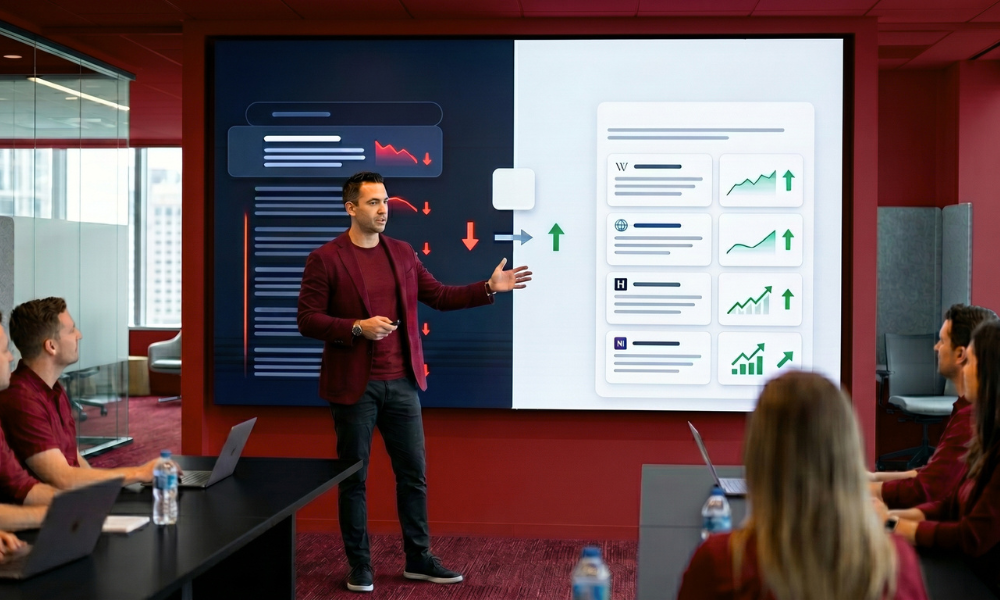
When Google displays an AI Overview for a query, the click-through rate for the top-ranking organic result drops 58%.
That’s not a marginal decline. That’s a demolition.
For context: the top three organic results experience an average 30-50% CTR reduction when an AI Overview appears. Some content-heavy sites are seeing tens of thousands of monthly clicks vanish.
This isn’t speculation. It’s documented across Ahrefs, Semrush, and independent research from 2024-2026.
The reason is straightforward: Google is giving users the answer they searched for without requiring them to leave the search page. Why click a link if you already have the information?
But Here’s Where It Gets Interesting
Brands that appear as cited sources inside AI Overviews experience something unexpected: they earn 35% more organic clicks than competitors not featured in the AI summary.
How is that possible if AI Overviews reduce clicks overall?
Answer: Appearing in the AI Overview builds trust. When an AI cites you as an authoritative source, users trust your deeper content more. They’re more likely to click through to your site for additional information.
Additionally, those cited brands see 91% more paid clicks. AI citations drive brand recognition and consideration that increases ad performance.
The Conversion Reality
Here’s the number that matters most to business leaders: AI-referred traffic converts at 4.4× the rate of standard organic search visitors.
This changes the equation entirely. A thousand visitors from an AI citation convert better than ten thousand visitors from traditional organic search.
Why? Because users who reach your site via an AI citation have been pre-qualified. The AI system implicitly endorsed you. Users come with higher trust and higher intent.
The Two Search Universes in 2026
There are now two distinct search experiences:
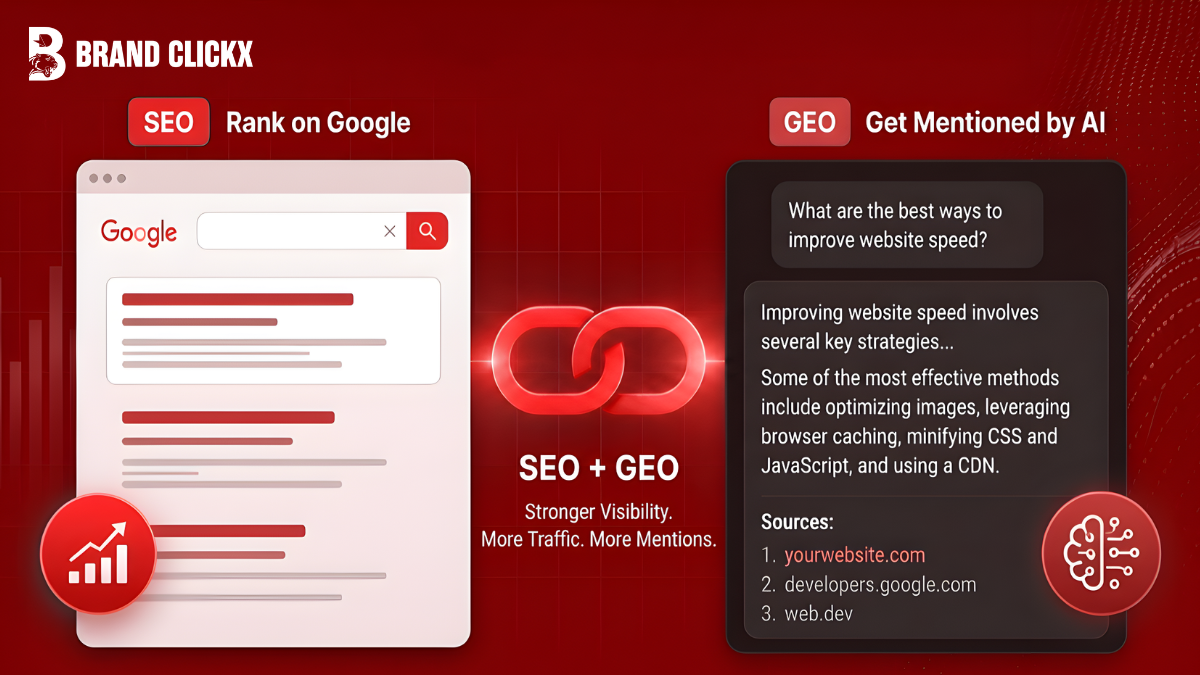
Universe 1: Traditional Organic Search (SEO Territory)
- Goal: Rank in Google’s blue links
- Measured by: Click-through rate, rankings
- Optimized for: Keywords, backlinks, page authority, Core Web Vitals
- Timeline: Results in weeks to months
- Traffic quality: Variable (depends on user intent)
This is what you’ve been doing. It still works. It still matters.
Universe 2: AI-Generated Answers (GEO Territory)
- Goal: Get cited inside AI Overviews, ChatGPT, Perplexity, Claude, Copilot
- Measured by: Citation rate, reference rate, AI share of voice
- Optimized for: Entity clarity, semantic depth, structured data, extractability, authority signals
- Timeline: Results emerge as AI platforms refresh (varies by platform)
- Traffic quality: Exceptional (4.4× conversion rate)
This is new. Most marketers aren’t optimizing for it yet.
The problem: only 1.2% of businesses are recommended on ChatGPT (according to SOCi’s 2026 Local Visibility Index). And fewer than 9% of ChatGPT and Google Gemini citations come from URLs ranking in Google’s top 10 results.
That means 90% of your top-ranking pages are never cited by AI.
Why Ranking #1 No Longer Guarantees Success
Let’s use a concrete example.
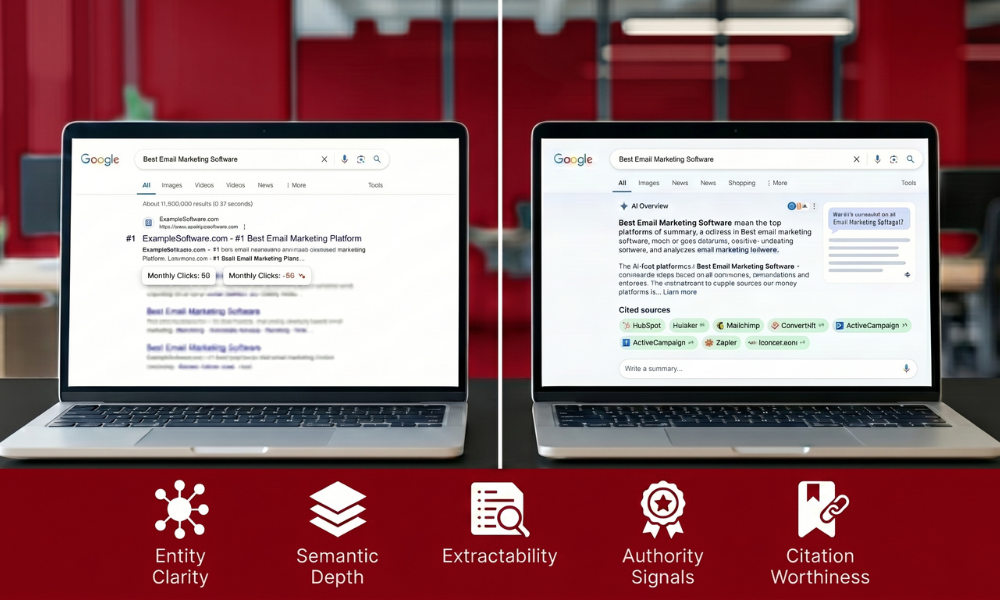
You rank #1 for “best email marketing software.” Your page is solid. It answers the question. It’s mobile-optimized. It has good Core Web Vitals.
But when a user searches that query, Google displays an AI Overview that synthesizes information from five sources: HubSpot, ConvertKit, Mailchimp, ActiveCampaign, and Zapier. Your page isn’t mentioned.
Result: You get zero clicks from that AI Overview, even though you rank #1.
Then a user asks ChatGPT the same question. ChatGPT cites those same five platforms (plus two others), but not you.
You’re invisible in the AI universe despite owning the #1 SEO position.
This happens because AI systems don’t simply extract the top-ranking page. They evaluate:
- Entity clarity: Does the AI understand who you are and what you offer?
- Semantic depth: Does your content comprehensively address the topic?
- Extractability: Can the AI pull a quotable, verifiable statement from your content?
- Authority signals: Is your brand recognized as authoritative on this topic?
- Citation worthiness: Is there original insight or just regurgitated information?
Traditional SEO optimizes for #1 and partially for #5. GEO optimizes for all five—with emphasis on items 1-4.
The GEO Framework: What Actually Works
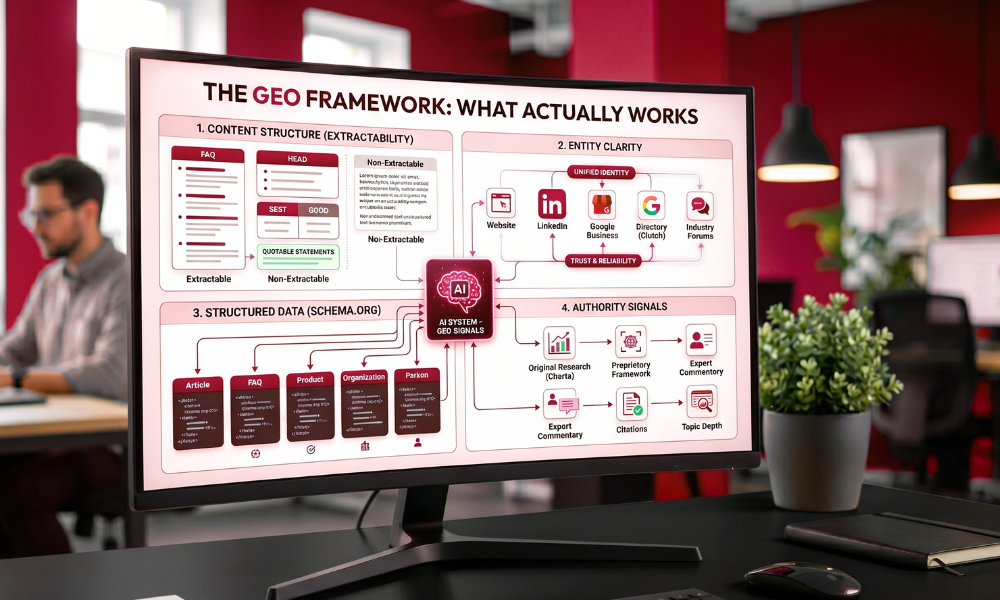
Based on brands that are successfully getting cited in 2026, there are four foundational elements:
1. Content Structure: Make It Extractable
AI systems don’t read content the way humans do. They parse it for extractable statements.
What works:
- FAQ sections with clear question-answer pairs
- Comparison tables (specifications side-by-side)
- Numbered lists and bullet points
- Explicit definitions (not buried in paragraphs)
- Quotable statements (specific claims, data, insights)
What doesn’t work:
- Dense paragraphs that require reading to understand
- Vague claims (“we’re industry leaders”)
- Unstructured information
- Content that requires inference
Example of extractable: “HubSpot’s email marketing platform integrates with 1,200+ third-party tools and costs $50-3,200/month depending on features.”
Example of non-extractable: “HubSpot is a comprehensive platform that offers many features at various price points.”
The first statement can be directly quoted. The second requires interpretation.
2. Entity Clarity: Be Consistently Recognizable
AI systems identify and track entities—your brand, your experts, your products. When these entities are consistent across sources, AI trusts you more.
Implementation:
- Brand description on your website matches LinkedIn
- Author information consistent across all platforms
- Company address, phone, website unified across Crunchbase, Google Business, industry directories
- Product names spelled consistently
- Publication dates and update timestamps present
Why it matters: When signals conflict (different descriptions, missing dates, inconsistent naming), AI systems downrank your citation likelihood.
3. Structured Data: Schema.org Markup
Schema helps AI systems understand the meaning of your content.
Essential for GEO:
- Article schema (title, author, publish date, main entity)
- FAQ schema (question-answer pairs)
- Product schema (price, availability, rating)
- Organization schema (company information)
- Person schema (author credentials)
Not all schema impacts citation, but missing schema makes extraction harder. Every schema implementation should answer: “How does this help an AI understand my content better?”
4. Authority Signals: Original Insight
AI systems cite brands they recognize as authoritative. Authority comes from:
- Original research: A study or dataset you conducted that no one else has
- Proprietary frameworks: A methodology or model you created
- Expert commentary: Perspective from recognized experts on your team
- Cited sources: Backing claims with credible references
- Consistent topic coverage: Deep coverage of a specific domain, not scattered topics
Why it matters: When multiple sources exist, AI picks the one most likely to be trustworthy. Original insight signals trustworthiness.
The Brands Winning in GEO (What They Do Differently)
Companies successfully getting cited in AI systems in 2026 share specific characteristics:
1. They Publish Regularly and Refresh
AI systems value freshness. A 2024 guide about email marketing will be deprioritized against a 2026 guide on the same topic.
Action: Refresh cornerstone content quarterly. Add new data. Update examples. Add “Last updated: June 2026” timestamp.
2. They’re Quotable, Not Keyword-Heavy
Traditional SEO sometimes rewards keyword density. AI systems reward specificity and quotability.
Instead of “Email marketing software has different pricing models,” say “Mailchimp charges $0-$300/month based on contact count and features, starting with a free tier for up to 500 contacts.”
The second is quotable. The first is filler.
3. They Build Multi-Platform Presence
AI systems cross-reference signals across multiple platforms. A strong website alone isn’t enough.
Required presence:
- Company website with rich content
- LinkedIn profile with detailed company info
- Crunchbase entry (if applicable)
- Industry-specific directories
- Publications on industry platforms
- Guest posts on authoritative sites
Consistent signals across platforms increase citation likelihood.
4. They Measure Citation, Not Just Ranking
Most measurement frameworks track traditional SEO metrics (rankings, organic clicks). GEO-focused brands track:
- How often their brand appears in AI responses
- Which topics drive citations
- Citation share versus competitors
- Conversion rate from AI referral traffic
- Brand mentions in AI-generated content
This requires different tools and approaches than traditional SEO measurement.
SEO vs GEO: Tactical Comparison
| Aspect | SEO | GEO |
| Goal | Rank in blue links | Get cited in AI answers |
| Primary Signals | Keywords, backlinks, Core Web Vitals | Entity clarity, semantic depth, structured data |
| Content Format | Long-form, keyword-optimized | Extractable, quotable, specific |
| Measurement | Rankings, CTR | Citation rate, reference rate |
| Timeline | Weeks to months | Varies by AI platform |
| Traffic Conversion | Standard rates | 4.4× better conversion |
| Key Requirement | Rank position | Be trustworthy enough to cite |
The Integrated Strategy: Doing Both in 2026
The smartest brands aren’t choosing between SEO and GEO. They’re doing both.
Here’s why:
SEO creates the foundation. Ranking in Google’s top 100 makes you available for citation. Poor traditional SEO makes GEO harder.
GEO amplifies authority. Being cited in AI increases brand credibility, which improves organic CTR even if your ranking doesn’t change.
Together, they’re multiplicative.
The 90-Day Implementation Plan
Weeks 1-2: Audit
- Identify which queries trigger AI Overviews for your industry
- Check which of those overviews cite you (if any)
- List top competitors and what they’re doing for GEO
- Audit your structured data (schema coverage)
- Review your entity signals across platforms
Weeks 3-4: Quick Wins
- Add missing Schema.org markup to cornerstone content
- Ensure consistent business information across all platforms
- Create FAQ sections on top pages
- Refresh three cornerstone pieces with updated data and “Last Updated” dates
- Clarify author information and credentials
Weeks 5-8: Content Structure
- Identify pages with extractable-statement opportunities
- Restructure with tables, lists, definitions
- Make specific claims backed by data
- Add citations and original research where possible
Weeks 9-12: Authority Building
- Publish original research or unique data
- Build multi-platform presence (LinkedIn, directories, industry sites)
- Guest post on authoritative publications
- Develop topic clusters for topical authority
Ongoing: Measurement
- Track citation mentions (via monitoring tools)
- Monitor conversion rates from AI referral traffic
- Measure organic CTR and AI Overviews impact
- Adjust based on what’s driving citations
Frequently Asked Questions
Will GEO completely replace SEO?
No. SEO and GEO are complementary. Strong SEO (ranking in Google) still drives significant traffic and creates the foundation for GEO. But in 2026, GEO is now equally important for businesses that want maximum visibility.
Should I optimize for ChatGPT or Google AI Overviews first?
Start with Google AI Overviews since it reaches your existing customers in their current search behavior. ChatGPT optimization is important but the audience is still smaller and behaviors vary.
How much should I invest in GEO vs SEO budget?
If you’re getting 20-40% traffic loss from AI Overviews, shift 30-40% of your SEO budget to GEO initiatives. If AI Overviews aren’t impacting your industry yet, maintain 80/20 SEO/GEO. Let your data guide the allocation.
Can I do GEO without a technical team?
You’ll need some technical support for Schema.org implementation and measurement setup. But strategy and content structure can be handled by marketing teams. Most GEO work is editorial (improving extractability, adding specificity) not technical.
Bottom Line
The era of “ranking #1 guarantees success” is over.
In 2026, you need to be visible in two universes: traditional search (SEO) and AI-generated answers (GEO). The brands winning are those optimizing for both.
SEO gets you found. GEO gets you cited. Cited traffic converts 4.4× better.
The choice isn’t GEO or SEO. It’s how you’ll do both.