
AI Summary
AI image recognition works by converting a picture into numerical patterns a neural network can analyze, then matching those patterns against millions of examples it learned from during training. Tools like Google Lens use convolutional neural networks (CNNs) to detect objects, text, and scenes, while newer systems like OpenAI’s vision-capable models use a different architecture transformers to understand both images and language together in one system.
The Short Version
When you point a camera at a flower and an app tells you its species, nothing about that process resembles how a human recognizes a flower. The AI never “sees” a flower the way you do. It sees a grid of numbers pixel values and runs that grid through layers of mathematical operations it learned during training, until it lands on a probability: 94% daisy, 4% chamomile, 2% something else.
That’s the entire trick, scaled up to billions of parameters and trained on enormous datasets. Everything else in this guide is detail on how that trick actually works.
What “Recognition” Actually Means to a Computer
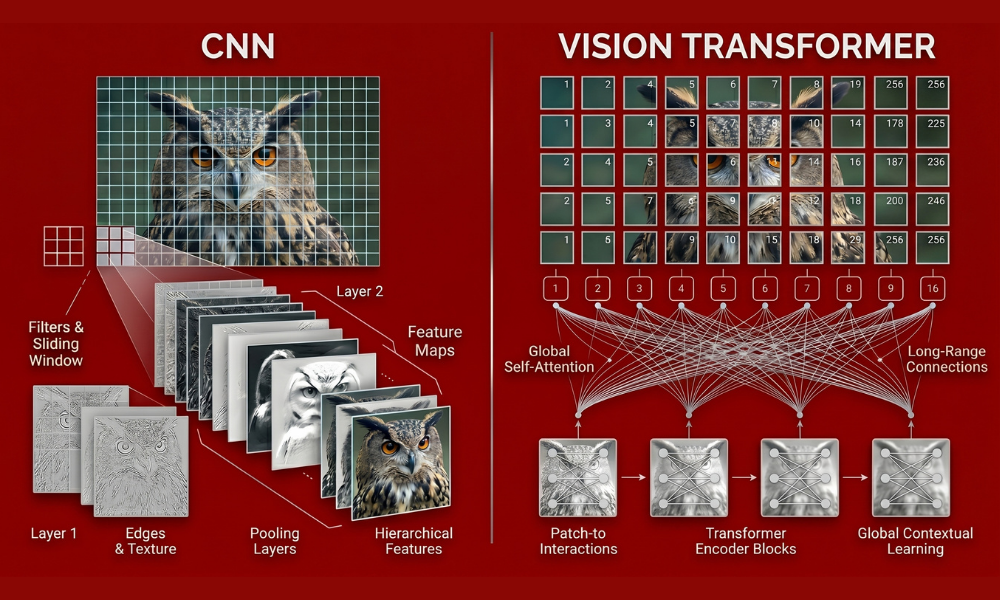
A digital image, at the most basic level, is just a grid of numbers each pixel holds values representing color and brightness. A computer doesn’t start with any concept of “cat” or “stop sign.” It starts with a few million numbers and has to learn, purely from exposure to labeled examples, which patterns of numbers tend to correspond to which labels.
This learning happens through a model architecture, and two architectures matter most in image recognition today:
- Convolutional Neural Networks (CNNs) the long-standing standard, used by tools like Google Lens. CNNs scan an image in small chunks, detecting simple features first (edges, curves, color boundaries), then combining those into more complex features (a shape that resembles an eye, a shape that resembles a wheel) across many stacked layers.
- Vision Transformers and multimodal models the newer approach, used in systems like OpenAI’s GPT-based vision models. Instead of scanning local chunks, these models treat an image as a sequence of patches and learn relationships between distant parts of the image simultaneously, which tends to help with understanding context and combining visual input with language understanding in one system.
Both approaches arrive at the same outcome a confident label or description through different mathematical routes.
How a Model Actually Learns to Recognize Anything
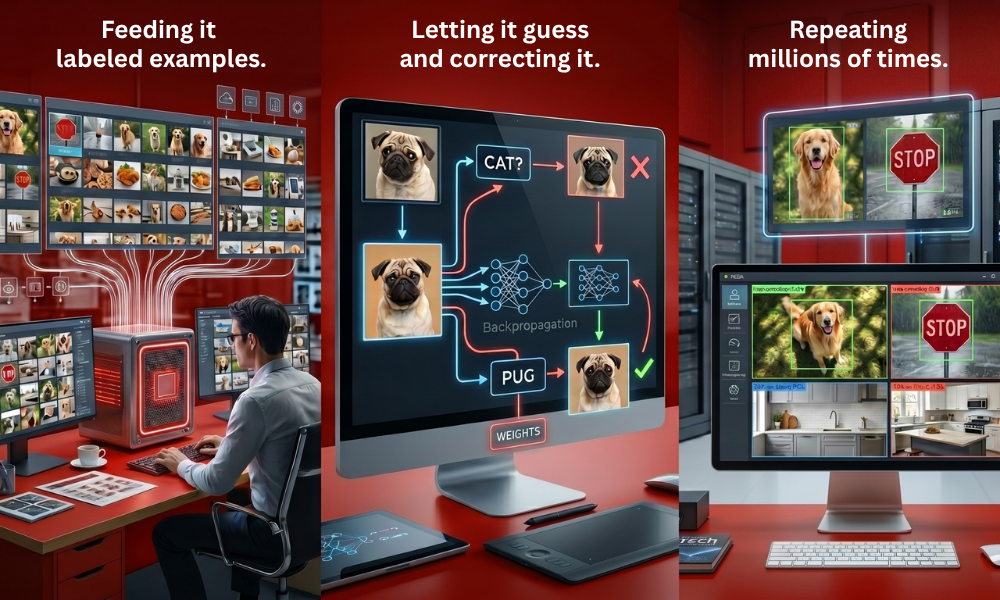
Training an image recognition model generally happens in three phases:
- Feeding it labeled examples. Millions of images, each tagged with what they contain “golden retriever,” “stop sign,” “kitchen.” The model has no shortcuts here; it needs volume and variety to generalize well.
- Letting it guess and correcting it. Early in training, the model’s guesses are close to random. Each wrong guess adjusts the internal math slightly (this is the “learning” in machine learning) so the next guess is a little more accurate.
- Repeating millions of times. Over enough repetition, the adjustments converge into a model that reliably recognizes patterns it’s seen enough variations of — different lighting, angles, breeds, backgrounds.
This is also why image recognition fails in predictable ways: a model trained mostly on photos of dogs outdoors in daylight may stumble on a dog photographed indoors under unusual lighting, simply because that specific pattern was underrepresented during training.
What These Systems Can Actually Do Today
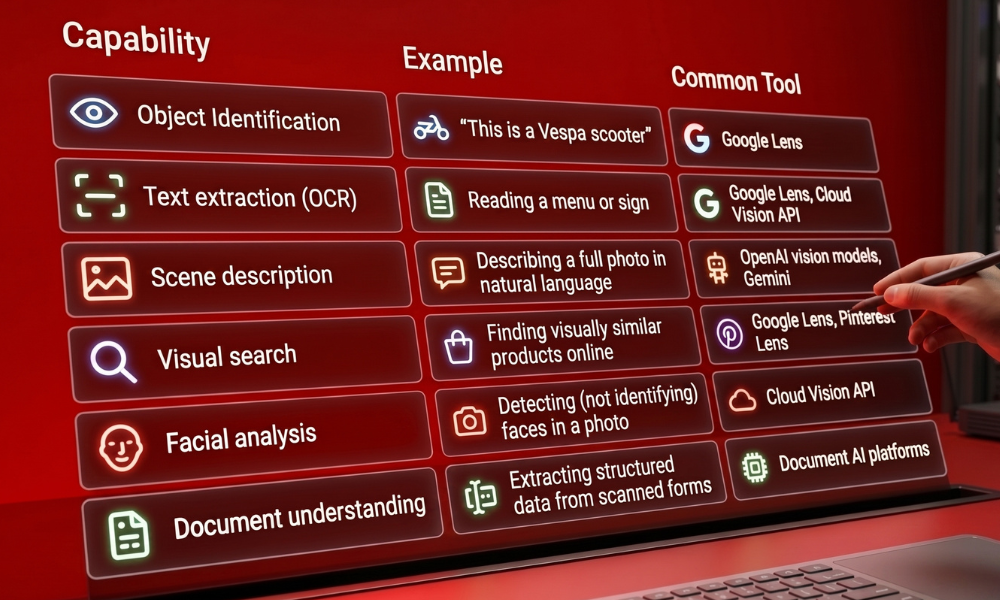
| Capability | Example | Common Tool |
| Object identification | “This is a Vespa scooter” | Google Lens |
| Text extraction (OCR) | Reading a menu or sign | Google Lens, Cloud Vision API |
| Scene description | Describing a full photo in natural language | OpenAI vision models, Gemini |
| Visual search | Finding visually similar products online | Google Lens, Pinterest Lens |
| Facial analysis | Detecting (not identifying) faces in a photo | Cloud Vision API |
| Document understanding | Extracting structured data from scanned forms | Document AI platforms |
Notice the split: tools like Google Lens are optimized for search and identification telling you what something is and where to find more of it. Vision-capable language models like OpenAI’s are optimized for description and reasoning explaining what’s happening in an image, answering follow-up questions about it, or combining it with other instructions in a conversation.
Google Lens vs. OpenAI’s Vision Models: Two Different Jobs
It’s tempting to think of these as competing the same race, but they’re built for different finish lines.
Google Lens is fundamentally a search tool wearing a camera. It compares objects in a picture to other images and ranks results based on similarity and relevance, gathering content from across the internet. Its job is to connect what you’re looking at to existing information Google already has indexed a product listing, a Wikipedia page, a translation.
OpenAI’s vision-capable models work differently. Rather than searching an index, they reason about the image directly using the same underlying language model that handles text. Ask one of these models what’s happening in a photo, and it can describe the scene, infer context, and answer follow-up questions about it all without needing a separate search index, because the “knowledge” is baked into the model’s training rather than retrieved live from the web.
In practice, this means Lens excels at “what is this and where can I find it,” while vision-language models excel at “explain what’s going on in this image and reason about it with me.”
Where the Accuracy Actually Comes From
People often assume “AI image recognition” means the AI is guessing intelligently in the moment. In reality, almost all of the intelligence was front-loaded during training, long before you ever uploaded a photo. A few overlooked accuracy factors:
- Dataset diversity matters more than dataset size. A model trained on one million diverse images often outperforms one trained on ten million near-duplicates.
- Resolution and lighting still matter, even for advanced models a blurry, poorly lit photo gives the model less signal to work with regardless of how sophisticated the architecture is.
- Confidence scores aren’t certainty. When a tool says “95% match,” it’s reporting statistical confidence based on training patterns, not a guarantee of correctness this is why occasional confident-but-wrong results still happen.
- Bias gets baked in from training data. If certain categories, regions, or demographics are underrepresented in training data, recognition accuracy drops for those categories specifically a known and actively studied limitation across the field.
Real-World Applications Beyond Search
Image recognition has moved well past novelty search apps:
- Medical imaging — assisting radiologists by flagging anomalies in X-rays and scans for closer review (not replacing diagnosis).
- Agriculture — identifying crop disease or pest damage from drone or phone photos in the field.
- Retail and inventory — automatically tagging and categorizing product photos at scale.
- Accessibility tools — describing scenes aloud for visually impaired users in real time.
- Manufacturing quality control — spotting defects on production lines faster and more consistently than manual visual inspection.
- Content moderation — flagging policy-violating images at a scale no human team could review manually.
Common Misconceptions, Corrected
- “The AI recognizes things the way I do.” It doesn’t have a concept of an object the way a human does — it has a statistical pattern learned from labeled examples.
- “More AI power means it always gets it right.” Even the most advanced models can be confidently wrong on unusual, low-quality, or adversarial images.
- “All image recognition tools do the same thing.” Search-oriented tools (Lens) and reasoning-oriented tools (vision-language models) solve different problems, even when both are labeled “AI image recognition.”
- “Image recognition and image generation are the same technology.” They’re related but distinct — generation models create new pixels from a description; recognition models classify or describe pixels that already exist.
Where This Is Heading (2026–2028)
A few directions worth watching:
- Tighter integration of recognition and reasoning — instead of just labeling an object, models increasingly explain why it matters in context (e.g., not just “broken pipe” but “this appears to be a burst pipe; here’s what to check next”).
- On-device processing growing — more recognition tasks running locally on phones rather than round-tripping to the cloud, improving speed and privacy.
- Multimodal-by-default systems — the separation between “an image tool” and “a language model” is fading as more systems handle text, images, audio, and video natively in one model.
- Stronger guardrails around sensitive recognition — increasing restrictions on facial identification specifically, distinct from general object recognition, as privacy regulation catches up with capability.
Frequently Asked Questions
What’s the difference between AI image recognition and computer vision?
Computer vision is the broader field covering any technology that lets machines interpret visual data. AI image recognition is one application within that field, specifically focused on identifying or classifying what’s in an image.
Does Google Lens use the same technology as ChatGPT’s image features?
No. Google Lens primarily relies on convolutional neural networks tied to a search index, while vision-capable language models like OpenAI’s use transformer-based architectures that reason about images using the same system that processes text.
Can AI image recognition identify a specific person?
Most consumer tools, including Google Lens, deliberately limit facial identification for privacy reasons and will detect that a face is present without naming the person. Dedicated facial recognition systems exist but are restricted to specific authorized use cases.
Why does AI image recognition sometimes get obvious things wrong?
Accuracy depends entirely on training data. If a model wasn’t exposed to enough examples of a specific angle, lighting condition, or rare object during training, it can misclassify something a human would identify instantly.
Is AI image recognition the same as reverse image search?
They’re related but not identical. Reverse image search uses image recognition technology to find matching or similar images online, while image recognition more broadly includes any task where AI identifies or describes visual content, search included or not.