Ask “what’s the best reverse image search tool” and you will get a ranked list that helps almost no one.
The honest answer is that the category does not have a single winner. It has a set of specialists, and the right one depends entirely on what you are trying to do. A team verifying an influencer needs a different engine than a team identifying a product or tracing a leaked photo.
So this is not a beauty pageant. It is a guide to the best reverse image search tools organized by the jobs marketers and brands actually need done.
And 2026 added a twist worth understanding. AI-native engines and multimodal assistants are reshaping the space, while the classics still own their categories. Here is how it all fits together.
Key Takeaways
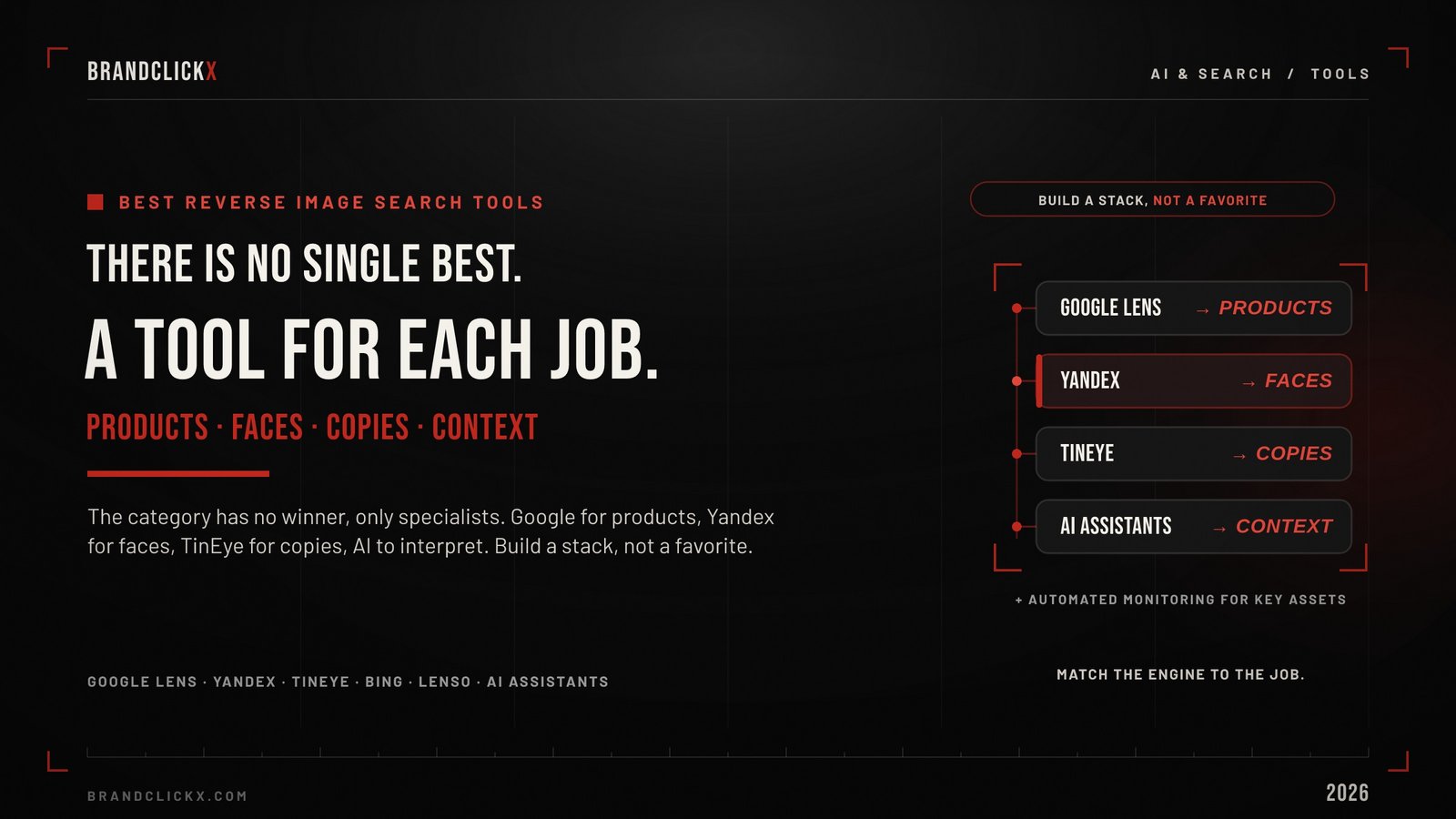
- There is no single best tool. Google Lens, Yandex, and TinEye each lead a different job.
- Google Lens wins products and scale. Yandex wins faces. TinEye wins copies and provenance.
- AI-native engines like Lenso.ai and multimodal assistants like Gemini are changing casual lookup.
- Face-search tools carry serious privacy and legal weight and should be used carefully.
- The smart move is a stack, not a favorite, matched to your real use cases.
The Honest Truth: There Is No Single Best
The reason “best” fails as a question is that these engines were built on different technology to solve different problems.
One matches an exact image and its edits. One matches faces. One identifies products. One understands a whole scene and answers questions about it.
Asking which is best is like asking whether a wrench is better than a screwdriver. The correct answer is “for what.”
Why it matters: the biggest mistake people make is loyalty to one engine. The pros keep three or four open and switch based on the goal in front of them.
The Mainstream Engines, by Job
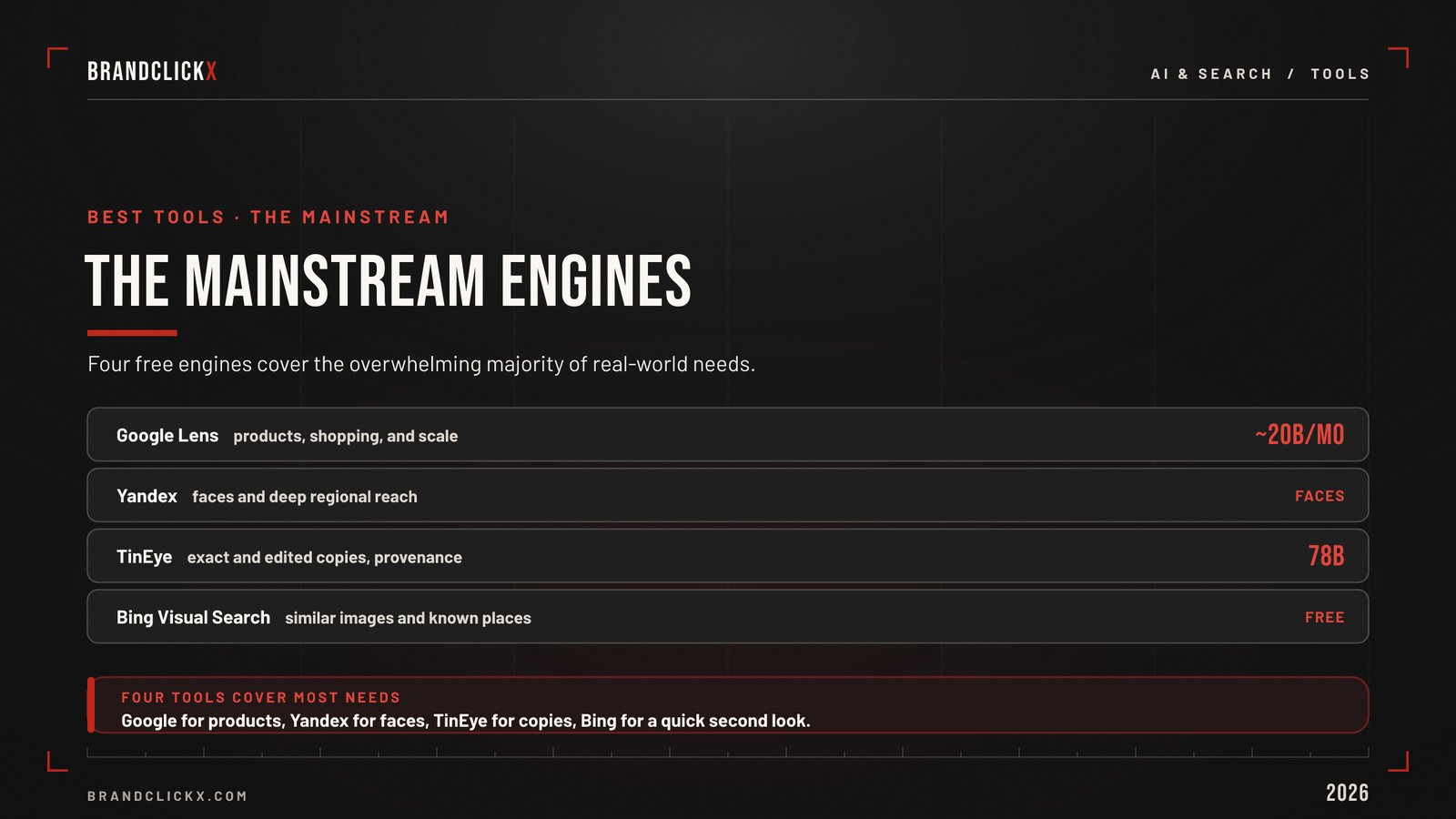
These four cover the overwhelming majority of real-world needs, and they are all free to start.
Google Lens: best for products, shopping, and scale
Google Lens is the default for a reason. It handles close to 20 billion visual searches a month, and Google calls Lens one of the fastest-growing query types in Search.
It is unmatched at identifying products and objects, reading text inside images, and tapping a shopping graph of tens of billions of items. For commerce and product research, start here. We break down its marketing uses in our guide to Google Lens for marketers.
Yandex: best for faces and regional reach
Yandex is the engine the investigation world reaches for. Its facial matching is aggressive enough to find the same person across different photos, clothing, and poses, and it indexes Russian, Eastern European, and Asian sites more deeply than Western engines.
That makes it the strongest free tool for verifying influencers, partners, and user-generated content. It also comes with a real data-governance consideration, which we cover in full in our breakdown of Yandex reverse image search.
TinEye: best for exact copies and provenance
TinEye is the specialist’s scalpel. It builds a visual fingerprint of an image and finds every copy, including crops, recolors, resizes, and watermark variants, across an index that has passed 78 billion pictures.
Its “First Seen” timestamp proves which version came first, which is gold for copyright and forgery cases. The deeper look lives in our explainer on TinEye reverse image search.
Bing Visual Search: best for simple, free similar-image lookup
Microsoft’s Bing Visual Search, which launched its image-match capability back in 2014, is a clean and capable free option. It is strong at surfacing visually similar images and identifying well-known places and products.
It rarely beats the specialists at their own jobs, but it is a solid second opinion and a frictionless free tool. For regional product hunting in Asia, Baidu’s image search is also worth knowing.
Strategic breakdown: Google for products, Yandex for faces, TinEye for copies, Bing for a quick second look. That four-tool base handles most situations.
The AI-Native Challengers
This is where 2026 gets interesting.
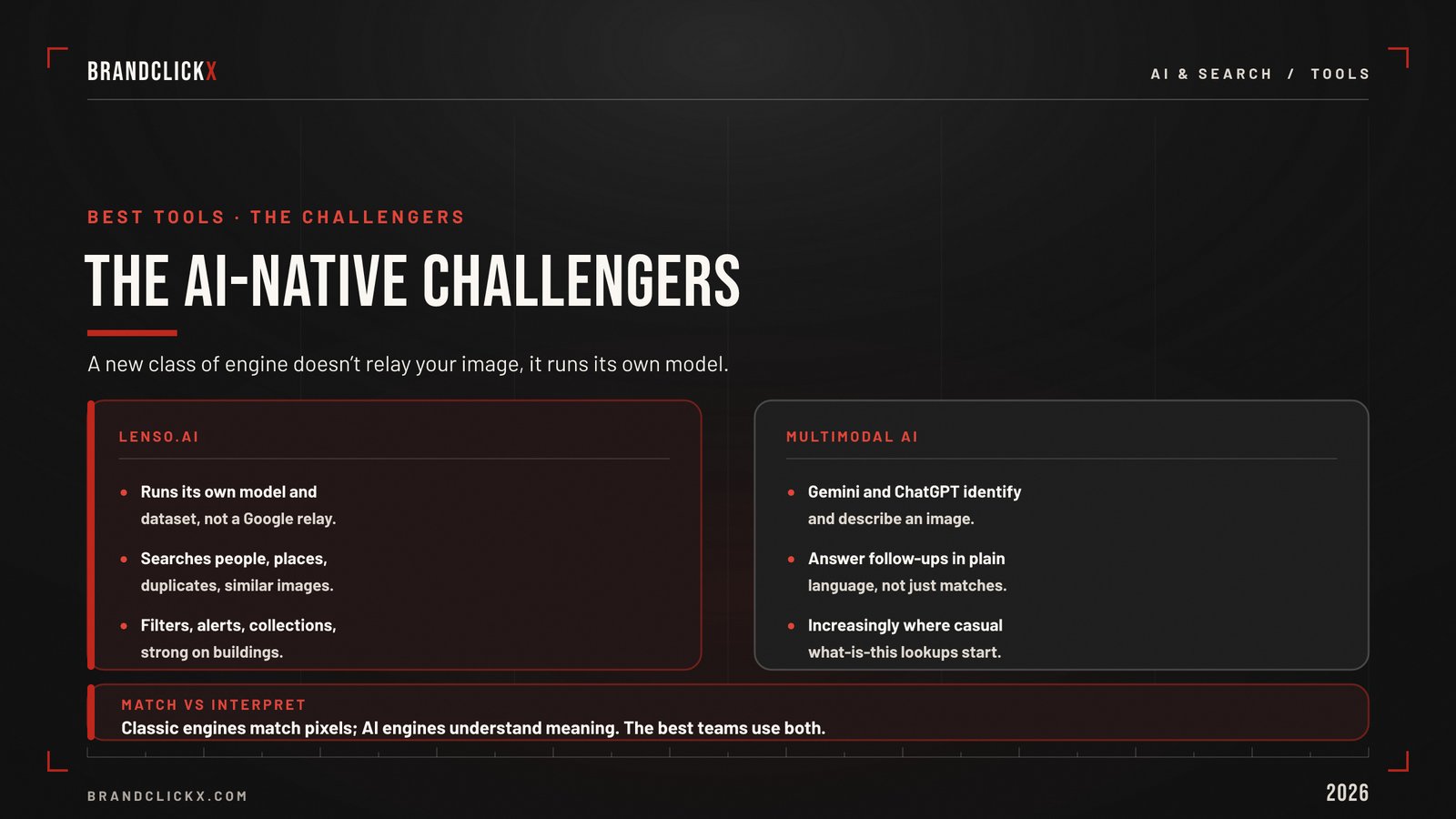
A new class of engine is not forwarding your image to Google or Bing. It runs its own AI model and maintains its own dataset.
Lenso.ai is the clearest example. It searches by distinct categories, people, places, duplicates, and similar images, and layers on filters, sorting, alerts, and collections. It is notably strong at recognizing buildings and places, and it offers monitoring features for longer investigations.
The bigger disruption is broader than any one tool.
Multimodal AI assistants like Gemini and ChatGPT can now take an uploaded image and tell you what is in it, describe the context, and answer follow-up questions in plain language. That is not a traditional reverse image search, but for casual “what is this” lookups, it is increasingly where people start.
The strategic signal is clear. Search is shifting from matching pixels to understanding meaning, and Gartner’s 2026 marketing outlook frames the next phase as ambient, visual, context-driven discovery rather than typed queries.
The bigger shift: the category is splitting. Classic engines match images. AI engines interpret them. The best teams will use both.
Face-Search Tools and the Line You Should Not Cross
A category of dedicated facial-recognition search tools exists, and it deserves a careful, honest treatment rather than a hype list.
Services in this space are built specifically to find a person across the web from a single photo. They can be powerful, and some are highly accurate.
They also carry real weight.
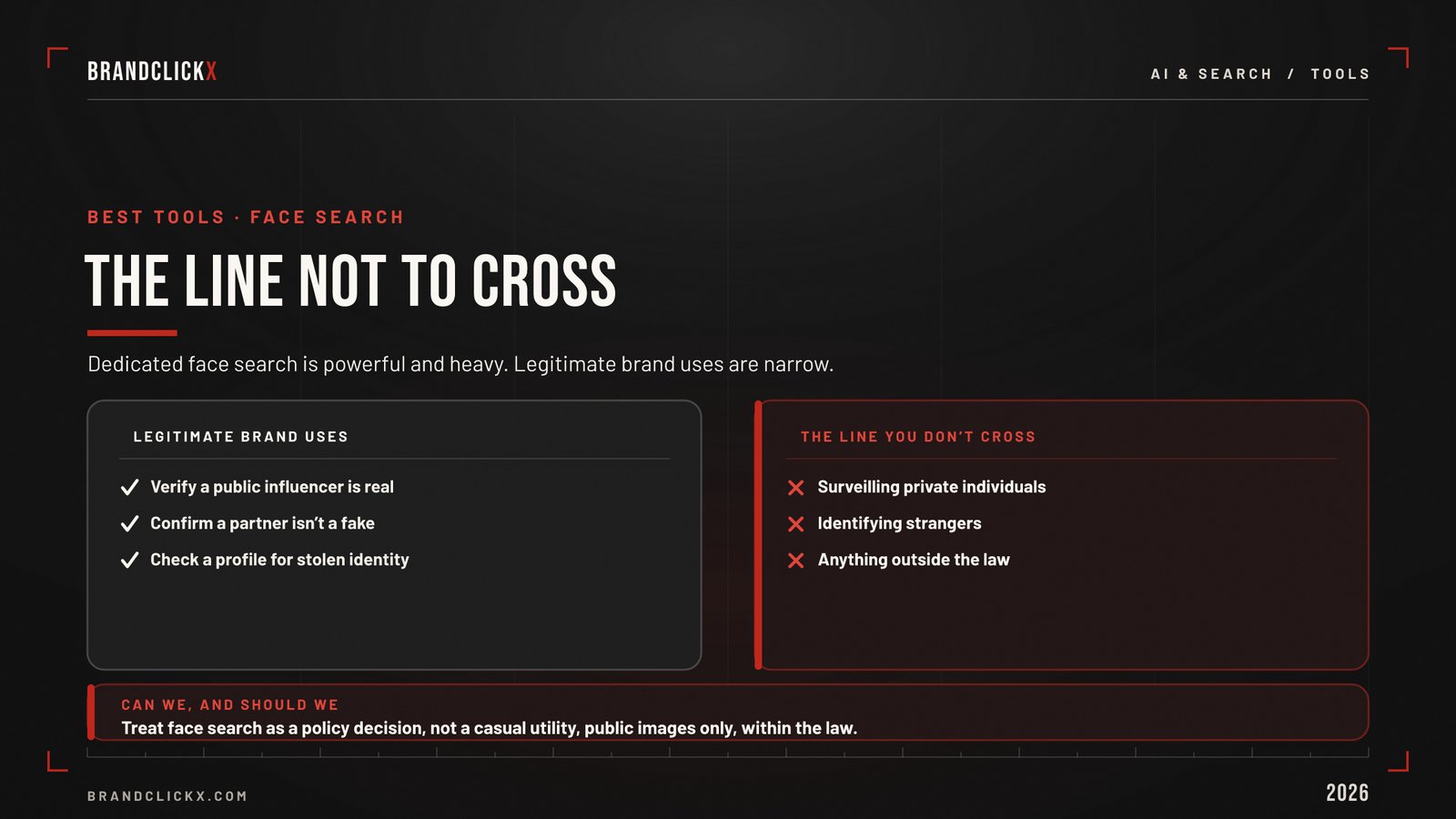
Searching for and identifying private individuals raises serious privacy, consent, and legal questions, and the rules vary widely by country. For a brand, the legitimate uses are narrow: verifying that a public influencer or partner is a real person, or confirming a profile is not a stolen identity, using images that are already public.
Building surveillance of private people, or using these tools to identify strangers, is a line responsible brands do not cross. When facial verification is genuinely needed for legitimate brand work, Yandex covers most of it without stepping into dedicated identity-search territory.
Enterprise perspective: the question is never just “can this tool find someone.” It is “are we allowed to, and should we.” Put a policy around it before anyone runs a search.
Enterprise and IP-Protection Tools
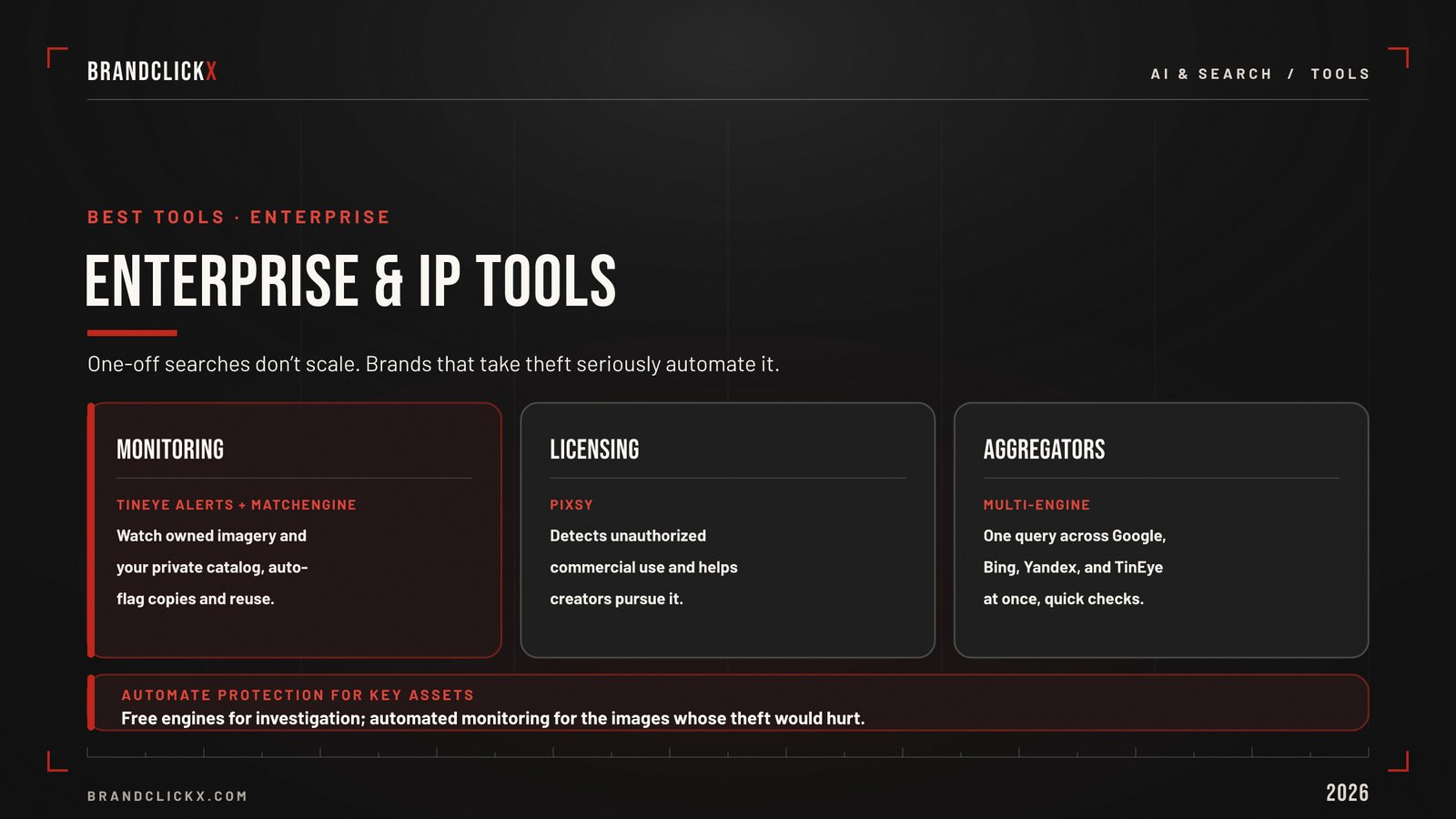
One-off searches do not scale. Brands that take image theft seriously automate it.
A few options matter here.
- TinEye Alerts and MatchEngine monitor your owned imagery and private catalog, flagging copies and reuse automatically rather than waiting for you to find them.
- Image-licensing platforms such as Pixsy specialize in detecting unauthorized commercial use and helping creators pursue it.
- Aggregator tools run a single query across Google, Bing, Yandex, and TinEye at once, which is handy for quick multi-engine checks, though they inherit each engine’s strengths and limits.
Tactical framework: use free engines for investigation and case-by-case checks, and use automated monitoring for the handful of assets whose theft would actually hurt.
The Master Comparison
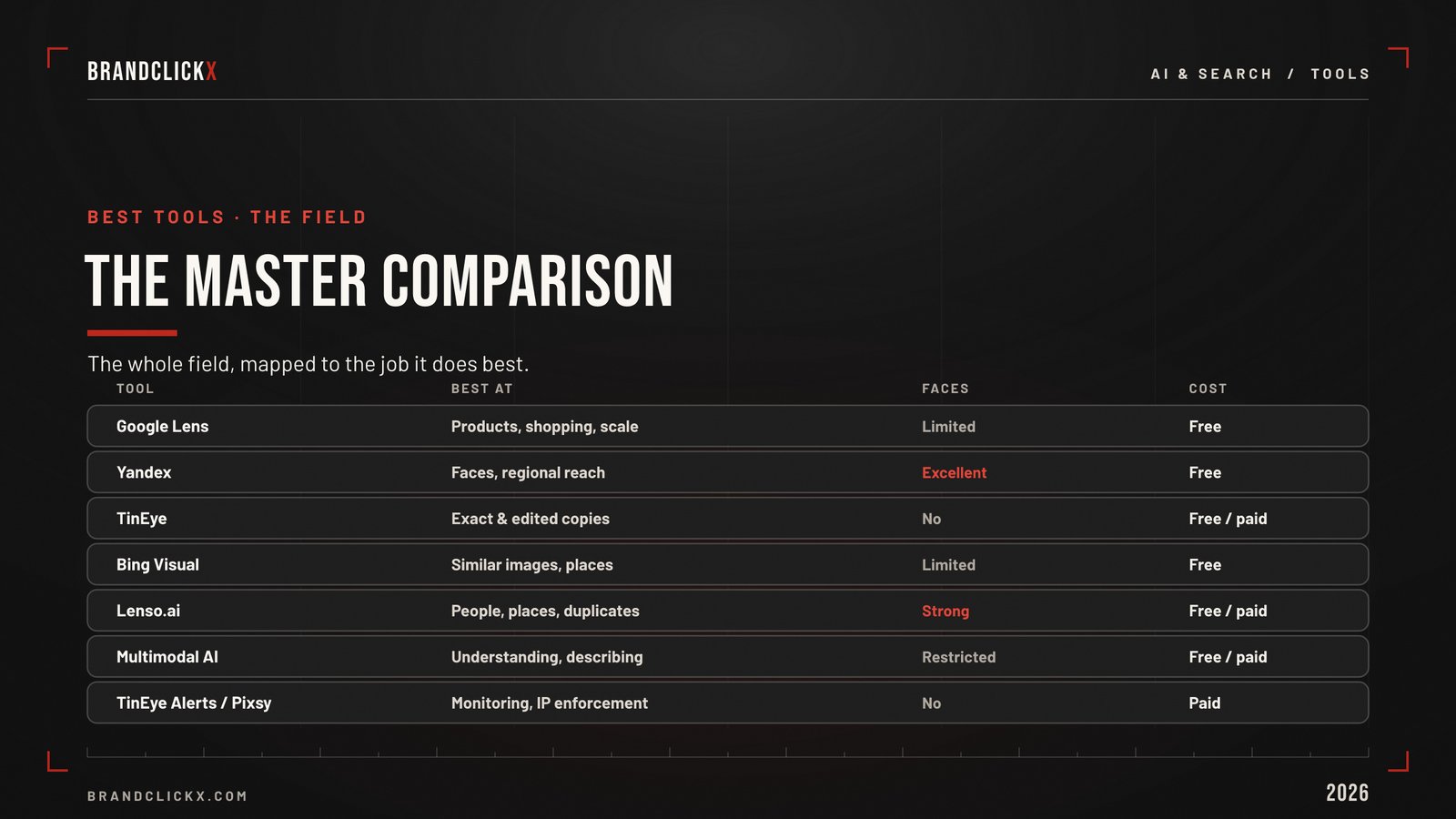
Here is the whole field, mapped to the job.
| Tool | Best at | Faces | Cost | Notable for |
| Google Lens | Products, shopping, scale | Limited | Free | Largest index, shopping graph |
| Yandex | Faces, regional reach | Excellent | Free | Facial matching, OCR |
| TinEye | Exact and edited copies | No | Free, paid tiers | First Seen, fingerprinting |
| Bing Visual Search | Similar images, places | Limited | Free | Simple, frictionless |
| Lenso.ai | People, places, duplicates | Strong | Free, paid | AI-native, filters and alerts |
| Multimodal AI (Gemini, ChatGPT) | Understanding and describing | Restricted | Free, paid | Plain-language image Q&A |
| TinEye Alerts / Pixsy | Monitoring and IP enforcement | No | Paid | Automated brand protection |
Build a Stack, Not a Favorite
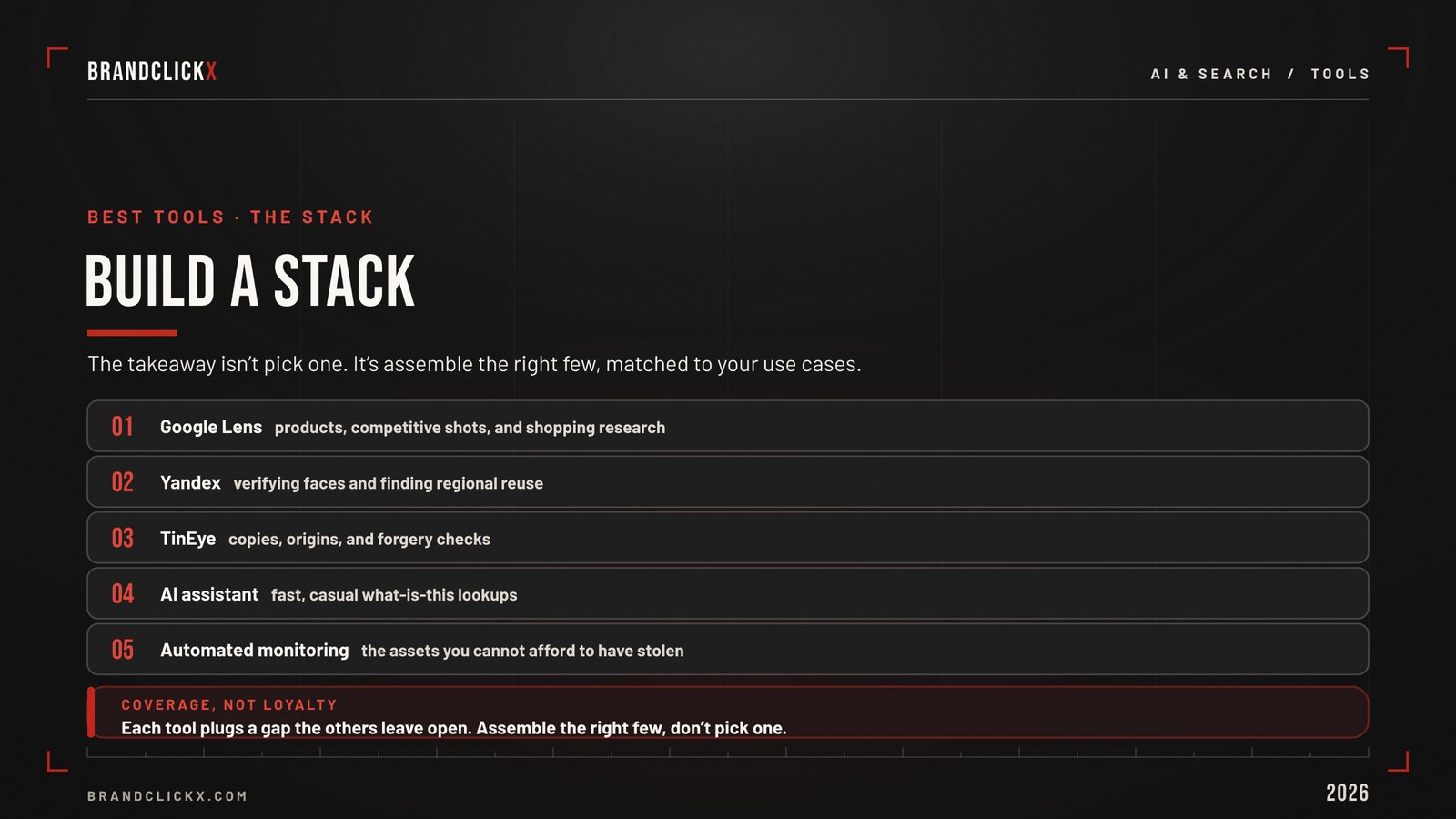
The takeaway is not “pick one.” It is “assemble the right few.”
A practical marketing stack looks like this.
Google Lens for products, competitive shots, and shopping research. Yandex for verifying faces and finding regional reuse. TinEye for copies, origins, and forgery checks. An AI assistant for fast, casual “what is this” lookups. Automated monitoring for the assets you cannot afford to have stolen.
If you are just getting started, our walkthrough on how to reverse image search covers the mechanics, and our mobile guide explains how to run all of this from your phone with reverse image search on iPhone. All of it connects back to the broader image search techniques that define visual SEO in 2026.
Expert insight: the goal is coverage, not loyalty. Each tool plugs a gap the others leave open.
Frequently Asked Questions
What is the best reverse image search tool?
There is no single best, because each leads a different job. Google Lens wins products and scale, Yandex wins faces, and TinEye wins exact copies and provenance. Use the right one for the task.
What is the best free reverse image search?
Google Lens, Yandex, Bing, and TinEye’s public search are all free. Google Lens is the best free all-rounder, Yandex the best free option for faces, and TinEye the best free option for exact copies.
Is there a reverse image search better than Google?
For specific jobs, yes. Yandex beats Google at faces, and TinEye beats it at finding exact and edited copies. Google still wins on index size and product identification.
What is the best reverse image search for faces?
Yandex is the strongest free engine for matching faces. Dedicated facial-recognition tools exist but carry serious privacy and legal weight and should only be used on public images and within the law.
Are there AI reverse image search tools?
Yes. AI-native engines like Lenso.ai run their own models for people, places, duplicates, and similar images. Multimodal assistants like Gemini and ChatGPT can also identify and describe objects in an uploaded image.
What reverse image tool do businesses use for IP protection?
Automated tools such as TinEye Alerts and MatchEngine, plus licensing platforms like Pixsy, detect unauthorized use of owned imagery at scale rather than relying on manual searches.
Key Takeaways for Executives
- Stop searching for one best tool. Match the engine to the job: products, faces, copies, or understanding.
- Run a stack. Google Lens, Yandex, TinEye, and an AI assistant cover nearly every legitimate need.
- Watch the AI-native shift. Engines that interpret images, not just match them, are changing the category fast.
- Govern face search. Treat facial-recognition tools as a policy decision, not a casual utility.
- Automate protection for key assets. Monitoring beats manual hunting for the images whose theft would actually cost you.
The Bottom Line
The best reverse image search tools in 2026 are not a ranked list. They are a toolkit, and fluency means knowing which to grab for products, faces, copies, or context, and when AI-native engines change the answer.
Brands that build the right stack catch theft, fraud, and fakes earlier, protect their creative, and understand the visual web the way their customers now experience it. The rest keep asking for one winner and keep getting beaten by teams that picked the right tool for the job.
Tracking exactly these shifts, where search, AI, commerce, and brand collide, is the work BrandClickX exists to do.