How the world’s most influential design systems quietly became the operating layer for machine-generated content and why 2026 is the year the bottleneck moved.
For most of the last decade, design systems were treated as a governance tool. A way to keep buttons consistent. A shared vocabulary between design and engineering. A pixel-level peace treaty.
That framing is now obsolete.
In 2026, the design system has become something far more strategic: the execution layer for AI-generated content and interfaces. When a model is asked to produce a landing page, a campaign variant, a localized product description, or an entire onboarding flow, it does not invent design from nothing. It assembles from a system. The quality, speed, and safety of that output is now bounded almost entirely by how machine-legible that system is.
The shift is measurable. Generative tooling can now draft marketing copy, layouts, and creative variations in seconds but enterprises consistently report that the assembly step, turning raw generation into on-brand, production-ready, accessible output, is where time and money still leak. The bottleneck didn’t disappear. It moved. It moved from creation to composition.
That is the story of this report. Across enterprise platforms, product-led companies, and open-source ecosystems, design system teams have spent the past 18 months re-architecting their systems for a new primary consumer: not a human designer in a Figma file, but a model generating at volume.
This is BrandClickX’s analysis of the 18 AI design systems and design-system upgrades that now define how on-brand content gets produced at scale, and what marketing and product leaders should take from each.
Why “AI Design Systems” Became a 2026 Priority
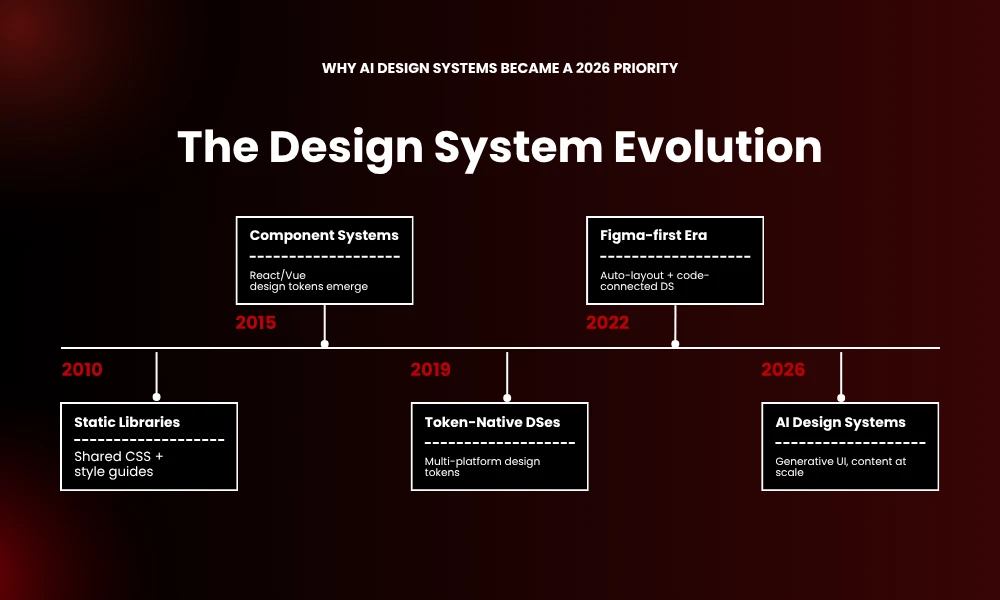
The phrase AI design systems is doing real work here, so it’s worth being precise.
It does not mean a design system that has a chatbot bolted onto its documentation site. It means a design system that has been structurally re-engineered so that generative models can read it, reason about it, and produce correct output from it without a human translator in the loop.
Three forces converged to make this urgent.
- Content volume outpaced human review. Marketing teams are now expected to ship dozens of localized, personalized, channel-specific variants of every asset. No headcount plan survives that demand. AI generation absorbs the volume but only a machine-readable system can absorb the consistency requirement that comes with it.
- Brand risk got sharper. A model that generates freely will eventually generate something off-brand, inaccessible, or legally exposed. A model that generates from a constrained system inherits that system’s guardrails. The design system became a risk-containment instrument.
- The interface itself became generative. The frontier is no longer just an AI-written copy inside a fixed template. It’s AI-assembled interfaces pages, flows, dashboards composed live from components. That only works if components carry enough semantic metadata for a model to choose correctly.
Why It Matters: In 2026, your design system is no longer a quality-control checkpoint. It is a content-production engine. If it can’t be read by a model, your AI strategy inherits a translation tax on every single asset.
What an “AI-Upgraded” Design System Actually Looks Like
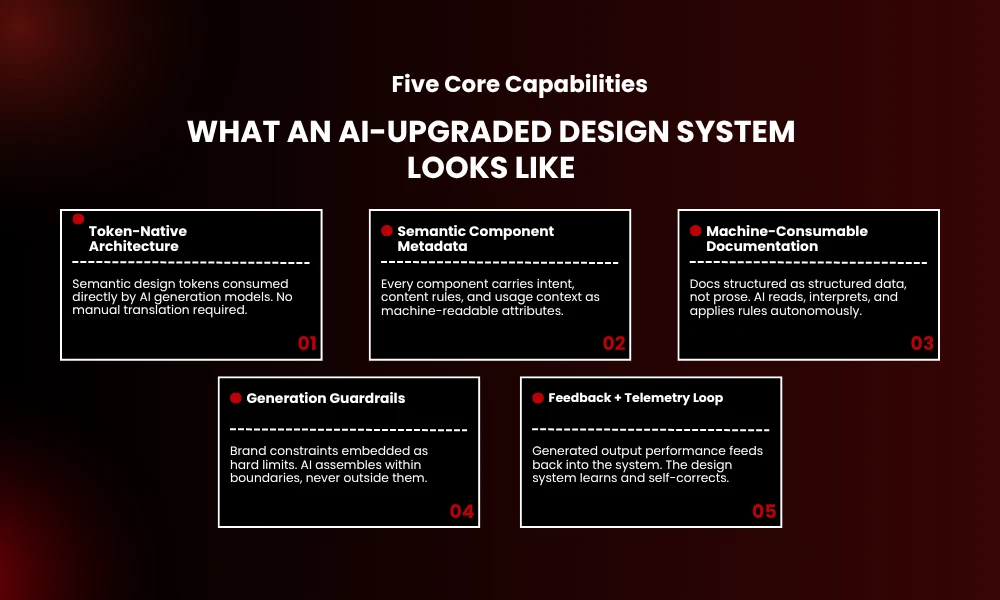
Before the list, a shared frame work because “AI-ready” is the most overused and least defined claim in the category right now.
Based on how the leading systems have evolved, an AI-upgraded design system tends to demonstrate five capabilities. We’ll use these as the evaluation lens throughout this report.
| Capability | What It Means | Why a Model Needs It |
| Token-native architecture | Color, type, spacing, motion expressed as structured, named design tokens not hard-coded values | A model can reason about “primary action” instead of guessing a hex code |
| Semantic component metadata | Each component carries machine-readable intent, usage rules, and constraints | The model picks the right component, not just a plausible one |
| Machine-consumable documentation | Guidelines available as structured data or via a query able interface, not only prose | The model can retrieve rules instead of hallucinating them |
| Generation guardrails | Explicit do/don’t logic, accessibility minimums, and content limits encoded into the system | Off-brand or non-compliant output is blocked at composition time |
| Feedback + telemetry loop | Usage data flows back to refine tokens, components, and prompts | The system improves as generation volume grows |
Hold those five against any vendor pitch. A design system that nails token architecture but has no semantic metadata will produce fast garbage. One with great guidelines locked in PDF prose gives a model nothing to retrieve.
The systems below were selected because they move the needle on at least three of the five and several are quietly redefining what’s possible on all five.
The 18 Design Systems Defining AI Content Generation at Scale
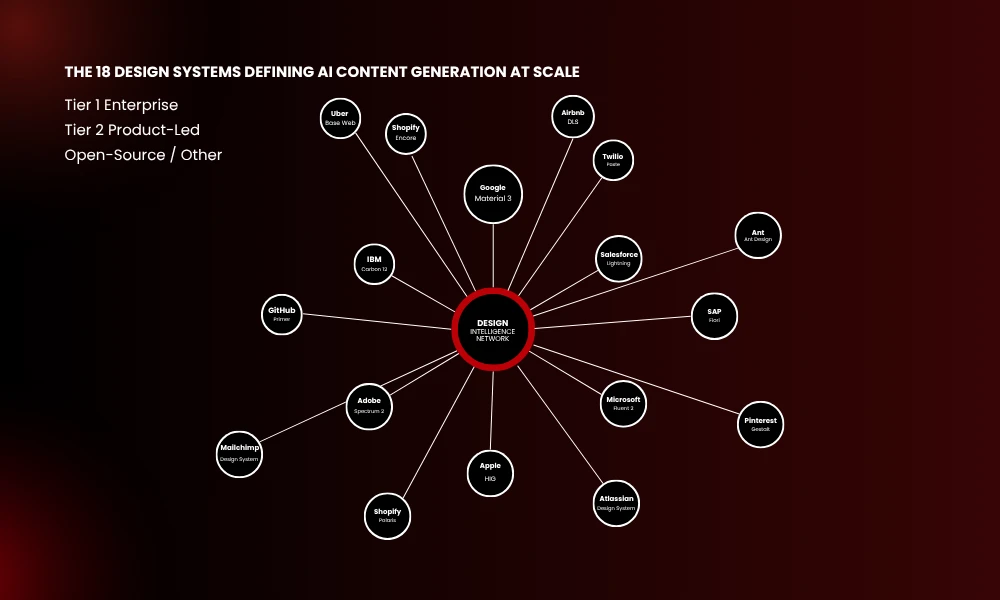
We’ve grouped these into three tiers that reflect how the market actually behaves: the enterprise platforms that set the standards, the product-led systems punching above their weight, and the open ecosystems quietly doing the most experimental work.
Tier 1: The Enterprise Standard-Setters
These are the systems whose decisions ripple outward. When they adopt a pattern, the rest of the industry treats it as a default.
1. Google Material Design
Material Design remains the most consequential design system on earth simply by reach it underpins an enormous share of the world’s app interfaces. Its evolution toward expressive, dynamically themed design made it inherently token-forward: color and type already behave as systematic, generatable variables rather than fixed assets.
For AI content generation, that matters because Material’s theming model is built around relationships between values, not the values themselves. A model can shift an entire palette by reasoning about one seed input. Why it matters: Material proved at scale that a design system can be dynamic and consistent at the same time the precondition for generation.
2. Microsoft Fluent
Fluent‘s strength is breadth. It spans web, native, productivity surfaces, and increasingly AI-assistant interfaces across one of the largest product portfolios in software. That cross-platform discipline forced Fluent into rigorous token and component abstraction early.
The strategic read: Microsoft has more incentive than almost anyone to make interfaces composable by AI, given how deeply generative assistants are woven into its products. Fluent is the design substrate underneath that ambition.
3. Apple Human Interface Guidelines
Apple’s Human Interface Guidelines is the outlier famously prose-driven, principle-led, and not packaged as a developer token library in the way most enterprise systems are. Yet it belongs on this list precisely because of its influence on expectations. The HIG defines what “correct” feels like for a generation of users.
Expert Insight: The HIG is a useful warning. A design system can be world-class for humans and still be hard for a model to consume. Beautiful prose guidelines are an asset for designers and a liability for generation pipelines. The lesson for every brand: document for both audiences, or accept a translation tax.
4. Adobe Spectrum
Spectrum sits at an unusually strategic intersection it’s the design system for the company that builds the creative tools where much AI generation now happens. That gives Adobe a structural advantage: its design system and its generative content tooling can evolve in lockstep.
Spectrum’s investment in tokens and platform-spanning components makes it a strong reference model for any organization trying to connect a design system directly to creative generation.
5. IBM Carbon
Carbon is, arguably, the most disciplined open enterprise design system in existence. It is rigorously tokenized, exhaustively documented, accessibility-serious, and open source which means its decisions are visible and copyable industry-wide.
For AI content generation, Carbon’s value is its structural honesty: the rules are explicit, versioned, and consistent. That is exactly the environment in which a model performs predictably. Why it matters: Carbon shows that “enterprise-grade” and “machine-legible” are the same engineering investment.
6. Salesforce Lightning Design System
Lightning governs interfaces across one of the largest enterprise software footprints in the world. Its job is consistency across thousands of customizations and admin-built screens a governance problem almost identical to the AI-generation problem. Notably, the very concept of “design tokens” traces back to the Salesforce design system team.
Salesforce’s broader push into AI-assisted workflows makes Lightning a system to watch closely: it has both the scale and the commercial motivation to make component assembly model-driven.
7. SAP Fiori
Fiori brings the enterprise-process lens. It is built to keep complex business applications coherent across an immense surface area. That makes it a useful study in constraint encoding. Fiori has long had to express not just visual rules but workflow logic.
For AI generation, encoded constraints are gold. A system that already knows which patterns are valid in context gives a model meaningfully more to work with than one that only knows what things look like.
Tier 2: The Product-Led Systems Punching Above Their Weight
These systems come from product companies, not platform giants. They tend to move faster, document more sharply, and are often the first to ship genuinely new ideas.
8. Atlassian Design System
The Atlassian Design System is one of the most thoughtfully structured in the industry, with a strong content-design discipline baked invoice, tone, and microcopy treated as first-class system citizens, not afterthoughts.
That content-design maturity is the underrated asset. AI content generation is not only a layout problem; it’s a language problem. Atlassian’s system gives a model rules for how the product should sound, which is exactly the metadata most systems lack.
9. Shopify Polaris
Polaris governs the experience that millions of merchants build on. Its standout contribution to the AI conversation is its explicit, well-developed content guidelines Polaris treats writing as systematized design.
Why It Matters: Commerce is a high-volume content environment by nature endless product pages, notifications, and merchant communications. Polaris is a model for how to make that volume both fast and consistent, because it systematized the words, not just the widgets.
10. GitHub Primer
Primer is engineering-led to its core, which gives it a particular strength: it is built by people who think in APIs. Components are treated as interfaces with clear contracts.
That mindset translates directly to AI consumption. A component designed with a clean, well-typed API is, almost by accident, a component a model can use correctly. Primer is a case study in how engineering rigor produces machine-legibility as a side effect.
11. Spotify Encore
Spotify’s Encore is notable for being a system of systems a framework that lets multiple Spotify product surfaces share a brand spine while retaining their own expression.
That federated model is increasingly relevant. Large organizations rarely have one design system; they have many. Encore’s approach to coherence-without-uniformity is a preview of how multi-brand companies will need to structure AI generation: shared tokens at the core, expressive freedom at the edge.
12. Twilio Paste
Paste is one of the most quietly excellent systems in the industry deeply tokenized, accessibility-first, and built with a clarity that makes its rules unusually explicit.
Paste’s accessibility seriousness is the AI-relevant signal. When accessibility minimums are encoded rather than recommended, they become guardrails a generation pipeline inherits automatically. Tactical takeaway: systems that encode accessibility don’t just protect users they protect AI output.
13. Pinterest Gestalt
Gestalt is a visually expressive system from a company whose entire product is visual content at massive scale. That gives Pinterest unusual fluency in the problem of generating visual layouts that stay on-brand.
Gestalt’s relevance is its comfort with visual density and variety; it’s a system built to handle enormous content volume without collapsing into sameness, which is precisely the failure mode of naive AI generation.
14. Workday Canvas
Canvas governs complex enterprise HR and finance interfaces, a domain where errors are expensive and consistency is non-negotiable. Its strength is predictability: Canvas is built so that interfaces behave the same way everywhere.
That predictability is what makes a system safe to hand to a model. The more deterministic the system, the lower the variance in generated output.
15. Mailchimp / Intuit Design Language
Mailchimp’s design language and its widely-cited Content Style Guide has always been brand-forward and content-rich, and its place inside Intuit connects it to a broader enterprise design ecosystem. Its contribution to this conversation is brand personality as system.
Most design systems can keep a model on-grid. Far fewer can keep it on-voice. Mailchimp’s tradition of encoding personality warmth, humor, and clarity into its guidelines is a template for the next frontier: design systems that govern tone, not just type.
Tier 3: The Open Ecosystems Doing the Experimental Work
Open-source and public-sector systems are often the most instructive, because their decisions are fully visible and because their constraints force clarity.
16. Ant Design
Ant Design is one of the most widely adopted open-source systems in the world, especially across data-heavy and enterprise web applications. Its scale of real-world usage makes it a vast, public dataset of component patterns.
That ubiquity is itself an AI advantage: models trained on or retrieving from widely-used systems perform better on them. Ant Design’s reach makes it a kind of lingua franca for generated web interfaces.
17. US Web Design System (USWDS)
The U.S. Web Design System governs a huge surface of public-sector digital services. Its defining commitment is accessibility and plain-language clarity non-negotiable, legally reinforced, and exhaustively documented.
Why It Matters: USWDS is proof that constraint produces machine-legibility. Because every rule must be explicit and defensible, the system is unusually structured and unambiguousan ideal environment for predictable generation. The public sector accidentally built one of the most AI-ready documentation models in existence.
18. The W3C Design Tokens Standard
The eighteenth entry is not a single company’s system it’s the connective tissue beneath all of them. The Design Tokens Community Group, a W3C community group, reached its first stable specification (version 2025.10) in October 2025 a vendor-neutral, production-ready format for sharing design decisions across tools and platforms. It is arguably the single most important AI-design-system development of the period.
Here’s why it’s the keystone. A model that learns to consume one standardized token format can, in principle, consume every design system that adopts it. Interoperability turns 17 separate systems into one addressable ecosystem. The token standard is what makes “AI design systems” a category rather than a collection of isolated upgrades.
Comparison: How the Tiers Differ for AI Generation
| Dimension | Tier 1: Enterprise | Tier 2: Product-Led | Tier 3: Open Ecosystems |
| Primary strength | Scale and influence | Speed and content discipline | Transparency and interoperability |
| Token maturity | High | High | Very high (standard-driven) |
| Content/voice rules | Variable | Strong | Variable |
| Best AI use case | Multi-product consistency | On-brand campaign variants | Interoperable, portable generation |
| Key risk | Prose-heavy legacy docs | Smaller component coverage | Less brand expressiveness |
| Watch for | AI-assistant integration | Tone-as-system maturity | Standard adoption velocity |
The pattern worth noticing: no single tier wins. Enterprise systems have reach but often carry prose-documentation debt. Product-led systems have the sharpest content discipline. Open ecosystems have the cleanest interoperability story. The organizations getting AI content generation right are borrowing from all three.
The Bigger Shift: From Design System to Content Operating System
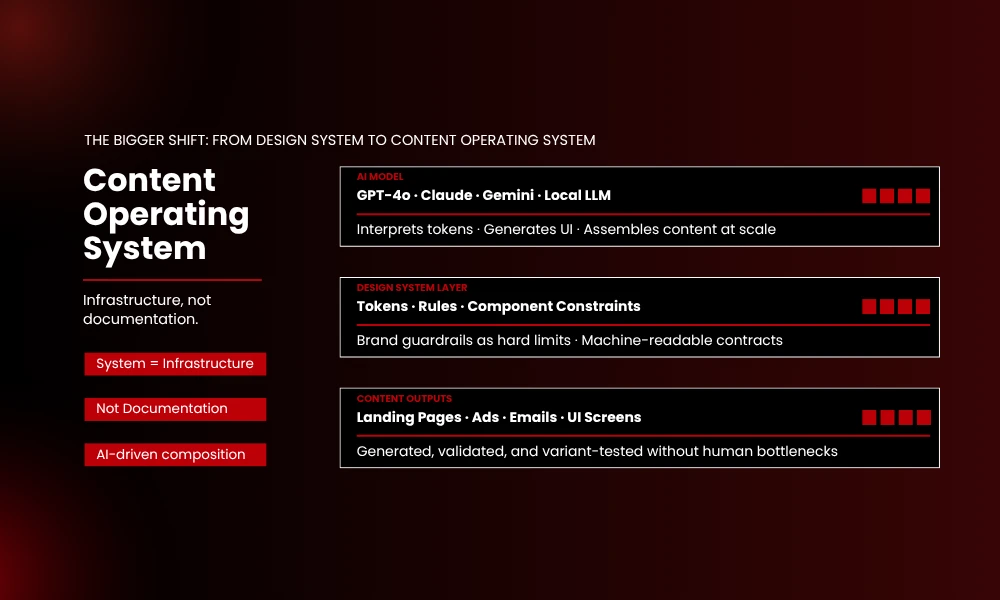
Step back, and a larger pattern emerges across all 18.
The design system is being promoted. It used to sit beside the content pipeline as a reference. It now sits inside it as infrastructure. Every AI-generated asset every page, email, ad variant, localized string flows through the system as a constraint layer.
This reframes the org chart. When the design system is a content operating system, three things change:
- Design-system teams become content-infrastructure teams. Their work directly governs marketing output volume and quality, not just product UI.
- Brand governance becomes code. Voice, accessibility, and visual rules stop being guidelines people are asked to follow and become constraints the generation pipeline cannot violate.
- The component library becomes a competitive asset. Two companies with the same AI models will produce dramatically different output quality based entirely on the system feeding those models.
Industry Impact: The competitive gap in AI marketing is narrowing on the model side everyone has access to strong generation. The gap is widening on the system side. The brands that invested in machine-legible design systems are now compounding that advantage on every asset they ship.
A Framework: The AI Design System Readiness Audit
For marketing and product leaders who want a concrete next step, here is a five-stage maturity model BrandClickX uses to assess where an organization actually stands. Most enterprises in 2026 sit at Stage 2 or 3and assume they’re at 4.
Stage 1 Documented. A design system exists, primarily as human-readable guidelines. AI tools can’t consume it directly. Generation requires manual translation.
Stage 2 Tokenized. Core visual decisions are expressed as structured tokens. Generated output can at least inherit correct color, type, and spacing.
Stage 3 Semantic. Components carry machine-readable metadata about intent and usage. A model can select the right component, not just a valid-looking one.
Stage 4 Guarded. Accessibility, brand voice, and content constraints are encoded as enforceable rules. Off-brand or non-compliant generation is blocked at composition.
Stage 5 Adaptive. Usage telemetry feeds back into the system. Tokens, components, and generation prompts improve continuously from real output data.
Tactical takeaway: Don’t aim to leap from Stage 1 to Stage 5. The highest-ROI move for most teams is the jump from Stage 2 to Stage 3 adding semantic metadata. That is the single change that most improves the correctness of AI-generated content, and it’s achievable without rebuilding the system.
What Happens Next: Three Predictions for the Next 18 Months
- The token standard becomes table stakes. With the W3C design token specification now stable, interoperable token formats will move from “best practice” to “expected.” Design systems that don’t adopt a shared standard will find themselves harder for AI tooling to consume and quietly less valuable as a result.
- Voice and tone get systematized. The next major upgrade across these 18 systems will not be visual. It will be linguistic. Expect “content tokens” and structured voice metadata to become as common as color tokens because AI content generation lives or dies on tone, and most systems still leave tone undocumented.
- The design system becomes a query able service. The leading systems will stop being static documentation sites and become live, query able interfaces that generation tools call in real time retrieving current rules, valid components, and brand constraints on demand rather than relying on a model’s training memory.
Expert Insight: The teams that win the next phase won’t be the ones with the most AI tools. They’ll be the ones whose design system answers a model’s questions clearly. In an AI content pipeline, an ambiguous design system is a defect and an unambiguous one is a moat.
Key Takeaways
- The bottleneck moved from creation to composition. AI can generate fast; the constraint is now assembling that output into on-brand, production-ready form. The design system is where that happens.
- “AI-ready” has a real definition. Token-native architecture, semantic metadata, machine-consumable docs, encoded guardrails, and a telemetry loop. Demand all five.
- The best systems span all three tiers’ strengths. Enterprise reach, product-led content discipline, open-ecosystem interoperability leading teams borrow from each.
- Interoperable token standards are the keystone. The W3C design token spec turns isolated system upgrades into a connected, AI-addressable ecosystem.
- The highest-ROI move is adding semantic metadata. The Stage 2-to-3 jump improves AI output correctness more than any other single investment.
- Voice is the next frontier. Systems that govern tone, not just type, will define the next wave of AI content quality.
Frequently Asked Questions
What is an AI design system?
An AI design system is a design system that has been structurally re-engineered so generative models can read and produce correct output from it directly through structured tokens, semantic component metadata, machine-consumable documentation, and encoded guardrails. It is distinct from a conventional design system, which is optimized for human designers and typically requires manual translation before AI tooling can use it.
Do AI design systems replace human designers?
No. They change the work. Human designers shift from producing every asset by hand to defining the system, the constraints, and the intent that generation operates within. The design-system role becomes more strategic closer to content infrastructure than to pixel production.
How is an AI design system different from an AI content tool?
A content tool generates. A design system constrains and composes. The tool produces raw material; the system ensures that material is on-brand, accessible, and production-ready. The strongest AI content workflows pair both generation feeding into a machine-legible system.
Why do design tokens matter so much for AI generation?
Tokens express design decisions as structured, named variables a model can reason about”primary action” instead of an arbitrary hex code. Standardized, interoperable token formats like the W3C Design Tokens specification let a model consume many design systems through one shared structure, which is what makes scaled, portable AI content generation viable.
Which design system is best for AI content generation?
There is no single winner. Enterprise systems offer reach, product-led systems offer content discipline, and open ecosystems offer interoperability. The right choice depends on your stack and brand needs and the leading teams adopt patterns from all three rather than committing to one.
How do we know if our design system is AI-ready?
Run a readiness audit against the five-stage maturity model: Documented, Tokenized, Semantic, Guarded, Adaptive. Most organizations sit at Stage 2 or 3. The most valuable next step is usually adding the semantic component metadata that defines Stage 3.
The Strategic Conclusion
For ten years, the design system was treated as a cost center with a quality-control mission important, but supporting.
That era is over.
In 2026, the design system is the layer where AI ambition meets brand reality. It is the difference between generation that scales your brand and generation that erodes it. Every one of the 18 systems in this report is, in its own way, an answer to the same question: how do you produce content at machine speed without losing the things that made the brand worth scaling?
The answer is structural. It is not a better prompt or a newer model. It is a system clear enough, tokenized enough, and constrained enough that a machine can build inside it without supervision and a brand can trust the result.
The organizations treating their design system as content infrastructure are pulling ahead. The ones still treating it as a style guide are about to discover that their AI strategy was bottle necked all along and that the bottleneck had their own logo on it.
BrandClickX tracks the systems, platforms, and structural shifts reshaping how modern brands produce and distribute content. As a marketing intelligence platform, our analysis is built for the leaders deciding where to invest as AI moves from novelty to infrastructure. For more on the architecture of AI-driven marketing from design systems to generative SEO to performance creative explore the BrandClickX intelligence library.