

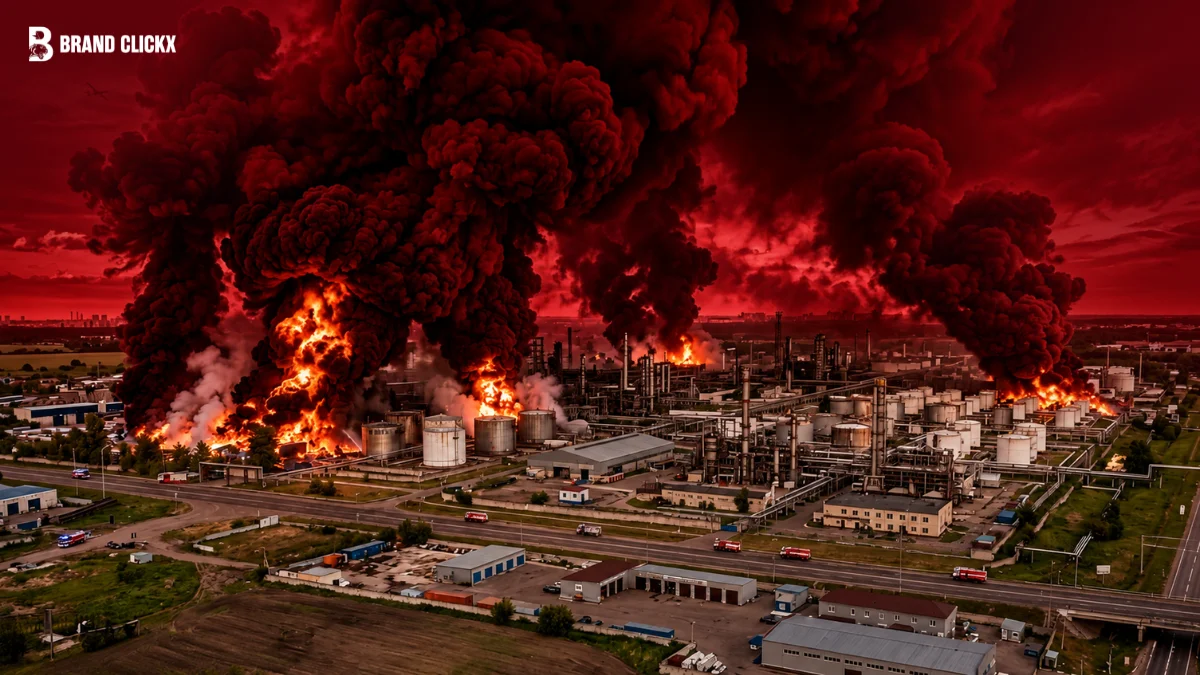
Kyiv was struck overnight as Ukraine reported drone strikes on refineries in Bashkortostan, Yaroslavl and Krasnodar, and naval drone attacks on 12 shadow-fleet vessels. Ukraine now expects agricultural exports to fall by more than half.
Active conflict reporting. Claims from both sides are difficult to verify independently. Damage assessments, casualty figures and interception counts are attributed to the party that issued them. Figures change rapidly.
Summary
Russia and Ukraine exchanged large-scale overnight attacks, with Kyiv struck by missiles and drones while Ukrainian forces targeted Russian oil refineries and shadow-fleet vessels. Ukraine reported strikes on refineries in Bashkortostan, Yaroslavl and Krasnodar, and said naval drones hit 12 vessels between 1 and 8 August. Ukraine now expects agricultural exports to fall to 29.6 million tonnes, from an earlier estimate of 64.4 million.
Key Takeaways
- Ukraine reported strikes on refineries in Bashkortostan, Yaroslavl, Krasnodar and possibly Samara
- The Bashneft-Novoil strike was more than 1,300km from the front line
- Slavneft-YANOS is among Russia’s five largest refineries, at 15 million tonnes annual capacity
- Five people were injured at the Ilsky refinery in Krasnodar, per regional authorities
- Russia reported intercepting 397 drones overnight and 83 on Saturday morning
- Ukraine said naval drones struck 12 shadow-fleet vessels between 1 and 8 August
- A Russian strike on Kyiv on 5 August killed 17 people
- Ukraine’s air defences are described as depleted and struggling
- Ukraine expects agricultural exports to fall to 29.6 million tonnes from 64.4 million
What Ukraine Says It Struck
President Volodymyr Zelenskyy described the operations as “long-range sanctions” Ukraine’s own framing for strikes on Russian energy revenue.
His statement: “Today, our long-range sanctions once again worked to limit Russia’s oil revenues, which it uses to finance the war and the killing of Ukrainians.”
| Target | Location | Distance | Reported damage |
| Bashneft-Novoil | Bashkortostan | 1,300+ km from the front line | Combined processing unit and L-35-11/1000 catalytic reforming unit, per Ukraine’s General Staff |
| Slavneft-YANOS | Yaroslavl | ~700 km from the border | Oil storage tanks on fire, per the regional governor |
| Ilsky refinery | Krasnodar | — | Fire from drone debris; five people injured, per regional authorities |
| Unidentified facility | Samara | — | Footage appeared to show fire near the Syzran refinery; not confirmed by Russian authorities |
The Bashkortostan strike is the notable one. At more than 1,300 kilometres — roughly 810 miles — from the front line, it demonstrates a reach that puts a large share of Russian refining capacity within range.
Slavneft-YANOS is the most economically significant. It is one of Russia’s five largest refineries, with annual crude capacity of about 15 million metric tons, and the largest in the country’s central region. It was struck four separate times in May 2026 alone.
Yaroslavl Governor Mikhail Yevrayev confirmed the attack and reported traffic restrictions on roads toward Moscow. The Kyiv Independent noted it could not independently verify the damage.
What Russia Says It Intercepted
Russia’s Defence Ministry reported intercepting 397 Ukrainian drones overnight and a further 83 on Saturday morning. A separate figure of 605 drones intercepted over Russian territory has also been reported.
Those figures cannot be independently verified, and interception claims from both sides in this war have consistently exceeded what can be confirmed.
The Attack on Kyiv
Kyiv was struck by missiles and drones in the same overnight exchange.
This follows a Russian ballistic missile and drone attack on Wednesday 5 August that killed 17 people in Kyiv and the surrounding area. The Kyiv region observed an official day of mourning the following day.
The critical detail is the defensive position. Reporting from the Associated Press describes Ukraine’s air defences as depleted and struggling to counter Russian barrages, prompting what it called an increasingly urgent scramble by Ukraine and its allies to find new air defence supplies.
That asymmetry defines the current phase. Ukraine’s offensive reach is expanding while its defensive capacity is contracting.
The Shadow Fleet Campaign
Ukraine said naval drones struck 12 vessels linked to Russia’s shadow fleet in the Black Sea and Sea of Azov between 1 and 8 August. The ships were not identified.
Ukrainian forces also reported attacking two Russian military patrol boats.
The shadow fleet refers to vessels, largely ageing tankers with opaque ownership, used to move Russian oil outside the reach of international sanctions. Ukraine has targeted them since at least November 2025, when it claimed responsibility for striking the tankers Kairos and Virat using Sea Baby naval drones.
Royal Navy officer Tom Sharpe has assessed the broader campaign against these tankers as likely conducted by Ukrainian special operations forces using limpet mines — describing it as unconventional warfare that damages the infrastructure supporting Russian oil revenue without escalating into direct conflict with the West.
The Cost Ukraine Is Paying
This is the part that receives the least attention, and it may be the most consequential.
Ukraine now expects agricultural exports to fall to 29.6 million tonnes in the 2026-27 marketing year, against an earlier estimate of 64.4 million tonnes.
That is a decline of roughly 54%. Wheat shipments alone are projected to fall 53%.
The mechanism is the widening maritime conflict. Ukraine’s strikes on shadow-fleet vessels and Russian naval assets, and Russia’s responses, have disrupted the Black Sea routes that carry both countries’ exports.
Ukraine is a major supplier of wheat, maize and sunflower oil to global markets, with much of it going to import-dependent countries in North Africa, the Middle East and Asia. A halving of its exports is not only a Ukrainian economic problem.
It also complicates the strategic logic. Ukraine is attacking the maritime infrastructure Russia uses to earn oil revenue, in a body of water Ukraine depends on to earn agricultural revenue.
Why Refineries Rather Than Oil Fields
Refining is the bottleneck, and it is the pressure point Ukraine has chosen.
Russia’s crude production is dispersed across vast territory and difficult to disable. Its refining capacity is concentrated in large, fixed, identifiable industrial facilities and refined fuel is what the Russian military and economy actually consume.
Reporting indicates repeated strikes have caused fuel shortages inside Russia, and that the campaign has led many refineries to suspend or halt production.
The targets have also been hit repeatedly rather than once. Ilsky has been attacked several times. Slavneft-YANOS was hit four times in May alone. That pattern suggests a strategy of preventing repair and restoration rather than achieving single-strike destruction.
Frequently Asked Questions
What did Ukraine target?
Oil refineries in Bashkortostan, Yaroslavl and Krasnodar, an industrial facility in Samara, two Russian military patrol boats, and 12 vessels linked to Russia’s shadow fleet in the Black Sea and Sea of Azov.
How far were the strikes from the front line?
The Bashneft-Novoil refinery in Bashkortostan is more than 1,300 kilometres about 810 miles from the front line. The Slavneft-YANOS refinery in Yaroslavl is roughly 700 kilometres from the Ukrainian border.
What is the Russian shadow fleet?
A collection of vessels, largely ageing tankers with opaque ownership structures, used to transport Russian oil in ways that circumvent international sanctions. Ukraine has targeted these ships since at least November 2025.
Why does Ukraine target refineries rather than oil fields?
Refining capacity is concentrated in large fixed facilities that are easier to identify and disable than dispersed production, and refined fuel is what Russia’s military and economy consume directly.
How badly is Ukraine’s own economy affected?
Ukraine now expects agricultural exports to fall to 29.6 million tonnes in the 2026-27 marketing year, from an earlier estimate of 64.4 million, with wheat shipments projected to decline 53% as maritime routes are disrupted.
What happened in Kyiv?
Kyiv was struck by missiles and drones in the latest overnight exchange. A separate Russian ballistic missile and drone attack on 5 August killed 17 people in Kyiv and the surrounding region.
Can these claims be verified?
Largely not. Damage assessments, casualty figures and drone interception counts come from the parties involved. The Kyiv Independent stated it could not independently verify damage to the refineries.
What are Ukraine’s “long-range sanctions”?
Zelenskyy’s term for strikes on Russian energy infrastructure, framing them as an economic instrument aimed at reducing the oil revenues funding Russia’s war rather than as conventional military targeting.
Conclusion
The strike on Bashkortostan puts Russian refining capacity 1,300 kilometres from the front line within Ukrainian reach, and the shadow-fleet campaign extends that pressure to the vessels moving the oil that survives.
But the same maritime conflict that makes those strikes possible has cut Ukraine’s own agricultural exports by more than half. A country that fed a substantial share of the world’s wheat importers is now projecting 29.6 million tonnes where it once projected 64.4 million.
And while Ukraine’s reach grows, its air defences are described as depleted. Seventeen people died in Kyiv on Wednesday. That is the arithmetic of the current phase: expanding offensive capability alongside contracting ability to defend against the response.