
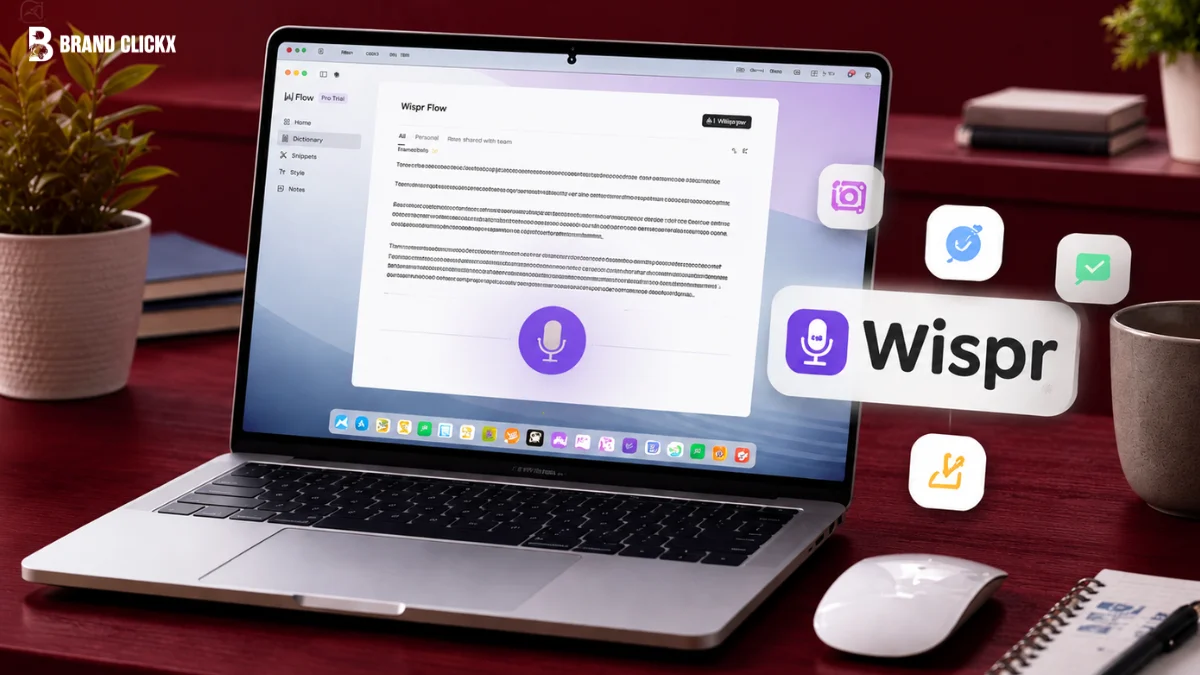
The dictation startup shipped a Granola-style notetaker for Mac at 12:10am PT. It was discovered days earlier in a Terms of Service update, and the terms are worth reading before you switch it on.
Published: Wednesday, 5 August 2026 | BrandClickX News Desk
Summary
Wispr Flow, the AI dictation startup, officially launched a meeting notetaker for Mac on 5 August 2026. It uses system audio to transcribe meetings without joining them as a visible participant, similar to Granola. The feature was first identified days earlier in updated Terms of Service, which describe processing of meeting audio, participant information, speaker labels and metadata.
Key Takeaways
- Wispr Flow launched its meeting notetaker for Mac on 5 August 2026
- It uses system audio and does not join meetings as a visible bot
- The feature was discovered days earlier in updated Terms of Service
- Terms cover meeting audio, participant information, metadata and speaker labels
- Outputs include transcripts, summaries, action items and speaker attribution
- It competes with Granola, Fireflies, Read AI, Otter and Fathom
- Wispr Flow has raised over $81 million at a $700 million valuation
- Bloomberg reported talks that could raise that to around $2 billion
- Undisclosed recording carries legal obligations that vary by jurisdiction
What Launched
A notetaker for Mac that captures meetings without appearing in the participant list.
TechCrunch confirmed the launch in an update timestamped 12:10am PT on 5 August. The mechanism is the notable part: it uses system audio to transcribe a meeting rather than joining it as a bot.
| Detail | |
| Platform | Mac |
| Method | System audio capture, no meeting bot |
| Outputs | Transcripts, summaries, action items, meeting insights, speaker attribution |
| Comparable to | Granola |
| Competitors | Granola, Fireflies, Read AI, Otter, Fathom |
It Was Found in the Terms of Service First
Days before the launch, updated legal documents gave it away.
Wispr Flow emailed customers about changes to both its Terms of Service and privacy policy. TechCrunch examined the revised documents and found new sections covering meeting data and a notetaker service.
The relevant passage:
“For Notetaker, Input may also include Meeting Data, including meeting audio, participant information, meeting metadata, speaker labels, meeting transcripts, and other information processed in connection with a meeting. Output may include AI-generated meeting transcripts, summaries, action items, meeting insights, speaker attribution, and other meeting-related content.”
That is worth reading twice. The inputs cover not just what you say, but who else was present, what the meeting’s metadata contained, and which speaker said what.
The Part That Deserves Real Attention
A notetaker that does not appear in the participant list is convenient for the user and invisible to everyone else on the call.
Bot-free capture is a genuine product advantage. Visible notetaker bots are awkward on client calls and are blocked outright by many corporate IT policies. Capturing system audio sidesteps both problems.
It also means the other participants may have no indication the meeting is being recorded.
This matters legally. Recording consent laws vary considerably:
- Some US states require all-party consent, others only one party
- The EU and UK apply data protection obligations to recording identifiable individuals
- Many employers have policies governing meeting recording independently of law
A tool that makes undisclosed recording frictionless does not change any of those obligations. It shifts responsibility entirely onto the user, who may not realise they have taken it on.
The practical advice: tell people you are recording. It is the legal requirement in many places, the ethical position everywhere, and it costs one sentence at the start of a call.
Who Wispr Flow Is
The company is known for dictation — converting speech into text with cleanup, positioned as faster than typing.
| Metric | Figure |
| Total funding raised | More than $81 million |
| Valuation, latest completed round | $700 million |
| Reported target valuation | Up to $2 billion |
Bloomberg reported in May that the startup was negotiating a round that could raise its valuation to roughly $2 billion.
Co-founder Tanay Kothari has said in interviews that the company intends to build a broader AI assistant. The notetaker is the clearest evidence yet of that direction — moving from correcting dictated text toward capturing and structuring meetings.
The Competitive Picture
Wispr Flow enters a crowded and well-established category.
Granola is the closest comparison, since it pioneered the bot-free approach. Fireflies, Otter, Read AI and Fathom all occupy adjacent positions with differing emphases on CRM integration, search and enterprise deployment.
Wispr Flow’s differentiator is the starting point rather than the feature. Its users already have the app installed for dictation. Adding meeting capture to an existing habit is a lower barrier than persuading someone to adopt a new tool, and it means one app covers both “write this for me” and “record that for me.”
Whether transcription quality and summarisation match incumbents that have spent years on the problem is unknown. Nobody has published independent comparisons yet.
A Note on Sources
Several versions of this story circulating today should not be trusted.
At least one widely syndicated version is a machine-translated rewrite of TechCrunch’s reporting, rendering the company name as “Wispr Movement,” the notetaker as a “gathering notetaker,” and meeting data as “Assembly Information.” It is scraped content, not journalism.
Separately, several “best AI notetaker” rankings currently surfacing are published by vendors in the same category, ranking their own product first. That is marketing.
The original reporting here is TechCrunch’s, based on the company’s own updated legal documents.
Timeline
| Date | Development |
| May 2026 | Bloomberg reports funding talks at a potential $2bn valuation |
| Early August 2026 | Wispr Flow emails customers about ToS and privacy policy changes |
| 3 August 2026 | TechCrunch identifies notetaker provisions in the updated terms |
| 5 August 2026, 12:10am PT | Notetaker officially launches for Mac |
Expert Analysis
The product logic is sound. The disclosure pattern is the interesting part.
Launching a meeting recorder is a meaningful expansion for a dictation company different data, different privacy obligations, different competitive set. Doing it required rewriting the terms of service, which is how it became public before the company announced it.
That is increasingly common. Legal documents are now a reliable leading indicator of product plans, because they must be updated before a feature ships and they are public by necessity.
On the category: bot-free capture is winning because visible bots create social friction and trip IT policies. But the reason bots exist is that they announce themselves. Removing the announcement removes the friction and the disclosure at the same time.
That is not a criticism of Wispr Flow specifically — Granola established the pattern and the whole category is moving this way. It does mean the responsibility that used to sit with a visible bot icon now sits entirely with the person running the software.
What remains unknown: pricing, whether the feature is included in existing plans, Windows availability, data retention periods, and whether meeting data is used for model training. The terms describe what may be processed rather than what is retained or for how long.
Frequently Asked Questions
What did Wispr Flow launch?
A meeting notetaker for Mac, launched on 5 August 2026. It transcribes meetings using system audio without joining as a visible participant, generating summaries, action items and speaker attribution.
How is it different from a normal notetaker bot?
Most notetakers join a call as a visible participant that everyone can see. Wispr Flow’s captures system audio instead, so it does not appear in the participant list the same approach Granola uses.
How was it discovered before launch?
TechCrunch examined Wispr Flow’s updated Terms of Service and privacy policy, which the company emailed to customers, and found new sections describing meeting data processing and a notetaker service.
What data does it process?
According to the terms, meeting audio, participant information, meeting metadata, speaker labels, meeting transcripts and other meeting-related information. Outputs include transcripts, summaries, action items and insights.
Do I need to tell people I am recording?
In many jurisdictions, yes. Some US states require all-party consent, and EU and UK data protection rules apply to recording identifiable individuals. Many employers also have their own policies. Announcing it is the safe course.
Which platforms does it support?
Mac at launch. Wispr Flow has not announced Windows or mobile availability for the notetaker feature.
What does it cost?
Pricing has not been detailed in reporting, including whether the notetaker is included in existing subscription tiers or charged separately.
Who else makes AI notetakers?
Granola, Fireflies, Read AI, Otter and Fathom are among the established competitors. Granola is the closest comparison, having popularised the bot-free system audio approach.
Conclusion
A dictation company shipping a meeting recorder is a logical step, and doing it invisibly is what the market currently rewards.
The terms of service are the part worth reading. They describe processing meeting audio, participant information and speaker labels data belonging to people who are not Wispr Flow customers and did not agree to anything.
That is not unique to this product. It is the shape of the whole category now, and the only safeguard left is the person who presses record saying so out loud.