
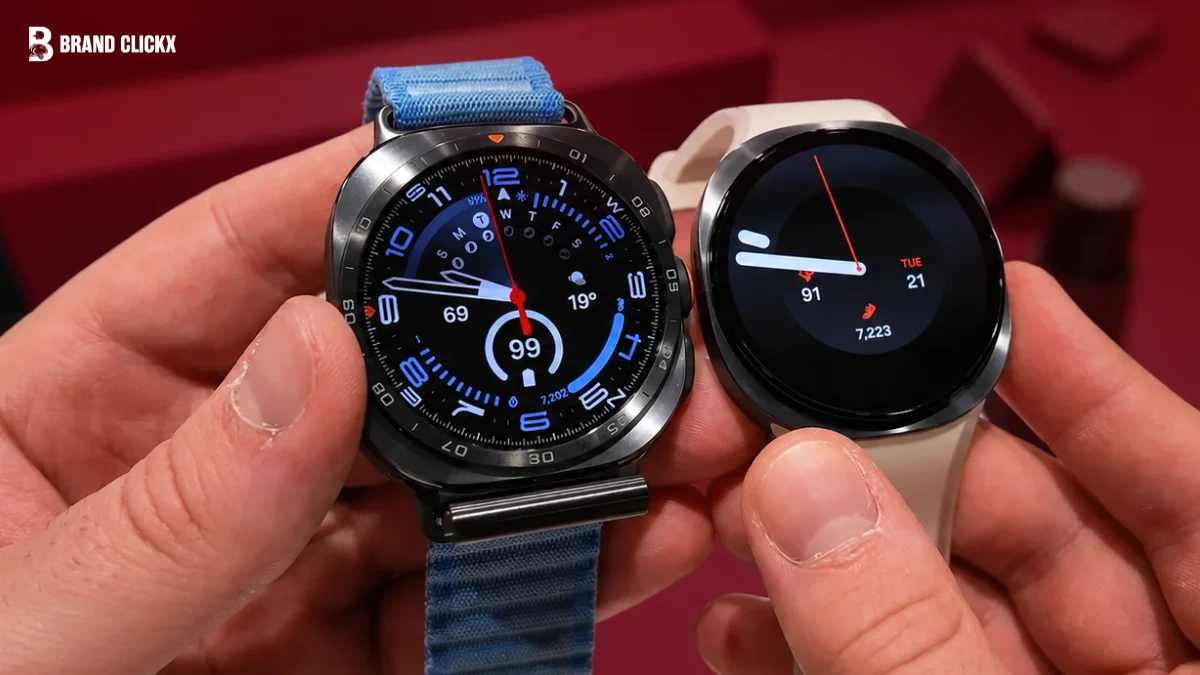
The Watch 9 goes on sale Friday at $380. Reviewers who tested it call it near-identical to last year’s model with underwhelming battery. The strongest alternative may be the watch it replaces.
Published: Wednesday, 5 August 2026 | BrandClickX News Desk
This is a sourced comparison, not a hands-on review. BrandClickX has not tested these devices. Every performance claim below is attributed to the publication that tested it, with links in the sources list. Check current prices before buying they change frequently.
Summary
Samsung’s Galaxy Watch 9 goes on sale on 7 August 2026, priced at $379 for the 40mm model and $409 for 44mm, with cellular versions $50 more. Reviewers describe modest upgrades over the Galaxy Watch 8 at a higher price. Alternatives worth examining include the Pixel Watch 4, the Galaxy Watch 8, the OnePlus Watch 3 and Samsung’s own Galaxy Watch Ultra 2.
What the Galaxy Watch 9 Actually Is
| Detail | |
| Announced | Galaxy Unpacked, London, July 2026 |
| On sale | 7 August 2026 |
| Price | $379 (40mm), $409 (44mm); +$50 for LTE |
| Chip | Snapdragon Wear Elite |
| Battery | 390mAh (40mm), 445mAh (44mm) |
| Display | 1.34-inch (40mm) |
| Requires | Android 13+ with Google Mobile Services |
New features include a raise-to-talk voice assistant, expanded health tracking, and larger batteries than the Watch 8’s 325mAh cell in the small size.
A date discrepancy worth noting: one outlet gives the announcement as 22 June 2026. Samsung’s Galaxy Unpacked took place in London on 22 July, and most coverage places the watches there. We have used July.
What Reviewers Who Tested It Said
Trusted Reviews published a full review on 4 August, and its findings are specific.
On battery, the reviewer reported that the 390mAh cell in the 40mm model did not last long in testing — stretching from 7am one morning to mid-afternoon the next, but not through two days and two nights. Their conclusion: this is a watch you will charge once per day.
They noted rivals such as the OnePlus Watch 3 last considerably longer.
What they rated positively:
- A compact but bright 1.34-inch screen, readable in daylight
- Dual-GPS tracking matching the far more expensive Galaxy Watch Ultra 2 for accuracy
- Comprehensive health features with no subscription fee
- Strong overall performance
Their verdict was that it ticks a lot of boxes but is best suited to Samsung phone users, with underwhelming battery life — and that Samsung “hasn’t reinvented the wheel,” the watch looking almost identical to the 2025 Watch 8.
The compatibility restriction matters. ECG, blood pressure and sleep apnoea detection reportedly work only with Galaxy phones. Other Android users get a reduced feature set, and iPhone users are excluded entirely.
Alternative 1: Samsung Galaxy Watch 8
The strongest value case is Samsung’s own previous model.
Samsung lists it at $350, but Android Authority reports it is widely available around $300 at Amazon and Best Buy — roughly $80 below the Watch 9.
The reason this is compelling: many of the Watch 9’s new health tracking features, including Sleep Apnea and Vitals, are expected to reach the Watch 8 through the One UI 9 Watch software update. The Watch 8 already introduced the redesigned BioActive sensor, Antioxidant Index, Running Coach, Vascular Load and AGEs Index.
The trade-offs, per Android Authority: it is not a multi-day device either, and it charges slowly — close to two hours for a full top-up.
Who it suits: anyone who wants Samsung’s health ecosystem and does not need the newer processor.
Alternative 2: Google Pixel Watch 4
Android Authority’s reviewer calls it the best pure Wear OS experience, and it undercuts the Watch 9 on price.
It comes in two sizes, matching the Galaxy Watch 9’s configuration options, and their assessment is that it is among the best Android smartwatches available.
Notably, the Galaxy Watch 9’s raise-to-talk feature is borrowed from the Pixel Watch 4.
Who it suits: non-Samsung Android users, who lose several health features on a Galaxy Watch anyway, and anyone who prefers Google’s software.
Alternative 3: OnePlus Watch 3
The battery figure is the entire argument.
Trusted Reviews cited it as lasting 120 hours against the Galaxy Watch 9’s roughly one day — a difference of five days versus one.
That figure comes from the reviewer’s comparison rather than our own testing, and battery claims always depend on settings and usage. But the gap is large enough that it changes what the device is for.
Who it suits: anyone whose main frustration with smartwatches is nightly charging, particularly for sleep tracking, which requires the watch to be worn overnight.
Alternative 4: Samsung Galaxy Watch Ultra 2
Only if you need what it does — and one headline feature ships incomplete.
At $699 it costs $320 more than the base Watch 9. What that buys, per Android Central: a 5,000-nit display, an 800mAh battery, a titanium 47mm case, and a chassis thinner than its predecessor.
But the two watches share the same Snapdragon Wear Elite chip, and Memeburn’s analysis found the Watch 9 carries every core health feature the Ultra 2 has, including Heart Health Score, Sleep Apnea tracking and Fitness Index.
The diving caveat is significant. The Ultra 2 is the first Galaxy Watch with EN13319 dive-instrument certification, 10ATM water resistance and an IP69K rating, tracking depth to 40 metres. But the advanced dive computer functions — decompression limits, nitrogen monitoring, safety stop alerts — live in a separate Mares app that was not ready at launch and requires a subscription reported at $7.99 monthly or $59.99 annually.
Who it suits: outdoor athletes and divers who want the battery and durability. For everyone else, Memeburn’s conclusion was that the cheaper Watch 9 may be the better deal.
The Honest Summary Table
| If you want… | Consider |
| The best value in Samsung’s ecosystem | Galaxy Watch 8 at ~$300 |
| Best experience on a non-Samsung Android phone | Pixel Watch 4 |
| Multi-day battery life | OnePlus Watch 3 |
| Rugged build and diving | Galaxy Watch Ultra 2 |
| Samsung health features on a Galaxy phone | Galaxy Watch 9 |
Note there is no iPhone option here. All of these require Android. iPhone users comparing smartwatches are looking at a different market entirely.
Why Prices Rose
The Galaxy Watch 9’s increase is not isolated.
Component costs, particularly memory, have risen sharply through 2026 as AI data centre demand consumed supply. Google’s vice president of devices and services has said publicly the company can no longer absorb those costs. Bloomberg expects iPhone price rises of $100 to $200 on the same pressure.
That context does not make the Watch 9 better value. It does explain why a modest upgrade arrived with a higher price, and why the previous generation looks unusually attractive this year.
Key Takeaways
- The Galaxy Watch 9 goes on sale 7 August at $379 (40mm) and $409 (44mm)
- Trusted Reviews found the 40mm battery does not last two days, requiring daily charging
- Reviewers describe it as near-identical in appearance to the 2025 Watch 8
- ECG, blood pressure and sleep apnoea reportedly require a Galaxy phone
- The Galaxy Watch 8 sells around $300 and should gain several Watch 9 health features via software
- The Pixel Watch 4 is cheaper and rated highly for pure Wear OS
- The OnePlus Watch 3 was cited at 120 hours of battery life
- The Galaxy Watch Ultra 2 shares the Watch 9’s chip and core health features at $320 more
- The Ultra 2’s dive computer requires a separate subscription app that was not ready at launch
Frequently Asked Questions
When does the Galaxy Watch 9 go on sale?
7 August 2026. It was announced at Samsung’s Galaxy Unpacked event in London in July 2026, alongside the Galaxy Watch Ultra 2 and the company’s new foldable phones.
How much does the Galaxy Watch 9 cost?
$379 for the 40mm model and $409 for the 44mm, with cellular variants adding $50 to each. That represents an increase over the 2025 Galaxy Watch 8.
How is the Galaxy Watch 9’s battery life?
Trusted Reviews found the 40mm model’s 390mAh battery lasted from 7am to mid-afternoon the following day in testing enough for daily charging but not two full days. The 44mm model has a larger 445mAh cell.
Is the Galaxy Watch 8 still worth buying?
Android Authority reports it is available around $300, roughly $80 below the Watch 9, and that several Watch 9 health features including Sleep Apnea and Vitals are expected to arrive via the One UI 9 Watch update.
Does the Galaxy Watch 9 work with iPhone?
No. It requires an Android phone running Android 13 or later with Google Mobile Services. Several health features including ECG and blood pressure additionally require a Samsung Galaxy phone.
Which smartwatch has the best battery life?
Among the models discussed, the OnePlus Watch 3 was cited by Trusted Reviews at 120 hours, considerably longer than the Galaxy Watch 9’s roughly one day. Battery performance varies with settings and usage.
Is the Galaxy Watch Ultra 2 worth $320 more?
It depends on use. It shares the Watch 9’s processor and core health features but adds a brighter display, much larger battery, titanium case and dive certification. Its advanced dive functions require a separate subscription app.
Why have smartwatch prices increased?
Component costs, especially memory, have risen through 2026 amid AI-driven demand. Manufacturers across the industry, including Google and Apple, have signalled or implemented price increases for the same reason.
Conclusion
The most interesting alternative to the Galaxy Watch 9 is the Galaxy Watch 8. Roughly $80 cheaper, visually near-identical according to reviewers, and expected to receive much of the newer model’s health functionality through software.
Beyond Samsung, the choice comes down to a single question. If you want longer battery life, the OnePlus Watch 3 was measured at five times the endurance. If you are not on a Galaxy phone, the Pixel Watch 4 costs less and gives you features Samsung restricts anyway.
None of which makes the Watch 9 a bad device. Reviewers rated its screen, GPS accuracy and health suite highly. It is simply a modest update at a higher price, in a year when the previous generation is discounted and doing most of the same things.