
The Shift Nobody’s Talking About (But Everyone Should)
In 2020, if you asked ChatGPT a question, you’d get a clever response with zero citations. It was a party trick.
In 2026, ChatGPT (and Perplexity, Gemini, Claude) are primary research tools for hundreds of millions of people.
And they cite sources.
When someone asks ChatGPT “what’s the best CRM for SMBs?”, the response synthesizes information from multiple sources and names specific brands.
Your brand either gets cited, or it doesn’t.
If it does, you’ve just introduced yourself to someone researching with high intent. The AI essentially endorsed you.
If it doesn’t, a competitor got that visibility. And you never knew it happened.
This is Generative Engine Optimization. And it’s not optional in 2026.
The Scale: AI Is Now The Primary Discovery Interface
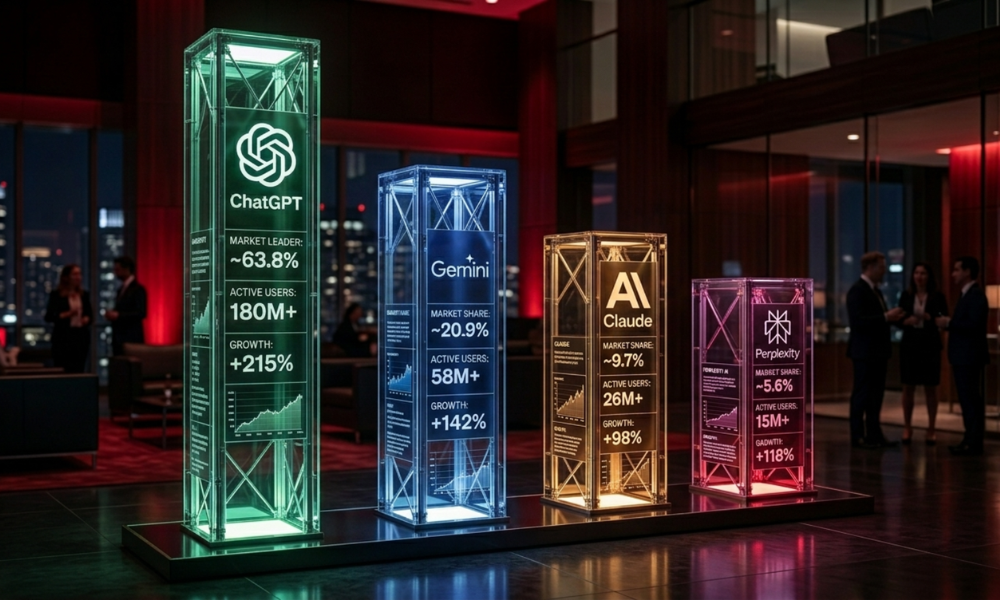
The numbers are undeniable.
ChatGPT: 800-900 million weekly active users by early 2026. That’s slightly larger than the population of the United States. Every week.
Perplexity: Handling 780 million monthly queries. With conversion rates for SaaS products sometimes exceeding traditional search.
Gemini: 750 million monthly users, plus an additional 2 billion people exposed to Google AI Overviews embedded in traditional search results.
Claude: 30 million users, but highest average session value ($4.56) among all AI assistants, suggesting higher engagement and deeper research tasks.
The trajectory: AI-referred sessions jumped 527% year-over-year in the first five months of 2025. That growth rate is accelerating, not decelerating.
The displacement: Gartner estimates that by 2026, roughly 25% of enterprise search queries now bypass Google entirely and route through conversational AI platforms instead.
Google AI Overviews appear on approximately 60% of search results pages.
Traditional organic search traffic is projected to decline 25% by 2026.
What this means: If you’re only optimizing for Google rankings, you’re optimizing for 75% of the search pie. The remaining 25% (and growing) is going through AI platforms that operate on completely different discovery rules.
GEO vs. SEO: The Fundamental Difference

This distinction matters because it changes almost everything about content strategy.
Traditional SEO
You create content → optimize for keywords → earn backlinks → compete for position in search results → user clicks through to your site
Success metric: Ranking position, click-through rate
Measurement: Keywords ranked, traffic generated
Generative Engine Optimization
You create content → structure for AI extraction → build off-page authority → get cited in AI responses → user sees your brand endorsed by AI → visits or inquires
Success metric: Citation rate, share of voice, qualified referral traffic
Measurement: Citation frequency, AI share of voice, conversion rate from AI-referred traffic
The fundamental difference: In traditional SEO, you’re fighting for a ranking position. In GEO, you’re fighting to be cited as a source.
A ranking guarantees visibility in a list. A citation brings endorsement credibility.
Why this matters for conversion: AI-referred traffic converts 4.4× better than traditional organic search traffic. Some B2B metrics show 23× better conversion than organic.
Why? Because the user has already been pre-qualified by the AI. When an AI says “this brand is good for X,” the user trusts that recommendation.
The Five Core GEO Signals (What Actually Works)

Based on brands successfully getting cited across ChatGPT, Perplexity, Gemini, and Claude, five signals consistently drive visibility:
1. Entity Clarity (The Foundation)
AI engines need to clearly understand who you are, what you do, and why you’re credible.
What this means:
- Your brand name, category, and value proposition are immediately clear
- Your credentials and expertise are explicit, not implied
- Your author/founder information is complete and verifiable
- Your company structure and team members are well-defined
Implementation:
- Create a comprehensive company entity definition (not just a bio)
- Use structured data (Schema.org Organization schema)
- Ensure consistent information across all web properties
- Include clear founder/expertise information with photos and credentials
- Build entity profiles on industry databases and citations
Why it matters: If AI can’t clearly resolve who you are, it won’t confidently cite you. Ambiguity leads to deprioritization.
2. Extractability (The Format)
AI systems read your content and pull quotable, verifiable statements for synthesis.
Content that’s easy to extract gets cited more frequently.
What this means:
- Specific claims with supporting data
- Numbered lists and clear structure
- TL;DR summaries at the top
- Q&A sections with direct answers
- Data tables and comparisons
- Statements written in a form AI can directly quote
Examples:
Bad (non-extractable): “Our platform is great for scaling teams. Companies love our features. We help businesses grow.”
Good (extractable): “HubSpot’s sales hub helps teams close 15% more deals on average by automating follow-up sequences. According to our 2025 benchmark report of 10,000+ sales teams, teams using automated follow-up see 8.2 day shorter sales cycles.”
The second example gives AI specific data to cite. The first is filler.
3. Authority Signals (The Credibility)
Entity authority is becoming the new PageRank in AI discovery. Being recognized as a trusted authority across multiple sources matters more than traditional link equity.
What this means:
- Third-party mentions and press coverage
- Expert quotes and commentary in publications
- Industry awards and recognitions
- Being cited as a source in other authoritative content
- Bylines and expert positioning in trusted publications
- Participation in industry reports and benchmarks
Implementation:
- Identify 5-10 trusted industry publications where your brand should be mentioned
- Pitch founder bylines and guest articles
- Pursue expert quotes in industry news
- Contribute to industry reports as a research partner
- Build relationships with journalists covering your space
- Create original research that others cite
Why it matters: When Perplexity or ChatGPT see that multiple authoritative sources cite you as an expert, they weight your content more heavily in answers.
4. E-E-A-T Signals (The Trust)
E-E-A-T (Experience, Expertise, Authoritativeness, Trustworthiness) remains critical for AI citation.
What this means:
- Experience: You’ve actually done the thing you’re writing about
- Expertise: You have credentials and deep knowledge
- Authoritativeness: You’re recognized by others as an authority
- Trustworthiness: You’re transparent, cite sources, correct errors
Implementation:
- Author bios with credentials and background
- Clear sourcing of all claims (links to original sources)
- Transparent about limitations and edge cases
- Corrections and updates when information changes
- Real-world examples showing you understand the topic deeply
- Data and research supporting major claims
5. Recency Signals (The Freshness)
AI systems weigh content recency differently than traditional search.
Perplexity uses real-time web search (RAG), so fresh, recent content is prioritized.
Even ChatGPT’s web-connected mode prefers recent, updated content.
What this means:
- Content has visible publish and update dates
- Cornerstone content is refreshed quarterly with new data
- Examples and case studies are current
- External links point to recent sources
- “Last updated” dates are prominent
Implementation:
- Add publish date and “last updated” date to every piece
- Set calendar reminders to refresh major pieces quarterly
- Update statistics with current year data
- Add current examples even if core content hasn’t changed
- Link to recent sources, not 5-year-old research
- Monitor your competitors’ content and update yours if they reference newer data
Platform-Specific Strategies (They’re Not All The Same)
Each AI platform weighs these signals differently. Understanding the nuances changes your implementation priority.
ChatGPT Strategy
What works:
- Domain reputation (authority across the web)
- Readability and clear structure
- Breadth of coverage (comprehensive content)
- Web-connected mode prioritizes recent content
Timeframe: Changes visible in 4-8 weeks
Approach:
- Focus on building overall brand authority
- Ensure comprehensive content coverage of core topics
- Write for clarity, not density
- Maintain consistent publishing cadence
Perplexity Strategy
What works:
- Verifiable citations (sourced claims)
- Real-time freshness (recent content)
- Direct answers (not long-form essays)
- High transparency about sources
Timeframe: Changes visible in 2-4 weeks (real-time RAG)
Approach:
- Prioritize content with specific, verifiable data
- Update content frequently (weekly or bi-weekly)
- Add clear source citations for all claims
- Use data tables and structured formats
- Publish proprietary research and datasets
Conversion advantage: Perplexity users are often higher-intent researchers doing specific comparison work. SaaS companies report strong conversion rates from Perplexity referrals.
Gemini Strategy
What works:
- Strong Google SEO fundamentals
- Structured data and schema markup
- Core Web Vitals and page speed
- Traditional ranking signals
Timeframe: Changes visible in 4-12 weeks
Approach:
- Optimize for traditional Google ranking factors (Gemini inherits that infrastructure)
- Implement comprehensive schema markup
- Focus on Core Web Vitals
- Build backlinks and authority for Google
- Optimize for featured snippets
Claude Strategy
What works:
- Multi-source verification (not relying on single sources)
- Balanced, non-promotional content
- Transparency about limitations and tradeoffs
- Comprehensive context
Timeframe: Changes visible in 6-12 weeks
Approach:
- Present balanced views (not just promotional)
- Acknowledge tradeoffs and limitations
- Reference multiple authoritative sources
- Provide context and nuance
- Avoid overly promotional language
- Write like you’re explaining to an expert, not selling
The 12-Week Implementation Framework
Most brands see measurable improvements within 4-8 weeks of proper GEO infrastructure.
Here’s how to structure a focused 12-week sprint:
Weeks 1-2: Baseline & Audit
Action:
- Select 30 target queries relevant to your business
- Run each query through ChatGPT, Perplexity, Gemini, Claude
- Document: Are you cited? What’s the mention type? Where do competitors appear?
- This becomes your baseline
Deliverable: Baseline citation audit showing current state vs. competitors
Weeks 3-4: Content Audit & Entity Setup
Action:
- Audit your top 20 pages for extractability, E-E-A-T signals, recency
- Set up structured data (Organization, Article, FAQPage schemas)
- Ensure author information is complete and visible
- Create comprehensive entity definitions (company, founders, expertise areas)
Deliverable: Entity setup complete, Schema.org markup deployed
Weeks 5-8: On-Page Optimization
Action:
- Rewrite top 10 pages with TL;DR summaries
- Restructure content as clear claims + supporting evidence
- Add Q&A sections answering conversational queries
- Add data tables and comparisons where relevant
- Update publish/modification dates
- Add author credentials and expertise signals
Deliverable: 10-20 optimized, extractable pages
Weeks 9-10: Off-Page Authority Expansion
Action:
- Identify 5-10 trusted industry publications
- Pitch founder bylines and expert commentary
- Build relationships with journalists in your space
- Contribute to industry reports and benchmarks
- Create original research to drive third-party citations
Deliverable: Guest article published, expert quotes secured, PR pipeline active
Weeks 11-12: Measurement & Iteration
Action:
- Re-run the 30 baseline queries across all platforms
- Document delta: new citations, citation rate changes, share of voice gains
- Prioritize next 20 pages based on what’s working
- Plan ongoing refresh cadence
Deliverable: Results dashboard, iteration roadmap
Real Results: The Dental Clinic Case Study
A mid-size dental practice implemented comprehensive GEO strategy over 12 weeks.
Baseline: No Perplexity citations for competitive queries like “best dentist for root canal anxiety” or “invisalign vs traditional braces.”
Implementation:
- Created extractable content answering specific dental questions (fear of root canals, Invisalign lifestyle impact, etc.)
- Built entity clarity with dentist bios and credentials
- Published original research: “How Root Canal Anxiety Affects 47% of Dental Patients”
- Secured mentions in dental industry publications
- Updated content with “last updated” dates
Results (by Week 10):
- 23 Perplexity answers citing the practice weekly
- 140 qualified leads monthly (vs. ~30 from traditional search)
- 34% conversion rate from Perplexity referrals (vs. 12% from organic search)
- Monthly revenue increase of $48,000 from new patient acquisitions
This is not anomalous. This is the pattern we see repeatedly: brands that build proper GEO infrastructure see measurable citation increases within 8-10 weeks, and qualified referral traffic that converts significantly better than organic.
The Competitive Moat Building Now
Here’s what makes GEO powerful in 2026: the competitive advantage compounds.
When you start getting cited frequently by ChatGPT or Perplexity for a topic, the AI systems develop a preference bias. Once a source proves reliable on a topic, the model favors it for related queries.
Citation moats built in Q2-Q3 2026 will be extremely hard for competitors to overcome by Q4 2026.
Why:
- Most brands are still only optimizing for Google
- GEO competition is currently low
- First movers capture citation preference bias
- By the time competitors realize what’s happening, you’ve already built authority
Frequently Asked Questions
Should I choose one AI platform to optimize for or optimize for all?
Optimize for shared patterns that work across platforms (entity clarity, E-E-A-T, extractability). Then prioritize based on your audience. B2B? Perplexity first. Broad reach? Focus on ChatGPT and Gemini. Choose 2-3 platforms to start; expand later.
How do I measure GEO success if I don’t have direct referral attribution?
Use monitoring tools (Otterly.ai, Semrush AI Toolkit, Ahrefs Brand Radar). Track citation frequency weekly. Correlate citation increases with traffic/lead changes. Set up UTM parameters in links you can control (author bios, off-page placements). Most improvements show up as branded search volume increase before direct referrals appear.
Does good GEO help SEO too?
Absolutely. Entity clarity, E-E-A-T signals, fresh content, and structured data improve both. The difference: SEO prioritizes keywords and backlinks. GEO prioritizes extractability and authority. But strong GEO almost always improves SEO too.
How much budget should GEO get vs. traditional SEO?
Start with 30% of SEO budget for GEO (especially if you’re B2B or in technical/professional services). Adjust based on results. If AI-referred traffic converts 4-23× better, even small amounts of GEO can outperform traditional SEO.
Bottom Line
Generative Engine Optimization is not a future trend. It’s happening now, at scale.
Hundreds of millions of people are using AI to research and make decisions, without ever touching a traditional Google search results page.
Brands that build GEO infrastructure now, clear entity signals, extractable content, off-page authority, will capture disproportionate share of AI-driven discovery in 2026 and beyond.
Brands that wait will eventually optimize for it. But they’ll be starting from behind, fighting competitors who already have citation preference bias.
The question isn’t whether to invest in GEO.
It’s when.