

AI OVERVIEW
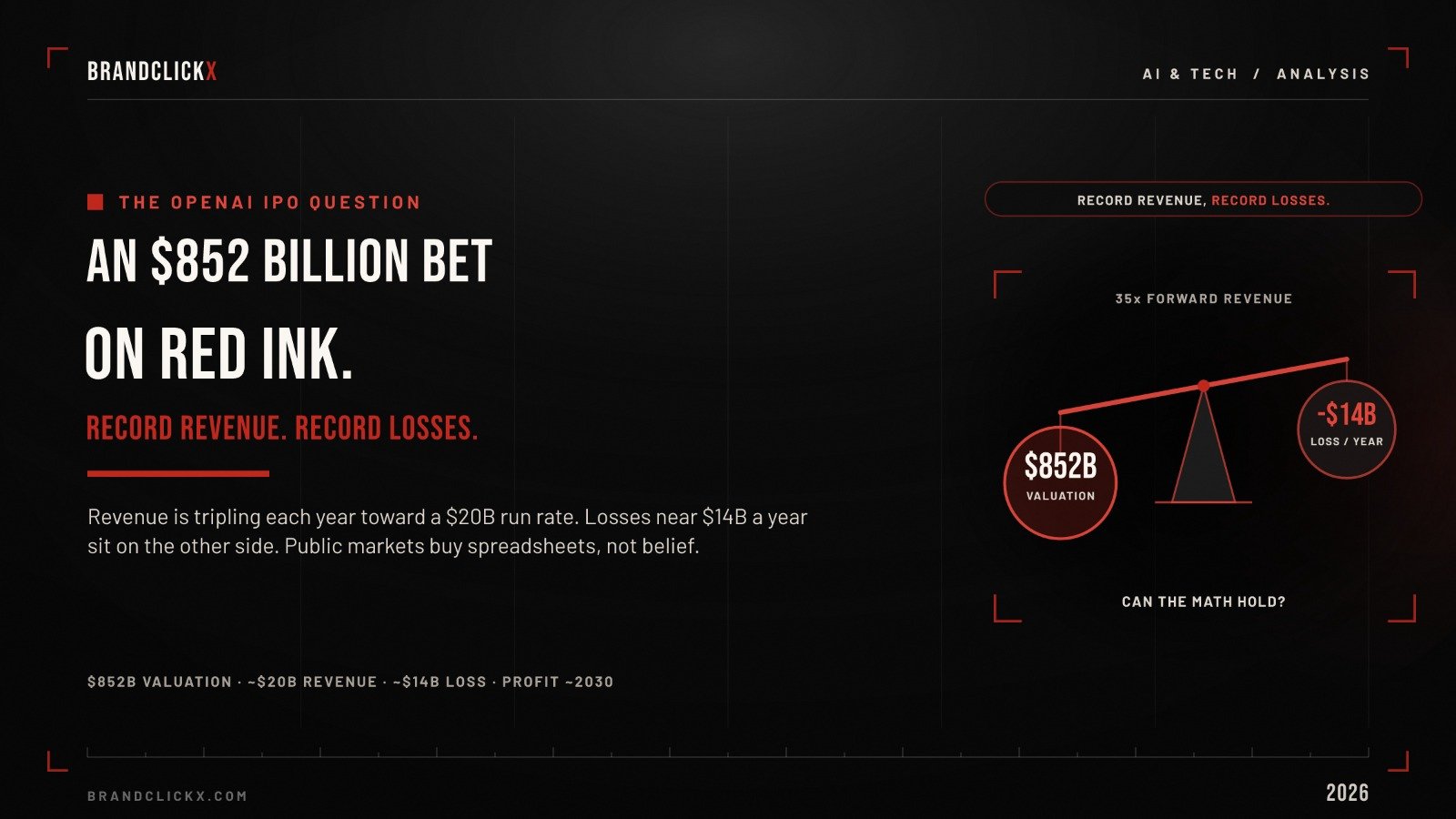
OpenAI confirmed on June 8, 2026 that it confidentially filed a draft S-1 with the SEC, last valued near $852 billion with some analysts projecting up to $1 trillion. Goldman Sachs and Morgan Stanley lead the offering, and a listing window of September to November 2026 is possible. Annualized revenue has passed $25 billion, yet OpenAI loses billions and does not expect profit until around 2030.
The OpenAI IPO is no longer a Silicon Valley dinner conversation. It is a live regulatory event, and it forces a single uncomfortable question into the open. How does a company that loses billions of dollars a year convince public investors it is worth close to a trillion?
On June 8, 2026, OpenAI confirmed it had quietly filed a draft S-1 with the Securities and Exchange Commission. The wording was almost casual. The stakes are not.
Why it matters: for the first time, the company that started the generative AI boom has to show real numbers to people who do not get paid in strategic upside. Venture investors buy belief. Public markets buy spreadsheets.
This piece breaks down what the filing actually means, what the money looks like underneath the headlines, and whether the OpenAI valuation can survive contact with a quarterly earnings report.
The Filing That Started the Clock
OpenAI did not announce a listing. It announced a filing. There is a difference, and it matters.
In a short note, the company said it had submitted a confidential S-1 and expected the news to leak, so it chose to get ahead of it. It also added a line that most coverage skipped past: it had not decided on timing and a listing might be a while because some moves are easier as a private company.
That is not the language of a company sprinting to the bell. It is the language of a company keeping its options open while the clock runs.
Market Observation: confidential filings usually arrive a couple of months before a public S-1, and another month or so before the actual debut. So a September window is plausible, but a slip into late 2026 or even into 2027 is just as realistic.
The timing was not random. The filing landed days after a federal jury dismissed Elon Musk’s lawsuit against OpenAI, clearing the most visible legal cloud hanging over any listing. First you remove the obstacle. Then you file.
The Number Everyone Is Arguing About
Here is where it gets interesting. OpenAI was valued at about $852 billion after its March 2026 round, which makes it one of the most valuable private companies on earth.
Reports peg the IPO target somewhere between $730 billion and $852 billion. Bullish voices push the story toward $1 trillion. So the spread between the cautious case and the optimistic case is larger than the entire market cap of most public companies.
The Bigger Shift: a trillion-dollar debut would rank among the largest IPOs in market history. For scale, that is several times the size of Alibaba’s record-setting listing in 2014.
Not everyone is sold. Bridgewater’s Greg Jensen reportedly told clients the implied 35x forward revenue multiple looks “priced for a monopoly outcome that does not yet exist.” That phrase should sit at the center of every investor conversation about this deal.
A 35x forward multiple is not unheard of for a hypergrowth name. It is unheard of at this scale, on this much cash burn, in a market this competitive.
Follow the Revenue
So let us look at the actual money. The growth story is real, and it is genuinely rare.
OpenAI went from roughly $2 billion in annualized revenue at the end of 2023, to about $6 billion in 2024, and then past $20 billion by the end of 2025. By early 2026, monthly revenue was reported near $2 billion, which works out to a run rate above $24 billion.
That is a tripling of revenue in consecutive years. Google took about seven years to reach $12 billion. Facebook took roughly six. OpenAI did it in under three.
Expert Insight: there is an important nuance buried in those numbers. Annualized run rate and recognized revenue are not the same thing. Recognized revenue for the full year 2025 was closer to $13 billion, as Reuters reported, while the $20 billion-plus figure reflects the exit run rate at year end.
That gap is not a trick. It is just how fast-scaling subscription businesses report. Still, it matters when you are pricing a company off forward revenue, because the multiple you choose depends on which number you anchor to.
The income itself comes from three engines: paid ChatGPT subscriptions, enterprise contracts, and API usage. Consumer demand drove the early surge. Enterprise is now the segment investors watch most closely, because it tends to be stickier and higher margin.
Now Follow the Losses
Here is the other side of the ledger, and it is the side that makes the OpenAI IPO so hard to price.
OpenAI is deeply unprofitable. Internal projections point to a loss near $14 billion in 2026 alone on a non-GAAP basis. Some independent estimates of the GAAP figure run materially higher, closer to $25 billion once everything is counted.
Cumulative losses could reach the tens of billions before the company turns the corner. And that corner is not close. OpenAI does not expect to reach profitability until around 2029 to 2030.
Strategic Breakdown: the losses are not a sign of a broken product. They are a sign of a business that has chosen to spend ahead of revenue at a scale almost no company has attempted.
Compute is the reason. OpenAI is targeting roughly $600 billion in total compute spend through 2030, and Sam Altman has publicly committed to spending around $1.4 trillion to build 30 gigawatts of computing capacity. That is enough power, by the company’s own framing, to run millions of homes.
So the picture is simple to state and hard to solve. Revenue is climbing fast. Costs are climbing faster. The bet is that growth catches up before the cash runs out.
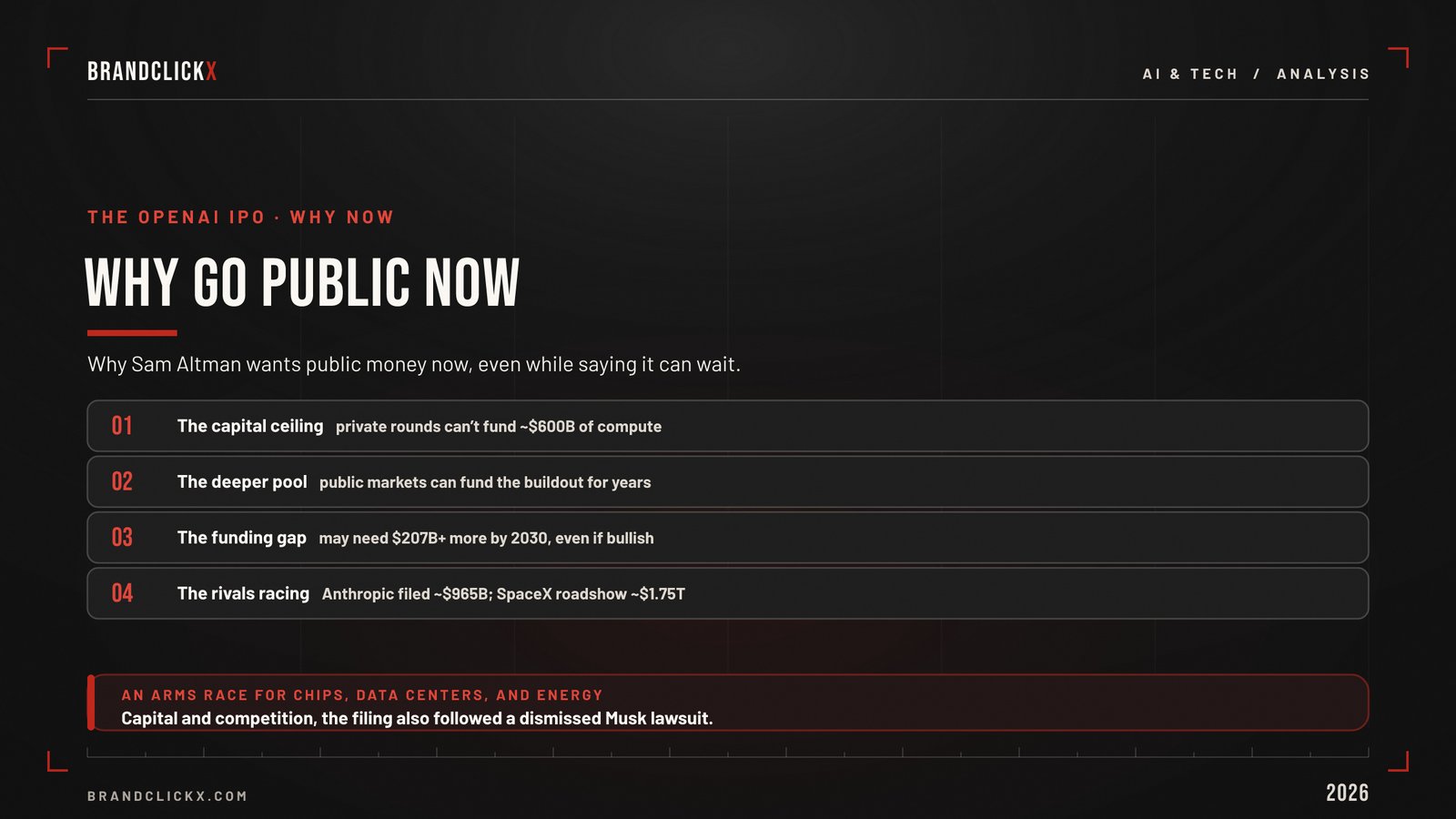
HSBC analysts estimate OpenAI may need more than $207 billion in additional funding by 2030, even under optimistic revenue assumptions. That is not a rounding error. That is a structural dependency on capital markets staying open and friendly.
The Business Model Nobody Has Fully Solved
This is where the AI business model debate gets real, and where most coverage stays shallow. Let us go deeper.
Running a query is not free. Every answer ChatGPT generates burns compute, and at the scale of hundreds of millions of weekly users, that cost is brutal. So margin depends on one thing above all: how cheaply OpenAI can serve each request.
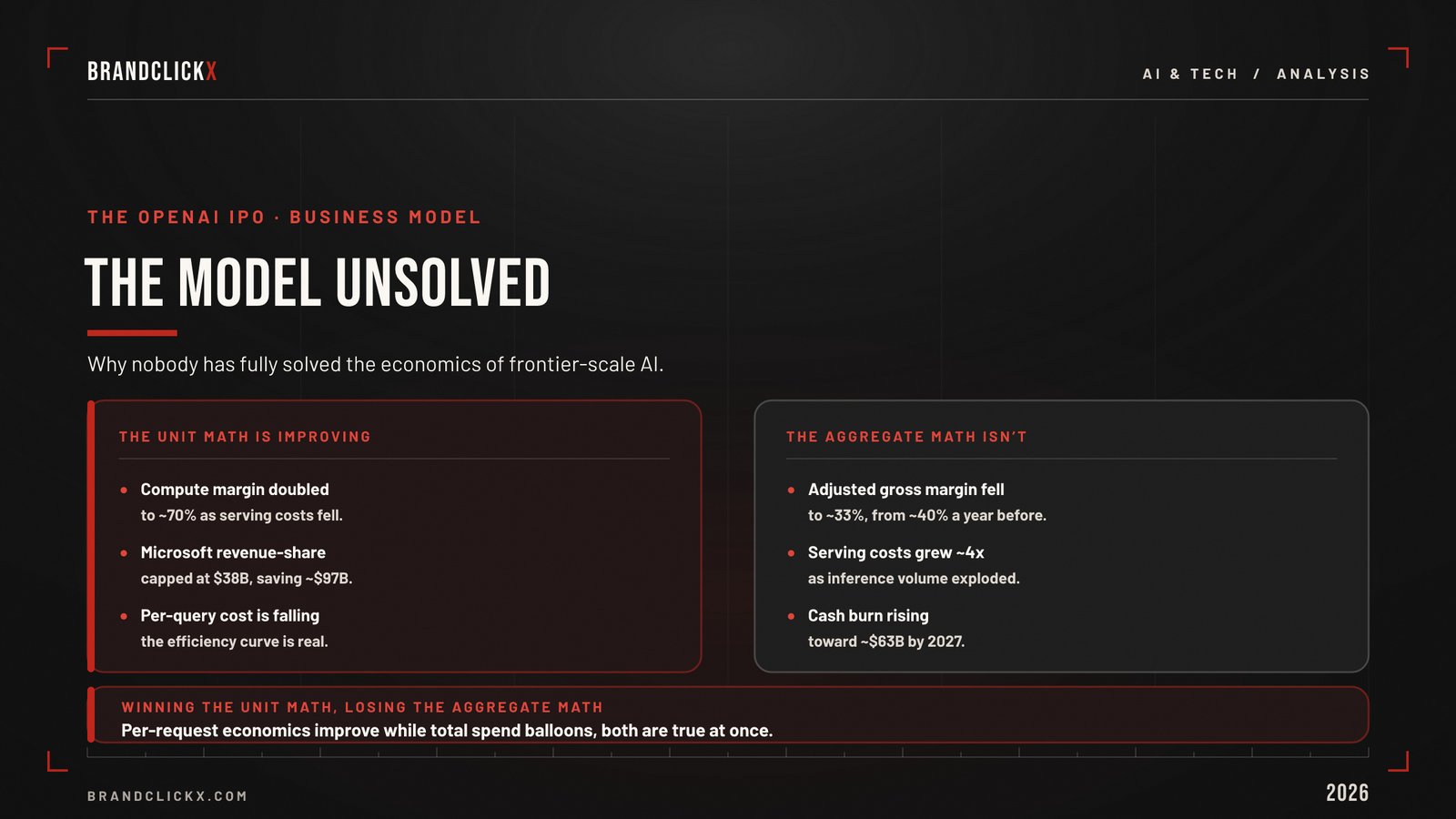
The good news for bulls is that this number is moving in the right direction. OpenAI roughly doubled its internal compute margin to about 70% during 2025 by cutting the cost of running models for paying users. That is real operational progress.
The complication is that other gross margin readings tell a harsher story. As inference volume exploded, adjusted gross margin reportedly fell to around 33% from 40% the year before, because total serving costs grew fourth-fold in a single year.
Enterprise Perspective: for any CMO or SaaS leader watching this, the lesson is familiar. Per-unit economics can improve while total spend balloons, because growth in volume swamps efficiency gains. OpenAI is winning the unit math and losing the aggregate math at the same time.
There is a genuine bright spot. OpenAI renegotiated its revenue-share arrangement with Microsoft, capping total payments at $38 billion through 2030, down from a prior trajectory near $135 billion. Sacra estimates that saves roughly $97 billion. If inference costs keep falling, the margin story can flip from liability to asset.
But that same analysis projects cash burn rising to about $27 billion in 2026 and $63 billion in 2027 under the revised Microsoft terms. So the relief on one line shows up as pressure on another.
The Circular Money Problem
Now we reach the part of the story that worries serious people, and it has a name. Circular financing.
The pattern works like this. Nvidia signaled it would invest up to $100 billion in OpenAI to fund a data center buildout, as Bloomberg reported. OpenAI then commits hundreds of billions to compute, much of it running on Nvidia chips. Oracle builds data centers and books OpenAI as an anchor customer, leaning on the same chip supply.
Money moves in a loop. A chipmaker invests in a customer, who then buys the chipmaker’s chips. Bernstein analyst Stacy Rasgon flagged that the structure would clearly fuel circular concerns.
Industry Impact: this is the systemic risk that separates the 2026 AI boom from a normal growth story. When the same dollars recycle through a small circle of mutually dependent balance sheets, headline growth can look stronger than the underlying demand actually is.
The scrutiny is not only coming from analysts. Senator Elizabeth Warren sent OpenAI a letter seeking assurances that the company would not seek an open-ended federal bailout if its spending outran its revenue. When a sitting senator is writing about your burn rate, the political dimension has arrived.
None of this proves a collapse is coming. It does explain why a public filing changes everything. Private circles can sustain optimism for years. Public markets demand that the loop eventually produces independent, durable cash flow.
Why Sam Altman Wants Public Money Now
So why go public at all, especially when the company itself says it might wait? The answer is capital, and the answer is competition.
Sam Altman is running an arms race. Building frontier models requires staggering amounts of money for chips, data centers, and energy. Private rounds, even ones north of $100 billion, eventually hit a ceiling. Public markets offer a deeper, more permanent pool of capital.
There is also a rival in the picture. Anthropic filed for its own IPO on June 1, 2026, at a reported valuation near $965 billion, just days before OpenAI’s filing. Two of the most important AI startups in the world are now racing toward public markets at the same time.
Market Observation: simultaneous mega-listings could split institutional appetite. There is only so much capital chasing AI exposure in a single window, and two trillion-dollar-scale debuts competing for it could force one or both to trim valuations.
The honesty from inside the industry is striking. Altman himself has said that someone is “going to lose a phenomenal amount of money” in this cycle, and he has openly agreed that investors are overexcited about AI. He frames it as both a bubble and the most important technology shift in a long time. Both things can be true.
The Bull Case vs the Bear Case
Strip away the noise and the OpenAI IPO comes down to two competing stories. Here is the honest version of each.
| Dimension | The Bull Case | The Bear Case |
| Revenue growth | Tripled each year, past $20B run rate, fastest scale in tech history | Recognized revenue near $13B in 2025, growth must stay near-vertical to justify price |
| Margins | Compute margin doubled to about 70% as serving costs fell | Adjusted gross margin slipped to about 33% as inference volume exploded |
| Valuation | $852B private mark, supported by strategic investors and demand | 35x forward multiple “priced for a monopoly outcome that does not yet exist” |
| Profitability | Microsoft cap saves roughly $97B, path to profit by 2029 to 2030 | $14B-plus loss in 2026, burn rising toward $63B by 2027 |
| Capital | Deep public markets can fund the buildout for years | May need $207B-plus more by 2030, dependent on open markets |
| Structure | Strategic partners signal long-term conviction | Circular financing inflates headline growth and adds systemic risk |
Neither column is propaganda. Both describe the same company. That is exactly why this listing is so contested.
What an OpenAI IPO Means for AI Startups and AI Funding
Zoom out, because the ripple effects reach far beyond one company. The OpenAI IPO is a referendum on the entire AI funding model.
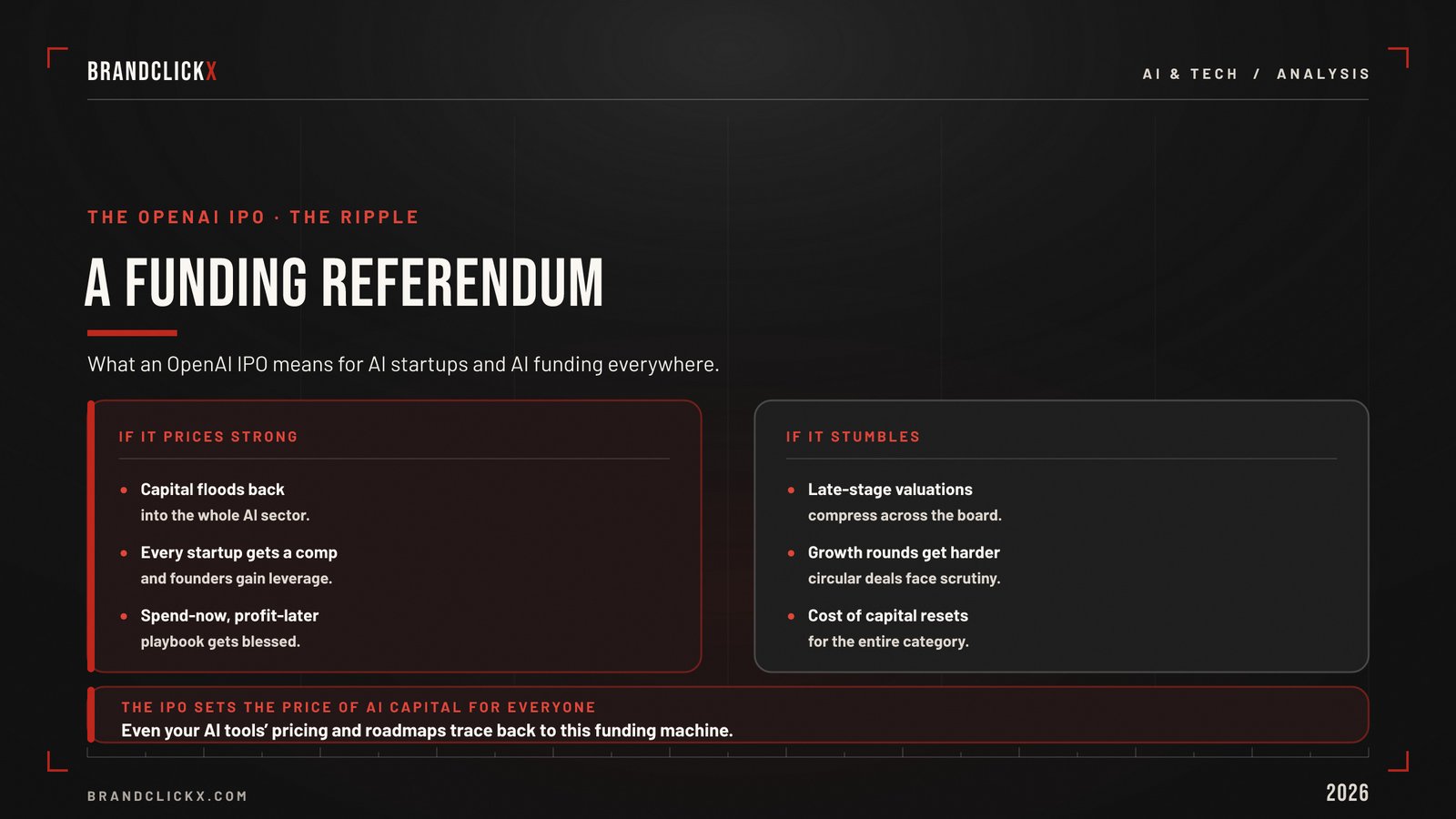
If the listing prices strongly and trades well, capital floods back into the sector. Every AI startup raising a round suddenly has a comparable, and founders gain leverage. The public market effectively blesses the spend-now, profit-later playbook.
If it stumbles, the opposite happens fast. Late-stage valuations compress, growth rounds get harder, and the circular deals that propped up headline numbers face real scrutiny. The cost of capital for the whole category resets.
Why It Matters for marketers and operators: the AI tools your team depends on are funded by this exact machine. Pricing, model availability, and roadmap stability all trace back to whether these companies can keep raising at favorable terms. An IPO that goes badly is not just a Wall Street story. It is a procurement risk.
There is a real optimistic counterweight worth naming. The Federal Reserve and major banks have noted that, unlike the dot-com era, today’s AI leaders generate substantial real revenue and corporate cash flows are far stronger than they were in 1999. The optimistic case is not empty. It is just not guaranteed.
What Happens Next
So where does this go from here? The filing is a starting gun, not a finish line.
The next milestone is the public S-1. The confidential version hides the full financials, which means revenue, costs, and margins will not be fully visible until OpenAI chooses to flip them public, likely a few weeks before any listing. That is the moment the real pricing fight begins.
Prediction markets are already hedging. Traders on Polymarket have treated a near-term listing as unlikely and a late-2026 debut as a coin-flip-style bet rather than a sure thing. The market believes the filing is real and the timing is soft.
Tactical Framework for what to watch:
- The public S-1 and the first fully disclosed revenue and margin figures.
- Whether the enterprise segment is growing or stalling relative to consumer.
- How the prospectus handles circular financing in its risk section.
- Whether Anthropic’s parallel listing forces either company to cut its target.
- The retail allocation, which OpenAI has signaled it wants to include for everyday users.
Each of these will move the story more than any headline valuation number.
COMPARISON TABLE: OPENAI AT A GLANCE
| Metric | Figure | Source Context |
| Private valuation | About $852 billion | March 2026 funding round |
| IPO target range | $730 billion to $1 trillion | Pre-filing analyst reporting |
| Annualized revenue | Past $20 billion (run rate) | End of 2025, CFO disclosure |
| Recognized 2025 revenue | About $13 billion | Reuters reporting |
| Projected 2026 loss | About $14 billion (non-GAAP) | Internal projections |
| Compute spend target | About $600 billion through 2030 | Reuters reporting |
| Expected profitability | Around 2029 to 2030 | Multiple analyst estimates |
| Underwriters | Goldman Sachs, Morgan Stanley | Reported lead banks |
| Filing date | June 8, 2026 | Confidential draft S-1 |
KEY TAKEAWAYS
- The filing starts a process, not a date. OpenAI submitted a confidential S-1 on June 8, 2026, but explicitly said the timing of a listing is undecided and could slip.
- The valuation is the whole debate. An $852 billion private mark and a possible trillion-dollar target sit on top of a 35x forward revenue multiple that skeptics call priced for perfection.
- Revenue growth is real and rare. Tripling annual revenue toward a $20 billion-plus run rate is one of the fastest scaling stories in tech history.
- The losses are structural, not accidental. A roughly $14 billion projected loss in 2026 and compute spending near $600 billion through 2030 mean OpenAI is betting growth outruns cost.
- Circular AI funding is the systemic risk. Money looping between Nvidia, OpenAI, and infrastructure partners can inflate headline growth and will feature heavily in the prospectus risk section.
- This IPO sets the price of AI funding for everyone. A strong debut reopens capital for the whole sector. A weak one resets valuations across every AI startup raising in 2026.
Frequently Asked Questions
Can you buy OpenAI stock right now?
Not yet. OpenAI remains private, so shares are not available on any public exchange. The confidential S-1 filed on June 8, 2026 only starts the process. A successful listing would give retail investors and index fund holders their first direct access to OpenAI equity, previously limited to venture capital. OpenAI has signaled it wants a dedicated retail allocation when it does list. Tech Journal
When will OpenAI go public?
Nothing is locked in. Reporting points to a potential listing window between September and November 2026, with September as the earliest target. OpenAI itself stressed that timing is undecided and a listing may be a while, since some moves are easier as a private company. Prediction markets treat a 2026 debut as roughly a coin flip rather than a certainty. Crypto Briefing
Who are the underwriters for the OpenAI IPO?
OpenAI tapped Goldman Sachs and Morgan Stanley as underwriters, with some reporting also naming JPMorgan among the banks leading the offering. These are the firms responsible for pricing the deal and lining up institutional demand once the public S-1 reveals OpenAI’s full financials. AI Weekly
Is OpenAI profitable?
No. OpenAI loses billions each year, with internal projections pointing to a loss near $14 billion in 2026 on a non-GAAP basis. The company does not expect to reach profitability until around 2029 to 2030. Compute costs for training and running large models are the main reason revenue has not yet caught up to spending.
How does the OpenAI IPO compare to Anthropic’s?
The two are racing to public markets at the same time. OpenAI filed roughly a week after Anthropic filed confidentially on June 1 at a reported $965 billion valuation, and both are following SpaceX, which has begun an IPO roadshow near $1.75 trillion. Analysts question whether two mega-listings in one window will split investor appetite and force one or both to trim its target. Tech Journal
Why is OpenAI going public now?
Capital and competition. Building frontier models demands enormous funding for chips, data centers, and energy that private rounds eventually cap. Public markets offer a deeper pool. The filing also landed days after a jury dismissed Elon Musk’s lawsuit against OpenAI, clearing the most visible legal obstacle to a listing.
CONCLUSION
The OpenAI IPO is the most important pricing test the AI economy has faced. Not because of one company, but because of what the company represents.
For three years, the industry ran on conviction. Investors funded the future and trusted the growth curve to justify the spend. A public listing ends that arrangement. It replaces belief with disclosure, and it forces the most consequential AI company in the world to prove its math in front of everyone.
Future Outlook: the likeliest path is not a clean yes or no. It is a negotiation. OpenAI files, the public S-1 reveals the real numbers, the market debates the multiple, and the valuation settles somewhere between the dream and the skeptics. A slip into 2027 would surprise no one.
What is certain is that this filing redraws the map. Every AI startup, every enterprise buyer, and every marketing team building on these tools now has a public scoreboard to watch. The spend-now, profit-later era is about to meet its first quarterly earnings call.
At BrandClickX, we read these filings the way operators do. Not as financial theater, but as a signal of where the tools, the budgets, and the leverage are heading next. The companies that understand the money behind the models will move first when the picture clarifies.
The clock has started. Now comes the part that conviction cannot fake.