The Update That Shook Search (And Why Your Speed Score Matters Now)
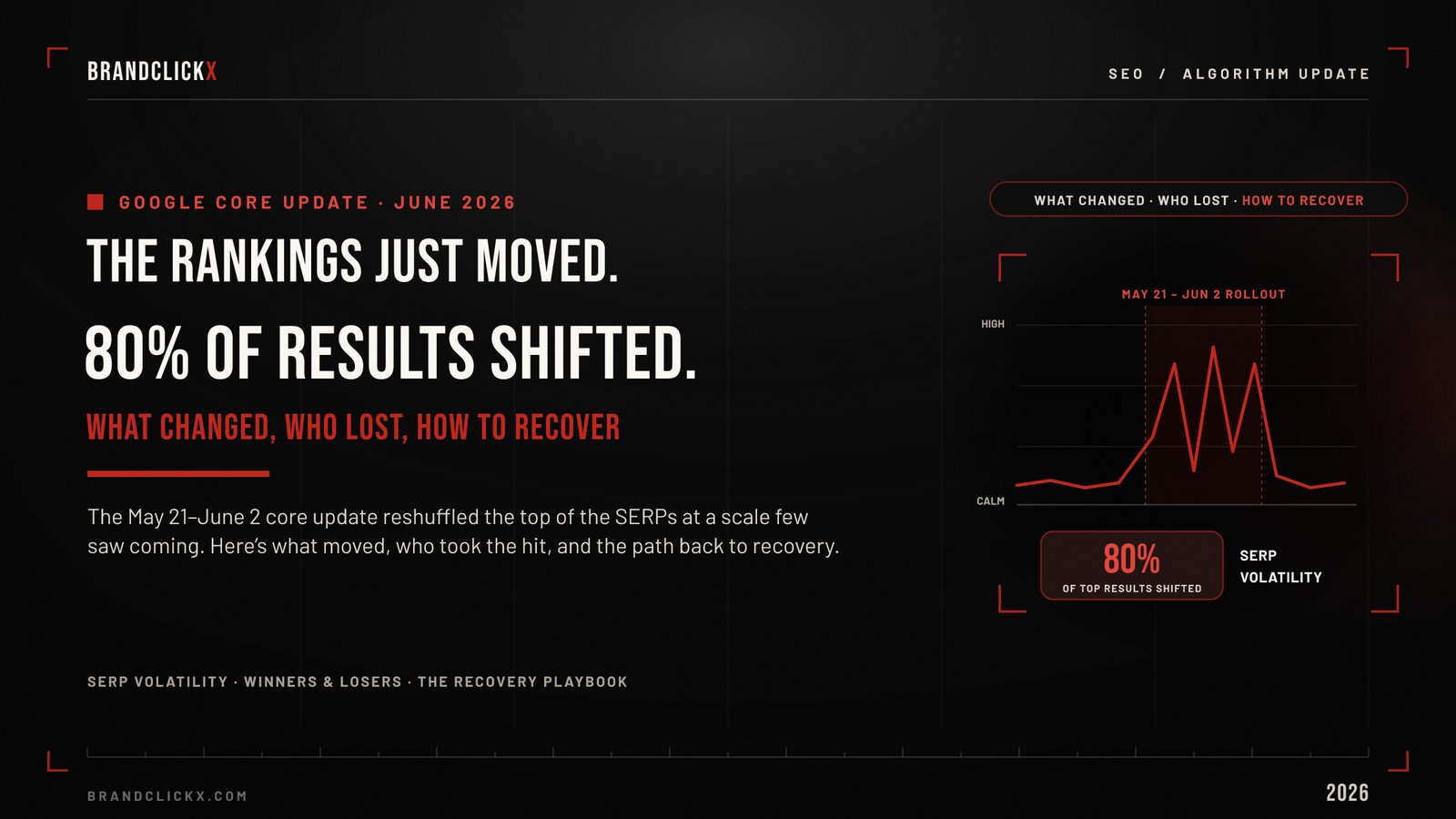
On May 21, 2026, Google began rolling out its second major core algorithm update of the year.
By June 2, it was complete.
And the search landscape looked different.
Early analysis showed that approximately 80% of top 10 results shifted position. Some sites gained visibility. Others lost it. The gap between winners and losers wasn’t random, it followed a clear pattern.
The sites that won:
- Fast (LCP under 2.5 seconds)
- Mobile-optimized
- High content quality
- Strong E-E-A-T signals
- Clear topical authority
The sites that lost:
- Slow (LCP above 3 seconds)
- Mobile-unfriendly or unresponsive
- Thin or aggregated content
- Unclear authorship or expertise
- Scattered topical coverage
This wasn’t a punitive update. It was a recalibration. Google simply re-evaluated what constitutes a good answer to a user’s search, and the new standards were stricter.
The Rollout Timeline and Impact Scale
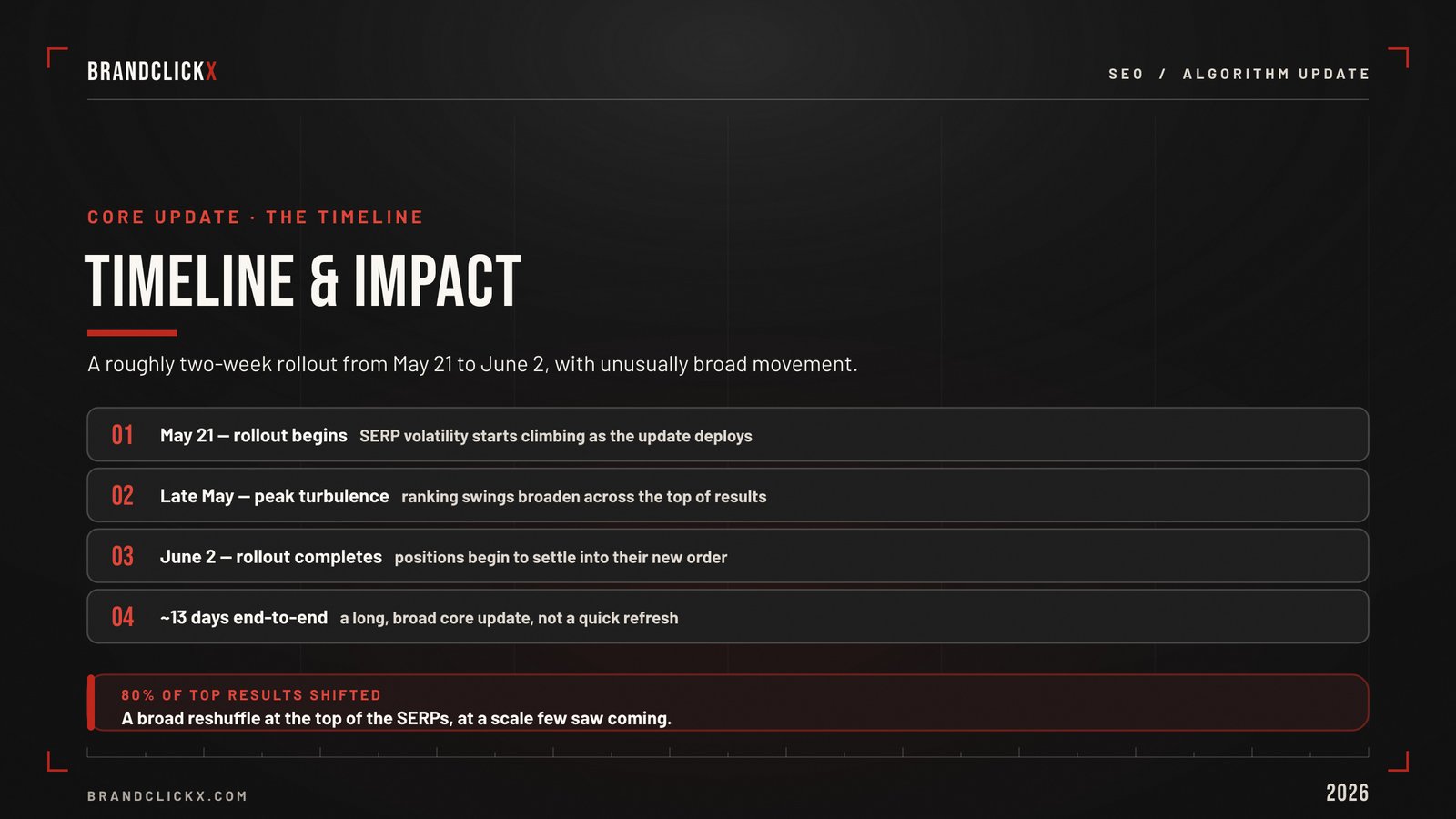
May 21, 2026, 11:49 AM ET: Google announced the update. Within hours, SEO tools registered significant ranking volatility. The search community knew something big was happening.
May 21-June 2, 2026: The update rolled out gradually across Google’s data centers. Sites experienced ranking fluctuations daily. Some gains, some losses. The pattern became clear only when viewed over the full 12-day period.
June 2, 2026: Rollout completed. The volatility subsided. The new ranking order stabilized.
June 3-9, 2026: Most significant impact reports came from agencies analyzing post-rollout data. The pattern became undeniable: fast, mobile-first, high-quality sites gained. Everything else lost ground.
Why This Update Mattered: The Real Data
Speed Became Non-Negotiable
A detailed analysis of sites that lost traffic showed a clear correlation: pages with LCP (Largest Contentful Paint) above 3 seconds lost approximately 23% more traffic than competitors with similar content but faster load times.
That’s not a coincidence. That’s algorithmic intention.
Google had already signaled that Core Web Vitals mattered. But the June 2026 update made it unmistakable: if your page is slow, your visibility suffers, even if your content is strong.
The threshold shifted down. Pages that were “acceptable” at 3-4 second load times became vulnerable. Pages under 2.5 seconds were preferred.
Mobile UX Moved from “Nice-to-Have” to “Essential”
Sites that invested in mobile-first design, proper spacing, readable fonts, fast response, intuitive navigation, saw a 15% average ranking increase post-update.
Conversely, sites with mobile-as-an-afterthought experienced losses.
Mobile-first indexing has been Google’s stated priority since 2018. But June 2026 was when the enforcement became visible in rankings.
If your desktop experience is premium but your mobile experience is compromised, you’re losing ground to competitors with balanced experiences across devices.
Content Quality Standards Tightened
The most affected signal in the June 2026 update was content quality. Sites with thin, surface-level, or heavily aggregated content without original insight lost visibility. Sites with depth, original research, expert perspective, and human review gained.
This wasn’t new in theory. But in practice, the update applied the standard more strictly.
What “quality content” now means:
- Demonstrates expertise (not just information transfer)
- Includes original data, research, or perspective
- Shows evidence of human review and editing
- Addresses search intent comprehensively
- Avoids keyword stuffing or unnatural optimization
Interestingly, AI-generated content itself wasn’t the disqualifying factor. Well-edited, high-quality AI-assisted content ranked fine. Low-quality, minimally-edited AI content ranked worse.
Google isn’t penalizing the tool. It’s penalizing the output quality.
E-E-A-T and Topical Authority Became Holistic Signals
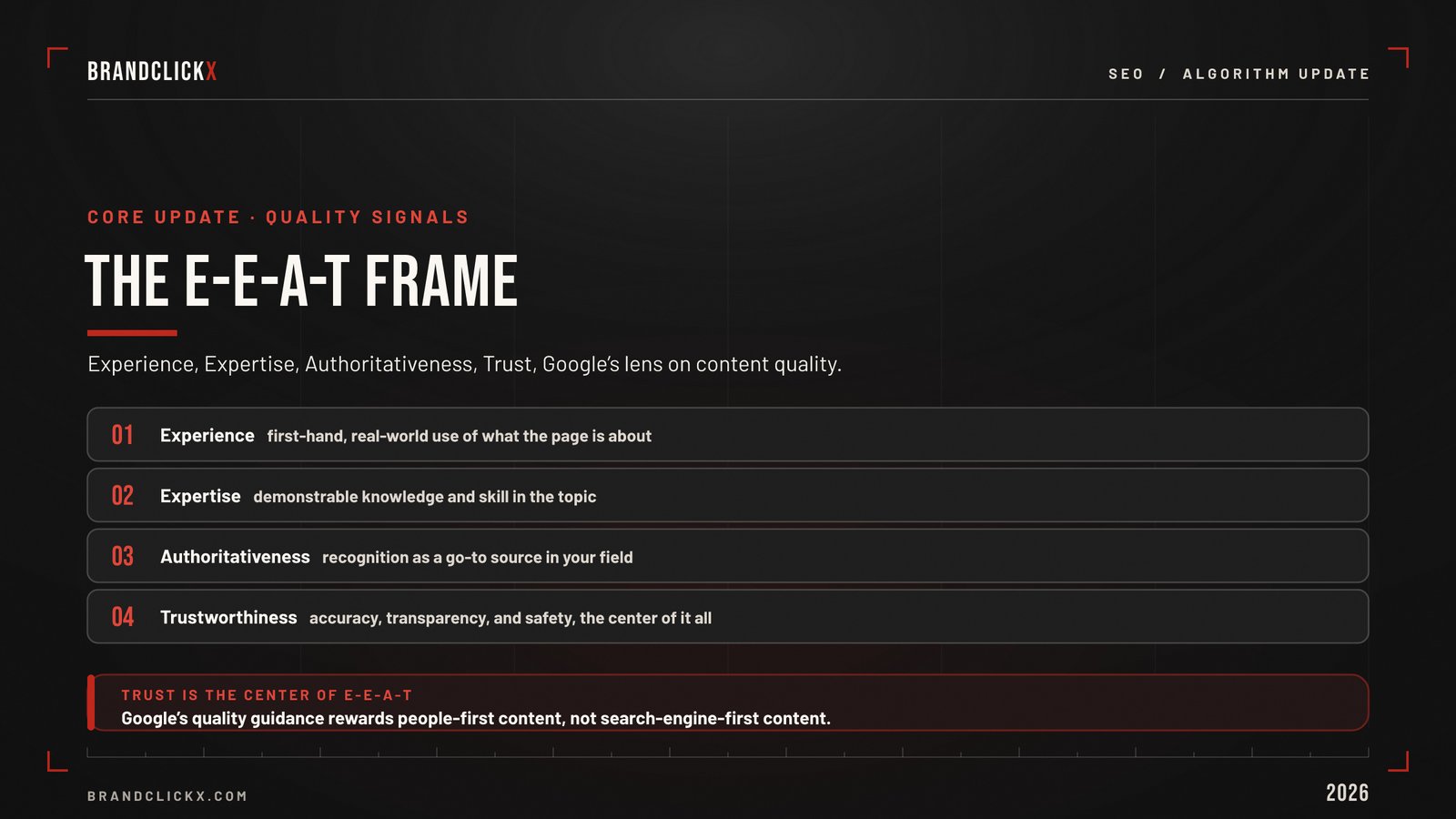
E-E-A-T (Experience, Expertise, Authoritativeness, Trustworthiness) wasn’t introduced in June 2026, it’s been part of Google’s evaluation for years. But the update applied it more systematically.
Google’s AI systems now evaluate E-E-A-T not just on individual pages, but across the entire site. A weakness in one area can reduce the impact of strengths elsewhere.
For example:
- Strong content on a page, but no author bio = lost authority signal
- Author bio present, but site hasn’t been updated in 8 months = lost recency signal
- Fresh content, but no topical consistency = lost expertise signal
The algorithm looks at patterns. Consistency matters.
Similarly, topical authority moved from a “nice advantage” to a core ranking factor. Sites that cover one topic in depth rank better than sites that scatter coverage across unrelated topics.
Who Got Hit Hardest
1. Aggregator Sites and Content Networks
Sites that primarily repackaged or summarized content from other sources without adding original value saw significant visibility loss. Aggregation itself isn’t problematic, but the update rewarded original insights over content recycling.
2. Affiliate and Thin Content Sites
Affiliate sites with minimal original content (product reviews that are essentially copied from product descriptions, for example) lost visibility to sites with deeper, hands-on review experience.
Thin content, pages with under 500 words addressing a search query, became harder to rank even in competitive verticals.
3. Mobile-Unfriendly or Slow Legacy Sites
Sites that hadn’t updated their mobile experience since 2018-2019 saw losses. Desktop-first design approaches that happened to work okay on mobile weren’t enough. Mobile-first design was required.
Older sites on legacy hosting or platforms with inherent performance limitations lost visibility to faster competitors on modern infrastructure.
4. Authority Websites Without Current Experts
Even established, authoritative sites lost visibility if author information was missing, outdated, or generic. The signal shifted from “this is an authority site” to “this is written by a current expert, and we can verify who.”
Who Gained Visibility
1. Sites with Exceptional Mobile Experience
Mobile-first design, fast load times, intuitive navigation. These sites gained 15%+ ranking increases on average. The gap between good mobile UX and poor mobile UX widened significantly.
2. Content with Clear Author Expertise
Pages with clear author information, credentials, recent update dates, and evidence of editorial review ranked higher. The shift rewarded transparency about who created the content.
3. Sites with Topical Authority
Sites that focus on specific topics in depth ranked better than broad generalist sites. If you own “mobile app development,” covering that thoroughly beats being a general programming blog.
4. Fresh, Original Research or Data
Sites that published original research, data, surveys, or proprietary findings gained visibility. Unique insight was rewarded more heavily than well-written rehashing of public information.
The E-E-A-T Framework in the June 2026 Update
This is crucial to understand because it shapes what you need to focus on next.
Google’s AI evaluation is now holistic, it doesn’t check E-E-A-T boxes. It patterns-matches across your entire site.
Experience: Do you actually use the product/service you’re writing about? Evidence of hands-on experience (screenshots, personal testing, dated examples) matters. Generic advice from someone who’s never used the tool ranks worse than specific advice from someone who has.
Expertise: Are you qualified to write about this? Author credentials, previous publications, job title, education. This isn’t about academic degrees exclusively, it’s about demonstrated knowledge. A professional chef’s cooking blog ranks higher than a marketing person’s cooking blog on cooking topics.
Authoritativeness: Is your site recognized as an authority? This includes links, citations, media mentions, but also structural signals. Do you have a clear author bio? Does your site have an established publication history on this topic? Are your articles cross-linked topically?
Trustworthiness: Can users trust this site? Privacy policies, transparent business models, clear contact information, editorial standards, correction of errors. Trustworthiness is the signal most harmed by deceptive practices, old content presented as new, or claim-making without source attribution.
The June 2026 update applied these holistically. Sites where E-E-A-T signals were scattered or inconsistent lost ground to sites where all signals aligned.
The Timing Context: Google I/O and AI Announcements
The May 21 – June 2 update happened just days after Google I/O 2026, where Google announced a wave of new AI and Search features.
This timing wasn’t accidental. The update was part of a broader shift toward AI-driven search evaluation. Google’s AI systems now understand context, expertise, and relevance at a deeper level than previous keyword-based or link-based systems.
The practical implication: traditional SEO tactics (keyword stuffing, link building, technical tricks) matter less. Fundamental content quality, demonstrable expertise, and topical depth matter more.
Recovery Framework: What to Do Now
Week 1: Assess and Wait
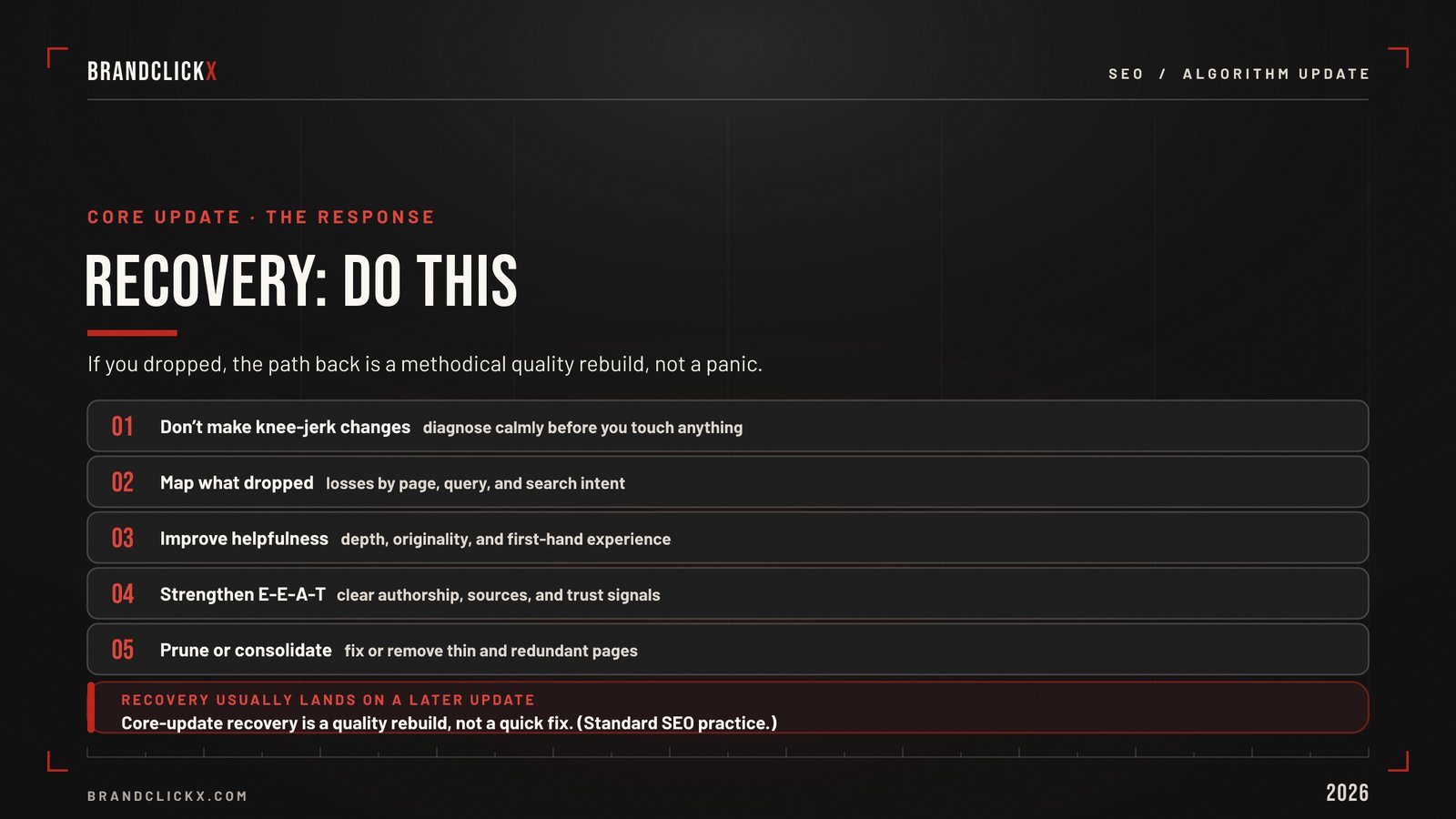
Don’t panic-modify your site in the first week after an update completes. You need data to make good decisions.
Actions:
- Use Google Search Console to track keyword position changes
- Compare traffic before (May 20) and after (June 10)
- Identify which pages lost visibility and which gained
- Note the pattern: which sections were hit, which thrived?
- Document: before making changes, understand what actually happened
Don’t do:
- Rewrite entire pages based on mid-rollout ranking fluctuations
- Change your entire content strategy
- Add keywords to pages (this often makes things worse)
Week 2: Root Cause Analysis
Once you have a full picture, identify the causes of losses.
Speed Analysis:
- Run your top-losing pages through [Google’s PageSpeed Insights]
- Check LCP specifically (target: under 2.5 seconds)
- Identify bottlenecks: image optimization? server response time? JavaScript?
Mobile Analysis:
- Test on actual mobile devices, not just browser simulation
- Check: spacing, font size, tap target size, loading speed on 4G
- Mobile-first doesn’t mean “works okay on mobile”, it means optimized for mobile
Content Quality Audit:
- Read your page from a user’s perspective
- Does it answer the search query comprehensively?
- Is there original insight or just information transfer?
- What could a competitor do better?
- Is the author clearly identified?
E-E-A-T Signals:
- Add author bios with credentials
- Date your content and update old content
- Link between related topics (topical consistency)
- Cite sources for claims
- Show evidence of expertise
Week 3-4: Targeted Improvements
Rather than rewriting everything, focus on high-impact changes:
For Speed:
- Optimize images (compression, modern formats like WebP)
- Minify CSS/JavaScript
- Implement lazy loading
- Consider upgrading hosting if server response time is the issue
- Use a CDN
For Mobile:
- Redesign if your mobile layout is compromise-based
- Increase font sizes
- Expand tap targets (buttons, links should be 48x48px minimum)
- Remove desktop-only content
- Test on real devices, not simulators
For Content:
- Deepen pages with low word count (add 1000+ words if under 500)
- Add original data, examples, or perspective
- Clarify author information
- Update dates and freshness signals
- Link topically related content
What “Winning” Looks Like Post-Update
Sites that recovered well typically did three things:
- They didn’t try to trick the algorithm. No keyword stuffing, no black-hat link building, no content spinning. They just made their pages genuinely better.
- They focused on user experience. Speed wasn’t just a technical metric, it was about user experience. Mobile UX wasn’t about compliance, it was about how users actually interact on phones.
- They built expertise signals. They weren’t trying to optimize E-E-A-T. They were genuinely being authoritative, transparent, expert sites. The algorithm noticed.
The Bigger Pattern: What June 2026 Reveals About Future Updates
Every core update in 2026 has tightened the same screw: content quality, expertise, user experience.
The pattern suggests that future updates will continue this direction:
- Speed will become more important, not less
- E-E-A-T will be evaluated more holistically
- Original content will be rewarded over aggregation
- Expertise signals will matter more than raw domain authority
- Mobile experience will be on parity with desktop (or more important)
Building sustainable rankings means aligning with these fundamentals, not trying to optimize for the next algorithm shift.
FAQ (Short Version)
Q: How long until I recover from ranking losses?
A: 4-12 weeks typically. Speed improvements can show results in 2-3 weeks. Content improvements take longer, Google needs to re-crawl, re-index, and re-evaluate. Be patient.
Q: Should I rewrite all my pages?
A: No. Focus on pages that lost significant traffic. Understand why they lost visibility. Fix that specific problem. Blanket rewrites often make things worse.
Q: Does AI content hurt my rankings?
A: Not if it’s high-quality. The update penalizes low-quality content (whether AI or human-written). Well-edited, expert-reviewed AI content ranks fine. Minimally-edited AI spam doesn’t.
Q: Will my site stabilize soon?
A: Yes. Most sites see stabilization 2-3 weeks post-rollout. After that, focus on the fundamentals. Updates will keep happening every 3-4 months, but if your site is solid on basics, rankings will stay resilient.
Bottom Line
The Google Core Update of June 2026 was a clear signal: quality matters more than ever. Speed matters. Expertise matters. Mobile experience matters. User trust matters.
If you lost rankings, your content likely wasn’t matching the updated quality bar. Rather than trying to reverse-engineer the algorithm, improve the fundamentals: make your site fast, mobile-first, expert-driven, and transparent.
The sites recovering strongest aren’t the ones chasing algorithm secrets. They’re the ones building genuinely better user experiences.