

In case you didn’t notice, the B2B buyer has changed. They no longer scroll through dozens of blue links in search results. Today, they ask Google AI Overviews, ChatGPT, and Gemini on their smartphone, and they get direct answers to their complex, natural language queries.
But that’s not all. From there, they can continue the conversation with AI, getting more and higher-quality answers, all within one conversational window. The history of their chats gets saved, and they can come back any time to ask for more information.
The implication for B2B content marketing is that traditional search visibility is no longer enough. Marketers need to adapt their strategies for this zero-click user behavior to ensure content appears in AI generated answers.
This post explains how AI powered search works in the B2B sector and what AI search optimization really means for marketers who want their content to appear in AI-generated answers.
The Rise of Zero-Click B2B Research
One way to look at this situation is that B2B buyers may have become lazy. Less brain work sorting through the answers, less clicking, less curiosity, and so on. But is it really so? Did buyers wake up one day and become reluctant to use traditional search?
How Buyers Get Answers Before Visiting a Website
In reality, buyers didn’t become less curious. If anything, they ask more questions than ever and have become more critical than ever.
It’s just that the AI tools have become exponentially more convenient and powerful (growing at 3.4x per year), roughly doubling their computing power every 7 months since 2022. They give quick, accurate, and detailed answers, and can guide the user through their queries the same way a teacher guides a curious student.
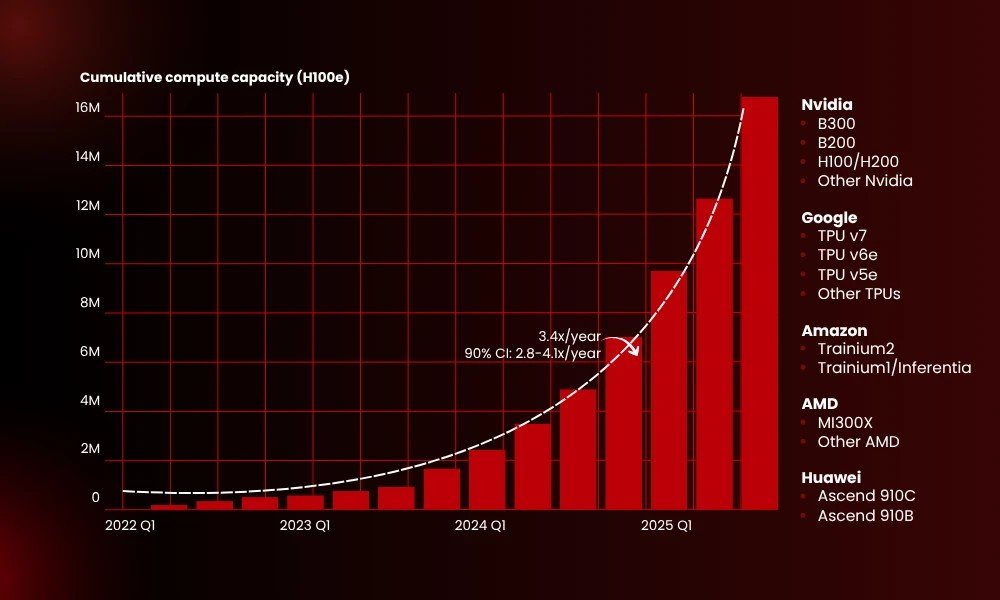
Source: EpochAI
This shift didn’t happen overnight. ChatGPT, back in 2022, often failed to capture the essence of user queries, gave inaccurate and incomplete answers, hallucinated more, and often refused to work at all. There was a lot of skepticism as to how useful it can be, especially for the hard-nosed B2B buyers who are always comparing options, analyzing, and often trying before buying.
However, with each new version of chatbots, whether ChatGPT, Claude, Perplexity, or others, their capabilities to answer human questions have grown. That incrementally led us to where we are today — modern buyers don’t click; they talk to their AI assistants. According to research conducted by Forester, 89% of B2B buyers use generative AI in at least one area of the purchase process.
That changes the role of B2B content. Your article may influence the answer without receiving the click. Your brand may be mentioned, summarized, or ignored before the buyer ever sees your website.
For maximum visibility in an AI system, AI search optimization now has to work in two directions:
- It must help human buyers understand the topic.
- It must give AI systems clear, extractable information.
Keywords, backlinks, and other authority signals are still important in LLM SEO, but they are no longer the only kinds in town. Content must also generate enough trust to be reused in AI responses, which is one of the main goals of AI content optimization.
In other words, your content is no longer just competing for ranking. This is how AI search is changing SEO: content now competes for a place inside the buyer’s first serious conversation with AI.
Why Informational Content Gets Hit First and What to Do About It
Informational content falls prey first to AI powered search. And there is a very simple explanation for that it’s just easier for AI to compress.
Any “how-to” guide, educational article on your software, or a detailed dive into the product features on your website are just some examples of the content that AI systems can quickly summarize and digest in their answers.
The weakest spot is informational and educational content that doesn’t bring much new to a given topic. If your post simply repeats what dozens of other posts say, even using a unique language, AI systems have no reason to use it in their answers. Such content just doesn’t stand out from the crowd.
This does not mean B2B brands should stop writing educational content. That would be a panic move. Buyers still need explanations, especially in complicated markets. But those explanations need more weight now.
Some of the best practices for AI search optimization start with making your informational content more unique:
- add opinions;
- add examples;
- add mistakes people actually make;
- explain what changes for a startup, a mid-market company, or an enterprise team;
- show the reader the essence upfront (don’t bury it in the main text body).
Buyers appreciate human judgment, personal experiences and a connection with their real-life problems (offering solutions). So have AI systems grown to appreciate a unique author’s take on any given topic.
Authority Signals Matter More Than Content Volume
For years, B2B marketers were taught to publish more. The ones who wrote more articles for major publications, posted more posts on social media, and created more graphical content for Pinterest and YouTube had much better chances of winning important clients.
AI content-selection algorithms have brought one significant change to AI search optimization: volume without authority is just noise with a publishing calendar. AI crawlers don’t need another explanation or a different take on the same problem. What they need instead are clear expertise, plenty of external authority signals and reliable sources.
How Mentions, Backlinks, and Digital PR Support AI Visibility
LLM SEO cannot be achieved by publishing content and optimizing only your website. It has to be based on additional authority signals that come from outside.
It’s pretty straightforward if you extrapolate it to social life. Let’s take a quick example and a short detour.
For instance, normally, you make your opinion about a person not only based on what they say, but also on how they behave and look, right? That picture would be incomplete. You need external proof, e.g., opinions of other people, how they talk about that person, and whether they respect the person or not.
That external proof of brand authority is what modern AI systems look for in products and services. Brand mentions and the context of such mentions on other websites, backlinks from reputable sources, and the overall reputation of the brand (created by digital PR) — all these things come into play.
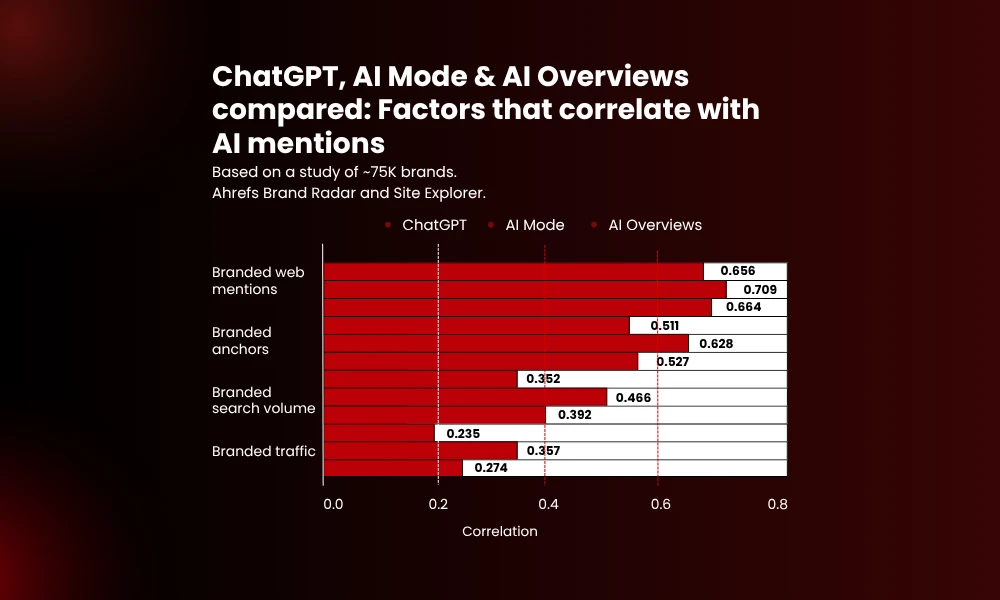
Source: Ahrefs
And like the social life analogy, in these external signals, quality matters more than quantity.
For example, a backlink from a random page means little, but contextual backlinks placed inside relevant content can strengthen topical authority much more naturally.
A dozen brand mentions on a shady or “fishy” website are worth much less than a single mention on a high-authority one (e.g., Forbes or Hubspot).
Semantic relevance is one of the most important criteria for AI search visibility. Your brand (personal or business) should appear on related resources, e.g., if you sell cosmetics, your brand should ideally appear in niche publications, where similar topics are being discussed.
How AI Systems Choose Which Brands to Cite
AI systems don’t mention brands for their popularity, alphabetical order, or simply because they “like” them. They choose based on credibility, usefulness, and match to the user’s question/query.
In general, a brand is more likely to appear when its content gives the system something solid to work with:
- clear explanations;
- consistent topic coverage;
- expert commentary;
- original examples or data;
- strong external references.
When marketers ask how to optimize content for AI search, the first answer is simple: AI systems reward clarity. If your content explains a concept in fewer and simpler words than your competitors, Gemini, Claud, or any other generative engine would take it as a basis for their AI generated answers.
Expertise is another important selection criterion. The depth of your answers, the specific language used, and the uniqueness of your insights are at play here. At the same time, achieving expertise with a single article is hardly possible. You need to consistently publish quality content on the same or adjacent topics to be seen by AI algorithms as an expert in your field.
How B2B Content Strategy Must Adapt to AI Search
Time to look more closely at the practical implications of what we have discussed so far. In particular, let’s explore how generative search optimization changes B2B content strategy.
Writing for Buyer Questions, Not Just Keywords
Keywords still matter, but they are no longer the whole game. In AI powered search, buyers rarely ask neat two-word queries. They ask full, messy, business-shaped questions. Sometimes they do it on the go, talking to their phone, sometimes during business meetings, typing as they think.
In any case, a typical buyer no longer searches for “CRM implementation.” Only the older generation remembers that finding the right keyword and pasting it into a search bar was a major success factor.
Today, modern buyers ask whether a CRM migration is worth the disruption, how long it should take, what usually goes wrong, and how to avoid annoying the sales team in the process. That is a very different kind of intent.
This means adjusting your content strategy for Google search to better match the way buyers actually think. Not the way SEO tools group keywords, but the way people describe problems when budget, risk, and internal pressure are involved.
The best content starts with the real question under the keyword. Why is the buyer asking this? What are they afraid of? What decision are they trying to make? What would help them explain the issue to their team?
Don’t just write around a term. Write around the conversation the buyer is already having in their head. And carefully proofread all your content and cut all fluff mercilessly before publishing.
Turning Product Knowledge Into Answer-Ready Content
B2B content marketers don’t have to mimic knowledge or invent something entirely new to get noticed and picked by AI search engines. In most cases, the knowledge is already there in their organizations.
It sits in sales calls, support tickets, business correspondence, project documentation, meeting notes, and in the heads of key product managers and support personnel. They just need to find ways to extract it into content that gets published.
This knowledge extraction can take many forms:
- Interviews with responsible (knowledgeable) employees.
- Analysis (involving AI if needed) of internal product documentation.
- Employee surveys.
The next key step is assigning responsible people, ideally product managers (the ones with the real knowledge about the product), to creating or fact-checking the content that gets disseminated online.
And for AI content optimization, the format of the final content is no less important. It needs to be extraction-ready, i.e., properly structured, saturated with entity information (brand and product names), and formulated in question-answer form.
To sum up, your content must send clear and strong signals to generative engines. It must be retrievable, extractable, credible, and rich in entities:
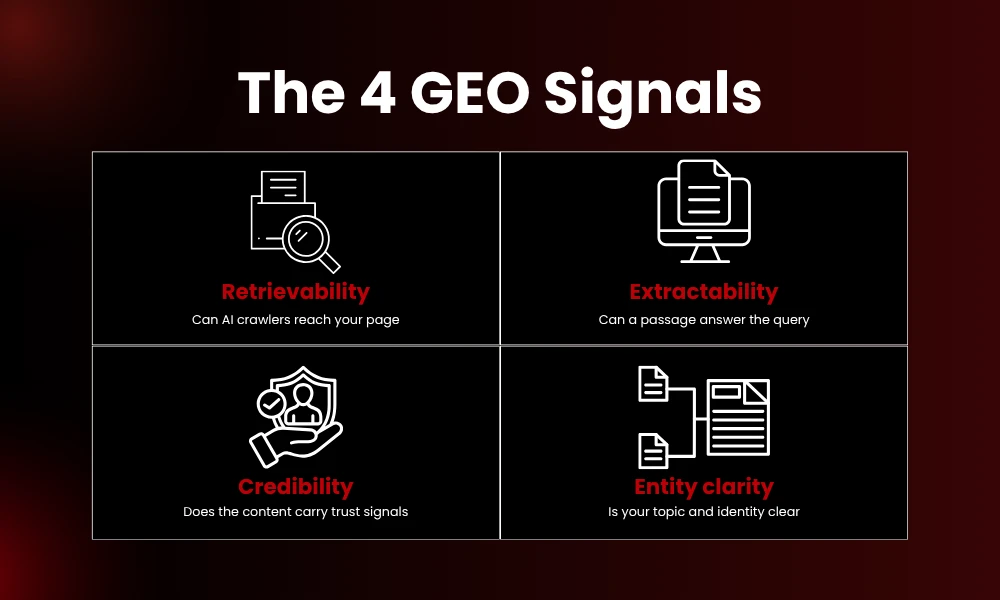
Source: we.optimizz
The Bottom Line
Online search and discovery in the B2B sector is rapidly changing in 2026, and the major force behind this change is AI. Artificial intelligence has made discovery easier, but that doesn’t mean that B2B buyers have become less curious, less analytical, or less demanding in the way they evaluate potential vendors.
For a content marketer, this shift points to several AI driven content marketing strategies that are becoming harder to ignore:
- Stop measuring content success only by clicks. Clicks are no longer the only route to your pages. Buyers increasingly rely on AI generated answers. Your goal as a B2B content marketer is to treat AI search optimization as part of the content strategy, not as a separate technical task.
- Build authority before publishing more content. You should strengthen topical authority around core themes central to your organization/business, because that’s where AI algorithms receive trust signals when picking what information to display in their answers.
- Turn internal expertise into AI-ready content. Your organization is a unique source of valuable data, insights, and experiences that play a huge role in how content is evaluated by AI search engines.
You should move away from keyword-first planning and focus on question-first planning. And in doing so, ask and answer the questions that truly concern your customers or your audience. The whole content marketing must be built around how buyers actually ask, compare, hesitate, and decide.