In early 2026, McDonald’s CEO posted a video of himself eating the new Big Arch burger.
He took a small, careful, corporate bite.
The internet destroyed him for it.
Within days, TikTok creators were mocking the delivery, calling it scripted, over-rehearsed, and painfully stiff. Parody videos flooded feeds. Then Burger King’s US president posted his own video no words, no caption, just a man taking an enormous, unapologetic bite of a Whopper. He shared his personal phone number and invited customers to give him direct feedback.
The contrast was instant. The earned media was enormous. And it cost Burger King almost nothing.
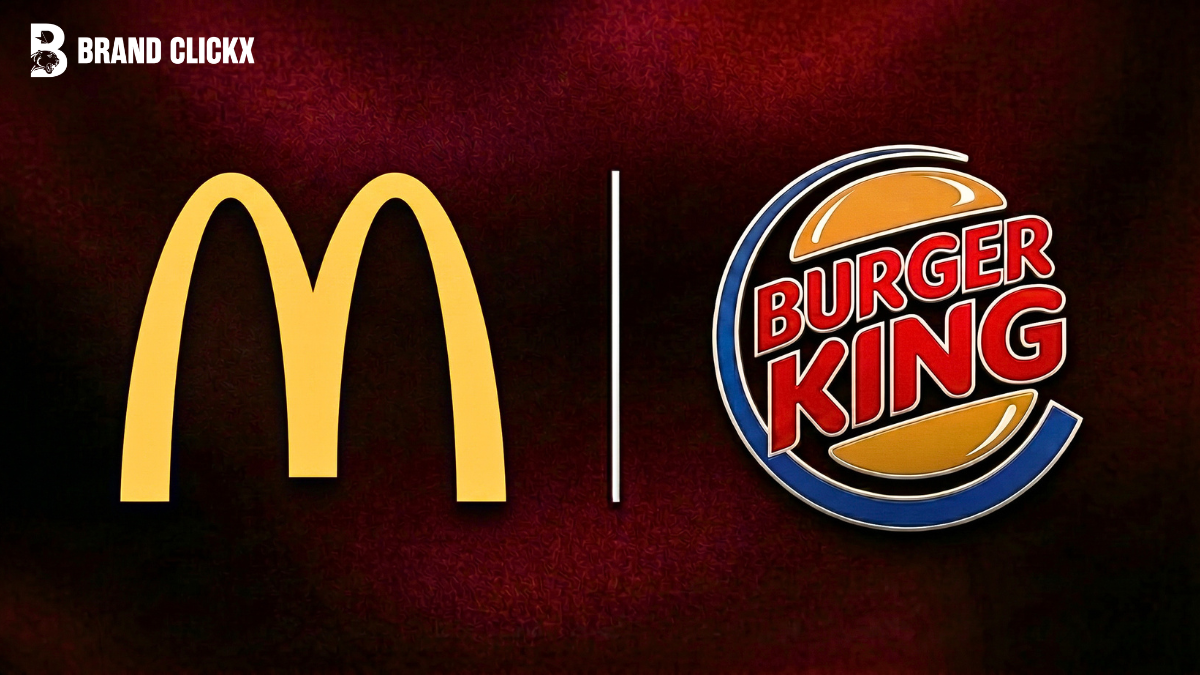
That exchange spontaneous, funny, a little petty, and genuinely revealing is the perfect lens through which to understand the world’s most studied fast food rivalry in the digital era. These aren’t just two burger chains competing for lunch orders.
They’re two radically different marketing philosophies competing for attention, cultural relevance, and brand loyalty across 70+ years of rivalry in a category where the product gap between them is genuinely narrow.
So whose social media strategy actually works?
The answer is more complicated and more instructive than you’d expect.
The Scoreboard Nobody Agrees On
Before getting into campaigns and creative strategy, let’s establish the scale gap. Because it matters enormously for how you interpret everything that follows.
McDonald’s is the runaway leader of the fast food burger market. Despite McDonald’s boasting twice as many restaurants, five times the ad budget and ten times the revenue, Burger King’s marketing innovations have had lasting impact which tells you something important right there.
These are two fast food giants with fundamentally different business models and scale and every social media decision flows directly from that structural reality.
McDonald’s delivered system-wide sales of nearly $140 billion, up 5.5% in constant currency for the full year. That scale is almost incomprehensible.
It means every McDonald’s social media campaign, every celebrity partnership, every viral moment operates at a reach and frequency that Burger King simply cannot match through paid amplification.
Burger King, meanwhile, is in the middle of a genuine turnaround. Burger King invested $400 million over its Reclaim the Flame plan, comprising $150 million in advertising and digital investments and $250 million for a Royal Reset involving restaurant technology, kitchen equipment, building enhancements, and high-quality remodels.
The chain’s growth outpaced the broader QSR market in nine of the prior 12 quarters. The turnaround is working.
But Wendy’s actually holds the number two spot in the US fast food burger space. Burger King, the brand that spent decades billing itself as McDonald’s main rival, is technically in third place.
Understanding that context matters because every Burger King social media decision is made by a brand fighting on two fronts simultaneously: trying to close the gap on McDonald’s while also reclaiming second place from Wendy’s.
That pressure, paradoxically, is what makes Burger King’s marketing so creatively interesting.
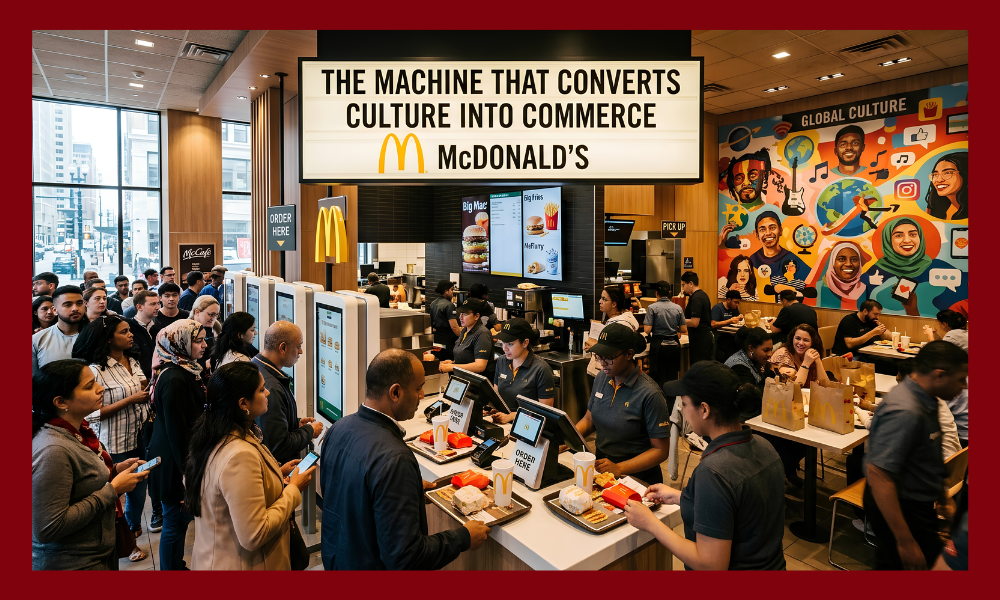
McDonald’s: The Machine That Converts Culture Into Commerce
How McDonald’s Thinks About Social Media
McDonald’s is not trying to be the most creative brand on the feed. It’s trying to be the most culturally embedded brand in the feed present in the moments consumers are already having, rather than manufacturing moments they haven’t asked for.
The shift happened gradually and then all at once with the Famous Orders franchise.
The idea was deceptively simple and brilliantly observed: no matter how famous you are, everyone has a McDonald’s order. The brand didn’t need to borrow celebrity credibility it just needed to surface the authentic McDonald’s relationship that celebrities already had.
The strategy debuted in McDonald’s 2020 Super Bowl commercial, featuring the go-to orders of Patrick Mahomes, Kim Kardashian, Kanye West, and Garth Brooks. Then, in September 2020, it went live in restaurants.
The Travis Scott Meal: When Social Media Becomes Supply Chain Disruption
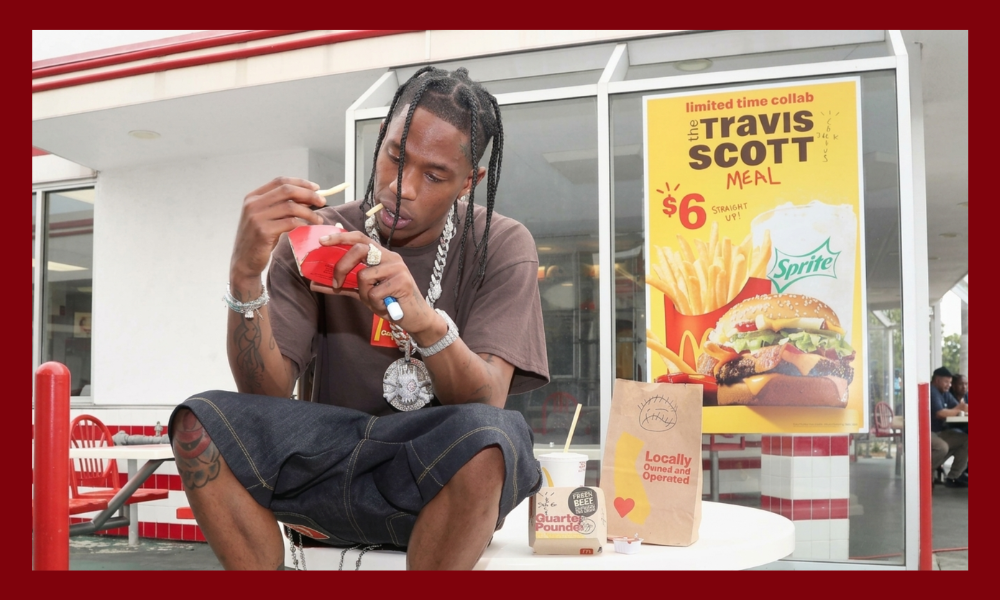
The Travis Scott Meal is the most analyzed QSR campaign of the last decade and it earns that attention.
The Travis Scott Meal, the first celebrity-named item on McDonald’s menu since the McJordan Special in 1992, doubled Quarter Pounder sales in its first week and trended #1 on Twitter, according to Marketing Dive. McDonald’s saw an 11% gain in US app installs in a single week.
The campaign generated 850 million PR impressions and 2.1 billion social reach. Within eight days of launch, McDonald’s ran out of ingredients at many franchises nationwide.
That last detail is the one people overlook. When your marketing campaign causes a supply chain crisis, you haven’t just run a good campaign. You’ve created demand that outpaced the physical capacity of the most operationally sophisticated food service company in the world.
That’s not social media success. That’s social media as a business-critical function.
What made it work wasn’t the budget McDonald’s spent an estimated $6.8 million on digital and social advertising during the campaign window, which is modest at this scale. What made it work was authenticity. Scott grew up in Houston eating that exact meal at McDonald’s.
He’d posted about his McDonald’s order on social media long before any partnership existed. The campaign made something real feel real, which is far harder to engineer than it looks.
Industry Impact: The Travis Scott Meal permanently established the template for culturally embedded celebrity partnerships in fast food. Not borrowed credibility shared credibility. Find someone who actually loves your brand, then amplify that love rather than manufacturing it.
The Grimace Shake Moment: When McDonald’s Lost Control and Won Anyway
Not every McDonald’s social moment was engineered in a planning meeting. Some of them just happened.
In 2023, McDonald’s introduced the Grimace Birthday Shake a purple, berry-flavored limited-edition drink to celebrate the character’s birthday. It was a nostalgic, friendly, brand-consistent product launch. Nothing controversial.
Then TikTok took over.
Creators started filming “Grimace Shake horror” videos staged scenes where a character drinks the shake and wakes up in disturbing situations. The trend was absurdist, completely divorced from McDonald’s intent, and wildly viral.
McDonald’s response was to lean in with humor rather than panic. The brand acknowledged the trend, played along, and watched the shake become one of the most talked-about limited-time items in its history.
This is what modern social media management actually looks like at scale. You don’t control the narrative you participate in it intelligently.
McDonald’s and the Feed Algorithm
TikTok and Instagram have genuinely reshaped how McDonald’s interacts with food culture. Menu hacks consumer-invented combinations of existing McDonald’s items go viral on TikTok regularly.
In several cases, McDonald’s has turned these viral creations into official limited-time menu items. The brand now closely monitors social trends when planning menu launches.
Recent online buzz surrounding the Big Arch burger launch is a direct example. As users posted memes, reactions, and food reviews, the burger gained global attention before McDonald’s had spent a significant dollar of paid media on it. Everyday social media users drove the conversation first.
This is McDonald’s social advantage in 2026. Its brand is so deeply embedded in everyday consumer life that any new product launch generates organic social response before the paid media even kicks in. The challenge isn’t generating attention it’s shaping it.
Burger King: The Underfunded Genius That Keeps Winning Creative Awards
Why Being the Underdog Is a Marketing Asset
Here’s what most brands miss when they look at Burger King’s social media strategy: the disadvantage is the strategy.
McDonald’s has five times the advertising budget. Every dollar Burger King spends on paid media, McDonald’s can answer with five. If Burger King tried to out-spend McDonald’s on awareness and reach, it would lose every time.
So it doesn’t try.
Instead, Burger King invents creative that earns the reach it can’t buy. It picks fights that cost almost nothing to start but generate enormous earned media responses.
It uses the David-and-Goliath dynamic not as a handicap but as a brand narrative the scrappy challenger taking shots at the global giant with a wink and a geolocated coupon.
That challenger identity has produced some of the most awarded marketing in QSR history. And it’s produced results that far exceed what the media budget should have been able to deliver.
The Whopper Detour: Geofencing as Competitive Strategy
The Whopper Detour is the canonical Burger King social campaign and understanding why it worked explains everything about the brand’s digital philosophy.
In December 2018, Burger King used mobile geofencing to offer a Whopper for one cent to anyone within 600 feet of a McDonald’s location. Order through the app, and it directed you away from McDonald’s to the nearest Burger King to collect your food.
The mechanic was simple. The brand statement was devastating. Burger King was essentially saying: we’re so confident in our burger that we’ll use your proximity to our competitor to remind you we exist and pay you to switch.
The Whopper Detour drove 1.5 million app downloads overall, briefly made Burger King’s app the most downloaded in the Apple App Store, and won Campaign of the Year awards across the industry.
The campaign successfully matched a creative advertising concept with technological excellence, turning a competitive disadvantage fewer locations, lower traffic into a campaign mechanic.
The lesson here isn’t “use geofencing.” The lesson is: your competitor’s strength can be the raw material for your disruption. McDonald’s huge store count became the triggering condition for Burger King’s campaign. The bigger the target, the more visible the shot.
The Moldy Whopper: The Ad That Made People Want to Buy a Rotting Burger
In February 2020, Burger King released a 34-second time-lapse video of a Whopper decomposing over 34 days.
Not stylized decomposition. Real mold. Real rot. Growing visibly, spreading across the bun, creeping over the patty. The tagline: “The Beauty of No Artificial Preservatives.”
It is genuinely disgusting. And it generated over 8.4 billion organic impressions, boosted sales by 14%, increased awareness of the removal of artificial preservatives by 400%, and drove positive brand sentiment up 88%.
It won the Grand Prix at Cannes Lions International Festival of Creativity, the One Show Best of Show, and a pile of other industry awards.
Burger King’s CMO Fernando Machado later revealed they’d sat on the idea for years deliberately waiting until the product promise was completely delivered before making the creative public. They didn’t run the ad until Burger King was genuinely, verifiably preservative-free. The product had to earn the campaign.
That sequencing product reality first, creative claim second is what separated Moldy Whopper from a cynical marketing stunt. It was a campaign that could only work because the underlying claim was true.
Expert Insight: The Moldy Whopper is the most important QSR creative of the last decade not because of the shock value, but because it reframed the competitive conversation entirely. McDonald’s was suddenly the brand defending its ingredient choices. Burger King was the brand brave enough to show real food doing what real food does.
The TikTok CEO Bite: When Speed Beats Budget
The 2026 CEO bite moment is the most recent example of Burger King’s social instincts in action and it’s worth unpacking in detail.
McDonald’s CEO posted an executive taste-test video of the new Big Arch burger. The video spread quickly on TikTok, Instagram, and X not because of the burger, but because of the delivery. Audiences mocked the corporate stiffness of the bite.
An Irish comedian’s TikTok parody amplified the mockery significantly. The conversation turned the launch into a lighthearted embarrassment.
Burger King didn’t plan this. It just moved fast.
Burger King recently went viral by mocking a video posted by chief rival McDonald’s, with the new agency partnership claiming credit for a TikTok video showing Burger King President Tom Curtis taking a big, genuine bite of the revamped Whopper.
Curtis shared his personal phone number, invited direct customer feedback, and redirected the spotlight to Burger King’s updated Whopper recipe without ever mentioning McDonald’s by name.
The post gathered 235,000 likes on TikTok. The brand spent almost nothing. The earned media was enormous.
The real sophistication here is the restraint. Burger King didn’t explicitly say “our CEO is better at eating than yours.” It didn’t need to. The internet drew the connection itself, and the conversation it generated was far more credible than anything Burger King’s media budget could have bought.
That’s the whole lesson. Speed and social intelligence are worth more than production budgets in moments like this.
Head-to-Head: The Social Media Stack Comparison
| Dimension | McDonald’s | Burger King |
| Social strategy type | Scale + cultural embedding | Disruption + earned media |
| Budget advantage | 5x advertising spend | Operates at significant disadvantage |
| Celebrity approach | Authentic fan partnerships | Cultural moment capture |
| Platform tone | Aspirational, inclusive, playful | Provocative, self-aware, challenger |
| Best campaign (last 5 years) | Travis Scott Famous Order | Moldy Whopper / Whopper Detour |
| Best viral moment (2026) | Big Arch launch (accidental) | CEO Whopper bite (reactive) |
| Awards credibility | Solid | Industry-leading (Cannes Grand Prix) |
| App engagement | 11% installs spike on Travis Scott launch | 1.5M downloads on Whopper Detour |
| Sales conversion from social | Consistent (Famous Orders drove sell-outs) | Strong spikes (Moldy Whopper +14% sales) |
| Real-time agility | Moderate (scale creates slower decisions) | High (challenger mindset = faster pivots) |
The Bigger Shift: What This Rivalry Reveals About Social Media Strategy in 2026
The Authenticity Premium Has Never Been Higher
Both brands have learned the same lesson from different directions: manufactured content underperforms genuine content at a rate that no paid media budget can fully compensate for.
McDonald’s Travis Scott campaign worked because Scott was a real fan before he was a paid partner. Burger King’s CEO bite worked because Tom Curtis looked like a person who actually wanted to eat that burger.
McDonald’s CEO’s video faltered because it looked exactly like what it was: an executive doing marketing homework.
This is the defining social media marketing lesson of the current era. Audiences in 2026 have been conditioned by a decade of influencer content, behind-the-scenes brand access, and creator-native storytelling to detect inauthenticity almost instantly. The moment something feels scripted, the meme-making begins.
The brands that win on social aren’t the ones with the most polished content. They’re the ones whose content feels like it came from a person who genuinely cares about the thing they’re talking about.
Platform-Native Behavior Beats Platform-Adapted Advertising
TikTok rewards content that feels native to the platform raw, quick, reactive, human-toned. Instagram rewards visual quality, aspiration, and styled shareability. Neither platform rewards traditional advertising formats adapted for digital distribution.
Both McDonald’s and Burger King have learned this. McDonald’s menu hack adoption turned user-created content into official product strategy. Burger King’s CEO bite post was filmed in what looked like a hallway, not a studio. Both are deliberately platform-native in format.
The mistake that McDonald’s CEO’s Big Arch video made wasn’t the concept executives eating their own food is fine content. It was the execution. It felt like a TV commercial squeezed into a TikTok. The platform noticed.
Strategic Breakdown: Platform-native content isn’t a production format. It’s a performance style. It means thinking like a creator, not like an advertiser. And it means giving up a degree of polish in exchange for a much higher degree of believability.
The SpongeBob Play: Burger King’s Pop Culture Franchise Model
Burger King’s latest cultural play deserves specific attention because it signals a newer dimension of its social strategy.
The SpongeBob SquarePants collaboration in late 2025 featuring a Krabby Whopper with a square yellow bun alongside cheesy bacon tots and a frozen pineapple float pushed kids meal sales to their highest level in over a decade.
The campaign worked across demographics: nostalgia-laced Gen Z humor on social media, genuine appeal to children in-store, and enough absurdist energy to generate organic sharing.
It also addressed a real commercial pressure: in the ongoing fast food pricing battle, McDonald’s, Burger King, and Wendy’s are each fighting hard for the cost-conscious consumer, and culturally resonant limited-time offers are one of the most effective ways to create perceived value without a price cut.
This is Burger King learning from McDonald’s pop culture playbook. McDonald’s has the Famous Orders franchise. Burger King is building its own version limited-time cultural collaborations tied to entertainment properties, launched with enough social noise to carry them beyond paid reach.
The SpongeBob activation was more than a kids’ menu play. It was a proof of concept for a broader cultural franchise strategy that Burger King will likely accelerate.
Tactical Framework: What Every Brand Can Steal
From McDonald’s
- Find the authentic fan first, then build the campaign around them. The Travis Scott Meal worked because McDonald’s started with a genuine cultural relationship and amplified it not because it looked for a celebrity and manufactured a story. The authenticity was upstream of the creative.
- Turn UGC from noise into product strategy. McDonald’s now monitors social media trends when planning menu launches. When a hack goes viral, the brand considers making it official. That loop from consumer creativity to product reality is one of the most powerful organic marketing engines in the industry.
- Build a franchise, not just campaigns. Famous Orders is a repeatable creative platform, not a one-off campaign. It can be activated quarterly with different partners, scaled globally, and adapted to local markets. Platform-level thinking beats campaign-level thinking every time at scale.
- Let memes happen to you gracefully. The Grimace Shake horror trend was unprompted and slightly unsettling. McDonald’s leaned in with humor. That’s the right posture. Trying to suppress organic social behavior around your brand doesn’t work joining it intelligently is far more valuable.
From Burger King
- Turn your competitor’s scale into your campaign mechanic. The Whopper Detour’s genius was using McDonald’s ubiquity as a triggering condition. The more McDonald’s there are, the more opportunities for the campaign to fire. Your biggest competitor’s dominance can be the raw material for your disruption.
- Make the product earn the campaign before you run it. Burger King waited years to run the Moldy Whopper until the preservative-free claim was fully delivered. The campaign’s credibility came from the product truth behind it, not the creative. When the claim is real, the boldness lands. When it isn’t, it backfires.
- Real-time agility beats production quality in cultural moments. The CEO bite post was filmed fast, posted fast, and earned massive returns. In reactive social situations, the first credible response wins more than the most polished response. Speed is a creative advantage.
- Pick fights that generate conversations you’d win either way. Burger King’s competitive trolling is so self-aware that even when McDonald’s doesn’t respond, Burger King looks good. When McDonald’s does respond, Burger King looks even better. Designing provocations where you win the attention game regardless of outcome is a genuine art form.
Enterprise Perspective: What CMOs Are Watching
Marketing leaders across QSR, retail, and consumer goods are studying this rivalry for the same reason they study Pepsi and Coca-Cola, it’s the cleanest real-world A/B test of two fundamentally different social media philosophies at scale.
McDonald’s represents the consistency-at-scale model: a clear creative platform (Famous Orders), deep investment in mobile and app engagement, authentic celebrity partnerships that convert pop culture into purchase behavior, and a social listening infrastructure that turns consumer creativity into product strategy.
Burger King represents the agility-with-constraints model: using limited budget to manufacture moments that earn disproportionate attention, picking creative fights with structurally superior returns, and deploying challenger energy not as a positioning claim but as an operational ethos.
Why It Matters: Most brands sit somewhere between these two models too big to be purely reactive, too small to dominate through sheer reach. Understanding where on the spectrum each of McDonald’s and Burger King’s tactics applies to your own brand is the practical takeaway from this rivalry.
The data is unusually clean. Both brands operate in the same category, same consumer market, same social platforms. The divergence in tactics is a controlled experiment in what different levels of budget, different brand postures, and different risk tolerances produce on social media.
What Happens Next
McDonald’s social strategy will continue deepening the Famous Orders franchise the platform is too proven, too scalable, and too well-aligned with the brand’s pop culture ambitions to slow down. Expect more celebrity collaborations, more limited-edition cultural moments, and a growing emphasis on using social moments to drive app downloads and loyalty program engagement.
The bigger McDonald’s story in 2026 is what happens after the Big Arch CEO video moment. Whether the brand responds by increasing the authenticity of its executive social presence or retreating to safer, more produced content will tell you a lot about how deeply the lesson landed.
Burger King is entering a genuinely exciting phase. The Reclaim the Flame investment is producing results. The new agency relationships are producing creative that cuts through. The SpongeBob collaboration proved the cultural franchise model works. Franchisees voted to continue the elevated advertising fund contribution through at least 2027 a direct vote of confidence from the people with the most at stake.
The question for Burger King isn’t whether the turnaround is working. It clearly is. The question is whether the brand can maintain the creative discipline and challenger energy that produced the Whopper Detour, the Moldy Whopper, and the CEO bite, as its scale, its budget, and its institutional confidence grow. The irony of challenger marketing is that it gets harder to execute as you become less of a challenger.
The Burger War, for the first time in decades, is genuinely competitive again.
Key Takeaways
- McDonald’s wins at scale. Burger King wins at creativity. Both are winning. McDonald’s $140 billion system-wide sales dwarfs Burger King’s footprint. But Burger King’s Cannes Grand Prix, its Whopper Detour downloads, and its viral CEO moment prove you don’t need a bigger budget to own a cultural conversation. Different wins on different metrics.
- Authenticity upstream of creative is the single most important social marketing lesson this rivalry teaches. Travis Scott already loved McDonald’s before the deal. The Moldy Whopper waited for the product to actually be preservative-free before claiming it. Burger King’s CEO bite worked because it looked like a person who wanted to eat that burger. In every case, the truth came first.
- The Whopper Detour is the most instructive QSR campaign of the last decade. Not because of geofencing the technology is a tactic. Because it turned a competitor’s strength into the campaign mechanic. Every brand operating from an underdog position should study how that inversion was designed.
- Real-time social agility is worth more than production budgets in reactive moments. Burger King’s CEO bite cost almost nothing and generated enormous earned media. McDonald’s most successful social moments often emerge from fan-driven behavior the brand didn’t plan. Speed and willingness to participate are the scarce resources, not money.
- Social media is now a product strategy input, not just a marketing channel. McDonald’s turns viral menu hacks into official products. Burger King uses social listening to inform campaign timing and product positioning. The brands that treat social media as a two-way intelligence system rather than a broadcast channel consistently outperform those that don’t.
- Platform-native execution is non-negotiable at every level of the organization. The McDonald’s CEO Big Arch video failed not because it was a bad idea but because the execution felt alien to TikTok’s culture. Executive content, product launches, brand announcements everything needs to be designed for the platform, not adapted to it.
- Challenger energy is a marketing asset that depreciates as you grow. Burger King’s best work comes from its underdog posture. As the Reclaim the Flame plan succeeds and the brand grows, maintaining that energy will require intentional creative discipline. The most dangerous outcome of winning is starting to act like the market leader.
Conclusion
McDonald’s and Burger King have been fighting over the same customers since 1954. For most of that time, the winner was obvious: McDonald’s had the locations, the budget, the brand recognition, and the operational machine that no competitor could match.
What’s changed in the social media era is that the factors which used to guarantee dominance distribution scale, advertising spend, global reach have become necessary but not sufficient. In a world where a single TikTok video from a brand president can generate more cultural impact than a $10 million campaign, the game has changed.
And Burger King, of all brands, was uniquely positioned to win in this new environment. It had spent decades developing the challenger instinct. It had learned to turn budget constraints into creative constraints that produced better work. It had built a brand identity, provocative, self-aware, unafraid to be weird that happens to be perfectly suited to social media’s native culture.
McDonald’s isn’t losing. It’s still the biggest, most valuable, most operationally excellent fast food company in the world. Its Famous Orders franchise is one of the best celebrity marketing platforms in any consumer category. Its social listening infrastructure is genuinely sophisticated.
But McDonald’s is no longer unbeatable on the feed.
That’s new. And for every marketer watching this rivalry, it’s a more important fact than any sales figure.
Because what it means is that a brand with the right instincts, the right agility, and the genuine courage to pick the right fights can compete with anyone on social media regardless of what the budget spreadsheet says.
In 2026, the Burger War is the best free marketing education available.
Pay attention.
FAQ: McDonald’s vs. Burger King Social Media
Q: Who has a better social media strategy McDonald’s or Burger King?
Both win on different dimensions. McDonald’s wins at scale its Famous Orders franchise and celebrity meal partnerships consistently drive app downloads, viral moments, and direct sales. Burger King wins at disruption its Whopper Detour, Moldy Whopper, and real-time trolling campaigns generate an outsized share of cultural conversation relative to its budget. Which “works” depends on what you’re measuring.
Q: What was the Burger King Whopper Detour campaign?
Launched in December 2018, the Whopper Detour used mobile geofencing to offer a Whopper for one cent, but only to customers within 600 feet of a McDonald’s location. After ordering through the app, customers were directed to the nearest Burger King to collect their food. It drove 1.5 million app downloads, briefly made Burger King’s app the most downloaded in the App Store, and is widely considered one of the most creative uses of location-based marketing in QSR history.
Q: How did McDonald’s Travis Scott meal campaign perform?
The Travis Scott Meal doubled Quarter Pounder sales in the first week, trended #1 on Twitter, drove an 11% gain in US app installs, generated 2.1 billion social reach, and caused McDonald’s to run out of ingredients at many franchises within eight days of launch, one of the most successful celebrity partnership campaigns in fast food history.
Q: What is Burger King’s Reclaim the Flame strategy?
Launched in September 2022, Reclaim the Flame is Burger King’s multiyear turnaround plan backed by $400 million in investment, $150 million in advertising and digital, $250 million in restaurant technology and remodels. By 2025, Burger King’s growth had outpaced the broader QSR market in nine of the prior 12 quarters.
Q: What can marketers learn from this rivalry?
The core lessons: challenger brands must create their own playing field; authenticity in celebrity partnerships compounds their impact; real-time cultural agility is a budget multiplier; and the most dangerous social media moment is often someone else’s content that creates an opening for you to respond.
Q: What is the difference between the Whopper and the Big Mac?
The Whopper uses a larger flame-grilled beef patty with fresh vegetables, while the Big Mac uses two smaller patties with a signature special sauce and a middle bread layer. The key differentiator is cooking method flame-grilling defines Burger King’s brand identity and the Whopper’s flavor profile. Consumer preference between them is largely driven by brand habit rather than taste superiority.