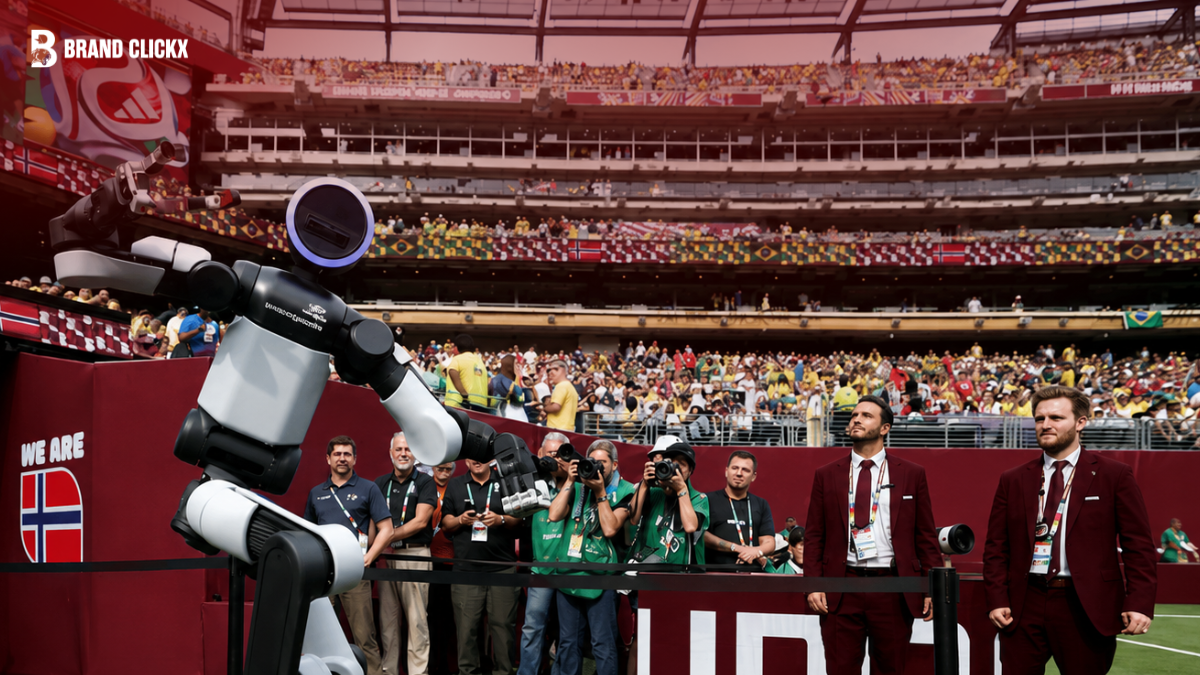
A robot walked out of the player tunnel at the FIFA World Cup. The stadium went quiet for a second, then erupted.
On July 5, 2026, Hyundai Motor Company made history at New York/New Jersey Stadium bringing a humanoid robot onto the world’s biggest sporting stage for the very first time. Here’s everything you need to know about what happened, the technology behind it, the campaign strategy, and what it means for sports marketing.
AI Overview
Hyundai Motor Company, as the Official Robotics Partner of FIFA World Cup 2026, deployed Atlas an advanced humanoid robot developed by Boston Dynamics in the first-ever robotics-powered halftime activation in World Cup history. The activation took place on July 5, 2026, during the Round of 16 match between Brazil and Norway at New York/New Jersey Stadium in East Rutherford, New Jersey.
At halftime, Atlas emerged from the player tunnel and performed iconic goal celebrations inspired by Harry Kane, Erling Haaland, Matheus Cunha, and Son Heung-min then delivered the ceremonial match ball to the referee to restart the second half. The performance was powered by three core robotics capabilities: Retargeting Technology, Reinforcement Learning, and Whole-Body Control.
The activation marked two significant industry milestones: the first public demonstration of the production version of Atlas (first introduced at CES 2026), and the first-ever integration of a humanoid robot into a live FIFA World Cup match environment. It sits within Hyundai’s broader “Next Starts Now” global campaign and advances the brand’s “Progress for Humanity” vision.
Key Takeaways
| # | Detail | Fact |
| 1 | Date of activation | July 5, 2026 |
| 2 | Match | Brazil vs Norway — FIFA World Cup Round of 16 |
| 3 | Venue | New York/New Jersey Stadium, East Rutherford, NJ |
| 4 | Hyundai’s role | Official Robotics Partner, FIFA World Cup 2026 |
| 5 | Robot deployed | Atlas, developed by Boston Dynamics |
| 6 | What Atlas did | Performed goal celebrations, delivered ceremonial match ball to referee |
| 7 | Celebrations mimicked | Harry Kane, Erling Haaland, Matheus Cunha, Son Heung-min |
| 8 | Three core technologies | Retargeting Technology, Reinforcement Learning, Whole-Body Control |
| 9 | First at World Cup | First-ever humanoid robot integration in a live FIFA World Cup match |
| 10 | “School of Football” TikTok | 10 million+ views per video in pre-event content series |
| 11 | Documentary film | “The Training Ground” — released July 7, 2026 |
| 12 | Agency | INNOCEAN USA |
| 13 | CMO quote | Sungwon Jee, EVP and Global CMO, Hyundai Motor Company |
| 14 | Spot robots also deployed | Hyundai’s dog-inspired Spot robots used for security at select venues |
What Happened: The Activation, Minute by Minute
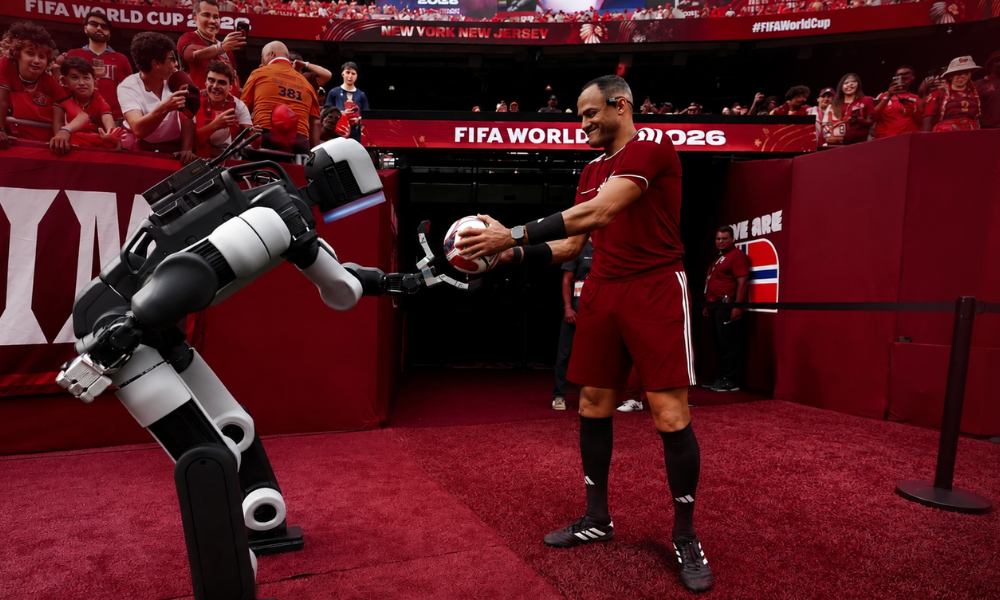
The match between Brazil and Norway paused at halftime. As the two sides left the pitch, the audience at New York/New Jersey Stadium and the millions watching on broadcast globally waited for something to fill the break.
What they got wasn’t a musical act or an ad reel. It was a humanoid robot emerging from the player tunnel.
Atlas, Hyundai Motor Company’s Boston Dynamics-developed humanoid robot, walked onto the pitch. It performed a sequence of goal celebrations drawn directly from the signature moves of some of football’s most recognizable players Harry Kane’s controlled bow, Erling Haaland’s meditation pose, Matheus Cunha’s gesture, and Son Heung-min’s signature celebration. Each move was fluid, balanced, and executed without stumbling on live television before a full stadium and a global broadcast audience.
Following the celebration sequence, Atlas carried the ceremonial match ball across the pitch and delivered it to the head referee, signaling the start of the second half. A handoff that any human ball boy could complete in seconds became one of the most-discussed moments of the entire tournament weekend.
According to Hyundai’s announcement, though an operator sends commands to initiate Atlas’s actions, the robot’s balance, movement, and recovery are driven entirely by its own capabilities not remote control of individual movements.
The Technology: How Atlas Actually Did This
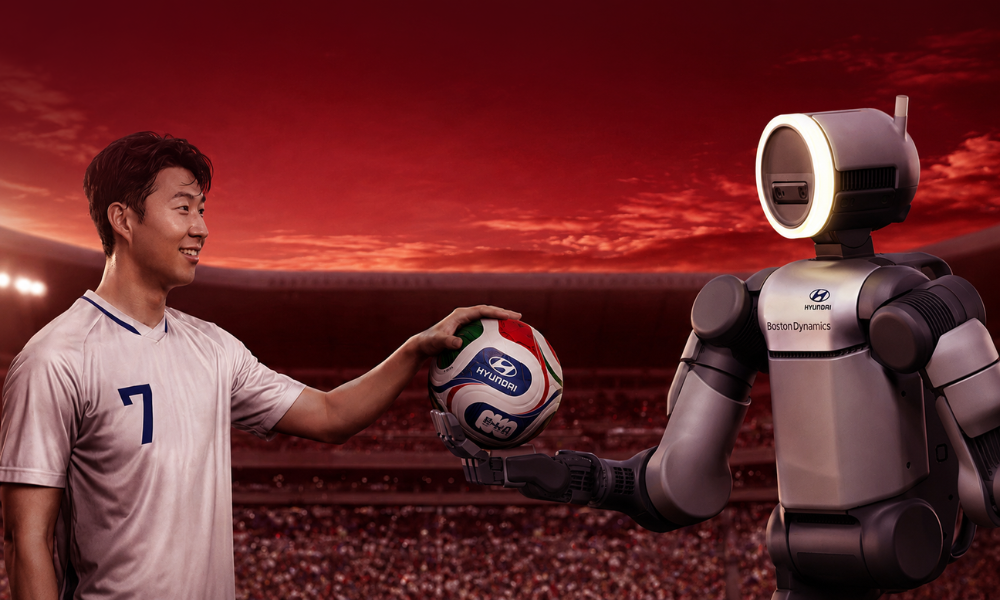
The activation looked effortless. It wasn’t. Atlas’s halftime performance required months of technical preparation and three interlocking robotics capabilities working simultaneously.
Retargeting Technology
Human movements — the goal celebrations of real footballers were captured and mapped onto Atlas’s robotic frame. This process, called motion retargeting, translates the proportions, joint angles, and timing of a human’s gesture into movement instructions that Atlas’s different body architecture can execute.
It’s the same principle that underlies motion capture in film and video games, but applied to a real-time robotic system that has to maintain balance while performing. Getting Erling Haaland’s meditation pose right on a bipedal robot requires solving the balance and weight distribution problems from scratch, not just copying the visual movement.
Reinforcement Learning
Before Atlas stepped onto the World Cup pitch, it ran through the same movements thousands of times in simulation. Reinforcement learning allows Atlas to practice movements in a virtual environment, receiving feedback on what works and what doesn’t, adjusting its approach until the behavior is reliable enough for live deployment.
Alberto Rodriguez, Director of Robotics Behavior at Boston Dynamics, explained the approach directly: “The way we trained Atlas to perform these fun movements at the match is similar to how we teach the robot to take on real-world industrial applications. It’s a great way to introduce people everywhere to the incredible potential of today’s AI-enabled robots.”
This is a critical point. The World Cup performance wasn’t a parlor trick separate from Atlas’s real capabilities. It was trained the same way Atlas learns industrial tasks the difference is the task was celebrating a goal rather than handling a component on a factory floor.
Whole-Body Control
Whole-body control is the real-time coordination system that keeps Atlas balanced and fluid while in motion. It coordinates movement across the robot’s entire body simultaneously adjusting posture, weight distribution, and joint positions in real time to maintain stability during dynamic, unpredictable movement.
Without whole-body control, performing a celebration sequence and then walking across a pitch carrying a ball would be impossible. The system is what makes Atlas’s motion look fluid rather than mechanical the same technology that has made Boston Dynamics’s robots famous across years of viral videos, now applied on the world’s biggest stage.
The Campaign: “Next Starts Now” and the Road to the World Cup
The Bigger Platform
The halftime activation didn’t exist in isolation. It was the climax of a carefully constructed multi-channel campaign built by Hyundai Motor Company and INNOCEAN USA the brand’s full-service agency partner.
The campaign platform is called “Next Starts Now.” Its central argument: innovation isn’t something you describe. It’s something you demonstrate. Sungwon Jee, Hyundai’s Executive Vice President and Global Chief Marketing Officer, articulated the strategy plainly: “Rather than talking about innovation, we wanted to demonstrate it at the biggest scale possible.”
The “Next Starts Now” campaign connects communities through football while using Atlas as its most visible proof point the clearest possible demonstration that Hyundai’s “Progress for Humanity” vision is moving from philosophy to reality.
School of Football: Building Atlas’s Audience Before the Stage
One of the most strategic elements of the entire campaign is what happened before July 5.
Hyundai launched a TikTok content series called “School of Football” a running narrative of Atlas learning to play football. The series documented the robot attempting different football moves, failing, trying again, and gradually improving. It was charming, human, and shareable — and it pulled over 10 million views per video.
The strategic logic was clear. By the time Atlas appeared at the World Cup, it already had an audience. Fans had followed its preparation. They had a relationship with the robot a sense of having watched it work toward this moment. The halftime appearance read as a payoff to a story already in progress, not a stunt dropped from nowhere.
This sequencing building audience in low-stakes environments before the high-stakes reveal is one of the most underappreciated elements of the entire campaign. It transformed a single activation into the climax of an ongoing narrative.
Hyundai also paired Atlas with Son Heung-min and five rising young players from clubs in the US, England, Argentina, and Brazil as part of the broader “Next Starts Now” content strategy connecting the robot to football’s human community rather than positioning it as separate from it.
The Training Ground Documentary
On July 7 — two days after the halftime activation Hyundai and BBC StoryWorks Commercial Productions released “The Training Ground,” a documentary-style film detailing Atlas’s technical preparation for the World Cup.
Produced in a 3.5-minute full-length version and a 30-second cutdown, the film extends the campaign beyond the live moment, giving audiences who missed the activation context, and giving those who saw it a deeper story. It’s the activation’s second act the content that turns a moment into a memory.
Spot at the World Cup: Hyundai’s Second Robotics Deployment
Atlas wasn’t the only Boston Dynamics robot Hyundai brought to the FIFA World Cup 2026. Hyundai also deployed Spot Boston Dynamics’s four-legged dog-inspired robot for security and asset protection operations at select venues during the tournament.
Spot’s application is quieter and more operational than Atlas’s performance role, but it serves the same strategic purpose: demonstrating that Hyundai’s robotics portfolio has real-world functional applications today, not just demonstration value for cameras.
The dual deployment underlines the breadth of Hyundai Motor Group’s robotics ambitions. One robot captures global attention on the pitch. Another secures the stadium perimeters behind the scenes. Together, they tell a more complete story about where robotics is heading.
What the CMO Said: The Strategy Behind the Stunt
The most revealing insight into Hyundai’s strategic thinking came directly from Sungwon Jee, the brand’s Executive Vice President and Global Chief Marketing Officer.
In an interview with Adweek, Jee described the competitive context Hyundai was navigating: “We’re not just competing with other sponsors on that pitch. We’re competing with every reel, every short-form, every piece of content flooding people’s screens every second of every day. In that context, incremental creativity isn’t enough. You need a moment so undeniably real, so present, that it breaks through.”
On the activation’s role within the broader campaign: “The ball delivery isn’t a standalone moment. It’s the climax of everything we’ve been building and the point where the narrative becomes a live, real-world experience that fans around the world can see and feel. From there, the story continues across broadcast, digital, and social, extending the conversation well beyond the final whistle.”
On the brand’s broader mission: “We are committed to developing human-centered innovation that integrates seamlessly into everyday life, and to presenting a new vision of future mobility expanded through robotics showing that robotics can be a trusted partner in humanity’s progress through diverse and creative brand experiences.”
Three things stand out in that language. First, Jee explicitly frames the competition as content other activations, other posts, other media not other car brands. Second, the activation is described as a climax within a narrative structure, not an isolated marketing event. Third, the language “trusted partner” is doing specific work positioning Atlas not as a threat to human activity but as a collaborator within it.
Why This Matters: The Marketing Strategy Unpacked
The Risk Was the Point
Handing a live performance on the world’s largest sporting stage, broadcast globally, in front of a sold-out stadiu to a robot is an enormous gamble. A stumble, a malfunction, a crash would have gone viral for entirely different reasons. Hyundai knew this.
But the risk itself was part of the message. If Atlas performs flawlessly, it proves the technology works at the highest possible pressure. The World Cup wasn’t just a platform. It was a test the hardest possible environment for a live robotics demonstration, chosen deliberately.
As DesignRush’s analysis noted: “This was the gamble, and Atlas pulled it off clean. Hyundai walked into a stadium full of superstars and made a robot the thing people went home talking about.”
Performance Over Promise
Most technology marketing tells you about the future. Hyundai showed it.
The distinction matters enormously in an era of marketing skepticism. Consumers particularly younger audiences have been told repeatedly about revolutionary technology that takes years to arrive. Hyundai put a robot on a pitch. That’s not a promise. That’s evidence.
“We wanted Atlas’s performance on the world’s biggest stage to demonstrate that the future isn’t something we imagine it starts now,” Jee said in Hyundai’s official press release.
The campaign tagline “Next Starts Now” is effective precisely because the activation gives it literal meaning. The next era of robotics started at halftime on July 5, 2026.
Making Technology Human
The celebration sequence was not an accident of creative execution. It was the strategic core of the entire activation.
Atlas performed the goal celebrations of Harry Kane, Erling Haaland, Matheus Cunha, and Son Heung-min. These aren’t arbitrary movements — they’re some of the most recognizable gestures in world football, tied to specific players that a global World Cup audience already has emotional connections to. When Atlas performs Kane’s celebration, it’s not just demonstrating mobility. It’s speaking a language the audience already understands.
This is the key insight behind the activation’s design: the audience doesn’t adopt a future because it has impressive architecture. It pays attention when the future shows up inside a behavior people already understand.
Sequenced Storytelling, Not a Single Stunt
The strategic structure of the full campaign School of Football → CES 2026 introduction → halftime activation → The Training Ground documentary is a masterclass in sequenced storytelling.
Each element builds on the last. The TikTok series creates affection and familiarity. CES establishes technical credibility. The World Cup activation delivers the payoff moment. The documentary extends the conversation and gives the moment depth. None of these work as well in isolation as they do together.
“The ball delivery isn’t a standalone moment,” Jee said. It’s a structured narrative, with the halftime performance as its most visible chapter.
What This Means for Sports Sponsorship and Brand Activation
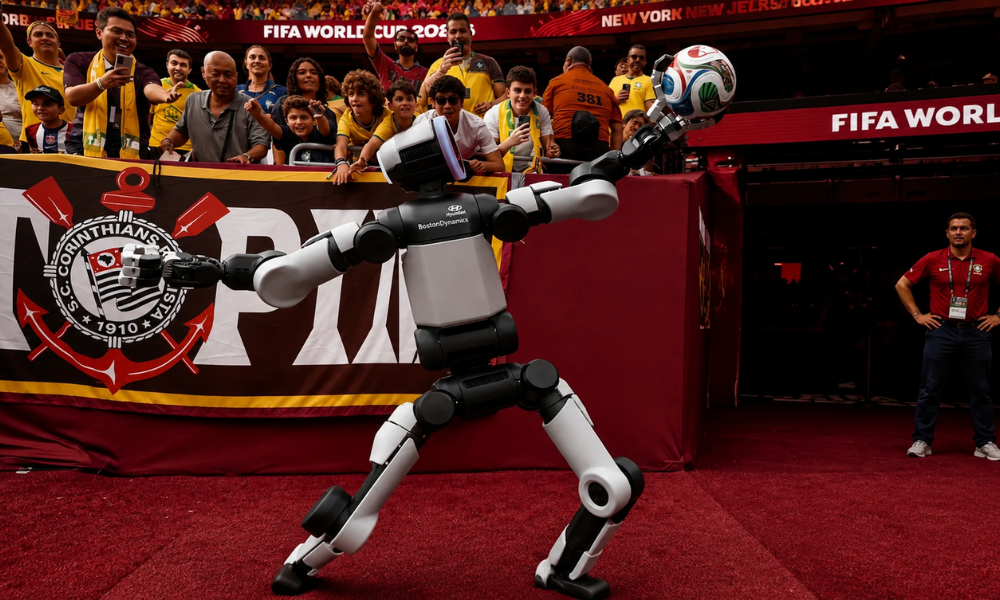
Hyundai’s World Cup robot activation is already being analyzed as a case study in experiential marketing and sports sponsorship innovation. Several things about the approach set it apart from standard FIFA sponsorship playbooks.
It used the sponsorship as proof, not just platform. Most World Cup sponsors use their official partner status to buy media exposure. Hyundai used it to demonstrate real capability. The Official Robotics Partner designation gave them access to the pitch and they filled that access with something no previous brand has done at this level.
It connected technology to human emotion. The goal celebration sequence is what made the activation memorable rather than merely impressive. A robot delivering a ball is technical. A robot doing Erling Haaland’s celebration is human. The emotional connection came from the human movements the robot was performing, not from the robot itself.
It built across channels and time. The activation generated content before (School of Football), during (broadcast and social of the live performance), and after (The Training Ground documentary). The halftime moment was the peak of an ongoing story not a standalone event.
It set a new benchmark. After July 5, 2026, every major sports sponsorship team in the world is now asking what its version of this activation looks like. The bar for what “official technology partner” means at a global sporting event has moved.
FAQs
What is the Hyundai World Cup robot activation?
Hyundai Motor Company, as Official Robotics Partner of FIFA World Cup 2026, deployed Atlas a humanoid robot developed by Boston Dynamics in the first-ever robotics-powered halftime activation at a FIFA World Cup match, on July 5, 2026.
What match did Atlas appear at?
The Round of 16 match between Brazil and Norway at New York/New Jersey Stadium in East Rutherford, New Jersey, on July 5, 2026.
What did Atlas do at the World Cup?
Atlas performed iconic goal celebrations inspired by Harry Kane, Erling Haaland, Matheus Cunha, and Son Heung-min, then delivered the ceremonial match ball to the head referee to restart the second half.
What technology powered Atlas’s performance?
Three core technologies: Retargeting Technology (mapping human movements onto the robot), Reinforcement Learning (training through thousands of simulated repetitions), and Whole-Body Control (real-time coordination of the robot’s full body for fluid, balanced movement).
What is Hyundai’s “Next Starts Now” campaign?
Hyundai’s global campaign platform developed with INNOCEAN USA that uses Atlas and football to demonstrate the brand’s innovation capabilities in real-world settings, advancing its “Progress for Humanity” vision. It includes the School of Football TikTok series, the World Cup halftime activation, and the Training Ground documentary.
What is the School of Football?
A TikTok content series documenting Atlas learning football moves, released by Hyundai in the lead-up to the World Cup activation. Individual videos earned over 10 million views, building an audience for Atlas before its World Cup debut.
Was this the first time a robot appeared at the FIFA World Cup?
Yes. July 5, 2026 marked the first-ever integration of a humanoid robot into a live FIFA World Cup match environment, and the first public demonstration of the production version of Atlas.
What other robots did Hyundai deploy at the World Cup?
Hyundai also deployed Spot, Boston Dynamics’s four-legged robot, for security and asset protection operations at select World Cup venues a separate operational deployment from Atlas’s halftime performance.