
AI OVERVIEW SUMMARY
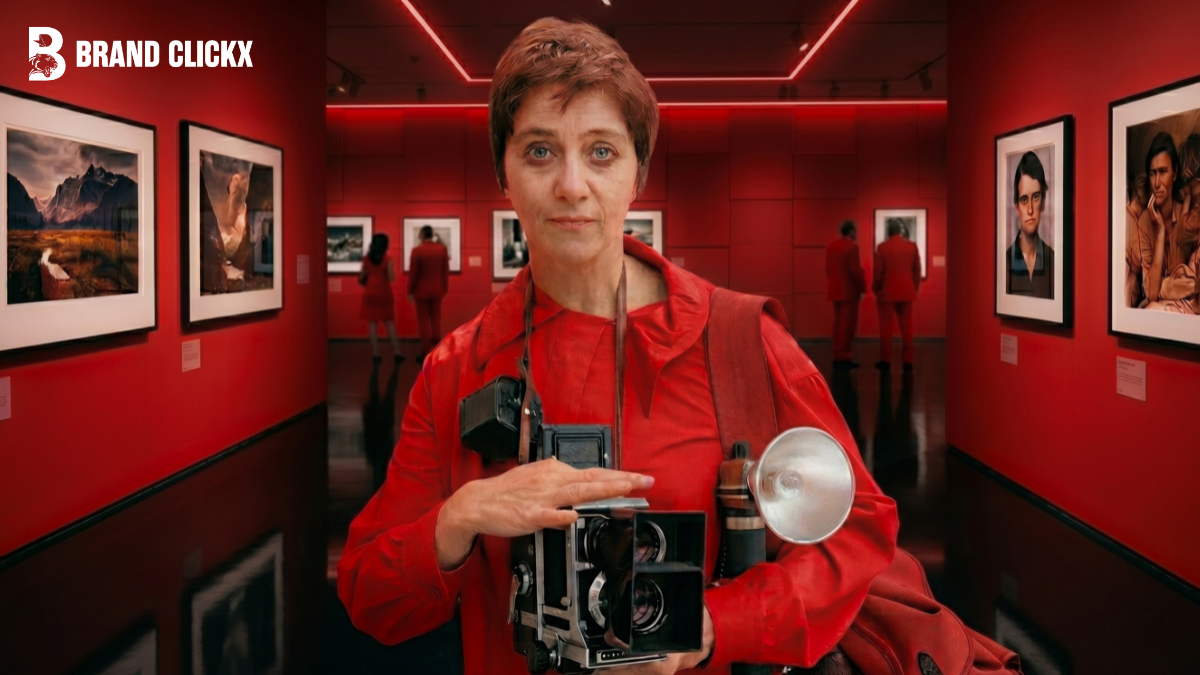
Diane Arbus (1923-1971) was an American photographer best known for stark black-and-white portraits of people on society’s margins, including circus performers, twins, drag queens, and nudists. Born into a wealthy New York family, she switched from fashion to fine art photography in 1956 and developed her signature square-format style after 1962 using a Rolleiflex camera. Famous works include Identical Twins, Roselle, N.J. (1967), A Jewish Giant at Home (1970), and Child with a Toy Hand Grenade (1962). She died by suicide in 1971 at age 48. Her current retrospective Constellation features 454 prints across LUMA Arles, Park Avenue Armory, and Gropius Bau Berlin.
The Photographer Who Forced America to Look at Itself
In 1967, a small exhibition opened at the Museum of Modern Art in New York. Three photographers shared the walls. Each morning before the museum opened, a young librarian named Yuben Yee came in early to wipe the spit off the photographs.
The photographs people kept spitting on belonged to Diane Arbus.
That was the kind of artist Arbus was. People did not just look at her work. They reacted to it physically. They turned away. They argued. They covered their mouths. Then, slowly, the same world that wanted to spit on her photographs began to call them masterpieces.
Today, more than 50 years after her death, Diane Arbus is widely considered one of the most original and influential photographers of the twentieth century. Her work hangs in the Metropolitan Museum of Art, the Museum of Modern Art, Tate Gallery, and the Smithsonian. Her prints sell for hundreds of thousands of dollars.
A single posthumous print from her famous portfolio sold for $792,500 in 2017. And in 2025, the most comprehensive exhibition of her work ever assembled, called Constellation, brought 454 of her prints to the Park Avenue Armory in New York and the Gropius Bau in Berlin.
This guide is the most complete and current portrait of Diane Arbus you will find online. We cover her biography, her famous photographs, her camera and technique, her death, the controversies that still shadow her work, her legacy, and the major exhibitions running right now. Every fact is sourced and verified.
If you want to truly understand Diane Arbus, you are in the right place. Let us begin.
Who Was Diane Arbus?
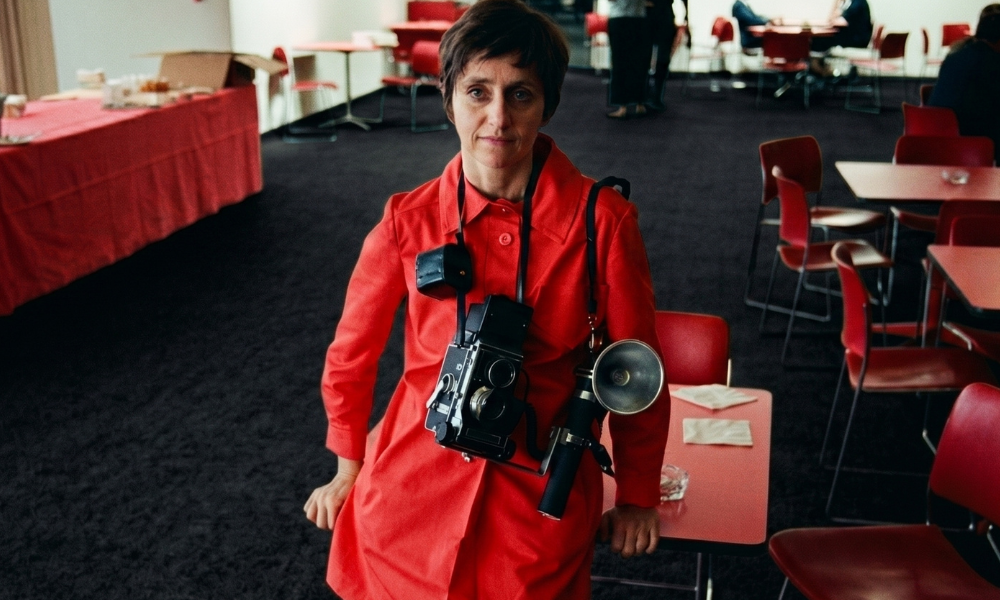
Diane Arbus (March 14, 1923 – July 26, 1971) was an American photographer best known for her stark, intimate black-and-white portraits of people who lived outside the boundaries of mainstream society. Circus performers.
Twins. Nudists. Drag queens. People with developmental disabilities. Suburban families who looked strange to the camera. Famous people who looked strange to the camera.
Arbus did not photograph her subjects from a distance. She got close. She talked to them. She visited their homes. She spent hours with them. And then she captured a single frame that often felt like it had pulled the mask off the world.
Her career was short, just about 15 years of independent work, and she died by suicide at age 48. But in that time, she rewrote what American photography could be. Her influence still shapes how photographers see strangers today.
Key Facts About Diane Arbus
| Fact | Detail |
| Full birth name | Diane Nemerov |
| Born | March 14, 1923, New York City |
| Died | July 26, 1971 (age 48), New York City |
| Nationality | American |
| Best known for | Black-and-white portraits of marginalized people |
| Cameras | Nikon 35mm (early), Rolleiflex 2 1/4″ twin-lens (after 1962), later Mamiyaflex and Pentax |
| Famous photograph | Identical Twins, Roselle, N.J., 1967 |
| Awards | Two Guggenheim Fellowships (1963, 1966) |
| First photographer included | Venice Biennale (1972, posthumous) |
| Estate manager | Doon Arbus (daughter) |
| Only authorized posthumous printer | Neil Selkirk |
Diane Arbus Biography: From Wealthy Childhood to Photography Pioneer
To understand the work, you have to understand the life.
A Wealthy New York Childhood (1923-1941)
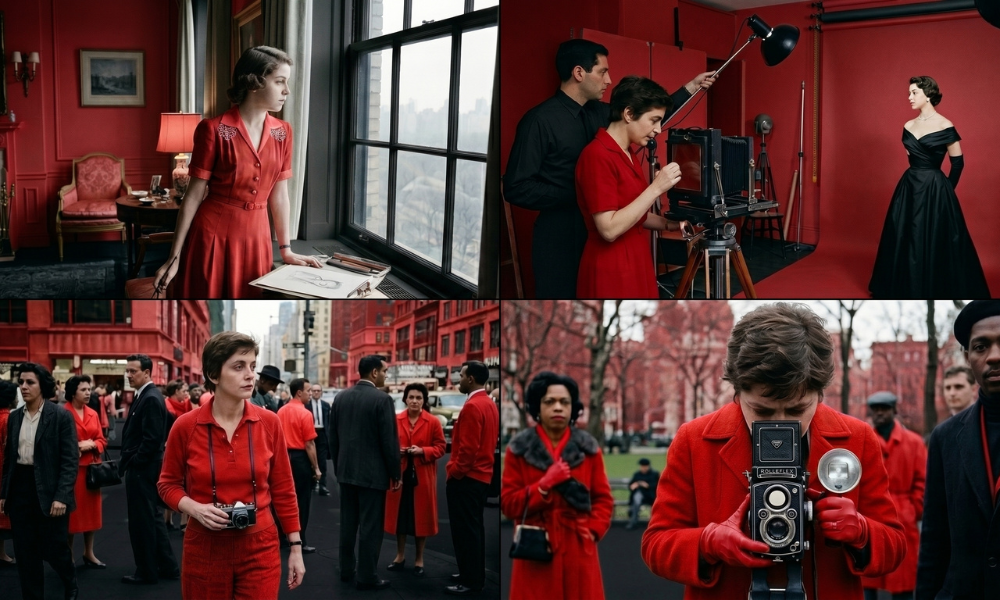
Diane Arbus was born Diane Nemerov on March 14, 1923, into a wealthy Jewish family in New York City. Her parents, David and Gertrude Nemerov, owned Russeks, an upscale Fifth Avenue department store originally founded as a fur company.
The family lived in spacious apartments on Park Avenue and Central Park West, attended by nannies, maids, a cook, and a chauffeur.
Despite this privilege, Arbus felt the wealth as a kind of trap. Her family income shielded her from the Great Depression that was reshaping America outside her windows, and she would later describe this insulation as one of the things that drove her toward the streets, the margins, and the strangers she would spend her career photographing.
Her older brother was the poet Howard Nemerov, who later became Poet Laureate of the United States. Her younger sister Renée became a sculptor and designer. Even by the standards of artistic families, the Nemerov children were unusual.
Arbus attended the Fieldston School for Ethical Culture, a private school in the Bronx known for its progressive, art-friendly education. By her late teens she was already creating drawings and paintings of real promise.
Marriage to Allan Arbus (1941-1959)
At age 14, Diane Nemerov fell in love with Allan Arbus, a 19-year-old employee at her family’s department store. They married in 1941 when she was 18.
Allan Arbus introduced her to photography. He set up a darkroom for her. He taught her the technical fundamentals. Together, they built a successful commercial photography business shooting fashion and advertising for the family store, then expanding to clients like Harper’s Bazaar, Glamour, Esquire, Show, The New York Times, and Vogue.
They had two daughters: Doon Arbus, born in 1945, who would later become a writer and the manager of Diane’s estate; and Amy Arbus, born in 1954, who would also become a photographer.
For 15 years, the Arbus duo was one of the most successful fashion photography teams in New York. But Diane was deeply unhappy with commercial work. She felt the polished, flattering aesthetic of fashion photography was lying to her, and she wanted out.
Breaking Away (1956-1962)
In 1956, Diane Arbus walked away from the commercial photography business. She was 33 years old, a mother of two, and had no clear plan. What she had was a hunger.
She enrolled in workshops with three teachers who would change everything for her:
- Berenice Abbott, the documentary photographer famous for her images of New York
- Alexey Brodovitch, the legendary art director of Harper’s Bazaar
- Lisette Model, an Austrian-born photographer whose intense street portraits became Arbus’s most important model
Model was the most influential. She pushed Arbus to confront her fear of strangers, to use that fear as creative energy, and to commit to making serious work about real human beings.
By 1959, Arbus and Allan had separated, though they remained close. They shared a darkroom for years afterward, and Allan continued to encourage her work even after he moved to California in 1969 to pursue acting. (Allan Arbus later became famous for playing the psychiatrist Dr. Sidney Freedman on the television show MASH*. He died in 2013.)
In late 1959, Arbus began a relationship with the art director and painter Marvin Israel that lasted until her death. Israel championed her work, encouraged her to make her first portfolio, and provided creative support during the most productive years of her career.
The Independent Years (1962-1971)
The transformation of Diane Arbus as an artist accelerated dramatically in 1962. That year she made a technical decision that became central to her style.
She switched from a 35mm Nikon to a 2 1/4-inch medium-format twin-lens Rolleiflex camera. Later she also worked with a Mamiyaflex and, by 1970, a Pentax. The Rolleiflex produced square-format negatives.
Combined with a flash, this gave her photographs a stark, frontal, slightly theatrical quality that became her signature.
Arbus walked into her subjects’ lives directly. She frequented Hubert’s Freak Museum in Times Square. She went to Coney Island. She visited gay nightclubs in Manhattan and tenements in Brooklyn. She knocked on the doors of nudist camps.
She got herself invited into the homes of strangers, sometimes spending eight hours photographing a single family until her subjects’ guards completely fell.
Her first published photographs appeared in Esquire in 1960. By the mid-1960s she was an established editorial photographer with regular work in Harper’s Bazaar, The New York Times Magazine, and New York Magazine.
In 1963 and 1966, she received Guggenheim Fellowships to fund a project she called “American Rites, Manners, and Customs.” Those fellowships gave her the freedom to pursue the personal work that defines her legacy.
Diane Arbus Famous Photographs: The Defining Images
If you want to understand the influence of Diane Arbus, you start with the individual photographs. These are the images that changed photography.
Identical Twins, Roselle, N.J., 1967
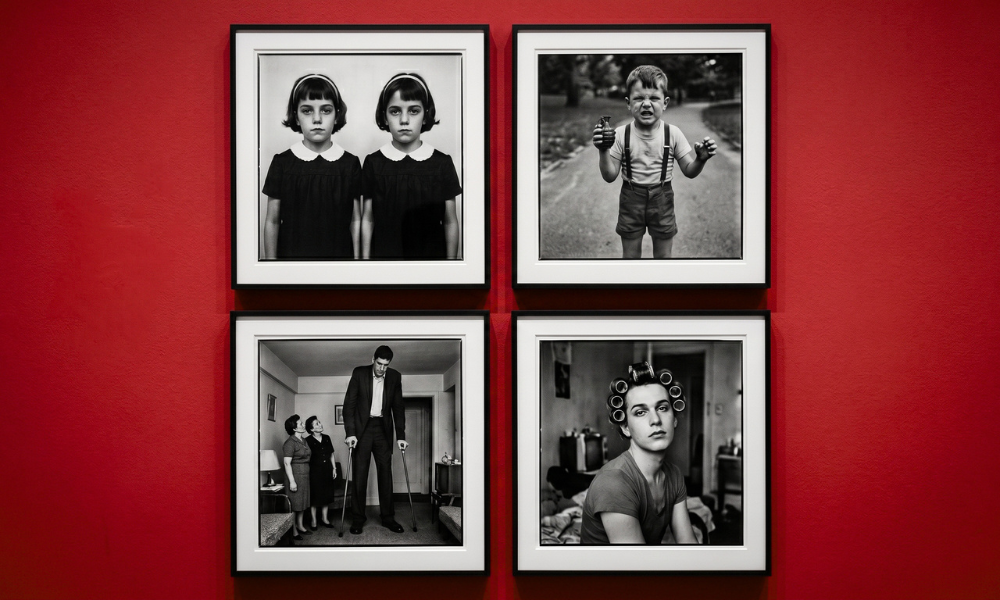
Of all her work, Identical Twins, Roselle, N.J. is the most famous Diane Arbus photograph. It shows two seven-year-old twin sisters, Cathleen and Colleen Wade, standing side by side in identical dark dresses with white collars, staring directly at the camera.
Arbus spotted the twins at a Knights of Columbus Christmas party for twins and triplets in 1967. The photograph captures what Arbus herself described as “differentness in identicalness.”
Look closely and the two girls are not identical at all. One smiles faintly. One frowns. One pair of eyes is dreamy. The other is sharp and skeptical.
The image inspired the famous twin imagery in Stanley Kubrick’s The Shining. It has been referenced and homaged by artists for half a century. In 2004, the Wade twins’ family sold their original print for $480,000. The image is now displayed at the Pier 24 Photography gallery in San Francisco.
The parents of the Wade twins, by the way, thought the photograph was “the worst likeness of the twins they had ever seen.”
A Jewish Giant at Home with His Parents in the Bronx, N.Y., 1970
The subject is Eddie Carmel (1935-1972), a Tel Aviv-born American sideshow performer billed by the Ringling Brothers and Barnum & Bailey Circus as “The Tallest Man on Earth” and “The World’s Greatest Giant.”
He had acromegaly, a glandular condition that caused his extreme height (advertised at over 9 feet, though likely closer to 7’7″). By 1970, the condition had curved his spine and required him to use canes.
Arbus had known Carmel for a decade before making the photograph. She first met him in 1960 at Hubert’s Freak Museum in Times Square. The 1970 image is set in his parents’ Bronx apartment. Carmel stoops under the low ceiling.
His parents stand below him, looking up at their son. The picture captures not the spectacle of size, but the painful intimacy of a family negotiating an impossible reality.
Carmel died in 1972, less than a year after Arbus.
Child with a Toy Hand Grenade in Central Park, N.Y.C., 1962
The subject is Colin Wood, the son of former tennis player Sidney Wood. The photograph shows him in shorts and a white shirt with suspender straps, gripping a toy hand grenade in one hand and clenching the other into a tight claw, his face contorted in what looks like a scream or a snarl.
Arbus shot multiple frames of Wood that day. The famous frame is the one where his face went strange. Wood would later say in interviews that Arbus had caught a flash moment of childhood frustration, but the image suggests something deeper about post-war American childhood, about the violence and unease beneath the polished surface of suburban life.
The print sold for $408,000 at Christie’s New York in April 2005.
Other Major Diane Arbus Photographs
The Arbus catalog contains hundreds of significant images. The ones most often discussed include:
- A Young Man in Curlers at Home on West 20th Street, N.Y.C., 1966 — A portrait of a drag queen at home, taken with the same dignity Arbus brought to senators and suburban housewives
- A Young Brooklyn Family Going for a Sunday Outing, N.Y.C., 1966 — A working-class couple with a baby and a young son who looks deeply uncomfortable, the mother styled to resemble Elizabeth Taylor
- Mexican Dwarf in His Hotel Room, N.Y.C., 1970 — A portrait of Cha-Cha, a Mexican performer, half-dressed and looking directly at Arbus from his hotel bed
- Boy with a Straw Hat Waiting to March in a Pro-War Parade, N.Y.C., 1967 — A young man holding a “Bomb Hanoi” sign and an American flag pin, photographed during the Vietnam War
- A Family on Their Lawn One Sunday in Westchester, N.Y., 1968 — A wealthy suburban couple lying in their backyard, the husband looking bored and disconnected, the wife sun-tanning, the entire frame radiating quiet domestic unease
- Retired Man and His Wife at Home in a Nudist Camp One Morning, N.J., 1963 — One of Arbus’s nudist camp series, showing the elderly couple in their living room as if nothing were unusual
- Triplets in Their Bedroom, N.J., 1963 — Three sisters seated on a bed, each visually similar yet distinct
- Two Female Impersonators Backstage, N.Y.C., 1962 — Documentary-style image from the world of drag performance
A Box of Ten Photographs: The Portfolio That Made Her Legacy
In late 1969, Diane Arbus began work on the only portfolio she ever made: A Box of Ten Photographs. She designed the clear Plexiglas box with her partner Marvin Israel. The portfolio was planned as a limited edition of 50, priced at $1,000 per set (the equivalent of about $7,500 today).
The ten chosen photographs were the ones Arbus felt best represented her work:
- Identical Twins, Roselle, N.J., 1967
- A Young Brooklyn Family Going for a Sunday Outing, N.Y.C., 1966
- Boy with a Straw Hat Waiting to March in a Pro-War Parade, N.Y.C., 1967
- A Jewish Giant at Home with His Parents in the Bronx, N.Y., 1970
- A Young Man in Curlers at Home on West 20th Street, N.Y.C., 1966
- Mexican Dwarf in His Hotel Room, N.Y.C., 1970
- A Family on Their Lawn One Sunday in Westchester, N.Y., 1968
- Retired Man and His Wife at Home in a Nudist Camp One Morning, N.J., 1963
- A Naked Man Being a Woman, N.Y.C., 1968
- King and Queen of a Senior Citizens’ Dance, N.Y.C., 1970
At the time of her death in 1971, Arbus had completed only eight boxes and sold just four:
- Richard Avedon (two sets) — fashion photographer and friend
- Jasper Johns — pop art legend
- Bea Feitler — art director of Harper’s Bazaar, for whom Arbus added an 11th photograph
After her death, Neil Selkirk, her former student, began printing the rest of the planned edition of 50 from her original negatives under the supervision of the Arbus Estate. Selkirk remains the only person ever authorized to print Diane Arbus photographs. In 2017, a posthumous edition of A Box of Ten Photographs sold at auction for $792,500.
The portfolio became the foundation of her posthumous career. It is widely credited with helping establish photography itself as a “serious” fine art form.
How Diane Arbus Died
The death of Diane Arbus is one of the most discussed and painful chapters in 20th-century art history.
On July 26, 1971, Arbus took her own life in her New York City apartment in Westbeth, the artists’ community in Greenwich Village. She was 48 years old. According to the accepted account, she ingested barbiturates and then slit her wrists in the bathtub. Her body was discovered two days later by her friend Marvin Israel.
What Drove Her to Suicide
Arbus had suffered from what she described as “depressive episodes” throughout her life. Her mother had experienced similar episodes. Several factors compounded her depression in the final years:
- Hepatitis that may have worsened her depressive symptoms and caused fatigue and weight loss
- Allan Arbus’s move to California in 1969, which finalized their long separation
- Their official divorce in 1969
- Declining magazine assignments as her commercial work began to feel less imaginative
- Financial pressure that forced her to take teaching jobs at Parsons, Cooper Union, and Westbeth (she found teaching uncomfortable)
- Restlessness with her own techniques and a sense that she had lost her fondness for flash photography
- Continued professional uncertainty despite her growing reputation, with her prints selling for only about $100 each during her lifetime
In her final years, Arbus wrote about photography as both an adventure and a struggle. The intimacy that fueled her best work also demanded an emotional toll she was no longer able to pay.
The Aftermath
In 1972, just a year after her death, Diane Arbus became the first American photographer ever included in the Venice Biennale. That same year, the Museum of Modern Art mounted a major retrospective that traveled the United States and Canada through 1975 and drew massive crowds.
The companion book to the MoMA retrospective, Diane Arbus: An Aperture Monograph, became one of the bestselling photography books in history. It is still in print more than 50 years later.
The Diane Arbus Technique: Camera, Square Format, and Flash
What made the Diane Arbus style instantly recognizable? Three technical choices, made in service of one ethical idea.
The Camera
Before 1962, Arbus worked primarily with a 35mm Nikon. Her early images often had grain, motion, and a documentary street-photography feel similar to other photographers of the era like Robert Frank.
In 1962, she switched to a 2 1/4-inch medium-format twin-lens Rolleiflex. She later worked with a Mamiyaflex, and by 1970, she was using a Pentax. The most important change was format: square negatives.
Why Square Format Matters
The square format eliminates one of the visual hierarchies of traditional photography. Rectangular images have a “long side” that the eye follows. Square images put everything on equal footing. The subject sits dead-center. There is no easy way to look away. The viewer is forced to confront the person.
This square framing, combined with a flat, frontal pose, became the Arbus signature. Critics described it as a “classical stillness.” Subjects look directly at the camera. The viewer looks directly at them. The geometry forces a confrontation.
The Flash
Arbus’s frequent use of flash, often with available light still present, gave her photographs a slightly artificial, theatrical, almost surreal quality. Skin looked too smooth. Eyes had a hollow gleam. Backgrounds receded into darkness.
This was deliberate. The flash created what one critic called “a sense of theatricality and surrealism.” It also made every subject equally bright, equally visible, equally exposed.
The Method
Beyond the technical choices, Diane Arbus was famous for her process. She did not snap and run. She visited. She spent time. She got invited back. She returned to nudist camps for years. She visited the same drag clubs over and over. She made appointments and waited.
She kept meticulous notebooks of people she wanted to photograph. She scanned newspaper want ads for events that might bring her into contact with new subjects. She built relationships. Many of her most powerful photographs were taken after hours of preparation and patience.
The Controversy: Did Diane Arbus Exploit Her Subjects?
The debate over Diane Arbus has never fully gone away. It is the most important question in any honest discussion of her work.
The Critique
Critics have argued that Arbus, a wealthy white woman from Park Avenue, used her camera to turn marginalized people into spectacles. Her favored subjects, circus performers, drag queens, people with disabilities, nudists, were people whose social position made them easy to photograph and hard to refuse.
The Sontag-school argument is that Arbus’s work was voyeuristic, that she made suffering and difference into aesthetic objects, and that her sympathy was a thin disguise for a more disturbing fascination.
Susan Sontag wrote one of the most famous criticisms of Diane Arbus in her 1973 essay collection On Photography. Sontag argued that Arbus’s photographs flattened her subjects into a category of the “freakish” and that her work removed political and historical context, leaving only the spectacle of “otherness.”
The Defense
Defenders of Arbus argue that her intimacy with her subjects, the hours she spent with them, the relationships she built, and the dignity in her compositions all push back against the exploitation charge.
Many of her subjects spoke favorably of her after her death. The Wade twins, the family of Eddie Carmel, and others have left records describing Arbus as respectful, curious, and genuinely interested in them as people.
Neil Selkirk, the only person authorized to print her photographs, has emphasized that Arbus was just as interested in fencers and ballroom dancers as she was in circus performers. The “freak” framing, he argues, was imposed on her work by viewers, not by her.
The work itself, defenders argue, gave dignity and presence to people who had been previously invisible to mainstream American photography.
The “Untitled” Series Question
The most controversial part of the Arbus catalog is the Untitled series, photographs taken between 1969 and 1971 at residences for people with developmental disabilities. Arbus visited these institutions repeatedly, photographing picnics, dances, and Halloween celebrations.
The images were published posthumously in 1995 under the title Untitled, chosen by her daughter Doon Arbus because Diane had not titled them or finished editing them for exhibition.
Some institutions refuse to exhibit these works on ethical grounds, arguing that the subjects could not consent to public photographic display in any meaningful way. Others, including critics like Hilton Als, have called the Untitled series “purely ecstatic” and the most fully realized work of her career.
The debate is not settled, and probably never will be.
Diane Arbus Legacy: Why She Still Matters
The influence of Diane Arbus on American photography is hard to overstate. Even photographers who never saw her work directly are shaped by photographers who did.
Direct Influence on Major Photographers
- Cindy Sherman — The conceptual photographer whose self-portrait work explores identity and stereotype has cited Arbus as a foundational influence
- Nan Goldin — Goldin’s intimate portraits of friends, lovers, and marginalized communities owe a direct debt to Arbus’s method of access and trust
- Mary Ellen Mark — Mark’s documentary work on circus performers, sex workers, and street kids extends the Arbus tradition
- Susan Meiselas — Carries Arbus’s commitment to immersion and time with subjects into documentary photography
- Larry Clark — His work on American teenagers and drug culture follows Arbus’s path into uncomfortable American spaces
- Sandro Miller — Recreated Identical Twins with John Malkovich for his 2014 series Malkovich, Malkovich, Malkovich: Homage to Photographic Masters
What Arbus Changed About Photography
Before Arbus, American documentary photography was largely about social reform. The tradition of Jacob Riis, Dorothea Lange, and Walker Evans focused on documenting injustice in service of policy change.
Arbus broke that mold. Her photographs were not policy arguments. They were existential encounters. She forced viewers to ask not “what should we do about these people?” but “who am I, looking at this person?”
This shift redefined what serious photography could be about. It opened the door for psychological portraiture, for queer photography, for body-positive photography, for the entire tradition of photography that explores identity and difference as ends in themselves.
Auction Prices and Market Status
During her lifetime, Diane Arbus prints sold for $100 or less. Today, the same prints sell for hundreds of thousands of dollars at auction.
- A Box of Ten Photographs (posthumous edition) — $792,500 in 2017
- Identical Twins (Wade family original) — $480,000 in 2004
- Child with a Toy Hand Grenade — $408,000 in 2005
Her work is held in major collections worldwide, including the Metropolitan Museum of Art, the Museum of Modern Art, the Smithsonian American Art Museum, Tate Gallery, Art Institute of Chicago, Bibliothèque Nationale (Paris), and the Art Gallery of Ontario. The Met acquired her complete archives, including negatives of 7,500 rolls of film, as a gift from her estate in 2007.
The Asteroid Named for Diane Arbus
On August 11, 2025, the main belt asteroid 2007 AD23 was officially renamed 262825 Dianearbus in her honor. It is one of the rare instances of a celestial body being named after a photographer.
Diane Arbus Exhibitions: What to See in 2025-2026
The current major exhibition cycle has made Diane Arbus more visible than at any point since her death.
Constellation (2023-2026)
Diane Arbus: Constellation is the largest exhibition of her work ever assembled. It brings together all 454 prints made by Neil Selkirk from her original negatives.
The exhibition opened at LUMA Arles in France in 2023-2024. It then traveled to the Park Avenue Armory in New York for the summer of 2025. It opened at Gropius Bau in Berlin on October 16, 2025, where it ran into 2026 under the German title Diane Arbus: Konstellationen.
The exhibition presents the photographs without chronological or thematic order, hung on a labyrinthine architecture of black scaffolding so visitors can wander and find their own connections. Curator Matthieu Humery of the LUMA Foundation designed the unconventional installation.
Sanctum Sanctorum (2025-2026)
Diane Arbus: Sanctum Sanctorum is a smaller exhibition of 44 photographs taken in private homes and rooms between 1961 and 1971. It traveled from David Zwirner in London to Fraenkel Gallery in San Francisco, where it runs from March 12 to May 22, 2026. A new monograph of the same name was co-published by Fraenkel and Zwirner.
Cataclysm: The 1972 Diane Arbus Retrospective Revisited (2022, 2025)
This exhibition recreated the original 1972 MoMA retrospective of her work. It opened at David Zwirner New York in 2022 and traveled to David Zwirner Los Angeles in 2025, giving new audiences the chance to see the show that defined her posthumous legacy.
Diane Arbus Books and Publications
If you want to go deeper, these are the essential books:
- Diane Arbus: An Aperture Monograph (1972) — The foundational book, still in print 50+ years later
- Diane Arbus: Magazine Work (1984) — Her commercial and editorial work
- Untitled (1995) — The controversial late series at residences for the developmentally disabled
- Diane Arbus: Revelations (2003) — Major catalog with letters, diaries, and 200 photographs
- The Libraries (2004) — A look at the books Arbus read
- Diane Arbus: A Chronology (2011) — Detailed timeline of her life
- Silent Dialogues: Diane Arbus and Howard Nemerov (2015) — Her relationship with her poet brother
- In the Beginning (2016) — Her early work from 1956-1962
- Diane Arbus: A Box of Ten Photographs (2018) — Smithsonian catalog
- Diane Arbus Documents (2022) — Recent scholarly volume
- Diane Arbus Sanctum Sanctorum (2025) — New monograph from Fraenkel and Zwirner
Biographies
- Patricia Bosworth, Diane Arbus: A Biography (1984) — The first major biography, unauthorized, controversial
- Arthur Lubow, Diane Arbus: Portrait of a Photographer (2016) — The most current comprehensive biography
- Alexander Nemerov, Silent Dialogues (2015) — A memoir by Arbus’s nephew
The Fur Film (2006)
In 2006, the fictional film Fur: An Imaginary Portrait of Diane Arbus was released, starring Nicole Kidman as Arbus and Robert Downey Jr. as a fictionalized neighbor. Loosely inspired by Patricia Bosworth’s unauthorized biography, the film took significant fictional liberties with Arbus’s life.
Critics generally rejected the film’s “fairytale” portrayal. The Arbus estate did not authorize it. For viewers interested in the real Diane Arbus, the documentary footage and her own audio recording in A Slide Show and Talk by Diane Arbus (recorded in 1970) are far more revealing.
FREQUENTLY ASKED QUESTIONS
Who was Diane Arbus?
Diane Arbus (1923-1971) was an American photographer best known for her black-and-white portraits of people who lived outside mainstream society, including circus performers, twins, nudists, drag queens, and people with developmental disabilities. Born Diane Nemerov in New York City to a wealthy Jewish family, she became one of the most influential photographers of the 20th century.
What is Diane Arbus famous for?
Diane Arbus is famous for her intimate, confrontational black-and-white portraits of marginalized people in America. Her most famous photograph is Identical Twins, Roselle, N.J., 1967, which inspired the twins in Stanley Kubrick’s The Shining. She is also known for being the first American photographer included in the Venice Biennale (1972, posthumously).
How did Diane Arbus die?
Diane Arbus died by suicide on July 26, 1971, in her New York City apartment at Westbeth. She was 48 years old. According to accepted accounts, she ingested barbiturates and slit her wrists in the bathtub. Her body was found two days later by her partner Marvin Israel.
Why did Diane Arbus kill herself?
Diane Arbus suffered from depressive episodes throughout her life, similar to those experienced by her mother. Multiple factors contributed to her suicide: depression possibly worsened by hepatitis, her husband Allan Arbus’s move to California in 1969, their 1969 divorce, declining magazine assignments, financial pressure that forced her to teach photography, and restlessness with her own techniques.
What was Diane Arbus’s most famous photograph?
Diane Arbus’s most famous photograph is Identical Twins, Roselle, N.J., 1967, showing seven-year-old twin sisters Cathleen and Colleen Wade in identical dark dresses. The image inspired the twins in Stanley Kubrick’s The Shining and is widely considered one of the most influential photographs of the 20th century. The Wade family’s original print sold for $480,000 in 2004.
What camera did Diane Arbus use?
Before 1962, Diane Arbus used a 35mm Nikon. In 1962 she switched to a 2 1/4-inch medium-format twin-lens Rolleiflex, which produced her signature square-format photographs. She later worked with a Mamiyaflex and, by 1970, a Pentax. Her use of flash, even in daylight, gave her photographs their distinctive theatrical quality.
When was Diane Arbus born?
Diane Arbus was born Diane Nemerov on March 14, 1923, in New York City to David and Gertrude Nemerov, owners of Russeks, an upscale Fifth Avenue department store and fur company.
Was Diane Arbus married?
Yes. Diane Arbus married Allan Arbus in 1941 when she was 18 and he was 19. They had two daughters, Doon (born 1945) and Amy (born 1954). Allan taught her photography and they ran a successful commercial photography business together until 1956. They separated in 1959 and divorced in 1969. Allan later became famous for playing Dr. Sidney Freedman on the TV show MASH*.
Who are Diane Arbus’s daughters?
Diane Arbus had two daughters: Doon Arbus (born 1945), a writer who manages the Diane Arbus estate, and Amy Arbus (born 1954), who became a photographer in her own right. Doon has been instrumental in shaping her mother’s posthumous legacy.
What is A Box of Ten Photographs?
A Box of Ten Photographs was the only portfolio Diane Arbus ever made. Designed with Marvin Israel and produced in 1970-1971, it contained ten of her most important photographs in a clear Plexiglas box. She planned an edition of 50 but completed only eight sets and sold just four before her death. A posthumous edition sold for $792,500 in 2017.
Did Diane Arbus exploit her subjects?
The question of whether Diane Arbus exploited her subjects has been debated for over 50 years. Critics like Susan Sontag argued her work made marginalized people into spectacles. Defenders argue her intimacy, time spent with subjects, and respect in her compositions contradict the exploitation charge. The debate continues today, particularly around her Untitled series of photographs at residences for people with developmental disabilities.
Where can I see Diane Arbus photographs?
Diane Arbus photographs are held in major collections including the Metropolitan Museum of Art, the Museum of Modern Art (New York), the Smithsonian American Art Museum, Tate Gallery (London), the Art Institute of Chicago, and many others. As of 2025-2026, Diane Arbus: Constellation is on view at Gropius Bau Berlin, and Sanctum Sanctorum is at Fraenkel Gallery San Francisco.
How much do Diane Arbus photographs sell for?
Diane Arbus photographs sell for hundreds of thousands of dollars at auction. A Box of Ten Photographs (posthumous edition) sold for $792,500 in 2017. Identical Twins (Wade family original) sold for $480,000 in 2004. Child with a Toy Hand Grenade sold for $408,000 in 2005. During her lifetime, her prints sold for $100 or less.
Who prints Diane Arbus photographs today?
Neil Selkirk is the only person authorized to print Diane Arbus photographs from her original negatives. He was one of her students and began printing for the Arbus Estate after her death in 1971. He produced the 454 prints featured in the current Constellation exhibition.
What movie was made about Diane Arbus?
The 2006 fictional film Fur: An Imaginary Portrait of Diane Arbus starred Nicole Kidman as Arbus and Robert Downey Jr. The film took significant fictional liberties with her life and was not authorized by the Arbus estate. Critics generally rejected its “fairytale” portrayal of the photographer.
What is the Diane Arbus exhibition Constellation?
Diane Arbus: Constellation is the largest Diane Arbus exhibition ever assembled, featuring all 454 prints made by Neil Selkirk from her original negatives. The exhibition opened at LUMA Arles in 2023, traveled to the Park Avenue Armory in New York in summer 2025, and opened at Gropius Bau in Berlin on October 16, 2025, where it ran into 2026.
SOURCES & CITATIONS
This article draws from authoritative biographical, museum, and exhibition sources:
Biographical Sources:
- Encyclopedia Britannica: Diane Arbus biography
- Biography.com: Diane Arbus profile
- Wikipedia: Diane Arbus comprehensive entry
- Jewish Women’s Archive: Diane Arbus entry by Anna Mendelssohn
- David Zwirner: Diane Arbus 1923-1971 biography
- The Art Story: Diane Arbus artist overview and analysis
- Totally History: Diane Arbus biography
- Patricia Bosworth, Diane Arbus: A Biography (1984)
- Arthur Lubow, Diane Arbus: Portrait of a Photographer (2016)
- Alexander Nemerov, Silent Dialogues (2015)
Museum and Gallery Sources:
- Fraenkel Gallery: Diane Arbus artist page and exhibitions
- The Metropolitan Museum of Art: Diane Arbus Revelations press materials
- Park Avenue Armory: Diane Arbus Constellation exhibition (2025)
- Gropius Bau Berlin: Diane Arbus Konstellationen (October 2025-2026)
- Smithsonian American Art Museum: A Box of Ten Photographs exhibition
- David Zwirner: Cataclysm exhibition documentation
- Artnet News: Diane Arbus haunting new retrospective (June 2025)
- Collector Daily: Diane Arbus Constellation review (July 2025)
Photograph and Auction Sources:
- Christie’s auction records (April 2005, 2017)
- Sotheby’s auction documentation (Hirsch Collection)
- Public Delivery: Diane Arbus Twins photo analysis
- Mental Floss: Diane Arbus stories behind the photos
Critical and Theoretical Sources:
- Susan Sontag, On Photography (1973)
- Hilton Als writing on Arbus
- Max Kozloff, review of “New Documents” (1967)
All facts, dates, and quotes are verifiable through the sources listed above as of June 2026.