


An estimated 90% of online content will be AI-generated by late 2026. Deepfake videos tripled in volume in a single year. The World Economic Forum ranks misinformation as the world’s second-highest near-term risk. Critical thinking is no longer a soft skill — it is operational infrastructure.
Introduction: The Most Expensive Mistake Is Believing Something False
A marketing team shares a competitor’s press release in a strategy meeting. The data looks compelling impressive market share numbers, a partnerships roster that shifts competitive positioning. The team adjusts its Q3 strategy based on the intelligence.
The press release was AI-generated. The partnership didn’t exist. The market share numbers were hallucinated by a language model and never verified by the company that published them.
That scenario is not hypothetical. It is the operating reality of 2026.
An estimated 57% of all online content is already AI-generated, and that figure is projected to reach 90% by late 2026. Deepfake videos tripled in volume in a single year, with an estimated 500,000 deepfakes shared on social media by 2023 — and the quality has improved significantly since then. The World Economic Forum’s Global Risks Report 2026 ranks misinformation and disinformation as the world’s second-highest near-term risk.
Critical thinking in this environment is not a philosophical pursuit. It is an operational capability.
For marketing professionals, media strategists, brand leaders, and business executives, the ability to evaluate the credibility of information to distinguish signal from noise, to detect synthetic content, to verify claims before acting on them is now as professionally important as knowing how to read a P&L or manage a campaign.
This guide is not about abstract reasoning skills. It is a practical toolkit 15 exercises built specifically for professionals working in digital media, marketing, and business contexts where the cost of acting on false information is measured in budget, reputation, and competitive position.
Part I: Why Critical Thinking Has Become an Operational Skill
The Information Environment Has Fundamentally Changed
For most of modern professional history, the primary critical thinking challenge was filtering large volumes of information to find what was relevant.
In 2026, the challenge has inverted. The primary problem is no longer finding relevant information. It is determining whether the information you’ve found is real.
AI-generated content, synthetic media, manipulated images, fabricated statistics, hallucinated citations, deepfake video, and AI-written press releases have flooded every information channel that professionals rely on from Google search results to social media feeds to industry newsletters to competitor websites.
The production cost of misinformation has dropped to zero. Anyone with access to a free AI tool can generate a convincing press release, a fake expert quote, a fabricated study, or a synthetic video of a real person saying something they never said.
As UNESCO’s 2025 report on deepfakes and the crisis of knowing stated: “Deepfakes don’t just introduce falsehoods into our information ecosystem they erode the very mechanisms by which societies construct shared understanding.”
That erosion affects professionals as much as it affects the general public. The marketing team sharing an AI-generated competitor analysis. The investor acting on a fabricated earnings report. The PR team responding to a deepfake video of their CEO. The brand manager citing a statistic from a study that doesn’t exist.
These are not edge cases. They are the operating risks of 2026.
The Professional Stakes
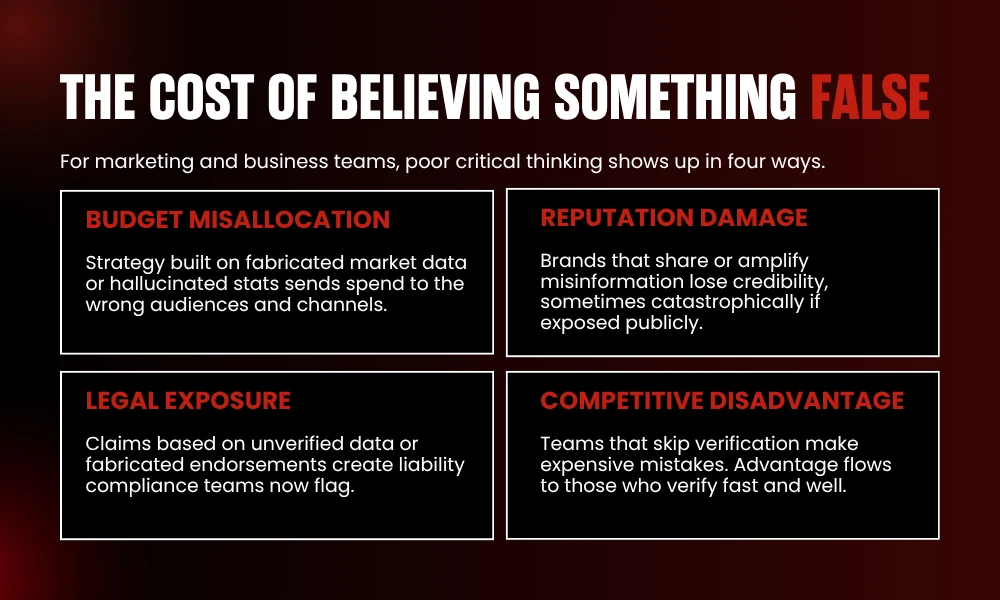
For marketing and business professionals specifically, the cost of poor critical thinking manifests in four ways:
Budget misallocation. Strategies built on false competitive intelligence, fabricated market data, or hallucinated statistics direct spending toward the wrong audiences, channels, or messages.
Reputation damage. Brands that share, amplify, or act on misinformation damage their credibility sometimes catastrophically if the misinformation is discovered publicly.
Legal exposure. Marketing claims based on unverified data, AI-hallucinated statistics, or fabricated endorsements create legal liability that compliance teams are increasingly flagging.
Competitive disadvantage. Teams that are slow to verify information lose speed. Teams that skip verification make expensive mistakes. The competitive advantage flows to teams that verify quickly and accurately combining speed with judgment.
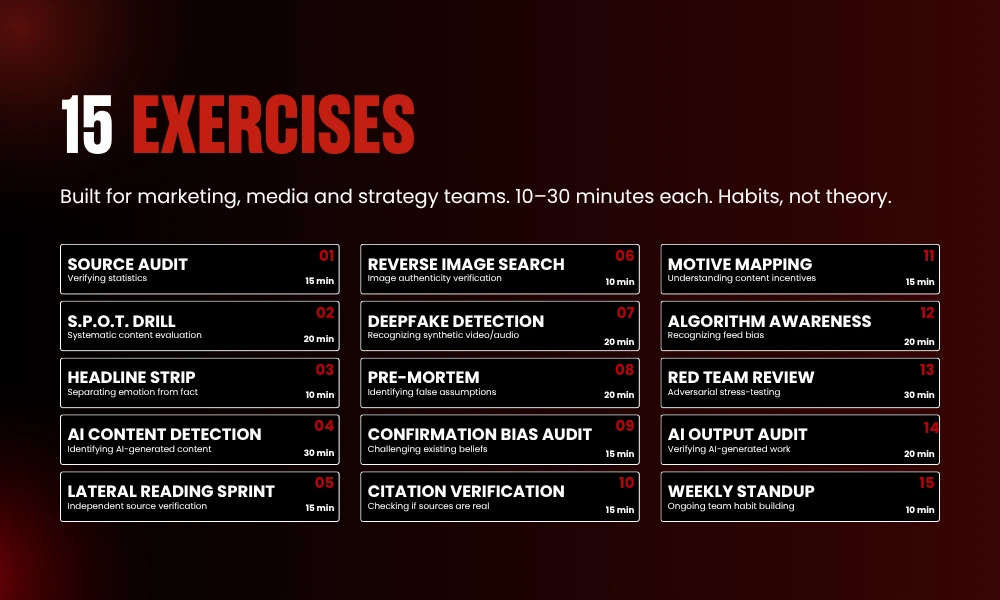
Part II: The 15 Critical Thinking Exercises
These exercises are designed for professionals working in marketing, media, communications, and business strategy. They build practical skills that apply directly to daily work not abstract reasoning capabilities.
Each exercise takes 10–30 minutes. They can be done individually or in team settings. The goal is building habits, not demonstrating knowledge.
Exercise 1: The Source Audit
Skill built: Verifying claims before using them
Time: 15 minutes
How it works: Take the last brief, deck, or strategy document your team produced. Identify every statistic, data point, and factual claim in the document. For each one, trace it back to its original source.
Not the article that cited it. Not the infographic that displayed it. The original study, survey, report, or dataset that generated it.
What you’ll find: Most teams discover that 30–50% of the statistics they regularly cite cannot be traced to a credible original source. The number was cited in a blog post, which cited another blog post, which cited a tweet, which cited nothing. The original source either doesn’t exist or says something different from what the citation chain claims.
The habit it builds: Before any data point enters a deliverable, someone on the team asks: “Where does this number actually come from?” That single question prevents the most common category of professional misinformation the unchecked statistic.
Exercise 2: The S.P.O.T. Framework Drill
Skill built: Systematic evaluation of unfamiliar content
Time: 20 minutes
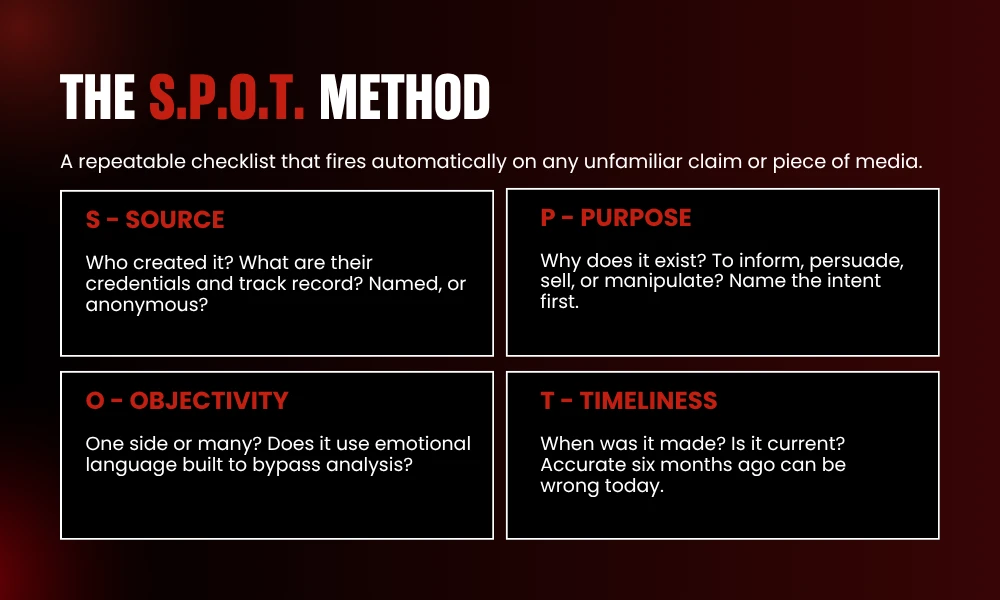
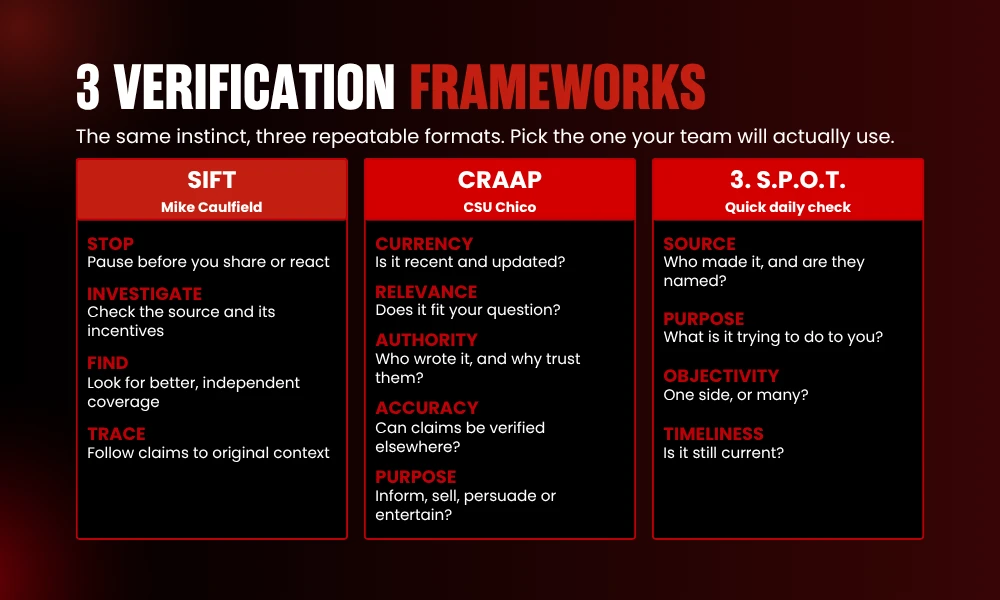
How it works: The S.P.O.T. framework provides a repeatable checklist for evaluating any piece of digital content:
S — Source. Who created this content? What are their credentials? What is their track record? Are they a named individual or organization — or anonymous?
P — Purpose. Why was this created? To inform? To persuade? To sell? To manipulate? Every piece of content has a purpose. Identifying it before engaging with the substance prevents the most common critical thinking failure: accepting persuasion as information.
O — Objectivity. Does this content present multiple perspectives, or only one? Does it acknowledge counterarguments? Does it use emotional language designed to bypass analytical thinking?
T — Timeliness. When was this created? Is it still current? Does it reflect the most recent data? In fast-moving industries, information that was accurate six months ago may be dangerously wrong today.
The drill: Take five pieces of content from your morning reading a LinkedIn post, a newsletter article, a competitor press release, a news story, and a social media post. Apply S.P.O.T. to each one. Write a one-sentence evaluation for each.
The habit it builds: A mental checklist that fires automatically when encountering any unfamiliar claim.
Exercise 3: The Headline Strip
Skill built: Separating emotional framing from factual claims
Time: 10 minutes
How it works: Collect five headlines from marketing industry news. For each headline, strip the emotional and attention-grabbing language and rewrite it as a neutral factual statement.
Example:
- Original headline: “This AI Tool Is DESTROYING the $600 Billion Advertising Industry”
- Stripped version: “A new AI tool automates part of the ad creative process. The advertising industry’s total revenue continues to grow.”
The gap between the emotional framing and the factual claim is the manipulation margin. The wider the gap, the less you should trust the source’s commitment to accuracy.
The habit it builds: The ability to read through emotional framing to identify the actual claim being made then evaluate that claim on its merits.
Exercise 4: Real or AI? The Content Detection Workshop
Skill built: Distinguishing AI-generated from human-created content
Time: 30 minutes (best as a team exercise)
How it works: Prepare a set of 10 content pieces five written by humans, five generated by AI on the same marketing or business topic. Do not label them. Distribute to the team. Ask each person to identify which are AI-generated and explain their reasoning.
What to look for in AI-generated content:
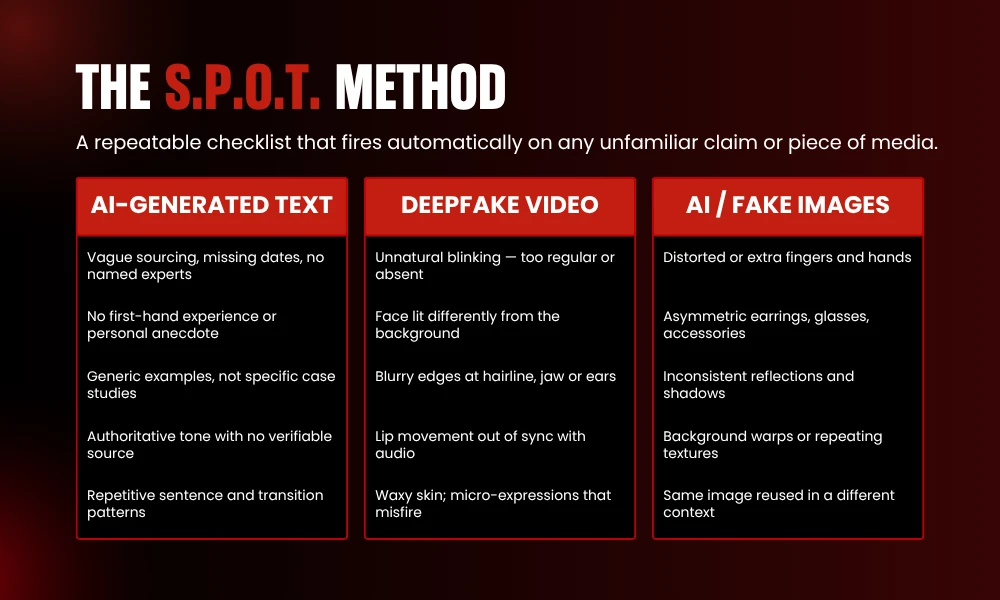
- Absence of first-hand experience or personal anecdote
- Generic examples rather than specific, named case studies
- Perfect grammar with no stylistic personality
- Claims that sound authoritative but lack verifiable sources
- Repetitive sentence structures and transitions
- Statistics without attribution to specific studies or dates
The learning: Most professionals overestimate their ability to detect AI content. Running this exercise once calibrates that confidence to a more accurate level and makes the detection signals conscious rather than intuitive.
41% of teens reported encountering misleading content online. Adults encounter it at similar rates they are just less likely to admit it.
Exercise 5: The Lateral Reading Sprint
Skill built: Verifying sources through independent third-party evaluation
Time: 15 minutes
How it works: Lateral reading is the technique professional fact-checkers use. Instead of reading a source’s own claims about itself (which proves nothing), open new browser tabs and search for what independent third parties say about that source.
The drill: Take a piece of industry content a research report, a company blog post, an analyst recommendation. Before evaluating the content itself, spend five minutes researching the source:
- What do independent outlets say about this organization?
- Has this source published false or misleading content before?
- What financial incentives does this source have that might influence its claims?
- Do experts in the field consider this source credible?
Why it matters for marketing teams: Brands regularly cite third-party research in marketing materials without verifying whether the “third party” is genuinely independent or a vendor-funded study designed to support a sales narrative.
Exercise 6: The Reverse Image Search Drill
Skill built: Verifying the authenticity of images before publishing or acting on them
Time: 10 minutes
How it works: Take five images from recent content social media posts, press releases, competitor marketing, or user-generated content. Run each through Google Reverse Image Search, TinEye, or Google Lens.
What you’re looking for: Has this image appeared elsewhere in a different context? Is the image being used to represent something it doesn’t actually depict? Is the image AI-generated (check for hand distortions, asymmetric accessories, background inconsistencies)?
Why it matters: Marketing teams regularly use stock imagery and user-generated content without verifying authenticity. A fake customer testimonial photo, an AI-generated product image, or a real photo used out of context can all create legal and reputational exposure.
Exercise 7: The Deepfake Detection Exercise
Skill built: Recognizing synthetic video and audio
Time: 20 minutes
How it works: Find five videos online a mix of authentic and known deepfakes (deepfake detection datasets from MIT Media Lab, Microsoft’s Video Authenticator demos, or educational deepfake examples provide good source material). Watch each one and attempt to identify which are synthetic.
Detection signals to train:
- Unnatural blinking patterns (too regular, too infrequent, or absent)
- Inconsistent lighting — the face is lit differently from the background
- Blurry or warped edges around the hairline, jawline, or ears
- Lip movements that don’t precisely match the audio
- Skin texture that appears unusually smooth or waxy
- Micro-expressions that don’t match the emotional content of the speech
The reality check: Deepfake videos tripled in volume and deepfake audio clips increased eightfold between 2022 and 2023. Quality has continued to improve. The goal of this exercise is not perfect detection it is building awareness that synthetic media exists in professional contexts where it was previously assumed not to.
Exercise 8: The Pre-Mortem
Skill built: Identifying false assumptions before they cause harm
Time: 20 minutes (team exercise)
How it works: Before launching a campaign, publishing a report, or making a strategic decision based on competitive intelligence, run a structured pre-mortem:
“Imagine it is three months from now. This project failed because we believed something that turned out to be false. What was it?”
Each team member independently writes down the most likely false assumption. Then the team shares and discusses.
Common findings:
- “We assumed the competitor’s funding announcement was accurate”
- “We assumed this influencer’s follower count was genuine”
- “We assumed the market research we cited was peer-reviewed”
- “We assumed the AI-generated customer testimonials on the competitor’s site were real”
The habit it builds: Pre-mortems make hidden assumptions visible before they become expensive. The exercise is most valuable precisely when the team is most confident because confidence correlates with reduced scrutiny.
Exercise 9: The Confirmation Bias Audit
Skill built: Recognizing when you are seeking evidence that supports what you already believe
Time: 15 minutes
How it works: Take a strategic recommendation your team recently made. Identify the three strongest pieces of evidence that support it. Then spend 10 minutes deliberately searching for evidence that contradicts it.
Not “Is there evidence against this?” that’s too easy to dismiss. Instead: “If a smart competitor believed the opposite, what evidence would they cite?”
Why this matters in marketing: Marketing teams are structurally vulnerable to confirmation bias because the incentive structure rewards conviction. The team that presents a confident strategy gets funded. The team that presents uncertainty gets questioned. This creates pressure to filter evidence toward supporting the chosen direction and to dismiss contradictory signals.
The confirmation bias audit makes the contradictory evidence visible before the budget is committed.
Exercise 10: The Citation Verification Challenge
Skill built: Verifying whether cited studies and statistics are real
Time: 15 minutes
How it works: AI language models frequently hallucinate citations generating plausible-sounding study titles, author names, and journal references that do not exist. This exercise builds the habit of verifying before citing.
Take five statistics from recent marketing or business content. For each one, attempt to locate the original study:
- Search for the exact study title in Google Scholar
- Search for the cited author and the topic
- Check whether the journal or publication exists
- Verify whether the statistic matches what the original study actually reported
What you’ll find: A significant percentage of commonly cited marketing statistics either cannot be verified, have been misquoted from their original source, or were generated by AI and have propagated through citation chains without anyone checking.
Exercise 11: The Motive Mapping Exercise
Skill built: Understanding who benefits from a piece of content existing
Time: 15 minutes
How it works: For any piece of content that is influencing a business decision, ask three questions:
- Who paid for this content to be created?
- What outcome does the creator benefit from if I believe it?
- What would the creator lose if I discovered this content was inaccurate?
Vendor-funded research, affiliate-driven tool recommendations, and corporate-sponsored studies all carry financial motives that shape their conclusions. Motive mapping does not mean dismissing all interested content it means adjusting the weight you assign to it based on the incentive structure behind it.
Why this matters for marketing professionals specifically: The marketing industry is saturated with vendor-funded research presented as independent insight. Motive mapping is the skill that separates the teams that get manipulated from the teams that stay informed.
Exercise 12: The Algorithm Awareness Drill
Skill built: Recognizing how personalized feeds shape perception
Time: 20 minutes
How it works: Open your primary news or social media feed. Read the first 10 items. For each one, ask:
- Why is this showing up in my feed? (Because I engaged with similar content before? Because it’s trending? Because it’s paid promotion?)
- What perspective is missing from my feed that I would see if I followed different accounts or searched different terms?
- If I only had this feed as my information source, what would I believe about the state of my industry?
Then open an incognito browser and search the same industry topic. Compare what appears in your personalized feed versus the unfiltered search results.
The insight: Algorithmic feeds create the illusion of consensus. If every post in your feed agrees on a trend, it feels like the industry agrees. In reality, the algorithm has learned what you engage with and is serving more of it. The exercise makes the filter bubble visible.
Exercise 13: The Red Team Review
Skill built: Stress-testing strategy against adversarial thinking
Time: 30 minutes (team exercise)
How it works: Assign one team member or a small group to act as the “red team” their job is to attack the team’s current strategy, messaging, or campaign from the perspective of a hostile critic, a skeptical journalist, a competitor, or a litigator.
The red team’s mandate: find every claim that is unverifiable, every statistic that is unsourced, every assumption that is untested, and every message that could be misinterpreted or fact-checked into embarrassment.
Why it matters: The red team exercise surfaces the vulnerabilities that confirmation bias, time pressure, and team consensus typically hide. Running it before publication is far less expensive than running it after a reporter or competitor finds the weakness.
Exercise 14: The AI Output Audit
Skill built: Evaluating the accuracy of AI-generated content before publishing
Time: 20 minutes
How it works: Take a piece of content your team generated using AI a blog draft, a research summary, a competitive analysis, a social media post. Before publishing, systematically verify every factual claim the AI made:
- Does the statistic exist? Can you find the original source?
- Are the named companies, people, and products real? Did the events described actually happen?
- Is the timeline accurate? Did the AI assign events to the correct year?
- Are the cause-and-effect relationships logical, or did the AI construct a plausible-sounding but incorrect narrative?
Research shows that 80% of knowledge bases are out of date and AI models trained on that data inherit and amplify those inaccuracies. AI-generated content requires the same verification rigor as any other unverified source.
Exercise 15: The Weekly Media Literacy Standup
Skill built: Maintaining team-wide critical thinking as an ongoing practice
Time: 10 minutes per week
How it works: Add a 10-minute block to one weekly team meeting. Each week, one team member shares one piece of content they encountered that was misleading, false, or AI-generated and explains how they identified it.
The format is simple: what was the content, what was wrong with it, and what signal tipped you off.
Why this works: Critical thinking is a habit, not a training event. The weekly standup normalizes skepticism, builds collective detection skills, and creates a shared language for discussing information quality without making anyone feel accused of being gullible.
Over time, the team develops a collective immune system a shared set of detection patterns that make the whole group more resistant to misinformation than any individual.
Part III: The Frameworks That Tie the Exercises Together
The SIFT Method (Mike Caulfield)
The most widely taught digital verification framework:
Stop — before you share, react to, or act on a piece of information, pause. Emotional reactions are the mechanism by which misinformation spreads. The pause is the intervention.
Investigate the source — who created this? What is their track record? What are their incentives?
Find better coverage — search for the same claim in multiple independent sources. If only one source is reporting it, that is a signal.
Trace claims to the original context — follow the citation chain back to the original study, quote, or event. Check whether the original supports the claim being made.
The CRAAP Test
Developed at California State University, Chico a structured evaluation framework:
Currency when was it published? Has it been updated? Relevance does it address your specific question? Authority who wrote it and what are their qualifications? Accuracy can the claims be verified through other sources? Purpose why does this content exist — to inform, sell, persuade, or entertain?
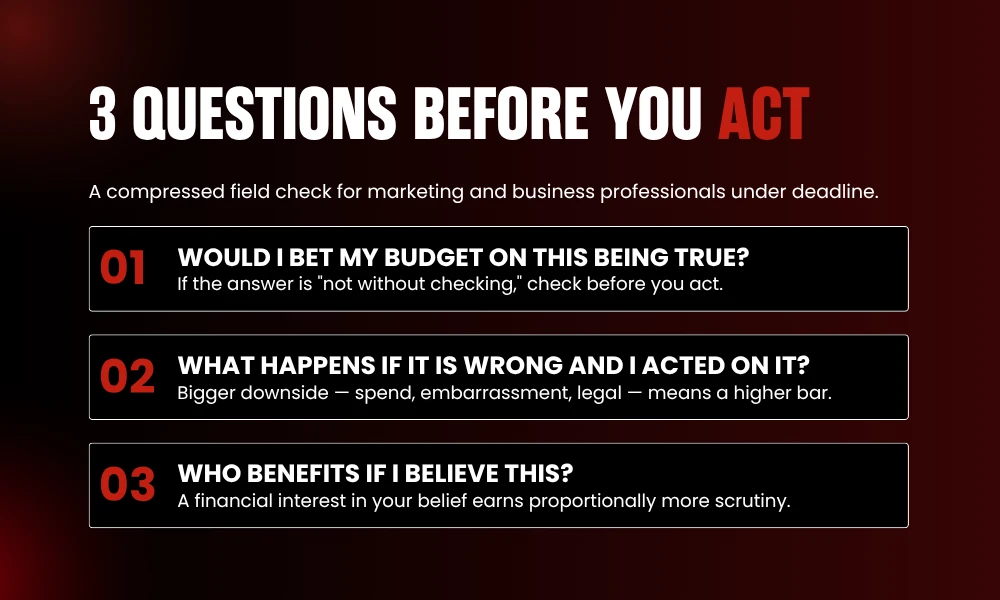
The BrandClickX Framework for Professional Media Evaluation
For marketing and business professionals, we use a compressed three-question framework:
- Would I bet my budget on this being true? If the answer is “not without checking,” check before acting.
- What happens if this is wrong and I acted on it? If the downside is significant budget misallocation, public embarrassment, legal exposure the verification threshold is higher.
- Who benefits if I believe this? If the creator has a financial interest in your belief, apply proportionally more scrutiny.
Part IV: Critical Thinking in the AI Era What’s Changed
The Scale Problem
The fundamental change in 2026 is not that misinformation exists. Misinformation has always existed.
The change is that it can now be produced at zero marginal cost, at unlimited scale, at a quality level that is indistinguishable from authentic content in most casual encounters.
A single person with access to free AI tools can produce:
- A fabricated press release with plausible quotes from real executives
- A synthetic video of a public figure making a statement they never made
- A fake research study with accurate-looking methodology sections and fabricated data
- Hundreds of fake customer reviews written in distinct voices
- A complete fake news website with months of archived content
The cost of producing all of the above: approximately $0 and one afternoon.
The Detection Gap
Edutopia’s 2025 media literacy guide observes that “AI-generated writing sometimes lacks context or specificity” but that observation is already outdated. The latest frontier models produce content that is contextually rich, specific, and stylistically varied.
The detection gap the difference between how good AI-generated content has become and how good humans are at detecting it — is widening. Human detection accuracy is declining as model quality improves. Automated detection tools are improving but remain unreliable at production scale.
The practical implication for professionals: you cannot detect AI-generated content reliably by reading it. You can detect it by verifying its claims. The exercises in this guide focus on verification not detection because verification is the skill that remains reliable regardless of how good the content generation becomes.
The Trust Architecture Is Broken
UNESCO describes the current moment as “a crisis of knowing.”
That phrase captures something deeper than misinformation. When any piece of content any video, any quote, any statistic, any image might be synthetic, the default assumption shifts from “this is probably real” to “this might not be real.” That shift fundamentally changes how professionals consume, evaluate, and act on information.
The exercise-based approach in this guide is designed for exactly this environment. It does not ask you to become a human lie detector. It asks you to build habits that make verification automatic so that the decision to check is not a special activity but a default behavior.
Part V: Building Critical Thinking Into Your Organization
The Team-Level Approach
Individual critical thinking is valuable. Organizational critical thinking is transformative.
The exercises in this guide are designed to be practiced at the team level not just the individual level. The weekly media literacy standup, the red team review, the pre-mortem, and the AI output audit all work best when practiced as group activities with shared accountability.
Why team-level matters: In most professional environments, misinformation doesn’t fail at the individual level. It fails at the approval level. A team member shares a fabricated statistic. A manager approves it because the brief looks polished. A director signs off because the strategy deck is compelling. Nobody checks because everybody assumed somebody else already did.
Team-level critical thinking creates multiple checkpoints rather than relying on a single person to catch every problem.
The Organizational Infrastructure
For enterprise teams, critical thinking infrastructure includes:
Source verification standards. Every data point in a published deliverable must link to its original source. No citation chains. No “according to reports.” The original study, survey, or dataset or the claim doesn’t get published.
AI content labeling. All AI-generated content used in external communications is reviewed for factual accuracy before publication. Internal teams know which content was AI-generated and which was human-created.
Red team protocols. High-stakes campaigns, press releases, and strategic recommendations are stress-tested by a designated skeptic before finalization.
Media literacy training. Annual training on AI content detection, deepfake awareness, and verification techniques updated annually as AI capabilities evolve.
The Critical Thinking Exercise Matrix
| Exercise | Skill Built | Time | Best For |
| Source Audit | Verifying statistics | 15 min | Strategy teams |
| S.P.O.T. Drill | Systematic content evaluation | 20 min | All teams |
| Headline Strip | Separating emotion from fact | 10 min | Content and PR teams |
| AI Content Detection | Identifying AI-generated content | 30 min | Editorial and marketing teams |
| Lateral Reading Sprint | Independent source verification | 15 min | Research and insights teams |
| Reverse Image Search | Image authenticity verification | 10 min | Social media and content teams |
| Deepfake Detection | Recognizing synthetic video/audio | 20 min | PR and communications teams |
| Pre-Mortem | Identifying false assumptions | 20 min | Strategy and campaign teams |
| Confirmation Bias Audit | Challenging existing beliefs | 15 min | Leadership and strategy teams |
| Citation Verification | Checking if sources are real | 15 min | Content and research teams |
| Motive Mapping | Understanding content incentives | 15 min | All teams |
| Algorithm Awareness | Recognizing feed bias | 20 min | Media buying and strategy teams |
| Red Team Review | Adversarial stress-testing | 30 min | Campaign and creative teams |
| AI Output Audit | Verifying AI-generated work | 20 min | Any team using AI tools |
| Weekly Standup | Ongoing team habit building | 10 min/week | All teams recurring |
Key Takeaways
- Critical thinking in 2026 is an operational skill, not a philosophical one. The cost of acting on false information is measured in budget, reputation, and competitive position. Verification is no longer optional for professional teams.
- Detection is losing. Verification is winning. AI-generated content is increasingly indistinguishable from human content. The exercises that remain reliable are those focused on verifying claims not detecting AI authorship.
- Team-level critical thinking beats individual-level. Misinformation fails at approval layers, not at individual desks. Build verification checkpoints into team workflows rather than relying on any single person.
- The exercises are habits, not events. A one-time training session teaches theory. Repeated exercises build automatic behavior. The weekly media literacy standup is more valuable than an annual workshop.
- The most dangerous content is the kind you want to believe. Confirmation bias is the primary mechanism by which professional teams get fooled. The pre-mortem and confirmation bias audit specifically target this vulnerability.
FAQ: Critical Thinking Exercises for Digital Media
Why are critical thinking exercises important for digital media?
An estimated 90% of online content will be AI-generated by late 2026. Deepfake videos tripled in a single year. The World Economic Forum ranks misinformation as the world’s second-highest near-term risk. For marketing and business professionals, critical thinking prevents costly decisions based on false information, synthetic media, or manipulated data.
What is the S.P.O.T. method for evaluating digital media?
S.P.O.T. stands for Source (who created it?), Purpose (why was it created?), Objectivity (does it present multiple perspectives?), and Timeliness (is it current?). It provides a repeatable mental checklist for evaluating unfamiliar claims, statistics, or media.
How do you detect AI-generated content and deepfakes?
AI-generated text often lacks specificity and verifiable sources. Deepfake video shows unnatural blinking, inconsistent lighting, blurry edges around hairlines, and lip-audio mismatches. However, detection is becoming less reliable as AI quality improves verification of claims is more effective than detection of authorship.
What critical thinking exercises work best for marketing teams?
The Source Audit, Reverse Image Search, Headline Strip, AI Content Detection Workshop, and Pre-Mortem are the five most immediately valuable exercises for marketing professionals building verification habits that prevent budget misallocation and reputational damage.
What frameworks exist for teaching critical thinking about digital media?
The most widely used are SIFT (Stop, Investigate, Find better coverage, Trace), CRAAP (Currency, Relevance, Authority, Accuracy, Purpose), S.P.O.T. (Source, Purpose, Objectivity, Timeliness), and Lateral Reading (verifying sources through independent third parties).
Conclusion: The Skill That Separates the Professionals From the Targets
The irony of the AI era is that the technology making information easier to produce is simultaneously making it harder to trust.
Every AI tool that can generate a compelling blog post can also generate a fabricated press release. Every model that can write persuasive marketing copy can also write persuasive misinformation. Every system that can create beautiful images can also create realistic deepfakes.
The professionals who thrive in this environment will not be the ones who avoid AI-generated content. That is impossible it is everywhere, and much of it is genuinely useful.
They will be the ones who have built the habits that make verification automatic. The ones whose teams check before citing, verify before sharing, and stress-test before committing budget. The ones who treat critical thinking not as a training topic but as an operational standard practiced weekly, embedded in workflows, and reinforced by the organizational culture around them.
The 15 exercises in this guide are not theoretical. They are habits. Practice them repeatedly, and the verification reflex becomes as natural as checking your calendar before scheduling a meeting.
In a world where 90% of the content you encounter may not have been created by a human, the most valuable professional skill is knowing how to determine what is worth believing.
That skill is critical thinking. It is no longer optional.