A few months ago, I attended a technology leadership event where founders, marketers, and executives shared stories about companies they admired. Names like Apple, Microsoft, NVIDIA, and Amazon dominated almost every conversation.
During one panel, however, an experienced business consultant asked a different question: “Why do we spend so much time studying successful companies but almost ignore the biggest tech brand failures?”
The room went quiet. It reminded everyone that success tells you what worked, but failure often explains why it worked, and what happens when businesses stop adapting.
That question stayed with me long after the event ended.
Some of the world’s most powerful technology companies once looked unstoppable. They controlled enormous market share, influenced consumer behavior, and generated billions in revenue. Yet many disappeared, were acquired for a fraction of their former value, or became cautionary tales taught in business schools.
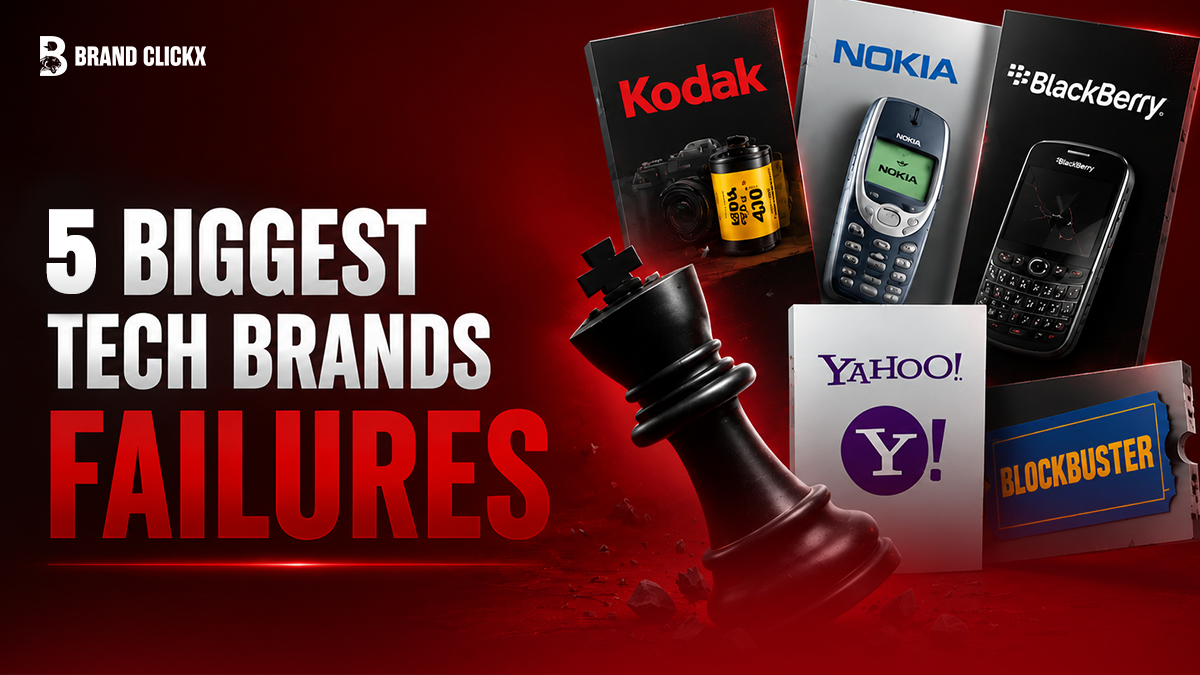
In this article, you’ll discover the five biggest tech brand failures, why each company lost its competitive advantage, the financial impact of those mistakes, and, most importantly, the practical lessons today’s businesses, startups, and AI companies should learn before history repeats itself.
Because in technology, yesterday’s market leader can quickly become tomorrow’s case study.
AI Overview
The biggest tech brand failures weren’t caused by a lack of innovation.
Ironically, several of these companies invented technologies that later transformed entire industries.
Instead, they failed because they underestimated changing customer behavior, delayed strategic decisions, ignored disruptive competitors, or became trapped by their own success.
This article examines five of the most influential technology failures, Kodak, Nokia, BlackBerry, Yahoo, and Blockbuster, to uncover the patterns behind their decline. You’ll also learn how these lessons apply to today’s AI-driven technology landscape and what modern businesses can do to avoid making the same mistakes.
Key Takeaways
Before exploring each case study, here are the biggest lessons you’ll find throughout this guide.
- Market leadership doesn’t guarantee long-term survival.
- Customer behavior changes faster than most organizations expect.
- Innovation must be paired with decisive execution.
- Protecting existing products often prevents future growth.
- Every major technology failure showed warning signs years before collapse.
- Businesses that continuously adapt usually outperform businesses that rely on past success.
What are the biggest tech brand failures?
The biggest tech brand failures include Kodak, Nokia, BlackBerry, Yahoo, and Blockbuster. Although each company once dominated its market, strategic mistakes, resistance to technological change, and failure to adapt to evolving customer expectations ultimately led to their decline. Their stories remain valuable business lessons for companies navigating rapid innovation today.
Why Great Tech Companies Fail
When people think about business failure, they often imagine poor products or weak leadership.
Reality is rarely that simple.
Many of history’s biggest technology failures happened because successful companies became too comfortable with the strategies that had made them successful in the first place.
Success can create dangerous confidence.
Once a company dominates an industry, internal processes become slower, decision-making becomes more cautious, and protecting existing revenue often takes priority over experimenting with new ideas.
That mindset can be expensive.
According to research published by McKinsey & Company, companies that successfully adapt to technological disruption significantly outperform organizations that resist major industry shifts over the long term.
Technology itself isn’t usually the problem.
Leadership decisions are.
History shows that businesses rarely disappear overnight. Instead, they experience years of missed opportunities, delayed investments, internal disagreements, and changing customer expectations before decline becomes visible.
The five companies in this article followed remarkably similar patterns despite operating in completely different industries.
Understanding those patterns is more valuable than memorizing individual company histories.
How We Selected These Five Companies
Lists about business failures are everywhere.
Many focus only on bankruptcy.
Others simply rank companies based on public popularity.
Neither approach provides meaningful business insight.
For this article, I selected companies using five criteria.
1. Industry Influence
Each company fundamentally shaped its industry before losing its leadership position.
These weren’t small startups.
They defined markets.
2. Market Dominance
Every company once controlled significant market share.
For example, Kodak reportedly accounted for roughly 90% of film sales and approximately 85% of camera sales in the United States during its peak years.
Similarly, Nokia controlled around 40% of the global mobile phone market in 2007, making it the world’s largest handset manufacturer.
3. Strategic Decision-Making
Rather than focusing solely on financial decline, this guide examines the business decisions that accelerated each company’s downfall.
Understanding why leaders made those decisions often provides more value than simply knowing the outcome.
4. Long-Term Industry Impact
Each failure reshaped its industry.
Netflix transformed entertainment after Blockbuster’s decline.
Apple and Android redefined smartphones after Nokia and BlackBerry stumbled.
Google strengthened its dominance while Yahoo struggled.
The effects extended far beyond the companies themselves.
5. Lessons Still Relevant Today
Most importantly, these stories continue offering practical lessons for modern businesses.
Whether you’re building an AI startup, managing an enterprise technology company, or launching a SaaS platform, the same strategic principles still apply.
History doesn’t repeat exactly.
But business patterns often do.
1. Kodak – The Company That Invented the Future but Refused to Embrace It
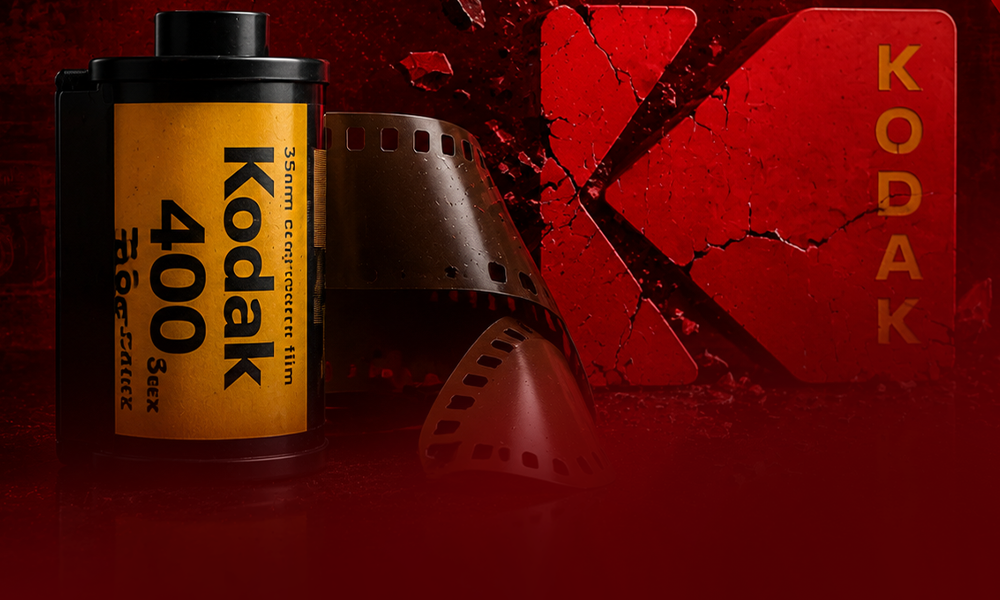
Few business stories are as ironic asKodak’s corporate history.
For decades, Kodak represented photography itself.
Families captured birthdays, vacations, graduations, and weddings using Kodak film. The company became so dominant that “Kodak moment” entered everyday language as a synonym for preserving life’s most important memories.
At its peak, Kodak wasn’t merely selling cameras.
It was shaping an entire industry.
By the late 1990s, the company employed more than 145,000 people worldwide, and its products were sold across nearly every major consumer market.
Its business appeared almost untouchable.
Yet the technology that eventually disrupted Kodak wasn’t created by a competitor.
It was invented inside Kodak.
The Digital Camera That Changed Everything
In 1975, a young Kodak engineer named Steven Sasson built one of the world’s first digital cameras.
The prototype weighed several kilograms, recorded black-and-white images at a resolution of 0.01 megapixels, and stored photographs on a cassette tape.
By today’s standards, it seems primitive.
At the time, however, it represented the future.
Kodak had the opportunity to lead the digital photography revolution before anyone else.
Instead, executives worried that digital cameras would reduce film sales, the company’s most profitable business.
Protecting today’s revenue became more important than building tomorrow’s market.
That single strategic decision changed corporate history.
Why Kodak Failed
Kodak didn’t fail because it lacked innovation.
It failed because it underestimated how quickly customer behavior could change.
As digital cameras improved and storage costs declined, consumers no longer wanted to buy rolls of film, pay for photo development, and wait days to see their pictures.
Convenience became more valuable than tradition.
When smartphones later combined cameras with internet connectivity, digital photography accelerated even further.
Kodak was no longer leading the industry it had once dominated.
It was trying to catch up.
Financial Impact
Kodak’s decline illustrates how quickly market leadership can disappear.
- Around 90% share of U.S. film sales at its peak.
- Approximately 145,000 employees during its strongest years.
- Filed for Chapter 11 bankruptcy protection in 2012 after years of declining revenue and unsuccessful restructuring efforts.
The company eventually emerged from bankruptcy with a much smaller focus on commercial imaging and printing technologies, but its position as the world’s leading consumer photography brand was gone.
What Businesses Should Learn
Kodak’s story teaches one of the most important lessons in business strategy.
Never assume your most profitable product today should prevent you from investing in the technology that could replace it tomorrow.
Disrupting yourself is often less risky than allowing someone else to do it first.
Companies that treat innovation as a threat rarely remain industry leaders for long.
2. Nokia , Losing the Smartphone Revolution
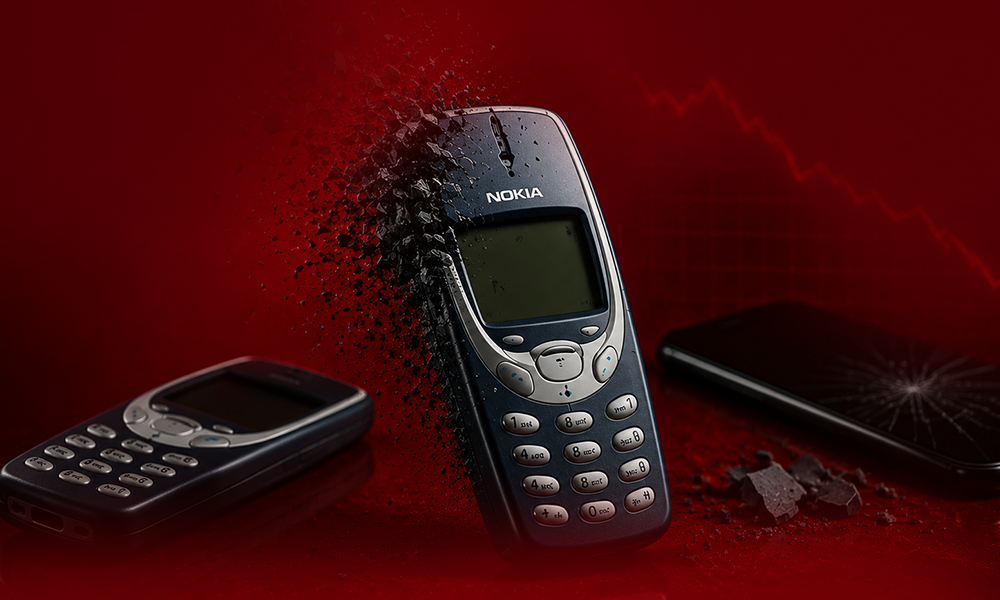
For much of the early 2000s, buying a mobile phone often meant buying a Nokia.
Whether you lived in New York, London, Lahore, or Tokyo, chances were high that someone in your family owned the iconic Nokia 3310, 6600, or N-series device.
Nokia wasn’t simply another phone manufacturer.
It was the mobile phone industry.
By 2007, the company shipped hundreds of millions of devices every year and held roughly 40% of the global mobile phone market, making it the world’s largest handset manufacturer.
Its scale seemed impossible to challenge.
Then everything changed.
The Smartphone Shift
When Steve Jobs introduced the first iPhone in 2007, many executives across the industry underestimated its significance.
Nokia was among them.
At the time, the company’s leadership believed consumers still prioritized:
- Battery life
- Durable hardware
- Physical buttons
- Traditional mobile features
Instead, customers quickly embraced something different.
They wanted touchscreens.
App ecosystems.
Better internet browsing.
Software updates.
A device that functioned like a pocket computer.
Apple wasn’t just selling a better phone.
It was redefining what a phone should be.
The Symbian Problem
Nokia’s biggest challenge wasn’t hardware.
Its engineers continued producing high-quality devices.
The real issue was software.
Symbian, Nokia’s long-standing operating system, struggled to keep pace with iOS and later Android.
Developers increasingly preferred building applications for Apple’s App Store and Google’s rapidly expanding Android ecosystem.
Without strong software, excellent hardware became less important.
Consumers weren’t simply buying phones anymore.
They were buying ecosystems.
Strategic Mistakes
Looking back, several decisions accelerated Nokia’s decline.
- Slow response to touchscreen innovation.
- Continued investment in Symbian despite mounting competition.
- Internal organizational complexity.
- Delayed adoption of Android.
- Overconfidence built on years of market leadership.
In 2011, Nokia instead partnered with Microsoft to use Windows Phone.
Although the partnership introduced innovative devices, it failed to attract enough developers or consumers to compete effectively against Android and iPhone.
Just three years later, Microsoft acquired Nokia’s mobile phone business for approximately €5.44 billion, marking the end of an era.
What Businesses Should Learn
Nokia reminds us that market leadership can disappear surprisingly fast when software innovation outpaces hardware excellence.
The lesson extends far beyond smartphones.
Technology companies must continuously evaluate whether customers still value what made them successful in the past.
If those priorities change, businesses must change too.
3. BlackBerry – When Enterprise Leadership Wasn’t Enough

Before iPhones became status symbols, BlackBerry was the device executives proudly carried into boardrooms.
Government officials relied on it.
CEOs trusted it.
Investment bankers considered it essential.
At its peak, BlackBerry wasn’t competing for teenagers or casual users.
It owned the enterprise market.
Its secure messaging platform, physical keyboard, and unmatched email experience made it indispensable for business professionals.
For years, that strategy worked exceptionally well.
Then smartphones evolved beyond productivity.
The Shift Toward Consumer Experience
Apple and Android manufacturers realized something important.
Consumers increasingly influenced enterprise purchasing decisions.
Employees wanted the same phones at work that they enjoyed using at home.
The “Bring Your Own Device” (BYOD) movement accelerated this trend.
BlackBerry continued prioritizing enterprise security while competitors improved:
- Touchscreen experiences
- Mobile applications
- Cameras
- Entertainment
- Developer ecosystems
The market shifted.
BlackBerry responded too slowly.
The Missing App Ecosystem
Hardware remained strong.
Security remained world-class.
The biggest weakness became software.
Developers focused on iOS and Android because those platforms attracted larger audiences and offered better monetization opportunities.
Without compelling applications, even loyal business users gradually migrated elsewhere.
Consumers weren’t buying operating systems.
They were buying ecosystems.
Strategic Lessons
BlackBerry’s decline demonstrates an important business principle.
A competitive advantage isn’t permanent.
The features customers value today may become basic expectations tomorrow.
Companies that continue optimizing yesterday’s strengths while competitors create tomorrow’s expectations often struggle to remain relevant.
What Businesses Should Learn
Customer expectations evolve continuously.
Businesses must innovate not only around their existing strengths but also around emerging market behavior.
Listening exclusively to current customers can sometimes prevent companies from recognizing future opportunities.
4. Yahoo – Missing Billion-Dollar Opportunities

During the late 1990s and early 2000s, Yahoo represented the internet for millions of people.
It offered:
- Search
- News
- Finance
- Sports
- Shopping
- Entertainment
Long before Google became dominant, Yahoo was one of the web’s largest destinations.
Its audience was enormous.
Its brand recognition was exceptional.
Its opportunities seemed limitless.
Yet history remembers Yahoo less for what it built and more for what it didn’t.
Missed Opportunities
Perhaps the most famous example involves Google.
In Google’s early years, Yahoo reportedly had opportunities to acquire the young search company but declined.
Although historical accounts differ regarding negotiations and valuations, the broader lesson remains the same:
Companies sometimes underestimate disruptive competitors until those competitors become impossible to ignore.
Yahoo also struggled to establish a consistent long-term strategy.
Leadership changes, shifting priorities, and acquisitions created a business with many strong products but no clear direction.
Meanwhile, Google remained relentlessly focused on search quality and advertising technology.
That focus eventually transformed Google into one of the world’s most valuable companies.
The Decline
Yahoo continued attracting millions of users for years.
However, declining advertising performance, increasing competition, and strategic inconsistency reduced its influence.
In 2017, Verizon acquired Yahoo’s core internet business for approximately $4.48 billion, far below Yahoo’s former market value during its peak.
What Businesses Should Learn
Growth creates opportunities.
Focus determines whether those opportunities become lasting advantages.
Companies trying to dominate every category sometimes lose leadership in the categories that matter most.
Execution often matters more than ambition.
5. Blockbuster – Ignoring Streaming
Few business failures have become as famous as Blockbuster.
For years, renting movies meant visiting a Blockbuster store.
Families spent Friday evenings browsing shelves filled with new releases before taking home DVDs for the weekend.
The business model worked.
Until technology changed consumer expectations.
The Netflix Opportunity
One of the most discussed moments in business history occurred around 2000.
According to widely reported accounts, Netflix co-founder Reed Hastings approached Blockbuster about a possible acquisition.
The deal reportedly wasn’t pursued.
At the time, streaming didn’t exist.
Netflix primarily mailed DVDs.
From Blockbuster’s perspective, there seemed little reason to abandon thousands of profitable retail stores.
Yet consumer behavior was already beginning to shift toward convenience.
Netflix continued evolving.
Blockbuster largely stayed the same.
Digital Disruption
Streaming eliminated many frustrations associated with physical rentals.
Customers no longer needed to:
- Visit stores.
- Return DVDs.
- Pay late fees.
- Wait for popular movies to become available.
Convenience won.
Technology enabled it.
Blockbuster responded too slowly.
In 2010, the company filed for bankruptcy protection, while Netflix continued growing into one of the world’s leading entertainment platforms.
What Businesses Should Learn
The biggest competitor isn’t always another company.
Sometimes it’s a completely different business model.
Organizations focused solely on protecting existing revenue often overlook technologies that fundamentally reshape customer expectations.
Failure Timeline Comparison
| Company | Peak Period | First Major Warning Sign | Critical Strategic Mistake | Outcome |
| Kodak | 1980s–1990s | Digital photography adoption | Protected film business instead of leading digital imaging | Filed for bankruptcy (2012); restructured around commercial imaging |
| Nokia | Mid-2000s | Rise of touchscreen smartphones | Delayed transition from Symbian and underestimated software ecosystems | Mobile division acquired by Microsoft (2014) |
| BlackBerry | Late 2000s | Consumer shift to app-centric smartphones | Focused on legacy strengths while competitors built richer ecosystems | Transitioned away from handset manufacturing |
| Yahoo | Early 2000s | Google’s search and advertising growth | Lack of strategic focus and missed acquisition opportunities | Core internet business acquired by Verizon (2017) |
| Blockbuster | Early 2000s | Growth of DVD-by-mail and streaming | Failed to adapt its retail-first business model | Filed for bankruptcy (2010) |
Financial Impact Comparison
| Company | Peak Market Position | Peak Scale | Major Decline | Final Outcome |
| Kodak | ~90% U.S. film market | ~145,000 employees | Collapse of film demand | Bankruptcy and restructuring |
| Nokia | ~40% global mobile phone share | World’s largest handset maker | Lost smartphone leadership | Mobile business sold to Microsoft |
| BlackBerry | Enterprise smartphone leader | Tens of millions of subscribers | Rapid decline after iPhone and Android | Shifted to enterprise software and cybersecurity |
| Yahoo | Leading internet portal | One of the web’s largest audiences | Advertising and search decline | Acquired by Verizon for ~$4.48B |
| Blockbuster | Largest video rental chain | More than 9,000 stores worldwide | Streaming disruption | Bankruptcy; only one franchised store remains as a cultural landmark |
The Five Warning Signs of Tech Decline (Exclusive Framework)
Looking across Kodak, Nokia, BlackBerry, Yahoo, and Blockbuster, one thing becomes clear.
These companies didn’t fail because of a single bad decision.
They followed remarkably similar patterns, patterns that modern businesses can still recognize today.
After analyzing their histories, I noticed five warning signs that appeared repeatedly, sometimes years before the companies lost their market leadership.
1. Protecting Yesterday’s Revenue Instead of Building Tomorrow’s Business
One of the biggest mistakes successful companies make is becoming overly protective of their existing products.
Kodak worried digital cameras would reduce film sales.
Blockbuster worried streaming would hurt its retail stores.
BlackBerry believed enterprise security alone would keep customers loyal.
In every case, leadership focused on preserving current revenue instead of preparing for changing customer expectations.
Businesses should remember:
If your next innovation threatens your current business, that’s often a sign you’re moving in the right direction.
2. Ignoring Changes in Customer Behavior
Markets rarely change overnight.
Customers do.
Long before Kodak declined, consumers wanted instant digital photography.
Long before Nokia lost its dominance, smartphone buyers increasingly preferred touchscreens and mobile apps.
Companies often monitor competitors while overlooking changing customer habits.
Customers don’t buy products because they’re familiar.
They buy products that solve today’s problems better than yesterday’s solutions.
3. Moving Too Slowly
Large organizations naturally become more complex.
More approvals.
More meetings.
More internal politics.
Unfortunately, technology markets rarely slow down simply because companies become larger.
While established brands debated strategy, smaller competitors moved faster.
Speed became a competitive advantage.
Today, AI startups demonstrate this principle almost daily.
4. Underestimating Emerging Competitors
Netflix wasn’t initially considered a serious threat.
Google seemed like another search engine.
Apple had never built a phone before.
History repeatedly shows that disruptive competitors often appear insignificant during their early years.
Successful businesses should study emerging competitors before those competitors become market leaders.
5. Believing Market Leadership Is Permanent
Perhaps the most dangerous assumption is believing today’s success guarantees tomorrow’s relevance.
Every company in this article once dominated its market.
Every company believed its competitive advantages would last.
None of them expected the pace of technological change that followed.
Leadership should never confuse market dominance with market permanence.
Could These Companies Have Been Saved?
One question appears repeatedly whenever people discuss famous technology failures.
Could these companies have survived?
The answer varies.
Kodak
Probably yes.
Kodak possessed the technology, engineering talent, manufacturing expertise, and global brand recognition to lead digital photography.
Its biggest obstacle wasn’t innovation.
It was organizational reluctance to disrupt its own business model.
Nokia
Possibly.
The company remained exceptionally strong in hardware design.
Had leadership embraced a modern software ecosystem earlier, or adopted Android instead of continuing with Symbian, it may have retained a stronger competitive position.
BlackBerry
Perhaps.
BlackBerry excelled in enterprise security.
Expanding that advantage while simultaneously investing more aggressively in consumer software and applications might have changed its trajectory.
Interestingly, today’s BlackBerry continues operating successfully as a cybersecurity and enterprise software company.
Yahoo
More difficult.
Yahoo’s biggest challenge wasn’t a lack of opportunity.
It was a lack of strategic focus.
The company owned excellent products but struggled to define a clear long-term direction.
Blockbuster
Very likely.
Few companies possessed stronger brand recognition in home entertainment.
Earlier investment in streaming technology, or acquiring Netflix when the opportunity existed, could have dramatically changed its future.
These examples remind us that failure isn’t always inevitable.
Sometimes it’s the result of delayed adaptation rather than impossible competition.
What Today’s Tech Companies Should Learn
Although these stories happened years ago, the lessons have never been more relevant.
Artificial intelligence, cloud computing, enterprise software, robotics, and automation are transforming industries faster than previous technological revolutions.
Today’s market leaders face similar risks.
Not because they’ll necessarily fail.
But because technological change never stops.
AI Won’t Protect Companies From Complacency
Many organizations assume adopting AI automatically makes them innovative.
It doesn’t.
Innovation depends on culture, leadership, customer understanding, and execution, not simply using new technology.
AI should accelerate better decisions, not replace strategic thinking.
Ecosystems Matter More Than Individual Products
Apple didn’t win because it built excellent hardware.
It combined hardware, software, services, and developers into one ecosystem.
Google followed a similar strategy.
Microsoft strengthened Azure by integrating enterprise software, productivity tools, and AI services.
Modern businesses should think beyond products.
They should build ecosystems.
Customer Experience Changes Faster Than Technology
Technology often improves gradually.
Customer expectations sometimes change almost overnight.
Businesses should regularly ask:
- What frustrates customers today?
- What could make our product obsolete?
- Which startup would we fear if we weren’t already successful?
Those questions often reveal opportunities competitors haven’t recognized yet.
Practical Implementation Checklist
Whether you’re leading a startup or managing a global enterprise, use this checklist to reduce the risk of repeating history.
- Challenge assumptions behind your most profitable products.
- Monitor changing customer behavior, not just competitors.
- Encourage teams to experiment before disruption becomes unavoidable.
- Invest continuously in emerging technologies.
- Measure long-term innovation alongside short-term revenue.
- Build flexible leadership structures that support faster decision-making.
- Regularly review whether your biggest competitive advantage could become your biggest weakness.
Small adjustments made consistently often prevent much larger problems later.
Frequently Asked Questions
What are the biggest tech brand failures of all time?
Among the most influential technology brand failures are Kodak, Nokia, BlackBerry, Yahoo, and Blockbuster. Each company once dominated its market but declined after struggling to adapt to major technological or consumer shifts.
Why did Kodak fail after inventing digital photography?
Kodak invented one of the first digital cameras but delayed investing aggressively in digital technology because executives feared it would reduce highly profitable film sales. Competitors eventually led the digital photography market instead.
Why did Nokia lose the smartphone market?
Nokia underestimated the importance of software ecosystems and touchscreen smartphones. Continued reliance on the Symbian operating system and delayed strategic decisions allowed Apple and Android manufacturers to gain market leadership.
What caused BlackBerry’s decline?
BlackBerry maintained exceptional enterprise security but struggled to compete in consumer-focused smartphones where app ecosystems, touchscreens, and user experience became increasingly important.
Could Blockbuster have survived?
Many business analysts believe Blockbuster had opportunities to remain competitive by investing earlier in digital distribution or embracing streaming technology before Netflix became dominant.
What common mistakes do failed tech companies share?
Most experienced similar problems:
- Resistance to innovation
- Slow decision-making
- Underestimating competitors
- Ignoring changing customer expectations
- Protecting legacy revenue instead of future opportunities
Are today’s AI companies at risk of making similar mistakes?
Yes.
Although technologies evolve, the underlying business risks remain remarkably consistent. Companies that stop listening to customers or adapting to market changes can quickly lose competitive advantages regardless of how advanced their technology becomes.
Conclusion
I still remember the silence that followed the question at that technology conference:
“Why do we spend so much time studying successful companies but almost ignore the ones that failed?”
After researching these companies, I think I understand the answer.
Failure makes us uncomfortable.
Yet it often teaches more than success ever can.
Kodak, Nokia, BlackBerry, Yahoo, and Blockbuster weren’t unsuccessful companies.
They were extraordinary businesses that changed industries before eventually being changed themselves.
Their stories remind us that innovation alone isn’t enough.
Leadership isn’t enough.
Market share isn’t enough.
Long-term success belongs to organizations willing to challenge their own assumptions before competitors do it for them.
As artificial intelligence, automation, and emerging technologies continue reshaping industries, the companies that thrive won’t necessarily be the ones with the biggest budgets or the most recognizable brands.
They’ll be the ones that remain curious, adaptable, and willing to reinvent themselves before the market forces them to.
History doesn’t guarantee the future.
But if these five companies taught us anything, it’s that ignoring history can become one of the most expensive business decisions a company ever makes.