Running a small business has always been hard. In 2026, it’s harder and more winnable at the same time.
The tools that used to sit behind enterprise budgets AI-powered content, automated campaigns, customer analytics, local search optimization are now available to any small business owner with a laptop and a modest monthly subscription. The question is no longer whether to use them. It’s whether you’ll move fast enough.
AI Overview
Small business digital marketing in 2026 is defined by two converging forces: the near-universal adoption of AI marketing tools and the intensifying competition for local search visibility. By the end of 2026, more than 80% of small businesses will use AI for marketing, according to Constant Contact’s Q1 2026 Small Business Now report. Meanwhile, 46% of all Google searches carry local intent, meaning nearly half of everything searched on Google is someone looking for something nearby and only the businesses that show up win.
The gap between early AI adopters and holdouts is widening fast. Businesses already using AI marketing tools report saving an average of 6.1 hours per week, publishing 47% more content per month, and achieving up to 41% higher email open rates than non-AI users. For small businesses with lean teams and tight budgets, that’s not a marginal advantage it’s a structural one.
Key Takeaways
| # | Takeaway | Source |
| 1 | 80%+ of small businesses will use AI marketing tools by end of 2026 | Constant Contact, 2026 |
| 2 | 46% of all Google searches have local intent | Google / BrightLocal, 2026 |
| 3 | AI saves marketers an average of 6.1 hours per week | HubSpot AI Trends 2026 |
| 4 | Complete Google Business Profiles get 70% more location visits | Google / BizIQ, 2026 |
| 5 | 98% of consumers search online before visiting a local business | BrightLocal, 2026 |
| 6 | 67% of small businesses use AI for content and SEO | Semrush, 2026 |
| 7 | Local SEO generates leads at 61% lower cost than outbound | BizIQ, 2026 |
| 8 | AI-driven email campaigns increase open rates by up to 41% | Business Dasher, 2026 |
| 9 | Only 35% of SMBs have a Google Business Profile | SMB Marketing Report, 2025 |
| 10 | $3.70 average ROI returned for every $1 invested in AI | Multiple sources, 2026 |
Why 2026 Is a Turning Point for Small Business Marketing
Two years ago, most small businesses were experimenting with AI. Today, they’re running operations on it.
According to a QuickBooks survey, 68% of U.S. small businesses now use AI regularly up from just 23% in 2023. The Small Business and Entrepreneurship Council puts the number even higher at 88% as of late 2025. Either way, the direction is unambiguous: AI has crossed from curiosity to infrastructure for small businesses in a historically short time.
The competitive math is also shifting. Enterprises have been using AI for years, but small businesses are catching up faster than analysts expected. The U.S. Federal Reserve found that by August 2025, the AI adoption gap between large and small firms had narrowed dramatically with large firm usage actually dipping slightly while SMB usage continued climbing.
The businesses that still haven’t moved face a compounding problem. Every month that early adopters use AI to produce more content, reach more customers, and serve faster is a month they pull further ahead. The tipping point, as Forbes put it in February 2026, “has arrived.
The State of Small Business Digital Marketing in 2026
The Numbers That Define the Landscape
Marketing budgets among small businesses remain tight 52% operate with monthly marketing budgets under $1,000, according to BizIQ. And yet, 88% of those that increased their marketing spend saw stable or improved sales. That’s the core tension of small business marketing in 2026: the constraint is real, but the ROI from smart investment is also real.
Social media dominates where SMBs plan to focus. In Constant Contact’s Q1 2026 survey, 68% of small businesses said social media would drive the most business this year. Email marketing came second at 41%. Both channels now run significantly better when AI assists the strategy behind them.
Customer engagement is the top challenge for 2026, cited by 44% of SMB owners in the same survey. AI is the most direct solution available — analyzing what content resonates, when to post, and who to target, without requiring a full-time marketing analyst on staff.
The $57 Billion AI Marketing Market
The global AI marketing market reached $57.99 billion in 2026, growing at a 37.2% compound annual growth rate. By 2030, 97% adoption is projected across businesses of all sizes. For small businesses, this isn’t an abstract market number it’s the infrastructure that makes affordable, high-performance marketing possible for the first time.
AI for Small Businesses: What’s Actually Working
Content Creation and SEO
The most widely adopted AI application among small businesses is content generation. According to Semrush’s 2026 data, 67% of small businesses use AI for content and SEO strategies. AI writing assistants are used by roughly 71% of AI-adopting small businesses, making it the most common tool in the category.
The results are measurable. Businesses using AI for content publish 47% more content per month on average, according to Semrush. More content means more indexed pages, more keyword coverage, and more organic traffic a compound effect that grows over time.
For small business owners who used to spend evenings writing blog posts or social captions, AI has handed those hours back. HubSpot’s AI Trends 2026 survey found that marketers recover an average of 6.1 hours per week effectively a reclaimed working day every week.
Email Marketing
AI-powered email marketing is delivering some of the clearest ROI data in the industry. AI-driven campaigns have been shown to increase email open rates by up to 41% in certain industries, according to Business Dasher’s 2026 data. Salesforce Marketing Cloud users report 299% ROI over three years.
The mechanism is targeting and timing. AI analyzes subscriber behavior what they open, when they engage, what links they click — and optimizes send times, subject lines, and content segmentation automatically. Small businesses get enterprise-grade personalization without the enterprise-grade headcount.
Among small businesses using AI for marketing, the top reported email application is email marketing copy at 62%, according to Lilach Bullock’s 2026 AI adoption analysis. Social media content comes second at 58%, followed by blog and website content at 49%.
AI-Powered Customer Service
AI customer service tools have seen the biggest acceleration among small businesses in the last 18 months, driven by one factor: cost.
A customer service AI agent resolves a standard ticket for $0.46 versus $4.18 for human handling a 9x cost reduction, according to Forrester TEI studies and Anthropic enterprise data from 2026. For a small business handling 50 to 100 customer queries a day, that difference becomes thousands of dollars per month.
Customer-facing chatbots are now used by 31% of AI-adopting small businesses for marketing and service functions. The tools handle first-contact queries, route complex issues to humans, and operate 24 hours without overtime.
Marketing Automation
Marketing automation scheduling posts, triggering email sequences, managing follow-ups is now used by 43% of small businesses with under 500 employees, up 13 percentage points from the previous year, according to the U.S. Chamber of Commerce Small Business AI Index.
The shift is from manual, one-task-at-a-time marketing to systems that run in the background. A small restaurant can automatically send a discount email to customers who haven’t visited in 60 days. A local service business can trigger a review request via SMS the day after a job is completed. These workflows used to require a marketing team. They now require a $30/month software subscription and one afternoon of setup.
Local SEO for Small Businesses: The Most Direct Revenue Channel
The Local Search Opportunity and the Gap
Forty-six percent of all Google searches have local intent. That’s nearly half of the billions of daily Google searches being made by people looking for something near them. For small businesses with a physical presence, local search is not a secondary channel it’s the primary way new customers find them.
The behavioral data is compelling. According to Google and BrightLocal, 76% of people who conduct a local search visit a business within 24 hours. Twenty-eight percent of local searches result in a purchase within a week. Local SEO generates cost-per-leads 61% lower than traditional outbound marketing, according to BizIQ’s 2026 analysis.
The gap in execution is the opportunity. Despite 89% of SMBs saying they invest in organic SEO, only 35% actually have a Google Business Profile, according to the SMB Marketing Report 2025. A significant portion of small businesses are leaving their most direct customer acquisition channel completely unclaimed.
Google Business Profile: The Highest-Leverage Free Tool
Google Business Profile (GBP) is the single most powerful free marketing tool available to local businesses in 2026 and one of the most consistently underused.
Businesses with complete and accurate GBP profiles receive 70% more location visits than those with incomplete profiles. Customers are 2.7 times more likely to trust a business they find with a complete profile on Search and Maps. A verified GBP receives an average of 1,420 views per month, according to SQ Magazine’s June 2026 data over 100 searches per day seeing your business without any paid spend.
The ranking factors are well-established. Profiles with regular posts appear 3.1 times more often in the top 3 map results. Listings with 50 or more reviews and a 4.5+ average rating have a 61% higher chance of top ranking. GBP signals now contribute approximately 32% of local pack ranking factors, making it the single most impactful lever in local SEO.
For any small business not yet on Google Business Profile, setting up and completing a profile is the highest-ROI action available it costs nothing, takes less than an hour to complete, and the competitive advantage compounds daily.
The Review Economy
Online reviews are no longer just social proof they are a direct local search ranking signal in 2026.
According to BrightLocal’s 2026 Local Consumer Review Survey, 98% of consumers read online reviews for local businesses before making a decision. Review signals drive approximately 15–17% of local pack rankings. And 68% of consumers will only use a business rated 4 stars or higher a number that has risen consistently year over year.
The implication for small businesses is clear: review management is not optional. Businesses that respond to at least 32% of their reviews see an 80% higher conversion rate compared to those that respond to 10%, according to BrightLocal’s enterprise data. Asking every satisfied customer to leave a review, and responding to every review received, should be a fixed part of every local business’s operating routine.
AI Search and Local Discovery
A new dimension of local search has emerged quickly. According to the SOCi Local Visibility Index 2026, less than half of businesses that rank well in Google’s local search results also appear in AI local recommendations meaning a separate optimization effort is now needed for ChatGPT, Perplexity, and Google’s AI Overviews.
AI Overviews now reach more than 1 billion people globally. Forty-five percent of consumers now use AI for local recommendations up from just 6% a year prior. This isn’t a future trend; it’s happening now. Small businesses that structure their online presence clearly accurate business data across all platforms, consistent NAP (name, address, phone), complete GBP, and service-specific pages will appear in AI recommendations more reliably than those with scattered or incomplete information.
Social Media Marketing for Small Businesses
Social media is the channel where small businesses feel most confident and where AI assistance is creating the biggest efficiency gains.
The top challenge on social media isn’t creativity; it’s consistency. Posting regularly, responding to comments, tracking what performs, and adjusting strategy requires more time than most small business owners have. AI tools address each part of this.
AI-assisted scheduling tools analyze past performance data and recommend optimal posting times by platform and audience. AI content tools generate first drafts of captions, carousels, and video scripts in minutes. AI analytics tools identify which content types are driving the most reach and engagement, without requiring a manual review of platform dashboards.
The practical result: small businesses using AI for social media report publishing content more consistently and spending less time doing it. For a lean team where the owner is also the marketer, that’s not a minor improvement it’s what makes a social media strategy sustainable.
Digital Marketing Trends 2026: What Small Businesses Need to Know
AI search is changing how customers find local businesses. Google AI Overviews, ChatGPT Search, and Perplexity are increasingly answering local search queries directly, without users clicking to a website. The businesses that appear in AI answers have structured, accurate, consistent information online not just a website, but a complete presence across GBP, review platforms, directories, and industry-specific sites.
Zero-click searches are accelerating. Semrush reported that 27.2% of U.S. search traffic is already zero-click, up from 24.4% in early 2024. By late 2026, multiple analysts project this reaching 70%. Small businesses need to win visibility in search results through GBP, featured snippets, and AI answers not just website clicks.
Video content is gaining ground. Short-form video on Instagram Reels, TikTok, and YouTube Shorts is outperforming static content for reach and engagement on most platforms. Small businesses that document their work, their team, and their customer experiences in short video format are building audience and trust at a lower cost than paid advertising.
Personalization is becoming the baseline. AI tools are making it possible to send every customer a message that feels like it was written specifically for them because, effectively, it was. Small businesses that deliver personalized email follow-ups, targeted promotions, and relevant content are converting better and retaining customers longer.
First-party data is more valuable than ever. With third-party cookie deprecation reshaping digital advertising, the businesses with a well-maintained email list, a CRM, and strong review profiles own their customer relationships. Those dependent entirely on paid social or paid search are most exposed to rising costs and changing platform rules.
AI Marketing Tools: What Small Businesses Are Actually Using
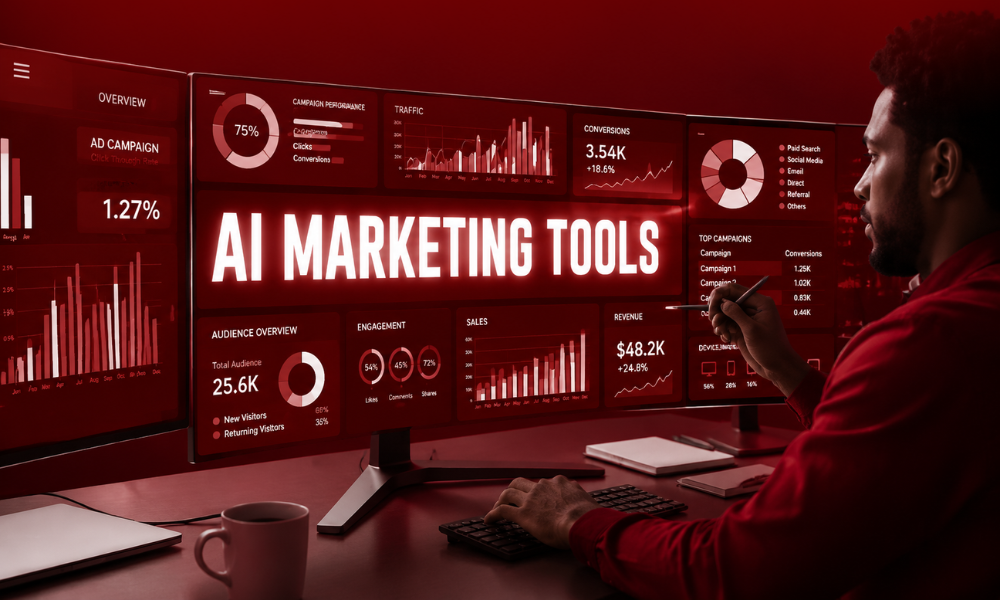
The average AI-using small business now runs a median of five AI tools, according to paidhosting.com’s June 2026 analysis a shift from single-tool experiments to an operational stack covering content, customer service, scheduling, analytics, and workflow automation.
The most commonly used tool categories in 2026:
AI writing assistants (used by ~71% of AI-adopting small businesses) ChatGPT, Claude, Jasper, Copy.ai. Used for email copy, blog posts, social captions, product descriptions, and ad creative.
AI-powered email platforms — Mailchimp, Klaviyo, Active Campaign, Constant Contact. These platforms now include AI features for subject line testing, send-time optimization, and audience segmentation built into standard plans.
AI scheduling and social media tools — Later, Buffer, Hootsuite. AI features generate content suggestions, predict best posting times, and provide performance analytics.
AI customer service tools — Tidio, Intercom, Freshdesk. Handle first-contact queries, route complex issues, and provide 24/7 availability without staffing costs.
AI SEO tools — Semrush, Surfer SEO, Ahrefs. AI features suggest content improvements, identify keyword gaps, and track ranking changes automatically.
Practical Digital Marketing Checklist for Small Businesses in 2026
Use this as a monthly review against your current marketing activity:
Google Business Profile:
- Profile claimed and fully completed (hours, photos, services, description)
- Minimum 10 photos uploaded (businesses with photos receive 42% more direction requests)
- Posting to GBP at least once per week
- Responding to every review within 48 hours
- Actively requesting reviews from satisfied customers
Local SEO:
- Consistent NAP (name, address, phone) across all online directories
- Dedicated service pages on your website for each service you offer
- Location-specific keywords in page titles, headings, and meta descriptions
- Mobile-optimized website loading under 2.5 seconds
Content and Social:
- Publishing at least two pieces of content per week (blog posts, social posts, video)
- Using AI tools to accelerate first drafts and research
- Tracking which content types drive the most engagement and repeating them
- Email newsletter or follow-up sequence in place for existing customers
AI and Automation:
- At least one automated email workflow running (welcome sequence, post-purchase follow-up, or re-engagement)
- Chatbot or automated response in place for website and social DMs
- AI tool used for at least one core marketing task per week
Frequently Asked Questions
What is the most effective digital marketing channel for small businesses in 2026?
Local SEO and Google Business Profile deliver the highest ROI for most small businesses leads at 61% lower cost than outbound, with zero monthly spend required to maintain a complete GBP.
How much should a small business spend on digital marketing?
The majority of small businesses operate with under $1,000/month in marketing budget. AI tools have dramatically improved what’s achievable at this level an AI writing tool, email platform, and SEO tool combined often costs under $200/month and replaces several hours of manual work weekly.
Is AI marketing worth it for small businesses?
Yes, based on current data. Businesses using AI marketing tools report $3.70 returned for every $1 invested, 6.1 hours saved per week, and significantly higher content output. The tools have crossed a threshold of affordability and accessibility that makes them practical for any team size.
What is a Google Business Profile and why does it matter?
Google Business Profile is a free listing that controls how your business appears in Google Search and Google Maps. Businesses with complete profiles receive 70% more location visits and appear in the Local 3-Pack the top three map results that capture 42% of local search clicks.
What AI tools are best for small business marketing?
The most practical starting points are AI writing assistants (ChatGPT, Claude, or Jasper) for content creation, and AI-powered email platforms (Mailchimp or Klaviyo) for automated campaigns. Both deliver measurable results within weeks without technical setup or large budgets.
What is the biggest digital marketing challenge for small businesses?
Customer engagement is cited as the top challenge by 44% of SMB owners in 2026. The second biggest is skills 58% of businesses cite the skills gap as their top AI implementation barrier. Both are addressable with consistent use of affordable AI tools over time.