Quick Answer
Omnicom CEO John Wren has laid out a clear, three-part John Wren business strategy for the post-IPG world: divest $3.2 billion in non-core businesses, cut $1.5 billion in costs (with $900 million targeted in 2026 alone), and invest in AI, media, data, and commerce capabilities through targeted acquisitions. He’s doing all three simultaneously while returning $5 billion to shareholders through a buyback program a signal of confidence in the combined entity’s cash-generation capacity.
The Omnicom Interpublic Group deal, which closed in December 2025, created the world’s largest advertising and marketing holding company. What comes next under Omnicom leadership, according to Wren, is a leaner, faster, more AI-powered operation and a CEO who has been waiting more than a decade to make this move.
The Man Who Kept His Notes from 2014
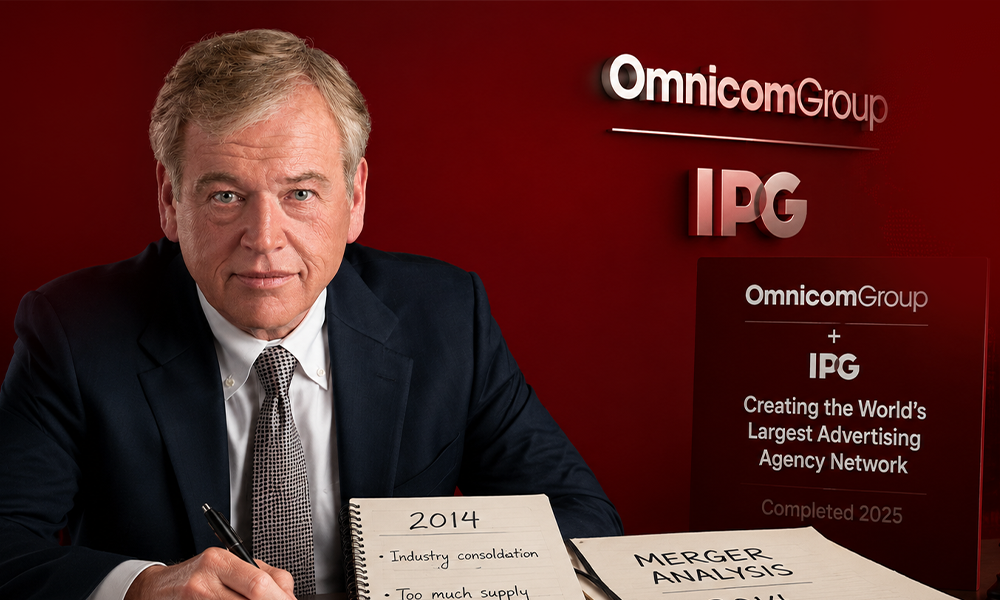
John Wren Omnicom CEO since 1997 an unusually long tenure for a public company leader kept notes from his failed attempt to merge with rival Publicis Groupe in 2014. Not because he expected that deal to come back around, but because he knew the fundamental analysis behind it would.
“What I knew that nobody else knew was there was too much supply in the industry, and I was gonna buy somebody,” Wren told AdWeek in a John Wren interview published at Cannes Lions in June 2026.
Over a decade later, the target turned out to be Interpublic Group Omnicom merger news that shocked the industry when announced in December 2024 and closed in late 2025. The advertising agency merger created the world’s largest global advertising agency network and is one of the most consequential advertising mergers and acquisitions in the history of the holding company era. The Omnicom CEO interview gave the clearest picture yet of what comes next.
The start was rough. Iconic agency brands like FCB, DDB, and MullenLowe ceased to exist. “Some of the things we did were shocking,” Wren said. About 10,000 people also lost their jobs, and top executives fought for duplicative posts.
But Wren’s position in early interviews is that the disruption was deliberate and necessary and that the hardest part is now behind the organization.
The $3.2 Billion Portfolio Rationalization
The most immediate element of Omnicom’s post-merger business strategy is one of the most concrete: divesting $3.2 billion in annual revenue tied to businesses Wren no longer considers core.
Omnicom has identified certain smaller markets and operations that are not strategic to its business and which it plans to sell or exit. After it completes the consolidation, those it retains a minority stake in will represent approximately $700 million in annual revenue.
The AdWeek interview that previewed Wren’s latest thinking described this specifically as ditching businesses that make “mud flaps and cheese samplers” a colorful characterization of the non-marketing services businesses that accumulated inside IPG over years of acquisition. Wren said these markets were no longer core to the Group’s long-term strategy.
The process is already underway. Omnicom has moved quickly to rationalise its portfolio, merging or sunsetting more than 20 agency brands and identifying $3.2 billion in annual revenue tied to non-core assets slated for disposal. Approximately $1 billion of those assets had already been divested in Q1 2026, with the remainder expected to follow over the coming months.
The sale of Jack Morton the global experiential marketing firm formerly part of IPG was the most prominent early divestiture. More are coming. The advertised plan is to complete the remaining sales and exits over the next 12 months, with proceeds recycled into buybacks and targeted acquisitions in the areas Wren does consider strategic.
The $1.5 Billion Synergy Target
When Omnicom announced the Interpublic Group acquisition, it projected $750 million in annual run-rate synergies. In February 2026, presenting the first post-merger earnings report, Wren doubled that to $1.5 billion with $900 million targeted in 2026 alone.
The key areas for these synergies are: $1 billion from reductions in labor cost through the elimination of duplicative corporate, network and operational functions; streamlining regional, country and brand structure; and optimizing utilization by shifting to a more unified resourcing model, including accelerating outsourcing and offshoring.
In addition, real estate consolidation is expected to save $240 million and synergies stemming from general and administration expenses, IT, procurement and other operational areas will account for $260 million.
The Omnicom layoffs number is significant. Last year, 3,200 roles were cut at IPG in preparation for the Omnicom deal. Omnicom has previously announced 4,000 roles will be cut in the group as a result of the merger. Combined with the IPG pre-merger headcount reduction, the total Omnicom restructuring impact touches roughly 7,000 to 10,000+ positions across the combined organization.
Wren’s framing of the labor situation in recent interviews has shifted. The AdWeek piece quotes him saying the “wholesale slaughter of people” is over indicating that the acute disruption phase is winding down and the organization is stabilizing.
He also insists, with some tension, that AI is not “a threat to jobs” while simultaneously confirming that AI-driven productivity gains will continue to reduce headcount. Wren said advancements in AI capabilities will mean it will continue to eliminate certain positions. However, he simultaneously insisted that AI isn’t “a threat to jobs,” arguing that it allows its staff to do more.
The AI Platform at the Center: Omni
Omnicom’s competitive positioning in the post-merger era is built primarily around one asset: Omni, its proprietary AI-enabled marketing platform.
“Our core focus is to deliver integrated services connecting media, creative content, commerce, consulting, data and technology. These connected capabilities, underpinned by Omni, bring together high-growth strategic services that drive business outcomes for our clients,” Wren said.
Omni is now deployed across the organisation. The system integrates data, media, and creative workflows, while enabling automation and more direct media buying capabilities. Wren described the shift as both operational and structural. “It reduces the need for what was previously manual work… in the simplest terms, it makes us more productive.”
The IPG acquisition significantly strengthened Omni’s data layer. A key asset Wren identified before the merger closed was Acxiom IPG’s gold standard of data. “When we integrate that into our Omni network and Flywheel, which deals with retail and consumer activity, we’ll have the best view of consumers available. This will allow us to create unique IDs for individuals around the world, enabling us to target and influence consumers while respecting their privacy.”
Executives also pointed to early experimentation with “agentic” media buying, where automated systems transact directly with publishers, potentially shortening the supply chain and improving efficiency. This is Omnicom’s bet on what media buying looks like in two to three years fewer humans in the transaction loop, more AI automation, and a margin structure that doesn’t depend on headcount growth.
Shareholder Returns: The $5 Billion Buyback
Alongside the operational restructuring, Omnicom’s Omnicom business strategy includes one of the largest capital return programs in advertising industry history.
The board authorized a $5 billion share repurchase program and immediately executed a $2.5 billion accelerated share repurchase agreement. The market reaction was swift Omnicom shares surged 13.4% to trade near $79.50 as investors cheered the aggressive focus on shareholder returns.
Omnicom repurchased $2.8 billion in stock during Q1 2026 as part of the broader $5 billion buyback plan, which is expected to reduce share count by up to 12% by year-end. Free cash flow rose 70% year-on-year, bolstered by improved operating performance and the addition of Interpublic’s business.
The tradeoff: Omnicom ended the quarter with $10.2 billion in gross long-term debt, and executives acknowledged that interest expenses would rise by roughly $200 million this year. The buyback strategy is partly designed to offset the earnings-per-share dilution that higher interest costs would otherwise create.
What Wren Is Buying Next
Even as Omnicom sells non-core assets, Wren is signaling intent to acquire but selectively, and in defined categories.
Any investments will focus on “strategic tuck-in acquisitions” in media, content, commerce, consulting, data and AI. This is the Omnicom acquisition strategy post-IPG: no more mega-mergers, targeted additions in the areas that strengthen the Omni platform and the “Connected Capabilities” positioning.
The agency consolidation narrative Wren has consistently pushed is that the next competitive advantage won’t come from additional scale it’s already the world’s largest but from depth in the highest-growth service categories. That means continuing to build data, automation, and performance marketing capabilities that clients can’t easily replicate in-house.
The Competitive Context: Omnicom vs WPP vs Publicis
The IPG acquisition reshaped the global advertising agencies competitive landscape and the advertising industry news surrounding it has been closely watched across the marketing industry trends conversation of 2026. Omnicom future plans signal where the largest holding company thinks the industry is heading.
Publicis Groupe, which recently reported strong organic growth of 5.6%, saw its shares slip on the day Omnicom announced its Q4 results and buyback a sign that investors are recalibrating expectations across agency holding companies.
WPP is facing its own pressures, having lost major accounts and undergoing leadership transition. Publicis is growing but faces the same structural questions about AI, in-housing, and platform disintermediation that every holding company does.
Wren’s read on why the merger was necessary is structurally clear. There was “too much supply in the industry.” The IPG deal was not primarily about scale for scale’s sake it was about eliminating redundancy, concentrating investment in the capabilities that matter, and building a data and AI asset base that smaller competitors can’t replicate.
New Business Momentum
Despite the disruption of integration, Wren’s post-merger client story has been more positive than the industry expected.
Wren said clients have met the merger with more “enthusiasm” than he expected and cited recent wins, including American Express, Bayer, BBVA, Mercedes-Benz, Clarins, and NatWest, as evidence of “significant progress made as a new organization.”
The addition of Adidas’ $512 million global media account won by PHD in the same week as the AdWeek interview at Cannes Lions adds to a 2026 new business run that includes IBM and Dyson. Each win validates the argument that Omnicom’s scale and platform capabilities are translating into competitive differentiation at the pitch level.
“We’ve strategically repositioned our portfolio for growth,” Wren said.
Key Takeaways
- John Wren’s Omnicom business strategy post-IPG has three pillars: divest $3.2 billion in non-core businesses, deliver $1.5 billion in synergies (with $900 million in 2026), and invest in AI, data, media, and commerce capabilities through targeted tuck-in acquisitions.
- The Omnicom layoffs are substantial but framed as largely complete. Combined pre- and post-merger job cuts total roughly 7,000 to 10,000+ positions. Wren says the “wholesale slaughter of people” is over.
- Omni, the proprietary AI platform, is the core competitive asset. Acxiom’s data, Flywheel’s commerce intelligence, and agentic media buying capabilities are Omnicom’s answer to the structural questions about AI and agency relevance.
- The $5 billion buyback is the most aggressive capital return in advertising holding company history. Wren is betting on earnings growth through share count reduction while managing higher post-merger debt.
- New business momentum is holding. American Express, Bayer, Mercedes-Benz, IBM, Dyson, and Adidas all joined or extended in the post-merger period contrary to the conventional expectation that integration disruption damages client relationships.
FAQ:
What is John Wren’s strategy for Omnicom after the IPG acquisition?
Divest $3.2B in non-core businesses, capture $1.5B in cost synergies (mainly labor and real estate), and invest in AI, data, media, and commerce through targeted acquisitions while returning $5B to shareholders via buybacks.
How many jobs are being cut at Omnicom after the IPG merger?
Combined pre- and post-merger reductions total roughly 7,000 to 10,000+ positions. Wren has said the major disruption phase is complete, describing it as a “wholesale slaughter” that is now over.
What is Omni, Omnicom’s AI platform?
Omni is Omnicom’s proprietary AI-enabled marketing platform integrating data, media, and creative workflows. It now incorporates Acxiom’s consumer data and Flywheel’s commerce intelligence from the IPG acquisition, and is being used to develop agentic media buying capabilities.
Is Omnicom planning more acquisitions after IPG?
Yes, but selectively. Wren has signaled focus on “strategic tuck-in acquisitions” in media, content, commerce, consulting, data and AI not another mega-merger.
How is Omnicom performing financially after the IPG merger?
Q4 2025 revenue reached $5.53 billion, up 27.9% year-over-year. Q1 2026 free cash flow rose 70%. The company has $10.2 billion in gross long-term debt and is on track to repurchase up to 12% of shares by year-end.
The Bigger Picture
John Wren has been CEO of Omnicom for nearly 30 years. The IPG acquisition is the largest move of his tenure and arguably the defining one. The restructuring is painful but deliberate: fewer agencies, fewer brands, fewer markets, and a much sharper focus on where marketing is actually heading.
The advertising industry is watching closely. If Omnicom can execute the $1.5 billion in synergies without losing the client relationships and talent that justify the premium the market puts on these businesses, it will have validated the holding company consolidation thesis. If integration disruption costs major clients or accelerates talent departure, the scale advantage will prove harder to convert than the buyback math suggests.
Wren’s bet is that data, AI, and connected capabilities are the differentiator not size alone. That’s a new argument for a 30-year CEO of what was already one of the world’s largest agency holding companies. Whether the market agrees will play out across the next 24 to 30 months of integration.
The notes he kept from 2014? He finally used them.