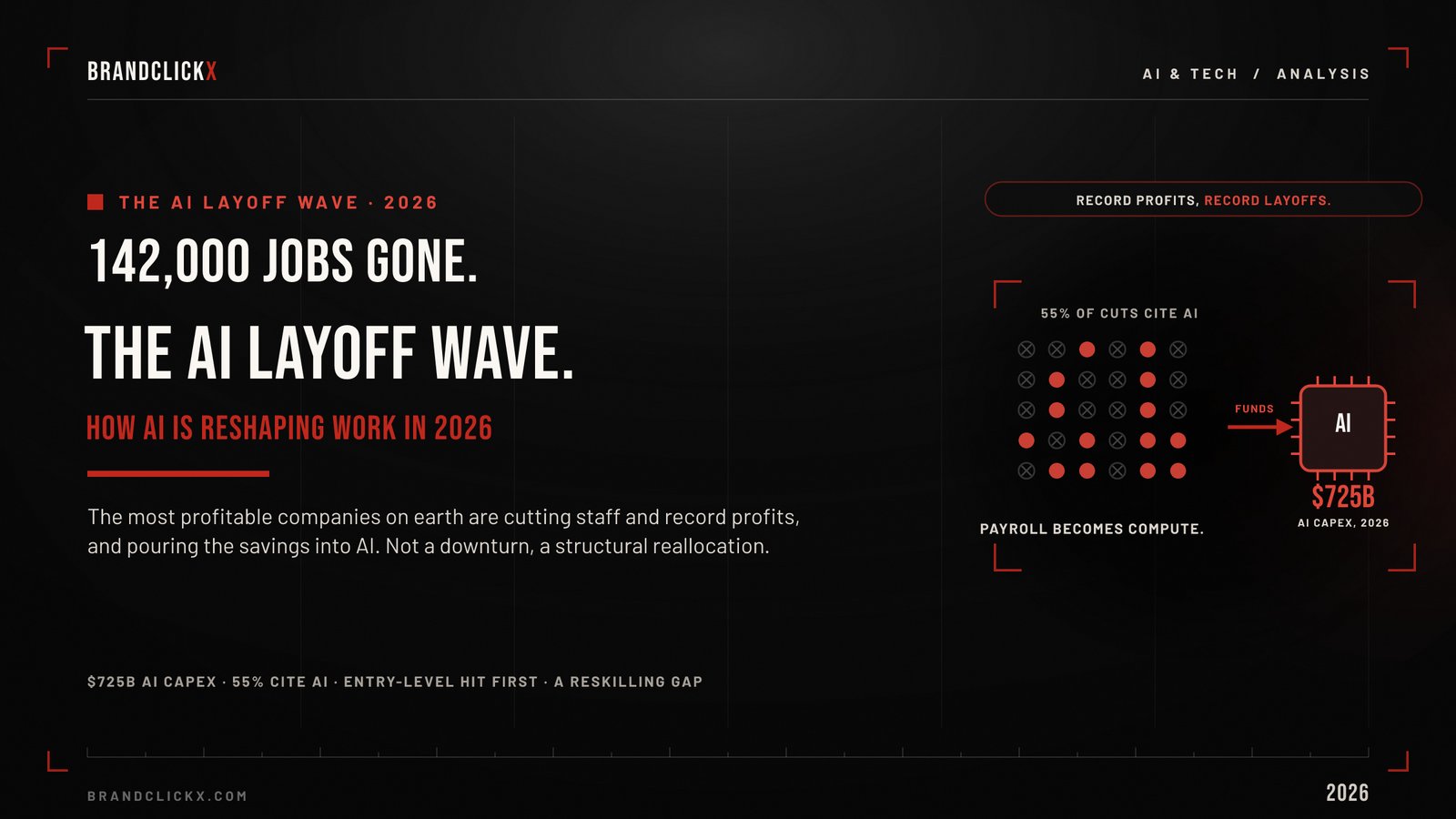
AI layoffs stopped being a forecast in 2026. They became a line item.
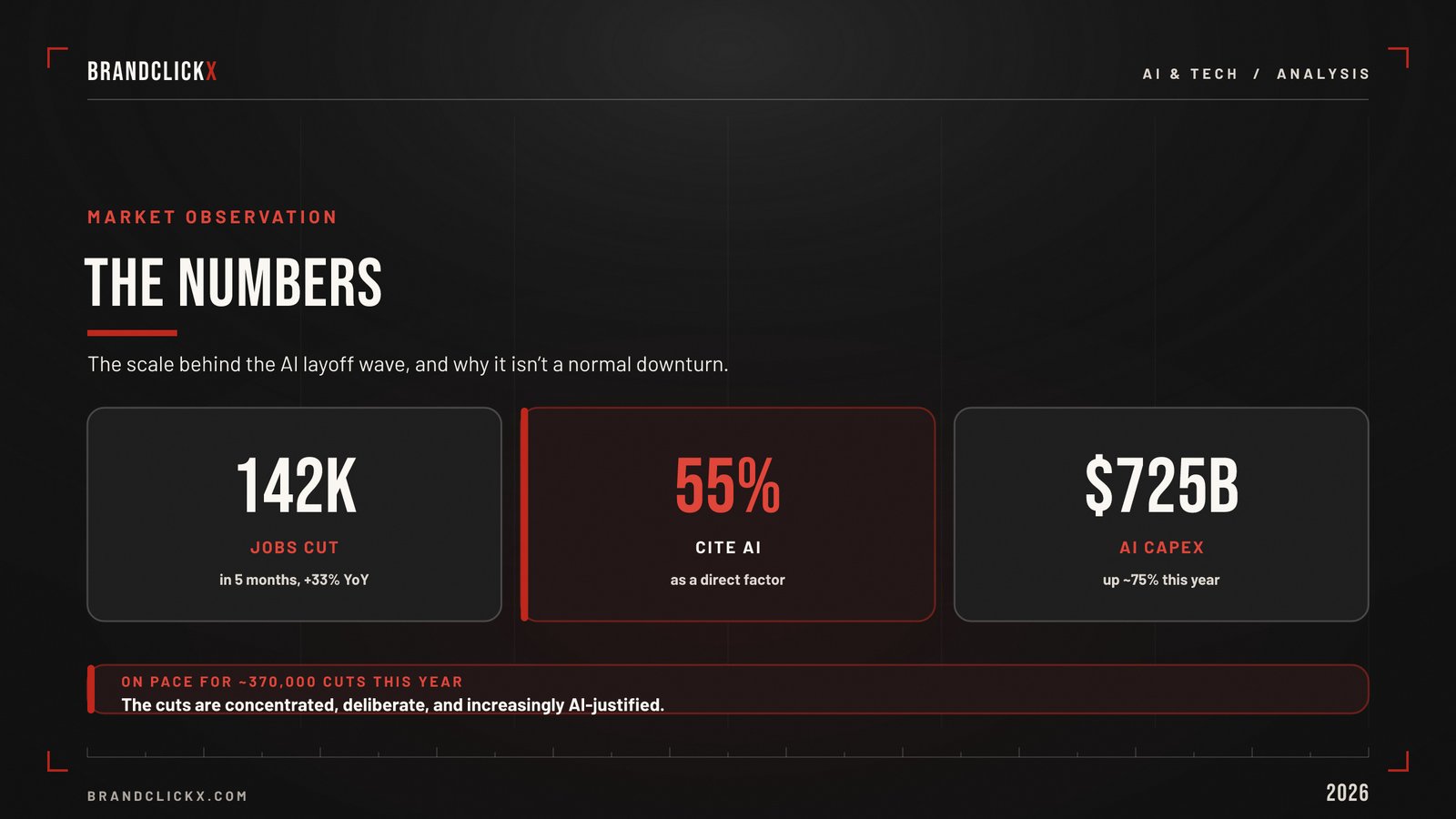
In the first five months of the year, more than 142,000 tech workers in the United States lost their jobs, a roughly 33% jump over the same stretch in 2025. The pace puts the industry on track to approach 370,000 cuts for the full year, edging toward the post-pandemic record of 430,000 set in 2023.
That number alone is not the story.
The story is that the companies doing the cutting are posting record profits while they do it. Meta, Amazon, Microsoft, and Alphabet committed roughly $725 billion in capital expenditure in 2026, about a 75% increase over the prior year, and nearly all of it is earmarked for AI data centers, chips, and infrastructure.
Read that twice. Companies are reducing payroll and buying GPUs with the savings. The blunt version of the 2026 economy is exactly that simple, and exactly that uncomfortable.
This is not the layoff cycle of 2023. That one was a hangover from pandemic overhiring, a painful but logical return to pre-pandemic staffing. The 2026 wave is structural. It is the moment AI job displacement moved from slideware into operating budgets, and it is reshaping how every modern company thinks about headcount, output, and the value of a human in the loop.
For marketing leaders, agency operators, and growth teams, this is not someone else’s industry news. It is a preview of the next two years of your own org chart.
Market Observation: The Numbers Behind the AI Layoff Wave
The data is messy, but the direction is not.
One widely cited tracker logged more than 113,000 cuts across 179 companies by mid-May, an average of roughly 825 people losing work every single day since January. Another aggregator counted over 183,000 affected individuals across 247 events, closer to 1,115 a day.
The trackers disagree on totals because they count differently. They agree on the trend line, and the trend line points up.
What separates 2026 from prior years is attribution. Around 55% of layoff events this year explicitly named AI, automation, or machine learning as a driver. In the first quarter alone, Nikkei Asia reported that 47.9% of 78,557 tech cuts were tied to reduced need for human workers because of AI and workflow automation.
The individual events tell the same story in sharper relief.
Meta began cutting roughly 8,000 employees in May, about 10% of its workforce, while closing thousands of open roles to free budget for AI. Block, led by Jack Dorsey, eliminated around 4,000 jobs, near 40% of its global staff, citing the growing capability of AI tools.
Oracle reportedly moved on 20,000 to 30,000 positions. Amazon announced about 16,000 corporate cuts in January, on top of 14,000 the prior October.
Goldman Sachs estimated AI was displacing around 16,000 US jobs a month in 2026.
These are not struggling firms trimming fat. These are the most valuable companies on earth restructuring around a new assumption: that software can now do work that used to require a salary.
Why It Matters: When the most profitable companies in the world treat headcount as a funding source for automation, the rest of the market follows within a quarter or two. The playbook does not stay in Big Tech. It spreads to mid-market SaaS, to agencies, to enterprise marketing departments, and to every team whose work product is words, code, or analysis.
Strategic Breakdown: Why Profitable Companies Are Still Cutting
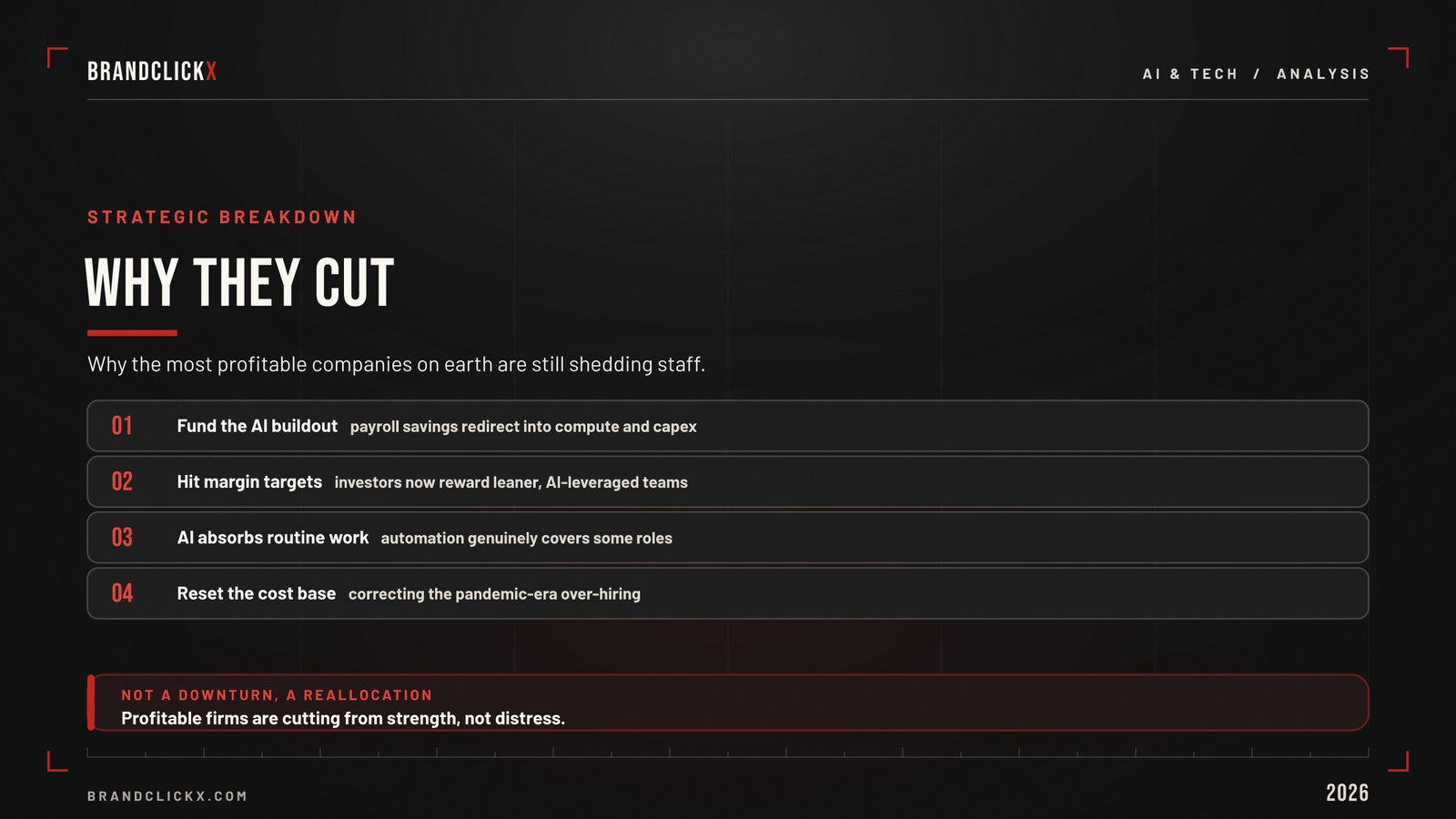
The instinct is to assume layoffs signal weakness. In 2026, they often signal the opposite.
A company cuts when it believes it can produce the same output with fewer people. That belief, right or wrong, is now baked into how leadership teams model the next three years. The math is straightforward and a little cold.
Every role that AI can plausibly absorb becomes a candidate for reallocation. The salary does not vanish. It migrates into compute, model access, and the small number of senior people who can orchestrate the systems.
This is the quiet logic of tech layoffs 2026. It is not panic. It is portfolio reallocation, with human jobs on one side of the ledger and AI infrastructure on the other.
There is a catch, and serious economists keep flagging it.
EY-Parthenon’s chief economist noted that companies are cutting labor expenses while AI investment grows rapidly, but whether that represents actual replacement or anticipated replacement remains an open question. In plain terms, many firms are firing on a bet. They are assuming AI will deliver the productivity to justify the cut, before the proof exists.
That distinction matters enormously for anyone trying to plan a career or a team.
| Layoff Driver | 2023 Cycle | 2026 Cycle |
| Primary cause | Pandemic overhiring correction | AI infrastructure reallocation |
| Profitability of cutters | Often under pressure | Frequently at record highs |
| Capital direction | Cost control, runway extension | $725B+ into AI data centers and chips |
| Roles targeted | Broad, recent hires | Routine and entry-level white-collar work |
| Reversibility | Hire back when demand returns | Bet that the work itself disappears |
Enterprise Perspective: For enterprise leaders, the takeaway is not “cut staff to look modern.” It is the harder discipline of separating real automation from automation theater. The companies that win this cycle will be the ones that cut where AI genuinely delivers and protect the human capacity they will desperately need when the bet on full replacement proves half right.
The Roles Disappearing First, and the Ones Quietly Growing
Not all jobs are equally exposed. The pattern of AI workforce impact is specific, and it is not the one most people predicted a decade ago.
For years the assumption was that automation would come for manual labor first. The opposite happened. AI is hitting educated, white-collar, screen-based work hardest, while many physical trades remain comparatively untouched.
The Entry-Level Collapse
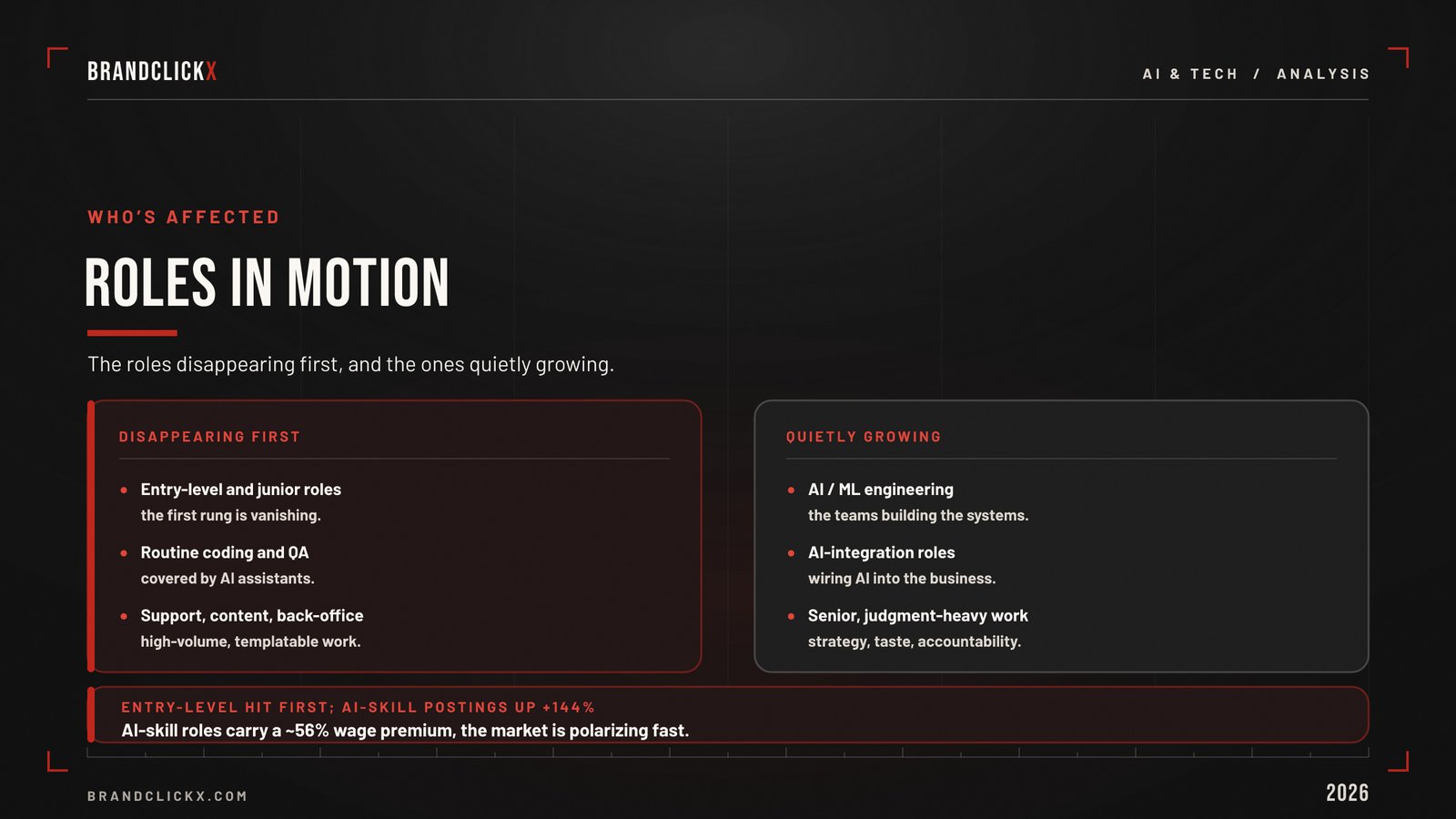
The most alarming signal sits at the bottom of the ladder.
Stanford research found that software developer employment for workers under 26 fell nearly 20% since 2024. Venture firm SignalFire reported that big-tech hiring of recent graduates dropped about 25% in a single year and sat roughly 50% below pre-pandemic levels.
Entry-level roles are career launchpads. They are also, unfortunately, the roles built from exactly the tasks AI does cheaply: basic coding, drafting, data processing, first-tier support, routine analysis.
When you automate the first rung, you do not just cut a job. You break the path that turns a junior hire into a senior leader five years later.
The Washington Monthly captured the paradox bluntly: the data say white-collar jobs are booming, the class of 2026 says the opposite, and both are right. Aggregate employment can hold steady while the on-ramp for new workers narrows to a sliver.
The Roles AI Is Quietly Creating
The grim half of the story has a counterweight, and ignoring it is its own kind of distortion.
Machine learning infrastructure, model evaluation, AI safety, and applied research roles are in acute shortage. Job postings requiring AI skills grew 144% year over year as of April 2026, according to the Bipartisan Policy Center’s analysis. Workers with AI skills command wage premiums of up to 56% over their peers, per PwC’s jobs research.
So the same wave that erases junior analysts is minting AI-fluent specialists at a premium.
The trouble is that these are different people. The laid-off recruiter does not become a model evaluation engineer over a weekend. The displacement gap is, at its core, a reskilling gap, and it is the defining operational problem of the decade.
| Role Category | Direction in 2026 | Why |
| Data entry and clerical | Declining sharply | Up to 80% automation potential |
| Tier-1 customer support | Declining | Chatbots and voice agents absorb volume |
| Junior software, basic analysis | Compressing | Drafting and routine coding automated |
| Recruiting and back office | Contracting | Workflow automation reduces headcount |
| AI, ML, data science | Booming | Acute talent shortage, 56% wage premium |
| Cybersecurity | Growing | Among fastest-rising skill demands |
| Skilled trades and personal services | Resilient | Physical judgment resists automation |
Industry Impact: The labor market is not shrinking so much as polarizing. The middle, where most routine knowledge work lived, is thinning. The top, where AI orchestration and judgment live, is growing and paying more. The bottom rung is quietly being sawed off. That shape, not a simple jobs-versus-no-jobs binary, is the real future of work.
Expert Insight: How Much of This Is Real, and How Much Is “AI Washing”?
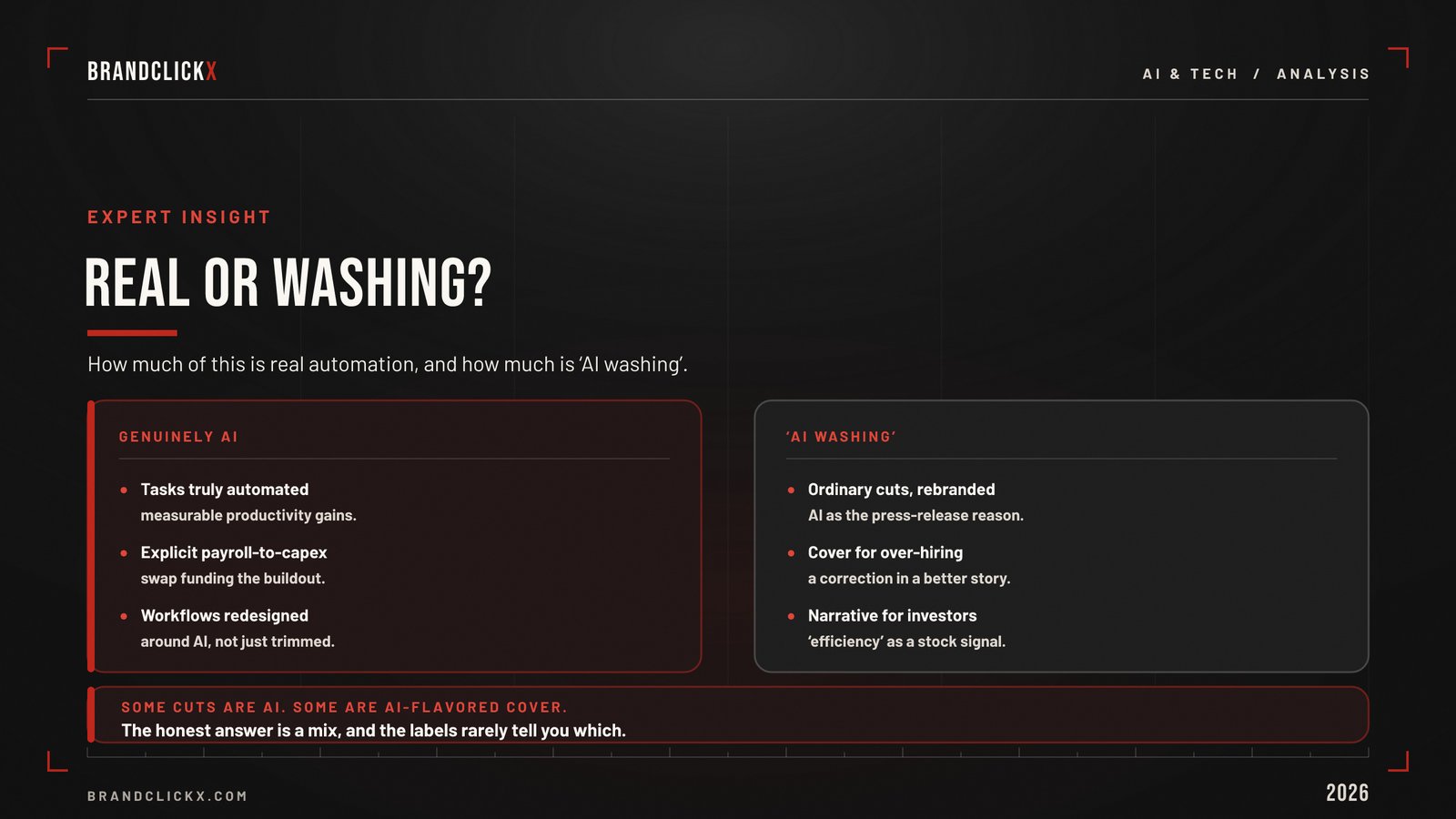
Here is the contrarian corner, because every honest analysis of the AI layoff wave needs one.
A large share of the 2026 cuts may be opportunistic. Companies wanted to trim for ordinary reasons, slowing growth, overhiring, missed bets, and AI became the cover story that sounds strategic instead of reactive.
OpenAI’s Sam Altman said it plainly: there is some AI washing where people blame AI for layoffs they would have done anyway, alongside genuine displacement of certain jobs. Cognizant’s chief AI officer added that it will take more than a year to see the true workforce impact of modern AI, and questioned whether the cuts are directly tied to real productivity gains.
The skeptics have receipts.
The Washington Monthly noted that occupations often described as AI’s first casualties have instead expanded: more software developers than in 2022, more radiologists, more paralegals. If AI were a pure job-killer, those lines would point down. They point up.
Several analysts now expect a reversal. By 2027, a meaningful share of companies that cut for AI are projected to rehire, having discovered they cut too deep and that the promised automation underdelivered.
So which is it? Real revolution or expensive theater?
The defensible answer is that both forces are operating at once, and the ratio differs company by company. Treating the layoff wave as pure inevitability is naive. Treating it as pure hype is reckless. The leaders who navigate it best hold both ideas in their head and let evidence, not narrative, drive the cuts they actually make.
Market Observation: The most telling tell is rehiring. IBM tripled its entry-level hiring in 2026 even while arguing AI can do much junior work, on the logic that the work still needs a human touch. When a major firm cuts and a peer expands in the same quarter, the technology is not the variable. Judgment is.
The Bigger Shift: The Google Core Update Nobody Connected to the Layoffs
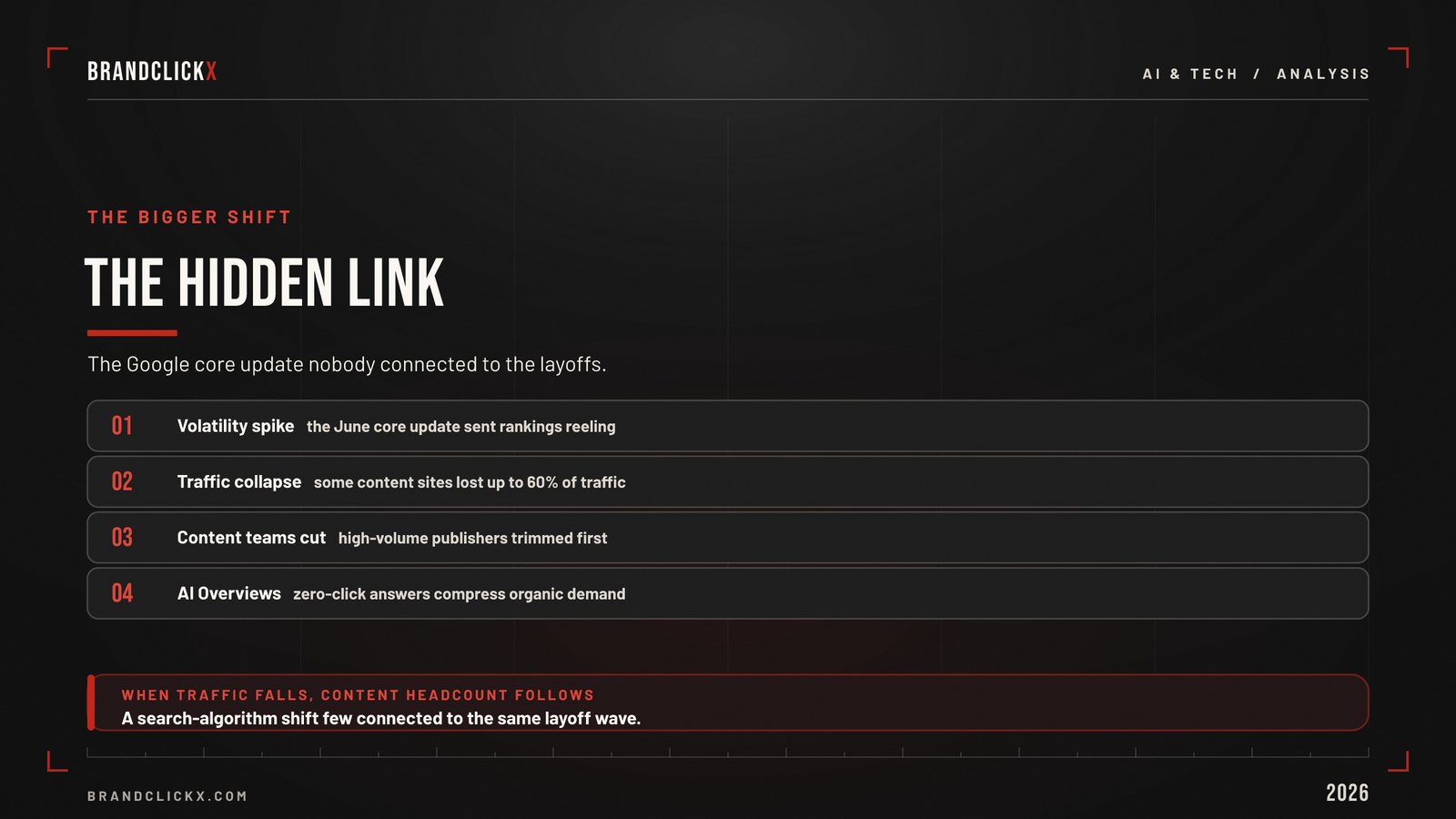
This is the part of the story most coverage misses, and it sits squarely in BrandClickX territory.
The same generative AI that thinned marketing and content teams also unleashed a flood of machine-written articles across the open web. For about eighteen months, the cheap play was obvious: fire the writers, prompt the model, publish at volume.
Then Google’s 2026 core updates arrived and broke that trade.
The May 2026 core update produced extreme ranking volatility. The Semrush Sensor, which measures fluctuation intensity, spiked to 9.4 on a scale where anything near that level signals a major reshuffle. Sites that had scaled to 50-plus articles a month reportedly lost up to 60% of their organic traffic.
The crucial nuance, confirmed across SEO analyses, is what the update actually targeted.
It did not punish AI content as such. It punished undifferentiated, high-volume, commodity content. AI was simply the instrument that made churning out that content cheap. The quality failure is what triggered the demotion, and plenty of human-written filler got caught in the same net.
Notice the symmetry with the layoff wave.
In both arenas, the lesson is identical. Volume is now nearly free. Commodity output, whether it is a junior analyst’s boilerplate or a model’s 800th near-identical blog post, has collapsing value. What survives is differentiated judgment, verifiable expertise, and a point of view that does not already exist a thousand times online.
Google’s AI Overviews reinforced the point by growing more selective about citations, favoring pages with verifiable claims and clear structure over long content with weak evidence. The signals that protect you in a core update, real expertise, extractable claims, evidence on the page, are the same signals that earn AI citations.
Strategic Breakdown: The marketing organization that replaced its content team with a prompt got a brutal double lesson in 2026. It lost institutional knowledge to the layoff, then lost the traffic when the volume play stopped working.
The teams that fared best did the opposite: they kept experienced humans, used AI to draft, and invested the saved time into the editorial judgment that both Google and readers now reward. Generative AI jobs in marketing are not disappearing. They are being redefined around oversight, originality, and proof.
Industry Impact: How Work Itself Is Being Re-Architected
Step back from the headlines and a deeper restructuring comes into view. The unit of work is changing.
For a century, organizations scaled by adding people. Need more output, hire more analysts. Need more content, hire more writers. The 2026 model breaks that link. Output now scales with compute and a smaller number of people who direct it.
The World Economic Forum frames one version of this as the “agentic leap,” where many jobs disappear but new occupations emerge fast and humans become, in their phrase, agent orchestrators. The job is no longer to do the task. It is to direct, evaluate, and take responsibility for a fleet of systems that do the task.
That reframe changes what a team even looks like.
| Operating Model | Traditional (Pre-2024) | AI-Native (2026 onward) |
| How output scales | Add headcount | Add compute plus orchestration |
| Junior role function | Do the routine work | Increasingly automated away |
| Senior role function | Manage people | Direct AI systems, own judgment |
| Bottleneck | Hours available | Quality of problem framing |
| Competitive edge | Process and scale | Differentiation and taste |
| Biggest risk | Understaffing | Cutting human judgment too deep |
The risk in this model is not laziness. It is over-correction.
Cut too few and you carry cost your competitors shed. Cut too deep and you hollow out the institutional knowledge, the editorial taste, and the senior judgment that AI cannot replace and that the next core update, the next client crisis, the next strategic pivot will demand.
Tactical Framework: Leaders should audit work along two axes before any AI-driven cut. First, how routine and rule-based is the task, which sets automation potential. Second, how much consequence rides on getting it right, which sets the need for human judgment.
Automate the high-routine, low-consequence quadrant aggressively. Protect the low-routine, high-consequence quadrant fiercely. Most organizations get this exactly backward under cost pressure, automating the judgment and keeping the busywork.
Tactical Framework: A Playbook for Leaders Navigating the Shift
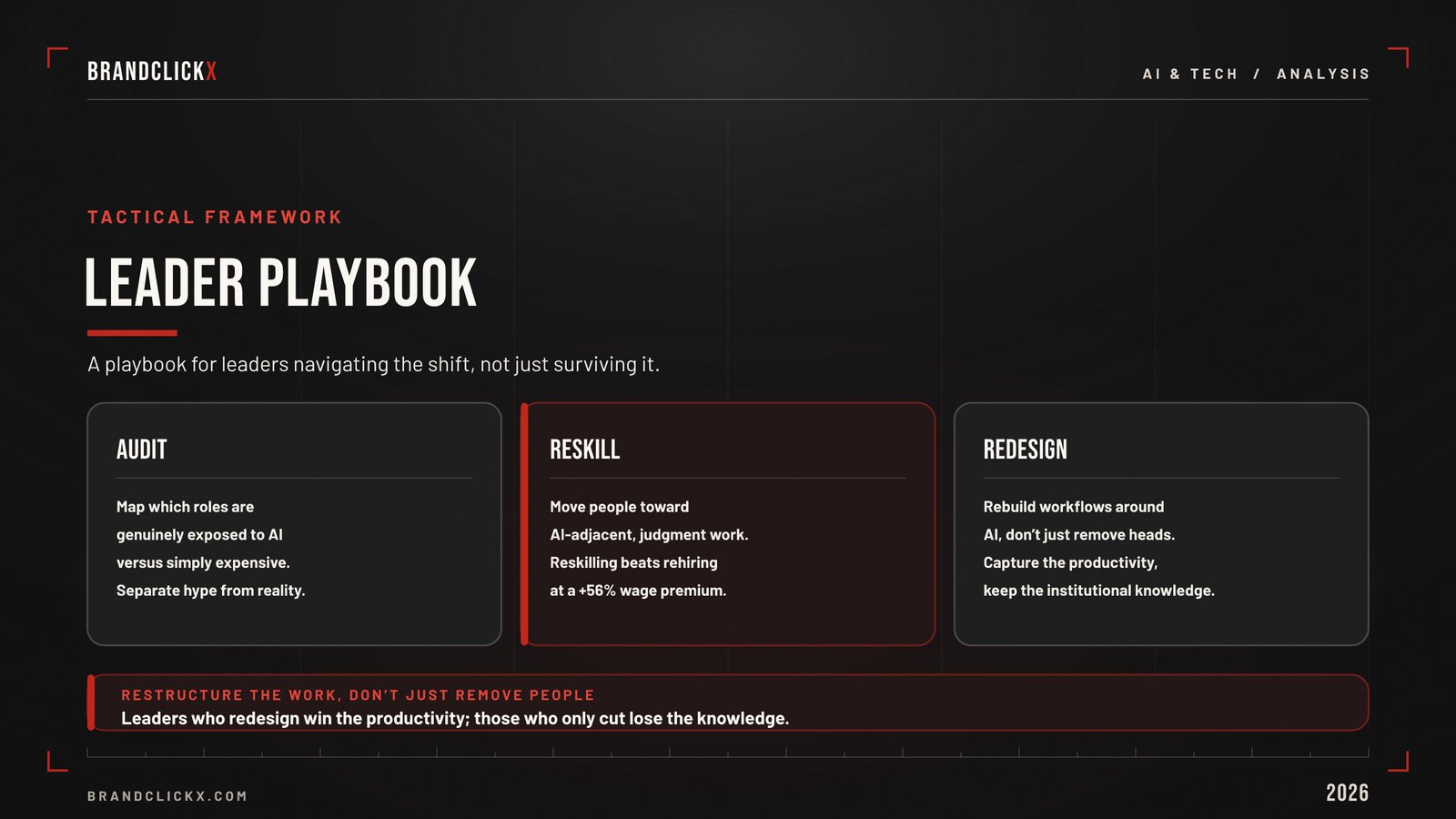
The macro trends are not actionable on a Monday morning. These principles are.
- Separate real automation from automation theater. Before cutting a role, run the work through AI for sixty days with the human still in place. If quality holds, the cut is real. If it does not, you just avoided an expensive rehire in 2027.
- Protect the on-ramp. Entry-level roles are not just cost. They are your leadership pipeline. Firms that eliminated junior hiring entirely will face a senior talent vacuum in five years. Redesign junior roles around AI oversight rather than deleting them.
- Invest the savings, do not just bank them. The payroll a company saves through automation should partly fund reskilling for the people who remain. The reskilling gap is the binding constraint of this decade, and the WEF estimates 39% of workers’ core skills will change by 2030.
- Reward judgment, not volume. In a world where output is cheap, the scarce skill is knowing what is worth producing. Compensation, promotion, and praise should track differentiation and decision quality, not raw throughput.
- Treat content like headcount. The same discipline that governs hiring should govern publishing. Before creating a page, ask what would justify keeping it two years from now. If the answer is “it targets a keyword,” reconsider. If it is “it answers a durable need with evidence we can maintain,” publish.
Key Takeaway in Practice: The organizations that thrive will not be the ones that cut the most or the fastest. They will be the ones that cut the right work, protected the right people, and reinvested the difference into the judgment that both algorithms and markets now reward.
Future Outlook: What Happens Next
The next twenty-four months will settle the central question: was 2026 genuine replacement or anticipated replacement?
The most credible roadmap looks like a staged transition. The years from 2023 to 2025 brought task automation and hiring freezes. 2026 through 2028 will bring the peak of displacement and a surge of difficult career transitions. By the end of the decade, a new equilibrium should form, with fewer but more leveraged roles and a labor market reorganized around AI fluency.
The aggregate numbers, if the optimists are right, are not catastrophic. The World Economic Forum projects 170 million new roles created against 92 million displaced by 2030, a net gain of 78 million jobs, with 22% of all jobs disrupted along the way.
A net gain is cold comfort to the displaced.
The displaced worker and the newly hired specialist are rarely the same person, and the transition between them is neither automatic nor painless.
That is why CNBC’s reporting on the hiring slowdown found white-collar unemployment rising each year since 2023 while blue-collar work held steadier, and why McKinsey data cited by Built In suggests annual US hires in the skilled trades could outpace net new white-collar jobs by a wide margin over the coming decade.
The American Dream is being rewritten, and for once the screen-based knowledge worker is the one feeling the ground move.
What Happens Next: Expect a wave of quiet rehiring in 2027 as overcut companies discover the limits of full automation. Expect AI fluency to become a baseline expectation rather than a differentiator. Expect the skilled trades, healthcare, and the small priesthood of AI specialists to absorb the energy leaving routine knowledge work.
And expect the firms that kept their best judgment in-house to look, in hindsight, like the smartest operators of the cycle.
Key Takeaways
- The 2026 AI layoff wave is structural, not cyclical. More than 142,000 tech jobs were cut in five months, with about 55% of events citing AI, and the cause is reallocation toward automation rather than financial distress.
- Record profits and record layoffs coexist by design. The biggest employers committed roughly $725 billion to AI infrastructure in 2026 and are funding part of it with payroll savings.
- Entry-level work is the front line. Junior and routine white-collar roles are vanishing fastest, breaking the career on-ramp even as aggregate white-collar employment holds.
- AI washing is real, and so is genuine displacement. Both forces operate at once, the ratio varies by company, and a meaningful share of 2026 cuts are likely to reverse by 2027.
- The layoff wave and the Google core update are the same lesson. Volume is cheap, judgment is scarce, and only differentiated human expertise holds value, whether the output is analysis or articles.
- The winners will cut surgically and reinvest. Protecting judgment, preserving the talent pipeline, and funding reskilling beat blanket cost-cutting every time.
Frequently Asked Questions
Are AI layoffs real or just an excuse?
Both. Sam Altman has said some firms blame AI for cuts they would make anyway, called AI washing, while real displacement also happens. Analysts expect some companies to rehire within two years.
Will AI create more jobs than it destroys?
The World Economic Forum projects 170 million new roles and 92 million displaced by 2030, a net gain of 78 million. The problem is that displaced workers rarely fill the new roles.
Which companies are cutting jobs for AI in 2026?
Meta cut about 8,000 in May while shifting toward AI-first work. Block dropped from roughly 10,000 to under 6,000, and Amazon announced about 16,000 corporate cuts early in the year.
What jobs are safe from AI in 2026?
Roles needing physical judgment, hands-on skill, or human accountability hold up best: skilled trades, healthcare delivery, and work where someone must direct AI, frame problems, and supply judgment.
Will companies rehire workers replaced by AI?
Likely some. Analysts estimate close to half of firms that cut for AI may rehire by 2027 once gains prove smaller than promised. IBM has already tripled entry-level hiring in 2026.
Conclusion
The AI layoff wave of 2026 will be remembered less for the jobs it eliminated than for the question it forced every organization to answer out loud: what work actually requires a human?
For a long time, that question stayed comfortably abstract. The $725 billion flowing into AI infrastructure made it concrete. Companies are now placing real bets, with real people on the other side of them, and the results of those bets will define the labor market through 2030.
The honest forecast is neither utopian nor apocalyptic.
Work is not ending. It is polarizing, around AI orchestration at the top, resilient physical and human-judgment roles at the edges, and a thinning middle that used to be the safest place to build a career. The net job math may even be positive. The transition will not feel that way to the people living through it.
What stays constant, across the layoff floor and the search results page alike, is the premium on judgment. The 2026 reckoning rewarded the same thing in both arenas: differentiated, verifiable, hard-won human expertise that cannot be cheaply reproduced. Everything commodity got demoted. Everything distinctive held its ground.
That is the throughline BrandClickX has tracked across this wave, reported by people who have run the campaigns and built the teams, not just written about them. The companies that understand it early will not just survive the AI transition. They will be the ones quietly hiring the talent everyone else let go.