Introduction
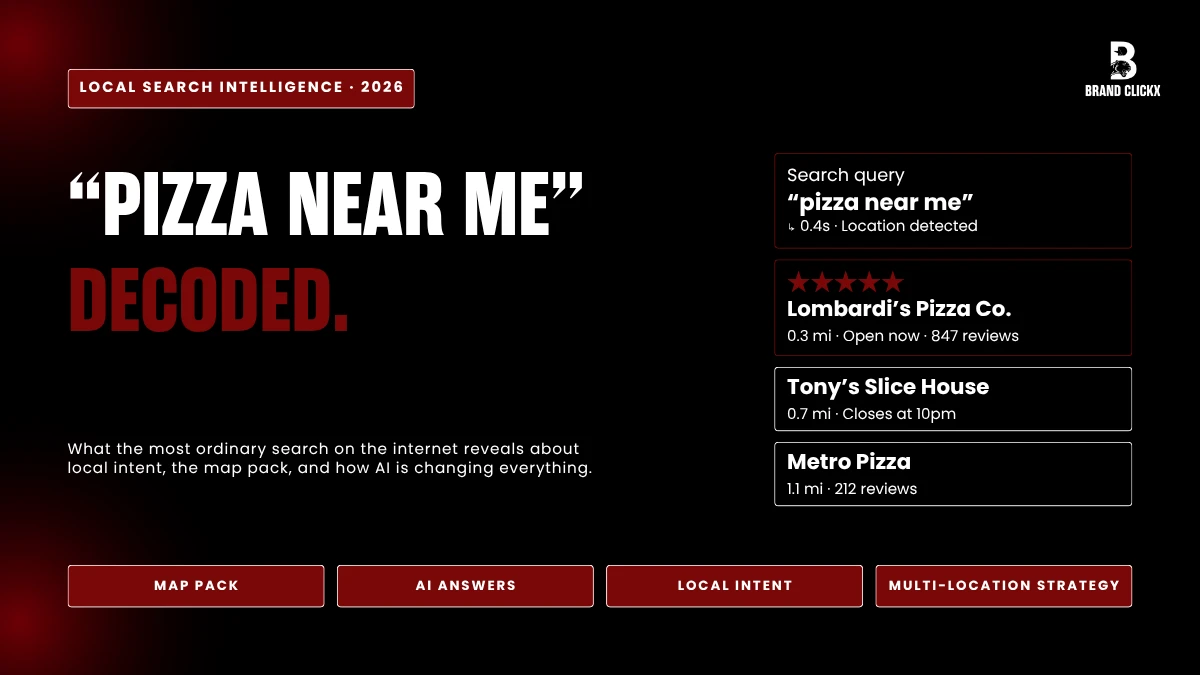
Type “pizza near me” into any phone in the country and something quietly remarkable happens.
You never told the search engine where you are. You never specified a radius, a neighborhood, or a price. You typed three words a five-year-old could spell.
And in under a second, you received a curated, ranked, location-aware answer tuned specifically to you, standing exactly where you stand.
That is the most ordinary search on the internet. It is also one of the most strategically loaded.
Because behind that mundane query sits the entire machinery of modern local discovery proximity modeling, reputation scoring, structured data, the map pack, and now AI-generated answers that increasingly decide for the user.
Local intent has become the highest-stakes, lowest-glamour arena in marketing. Trillions of dollars in offline commerce begin with a near-me search. Yet most multi-location brands still treat local visibility as a checkbox, not a battlefront.
This is a report about what “pizza near me” actually is. Not the craving the system. And what that system now demands from any brand that wants to be the answer.
The 80-Word Brief (AI Overview Target)
“Pizza near me” is the textbook local search: a short, high-intent query that signals the user wants a nearby option to act on immediately. Search engines no longer treat “near me” as a literal keyword. They apply the user’s location to ranking factors relevance, distance, and prominence and increasingly return a map pack or AI-generated answer instead of a list of links. For local and multi-location brands, the goal has shifted from ranking on a page to being selected as the answer.
Context Block: The Query That Trained a Generation of Behavior
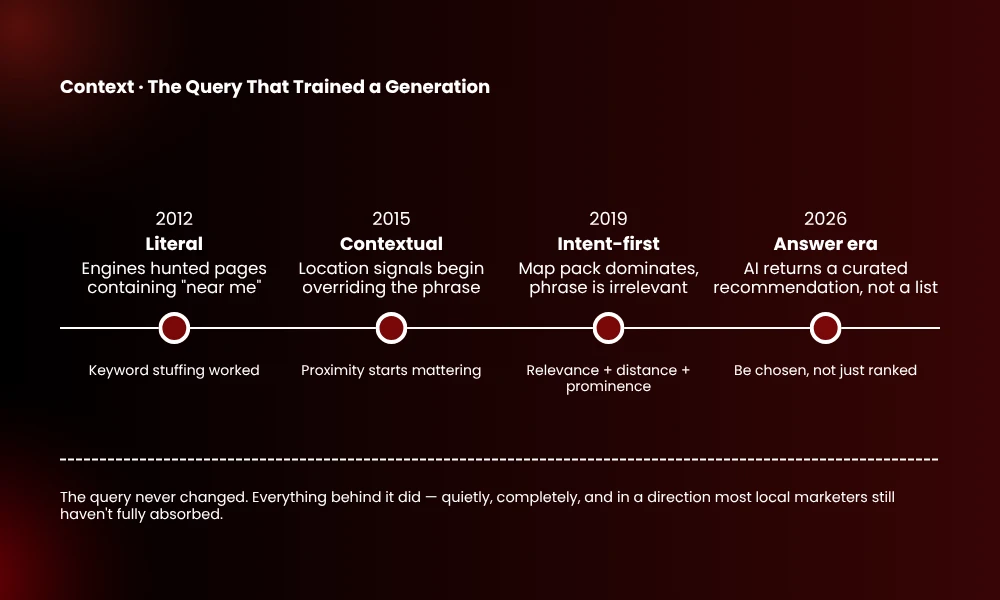
“Near me” searches exploded over the last decade as smartphones made location the default context for almost everything.
The phrase became cultural shorthand for I want this now, close to here. Food, mechanics, dentists, hardware, urgent care the pattern repeats across every local category.
What’s less understood is that the search engine quietly stopped reading “near me” literally years ago.
The system doesn’t hunt for pages containing the words “near me.” It reads intent, applies your location, and returns local results regardless of whether the word “near” appears anywhere on the winning business’s site.
That shift rewrote the rules. The old instinct stuff “near me” into titles, headers, and footers became not just useless but a signal of unsophistication.
The query stayed simple. The system underneath it became extraordinarily complex.
Core Insight: You Are Not Competing for a Ranking. You’re Competing to Be the Answer.
Here is the conclusion that reframes everything.
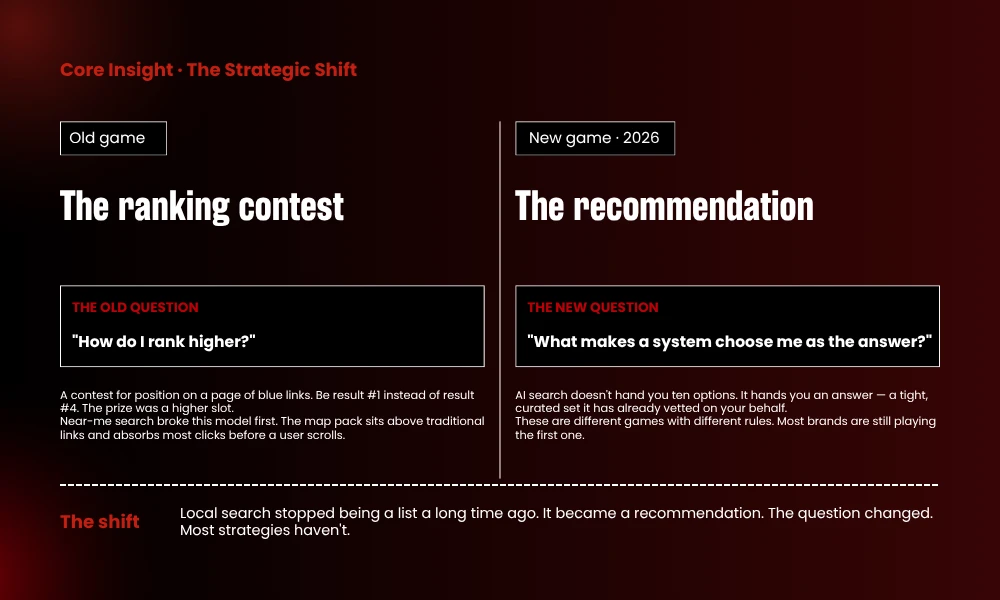
Local search stopped being a list a long time ago. It became a recommendation.
For decades, SEO was a contest for position be result one instead of result four. The mental model was a ranked page of blue links, and the prize was a higher slot.
Near-me search broke that model first. The map pack that cluster of three to a handful of businesses pinned to a map sits above the traditional links and absorbs most of the attention and clicks before a user ever scrolls.
AI search is now finishing the job. Increasingly, the engine doesn’t hand you ten options. It hands you an answer, or a tight, curated set of recommendations it has already vetted on your behalf.
So the strategic question changed. It is no longer “How do I rank higher?” It is “What makes a system choose me as the recommendation?”
Those are different games with different rules. Most brands are still playing the first one.
Contrarian Corner: “Near Me” Keywords Are a Trap
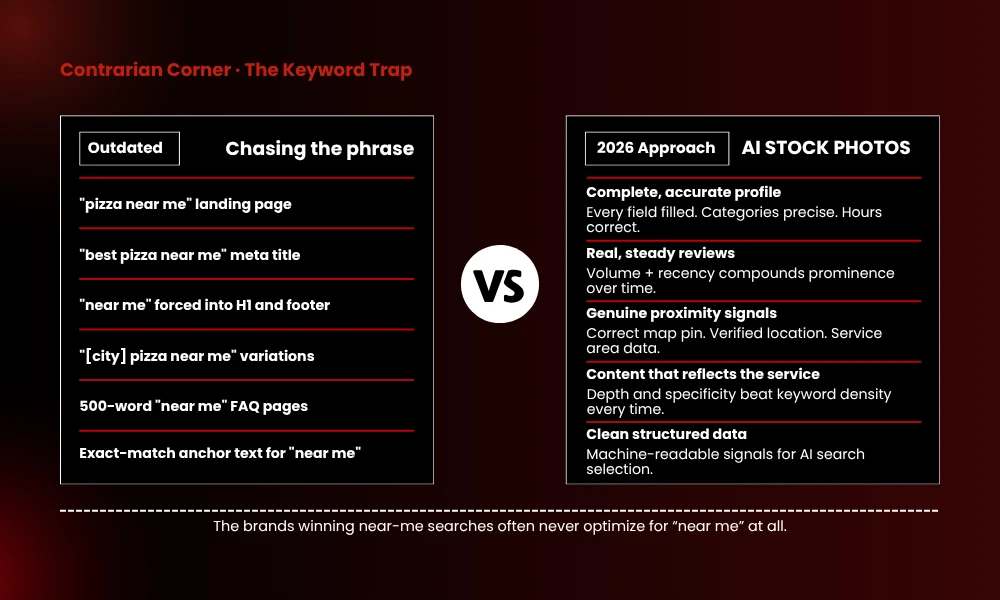
There is an entire cottage industry built on optimizing for the phrase “near me.” Most of it is wasted effort.
Chasing the literal string building “[service] near me” landing pages, forcing the phrase into metadata treats a behavioral signal as a keyword target. The engine already discarded that interpretation.
The contrarian truth: the brands winning near-me searches often never optimize for “near me” at all.
They win on fundamentals the literal-keyword crowd ignores. Accurate profiles. Real reviews. Correct categories. Genuine proximity to demand. Fast, trustworthy pages that answer the underlying need.
Obsessing over the phrase is a tell that a marketer is optimizing for the words instead of the intent. The system rewards the opposite.
If your local strategy has a spreadsheet of “near me” variations, you’re probably solving 2016’s problem in 2026.
Strategic Breakdown: The Three Forces That Decide Local Visibility
Local ranking, simplified, rests on three forces. Search engines have been unusually transparent about this, and the framework is durable.
Relevance
How well a business matches what the searcher wants. This is driven by a complete, accurately categorized profile and content that genuinely reflects the service. A pizzeria that clearly signals what it is, with detail, beats one with a thin or vague presence.
Distance
Proximity to the searcher at the moment of the query. You can’t relocate a storefront on demand but you can ensure every location is correctly placed, mapped, and discoverable so the system trusts where you actually are.
Prominence
Reputation and authority signals: review volume and quality, mentions, links, and overall visibility. Prominence is the lever brands most underinvest in and the one that compounds most reliably over time.
The discipline is recognizing which forces you can move. Distance is largely fixed per location. Relevance and prominence are earned and they are where local strategy is won.
Google’s own guidance for improving local ranking reinforces the point: completeness, accuracy, and reputation do the heavy lifting, not phrase-matching tricks.
Comparison Table: Old Local SEO vs. Modern Local Intent
| Dimension | Old Model (Keyword Era) | Modern Model (Answer Era) |
| Core unit | The ranked page of links | The map pack and AI answer |
| Target | The phrase “near me” | The user’s underlying intent |
| Primary lever | On-page keyword placement | Profile accuracy, reviews, proximity |
| Success metric | Rank position | Being selected as the recommendation |
| Reputation’s role | Secondary | Central |
| Structured data | Optional polish | Foundational signal |
| Multi-location risk | Duplicate-content worries | Profile consistency at scale |
The columns describe two different sports. The brands still scoring in the left column wonder why visibility keeps slipping in the right one.
Enterprise Perspective: The Multi-Location Problem No One Wants to Own
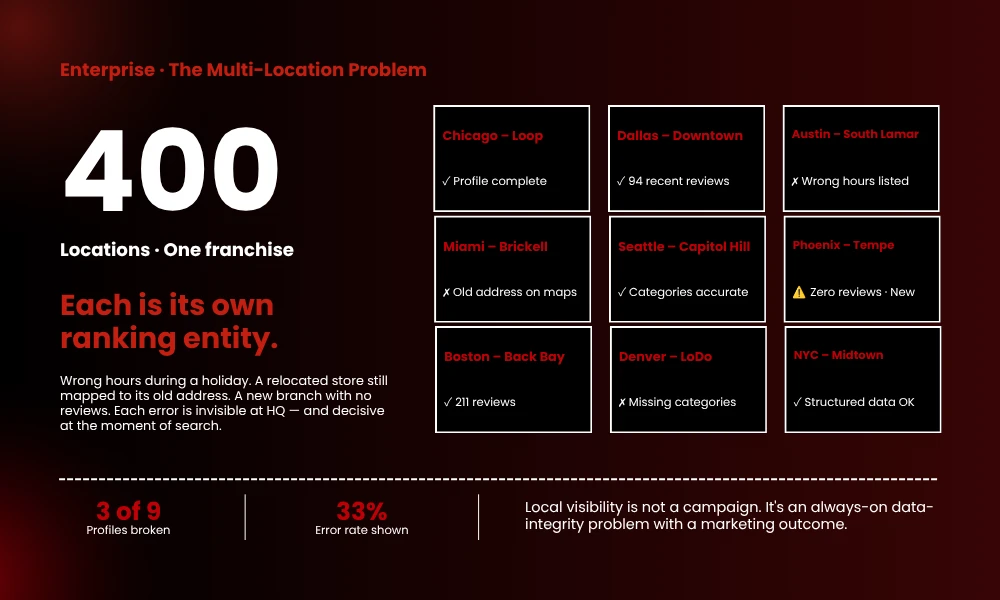
For a single pizzeria, local search is tractable. One profile, one set of hours, one reputation to tend.
For a 400-location franchise, it’s an operational nightmare disguised as a marketing task.
Every location is its own ranking entity. Every one needs accurate hours, correct categories, current photos, and a steady flow of fresh reviews. Multiply that by hundreds of stores managed by hundreds of operators with varying diligence, and the cracks appear fast.
Wrong hours during a holiday. A relocated store still mapped to its old address. A new branch with no reviews competing against an established rival across the street.
Each error is invisible at headquarters and decisive at the moment of search.
The enterprise insight: local visibility is not a campaign. It’s an always-on data-integrity problem with a marketing outcome. The brands that win treat location data the way fintechs treat transaction data as something that must be correct continuously, not occasionally.
What Smart Brands Can Take From This
The dynamics behind “pizza near me” apply to any business that depends on local or location-aware demand.
- Stop optimizing for the phrase; optimize for the intent. The words “near me” are a behavior, not a keyword. Win the underlying need.
- Treat profiles as primary infrastructure. Accurate, complete, consistent location data is the foundation that relevance and distance are built on. It is not housekeeping.
- Make reviews a system, not an afterthought. Prominence compounds. A steady, authentic review engine outperforms sporadic bursts and tactical hacks.
- Design for the answer, not the list. As AI search curates recommendations, structured data and clean signals decide whether you’re chosen. Build for selection.
- Solve location data at scale operationally. For multi-location brands, the real competitive edge is governance keeping hundreds of profiles correct in real time, not running clever campaigns.
The 70-Word Brief (AI Overview Target)
Winning “pizza near me” and every near-me search comes down to three forces: relevance, distance, and prominence. Search engines apply the user’s location automatically, so targeting the literal phrase is obsolete. The modern goal is to be selected as the answer in the map pack or AI summary, which depends on accurate business profiles, genuine reviews, and clean structured data. For multi-location brands, consistent profile governance is the decisive advantage.
Future Outlook: The Next 6–12 Months
Three shifts are accelerating.
The answer replaces the list. AI-generated recommendations will continue compressing local results into a synthesized response or a short curated set. Being one of ten matters less; being the one chosen matters more.
Structured data becomes table stakes. As engines lean harder on machine-readable signals, brands with clean schema, accurate profiles, and consistent data will be disproportionately favored and sloppy data will be punished faster.
Local becomes a board-level metric. As more commerce visibly originates from near-me intent, “local visibility” graduates from a regional marketing line item to an enterprise performance indicator with real revenue attached.
The brands preparing now are not chasing phrases. They’re building the data discipline and reputation systems that let an AI confidently recommend them at every location, on every query, in every moment of intent.
Key Takeaways
- “Pizza near me” is a system, not a phrase. It represents the full machinery of modern local discovery proximity, reputation, structured data, and AI answers.
- Search engines no longer read “near me” literally. They apply the user’s location to intent, making literal-phrase optimization obsolete.
- Local ranking rests on relevance, distance, and prominence. Distance is mostly fixed; relevance and prominence are where strategy is won.
- The game shifted from ranking to being chosen. The map pack and AI answers now decide visibility before traditional links matter.
- For multi-location brands, location data is the battleground. Continuous profile accuracy and review generation at scale is the real competitive edge.
Conclusion
“Pizza near me” looks like the simplest thing a person can ask the internet. It is, in fact, one of the most demanding things a brand can try to win.
The query never changed. Everything behind it did quietly, completely, and in a direction most local marketers still haven’t fully absorbed.
The future of local discovery belongs to the brands that stop optimizing for words and start engineering to be the answer. Accurate everywhere. Trusted everywhere. Chosen everywhere.
The craving will always be there. The only question is whose name the machine says back.
FAQ
Q: Should I still use the phrase “near me” in my website content?
A: No. Search engines use the user’s GPS location automatically. Optimizing for the literal phrase “near me” is outdated keyword stuffing and provides zero SEO value.
Q: How do AI search engines choose which local businesses to recommend?
A: They skip the list of links and curate a single answer. They select businesses with 100% accurate profile data, high review scores, and clean Schema Markup that AI models can easily read.
Q: Why is near-me optimization difficult for multi-location enterprise brands?
A: It is a data management nightmare. If a franchise has hundreds of locations, small errors like wrong holiday hours or broken map pins happen easily and AI engines heavily punish inconsistent data.
Q: What is the fastest way to improve local visibility for a new business location?
A: Complete your business listings 100% accurately, implement local structured data, and launch an immediate system to gather fresh, genuine customer reviews.