One brand deleted its entire Instagram feed, hired Charli XCX for a surprise Times Square concert, and rebuilt its digital identity from scratch.
The other one barely said a word, and still grew revenue by 3.2%.
This is the Zara versus H&M story in 2026. Not a story about clothes. A story about two radically different philosophies of attention, desire, and digital power, and what they reveal about where brand marketing is heading.
Inditex, Zara’s parent company, has been carving out a clear lead on high street rival H&M, which posted weaker-than-expected fiscal first quarter revenues, as sales continue to soften at the Swedish fashion giant. Yet H&M isn’t retreating.
It’s repositioning. Its digital relaunch signals a brand that understands one uncomfortable truth: in a fractured media landscape, cultural currency matters as much as supply chain efficiency.
What makes this duel genuinely fascinating for marketers is that both strategies are working, in different ways, on different metrics, for different reasons.
Understanding why requires going deeper than follower counts.
The Fundamental Divide: Philosophy Before Tactics
Before comparing TikTok engagement rates or influencer spend, it’s worth naming the philosophical division at the heart of this rivalry.
Zara operates on the belief that desire is created through restraint.
H&M operates on the belief that relevance is created through presence.
Neither is wrong. Both are increasingly sophisticated. And the tension between them maps almost perfectly onto a broader debate in enterprise marketing: Does a brand win by saying less, or by showing up everywhere?
In 2026, the answer depends entirely on who you’re selling to, what you’re selling, and how much trust you’ve already built.
Zara: The Anti-Marketing Machine
Silence as Strategy
Zara does not run big advertising campaigns. There are no celebrity endorsements, no email blasts stuffed with sales, and no lifestyle slogans on billboards. Yet walk into almost any mall in the world, and there it is, Zara. Always busy. Always current. Always a little mysterious.
For a brand generating close to $44 billion in annual revenue, that’s not an oversight. It’s a doctrine.
Zara spends only 0.3% of its budget on marketing efforts, significantly below the industry average of 3.5% in retail. That figure is almost incomprehensible at this scale. Most mid-tier DTC brands spend more on Meta ads in a quarter than Zara spends on advertising globally in a year.
And yet, the brand has cultivated a loyal customer base that visits their stores about six times per year, compared to the contemporary market norm of two to three visits per year.
That visit frequency, two to three times higher than industry norm, isn’t driven by retargeting pixels or email drips. It’s driven by something harder to replicate: the fear of missing out on a product that will be gone by next week.
The Scarcity Engine
Zara introduces new items to stores twice weekly, creating approximately 104 micro-collections annually instead of traditional seasonal releases. This constant rotation keeps inventory fresh and gives customers reasons to visit frequently.
This is Zara’s real marketing machine. Not ads. Product velocity.
Each restocking cycle creates an event. Each sold-out item creates a myth. Each store visit becomes an act of discovery, not just purchase. Their scarcity model creates word-of-mouth promotion that delivers better return on investment than paid campaigns while reinforcing premium positioning.
The result: 85% of Zara’s inventory sells at full price, compared to an industry average of 60-70%. That single data point may be the most devastating competitive advantage in fast fashion. Every competitor spending millions on promotions and markdowns is, in effect, subsidizing a race to the bottom. Zara opted out.
Industry Impact: Full-price sell-through at 85% effectively means Zara’s supply chain is its promotions department. Marketing ROI doesn’t need to be calculated, it’s baked into the gross margin.
Store as Media Channel
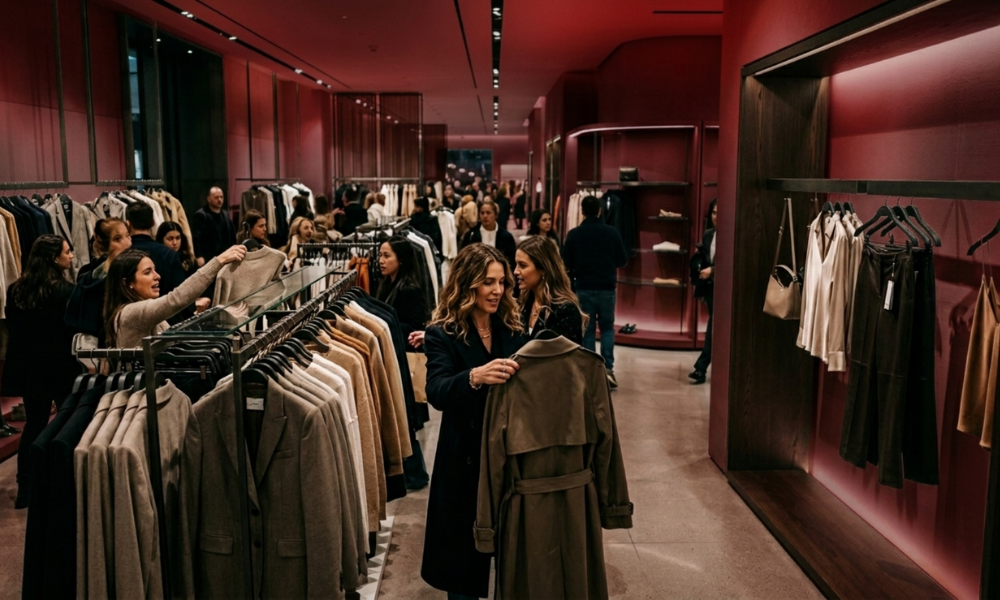
Instead of massive ad campaigns, Zara invests in prime store locations and high-end interiors, turning its storefronts into marketing channels. This strategy positions the brand as upscale yet accessible.
The store window is Zara’s billboard. The changing display is its content calendar.
For a generation of marketers trained to think digitally first, this is a useful corrective. Physical presence, done well, in high-traffic premium locations, generates organic attention that no paid media can replicate. Every person who walks past a Zara storefront in a major city is receiving a brand impression. None of those impressions appear in any media plan.
Zara’s Digital Presence: Minimalism With Intent
On social media, Zara’s approach mirrors its advertising philosophy. The brand’s Instagram engagement rate sits at approximately 0.15%, low by surface-level benchmarks, but predictable and almost intentional for an account at mega-brand scale.
Instagram engagement declined 17% year-over-year from 2025 to 2026 as the platform prioritized watch time over likes, shifting algorithmic favor toward Reels and away from static posts. Zara has not pivoted aggressively to address this. Its content remains editorial, lookbook-driven, and sparse. This isn’t a social media weakness, it’s brand consistency applied to a platform.
Zara’s recent ads often feature clean and minimalist visual aesthetics, reflecting the brand’s modern and sophisticated image. The focus is primarily on the clothing items themselves, showcasing the quality and design of the products.
The clothes do the talking. Always. That discipline is harder to maintain than it looks, especially when competitors are flooding feeds with influencer content, trend sounds, and UGC campaigns.
AI as the Silent Intelligence Layer
Where Zara truly separates itself from H&M, and frankly, from most retail brands, is at the data infrastructure level.
Inditex invested €1.8 billion in technology and logistics for 2025-2026, with AI-powered demand forecasting now driving 85% of initial production allocation decisions.
AI tools analyze a wide range of data, such as past sales, current purchasing patterns, weather forecasts, and social media trends, to accurately anticipate demand. AI can detect emerging trends in real time, enabling Zara to adjust its production and stocking decisions rapidly.
This is where Zara’s “anti-marketing” ethos gets philosophically interesting. The brand doesn’t need to tell customers what’s trending because its supply chain already knows what they want before they say it. Demand forecasting becomes, in effect, a form of proactive personalization at industrial scale.
Every store, every click on its app, every garment that disappears from the rack leaves a trace. That trail, processed in real time by a data analytics system as precise as it is relentless, dictates what is designed, what is manufactured, and what is distributed.
No guesses. No billboards. Just signal.
H&M: The Spectacle Machine
A Brand That Needed to Remake Itself
H&M entered 2024 under pressure. H&M Group reported relatively moderate revenue growth from 2020 to 2023, and 2024 saw a slight contraction of –0.7%, bringing revenue down slightly. The flatlining of sales reflects inflationary pressures on consumers, delayed inventory sell-through, and a strategic pause in aggressive expansion.
It was a brand with reach but diminishing resonance. Over 60 million Instagram followers, but a feed that felt inert. Recognizable globally, but increasingly invisible to the Gen Z consumers it needed most.
The response was audacious.
Deleting the Feed: A Masterclass in Disruption
When it was time for H&M to announce its autumn-winter collection, the fast fashion retailer signified a clean start by deleting its entire Instagram feed.
Think about what that decision actually required. Years of content, hundreds of millions of followers watching a feed go blank. In digital marketing terms, it was the equivalent of setting your media kit on fire, publicly, deliberately, and with full awareness that everyone would notice.
What followed was a partnership that demonstrated exactly how well H&M’s marketing team understands the current cultural moment.
The Charli XCX Gambit
What came next was a partnership with Charli XCX that extended the pop star’s culture-shaking “brat summer” into fall and helped the brand capture the zeitgeist for months.
Times Square screens were adorned with Charli XCX’s “Brat” branding from her latest album, sparking curiosity and speculation without disclosing details of the upcoming event. The concert’s details were revealed just 30 minutes before it began, creating urgency and a sense of exclusivity among fans and onlookers.
The timing was precise. Stars like Charli XCX, who have niche but devoted communities, provide brands with opportunities to plug into highly engaged fanbases. H&M didn’t just buy a celebrity endorsement. It bought cultural alignment, access to a community that was already primed for exactly the kind of experience H&M was delivering.
Expert Insight: The Charli XCX partnership worked not because of her audience size, but because of her audience type. Highly engaged, trend-setting Gen Z consumers who don’t respond to traditional advertising but do respond to experiences that feel authentic, urgent, and worth sharing.
Building Shoppable Culture
The strategic sophistication behind H&M’s relaunch goes deeper than a concert.
H&M loaded photos from the live events featuring Charli XCX onto its site and tagged all of the products that influencers were wearing to create shoppable content. Around a SoHo block party hosted by Amelia Gray, the brand built out a campaign page that featured shoppable photos of the model and reality TV personality.
This is the evolution of influencer marketing: every cultural moment becomes a commerce event. Every live experience feeds a digital funnel. The brand isn’t just sponsoring culture, it’s converting culture into revenue in real time.
H&M’s head of digital described influencer marketing as having “flipped the marketing funnel on its side,” adding: “Influencer marketing can address each challenge in the funnel, whether it’s awareness or conversion.”
That’s not a marketing team treating influencers as a line item. That’s a marketing team reorganizing their entire funnel architecture around creator partnerships.
The Platform-Native Playbook
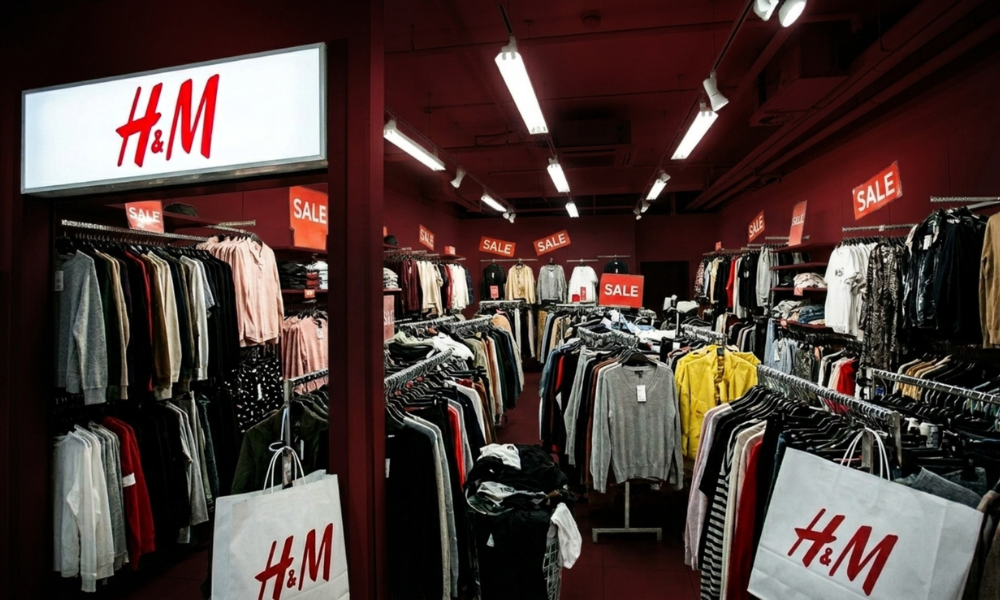
H&M boasts social media via bold visuals, influencer marketing, and trending posts fueling viral engagement. Shoppable features like product tags and in-video calls-to-action blur the line between browsing and buying.
In 2024, H&M’s marketing spend was around $600 million. Digital channels were key, with 60% of the budget allocated there. It’s a bet aligned with the broader market: US influencer marketing spending surpassed $10 billion in 2025, one year earlier than previously forecast.
That’s a very different posture from Zara. H&M is playing an attention economy game, buying reach, building awareness, and engineering conversion across every available touchpoint. The logic is volume-first: reach more people, generate more cultural moments, create more entry points into the brand.
H&M’s ads often incorporate short narratives that highlight the creativity and styling of collections, with vibrant and colorful visuals reflecting the brand’s youthful and playful image. The storytelling approach is deliberate, emotional connection before product consideration.
Head-to-Head: The Marketing Stack Comparison
| Dimension | Zara | H&M |
| Ad spend (% of revenue) | ~0.3% | ~3.5%+ |
| Core strategy | Scarcity + silence | Spectacle + volume |
| Influencer approach | Minimal / earned | Heavy investment, paid |
| Primary social content type | Editorial lookbook | Campaign storytelling |
| AI investment | €1.8B (tech + logistics) | Moderate digital AI |
| Full-price sell-through | ~85% | ~60-70% (industry avg) |
| Instagram engagement rate | ~0.15% | ~0.5-0.8% (est.) |
| Revenue trajectory (2024-25) | +3.2% (record highs) | -0.7% (slight contraction) |
| Gen Z strategy | Product + scarcity | Cultural alignment |
| Digital-to-physical integration | Seamless omnichannel | Active relaunch phase |
Attention Is Not the Same as Desire
The most important strategic insight from comparing these two brands is this: generating attention and generating desire are not the same thing, and conflating them is expensive.
H&M generates enormous amounts of attention. The Charli XCX campaign was a genuine cultural moment, covered widely and shared heavily. But attention without conversion is a media business, not a retail business.
Zara generates almost no attention in the traditional sense. You’ll find very few Zara campaigns trending on Twitter. No celebrity controversies. No viral moments. But when Zara releases a new collection, its customers show up. Twice a week. And buy at full price.
The philosophical question for every CMO watching this rivalry: are you optimizing for the metric that drives revenue, or the metric that drives coverage?
The Data Layer Is the New Brand Moat
Zara reduced inventory costs by an impressive 34% through AI demand forecasting implementation, while simultaneously improving product availability and customer satisfaction.
This is not a marketing story. This is an infrastructure story with massive marketing implications.
When your supply chain knows what your customers want before they know it themselves, you have a fundamentally different relationship with “conversion.” You’re not persuading someone to buy something they’re ambivalent about. You’re simply making available something they were already going to want.
That’s the real competitive moat in 2026: not social followers, not influencer budget, not cultural moments. It’s the intelligence layer beneath the brand that turns data into desire.
Strategic Breakdown: Zara’s AI investment isn’t just operational efficiency. It is, effectively, a marketing function, one that operates at the product level rather than the campaign level, and that scales without proportional spend increases.
H&M’s Omnichannel Relaunch Has Real Legs
It would be a mistake to frame H&M’s digital relaunch as merely reactive desperation. The strategy has genuine sophistication.
H&M is also investing heavily in an omnichannel customer experience that extends beyond digital channels, acknowledging that young cohorts value in-person experiences.
The pivot from broadcast marketing to experience-first marketing is exactly the right direction for a brand trying to win Gen Z. This demographic doesn’t respond to advertising in the traditional sense. They respond to cultural participation, to brands that create moments worth talking about rather than messages worth ignoring. Brands are increasingly directing marketing budgets away from traditional advertising and toward influencer and creator-led campaigns, a structural shift that favors H&M’s relaunch strategy.
The question is whether H&M can sustain the execution quality of the Charli XCX moment across more touchpoints and more campaigns, or whether it was a single perfect swing.
Market Observation: Where Shein and Temu Change the Calculus
Neither Zara nor H&M operates in a vacuum.
Both retail giants have struggled with increased competition from lower-cost fast fashion brands such as Chinese-founded Shein and Temu. Higher U.S. tariffs on Chinese goods and the closure of the de minimis trade loophole are seen as creating notable headwinds for the disruptor companies.
This tariff development is significant. Shein and Temu built their digital marketing empires on price, and in the short term, that price advantage is narrowing. The brands that have competed on culture and supply chain intelligence rather than pure price are better positioned to absorb this disruption.
Zara’s scarcity model and H&M’s cultural positioning are, in this context, moats that Shein cannot easily replicate. A TikTok haul video can drive Shein sales. It cannot create the Zara discovery experience or H&M’s “brat” cultural moment.
Future Outlook: As Shein faces regulatory headwinds in Western markets, the mid-market fast fashion space reopens. Zara and H&M are both competitively positioned to capture consumers trading up from ultra-low-cost alternatives, but only if they maintain the perception of quality, style authority, and cultural relevance that differentiates them from the discount tier.
Tactical Framework: What Brands Can Steal From Each Playbook
From Zara’s Playbook
- Make your product the media. If your product is genuinely differentiated, constant advertising may actually dilute it. Let scarcity and quality create demand. Let frequency of renewal create the social media moment, organically.
- Invest in the data layer first. Before content calendars and influencer briefs, ask whether your supply chain, CRM, and customer intelligence systems can tell you what your audience wants before they articulate it. That’s where Zara’s real marketing lives.
- Silence is a positioning decision. Restraint in a noisy market is not passivity, it’s strategy. If every competitor is loud, being quiet can be a form of differentiation. Premium positioning often requires refusing to compete on volume.
- Full-price sell-through is a brand metric. Your markdown rate is, indirectly, your measure of how well your marketing is performing. A brand that constantly discounts is a brand that never fully converted its audience on value.
From H&M’s Playbook
- Cultural alignment beats category alignment. H&M aligned with Charli XCX not because she wears H&M, but because her cultural moment matched where H&M needed to go. The lesson: partner with the culture you want to be associated with, not the influencer who most obviously uses your product.
- The blank slate is an underused tactic. Deleting your Instagram feed is dramatic. But the signal it sends, that the brand is willing to start over, to prioritize relevance over archive, is genuinely powerful. Sometimes a reset is more credible than a refresh.
- Shoppable content is table stakes; shoppable experiences are the edge. H&M’s innovation wasn’t tagging products in a post. It was building campaign pages that converted live event footage into commerce in real time. That’s a genuinely different architecture.
- Authenticity to the platform beats platform-agnostic content. H&M recognized the need for content that is “really authentic to the platform where the customer is actually experiencing it.” Platform-native content isn’t a production format. It’s a mindset.
Enterprise Perspective: What CMOs Are Watching
The Zara-H&M dynamic is being closely observed by marketing leaders well outside fast fashion.
The questions it raises are universal:
Should a brand with strong product-market fit lean into paid media, or trust organic demand to do the work?
When is a cultural moment worth the risk of brand-ambassador misalignment?
How do you measure the marketing value of a supply chain?
At what follower count does social engagement become a vanity metric?
These aren’t rhetorical. They’re the questions that show up in board decks, agency pitches, and CMO reviews across verticals. Fast fashion happens to be the context in which the choices are most visible, because the stakes are high, the competition is brutal, and the consumer relationship is transactional enough to produce clean attribution signals.
Why It Matters: The Zara-H&M rivalry is, effectively, a live A/B test between two fundamental brand philosophies. Enterprise marketers who understand the variables being tested, and the conditions under which each strategy outperforms, are better equipped to make resource allocation decisions in their own organizations.
What Happens Next
Zara and H&M will continue to evolve, but their evolutionary paths look very different.
Zara will deepen its AI infrastructure. The €1.8 billion technology investment signals a brand doubling down on its core advantage: knowing what customers want before they say it and getting products to them faster than any competitor. The “marketing department” at Zara increasingly lives inside the supply chain algorithm, not inside an agency brief.
H&M’s trajectory hinges on execution consistency. The Charli XCX campaign proved the team has the strategic instincts to capture cultural moments at scale. The harder question is whether the brand can maintain that execution quality, or whether it was a single perfect campaign followed by regression to mediocrity.
Inditex expects store and online sales in constant currency to have increased 9% between 1 February and 8 March 2026 versus the same period in 2025. That trajectory, combined with AI infrastructure investment, positions Zara as the structurally stronger business heading into the back half of the decade.
But H&M is not finished. A brand that can delete its entire Instagram feed and replace it with a Times Square concert is a brand willing to make uncomfortable decisions in pursuit of relevance. That willingness, to blow up what’s comfortable and start over, is rarer and more valuable than most marketing metrics capture.
Key Takeaways
- Zara’s 0.3% ad spend is not frugality, it’s a philosophy. The brand has built a system where product velocity, prime retail placement, and AI-powered supply chain intelligence do the marketing work that competitors pay agencies to do.
- H&M’s cultural pivot is strategically correct, execution-dependent. The Charli XCX campaign was a genuine marketing breakthrough. Whether it becomes a repeatable model or a one-off moment depends on H&M’s ability to sustain the creative and strategic discipline that made it work.
- The data layer is now a marketing function. Zara’s AI investment in demand forecasting, inventory optimization, and real-time trend detection is, effectively, a marketing investment with implications for brand perception, conversion, and loyalty that traditional marketing spend cannot replicate.
- Full-price sell-through is an underrated marketing metric. Zara’s 85% full-price sell-through versus the industry’s 60-70% is a direct reflection of how well its product strategy creates demand. Brands that constantly discount are revealing a marketing weakness, not running a smart promotion.
- Silence is a competitive position. In an attention economy built on volume and frequency, restraint can function as differentiation. For brands with strong product-market fit and loyal repeat customers, the most effective marketing strategy may be the one that doesn’t look like marketing at all.
- Platform-native content is structural, not cosmetic. H&M’s relaunch recognized that content must be built for the platform, not adapted to it. The distinction matters enormously at scale, and it’s a lesson that most enterprise brands are still learning.
- Cultural alignment beats celebrity endorsement. H&M didn’t hire Charli XCX because she was famous. It hired her because she was the culture H&M wanted to enter. The difference is the difference between a sponsorship and a strategic partnership.
Conclusion
The Zara versus H&M duel is not really about fast fashion.
It’s about two fundamentally different answers to the most important question in modern marketing: How do you create desire at scale, in a world where attention is cheap and trust is scarce?
Zara’s answer is to withhold. To use silence, scarcity, and supply chain intelligence to create a brand that feels perpetually ahead of the consumer, one step richer, one degree more current, always just slightly out of reach.
H&M’s answer is to show up. To build cultural relevance through presence, through high-stakes partnerships, through digital architectures that convert moments into revenue.
Both answers are working. Neither is complete.
The real strategic insight for marketers watching this rivalry in 2026 is not which brand to imitate, it’s that the most durable brand strategies are those built around a coherent philosophy, executed with discipline, and anchored in a genuine understanding of what your audience actually responds to.
Zara doesn’t need to post more. H&M doesn’t need to go quiet.
What both brands understand, and what every CMO, growth lead, and brand strategist should internalize, is that the feed is not the battle. The feed is the surface. Underneath it, the real competition is for intelligence, infrastructure, and the kind of cultural trust that no ad budget can manufacture.
In 2026, the brands that win on the feed are the ones that have already won somewhere deeper.
FAQ: Zara vs. H&M Digital Marketing
Q: How much does Zara spend on advertising compared to H&M?
Zara spends only about 0.3% of revenue on advertising, while H&M invests heavily in marketing, including roughly $600 million in 2024. Their budgets reflect two different strategies: scarcity versus visibility.
Q: What is Zara’s social media strategy?
Zara focuses on minimalist, product-first content rather than influencers or aggressive promotions. Its goal is to earn attention through brand appeal, not buy it through constant advertising.
Q: What was H&M’s Charli XCX campaign and why did it work?
H&M reset its Instagram presence and partnered with Charli XCX through surprise live events and shoppable content. The campaign succeeded by creating urgency, cultural relevance, and strong Gen Z engagement.
Q: How does Zara use AI in its marketing and operations?
Zara uses AI for demand forecasting, inventory planning, trend detection, and personalization. This helps the brand predict customer demand and improve product availability with minimal marketing spend.
Q: Who is winning the digital marketing battle between Zara and H&M in 2026?
Zara leads in revenue growth, supply chain efficiency, and full-price sales, while H&M is gaining momentum through culture-driven marketing. Both brands are succeeding, but through very different strategies.
Q: What can marketers learn from the Zara vs. H&M comparison?
Zara shows the power of scarcity, product quality, and data-driven decisions, while H&M highlights the value of cultural relevance and creator partnerships. The key lesson is that consistency matters more than copying trends.