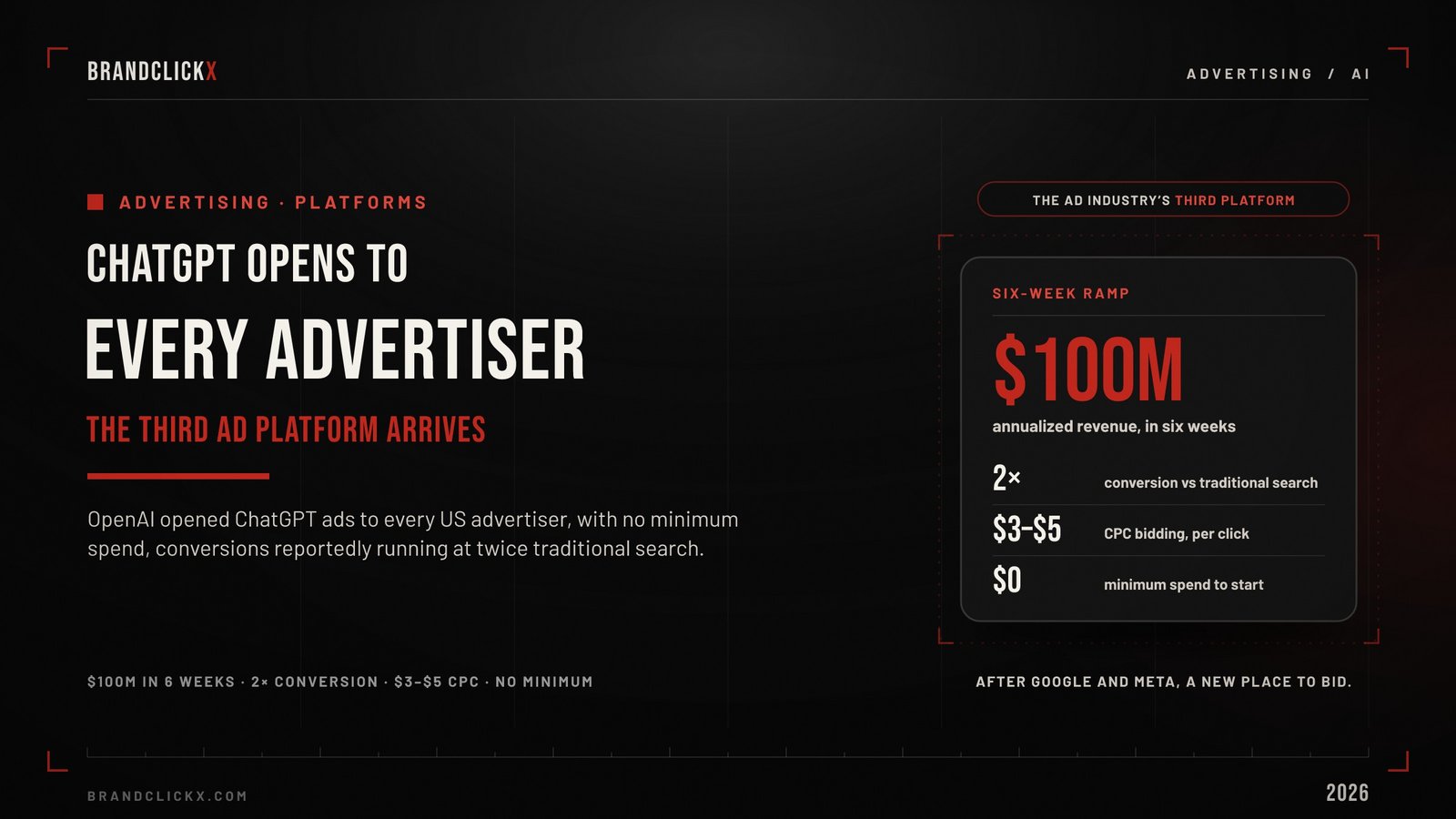
$100 million in annualized revenue in six weeks. Conversion rates 2x traditional search. CPC bidding at $3–$5 per click. No minimum spend. The most consequential advertising platform launch since Meta opened self-serve in 2007.
The Ad Platform Nobody Can Ignore Anymore
For two decades, digital advertising has been a two-platform story.
Google captured intent. Meta captured identity. Every other advertising platform, LinkedIn, TikTok, Amazon, programmatic display, operated in the space between those two gravitational forces.
On May 5, 2026, OpenAI confirmed it had launched a beta self-serve Ads Manager for US advertisers, introducing CPC bidding alongside the existing CPM model, dropping the minimum spend requirement entirely, and publishing the Conversions API and pixel-based measurement tools that performance marketers had been waiting for.
That announcement was not an iteration. It was a platform declaration.
ChatGPT is no longer experimenting with advertising. It is building the infrastructure to become the third major advertising surface in digital, after Google Search and Meta’s social graph, by offering something neither has: the conversation.
Ads inside ChatGPT don’t interrupt a content feed. They don’t sit alongside search results competing for ten blue links. They appear inside an active, considered conversation where the user has already expressed specific intent, is already comparing options, and is already moving toward a decision.
Here is the complete strategic breakdown.
From Closed Pilot to Open Platform: The Complete Timeline
The ChatGPT advertising program moved from concept to self-serve platform in under four months. The velocity is instructive.
How ChatGPT Ads Actually Work
The mechanics are straightforward. The implications are not.
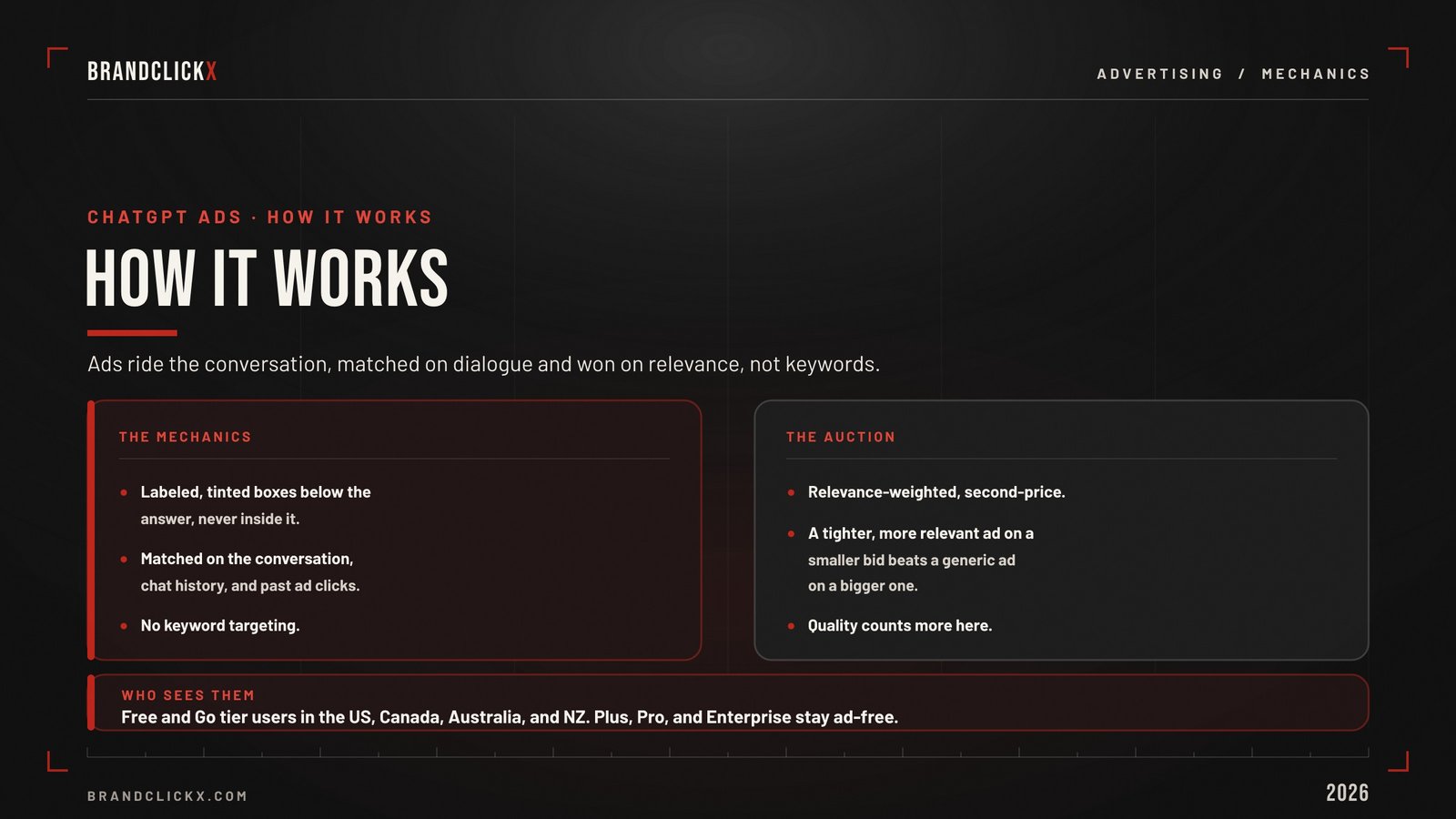
Ads appear in clearly labeled, subtly tinted boxes at the bottom of AI responses, never inside the actual answer content. As 2Point Agency’s guide details, the platform uses contextual matching based on the current conversation topic, past chat history, and previous ad interactions. It does not use traditional keyword targeting.
This is the critical distinction from Google Search.
A user who types “best CRM for small business” into Google is expressing intent through a keyword. A user having a conversation with ChatGPT about CRM options is expressing intent through a dialogue, asking follow-ups, comparing features, describing their specific context.
The auction is relevance-weighted and second-price, meaning a tighter, more relevant creative on a smaller bid can beat a lazy, generic ad with a larger bid. Quality matters more in this auction than in most.
Who sees ads: Free and Go tier users in the US, Canada, Australia, and New Zealand. Plus, Pro, and Enterprise users remain ad-free. If your buyers skew toward power users on paid plans, your addressable reach is narrower than the 200M monthly user number suggests.
ChatGPT Ads vs. Established Platforms: The Numbers
Criteo reports more than 1,000 brands active on the platform and conversion rates approaching 2x traditional search. Here’s how the key metrics compare.
The Measurement Stack: What Changed on May 5
The measurement gap was the most persistent criticism of the ChatGPT ad platform since launch. May 5 closed that gap, partially.
Conversions API (CAPI): Server-side event tracking that ties post-click events, sign-ups, purchases, demo requests, back to the ChatGPT impression. Same architectural pattern Meta and Google use.
Pixel-based tracking: Client-side JavaScript pixel for tracking conversion events after a ChatGPT ad click. Standard implementation.
Custom audience upload: CSV or TXT files up to 512MB containing hashed or raw email addresses for audience filtering and exclusion.
What is still missing: Cross-device attribution is limited. View-through conversion windows are not yet customizable. Frequency capping is basic. And the platform has no equivalent to Google’s Enhanced Conversions or Meta’s Advantage+ — meaning optimization data will accumulate slower.
“The content of the user’s chat prompt is still private; what you get is post-click signal, not pre-click intent.” — Flywheel Performance Analysis
Why This Matters More Than Most New Ad Platforms
1. The conversational context is genuinely new territory
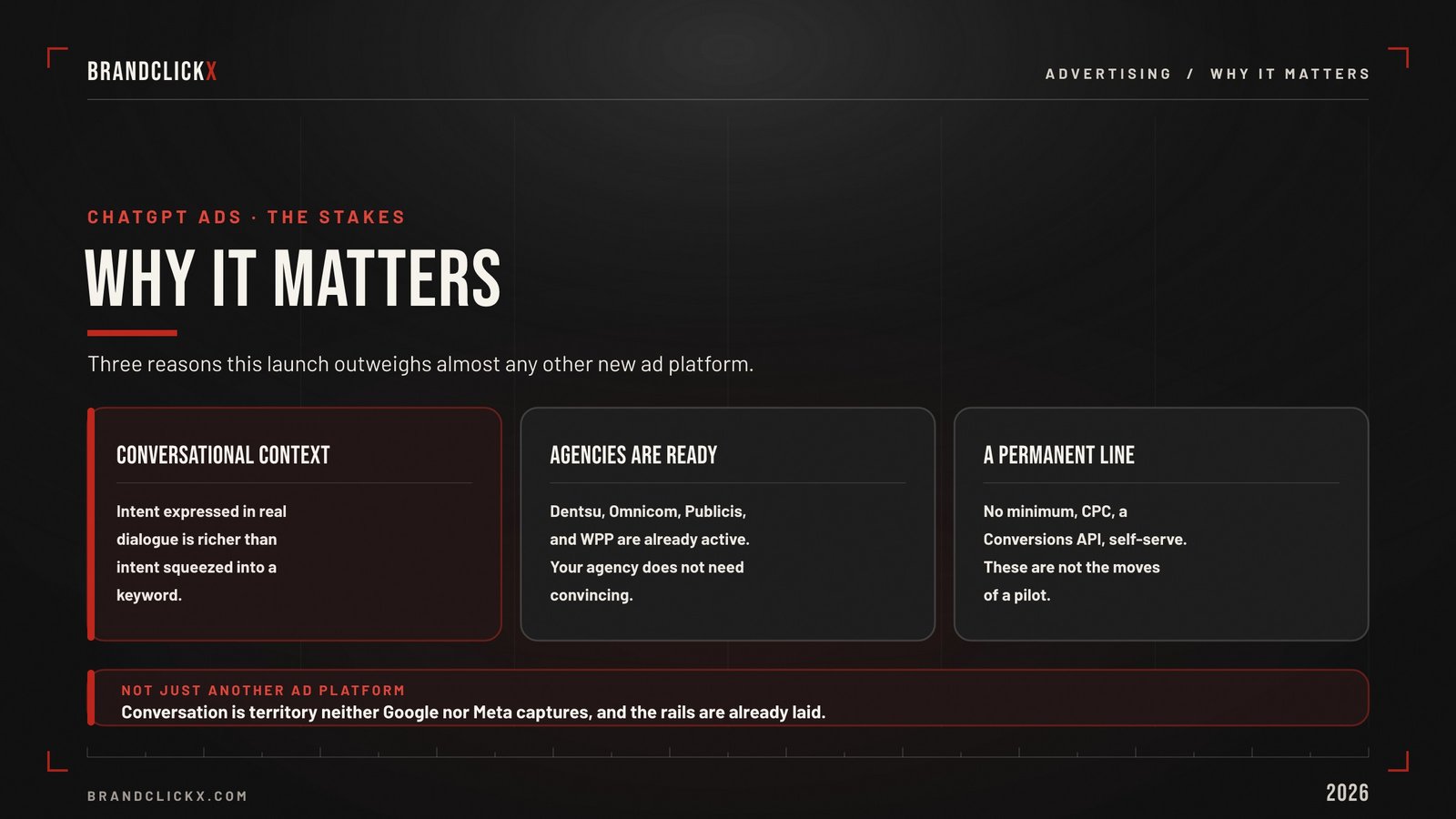
In ChatGPT, the user has already articulated what they want in natural language. They are already comparing options. They are already in a decision-making conversation they initiated.
That conversational context, intent expressed in dialogue rather than compressed into a keyword — is richer than what any existing advertising platform captures.
2. The agency infrastructure is already built
Dentsu, Omnicom, Publicis, and WPP, the four largest agency holding companies in the world, are already active ChatGPT Ads partners. Technology integrations with Adobe, Criteo, Kargo, Pacvue, and StackAdapt are live.
For CMOs: you don’t need to convince your agency to learn a new platform. They already have access.
3. The self-serve launch signals permanent revenue commitment
Removing minimum spend, adding CPC bidding, building a Conversions API, and launching a self-serve interface are not pilot actions. They are the actions of a company building a permanent revenue line, especially with an IPO approaching.
The ChatGPT Advertising Ecosystem
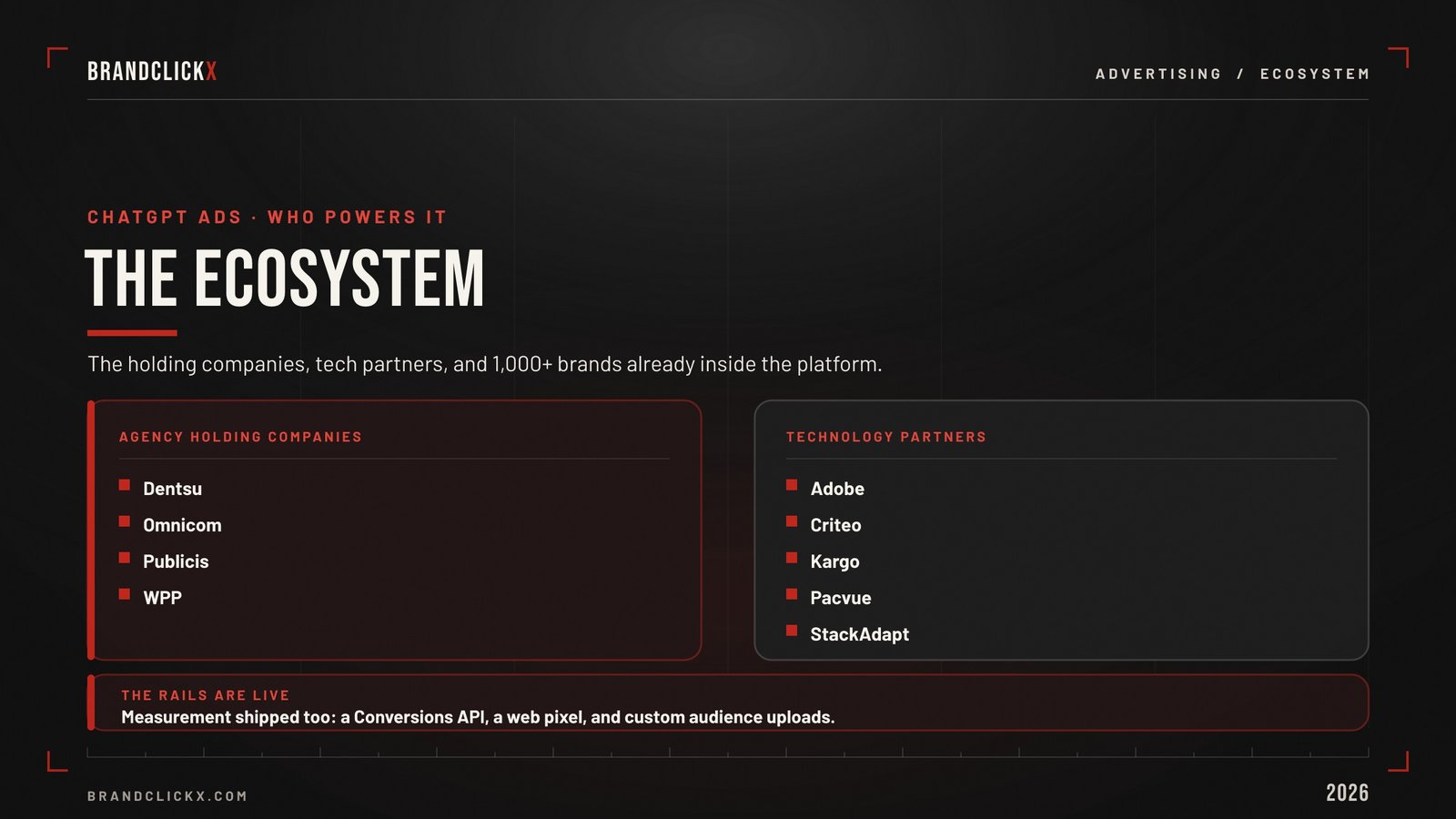
Understanding who powers the platform, and who’s already buying, is the prerequisite for a smart testing strategy.
What CMOs and Performance Teams Should Actually Do
Start small. Measure everything. Don’t bet the quarter.
The platform is genuinely promising and genuinely early. Benchmarks are limited. The audience is restricted to free-tier users. The learning algorithms have less data than Google or Meta’s mature systems.
Week 1–2: Register at ads.openai.com and complete verification. Set up the Conversions API and pixel on your website.
Week 3–4: Launch a CPC test campaign at the recommended $3–$5 bid with a modest daily budget ($100–$500/day). Test 3–5 creative variations.
Week 5–8: Evaluate traffic quality, not just conversion rate but engagement metrics. Compare ChatGPT traffic against Google and Meta traffic on the same landing pages.
Month 3+: If traffic quality meets thresholds, scale gradually. Test custom audience targeting. Begin CPC vs. CPM comparison testing.
The planning questions every CMO should ask
What percentage of our target audience uses ChatGPT on free or Go tiers? If your buyers are primarily on paid tiers, they won’t see ads.
Is our conversion infrastructure ready? The Conversions API and pixel require the same implementation rigor as Meta CAPI or Google tag.
What does our agency already know? If your agency is with Dentsu, Omnicom, Publicis, or WPP, they have early data and partner insights.
What is our acceptable CPC? At $3–$5, ChatGPT Ads are priced above Meta but below LinkedIn. ROI depends on downstream conversion from conversational intent.
The Privacy Question That Hasn’t Been Answered Yet
ChatGPT conversations are inherently more intimate than search queries or social interactions. Users share health concerns, financial situations, relationship questions, and business strategies.
As Vizup’s analysis noted: “ChatGPT ads rely on contextual targeting tied to the conversation rather than user data.”
The distinction between “targeting based on conversation context” and “targeting based on user data” is real, but narrower than it appears. Conversation context is user data. How the platform handles that distinction at scale, under regulatory scrutiny, and with an IPO approaching will determine whether the privacy model is sustainable.
Key Takeaways
- Self-serve is live, no minimum spend, production-grade infrastructure. CPC bidding, Conversions API, pixel tracking, and custom audience uploads are all available now at ads.openai.com.
- Start with CPC, not CPM. CPC at $3–$5 gives direct control over cost-per-action during early testing when CPM benchmarks are unreliable.
- The 2x conversion rate signal is real but early. Criteo’s 1,000+ brand data is the best performance benchmark available. Validate against your own data before scaling.
- Free and Go tier users only. Plus, Pro, and Enterprise users don’t see ads. Know your audience’s ChatGPT tier before budgeting.
- The privacy model is structurally riskier. Conversational context is richer than keyword intent. How OpenAI navigates this under IPO scrutiny will determine sustainability.
FAQ: OpenAI ChatGPT Ads Manager
What is the ChatGPT Ads Manager?
OpenAI’s self-serve advertising platform, launched in beta on May 5, 2026, allowing US businesses to create, manage, and measure ad campaigns inside ChatGPT conversations. Available at ads.openai.com with no minimum spend, CPC and CPM bidding, and conversion tracking.
How much do ChatGPT ads cost?
CPC bidding starts at a recommended $3–$5 per click. Default CPM is $60, though auction pricing has pushed CPMs as low as $25. No minimum spend requirement.
Who sees ChatGPT ads?
Free and Go tier ChatGPT users in the US, Canada, Australia, and New Zealand. Plus, Pro, and Enterprise subscribers remain ad-free.
What measurement tools are available?
Conversions API for server-side event tracking, a web pixel for client-side conversion tracking, and custom audience upload for filtering via hashed email lists up to 512MB.
Which agencies support ChatGPT ads?
Agency holding company partners include Dentsu, Omnicom, Publicis, and WPP. Technology partners include Adobe, Criteo, Kargo, Pacvue, and StackAdapt.
The Third Platform Is Being Built in Real Time
A platform that captured $100 million in annualized revenue in six weeks. That is delivering 2x conversion rates in early Criteo data. That has every major agency holding company already active. That now offers self-serve buying, CPC bidding, conversion tracking, and custom audience targeting to any business in America.
The platform is early. The benchmarks are limited. The privacy questions are unresolved. The optimization algorithms are learning.
None of that changes the structural reality: the third pillar of digital advertising, after search and social, is now under construction inside the conversational AI platform that 200 million people use every month.
The CMOs who test now, carefully, with measured budgets and rigorous tracking, will have the learning advantage when the platform matures. The ones who wait will be buying into a market where the early movers have already established their benchmarks, their creative playbooks, and their audience signals.
The self-serve door is open. The question is no longer whether to pay attention.
It is whether you are ready to walk through it.