Pick up any electronic device within arm’s reach right now. A phone, a laptop, wireless earbuds, a smart speaker. Somewhere inside it, beneath the chips, is a printed circuit board.
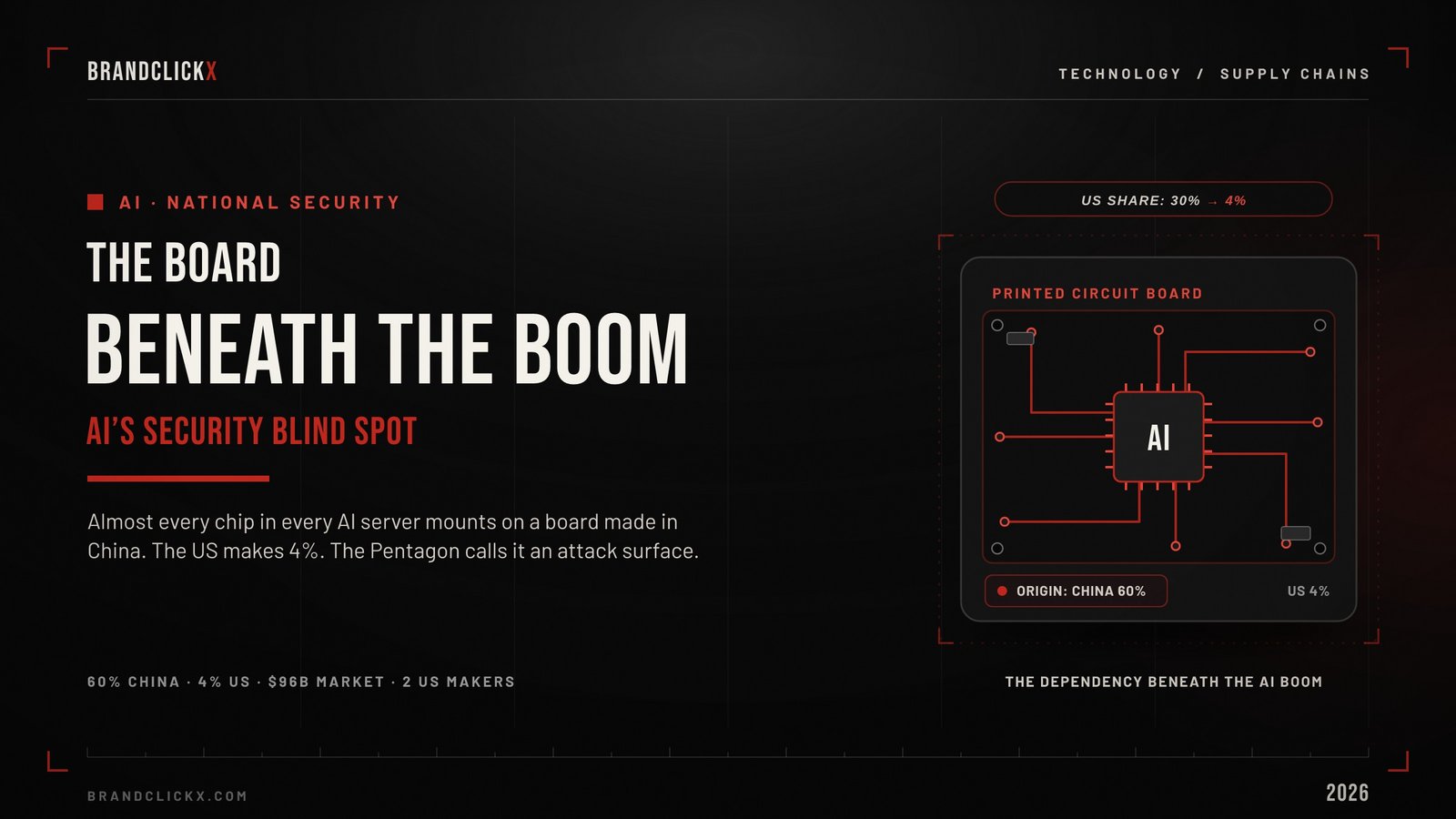
That circuit board is almost certainly made in China.
For consumer electronics, that dependency is a business risk. For an Nvidia AI server rack that costs $2 million and processes sensitive national data, it is a national security problem.
And for the US military, it is something more specific: the “easiest place to disrupt an electronics chain,” according to former US deputy under secretary of defense Al Shaffer.
The story of printed circuit boards, or PCBs, is not a new story. But it became an urgent one the moment AI turned circuit boards from background infrastructure into load-bearing components of the most strategically important technology buildout in a generation.
This is the dependency hiding in plain sight beneath the AI boom.
The Component Nobody Talks About
Everyone in tech knows about chips.
The Chips Act, the TSMC factories in Arizona, Nvidia’s GPU shortage, the export control wars with China, Intel’s struggles, ASML’s monopoly on extreme ultraviolet machines. The semiconductor supply chain has become a front-page geopolitical story.
Printed circuit boards have not.
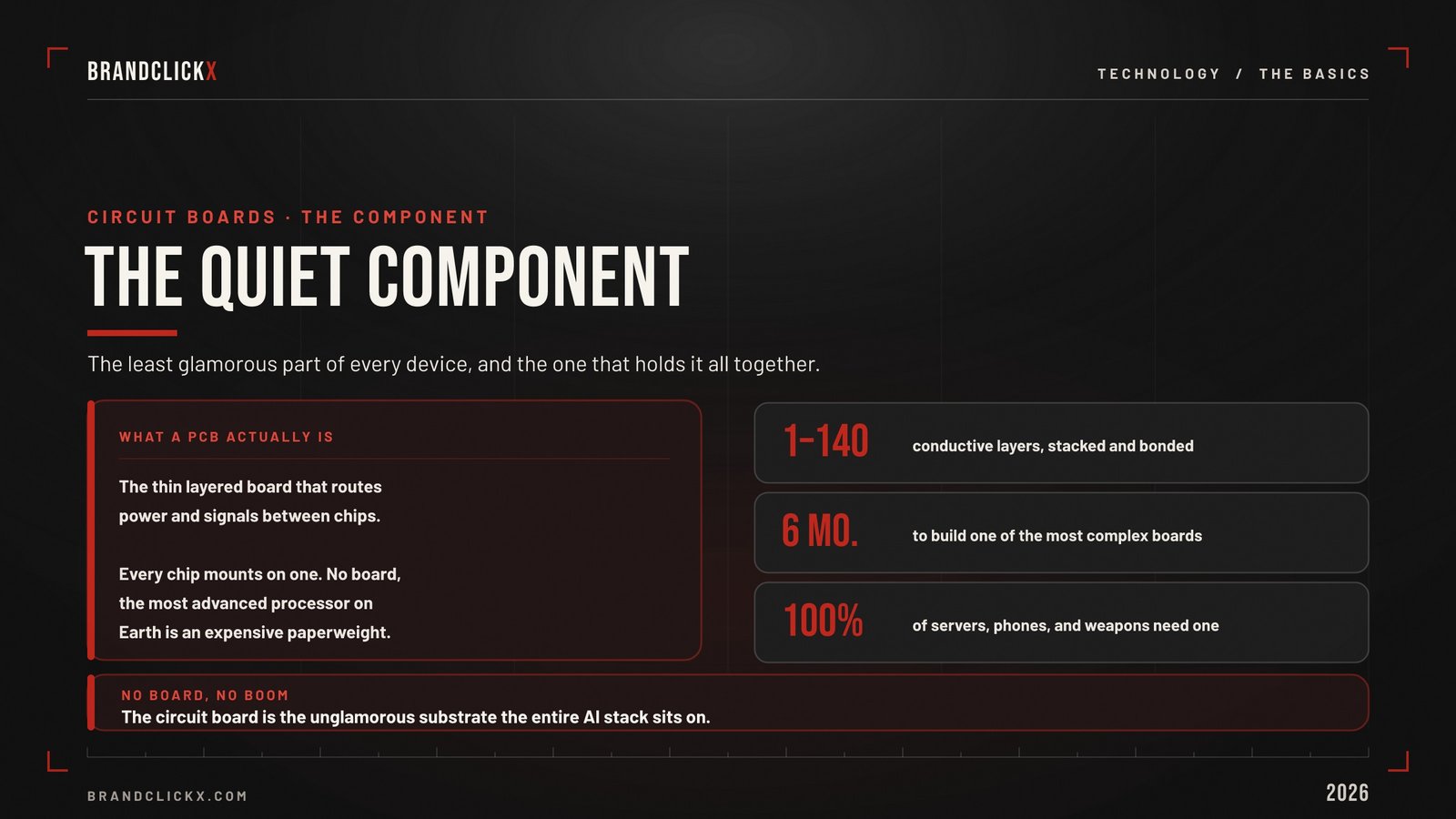
They should be, because no chip operates without one. A PCB is the foundation a chip mounts on, a multi-layered board printed with conductive pathways that let chips communicate with each other and with the outside world.
TTM Technologies calls it the simplest way: “Chips don’t float. They have to mount on a board in order for that entire package to work successfully.”
The layers matter. A PCB can have anywhere from one to 140 of them, with increasingly dense pathways etched in copper that carry electrical signals through the system. More complex AI hardware requires more layers.
More layers require more exotic materials: copper foil, resin, gold, palladium, immersion tin. More materials means more single points of failure.
And more PCBs means more surface area for risk.
How America Lost Its Lead
The US did not always trail on circuit boards.
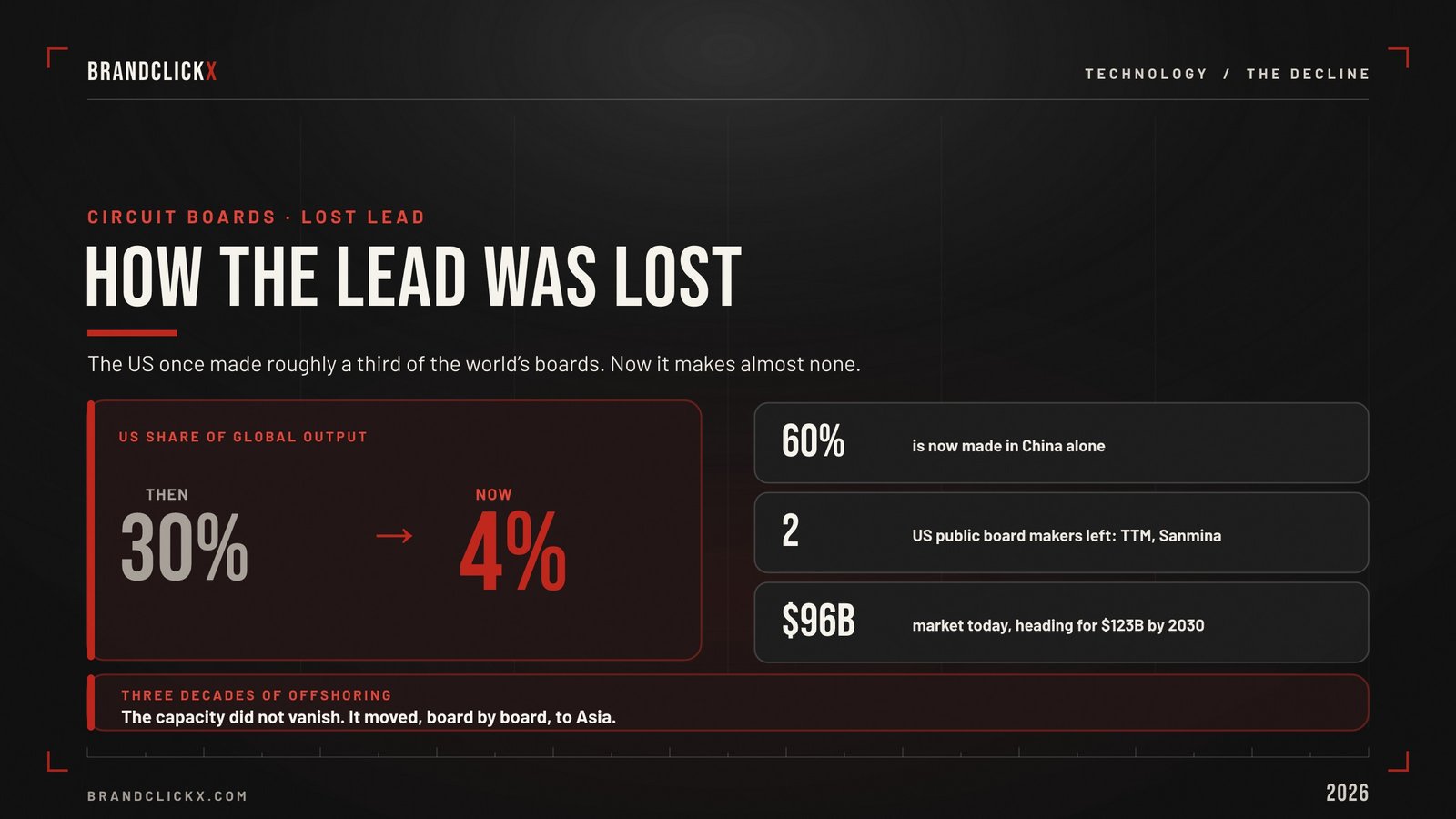
Roughly 30% of the world’s PCBs once came from American factories. Today that figure has fallen to just 4%, according to the Printed Circuit Board Association of America. China’s share has climbed to 60%.
This did not happen because American engineers forgot how to make circuit boards. It happened because of economics.
Chinese manufacturers, heavily subsidized by Beijing, can produce at lower cost using cheaper materials and labor. Over decades, the rational business decision for most US electronics companies was to offshore production. Factory by factory, the domestic capability hollowed out.
David Schild, executive director of the PCBAA, now describes America’s reliance on Chinese PCBs as a “risky dependency.” The understatement of the decade.
Because the consequences are not abstract. They are structural.
US domestic capacity has fallen so far behind that even with full political will, a subsidy program, and a regulatory mandate, rebuilding it takes years. PCB factories cost between $250 million and $400 million each to build.
The process to make a complex board takes up to six months. A modern facility requires enormous amounts of power and water. TTM used as much electricity as 70,000 homes and more than two billion gallons of water in a single year.
You cannot fix this problem with an announcement. You fix it with decades of consistent investment.
The Security Threat That Keeps DoD Awake
For commercial electronics, a Chinese-made PCB is an economic and quality-control question.
For a fighter jet, a missile guidance system, or an AI-enabled surveillance platform, it is something else entirely.
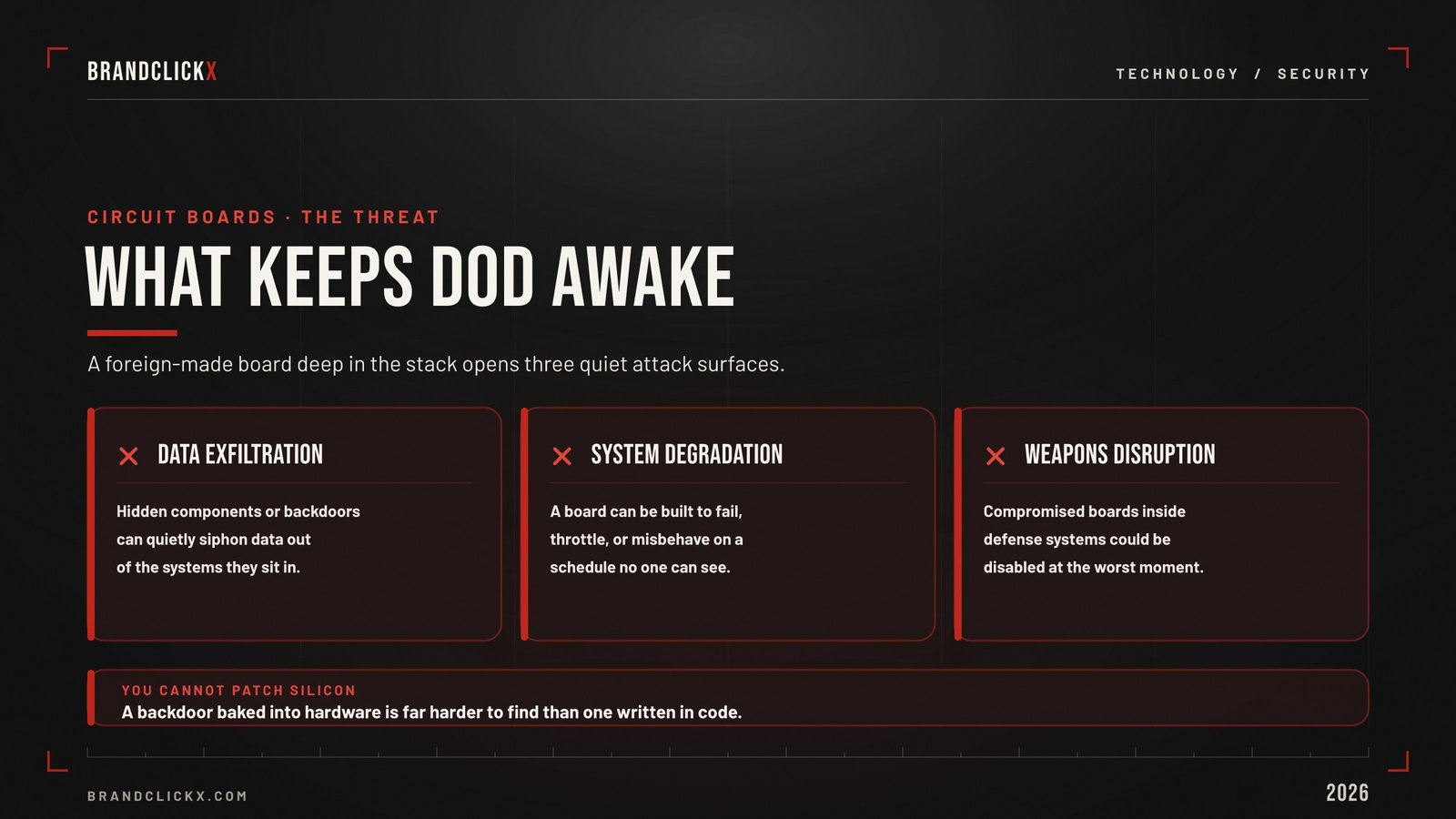
Mike Cadenazzi, the US assistant secretary of war for industrial base policy, told CNBC that chips, substrates, and PCBs represent “multiple avenues of attack for a potential malicious actor.” He was not speaking hypothetically.
A circuit board can be compromised in ways that are invisible to basic inspection because of the sheer number of layers and the microscopic nature of the components. Malicious actors can embed mechanisms that siphon data back to a foreign government.
They can reduce the performance of a system without triggering an obvious fault condition, creating degraded capability that looks like normal wear. And at the extreme end, Cadenazzi described a scenario where specific code activates within a weapon system, causing its guidance to fail at a critical moment. A missile “malfunctions in flight,” as he put it.
Shaffer, who shaped technology acquisition decisions across two administrations, says the layered construction of PCBs creates opportunities to hide things in substrates and between layers that standard testing does not catch.
Nvidia and its assembly partners have responded by physically inspecting every board with X-rays and AI-enabled imaging tools. That is the industry frontier for mitigation.
It is also a band-aid on a structural wound.
The real fix is provenance. And provenance requires domestic production.
This is why the US Defense Department has already moved to require most of its purchases to come from domestic manufacturers. Under legislation set to take effect next year, defense electronics will be legally required to be made in the United States. That mandate would have been unenforceable a few years ago. It is barely enforceable now.
The AI Connection: Why This Got Urgent Fast
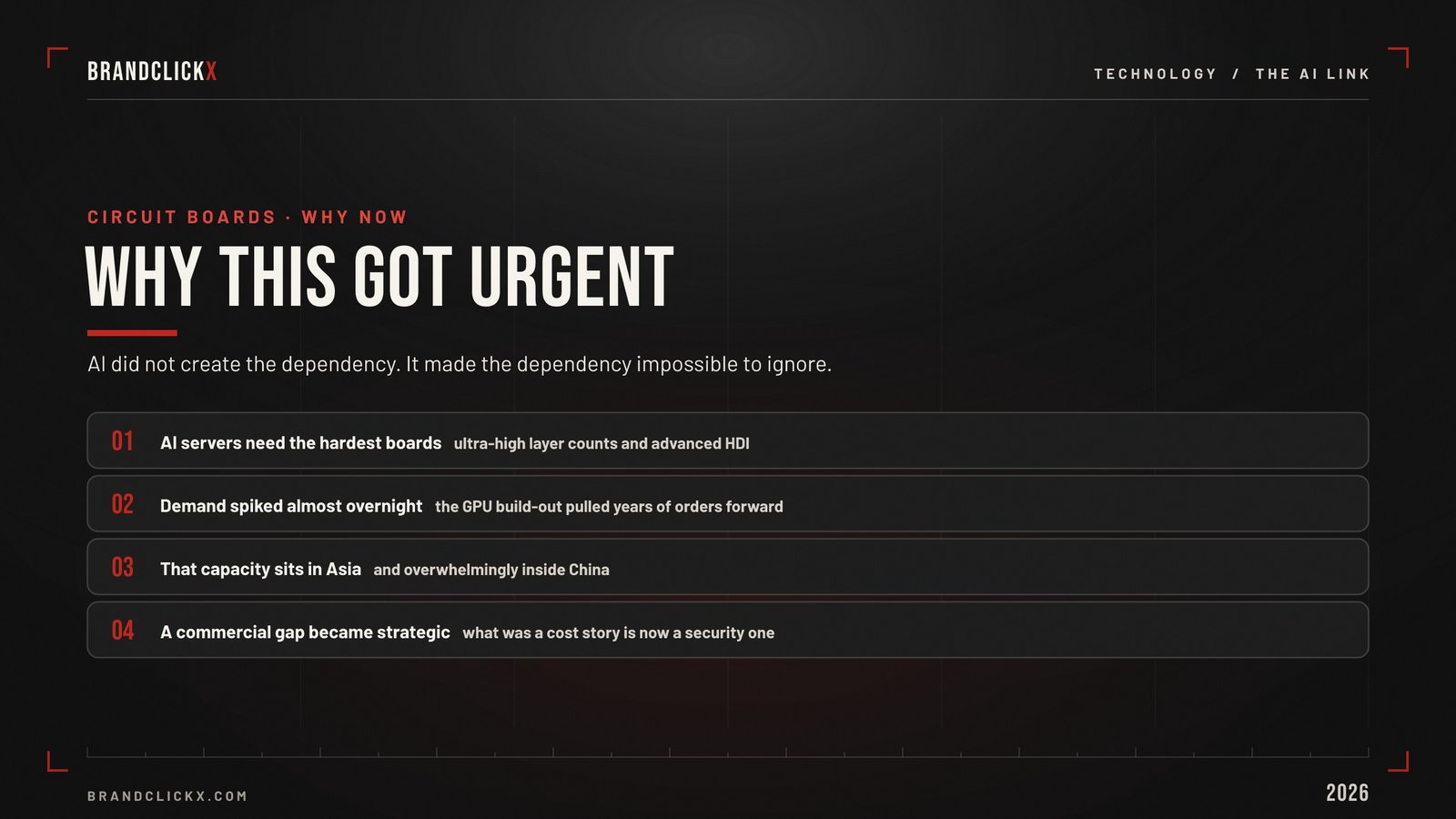
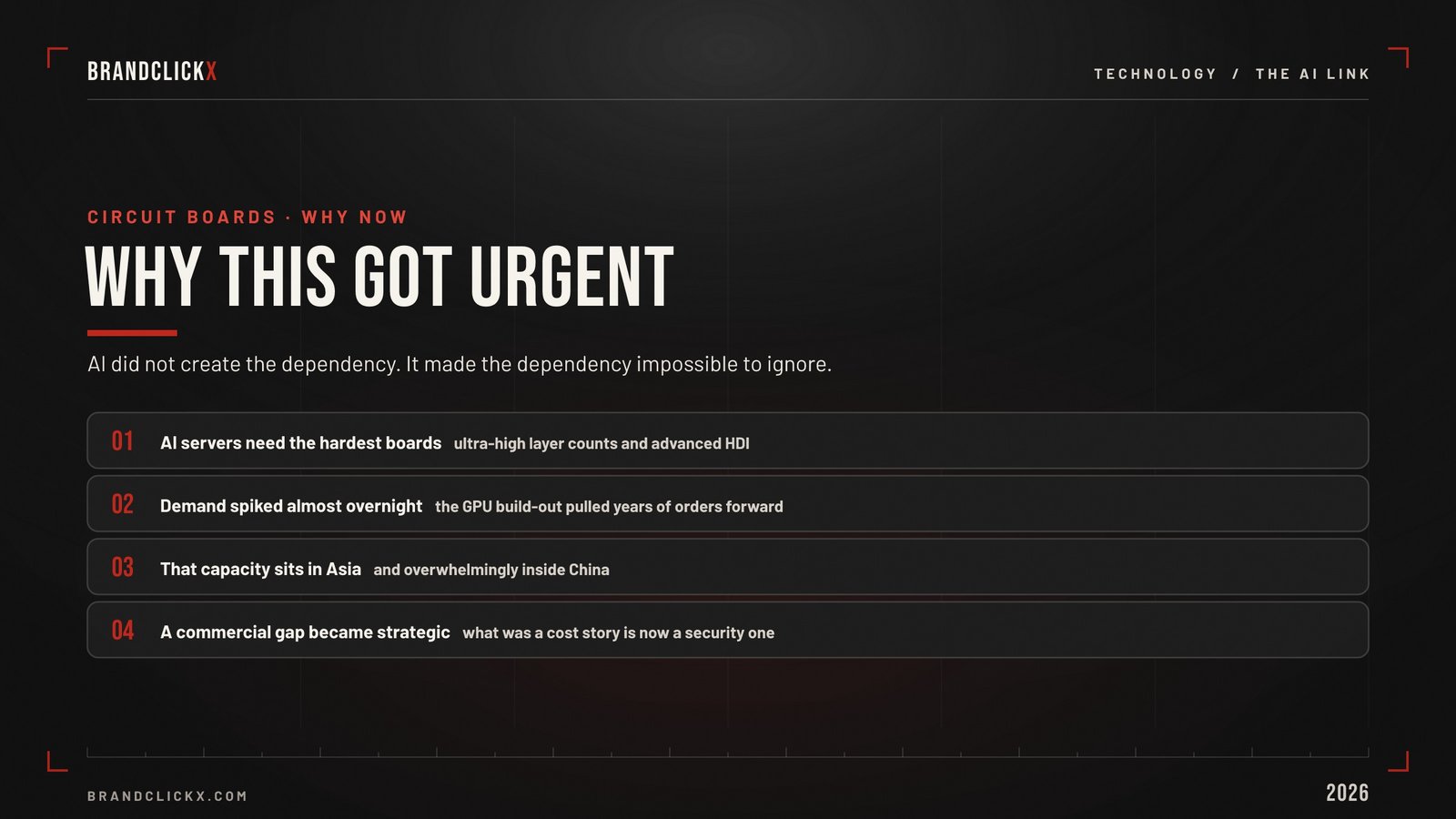
The PCB dependency existed long before the AI boom. The AI boom made it existential.
The global PCB market is projected to grow 12.5% this year alone, reaching nearly $96 billion, and is on track to hit $123 billion by the end of the decade, according to electronics research firm Prismark Partners.
That growth is overwhelmingly driven by AI data center construction, which requires servers, which require boards, which are overwhelmingly built in China.
Nearly three-quarters of the boards made at TTM’s largest China facility end up in data centers. When Nvidia ships a Vera Rubin server rack for a hyperscaler, the boards inside it traveled a supply chain that almost certainly passed through a Chinese factory.
TTM’s CEO Edwin Roks said the company is supplying “the big guys” in AI, a category that includes Nvidia, Google, Apple, and effectively every company building AI infrastructure at scale.
The strategic tension here is not subtle.
The US government is simultaneously pouring hundreds of billions of dollars into building domestic AI capabilities, imposing export restrictions on advanced chips to prevent China from accessing them, and building those same chips on circuit boards that China manufactures. Both sides of the strategy are running at the same time.
In April, the Trump administration accused Chinese entities of running “industrial-scale campaigns” to steal US AI systems. The boards those systems run on were most likely made in the country doing the stealing.
The Market Is Already Pricing the Fix
For investors watching this story, the trade is already active and has been for some time.
TTM Technologies, America’s largest PCB manufacturer, has seen its stock climb roughly 500% over the past year. Sanmina, the only other public US PCB maker, has more than tripled.
These moves reflect both genuine earnings growth and the forward expectation that legislative incentives and government contracts will continue to flow toward domestic producers.
The pricing environment makes that thesis even stronger.
PCB prices rose by as much as 40% between March and April, according to a Goldman Sachs note cited by Reuters. The driver was a convergence of AI demand and supply constraint, compounded by the Iran War’s effect on raw materials.
Victory Giant, one of the world’s largest PCB makers and an Nvidia supplier based in China, warned that the conflict was threatening supplies of copper and resin, two materials central to board production, and that prices could rise further. TTM told CNBC it is raising its own prices by 5% to 25%.
Higher prices mean higher revenue for domestic manufacturers, and they have been struggling to keep up with demand from both commercial AI customers and the military. The company is expanding rapidly, building new plants in Syracuse, New York, and Wisconsin, which will bring its US total to 18 factories while it maintains seven plants in Asia, including its largest, still in China.
That mix is the current strategic reality: a company trying to reshore production while remaining dependent on the same geography it is being asked to move away from.
Enterprise perspective: For procurement teams at major AI companies, the calculus is shifting. Chinese boards are cheaper. American boards are, increasingly, a requirement for any customer touching government contracts, and a competitive differentiator for companies that want to position themselves as trusted, secure providers.
The premium for domestic supply is real, but so is the reputational and regulatory risk of the alternative.
What the Legislation Actually Proposes
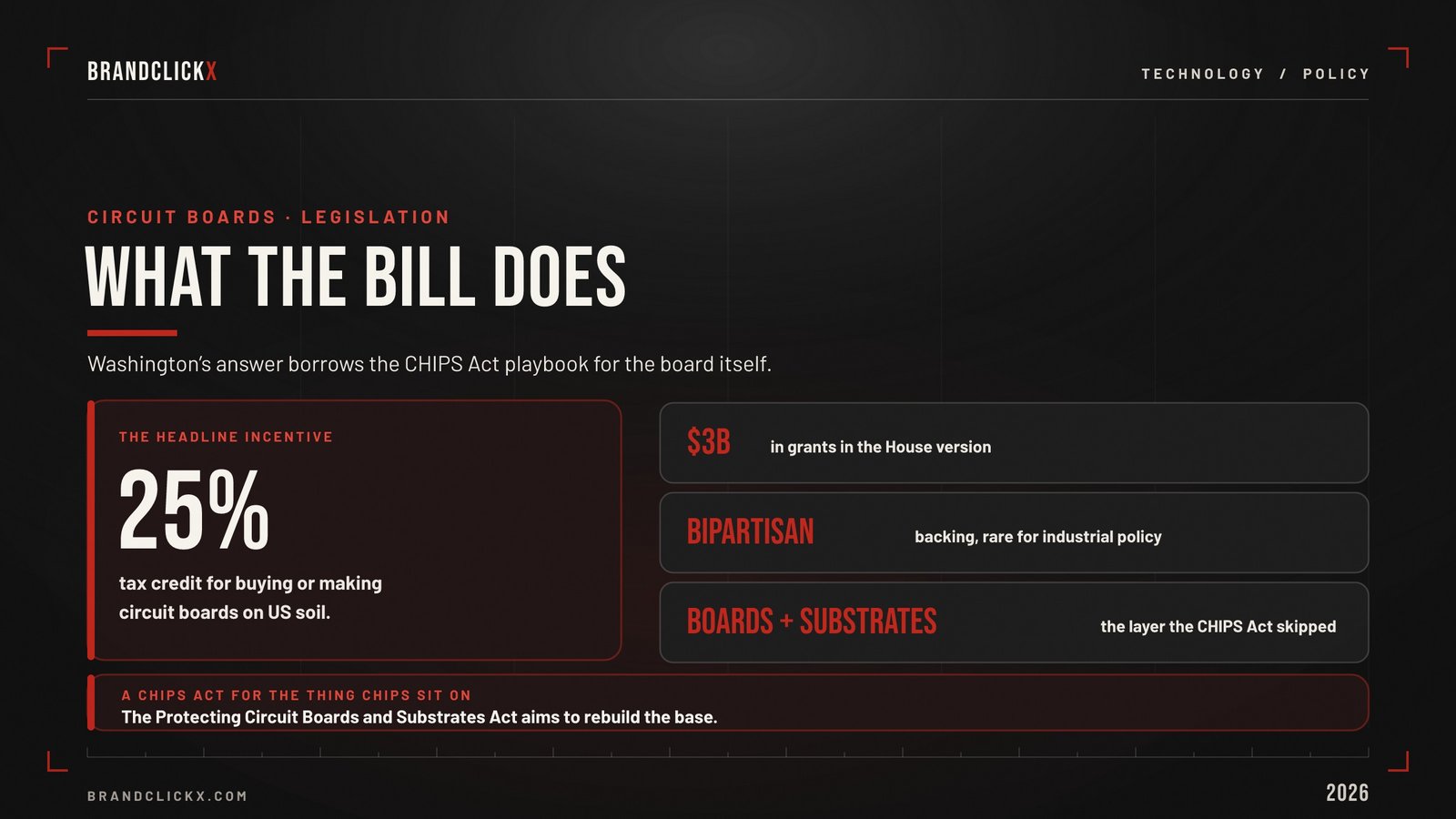
Congress has moved from concern to legislation.
Senators from both parties introduced the Protecting Circuit Boards and Substrates Act in May, which would give companies a 25% tax credit when they choose American-made circuit boards over foreign alternatives. A companion bill in the House calls for $3 billion in direct grants to US manufacturers.
Both measures are aimed at narrowing the cost gap that drove the original offshoring. Chinese manufacturers operate with heavy state subsidies, which creates a structural price advantage that market forces alone cannot overcome. The incentive bills are Washington’s attempt to level a playing field that has been tilted for three decades.
There is still a brutally honest constraint, which Schild of the PCBAA articulated clearly: the numbers need to pencil out for the companies making the decision. A 25% tax credit helps. A $3 billion grant program helps more. But building a PCB factory still costs up to $400 million, requires years of operational ramp, and depends on a domestic supply chain for raw materials that is itself fragile.
TTM’s Cathie Gridley, who oversees its aerospace and defense business, identified a single-supplier dependency for copper foil in the United States. One supplier. For a material that is foundational to every board the company makes. “If anything were to happen to that one supplier,” she said, “it would cripple the industry.”
The Startups and the Longer Game
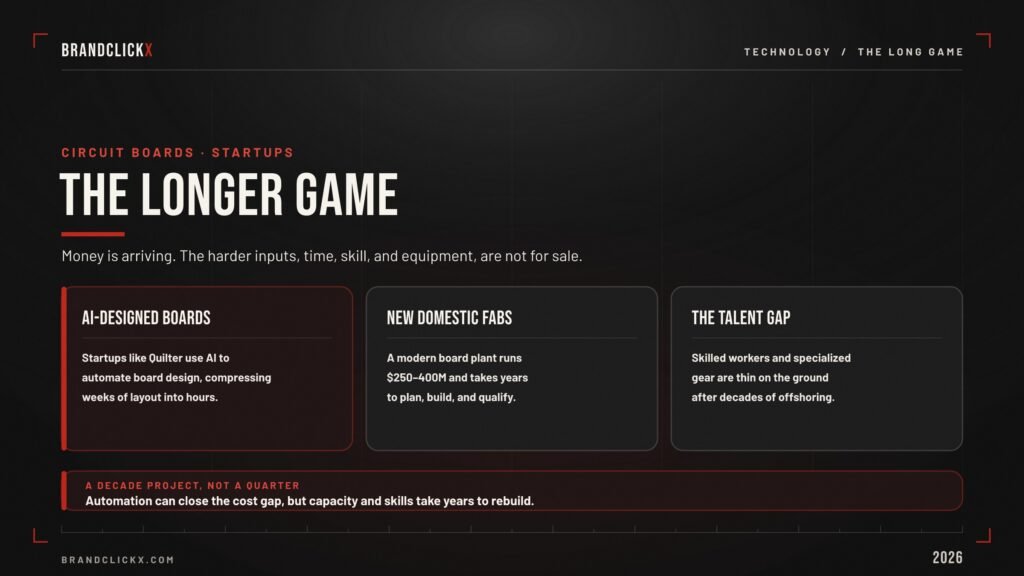
Beyond TTM and Sanmina, a generation of startups is trying to attack the problem from a different angle.
Quilter, founded by a former SpaceX engineer, uses AI to design increasingly complex circuit boards, compressing the engineering time that currently makes advanced domestic boards so expensive and slow to produce. The more complexity you can automate, the faster you close the cost gap with Chinese manufacturers.
Itera is working on a “fluid” circuit board that can be rewired after manufacture, reducing the need to build and order new boards every time a system design changes. That flexibility could dramatically cut the volume of boards required in development cycles.
Neither company is at production scale. Both represent the kind of design-layer innovation that could meaningfully change the economics of domestic PCB manufacturing over the next five to seven years.
The hard truth is that the timeline for the easy fix has already passed.
The window where domestic capacity could have been preserved without a major government program closed sometime in the late 2000s. What remains is the hard version: legislate the incentives, fund the factories, build the supply chains, certify the materials, and train the workforce. All of it simultaneously, while the AI infrastructure buildout it is meant to protect continues accelerating.
The bigger shift: This is not just a PCB story. It is a preview of every strategic technology dependency the US has allowed to drift offshore over the past 30 years. The semiconductor lesson took a decade to turn into the Chips Act.
The PCB lesson is arriving faster, partly because the AI boom compressed the timeline, and partly because DoD is willing to say out loud what the commercial sector prefers not to: that a component with this kind of attack surface has no business being manufactured by an adversary.
What Happens Next
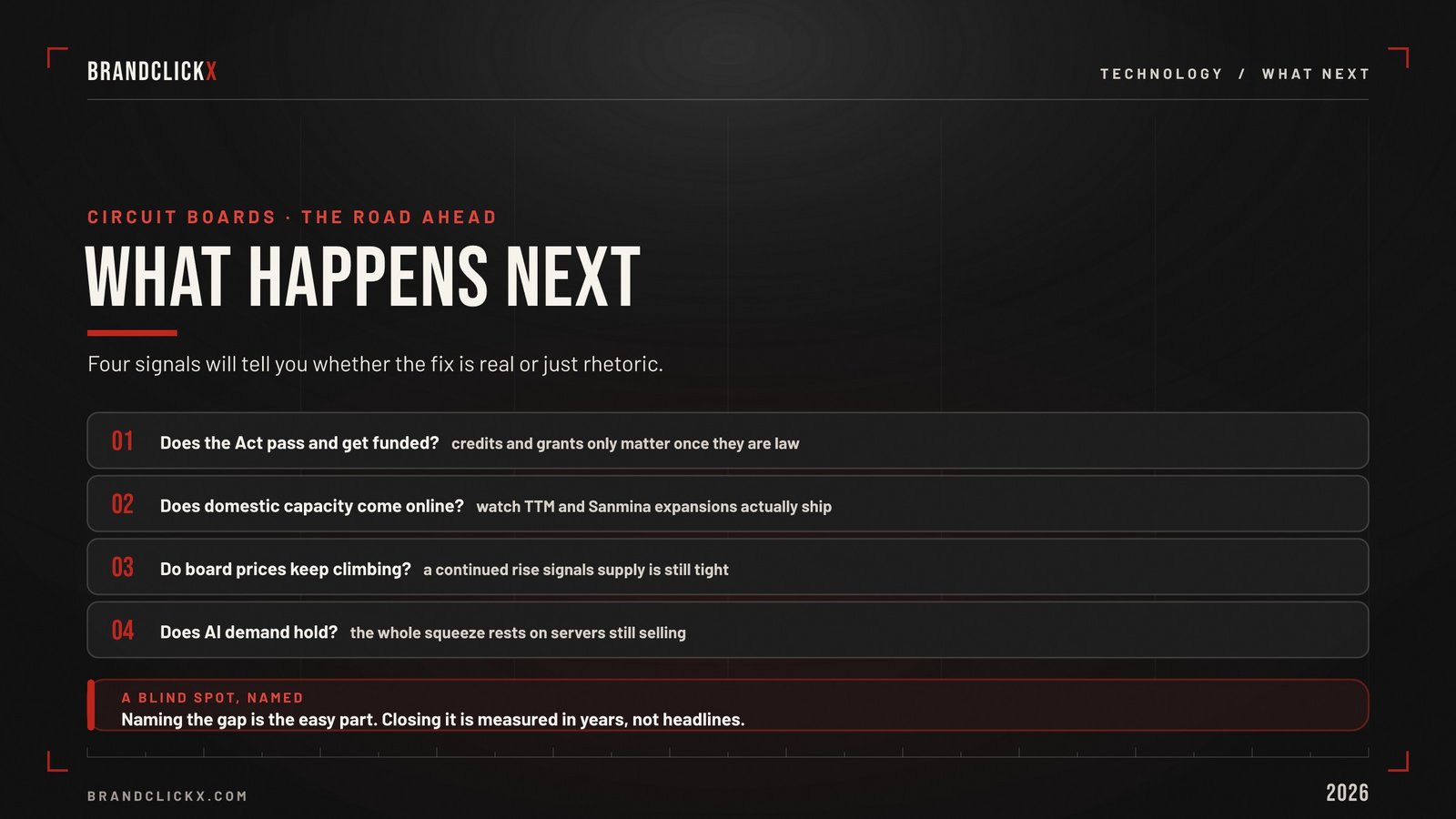
Watch four signals.
First, whether the Protecting Circuit Boards and Substrates Act advances through both chambers. The bipartisan support is genuine but Congress still has to act.
Second, TTM’s pricing power. If the company can hold and expand its 5-25% price increases while simultaneously filling its new US capacity, it has structurally moved from a commodity to a strategic supplier. That is a different multiple.
Third, whether hyperscalers start disclosing PCB sourcing. Any major AI company announcing a domestic sourcing commitment would accelerate the legislative case and provide TTM and Sanmina with the anchor customers that justify the next round of factory investment.
Fourth, the startup layer. If Quilter or Itera can demonstrably cut design cost and cycle time, the economic case for domestic production gets materially better without any subsidy.
The AI boom built demand. The security concerns built urgency. The legislation is building the framework. What is missing is the scale of investment and the speed of execution to match the pace at which the dependency deepens every time another data center comes online.
Key Takeaways
- The AI boom runs on Chinese circuit boards. Almost every chip in every Nvidia server, Google data center, and Apple device is connected to a board made in China. The US share of global PCB production has fallen from 30% to 4%.
- The security risk is not theoretical. The US Defense Department has outlined specific attack scenarios: data exfiltration, system degradation, and weapons guidance disruption. The Pentagon is already requiring domestic sourcing for most defense purchases.
- Two companies own the entire US public PCB market. TTM Technologies and Sanmina are the only publicly traded US manufacturers. TTM is up roughly 500% in the past year; Sanmina has more than tripled. Prices rose 40% in a single two-month period.
- The legislation has bipartisan support but needs to move. A 25% tax credit and $3 billion in grants are on the table. The economics still require both programs to make domestic production cost-competitive against state-subsidized Chinese manufacturers.
- Single points of failure exist inside the fix. The US has a single domestic supplier of copper foil, a foundational PCB ingredient. The supply chain resilience story has its own vulnerability embedded inside it.
- The timeline is compressed. AI infrastructure demand is growing faster than domestic manufacturing capacity can be rebuilt. The gap between need and supply may widen before it narrows.
Frequently Asked Questions
What is a printed circuit board and why does it matter for AI?
A printed circuit board is the layered base that connects chips and electronics into a working system. Every Nvidia GPU, every server processor, every AI accelerator needs one to function. No chip operates in isolation. The PCB is the foundation that makes the entire system work.
How much of the world’s PCB production does China control?
According to the Printed Circuit Board Association of America, China now produces about 60% of the world’s circuit boards. The US, which once produced 30%, now makes about 4%.
What are the national security risks of Chinese-made PCBs?
US officials have identified three main risks. First, hidden components could siphon sensitive data back to China. Second, a board could be designed to degrade system performance in a way that is difficult to detect. Third, in a weapons system, a compromised PCB could interfere with guidance, potentially causing a missile to malfunction in flight.
Which US companies make printed circuit boards?
TTM Technologies and Sanmina are the only two publicly listed US PCB manufacturers. TTM is the largest, with 18 US factories and 7 in Asia. Both have seen their stocks surge on the back of AI demand and defense contracts.
What legislation is being proposed to fix US PCB supply chains?
The Protecting Circuit Boards and Substrates Act, introduced in May 2026 by senators from both parties, would offer a 25% tax credit to companies that choose American-made boards. A companion House bill calls for $3 billion in direct grants to domestic manufacturers. Both are under consideration.
The Bottom Line
The AI infrastructure race has a supply chain problem hiding one layer below where everyone is looking.
The chips get the attention. The semiconductor fabs get the subsidies. The GPU shortages make the headlines. But beneath every chip that powers every AI model is a circuit board that almost certainly began its life in a Chinese factory, made its way through a Chinese supply chain, and arrived in a US data center with its provenance largely unexamined.
That worked well enough when the worst-case scenario was a counterfeit AirPod.
It works less well when the same component architecture runs inside a missile guidance system or a classified AI platform. The military figured that out first. The AI industry is figuring it out now. Congress is trying to legislate a solution to a dependency that took three decades to build.
Roks, TTM’s CEO, said the situation is “very scary,” and that fixing it is not optional. It has to be domestic, he said, and soon it will need to extend to Europe.
That is not the statement of an executive selling a growth story. That is the statement of someone who has seen inside the problem.
The board beneath the boom is the part the boom forgot to secure. The window to fix that is open. Whether the US moves fast enough through it is the question that will define a significant piece of the AI infrastructure story over the next decade.