

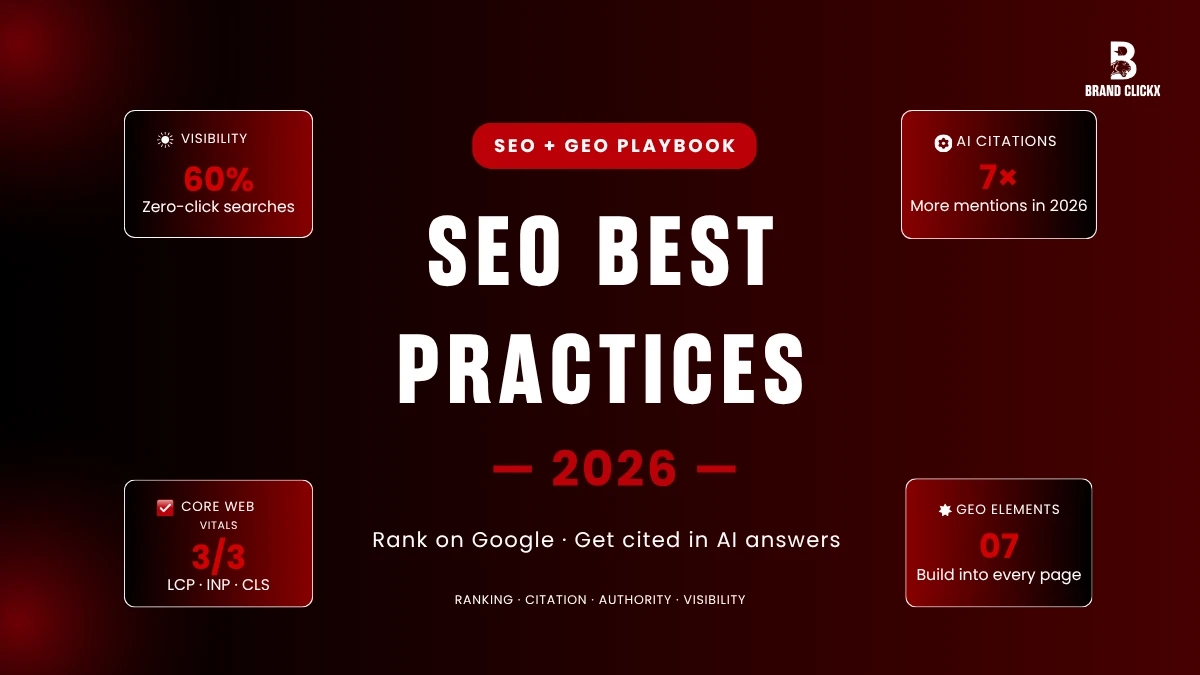
The biggest shift in search this decade did not arrive with a Google algorithm update. It arrived when users stopped expecting blue links to be the answer.
AI Overviews, generative engines, and conversational search interfaces now sit between the searcher and the source. Click-through rates on traditional rankings have softened across most informational queries, while branded queries, entity authority, and structured content are quietly becoming the new currency of visibility.
SEO best practices in 2026 are no longer a checklist of on-page tweaks. They have become a layered discipline that blends technical engineering, editorial judgment, and machine-readable storytelling.
This is the field guide for what actually works now, written for marketing leaders, in-house SEOs, and operators who need to separate the noise from the signal.
Why SEO Best Practices Look Different in 2026
Search behavior has fragmented. A user researching a B2B tool might start in ChatGPT, verify in Google, scan a Reddit thread, and finish on a vendor comparison page. The funnel that SEOs optimized for over the last decade was linear. The one playing out today is recursive.
Three forces explain the shift:
- Generative answers compress the SERP. AI Overviews and answer engines pull from multiple sources, summarize, and reduce the need for a click.
- Search is now multi-engine. Google still dominates, but Perplexity, ChatGPT Search, Bing Copilot, and TikTok have become real discovery surfaces for specific audiences.
- Topical authority outperforms keyword density. Sites that own a subject end-to-end outrank sites that publish scattered keyword pages, regardless of domain rating.
Why It Matters: The brands winning in search this year are not the ones writing more. They are the ones writing with deeper structure, clearer authorship, and a stronger entity footprint across the web.
The New Foundation: Search Has Three Audiences Now
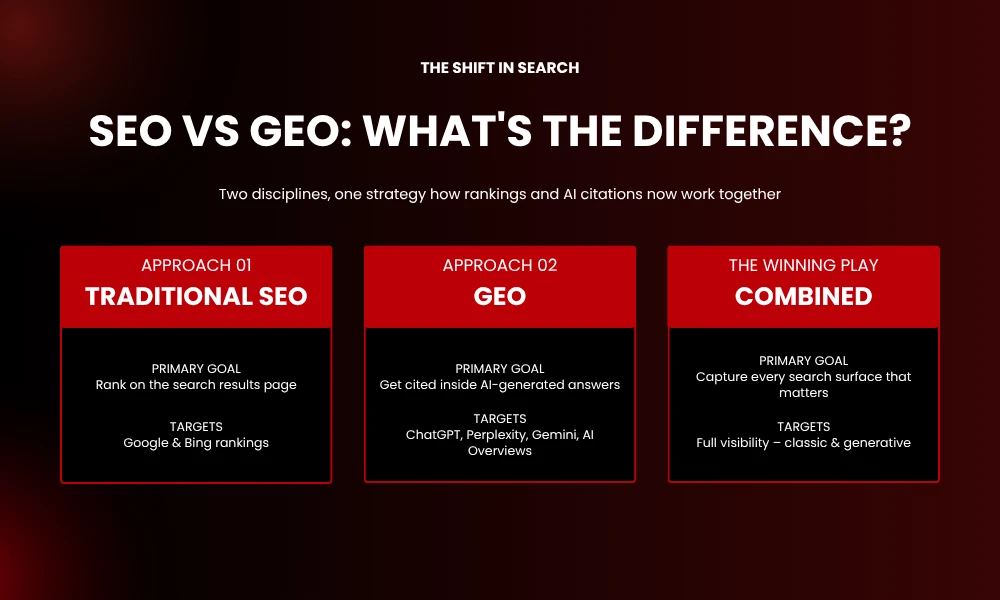
Modern SEO best practices have to satisfy three readers at once.
| Audience | What They Want | What They Reward |
|---|---|---|
| Human searchers | Clarity, depth, relevance | Time on page, return visits, brand recall |
| Google’s ranking systems | Crawlability, topical coverage, authority signals | Organic rankings, sitelinks, rich results |
| AI answer engines | Structured facts, citations, entity clarity | Inclusion in summaries, mentions in generative outputs |
If a single page does not work for all three, it is leaving performance on the table. A 2026-grade SEO strategy treats each audience as a deliberate optimization target, not an afterthought.
Technical SEO Best Practices That Still Move Rankings
Technical SEO is no longer the exciting part of the conversation, and that is precisely why it is undervalued. Sites that nail the fundamentals consistently outperform competitors with louder content strategies.
Core Web Vitals and the speed problem
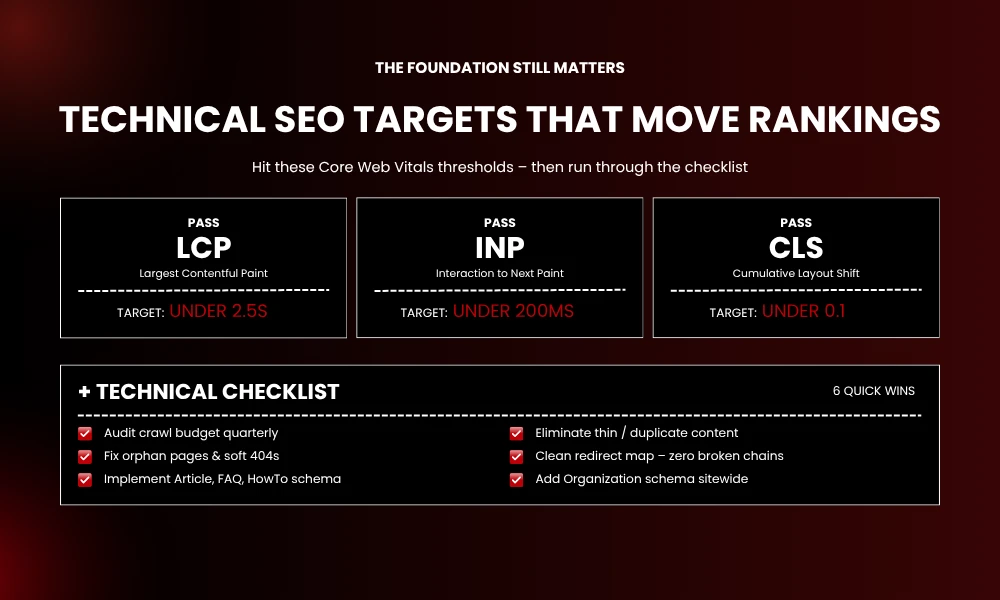
Page experience signals remain a tiebreaker, especially on mobile. The metrics that matter:
- Largest Contentful Paint (LCP): under 2.5 seconds
- Interaction to Next Paint (INP): under 200 milliseconds
- Cumulative Layout Shift (CLS): under 0.1
Speed is rarely a single fix. It is the cumulative effect of image compression, lazy loading, font optimization, render-blocking script audits, and hosting infrastructure. Treat performance as a quarterly engineering ritual, not a one-time project.
Crawl budget and indexation hygiene
For sites above 10,000 pages, crawl budget becomes a strategic asset. Audit for:
- Orphan pages with no internal links
- Thin or duplicate content cannibalizing primary URLs
- Faceted navigation generating infinite crawl loops
- Soft 404s and broken redirect chains
Use log file analysis to see what Googlebot actually fetches versus what your sitemap claims is important. The two are almost never identical.
Schema markup is now table stakes
Structured data has graduated from a nice-to-have to a non-negotiable. Article, FAQ, HowTo, Product, Organization, and Person schema all give search engines and AI models the entity context they need to cite your content. Sites with rigorous schema implementation are appearing in AI Overviews at materially higher rates than those without.
Expert Tip: Treat schema as a content-creation step, not a developer task. The writer should know which entities and properties the article maps to before publishing. – Google Search Central
Content Strategy: From Keywords to Knowledge
The content side of SEO best practices has changed more in the last 18 months than in the previous five years. Keyword-first thinking has given way to entity-first thinking.
Build for topical authority, not page authority
A single 3,000-word “ultimate guide” no longer dominates the way it did in 2019. Today, search engines reward topical depth across a cluster of interconnected pages. The winning structure looks like this:
- One pillar page covering the topic broadly
- 8 to 15 supporting articles addressing specific subtopics, questions, and use cases
- Tight internal linking between pillar and cluster, with descriptive anchor text
- A clear information architecture that signals expertise to crawlers and humans
This is how niche sites with smaller backlink profiles routinely outrank Fortune 500 brands on specialized queries.
Write for the question, then for the keyword
Search intent has become granular. A query like “best CRM for startups” implies a comparison. A query like “how to set up a CRM” implies a tutorial. A query like “what is a CRM” implies a definition. The page that wins is the page that matches the intent first and the keyword second.
Map every target query to one of four intents:
- Informational (learn something)
- Navigational (find a specific place)
- Commercial (compare options)
- Transactional (take action)
Then build the page around the format that intent demands. A listicle ranks for comparison queries because that is what searchers want. A clean step-by-step guide wins tutorials. Forcing a single template across all intents is one of the most common reasons content underperforms.
The new readability standard
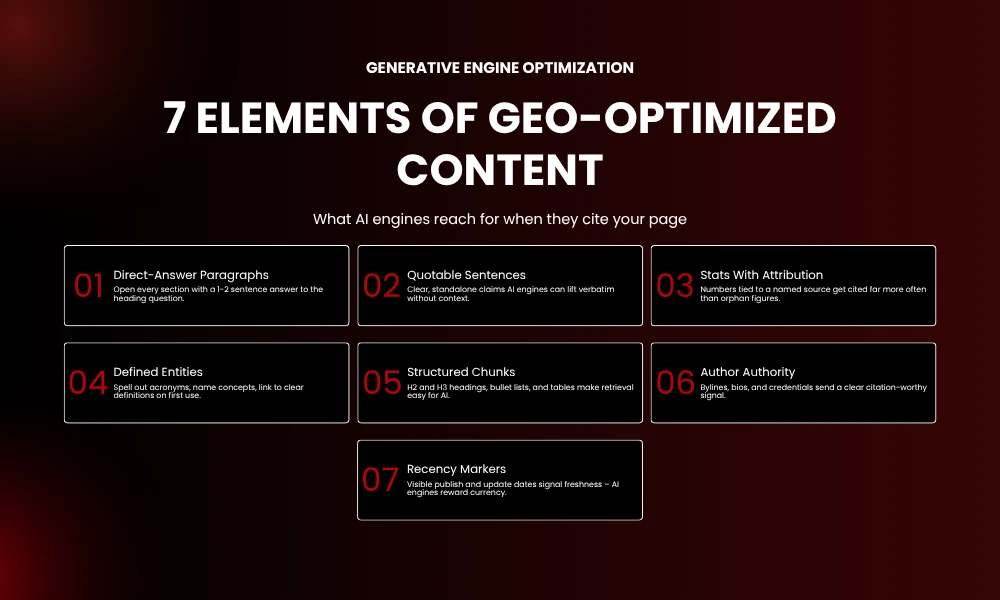
AI engines parse content in chunks. Long, dense paragraphs lose to scannable structure every time. Modern editorial SEO uses:
- Short paragraphs, often 2 to 3 sentences
- Frequent H2 and H3 subheadings
- Bullet points and tables for comparative information
- Bold text on key phrases, used sparingly
- Direct answers placed in the first paragraph under each heading
This is not dumbing down. It is engineering for how content actually gets read and re-served.
E-E-A-T Is No Longer Optional
Experience, Expertise, Authoritativeness, and Trust used to live mostly in YMYL niches like finance and health. That fence is gone. Google’s quality systems now apply E-E-A-T signals across categories, and AI engines disproportionately cite sources with visible author authority.
What E-E-A-T actually looks like on the page
- A named author with a real biography, credentials, and links to verified profiles
- First-person experience woven into the content, not stripped out for “objectivity”
- Citations and outbound links to primary sources
- Last-updated timestamps that reflect genuine revisions
- An About page that explains who writes, who edits, and what the editorial process is
Anonymous content farms are being filtered out of organic results and AI citations alike. The brands winning are the ones publishing under real names and standing behind their work.
Key Takeaway: Author authority is now a ranking lever. Building a recognizable byline strategy is one of the highest-leverage SEO moves available in 2026.
Links Still Matter, But the Game Has Shifted
Backlinks have not lost their value. The way they get earned has.
Mass guest posting, PBNs, and link exchanges produce diminishing returns and growing risk. The link profiles of top-performing sites in 2026 share three traits:
- Editorial relevance. Links come from sites covering the same topic, not from generic high-DR domains.
- Brand mentions and unlinked citations. Search engines treat consistent brand mentions across reputable sources as a trust signal, even without a hyperlink.
- Digital PR over link building. Earning press coverage through original data, expert commentary, and newsworthy assets outperforms transactional outreach.
The link-building checklist that still works
- Publish original research, surveys, or proprietary data others want to cite
- Build relationships with journalists in your vertical through tools like Qwoted and Featured
- Create linkable assets (calculators, frameworks, benchmark reports)
- Pitch contributed expertise to industry publications, not low-authority blogs
- Audit and disavow toxic links quarterly
Local and Entity SEO: The Quiet Growth Channel
For service businesses, location-based SEO has become the single highest-ROI channel. Google Business Profile optimization, review velocity, and local citation consistency drive a disproportionate share of revenue for retailers, agencies, clinics, and trades.
The core local checklist:
- Complete every field on your Google Business Profile
- Maintain NAP (name, address, phone) consistency across all citation sites
- Generate a steady cadence of reviews, with real responses to each one
- Publish location-specific landing pages with genuine local content, not template clones
- Build links from local press, chambers of commerce, and community organizations
Entity SEO, the broader discipline of becoming a recognized “thing” in Google’s Knowledge Graph, is the enterprise version of this. The signals overlap: consistent name usage, structured data, third-party validation, and visible authorship.
Measuring What Actually Counts
The metrics that defined SEO success a decade ago are increasingly misleading. Rankings alone tell a smaller part of the story when AI Overviews intercept clicks before a user reaches the SERP.
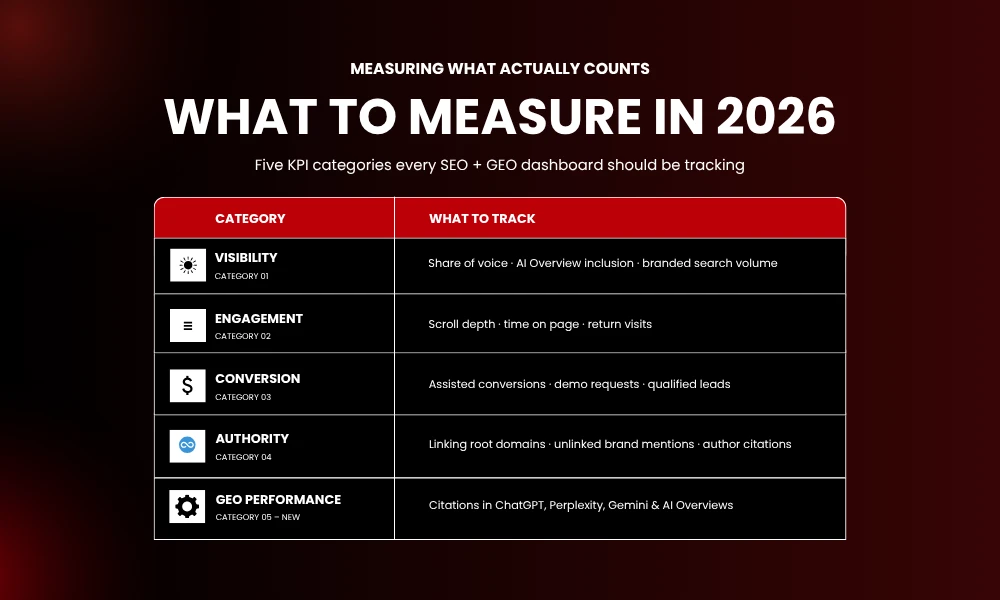
A modern SEO measurement framework tracks:
| Metric Category | What to Track | Why It Matters |
|---|---|---|
| Visibility | Share of voice, AI Overview inclusion, branded search volume | Reflects real authority, not just ranking |
| Engagement | Scroll depth, time on page, return visits | Signals content quality to ranking systems |
| Conversion | Assisted conversions, demo requests, qualified leads | Connects SEO to revenue |
| Authority | Linking root domains, unlinked brand mentions, author citations | Predicts future ranking durability |
Dashboards built around these four pillars give marketing leaders a defensible view of SEO contribution, especially in budget conversations where attribution is contested.
The SEO Mistakes Quietly Killing Performance
Some of the most damaging issues in 2026 are not violations. They are habits left over from older playbooks.
- Publishing without an entity strategy. Pages that do not connect to a clear topic cluster waste authority.
- Ignoring AI engines. Sites that do not appear in Perplexity, ChatGPT Search, or Google AI Overviews lose top-of-funnel demand they never see in analytics.
- Treating updates as cosmetic. Refreshing a date without revising content fools nobody, including Google.
- Over-optimizing anchor text. Exact-match anchors at scale look manipulative and trigger algorithmic suspicion.
- Hiding authorship. Removing bylines to “look more corporate” tanks E-E-A-T signals.
- Building for one search engine. Optimizing exclusively for Google leaves visibility on the table across an increasingly multi-engine landscape.
The Bigger Shift: SEO has stopped being a marketing tactic and become a publishing discipline. The brands treating it that way are pulling away from the ones treating it as a checklist.
Modern SEO is no longer just about keywords; it also depends on user experience, design, and how clearly a website communicates value. Good design improves engagement, trust, and overall search performance. You can see how design-driven thinking supports digital growth.
The Actionable SEO Best Practices Checklist for 2026
For teams that want a tactical summary, here is the working checklist that maps to everything above.
Technical foundation
- Pass Core Web Vitals on mobile and desktop
- Implement schema across articles, products, FAQs, and organization data
- Audit crawl budget quarterly with log file analysis
- Maintain a clean redirect map and zero soft 404s
Content and editorial
- Build topic clusters with pillar plus supporting structure
- Match every page to one dominant search intent
- Use scannable formatting designed for AI ingestion
- Publish under named authors with full bios
Authority and links
- Earn editorial links through original data and expert commentary
- Build brand mentions, not just hyperlinks
- Audit and disavow toxic links each quarter
- Strengthen author E-E-A-T signals across the web
Measurement
- Track AI Overview inclusion as a core KPI
- Monitor branded search volume monthly
- Tie SEO performance to revenue, not rankings alone
- Build dashboards around visibility, engagement, conversion, and authority
Frequently Asked Questions
What are the most important SEO best practices in 2026?
The highest-leverage practices are topical authority, technical site health, named-author E-E-A-T, schema markup, and optimization for AI answer engines. Sites doing all five consistently outperform those that pick only two or three.
How long does SEO take to show results?
Most pages need 3 to 6 months to reach stable rankings, and competitive queries can take 9 to 12 months. New domains take longer than established ones because trust signals accumulate slowly. The payoff is durability: organic traffic compounds in a way paid channels do not.
Is SEO still worth it with AI Overviews reducing clicks?
Yes, but the goal has shifted. Visibility now includes being cited in AI summaries, not just ranking number one. Brands appearing in AI Overviews see meaningful lifts in branded search, direct traffic, and conversion rates even when raw click-through rates dip.
Do backlinks still matter?
Backlinks remain a strong ranking signal, but quality has overtaken quantity by a wide margin. Editorial links from topically relevant sites move the needle. Bulk link buying, link exchanges, and PBN tactics increasingly trigger algorithmic and manual penalties.
How often should content be updated for SEO?
High-value pages benefit from substantive refreshes every 6 to 12 months. The update has to add new information, refine the structure, or improve accuracy. Cosmetic date changes without real edits no longer influence rankings and may erode trust signals.
What Happens Next: The Future of Search
The next 24 months will accelerate the trends already in motion. AI Overviews will expand into more query types. Voice and conversational search will reshape how content gets structured. Multi-engine optimization will become standard practice rather than an experimental edge.
The strategic implication for marketing leaders is straightforward. SEO can no longer be outsourced to the cheapest vendor who promises rankings. It has to be treated as a core publishing function, owned by senior strategists who understand both the algorithms and the audiences. The brands building that capacity now will compound a visibility advantage that becomes structurally hard to dislodge.
At BrandClickX, we treat SEO as marketing intelligence, not a service line. The discipline rewards depth, patience, and editorial rigor. The brands that internalize that reality are the ones quietly winning the next decade of search.