
A brand can look more profitable in DTC simply because it collects the full retail price. That doesn’t mean it keeps more after making the sale. Wholesale gives up some selling price but can put the product in front of shoppers without the brand funding every customer acquisition itself.
For wholesale vs DTC, the better comparison is contribution margin, not gross margin. More importantly, the two channels do different jobs: DTC gives a brand control, customer learning and a direct relationship, while wholesale provides distribution, retail reach and scale.
That changes the decision. A high-value considered purchase can justify a DTC-first model. A low-value repeat product may need wholesale scale first. A brand with little awareness may need retail distribution to create demand before asking DTC to capture it.
Key Takeaways
- DTC isn’t automatically more profitable just because the brand keeps the full retail price.
- Wholesale gives up selling price but can provide distribution and access to existing retail demand.
- Contribution margin is a better channel comparison than gross margin.
- DTC’s strongest strategic value is often customer learning and control rather than margin alone.
- The right mix depends on product economics, customer behavior and how much demand the brand can generate itself.
What Each Channel Actually Is
Wholesale means selling your product to a retailer or other business that then sells it to the consumer. DTC means selling directly to that consumer through your own website, stores or other owned channels.
That difference changes more than who collects the money. In a retail partnership strategy, the retailer can provide physical distribution, shopper access and part of the selling experience. In DTC, the brand owns much more of the journey, including acquisition, merchandising, transaction and customer relationship.
Two channels, two jobs
Think of wholesale as a distribution engine and DTC as a learning and relationship engine. That doesn’t mean wholesale can’t build a brand or DTC can’t scale. It means the costs and benefits should be judged against the job each channel is expected to perform. Major brands continue to operate both channels because each can contribute something different to growth.
The Margin Comparison Everybody Gets Wrong
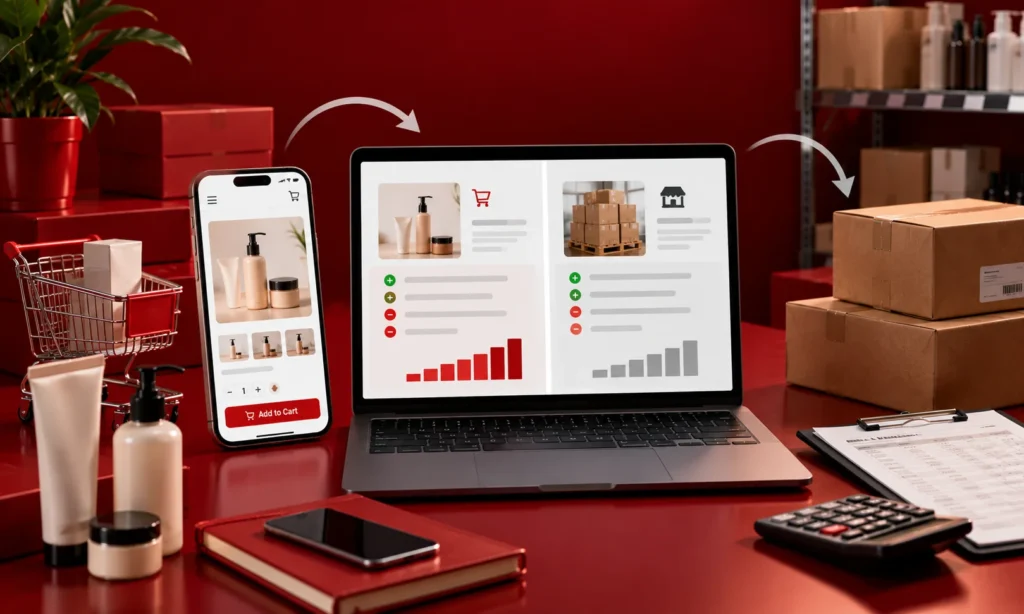
The biggest mistake is comparing the retail price in DTC with the wholesale price and stopping there. In DTC, the brand collects the retail selling price but also carries the costs attached to making that sale. A useful contribution view removes COGS, payment fees, shipping, fulfillment and returns before considering the cost of acquiring the customer.
Current DTC benchmarks use this structure essentially for contribution margin. Wholesale starts with a lower selling price because the retailer needs room to operate. But the retailer is also taking on part of the downstream selling job. Wholesale revenue can also be affected by discounts, allowances, returns and retailer-funded or retailer-supported promotions.
An illustrative product
The following example is illustrative only. It is designed to show how the calculation works, not to represent a real brand. Assume one product sells to consumers for $100 and costs $30 to make.
| DTC | Wholesale | |
| Consumer retail price | $100 | $100 |
| Brand selling price | $100 | $50 |
| COGS | -$30 | -$30 |
| Payment cost | -$3 | $0 |
| Fulfillment + shipping | -$10 | -$3 |
| Returns allowance | -$5 | -$2 |
| Acquisition cost | -$20 | $0 |
| Illustrative contribution | $32 | $15 |
The point isn’t that every brand will produce these numbers. The point is that the DTC advantage can shrink dramatically once the costs of making the sale are included.
DTC still wins this particular illustration. But the $50 difference in selling price did not become a $50 contribution advantage. That is why a brand should run the comparison using its own product-level inputs rather than assuming DTC always wins.
The broader benchmark evidence also shows why a single universal margin assumption is dangerous. Contribution margins vary substantially by category, from lower margins in electronics and food to materially higher margins in some beauty and jewelry categories.
What the calculation tells you
If DTC contribution after variable selling costs is only slightly better than wholesale contribution, wholesale can be the better growth channel when it gives the brand substantially more distribution without requiring the same customer-acquisition investment.
If DTC contribution is much stronger and the brand can acquire customers efficiently, DTC deserves more investment. The answer comes from the difference between the two contributions, not from the word “DTC” or “wholesale.”
Side by Side on What Each Channel Delivers
The margin number is only half the decision. The other half is what happens around the transaction.
| Factor | DTC | Wholesale |
| Margin per unit | Higher selling price can create more contribution | Lower selling price but potentially lower customer-acquisition burden |
| Cash cycle | Customer generally pays at purchase | Retailer may pay on agreed credit terms |
| Volume ceiling | Limited by brand demand generation and operational capacity | Can expand through multiple retail accounts |
| Customer data | Strong direct visibility | Usually more limited at the brand level |
| Experience control | High | Shared with retailer |
| Cost to scale | Often requires continued demand-generation investment | Retail distribution can add reach through partner networks |
| Demand generation | Brand carries much of the burden | Retailer contributes shopper access and discovery |
| What happens when investment stops | New demand generation can weaken quickly | Existing retail distribution and reorders can continue, although accounts still need support |
The two rows that matter most are contribution per unit and what you are paying to keep demand moving.
A wholesale account isn’t free growth. It has trade terms, account management and operational requirements. DTC isn’t free margin. It has acquisition and fulfillment costs. The decision is about which set of economics better matches the brand’s growth problem.
What Wholesale Costs You That Is Not on the Invoice

The wholesale price isn’t necessarily the final economic value of the order. Retail relationships can involve discounts, promotional funding, allowances, returns, freight, compliance costs and deductions. Public-company reporting shows that net sales can already reflect returns, discounts, allowances and retailer promotion funding rather than simply the initial invoice value.
That doesn’t mean wholesale costs are automatically larger than DTC acquisition costs. It means they need to be included before declaring one channel more profitable.
The cash problem
Wholesale can also create a timing problem. One public company that sells through both channels reports wholesale credit terms of 30 to 90 days and notes that a greater wholesale mix increases accounts receivable before later collections improve cash flow.
That’s a company-specific example rather than a universal wholesale term, but it shows why a profitable wholesale order can still put pressure on working capital. So don’t ask only, “How much margin do I make?” Ask, “When do I get the cash?”
What DTC Gives You That Wholesale Cannot
DTC’s strongest argument isn’t simply that the brand gets to charge full retail price. It’s that the brand can see the customer relationship much more directly. It can observe what people buy, test products and offers faster, control the experience and learn from behavior without depending entirely on a retailer’s view of the shopper.
That learning can also improve the wholesale business. A major fashion brand, for example, has described using sales information from its own stores and ecommerce operations to help wholesale customers with ordering and inventory decisions.
DTC can be a learning channel
This is where customer lifetime value, retention cohorts and average order value matter. They help explain what a customer relationship can become after the first transaction.
The article doesn’t need to reteach those metrics. The important point is simpler: a DTC customer can generate information that helps the brand improve products, pricing, merchandising and future channel decisions. That makes DTC strategically useful even when wholesale produces more efficient distribution.
The Hybrid, and How Brands Actually Run It
The strongest strategy isn’t always choosing one channel. It can be DTC for testing and learning, wholesale for distribution and scale. A brand can launch a product through DTC, see which products and offers attract demand, then use wholesale to put proven products into more stores.
At the same time, it can keep selected products, bundles, launches or subscription relationships direct. That is a more useful version of omnichannel distribution than simply putting the same product everywhere.
Keep the jobs separate
A practical hybrid model looks like this:
DTC: launches, testing, customer relationship, direct feedback, selected exclusives and subscriptions.
Wholesale: distribution, retail discovery, geographic expansion, larger account orders and physical availability.
Real businesses demonstrate that these channels can coexist at substantial scale. One major footwear company reported more than $1 billion in DTC sales alongside hundreds of millions in wholesale sales, while another large apparel brand generated substantially more revenue through wholesale than DTC.
Avoid channel conflict
The hybrid model breaks when customers or retailers feel the channels are competing unfairly. The basic rules are straightforward:
- Keep core pricing consistent.
- Give DTC a reason to exist through bundles, launches or differentiated products.
- Give retailers products they can sell profitably.
- Avoid undercutting a retail partner with constant DTC promotions.
- Coordinate launches and major promotions.
Subscription businesses also illustrate why some relationships belong closer to DTC. When the brand owns the transaction, it controls the customer relationship instead of handing that recurring interaction to a retailer.
Which Suits Which Brand?
There is no universal winner. But that doesn’t mean the answer has to be vague. The product, order value, repeat behavior and level of brand awareness can point toward a clear starting channel.
1. High order value, considered purchase
Start with DTC.
A higher order value gives the brand more room to absorb the cost of acquiring and serving the customer. DTC also gives the brand more control over education, product presentation and the buying experience.
Wholesale can still matter later, especially when customers want to see or experience the product before buying. But if the economics support it, DTC should lead the learning process.
2. Low order value, repeat purchase
Start wholesale-led, then build the DTC relationship.
A low-value first purchase leaves less room to absorb customer acquisition costs. Repeat purchases can improve the economics, but the brand still has to survive the first transaction.
Wholesale can provide distribution while DTC builds the direct relationship with customers who want to reorder, subscribe or buy additional products.
3. No awareness in a crowded category
Start wholesale-led with DTC as the learning layer.
When nobody knows the brand, DTC has to pay for attention before it can monetize the relationship. Retail distribution can put the product in front of shoppers who are already browsing the category.
The DTC channel can then capture learning from those customers, test messaging and identify which products deserve wider distribution.
Final Verdict for Wholesale vs DTC
There is no universal DTC vs wholesale winner.
- For high-AOV considered products, DTC wins the starting position because there is more room to absorb acquisition costs and more value in controlling the buying experience.
- For low-AOV repeat products, wholesale wins the starting position when first-order DTC contribution is too weak to support acquisition. DTC should still build the direct customer relationship.
- For brands with little awareness in crowded categories, wholesale wins the distribution battle because retail access can put the product in front of shoppers the brand would otherwise have to acquire itself.
The answer changes when the actual contribution-margin math changes. A brand with unusually efficient acquisition, high repeat purchase or strong DTC contribution can rationally prioritize DTC. A brand with weak first-order economics but strong retail demand can rationally prioritize wholesale. The smartest brands don’t ask which channel should win.
They ask what job each channel should perform, what that job costs and what the brand gets back. If DTC creates the strongest contribution and the strongest customer learning, invest harder there. If wholesale creates better scale for the available capital, use it to distribute. If both solve different problems, keep both and stop forcing them to compete for the same job.