
The freelance economy stopped being a side hustle a while ago.
It is now one of the largest structural shifts in modern labor, and in 2026 it is being rewired in real time by artificial intelligence. The global gig economy is projected to reach roughly $674 billion this year, growing at close to a 16% annual clip. Independent work has moved from the margins to the operating model.
Two names still dominate the conversation: Fiverr and Upwork.
But the old way of comparing them cheaper fees, bigger marketplace, easier signup misses what actually matters now. AI has changed what clients buy, what they pay, and which freelancers get hired at all. The platforms are not just competing with each other anymore.
They are competing with a client’s ability to open ChatGPT and skip the marketplace entirely.
This is not a beginner’s “make your first gig” guide.
It is a strategic read for freelancers, agencies, and marketing teams who treat independent work as a serious channel and who want freelancing tips that hold up in a market AI already reshaped.
Why it matters: The freelance platform market specifically is expanding from about $6.4 billion in 2025 toward an estimated $7.3 billion in 2026, even as the value of low-skill, automatable work erodes. Money is not leaving freelancing. It is moving toward specialization, judgment, and outcomes. Knowing where it moves is the whole game.
The State of Freelancing in 2026
Start with the uncomfortable truth.
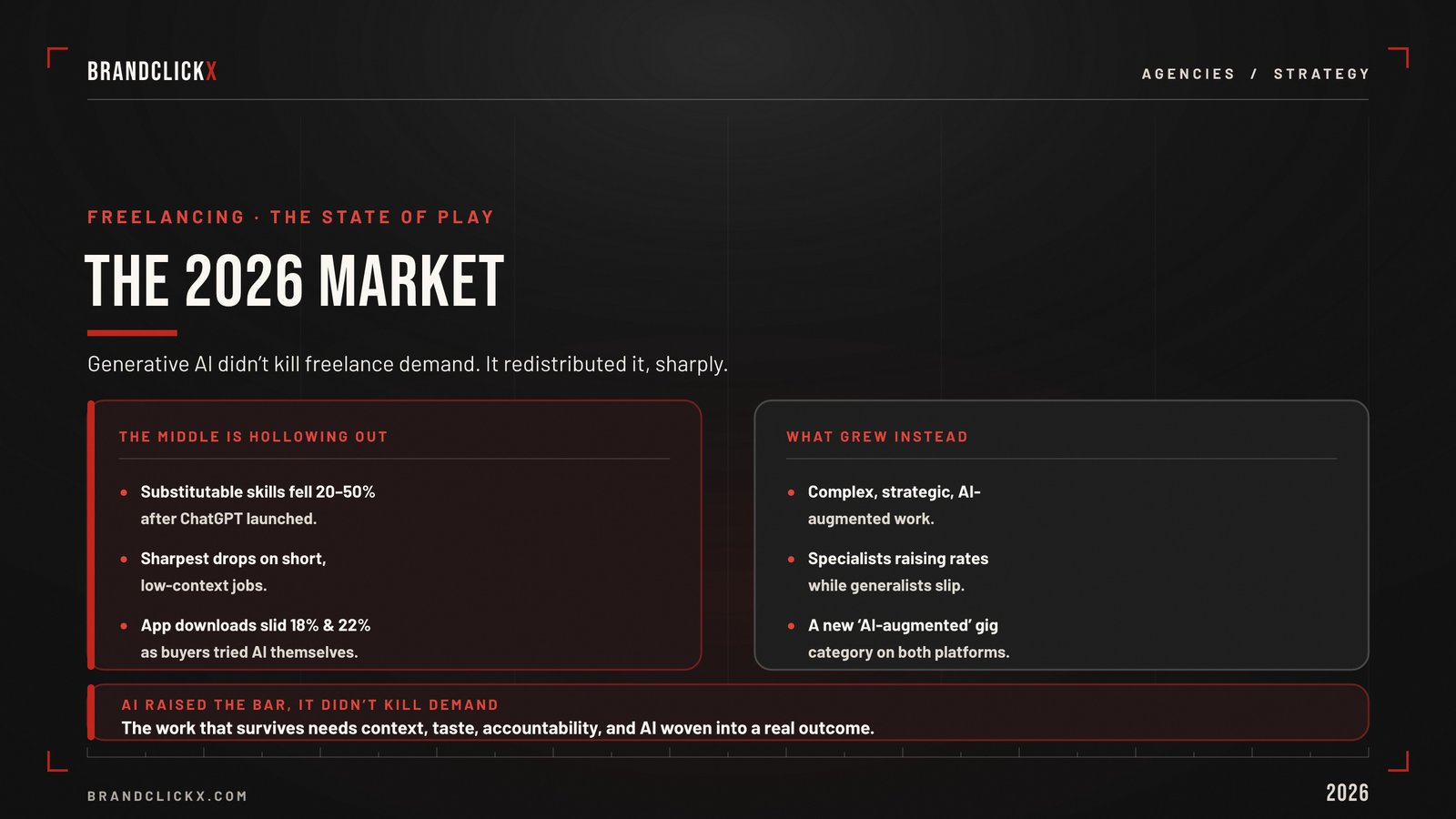
Generative AI has not killed freelance demand in aggregate. It has redistributed it, sharply. A peer-reviewed analysis of freelance job postings found that after ChatGPT launched, demand for “substitutable” skills basic writing, translation, routine copy dropped by 20% to 50% relative to where it would have been. The steepest declines hit short, low-context jobs.
Meanwhile, complementary and specialized work grew.
That split is the defining feature of the 2026 market. The middle is hollowing out. Commodity output is being absorbed by machines, while complex, strategic, and AI-augmented work commands a premium. Freelancers who built businesses on speed and volume are feeling the floor move. Freelancers who sell judgment are raising rates.
The platforms feel it too.
Both Fiverr and Upwork have seen app downloads slide as some clients route simple tasks directly to AI tools. One industry analysis noted Fiverr and Upwork app downloads falling 18% and 22% year over year at the start of the disruption, a trend that carried forward as buyers experimented with doing it themselves.
A new category of “AI-augmented” gigs emerged on both platforms sellers openly generating bulk deliverables and lightly editing them.
The Bigger Shift
Here is the part most coverage gets wrong.
The story is not “AI replaces freelancers.” The story is that AI raised the bar on what a freelancer has to be. The work that survives requires context, taste, accountability, and the ability to integrate AI into a real outcome a client cannot produce alone.
That reframing should sit underneath every platform decision you make.
Fiverr vs Upwork: How the Two Models Actually Differ
People compare Fiverr and Upwork as if they were the same product with different logos. They are not.
They are two fundamentally different business models, and the difference dictates how you should sell, price, and position on each one.
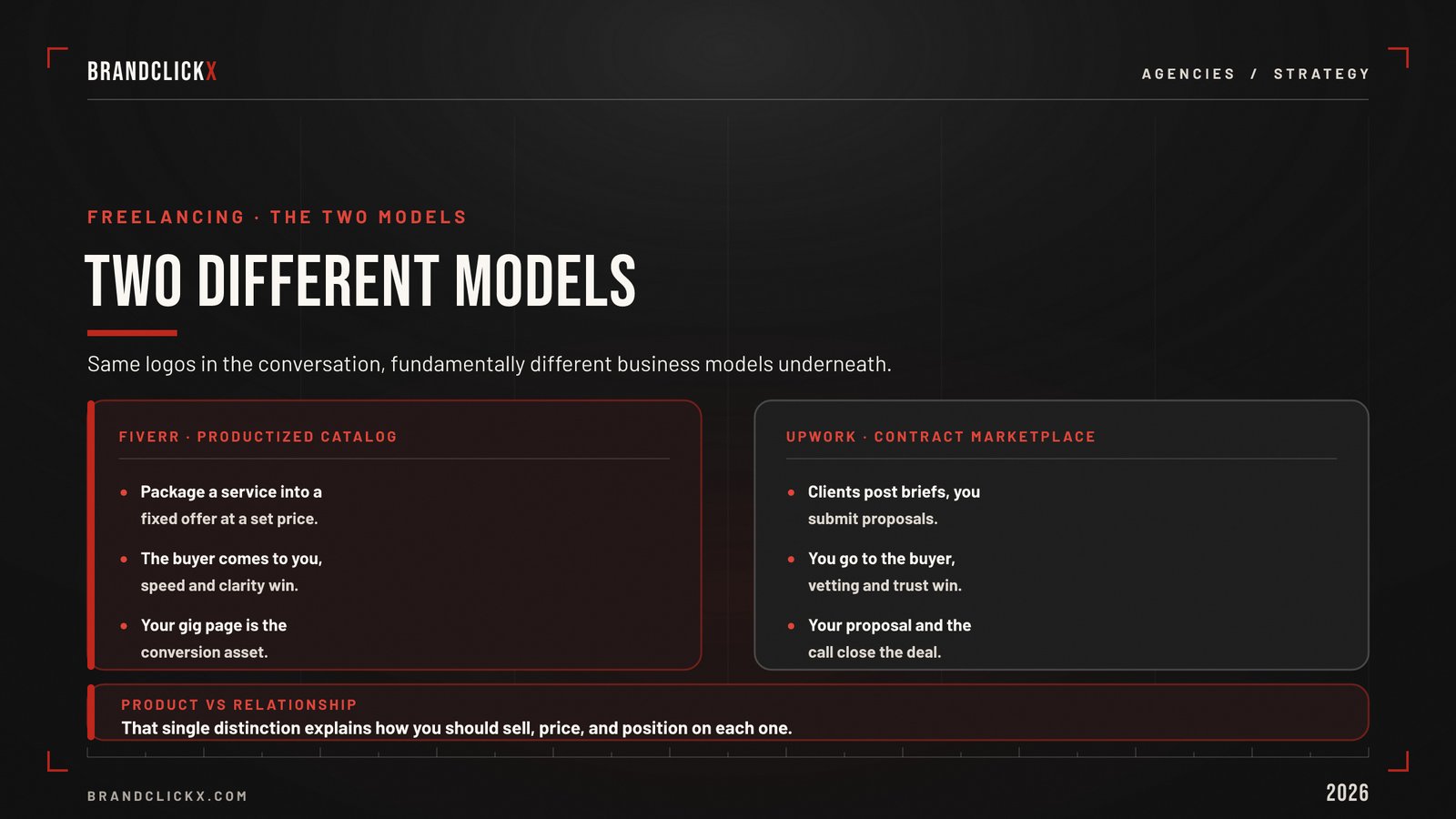
Fiverr is a productized catalog. You package a service into a fixed offer a logo, a 60-second edit, a landing page list it with a price, and buyers purchase it like a product off a shelf. The buyer comes to you. Speed and clarity win. It rewards sellers who can turn a skill into a repeatable, scoped package.
Upwork is a contract marketplace. Clients post briefs, freelancers submit proposals, and work happens through hourly or fixed-price contracts that often become ongoing relationships. You go to the buyer. Vetting, communication, and trust win. It rewards specialists who can scope a problem and hold a client relationship over months.
Strategic Breakdown
That single distinction product versus relationship explains almost everything downstream.
On Fiverr, your conversion asset is the gig page: the thumbnail, the packaging, the proof. On Upwork, your conversion asset is the proposal and the call. One is a storefront. The other is a pitch.
It also explains the scale numbers. Fiverr reported around 3.3 million annual active buyers as of late 2025, with spend per buyer rising to roughly $330 as the company pushed deliberately upmarket toward higher-value work. Fewer buyers, spending more each.
Upwork operates at a different shape, with more than 18 million registered freelancers and around 796,000 active clients skewed toward larger, longer engagements.
Fiverr has also widened far beyond its $5-gig origins, now spanning more than 600 service categories with “AI Services” as its newest addition. The platform that built its name on cheap, fast tasks is now chasing the exact high-value, AI-driven work that AI itself made scarce at the bottom.
Market observation: Both platforms are running the same play flee the commodity tier they helped create, and climb toward specialized, defensible work. That tells you precisely where to aim if you want to grow on either one.
The Real Cost of Each Platform
Fees are where freelancers lose money quietly, so let’s decode them properly.
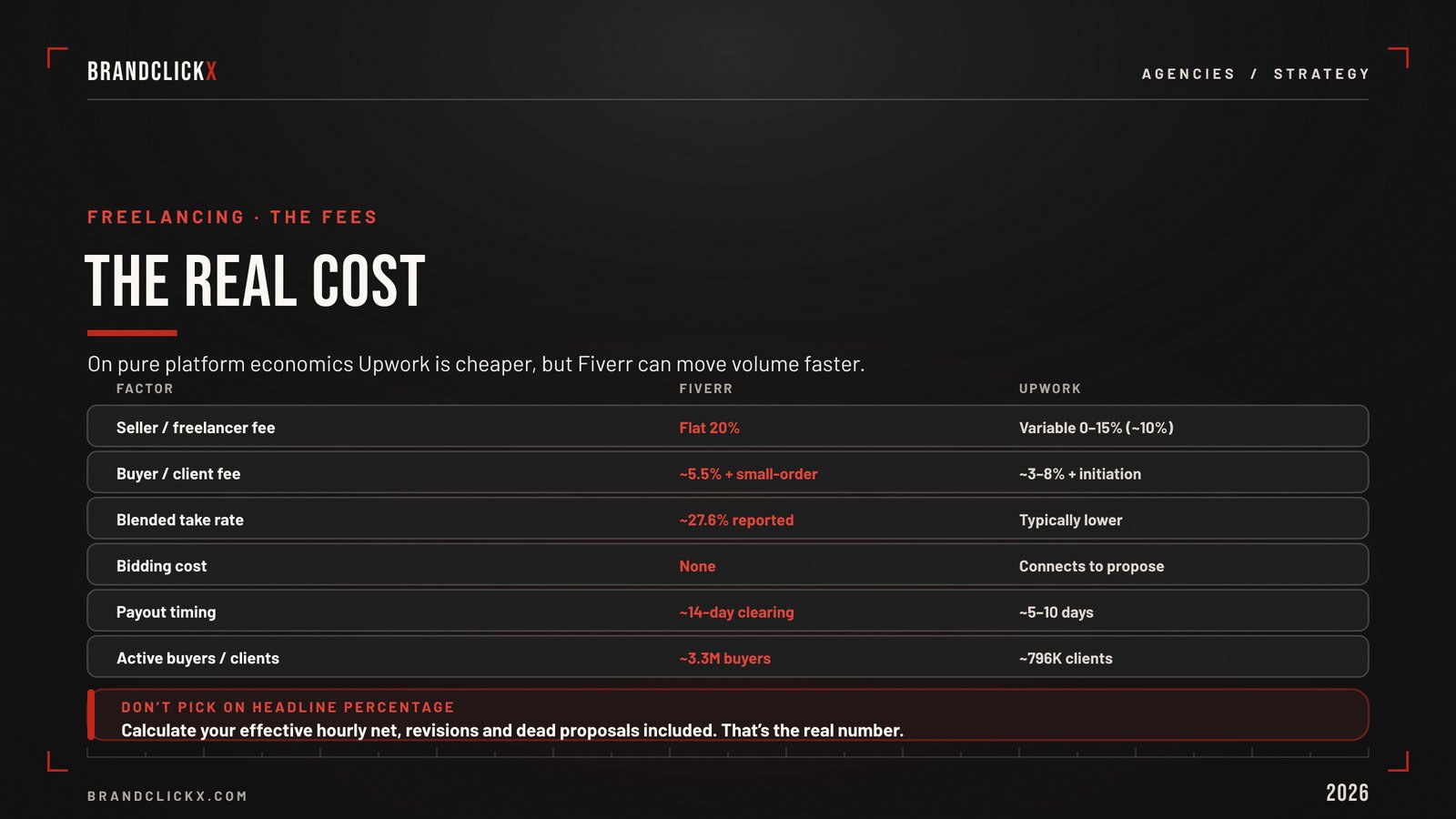
Fiverr takes a flat 20% commission from sellers on every order including tips and extras, with no volume discount and no loyalty tier. Buyers pay an additional service fee of roughly 5.5% plus a small-order fee on low-value purchases.
When you stack seller commission, buyer-side fees that suppress what clients will pay you, withdrawal costs, and currency conversion, the effective seller take rate runs from about 24% to over 35%. Fiverr also holds funds for a 14-day clearing period before payout.
Upwork changed its model meaningfully in May 2025.
It retired the old flat 10% freelancer fee and before that, a tiered 20% / 10% / 5% structure that rewarded long client relationships and replaced it with a variable 0% to 15% service fee set per contract and locked when the proposal is sent.
Most freelancers land near 10%, but the exact rate is opaque, shifting with supply, demand, and category.
Clients pay a marketplace fee of roughly 3% to 8% depending on payment method, plus contract initiation fees. Freelancers also burn Connects to bid, which adds a real monthly cost for high-volume proposers.
Now the apples-to-apples number that actually settles the fee debate.
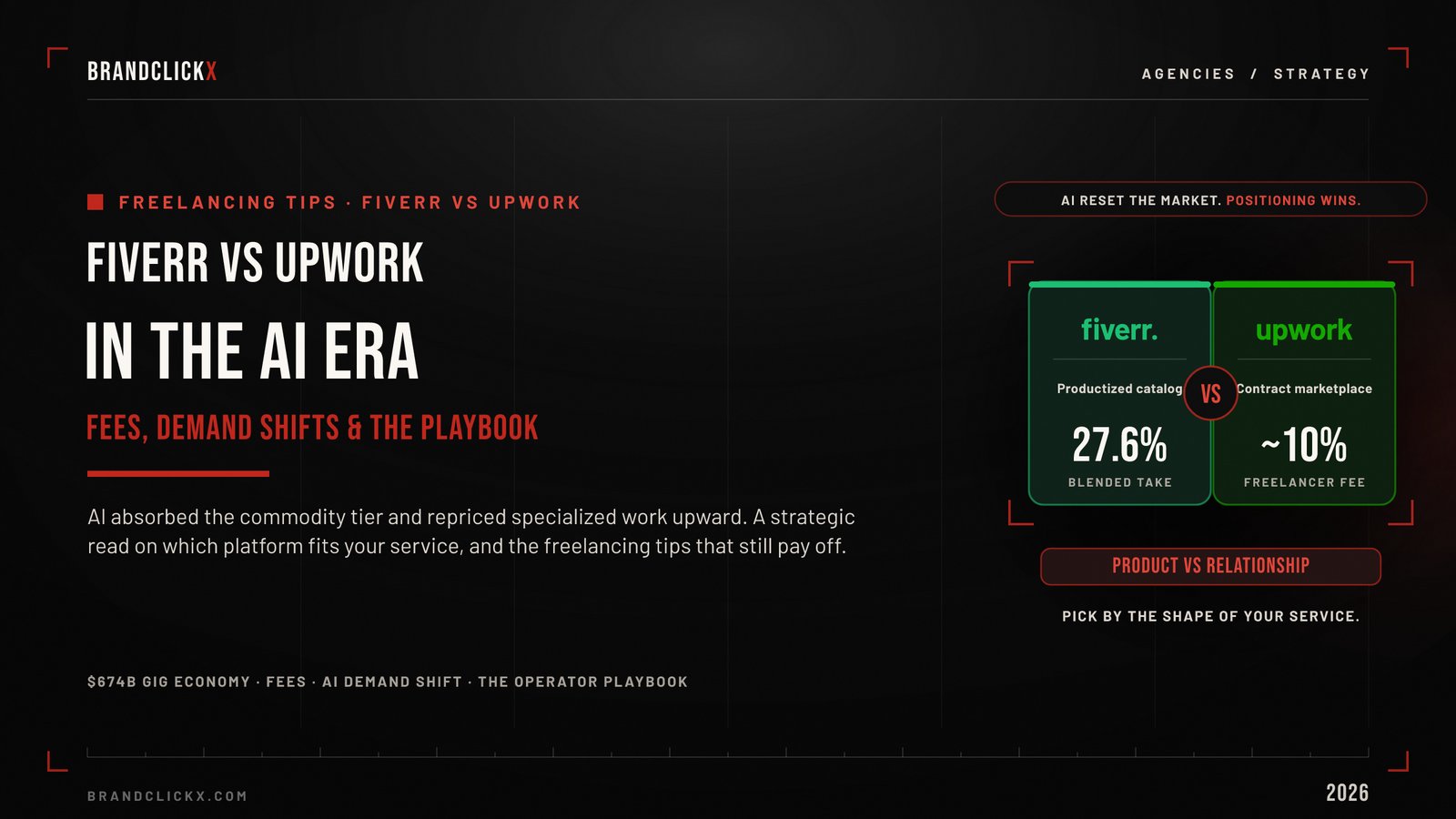
Fiverr’s own financial reporting puts its blended marketplace take rate near 27.6%. Upwork’s combined freelancer-plus-client deductions land materially lower in most scenarios. On pure platform economics, Upwork is the cheaper venue for the freelancer, but cost is only one variable, because Fiverr’s productized model can move volume faster.
Fee & Platform Comparison
| Factor | Fiverr | Upwork |
| Core model | Productized gigs (fixed-price catalog) | Contract marketplace (bids, hourly/fixed) |
| Seller / freelancer fee | Flat 20% on all earnings | Variable 0%–15% per contract (most pay ~10%) |
| Buyer / client fee | ~5.5% service fee + small-order fee | ~3%–8% marketplace fee + initiation fee |
| Blended take rate | ~27.6% (reported) | Typically lower than Fiverr |
| Bidding cost | None (buyers come to you) | Connects required to send proposals |
| Payout timing | ~14-day clearing | Hourly ~10 days; fixed-price ~5 days post-approval |
| Active buyers/clients | ~3.3M annual active buyers | ~796K active clients |
| Best fit | Packaged, fast-turn deliverables | Specialized, ongoing engagements |
Tactical framework the fee math that matters: Do not pick a platform on headline percentage alone. Calculate your real net per hour of effort, including unpaid time. On Fiverr, that means time spent on revisions and small orders eaten by the 20% cut.
On Upwork, that means Connects spent on proposals that never convert. The platform that wins is the one where your effective hourly net is highest for the work you actually do.
Where the Demand Is Moving
This is the section that should change how you spend the next twelve months.
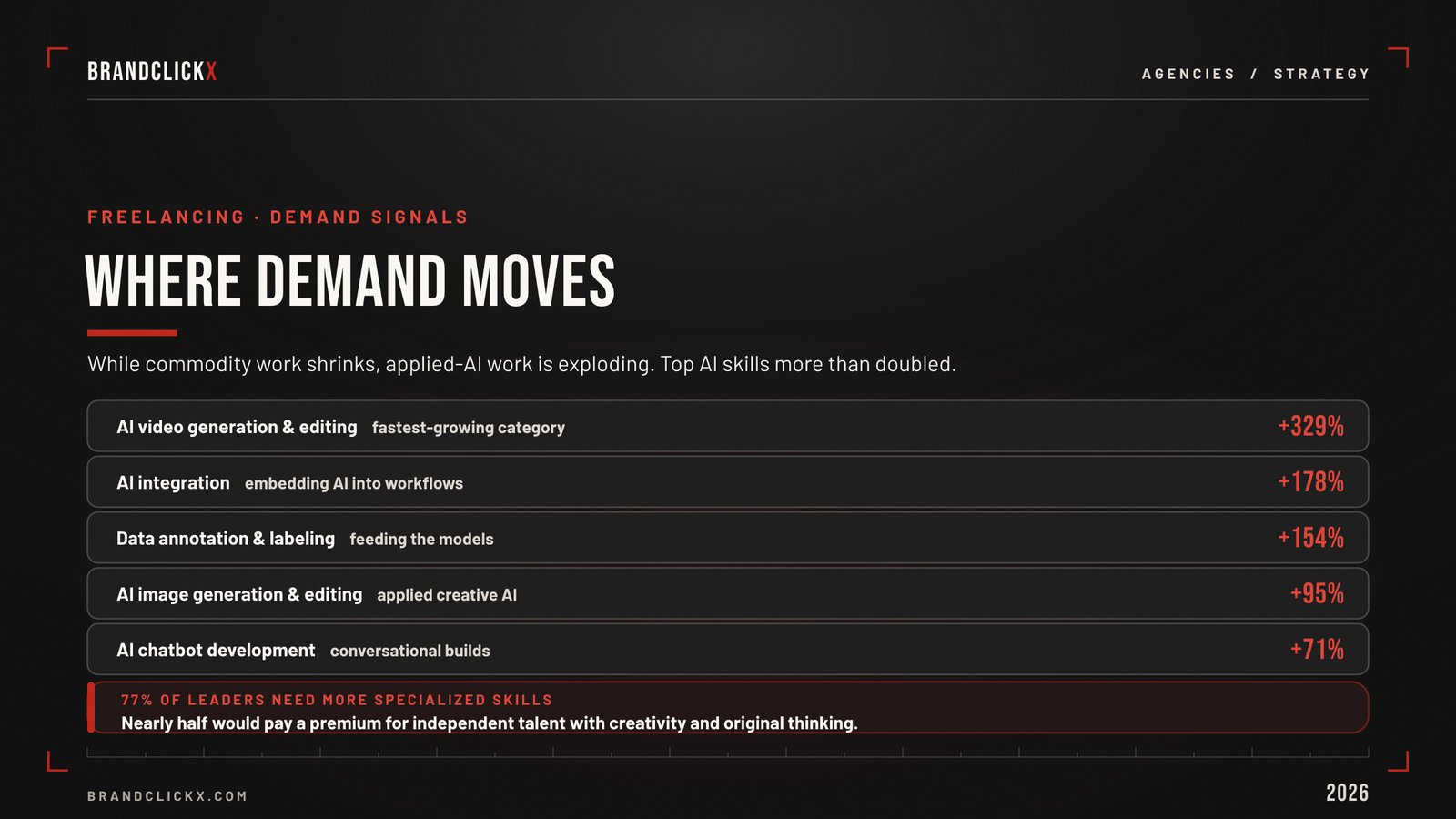
While commodity work shrinks, applied AI work is exploding. According to Upwork’s 2026 in-demand skills data, demand for top AI skills more than doubled year over year, with several categories posting standout growth:
- AI video generation and editing: +329%
- AI integration: +178%
- Data annotation and labeling: +154%
- AI image generation and editing: +95%
- AI chatbot development: +71%
The pattern is unmistakable. Businesses are embedding AI into existing disciplines and paying specialists to do it well.
Upwork’s research also found that 77% of business leaders say AI is increasing their need for specialized skills, and nearly half would pay a premium for independent talent who bring creativity and original thinking. Human capability is not being discounted. It is being repriced upward for the people who have it.
Rising vs. Declining: A 2026 Snapshot
| Direction | Skill categories | What it signals |
| Rising fast | AI video, AI integration, data annotation, AI image, chatbot dev | Applied AI woven into real business workflows |
| Premium / resilient | Strategy, creative direction, consulting, coaching, complex problem-solving | Judgment and accountability AI can’t supply |
| Declining | Data entry, basic graphic design, generic copywriting, simple translation | Easily automated, low-context, commodity output |
Expert insight: In agency hiring, the brief has flipped. A year ago, “fast and cheap” topped the spec sheet. Now the highest-value freelance roles are the ones that pair AI fluency with domain depth someone who can run AI tools and defend why the output is right for a specific brand. We see this directly when sourcing talent: rate is no longer the first filter. Proof of judgment is.
The freelancers losing ground are not losing to AI. They are losing to other freelancers who learned to use it.
How to Choose Your Platform
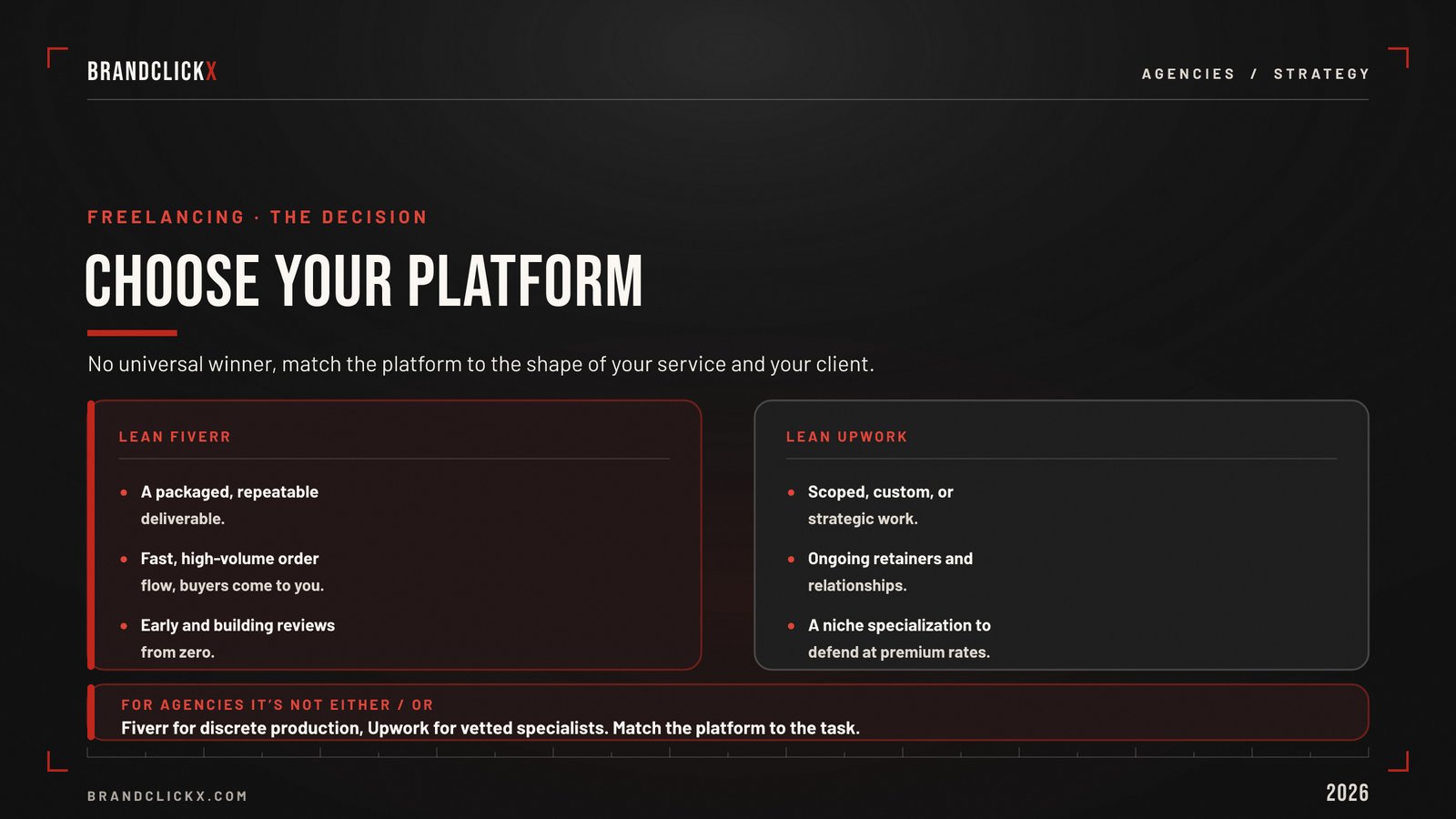
There is no universal winner, so use a decision framework instead of a verdict.
Match the platform to the shape of your service and the type of client you want.
| If you… | Lean Fiverr | Lean Upwork |
| Sell a packaged, repeatable deliverable | ✅ | |
| Need fast, high-volume order flow | ✅ | |
| Want clients to come to you | ✅ | |
| Sell scoped, custom, or strategic work | ✅ | |
| Want ongoing retainers and relationships | ✅ | |
| Charge premium hourly or project rates | ✅ | |
| Are early and building reviews from zero | ✅ | |
| Have a niche specialization to defend | ✅ |
Enterprise perspective: For agencies and in-house marketing teams, this is not either/or. The smart operating model uses Fiverr for discrete production a batch of edits, a quick design, a defined task and Upwork for vetted specialists on ongoing work.
Both function as flexible capacity that flexes with project load, not as a replacement for core staff. With most business leaders now treating freelance talent as a strategic source of specialized skills, the question shifts from “which platform” to “which platform for this task.”
Freelancing Tips That Actually Work in 2026
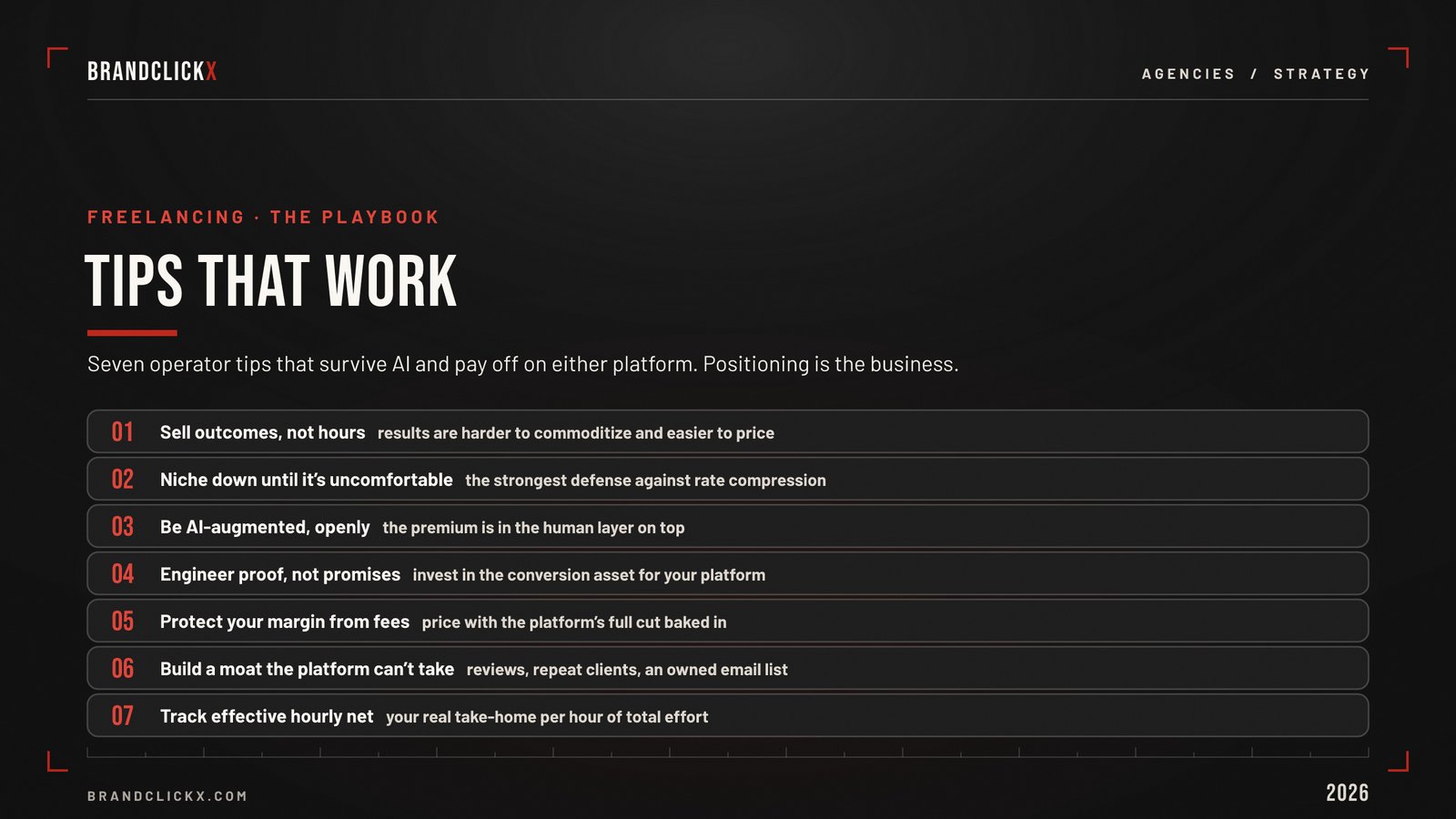
Here is the operator playbook the freelancing tips that survive AI and pay off on either platform.
- Sell outcomes, not hours. The freelancers under the most pressure are the ones selling time and output that AI can replicate. Reposition around results: not “I’ll write 10 articles,” but “I’ll build the content engine that grows your organic traffic.” Outcomes are harder to commoditize and easier to price.
- Niche down until it’s uncomfortable. “Graphic designer” competes with everyone, including AI. “Packaging design for premium skincare brands” competes with almost no one. A sharp niche raises your rate, sharpens your portfolio, and makes you the obvious hire. Specialization is the single strongest defense against rate compression.
- Become AI-augmented, openly. Use AI to expand capacity and speed, then add the judgment AI lacks. Clients increasingly know AI exists they are paying you for the curation, the taste, and the accountability on top of it. The premium is in the human layer, so make that layer your pitch.
- Engineer proof, not promises. On Fiverr, your gig thumbnail and reviews close the sale. On Upwork, a tailored proposal that proves you understood the problem beats ten generic pitches. Invest disproportionately in the conversion asset for your platform that is where the money is won or lost.
- Protect your margin from fees. Price with the platform’s full cut baked in, not as an afterthought. Where contracts allow, build toward long-term client relationships that can move off marketplace overhead legitimately over time. The 20% to 30% you give up on every order is the difference between a job and a business.
- Build a moat the platform can’t take. Reviews, repeat clients, a personal brand, an email list of past buyers these are assets you own. Platforms change fees and algorithms whenever they like. The freelancers who last treat the marketplace as a customer-acquisition channel, not their entire identity.
- Track your effective hourly net obsessively. Not your rate. Your real take-home per hour of total effort, including bidding, revisions, and admin. Most freelancers have no idea what their true number is. The ones who measure it make far better decisions about which gigs, clients, and platforms to keep.
Industry impact: These are not lifestyle tips. They are the same principles that separate durable agencies from disposable ones positioning, specialization, owned demand, and margin discipline. The freelancers internalizing them now are building businesses that will outlast the current AI shakeout. The rest are competing on a price floor that keeps dropping.
What Happens Next
The next phase is already visible in the data.
Both platforms are racing upmarket, away from the commodity work AI absorbed and toward specialized, higher-value services. Fiverr’s deliberate push toward bigger-spending buyers and Upwork’s pivot to AI-skill demand are two versions of the same bet: the future of these marketplaces is premium, specialized, and AI-adjacent.
Expect three things to accelerate.
Consolidation around specialists. As commodity gigs get automated or undercut, marketplace earnings will concentrate among freelancers with defensible niches and AI fluency. The long tail of generalists will thin.
Fee pressure and transparency fights. Opaque variable pricing and high blended take rates will keep drawing scrutiny. Freelancers will get savvier about true cost, and platforms will face pressure to justify their cut as direct-to-AI alternatives improve.
The rise of the hybrid operator. The most valuable independent professional in 2026 is part strategist, part operator, part AI orchestrator someone who turns AI capability into outcomes a client cannot reach alone. That profile commands premiums on both platforms and is nearly impossible to commoditize.
Future Outlook
The freelancers who win the next three years will not be the cheapest or the fastest. They will be the most clearly positioned, the most specialized, and the most fluent at turning AI into results. Platform choice matters but positioning matters more.
Key Takeaways
- The freelance market is being redistributed, not destroyed. Commodity work is shrinking by 20%–50% in AI-exposed categories, while specialized and AI-augmented work commands a premium. Aim up.
- Fiverr and Upwork are different business models. Fiverr is a productized catalog where buyers come to you; Upwork is a contract marketplace where you pitch and build relationships. Pick by the shape of your service.
- On pure fees, Upwork is cheaper; on volume, Fiverr can move faster. Fiverr’s blended take rate sits near 27.6% with a flat 20% seller cut. Upwork’s variable 0%–15% freelancer fee usually lands lower. Calculate effective hourly net, not headline rate.
- Demand is exploding in applied AI. AI video, AI integration, data annotation, AI image work, and chatbot development are the fastest-growing categories. Skills with AI fluency plus domain depth win.
- Specialization is the strongest defense against AI. Niche down, sell outcomes, and make your human judgment the pitch. Generalists competing on price face the steepest erosion.
- Own your demand. Reviews, repeat clients, and a personal brand are assets you control. Treat marketplaces as acquisition channels, not your whole business.
Frequently Asked Questions
Is Fiverr or Upwork better for freelancers in 2026?
Neither is universally better. Fiverr works best for fixed-price, productized services, while Upwork is better for custom projects, retainers, and long-term client relationships. The right choice depends on your service model and goals.
What are the fees on Fiverr vs Upwork?
Fiverr charges freelancers a flat 20% commission on every order. Upwork uses a variable freelancer fee of 0%–15% per contract, with most freelancers paying around 10%, making it cheaper in many cases.
How is AI affecting freelancing on Fiverr and Upwork?
AI is reducing demand for simple, repetitive tasks while increasing demand for specialized and AI-related services. Freelancers who combine expertise with AI tools are seeing the strongest growth.
Which freelance skills are most in demand in 2026?
AI video editing, AI integration, chatbot development, AI image generation, and data annotation are among the fastest-growing skills. Strategic consulting and creative problem-solving also remain highly valuable.
Can you make a full-time income on Fiverr or Upwork?
Yes. Success depends more on specialization, positioning, and delivering results than on the platform itself. Freelancers with niche expertise and strong client relationships can build a sustainable full-time income.
Should agencies hire freelancers on Fiverr or Upwork?
Both platforms can be valuable. Fiverr is ideal for quick, well-defined tasks, while Upwork is better for ongoing projects and specialized talent that requires deeper collaboration.
The Bottom Line
The Fiverr vs Upwork debate has outgrown its old answer.
Cheaper fees and bigger marketplaces no longer decide who wins, because the ground under both platforms shifted. AI absorbed the commodity tier, repriced specialized work upward, and forced every freelancer to choose between competing on price they can’t defend or competing on judgment that AI can’t replicate.
The platforms have already made their choice, both are climbing toward premium, specialized, AI-adjacent work. The freelancers who read that signal early are climbing with them.
So the real freelancing tip for 2026 is not “use Fiverr” or “use Upwork.”
It’s this: pick the platform that fits the shape of your service, price for the full cost of doing business there, specialize until you’re the obvious hire, and make AI your multiplier instead of your replacement. The marketplace is a channel. Your positioning is the business.
The independent economy is not slowing down it’s getting more demanding, more specialized, and more valuable for the people who adapt. That’s the shift worth watching, and the one worth building for.
BrandClickX tracks the platforms, the demand signals, and the AI shifts reshaping how modern work gets done because our coverage comes from people who have run campaigns, not just written about them.