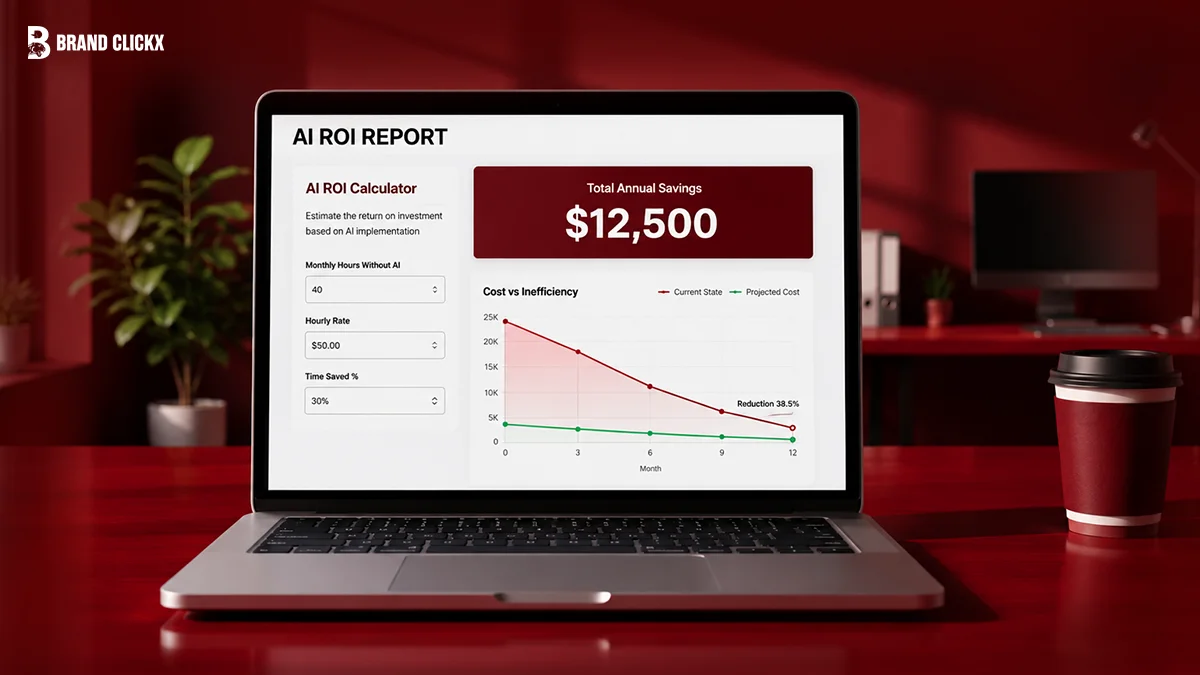
A lot of companies are using AI now. The harder question is not whether AI is useful. It is whether the money spent on it is actually coming back to the business.
That is where an AI ROI report becomes useful. It helps you look past simple numbers like how many employees use ChatGPT or how much faster someone writes a report. You need to know what the AI costs, what changed after using it, and whether that change created real business value.
The 2026 numbers show why this matters. McKinsey found that nearly nine in ten organizations use AI in at least one business function, while only 37% of respondents said AI had made some positive contribution to enterprise EBIT. Only 6% met McKinsey’s definition of an AI high performer.
So, in this report, I will explain what AI ROI really means, how companies measure it, where the returns are showing up, why many projects struggle, and what you should check before believing a big ROI number.
AI ROI Report: The Short Answer
An AI ROI report measures whether an AI project creates more financial value than the full cost of buying, building, running, and managing it.
A proper calculation looks at things such as software and API costs, cloud infrastructure, integration, employee time, training, governance, human review, and the actual business benefit.
The important part is separating productivity from financial return. An employee finishing a task faster does not automatically mean the company saved money or increased profit.
In 2026, the evidence shows that AI adoption is much broader than proven enterprise-level financial impact.
Key Takeaways
- Nearly nine in ten organizations surveyed by McKinsey regularly use AI in at least one business function.
- 80% of McKinsey respondents said AI improved their individual productivity.
- Only 37% reported at least some positive AI contribution to enterprise EBIT.
- Just 6% qualified as AI high performers under McKinsey’s definition.
- About one in five respondents said AI operating costs were limiting their use of the technology.
- 32% said agentic coding tools had helped their organization avoid buying at least one software product or feature.
- A useful ROI calculation must include hidden costs such as integration, human review, governance, and AI usage.
Featured Snippet: What Is an AI ROI Report?
An AI ROI report measures the financial return created by an artificial intelligence investment compared with its total cost. It normally looks at expenses such as software, API usage, infrastructure, integration, training, and human review, then compares them with measurable savings, additional revenue, avoided costs, or increased business capacity.
What Is an AI ROI Report?

An AI ROI report is not a single software product or an official report with one standard format. It is a way of measuring whether an AI investment is producing enough value to justify its cost.
You may also see similar work called an AI business-value assessment, AI value realization report, AI impact measurement framework, or AI financial-impact dashboard.
The name is less important than what is inside the report.
A useful report should tell you three things: what you spent, what changed, and how much of that change can reasonably be connected to AI.
The basic ROI calculation
The basic idea is simple:
ROI = (Financial benefit − Total cost) ÷ Total cost × 100
The difficult part is not the formula. The difficult part is deciding what counts as a financial benefit and making sure you have counted the complete cost.
For example, saving 100 employee hours sounds impressive. But if those hours are not converted into additional output, lower staffing costs, avoided hiring, or another measurable benefit, you cannot automatically call them financial savings.
How AI ROI Measurement Has Changed
AI ROI was easier to think about when companies were using machine learning for focused problems such as fraud detection, forecasting, or maintenance.
The generative AI boom changed the conversation. Companies started measuring things like writing speed, coding time, customer-support handling time, and employee adoption.
Now the focus is moving again toward AI agents and complete workflows.
The question is no longer only, “Did AI help someone finish this task faster?”
It is becoming, “Did the whole business process become cheaper, faster, better, or more profitable?”
That difference is a big part of the current AI ROI discussion.
AI ROI Report 2026: What the Latest Numbers Show
The current evidence gives a mixed picture.
McKinsey’s 2026 State of AI survey covered 1,719 respondents across 97 countries. Nearly nine in ten said their organizations regularly used AI in at least one business function, and 44% said AI was scaling across the enterprise.
But broad adoption does not mean broad financial success.
McKinsey found that 37% of respondents said AI had made at least some positive contribution to enterprise EBIT. That figure was effectively unchanged from the previous year. Only 6% qualified as AI high performers, based on McKinsey’s definition of significant AI impact representing at least 5% of EBIT.
There is another number I find especially interesting.
80% of respondents said AI improved their individual productivity, while 50% said it helped them make better decisions.
This tells you why measuring AI ROI can be confusing. People can genuinely feel more productive while the company’s financial results remain difficult to prove.
AI spending is also becoming part of the problem
About 20% of McKinsey respondents said AI-related operating costs were constraining their use of AI. Around 28% said their organizations spent more than 10% of their total enterprise ICT budget on AI technologies.
So, if someone gives you an AI ROI number without showing the operating costs, I would be careful with that number.
How Do You Measure AI ROI?

If you want your own AI ROI report to mean something, start with one specific workflow.
Do not begin with “our company uses AI.” That is too broad to measure.
Instead, choose something such as customer-support triage, software testing, contract review, internal search, content production, or purchase-order processing.
1. Record the baseline first
Before introducing AI, record what the process looks like.
You might measure average handling time, cost per transaction, error rate, backlog, conversion rate, customer satisfaction, or employee hours.
Without a baseline, you have no strong way to show what actually changed.
2. Decide what success means
Your AI project needs a business outcome.
For example, a customer-support system may aim to reduce handling time without lowering customer satisfaction.
A coding tool may aim to reduce development time or help the company avoid purchasing another software feature.
The target should be measurable before you start.
3. Count the complete cost
This is where many simple ROI calculations go wrong.
Your cost calculation may need to include:
- AI software or model licenses
- API and token usage
- Cloud infrastructure
- Data preparation
- Integration work
- Security and compliance
- Monitoring and evaluation
- Employee training
- Change management
- Human review
- Ongoing maintenance
McKinsey’s finding that AI operating costs are already constraining some organizations makes this especially relevant in 2026.
4. Compare the new result with the old one
Now compare the AI-enabled workflow with your original baseline.
Where possible, a comparable non-AI group or period makes the comparison stronger.
You should measure quality at the same time as speed.
If AI finishes work faster but creates more corrections, complaints, security problems, or review work, the apparent productivity gain may not be a real business gain.
5. Convert the improvement into money
This is one of the most important steps.
A saved hour is not automatically a saved dollar.
The financial benefit should come from something the business can actually realize, such as lower spending, avoided hiring, higher capacity without additional staff, additional revenue, improved conversion, or reduced operating costs.
6. Show your assumptions
A good AI ROI report should not hide uncertainty.
Show your measurement period, sample size, adoption level, cost assumptions, quality results, exceptions, and risks.
A slightly lower ROI number with clear evidence is more useful than a huge number nobody can explain.
Which AI ROI Metrics Should You Track?
Different AI projects need different measurements.
| AI project | Useful metrics | Main problem |
| Productivity | Cycle time, output, task completion | Time saved may not become cash savings |
| Cost reduction | Cost per case, labor hours, avoided vendor spend | Costs can move into review or governance |
| Revenue growth | Conversion, revenue, retention, upsells | Revenue has many causes |
| Quality | Error rate, rework, escalations, satisfaction | Some improvements are difficult to monetize |
| AI agents | Completion rate, exceptions, human overrides, unit cost | More autonomy can also increase risk |
| AI portfolio | Net benefit, payback, adoption, risk | Successful projects can hide weak ones |
This is also where artificial intelligence, machine learning, and generative AI should not always be measured in the same way.
A machine learning fraud system may have a very clear financial outcome. A generative AI assistant may first show value through faster work, with the financial benefit appearing later.
Where Is AI Actually Showing Business Value?
The evidence does not point to one universal winning AI use case.
McKinsey found that respondents most often connected AI-related cost reductions with supply-chain management, service operations, and manufacturing.
Revenue gains were more commonly associated with marketing and sales, product and service development, and software engineering.
That is useful because it gives you a starting point.
But you should not take those categories as a guarantee. Your own data still has to prove the result.
Software development is one interesting example
McKinsey found that 32% of respondents said their organizations had decided not to buy at least one software product or feature because agentic coding tools allowed them to build the functionality internally.
That can be a real financial benefit.
Still, you should include development, maintenance, security, reliability, and staffing costs before calling the avoided purchase a net ROI.
Why Are AI Projects Struggling to Show ROI?
The biggest issue is often not the AI model itself.
A company may have good AI technology but poor data, difficult legacy systems, unclear ownership, or a workflow that was never redesigned around the technology.
McKinsey’s higher-performing organizations were more likely to redesign workflows around AI, have senior leadership involvement, use formal impact measurement, and manage AI-related risks. The survey shows an association, not proof that one practice directly causes higher ROI.
There is also a simple problem that gets overlooked: people can become faster without the organization becoming more profitable.
If an employee saves an hour but spends that hour reviewing AI output, correcting mistakes, or doing additional administrative work, the original productivity number can look much better than the final result.
That is why I would always look at the complete workflow instead of one impressive metric.
Three Things Most AI ROI Reports Miss
1. Time saved is not the same as money saved
This sounds obvious, but it is easy to miss.
If AI saves an employee two hours, ask what happened to those two hours. Did the company reduce overtime, increase output, avoid hiring, or improve another measurable result? If not, you may have a productivity improvement rather than a direct financial saving.
2. AI costs do not stop at the subscription
A monthly AI license is only one part of the calculation.
Integration, data work, cloud usage, security, training, monitoring, human review, and ongoing maintenance can all affect the final return. This is one reason operating-cost tracking needs to sit beside the headline ROI figure.
3. Vendor case studies need careful reading
Google Cloud’s July 2026 AI ROI research included examples from organizations such as Best Buy, PayPal, Tata Steel, Highmark Health, Elanco, Amdocs, and Thomson Reuters.
For example, Google Cloud reported that Highmark Health said its internal assistant delivered $27.9 million in value during 2025. It also reported that Elanco estimated $1.9 million in ROI from its AI work.
Those examples are useful because they show real deployments.
But “reported value” is not automatically the same as audited profit. Before using such a number in a board presentation, check how the company calculated it, what costs were included, and whether an independent party verified the result.
What Does the Current AI ROI Evidence Really Tell You?
There is no reliable single number for the average AI ROI across all companies.
That is because different reports use different definitions, populations, time periods, costs, and methods.
Google Cloud’s July 2026 survey, for example, reported that 84% of surveyed executives said they were seeing increasing financial returns from AI. But it was a vendor-sponsored survey, so it should be read differently from independent financial reporting.
Domino Data Lab reported in July 2026 that 57% of surveyed enterprises said AI ROI still did not outpace spending, while 93% reported improved production capability. Again, this is useful evidence, but it comes from a company-commissioned study and should be read with its methodology in mind.
The important lesson is not that one report is right and another is wrong. It is that you need to understand what each number actually measures.
Practical AI ROI Report: How to Build One Yourself
If you are responsible for an AI project, you can make the process much simpler.
Step 1: Pick one business process
Choose one workflow with a measurable cost or outcome. Avoid measuring “AI adoption” as the main success metric.
Step 2: Capture the old numbers
Record the current cost, time, quality, volume, and revenue-related measures that matter. Keep the measurement period clear.
Step 3: Set a financial target
Decide what would count as a successful result. That might be lower cost per case, more output from the same team, avoided software spending, better conversion, or another measurable financial outcome.
Step 4: Track every AI expense
Include model usage, licenses, infrastructure, integration, training, governance, monitoring, and human review. Do not leave these costs outside the calculation just because they are difficult to measure.
Step 5: Measure quality alongside productivity
Track errors, rework, customer complaints, exceptions, and human overrides. An AI system that is faster but less reliable may not produce a better return.
Step 6: Compare against a baseline
Use your pre-AI numbers and, when possible, a comparable non-AI group. This gives you a stronger way to separate AI’s effect from other changes in the business.
Step 7: Decide whether to scale
Do not scale simply because employees like the tool.
Scale when the evidence shows that the workflow creates enough value after costs, risks, and quality issues are included.
Who Should Use an AI ROI Report?
An AI ROI report is most useful for companies that already have an AI project and need to decide whether to continue, expand, redesign, or stop it.
It is also useful for finance teams, technology leaders, operations teams, and executives who need to connect AI spending with measurable business results.
You can use the same approach for generative AI, machine learning, AI agents, copilots, and workflow automation.
Who Should Avoid Simple AI ROI Calculations?
You should avoid relying on a simple ROI percentage when the project is still too new to produce meaningful data.
You should also be careful when the supposed benefit is based only on employee opinions, usage numbers, or hours saved.
Those numbers can be useful early signals, but they should not be presented as proven financial returns.
What Is Likely to Change Next?
The next stage of AI ROI measurement will probably focus less on individual tasks and more on complete workflows.
Companies will have more reason to track unit cost, completion quality, exceptions, human intervention, operating costs, and actual business outcomes together.
AI agents will also become a bigger part of this discussion. McKinsey reported that 40% of respondents at organizations with more than $1 billion in annual revenue were scaling AI agents, compared with 27% the year before.
That does not prove agents will produce better ROI.
It does show that companies are moving toward systems that can perform multiple steps, which makes measuring the entire workflow even more important.
Common Mistakes to Avoid
The first mistake is using adoption as proof of ROI. The second is counting every hour saved as cash savings.
The third is ignoring token, infrastructure, integration, and human-review costs. Another common problem is using a vendor case study as if it were an independent financial audit.
Finally, do not hide negative results. A good ROI report should be able to say that a project did not work. That information can save a company much more money than a polished success story.
AI ROI Report FAQ
What is AI ROI?
AI ROI is the measurable return a company receives from an AI investment after accounting for the full cost of building, buying, running, and managing it. It can include savings, additional revenue, avoided spending, or increased capacity. Faster work alone does not automatically mean positive financial ROI.
How do you calculate ROI for AI?
Use the standard formula: net financial benefit divided by total cost, multiplied by 100. Before calculating it, establish a baseline, measure the AI-enabled workflow, include all relevant costs, and explain how the measured benefit was converted into money.
Is AI delivering ROI in 2026?
Yes, some organizations are reporting measurable business value, but enterprise-wide results remain uneven. McKinsey found that 37% of respondents reported at least some positive AI contribution to enterprise EBIT, while only 6% met its high-performer definition.
Why can employees save time while the company sees no ROI?
Employee productivity and company profit are different measurements. Time saved may be absorbed by review work, additional tasks, low adoption, new AI costs, or other parts of the workflow. McKinsey’s 80% individual-productivity figure compared with 37% enterprise EBIT impact shows this gap clearly.
What costs should an AI ROI report include?
You should include AI licenses, API or token usage, cloud infrastructure, data preparation, integration, security, compliance, monitoring, training, human review, and ongoing support. Leaving these costs out can make an AI project appear more profitable than it really is.
Which business functions show AI value first?
McKinsey respondents most often connected AI-related cost reductions with supply chain management, service operations, and manufacturing. They more commonly associated revenue gains with marketing and sales, product and service development, and software engineering. These are reported patterns, not guaranteed results.
What is the difference between AI productivity and AI ROI?
AI productivity measures whether people can complete work faster or produce more. AI ROI goes further by asking whether the resulting value exceeds the complete cost of the AI initiative. A productivity gain becomes financial ROI only when the business can actually realize and measure that value.
How long does AI take to show ROI?
There is no single reliable timeline that applies to every AI project. The time depends on the workflow, data, integration work, adoption, accuracy requirements, process changes, and how quickly the benefit can be converted into a financial result.
Can AI ROI be measured for marketing content?
Yes, but article or content volume alone is not enough. You can compare production time, editorial rework, qualified traffic, conversions, cost per qualified lead, and other business metrics before and after introducing AI. Revenue should only be attributed to AI when the measurement method supports that conclusion.
Are AI agents more valuable than chatbots?
Not automatically. AI agents can handle multi-step workflows, but they can also require more integration, controls, and computing resources. Their value depends on the specific process and whether the additional autonomy creates more measurable benefit than cost and risk.
How can a company avoid inflated AI ROI claims?
Start with a pre-AI baseline and document every important cost and assumption. Measure quality as well as productivity, use a comparison group or period where possible, and clearly separate estimated value, avoided cost, revenue influenced, and actual financial savings.
Conclusion
When you first look at AI ROI, it is easy to focus on the impressive numbers. Faster coding, more content, fewer support tickets, and higher employee productivity all sound like obvious wins.
But the real question is what happens after those improvements reach the business.
The latest evidence shows a clear gap. AI use is widespread, and 80% of McKinsey respondents reported better individual productivity, yet only 37% reported some positive enterprise EBIT impact. Only 6% met the firm’s high-performer definition.
That is why a good AI ROI report should not try to make AI look better than it is. It should show the baseline, the full cost, the actual improvement, the risks, and the financial result.
The best number is not always the biggest number. It is the number you can explain, defend, and still believe after all the costs have been counted.