
I started looking into the AI job displacement question because I kept seeing two very different stories.
One side says AI is going to replace software developers, analysts, and other tech workers. The other side points to job-growth numbers and says there is no real displacement happening.
After looking at the actual data, I think the truth is somewhere in the middle.
AI is clearly changing software work. But saying that AI has already replaced software jobs on a large scale is a much bigger claim, and the evidence isn’t strong enough for that yet.
That is where the AI Job Displacement Index becomes interesting.
AI Overview
The AI Job Displacement Index, better known as DisplaceIndex, is a U.S.-focused dashboard that tries to show the current level of pressure on jobs from AI, automation, layoffs, and changes in the labor market.
As of September 1, 2026, the live index showed 48.6 out of 100, which it labels “Transitional.”
But don’t read 48.6 as “48.6% of jobs are at risk.” That’s not what the number means.
The index combines traditional labor-market data with AI-scored news and employment signals. It can be useful for watching the direction of the market, but it isn’t an official government statistic and it doesn’t prove that AI caused a particular layoff.
For software professionals, I would use it as one signal not as the final answer about your career.
Key Takeaways
- DisplaceIndex is an independent AI job-displacement dashboard, not a U.S. government index.
- Its live score was 48.6/100 on September 1, 2026.
- A higher score means a stronger labor market in its scoring system, not more job displacement.
- Computer programmers are highly exposed to AI at the task level.
- High AI exposure does not automatically mean a high probability of losing your job.
- Stanford found a concerning employment gap among younger workers in highly AI-exposed occupations, but it did not prove AI was the only cause.
- The U.S. Bureau of Labor Statistics still projects growth for software developers, QA analysts, and testers through 2035.
- The most important thing to watch may be how software jobs are changing, especially junior and repetitive work, rather than simply asking whether developers will disappear.
What Is the AI Job Displacement Index?
When people search for an AI Job Displacement Index, they are usually trying to answer a very simple question:
Is AI actually taking people’s jobs yet? That sounds like it should have a simple number.
It doesn’t.
AI can change a job without removing the job. A developer might use AI to write boilerplate code, create tests, explain an error, or document an API. The developer is still there, but the work has changed.
This is why it is important to separate AI exposure from AI displacement. Exposure means AI can potentially perform some tasks in a job. Displacement means those changes actually lead to something like fewer jobs, slower hiring, fewer working hours, or workers being replaced.
Those are two different things.
DisplaceIndex tries to monitor the second problem, but its methodology also includes broad labor-market indicators that aren’t specific to AI.
Why Are People Searching for This?
From what I see, people searching this topic usually aren’t looking for another definition of artificial intelligence. They want to know what is happening to real jobs.
A software developer wants to know if coding is still a good career. A student wants to know if learning programming is worth the time. A manager wants to understand whether AI is changing hiring. And someone who has already seen layoffs wants to know if AI is actually responsible.
That’s why just giving an index score isn’t enough. You need to look at the score, how it was calculated, actual employment data, AI usage, company layoffs, and what is happening specifically in software. That gives a much better picture.
What Does the AI Job Displacement Index Measure?
DisplaceIndex produces a score from 0 to 100.
Its current scoring bands are:
| Score | Label |
| 75–100 | Strong Growth |
| 60–74 | Cautious Growth |
| 40–59 | Transitional |
| 25–39 | Displacement Pressure |
| 0–24 | High Displacement |
There is one important thing to understand here. The score is not a percentage. So, if the index says 48.6, that does not mean 48.6% of workers are being replaced by AI.It is simply the score produced by the dashboard’s own model.
As of September 1, 2026, the dashboard showed:
- Overall index: 48.6
- Hard-data score: 51.9
- Sentiment score: 41.0
- Status: Transitional
The difference between the hard-data score and sentiment score is also interesting. It shows why I wouldn’t rely on headlines alone. People can feel that AI is destroying jobs before the wider labor-market numbers actually show it.
How Does DisplaceIndex Work?
The methodology is actually easier to understand once you break it into two parts.
1. Hard labor-market data
Around 70% of the current composite comes from hard data. The system uses labor indicators connected to the Federal Reserve’s FRED database, including things such as:
- Initial jobless claims
- Job openings
- Quits
- Layoffs and discharges
- Unemployment
- Information-sector employment
These numbers help show whether the labor market is getting stronger or weaker.
But there is a weakness here.
Unemployment can rise because of a recession. Job openings can fall because companies are cautious. Layoffs can happen because demand is falling. None of those things automatically mean AI caused them.
2. AI and employment sentiment
The remaining 30% comes from a sentiment layer.
DisplaceIndex looks at things such as news headlines, layoff announcements, Reddit posts, and industry feeds. It then uses AI to score the employment-related sentiment of those signals.
The published formula is:
DisplaceIndex = 70% hard-data score + 30% sentiment score
This makes the dashboard faster to react to news, but it also makes the number more sensitive to headlines. One large layoff announcement can create a lot of discussion even if the wider labor market hasn’t changed much. So I see this part as an early-warning signal, not hard proof.
What Is Happening to Tech and Software Jobs?
This is probably the part most people actually care about. And honestly, the answer is more complicated than “AI will replace programmers.” Software is one of the fields where AI can do a lot of useful work.
It can generate code.
It can find bugs.
It can explain existing code.
It can write tests.
It can create documentation.
It can help with SQL, scripts, debugging, and repetitive development work. So yes, software has high AI exposure.
Anthropic’s March 2026 research found computer programmers at the top of its observed-exposure measure, with 75% task coverage. That sounds scary if you read the number quickly. But it doesn’t mean 75% of programmers will lose their jobs.
It means a large share of programming-related tasks showed AI coverage in that research. That difference is very important.
AI Can Cover Tasks Without Replacing the Worker
Think about a developer working on a web application.Maybe AI writes 40 lines of repetitive code in a few seconds.
The developer still needs to decide:
- What should the application actually do?
- Is the generated code safe?
- Does it work with the existing system?
- What happens when the user does something unexpected?
- Is the architecture good?
- How should the database be designed?
- Who is responsible if the system breaks?
The code-writing part may become faster. The responsibility doesn’t disappear that easily. This is why I think the better question isn’t:
“Will AI replace developers?”
A better question is:
“Which parts of a developer’s job are becoming less valuable, and which parts are becoming more valuable?”
That is a much more useful question for someone planning a career.
What Does the Latest Research Say?
There are a few numbers worth paying attention to. Anthropic reported that computer programmers had 75% observed task coverage in its March 2026 research.
For the broader computer-and-mathematical occupational group, Anthropic estimated theoretical LLM feasibility across 94% of tasks, while observed Claude coverage was around 33%.
That gap tells us something important. AI may technically be capable of doing more work than people are currently asking it to do. Businesses still need to change their processes before that capability turns into large employment changes.
Stanford’s Young-Worker Finding
Stanford’s August 2026 research is probably one of the more important things to watch.
Using ADP payroll data, researchers found that employment among workers aged 22–25 in highly AI-exposed occupations was about 19% below the level it would have reached if it had kept pace with less-exposed occupations.
Now, this is where I would slow down. The researchers did not say, “AI caused 19% of these workers to lose their jobs.”
The finding is descriptive. They also found that the difference appeared to be more related to slower hiring than increased separations.
That matters a lot.
It may mean companies are becoming more careful about hiring junior workers for tasks that AI can already help with.
But other things can also affect young-worker employment, including education, industry trends, and changes that started before generative AI became widespread. So this is an important warning sign, not a final verdict.
Are Software Developers Actually Being Replaced?
At the moment, I wouldn’t describe the evidence that way. There is strong evidence that AI is changing software development. There is evidence that some companies are reducing or changing certain roles.
There is evidence that junior workers in highly exposed occupations are facing a difficult employment environment. But there is not strong evidence showing that software developers as a whole are disappearing.
In fact, the U.S. Bureau of Labor Statistics projects 10% employment growth from 2025 to 2035 for software developers, quality-assurance analysts, and testers, with roughly 106,100 openings per year on average.
Of course, BLS projections aren’t a guarantee. AI could change the market faster than expected. But it shows why two things can be true at the same time:
Some software tasks are becoming automated while overall software employment still grows.
That’s not really a contradiction.
Which Tech Jobs Are More Exposed?
I wouldn’t make a simple list saying “these jobs will disappear.” AI exposure depends heavily on the tasks inside a job.
Generally, work becomes easier for AI to assist when it is:
- Digital
- Repetitive
- Structured
- Text-based
- Rule-driven
- Easy to check automatically
That can include parts of:
- Software development
- Data entry
- Technical documentation
- Basic customer support
- Simple analysis
- Routine testing
- Basic content production
But jobs also contain less predictable work.
A developer might spend only part of the day writing code. The rest could involve talking with clients, understanding business requirements, investigating strange bugs, reviewing architecture, or making decisions where there isn’t one obvious answer.
That’s why looking only at the job title can be misleading.
AI Job Displacement Examples in Technology
DisplaceIndex currently reports large numbers of AI-attributed cuts in technology. Its tracker reports 373,784 AI-attributed cuts across 56 events or companies since January 2023, with about 247,828 attributed to technology.
Those are very large numbers. But there is another important sentence after those numbers:
They are the dashboard’s compiled public-report figures, not an official count of jobs directly replaced by AI.
This is one place where I think readers need to be careful. A company can announce layoffs while also increasing AI investment. That doesn’t automatically mean AI replaced every person who was laid off.
Companies cut employees for many reasons:
- Cost reduction
- Lower demand
- Restructuring
- Business strategy
- Outsourcing
- Changing product priorities
- AI investment
- Economic uncertainty
Sometimes several of these happen together.
Examples Mentioned by the Tracker
DisplaceIndex currently includes examples involving companies such as Microsoft, Oracle, GitLab, Intuit, Cisco, and Salesforce.
For example, its tracker associates approximately 9,000 Microsoft cuts in July 2026 with cost control and higher AI-infrastructure spending.
That is useful information to investigate.
But I wouldn’t rewrite that as:
“Microsoft replaced 9,000 workers with AI.”
That’s a much stronger claim than the evidence supports. The same caution applies to other companies listed by the tracker. This is one reason I prefer checking the original company announcement or filing when discussing a specific layoff.
Why the AI Job Displacement Index Can Be Useful

Despite its limitations, I think there is a real use for the dashboard. The biggest benefit is convenience. Instead of opening several labor-market datasets and searching hundreds of news reports, you get a quick snapshot in one place.
It can help you notice:
- Whether labor-market pressure is increasing
- Whether AI-related layoffs are becoming more common in public reporting
- Which sectors are receiving attention
- How sentiment is changing
- Which occupations have high AI task exposure
For someone doing research, that’s useful. But I wouldn’t use the index alone for an important decision.
If I were researching the future of software jobs, I’d look at the index and then compare it with BLS data, Stanford research, Anthropic’s findings, job postings, and company announcements.
That gives you a much more balanced view.
The Biggest Problem With the Index
The biggest problem isn’t that the dashboard uses AI. It’s that AI causation is difficult to measure. Suppose unemployment increases.
Was AI responsible?
Maybe a little.
But maybe interest rates increased. Maybe companies had lower sales. Maybe there was a recession. Maybe businesses moved work overseas. The same problem happens with layoffs.
A company may say it is becoming more efficient because of AI. That doesn’t tell us exactly how many jobs AI replaced. DisplaceIndex itself acknowledges that its hard-data indicators are not AI-specific.
That is why I wouldn’t treat the headline number as a scientific measurement of “jobs replaced by AI.” It’s better viewed as a monitoring indicator.
What About AI Task Coverage?
This is another number that people can easily misunderstand. DisplaceIndex has separate occupation scores that estimate how much of a job’s tasks AI can perform. The site says it uses AI models to evaluate occupational tasks. But a task-coverage score is not a layoff probability.
For example, suppose an AI system can perform 70% of the technical steps involved in a task. A company may still keep a human worker because someone needs to supervise the process, check quality, handle exceptions, communicate with customers, or take responsibility for the final result.
So:
Task exposure → capability
doesn’t automatically become:
Task exposure → job loss
There are several steps between those two things.
Is DisplaceIndex an Official Government Index?
No.
This is worth saying clearly because the name can make it sound more official than it is. DisplaceIndex is an independent project.
It uses public labor-market data, including information connected to FRED, but its final score, normalization process, sentiment scoring, occupation estimates, and labels come from its own methodology.
The site identifies Timmy Grimberg as its builder and maintainer.
So if you see “AI Job Displacement Index” in an article, don’t assume you’re looking at a government statistic like unemployment or the Consumer Price Index.
You aren’t.
How Often Does It Update?
The site says its pipeline updates every six hours. That sounds very real-time. But there is an important catch. The underlying labor statistics don’t all change every six hours.
Some data are weekly.
Some are monthly.
Some arrive with reporting delays.
So the six-hour refresh mainly means the dashboard is recalculating and updating its available signals. It doesn’t mean the U.S. employment situation is being measured from brand-new government data every six hours.
Is DisplaceIndex Free?
Yes.
The public dashboard and methodology information are currently available for free. The site also describes future Pro and Research plans.
Those plans are expected to include things such as:
- Email alerts
- API access
- CSV exports
- Reports
- Bulk access
- Priority support
But as of September 1, 2026, public pricing and launch dates weren’t available.
My Take: Should You Trust the Index?
I would say yes, but know what you’re trusting it for. If you’re using it to monitor signals and find stories worth researching, it can be useful.
If you’re using it to prove that AI caused a specific number of layoffs, I wouldn’t rely on it. And I definitely wouldn’t use a 48.6 score to decide whether software is a “dead career.” That’s asking one number to answer a question it was never designed to answer.
For career decisions, I’d pay more attention to what is happening underneath the number.
Are junior job postings falling?
Are companies asking developers to work with AI tools?
Are developers becoming more productive?
Are teams getting smaller?
Are companies hiring fewer entry-level workers but more experienced engineers?
Those questions tell us much more about where software careers are going.
What Software Professionals Should Watch Now
If you work in software, I wouldn’t spend too much time worrying about an index every day.
Instead, watch the changes happening inside the job. Learn how AI coding tools actually work. Understand how to review AI-generated code. Get better at system design.
Learn security.
Understand databases and infrastructure. Improve your ability to understand a business problem, not just write syntax.
And don’t ignore communication. The more your work depends on simple, repeatable code, the easier it is for AI tools to assist with it.
The more your value comes from solving messy problems, making decisions, understanding users, designing systems, and taking responsibility for results, the harder it is to reduce your contribution to a simple “generate code” task.
That’s the part I think gets missed in a lot of AI job discussions.
What Happens Next?
The next one to three years will probably tell us much more than today’s headlines. DisplaceIndex says it plans to change its methodology in a future Phase 2.
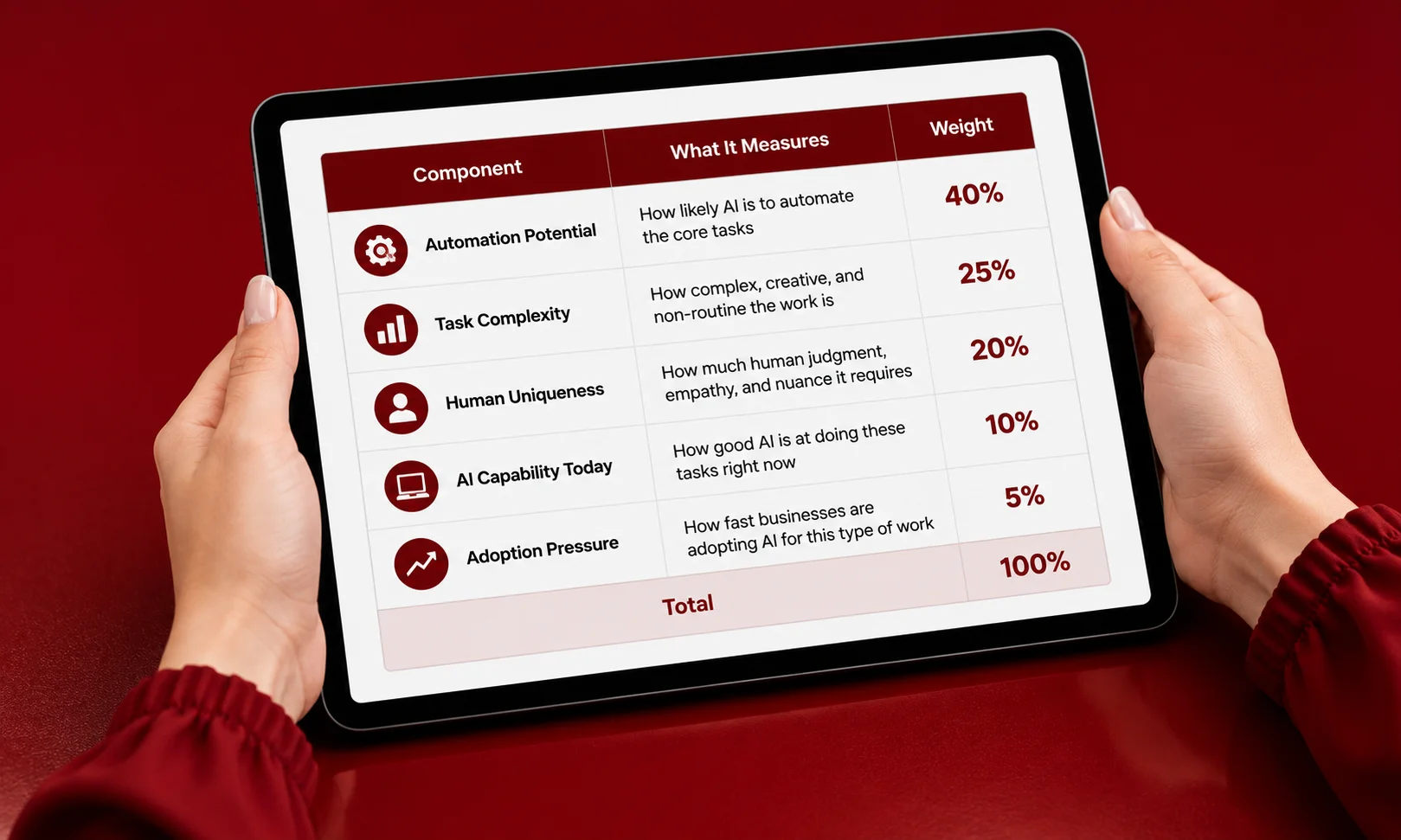
The proposed model would give:
- 60% to hard data
- 10% to AI events
- 20% to sentiment
- 10% to occupation risk
But this is a planned change, not something already confirmed as released. There is also a bigger question outside the index. Will AI mostly help software professionals do more work?
Or will companies use those productivity gains to reduce hiring? Those outcomes are not the same.
We may see fewer junior positions in some areas while experienced developers become more productive and demand for other technical skills increases. That is why I don’t think the future of software can be explained with one “AI will replace developers” headline.
Final Verdict
The AI Job Displacement Index is useful if you understand its limits.
As of September 1, 2026, DisplaceIndex showed 48.6/100, putting its U.S. labor-market reading in the “Transitional” range.
At the same time, independent research gives us a more complicated picture.
Anthropic found very high AI task exposure among programmers. Stanford found a worrying employment gap among young workers in highly exposed occupations. But Stanford did not establish that AI alone caused that gap, and BLS still projects strong overall growth for software developers, QA analysts, and testers through 2035.
So my conclusion is pretty simple.
AI is already changing software jobs. It is not yet proven that AI is broadly eliminating software jobs.
The bigger risk may be the gradual change in how people enter the industry.
If AI can handle more basic coding, testing, documentation, and routine analysis, companies may need fewer people for some entry-level tasks. At the same time, they may need people who can manage AI systems, review the output, solve harder problems, and connect technology with real business needs.
That’s the part I would watch. Not just whether the index goes from 48 to 45. But what is actually happening to the work behind that number.
Frequently Asked Questions
What is the AI Job Displacement Index?
The AI Job Displacement Index is an independent dashboard called DisplaceIndex that combines U.S. labor-market data with AI-scored employment and news signals. It produces a 0–100 score showing the level of labor-market pressure in its own model.
What was the AI Job Displacement Index score in September 2026?
On September 1, 2026, DisplaceIndex showed 48.6 out of 100 and labeled the environment “Transitional.” The score is not a percentage of jobs being displaced.
Does the index prove that AI is causing layoffs?
No. The index includes general labor-market data that can change because of many factors besides AI. Its AI-attributed layoff tracker is also based on public reports and should not be treated as a definitive causal count.
Are software developers being replaced by AI?
Not broadly based on current evidence. AI can perform or assist with many programming tasks, but BLS still projects 10% growth for software developers, QA analysts, and testers from 2025 to 2035.
Which software jobs are most exposed to AI?
Programming and other highly digital, structured, repetitive tasks are among the more exposed areas. However, exposure means AI can perform parts of the work; it doesn’t mean the entire occupation will disappear.
Are junior tech workers more at risk?
There are some warning signs. Stanford found that employment among 22–25-year-olds in highly AI-exposed occupations was about 19% below its comparison benchmark through June 2026, but researchers described this as descriptive evidence rather than proof that AI caused the difference.
Is DisplaceIndex an official government statistic?
No. It is an independent dashboard that uses public labor-market data but applies its own scoring model, sentiment analysis, and occupation estimates.
How often does DisplaceIndex update?
The publisher says its system updates every six hours. However, the government labor data used by the dashboard are released on different schedules, so not every underlying metric changes every six hours.
Is DisplaceIndex free?
Yes. The public dashboard is currently free. The site says paid Pro and Research plans are planned, but public pricing and launch dates were not available as of September 1, 2026.
Should software developers worry about AI?
They should pay attention, but I wouldn’t treat AI as a reason to leave software automatically. The more useful approach is to learn how AI changes development work and build skills around system design, problem-solving, security, architecture, communication, and reviewing AI-generated output.