

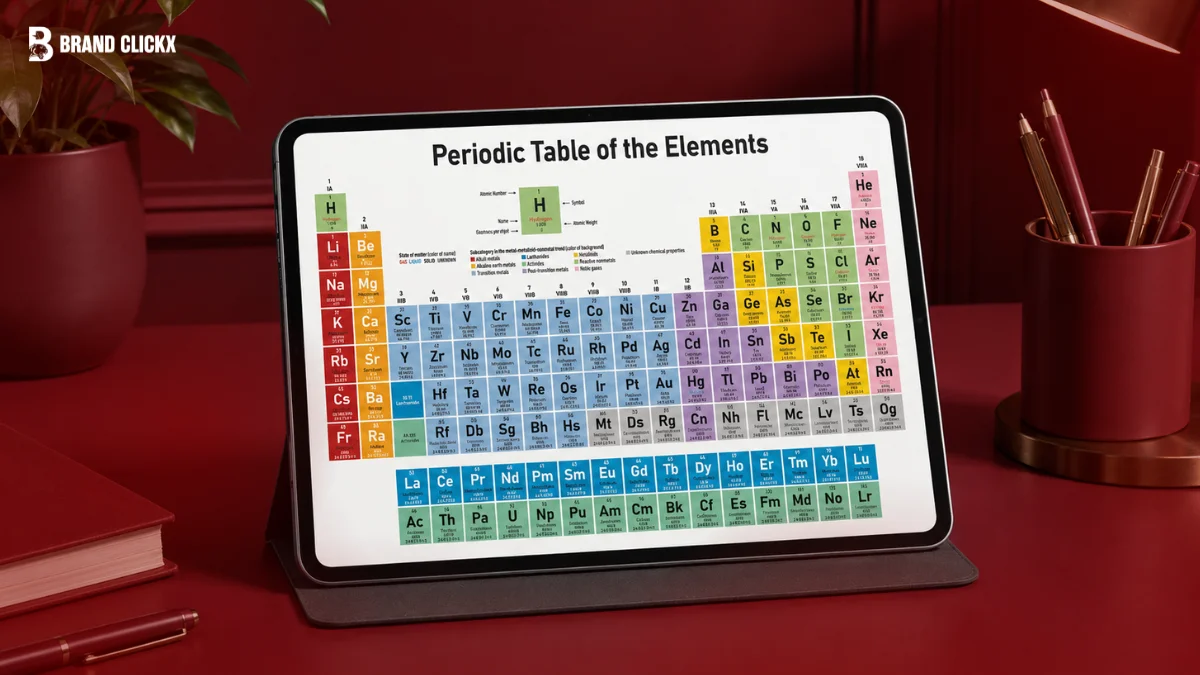
The first time the periodic table of elements really makes sense, it is usually not because someone memorized it. It is the moment you realize that the strange rows and columns are actually telling you a story about atoms.
Hydrogen sits at the beginning. Oxygen appears near the top. Iron, copper, gold, uranium, and 114 other elements all have a specific place for a reason.
That arrangement is what makes the table so useful. You can use an element’s position to understand its atomic number, group, period, broad chemical behavior, and place in the larger structure of chemistry.
As of August 18, 2026, there are 118 officially recognized elements, from hydrogen (H) to oganesson (Og). IUPAC’s official records confirm that elements 113, 115, 117, and 118 received their permanent names in 2016.
This guide explains all 118 elements, how the periodic table works, why its arrangement matters, where elements appear in everyday technology, and what scientists are trying to discover next.
AI Overview: What Is the Periodic Table of Elements?
The periodic table of elements organizes the 118 confirmed chemical elements by increasing atomic number. Its 18 columns are called groups, while its seven horizontal rows are called periods. Elements in the same group often have related chemical properties because their outer-electron arrangements are similar.
The modern table developed from Dmitri Mendeleev’s 1869 work and was later reorganized around atomic number after Henry Moseley’s work. IUPAC officially named elements 113, 115, 117, and 118 in 2016, completing the seventh period.
Today, the table is used to understand chemical behavior and to connect elements with applications in medicine, electronics, energy, materials science, agriculture, and other fields.
Key Takeaways
- The periodic table contains 118 officially recognized elements.
- Atomic number determines an element’s position and equals its number of protons.
- The table has 7 periods and 18 groups under the IUPAC numbering system.
- Elements are divided into broad categories such as metals, nonmetals, and metalloids.
- The four major electron blocks are s, p, d, and f.
- Dmitri Mendeleev published his influential periodic table in 1869.
- IUPAC officially approved the names nihonium, moscovium, tennessine, and oganesson in 2016.
Featured Snippet: How Many Elements Are in the Periodic Table?
There are 118 confirmed chemical elements in the modern periodic table, beginning with hydrogen at atomic number 1 and ending with oganesson at atomic number 118. The elements are arranged by increasing atomic number into seven periods and 18 groups, with recurring chemical properties appearing throughout the table.
What Is the Periodic Table of Elements?
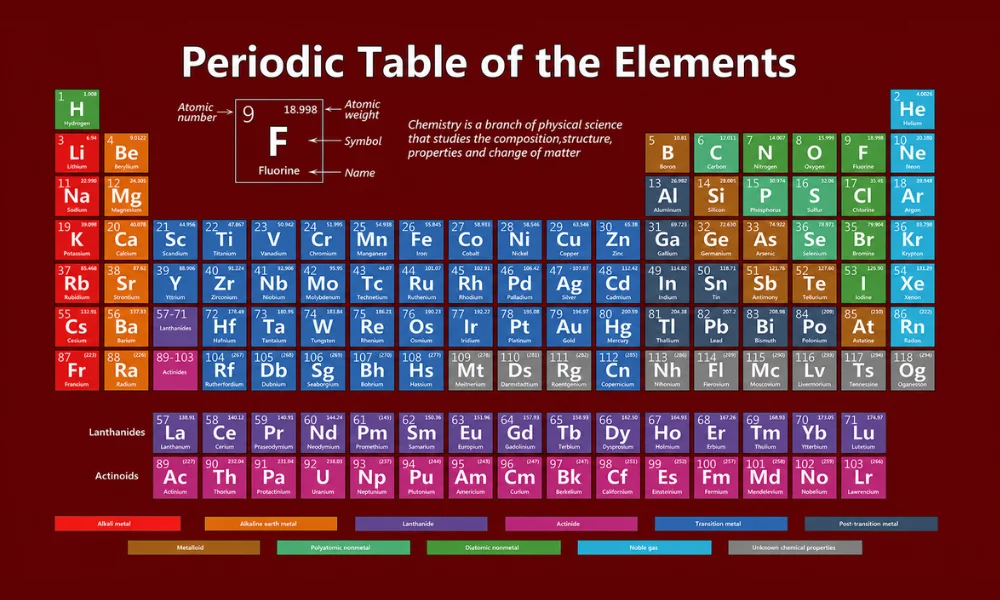
The periodic table is a structured chart of chemical elements arranged primarily by atomic number, the number of protons in an atom’s nucleus.
That number gives every element its identity. Carbon always has atomic number 6, while oxygen has atomic number 8.
The arrangement also reveals repeating patterns in electron configuration and chemical properties. That is the meaning behind the word periodic: certain properties recur in a regular way as atomic numbers increase.
Why Atomic Number Matters
Atomic number is more than a position on a chart.
If an atom has one proton, it is hydrogen. If it has six, it is carbon. If it has 79, it is gold.
This is why the modern periodic table is ordered by atomic number rather than simply by atomic mass.
What the Numbers in an Element Box Mean
A typical element box can contain several pieces of information:
- Atomic number: number of protons.
- Symbol: short chemical abbreviation.
- Element name: the element’s full name.
- Atomic weight or mass value: a value associated with the element’s atomic mass.
IUPAC’s official tables provide these standardized element data, although radioactive elements without a characteristic natural isotopic abundance may not have a conventional standard atomic weight listed.
Complete 118 Elements of the Periodic Table
The following table gives the complete sequence from hydrogen to oganesson.
| Atomic No. | Symbol | Element | Atomic Weight* |
|---|---|---|---|
| 1 | H | Hydrogen | 1.008 |
| 2 | He | Helium | 4.003 |
| 3 | Li | Lithium | 6.94 |
| 4 | Be | Beryllium | 9.012 |
| 5 | B | Boron | 10.81 |
| 6 | C | Carbon | 12.011 |
| 7 | N | Nitrogen | 14.007 |
| 8 | O | Oxygen | 15.999 |
| 9 | F | Fluorine | 18.998 |
| 10 | Ne | Neon | 20.180 |
| 11 | Na | Sodium | 22.990 |
| 12 | Mg | Magnesium | 24.305 |
| 13 | Al | Aluminum | 26.982 |
| 14 | Si | Silicon | 28.086 |
| 15 | P | Phosphorus | 30.974 |
| 16 | S | Sulfur | 32.06 |
| 17 | Cl | Chlorine | 35.45 |
| 18 | Ar | Argon | 39.948 |
| 19 | K | Potassium | 39.098 |
| 20 | Ca | Calcium | 40.078 |
| 21 | Sc | Scandium | 44.956 |
| 22 | Ti | Titanium | 47.867 |
| 23 | V | Vanadium | 50.942 |
| 24 | Cr | Chromium | 51.996 |
| 25 | Mn | Manganese | 54.938 |
| 26 | Fe | Iron | 55.845 |
| 27 | Co | Cobalt | 58.933 |
| 28 | Ni | Nickel | 58.693 |
| 29 | Cu | Copper | 63.546 |
| 30 | Zn | Zinc | 65.38 |
| 31 | Ga | Gallium | 69.723 |
| 32 | Ge | Germanium | 72.63 |
| 33 | As | Arsenic | 74.922 |
| 34 | Se | Selenium | 78.971 |
| 35 | Br | Bromine | 79.904 |
| 36 | Kr | Krypton | 83.798 |
| 37 | Rb | Rubidium | 85.468 |
| 38 | Sr | Strontium | 87.62 |
| 39 | Y | Yttrium | 88.906 |
| 40 | Zr | Zirconium | 91.224 |
| 41 | Nb | Niobium | 92.906 |
| 42 | Mo | Molybdenum | 95.95 |
| 43 | Tc | Technetium | — |
| 44 | Ru | Ruthenium | 101.07 |
| 45 | Rh | Rhodium | 102.906 |
| 46 | Pd | Palladium | 106.42 |
| 47 | Ag | Silver | 107.868 |
| 48 | Cd | Cadmium | 112.414 |
| 49 | In | Indium | 114.818 |
| 50 | Sn | Tin | 118.710 |
| 51 | Sb | Antimony | 121.760 |
| 52 | Te | Tellurium | 127.60 |
| 53 | I | Iodine | 126.904 |
| 54 | Xe | Xenon | 131.293 |
| 55 | Cs | Cesium | 132.905 |
| 56 | Ba | Barium | 137.327 |
| 57 | La | Lanthanum | 138.905 |
| 58 | Ce | Cerium | 140.116 |
| 59 | Pr | Praseodymium | 140.908 |
| 60 | Nd | Neodymium | 144.242 |
| 61 | Pm | Promethium | — |
| 62 | Sm | Samarium | 150.36 |
| 63 | Eu | Europium | 151.964 |
| 64 | Gd | Gadolinium | 157.25 |
| 65 | Tb | Terbium | 158.925 |
| 66 | Dy | Dysprosium | 162.500 |
| 67 | Ho | Holmium | 164.930 |
| 68 | Er | Erbium | 167.259 |
| 69 | Tm | Thulium | 168.934 |
| 70 | Yb | Ytterbium | 173.045 |
| 71 | Lu | Lutetium | 174.967 |
| 72 | Hf | Hafnium | 178.49 |
| 73 | Ta | Tantalum | 180.948 |
| 74 | W | Tungsten | 183.84 |
| 75 | Re | Rhenium | 186.207 |
| 76 | Os | Osmium | 190.23 |
| 77 | Ir | Iridium | 192.217 |
| 78 | Pt | Platinum | 195.084 |
| 79 | Au | Gold | 196.967 |
| 80 | Hg | Mercury | 200.592 |
| 81 | Tl | Thallium | 204.38 |
| 82 | Pb | Lead | 207.2 |
| 83 | Bi | Bismuth | 208.980 |
| 84 | Po | Polonium | — |
| 85 | At | Astatine | — |
| 86 | Rn | Radon | — |
| 87 | Fr | Francium | — |
| 88 | Ra | Radium | — |
| 89 | Ac | Actinium | — |
| 90 | Th | Thorium | — |
| 91 | Pa | Protactinium | — |
| 92 | U | Uranium | — |
| 93 | Np | Neptunium | — |
| 94 | Pu | Plutonium | — |
| 95 | Am | Americium | — |
| 96 | Cm | Curium | — |
| 97 | Bk | Berkelium | — |
| 98 | Cf | Californium | — |
| 99 | Es | Einsteinium | — |
| 100 | Fm | Fermium | — |
| 101 | Md | Mendelevium | — |
| 102 | No | Nobelium | — |
| 103 | Lr | Lawrencium | — |
| 104 | Rf | Rutherfordium | — |
| 105 | Db | Dubnium | — |
| 106 | Sg | Seaborgium | — |
| 107 | Bh | Bohrium | — |
| 108 | Hs | Hassium | — |
| 109 | Mt | Meitnerium | — |
| 110 | Ds | Darmstadtium | — |
| 111 | Rg | Roentgenium | — |
| 112 | Cn | Copernicium | — |
| 113 | Nh | Nihonium | — |
| 114 | Fl | Flerovium | — |
| 115 | Mc | Moscovium | — |
| 116 | Lv | Livermorium | — |
| 117 | Ts | Tennessine | — |
| 118 | Og | Oganesson | — |
*Values are based on the IUPAC periodic-table data supplied in its official archive; dashes reflect elements for which that table does not list a standard atomic weight.
The important distinction is that an absent standard atomic weight does not mean the element is missing or unrecognized. Many of the heaviest elements are radioactive and do not have the characteristic isotopic abundance needed for a conventional standard atomic-weight value.
How Do You Read the Periodic Table?
Once you know what each element box contains, the entire chart becomes much easier to navigate.
Atomic Number
The atomic number tells you the number of protons in an atom.
For example, carbon is number 6, so every carbon atom has six protons.
Element Symbols and Names
Chemical symbols provide a compact way to identify elements.
Some are obvious, such as O for oxygen and C for carbon. Others come from older names or Latin roots, such as Na for sodium and Fe for iron.
Atomic Mass
Atomic mass relates to the masses of an element’s atoms and their isotopic composition.
It should not be confused with atomic number. Atomic number identifies the element; atomic mass reflects the mass of its atoms.
How Are the Elements Arranged?
The periodic table isn’t simply a list of 118 names.
Its position system is what gives the chart much of its predictive power.
Groups and Periods
A group is a vertical column. IUPAC numbers the groups from 1 through 18. A period is a horizontal row, and the modern table contains seven periods.
| Feature | Groups | Periods |
|---|---|---|
| Direction | Vertical | Horizontal |
| Number | 18 | 7 |
| Main idea | Similar chemical patterns | Electron-shell progression |
| Example | Group 17 contains halogens | Period 3 contains Na through Ar |
Elements within a group often show related chemistry because their outer-electron arrangements follow similar patterns.
Periodic Table Groups and Element Families
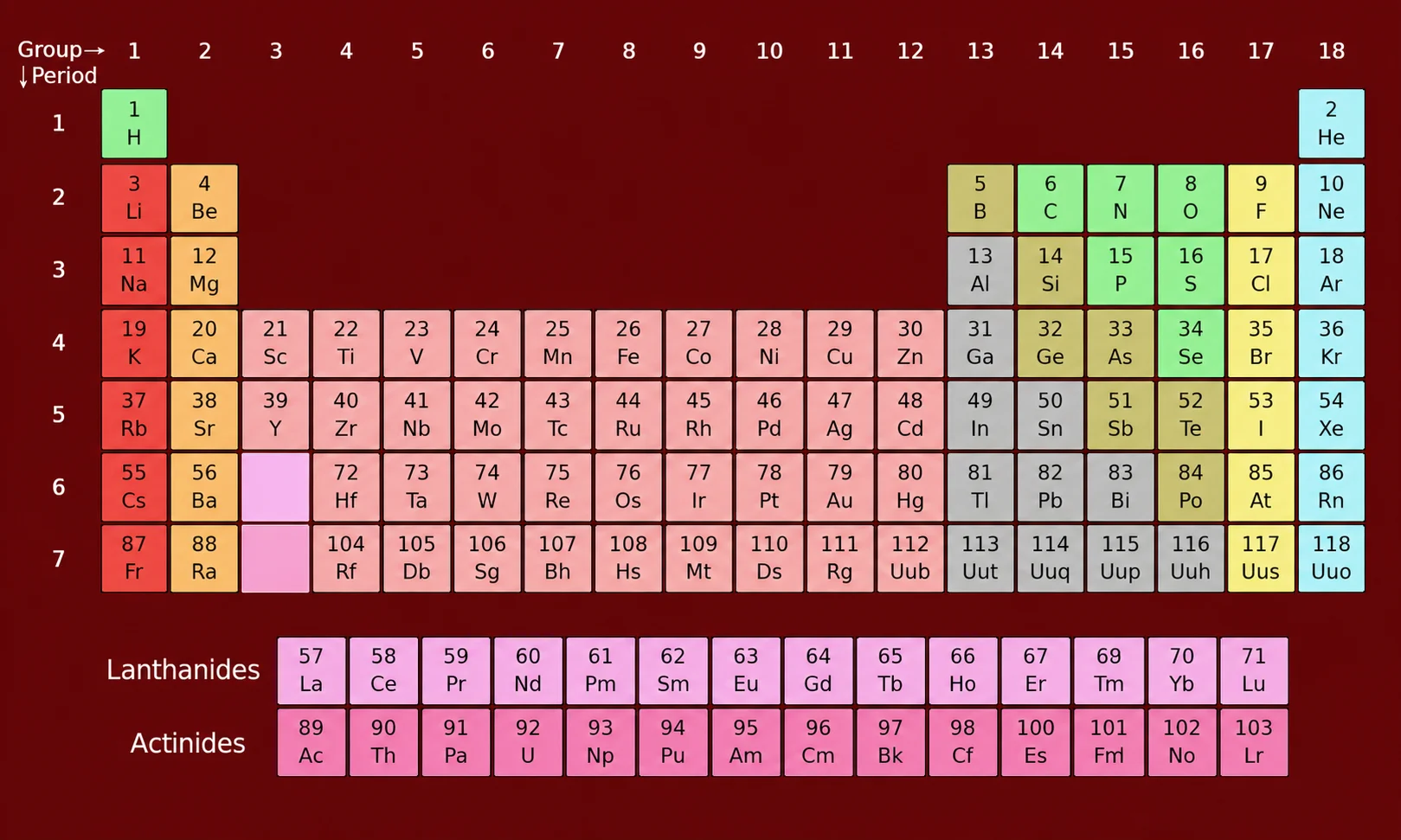
Grouping is one of the fastest ways to make sense of the table.
Group 1: Alkali Metals
Group 1 contains the alkali metals, including lithium, sodium, and potassium.
These elements have one outer-shell electron and are known for high chemical reactivity.
Hydrogen occupies the top position in Group 1, but it does not behave like a typical alkali metal. That unusual position is one of the periodic table’s long-standing complications.
Group 2: Alkaline Earth Metals
Group 2 contains elements such as beryllium, magnesium, calcium, and barium.
They are metals with characteristic chemical patterns associated with their outer-electron configuration.
Groups 3–12: Transition Metals
The middle of the table contains the transition metals.
Iron, copper, titanium, gold, platinum, and many other familiar elements belong here.
These elements are especially important in materials, construction, electronics, manufacturing, medicine, and technology.
Groups 13–16
These groups contain a mixture of metals, metalloids, and nonmetals.
They include elements that are fundamental to life and technology, including carbon, nitrogen, oxygen, silicon, phosphorus, sulfur, and others.
Group 17: Halogens
Fluorine, chlorine, bromine, iodine, and tennessine belong to Group 17.
The halogens are highly reactive nonmetals, although the behavior of the heaviest members becomes increasingly difficult to observe directly.
Group 18: Noble Gases
Helium, neon, argon, krypton, xenon, radon, and oganesson occupy Group 18.
These elements have distinctive electron configurations and are generally characterized by low chemical reactivity compared with many neighboring elements.
The Seven Periods of the Periodic Table
The seven periods are the table’s horizontal rows.
As you move across a period, atomic number increases and electron configurations change in an organized sequence.
The first period contains only hydrogen and helium.
The longer later periods contain progressively more elements because additional electron subshells become available.
This is one reason the periodic table has its distinctive shape rather than appearing as a simple rectangular list.
Metals, Nonmetals, and Metalloids
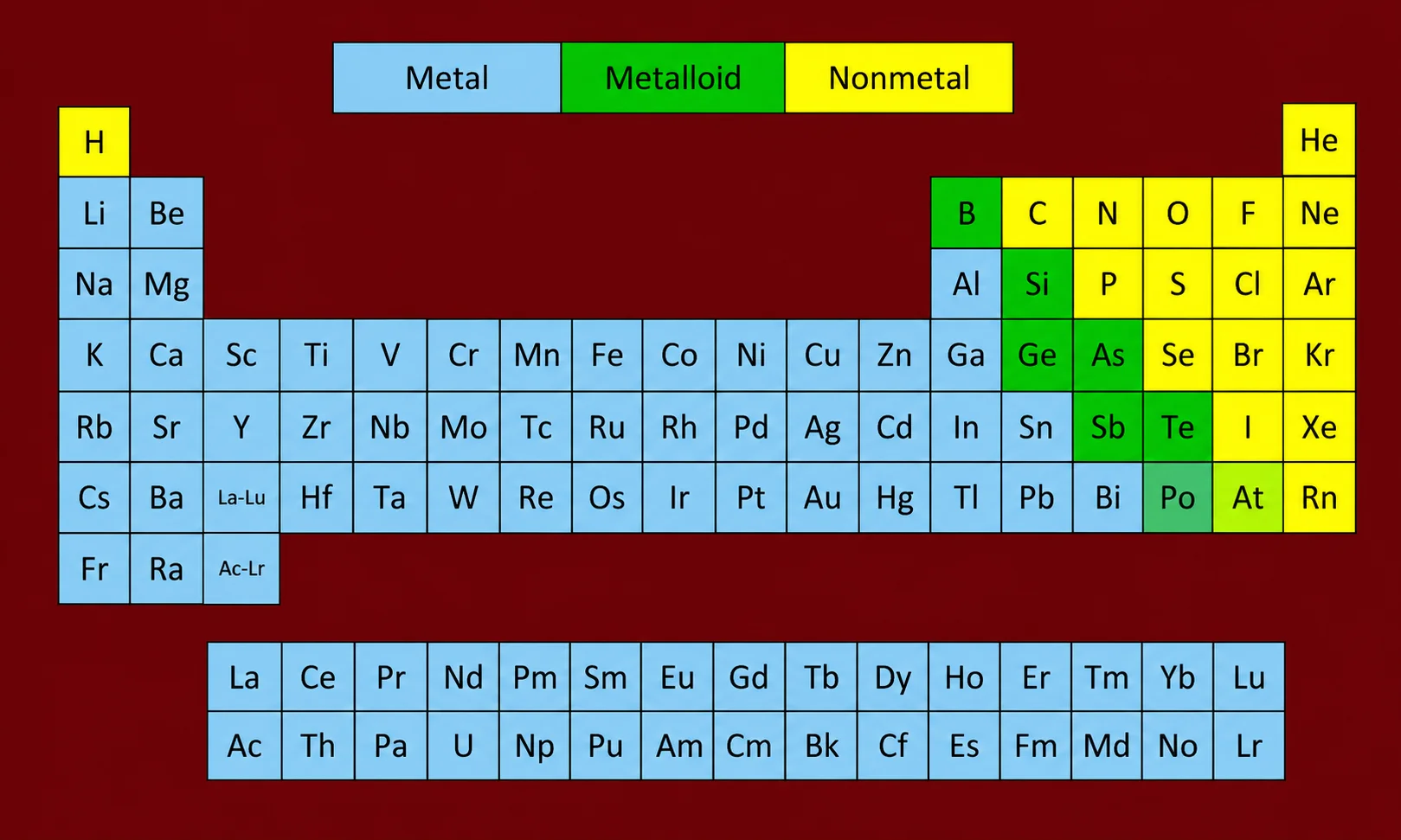
Another useful way to understand the elements is to classify them by broad physical and chemical behavior.
| Classification | General characteristics | Examples |
|---|---|---|
| Metals | Often conductive, malleable, and lustrous | Iron, copper |
| Nonmetals | Generally poorer conductors; include gases and brittle solids | Oxygen, carbon |
| Metalloids | Intermediate properties; several are semiconductors | Silicon, germanium |
These categories help you predict broad behavior, but they are not substitutes for studying an individual element.
Silicon is a particularly useful example. Its properties help make it valuable in semiconductor technology.
What Are the Four Periodic Table Blocks?
The table can also be divided into four blocks according to the electron subshell being filled.
s-Block
The s-block includes Groups 1 and 2.
Hydrogen, lithium, sodium, magnesium, and other elements in this region are part of this block.
p-Block
The p-block includes Groups 13 through 18.
It contains a diverse mixture of metals, metalloids, nonmetals, halogens, and noble gases.
d-Block
The d-block occupies Groups 3 through 12.
These are the transition metals, including iron, copper, titanium, silver, gold, and platinum.
f-Block
The f-block contains the lanthanoids and actinoids.
They are commonly displayed below the main table to keep the overall layout compact. IUPAC recognizes lanthanoids and actinoids as collective names for these series.
Periodic Trends Explained
The table becomes especially powerful when you stop seeing it as a collection of boxes and start seeing the patterns across those boxes.
Atomic Radius
Atomic radius generally changes predictably across periods and down groups.
The trend reflects changes in nuclear charge and electron-shell structure.
Ionization Energy
Ionization energy describes the energy involved in removing an electron from an atom.
Its periodic behavior helps explain why some elements lose electrons more readily than others.
Electronegativity
Electronegativity describes an atom’s tendency to attract electrons in a chemical bond.
Its pattern across the table is one of the most useful tools for understanding chemical bonding.
Electron Affinity
Electron affinity concerns the energy change associated with an atom gaining an electron.
Like ionization energy and electronegativity, it follows recognizable periodic patterns, although the detailed behavior contains exceptions.
Metallic Character
Metallic character generally becomes stronger toward the lower-left region of the periodic table and weaker toward the upper-right.
These trends are not isolated facts. Together, they help explain why neighboring elements can behave very differently.
How the Periodic Table Developed
The modern periodic table did not appear fully formed.
Scientists spent decades searching for ways to organize the growing list of known elements.
Dmitri Mendeleev’s 1869 Breakthrough
Dmitri Mendeleev published his influential periodic table in 1869.
He arranged the known elements primarily by atomic mass and grouped elements with similar properties.
His most remarkable decision was to leave gaps where he believed undiscovered elements should exist.
Those predictions later proved successful for elements including gallium, scandium, and germanium.
From Atomic Mass to Atomic Number
Mendeleev’s system worked remarkably well, but atomic mass was not ultimately the best organizing principle.
Henry Moseley’s work in 1913 showed that atomic number provided the more fundamental ordering.
That insight resolved several inconsistencies and helped establish the structure used today.
The Table Reached 118 Elements
IUPAC and IUPAP verified the discoveries of elements 113, 115, 117, and 118, completing the seventh row.
In 2016, IUPAC formally approved their names as nihonium (Nh), moscovium (Mc), tennessine (Ts), and oganesson (Og).
That is why the modern table ends at element 118.
Why Is the Periodic Table Important in Real Life?
The periodic table may look like a schoolroom chart, but its elements are woven into modern life.
Medicine
Titanium is used in biocompatible applications, while radioactive isotopes such as iodine-131 have medical uses.
Platinum is also important in medicines such as cisplatin.
Electronics
Silicon forms the foundation of modern semiconductor technology.
Copper is widely used for electrical wiring because of its useful electrical conductivity.
Energy
Lithium is central to lithium-ion battery technology.
Uranium is important in nuclear energy, while other elements appear in energy-related materials and technologies.
Materials Science
Aluminum contributes to lightweight alloys.
Carbon is central to materials such as graphene and other advanced carbon structures.
Iron, chromium, and nickel combine in stainless-steel applications where corrosion resistance matters.
Agriculture
Nitrogen, phosphorus, and potassium are key elements in fertilizers.
Their symbols — N, P, and K — are familiar to anyone who has looked at fertilizer labels.
Water Treatment
Chlorine and chlorine-based chemistry play an important role in water disinfection.
These examples show why understanding element properties matters beyond the classroom.
Ten Real-World Examples That Make the Table Easier to Remember
Instead of memorizing isolated symbols, connect elements to something you already recognize.
- Lithium (Li): lithium-ion batteries.
- Silicon (Si): semiconductor technology and solar cells.
- Copper (Cu): electrical wiring.
- Titanium (Ti): medical implants and advanced materials.
- Uranium (U): nuclear energy.
- Iron (Fe): infrastructure and steel.
- Chromium (Cr): corrosion-resistant stainless steel.
- Platinum (Pt): medicines including cisplatin.
- Chlorine (Cl): water disinfection.
- Gallium (Ga): compounds used in semiconductor and LED technology.
The connection is simple: the position of an element helps explain its behavior, and its behavior helps determine where people can use it.
Practical Application: How to Use the Periodic Table
You don’t need to memorize all 118 elements before you can use the table effectively.
Start with these steps.
Step 1: Find the Element
Locate the element by its name, symbol, or atomic number.
For example, if you see Fe, identify it as iron and then check its position.
Step 2: Check the Atomic Number
The atomic number tells you how many protons the neutral atom has.
That immediately identifies the element.
Step 3: Look at Its Group
The group gives you useful information about related chemical behavior.
Compare the element with others in the same column rather than studying it in isolation.
Step 4: Check Its Period
The period tells you where the element sits in the horizontal sequence.
This helps you understand its electron-shell structure and compare it with neighboring elements.
Step 5: Identify Its Block and Category
Ask whether it belongs to the s-, p-, d-, or f-block.
Then check whether it is broadly classified as a metal, nonmetal, or metalloid.
Step 6: Look for Trends
Finally, compare the element with nearby elements.
Atomic radius, ionization energy, electronegativity, and metallic character can provide clues about how its chemistry differs from its neighbors.
This approach is much more useful than memorizing 118 disconnected names.
Who Should Use the Periodic Table?
The periodic table is useful for anyone studying or working with chemistry.
That includes:
- Chemistry students
- Teachers and educators
- Chemists
- Chemical engineers
- Pharmacists
- Materials scientists
- Environmental analysts
- Researchers
- Students preparing for science examinations
You also do not need a chemistry career to benefit from understanding it. A basic grasp of atomic number, groups, periods, and element symbols is enough to make many scientific topics easier to follow.
Who Should Not Treat It as a Complete Chemistry Course?
The periodic table is a reference framework, not a replacement for chemistry itself.
It can help you predict patterns, but it cannot by itself explain every reaction, isotope, compound, bonding situation, or advanced nuclear effect.
That distinction becomes especially important with the heaviest elements.
What Are the Periodic Table’s Limitations?
The standard table is extraordinarily useful, but it is not free from complications.
Hydrogen’s Position
Hydrogen appears above Group 1, yet its chemistry differs significantly from the alkali metals.
That is why its placement has remained a subject of discussion.
The f-Block Layout
The lanthanoids and actinoids are normally displayed separately below the main table.
This makes the table easier to print and view, but it means the displayed layout does not show every position in one uninterrupted row.
Superheavy Elements
The chemistry of the heaviest elements is difficult to study directly because many of them are extremely short-lived.
As a result, some chemical behavior must be inferred rather than observed in the same way as the chemistry of common elements.
Alternative Periodic Tables
Scientists and educators have proposed spiral, three-dimensional, and left-step versions.
These layouts can emphasize different relationships between elements, but the familiar 18-column arrangement remains the standard used in mainstream chemistry education and scientific communication.
What Comes After Element 118?
This is where the periodic table stops being only a history lesson and becomes an active research question.
As of August 18, 2026, element 118 remains the highest officially recognized element.
IUPAC’s procedures require claims for new elements to undergo scientific assessment before a discovery is recognized and a permanent name can be assigned.
Scientists are interested in elements beyond 118, particularly elements 119 and 120.
However, possible future elements should not be presented as confirmed additions. A successful experiment is not automatically the same thing as an officially recognized new element.
What Is the Island of Stability?
The island of stability is a theoretical idea concerning superheavy atomic nuclei.
Certain combinations of protons and neutrons may produce nuclei that survive longer than neighboring superheavy nuclei.
The exact location and practical significance of such a region remain uncertain, so it should be treated as scientific theory rather than a guaranteed future discovery.
Common Periodic Table Mistakes to Avoid
Mistake 1: Confusing Atomic Number With Atomic Mass
Atomic number tells you the number of protons.
Atomic mass is a different measurement related to atomic mass and isotopic composition.
Mistake 2: Treating Groups and Periods as the Same Thing
Groups run vertically.
Periods run horizontally.
Remembering that distinction makes the table much easier to navigate.
Mistake 3: Assuming Every Element Is a Metal
The table contains metals, nonmetals, and metalloids.
Their positions and properties differ substantially.
Mistake 4: Assuming the Bottom Rows Are Separate Elements From the Main Table
The lanthanoids and actinoids are part of the same periodic system.
They are displayed below the main body mainly to keep the table compact.
Mistake 5: Treating Element 119 as Confirmed
Element 119 is not part of the officially recognized 118-element table.
Future discoveries must pass the appropriate scientific validation process before the periodic table changes.
Frequently Asked Questions About the Periodic Table of Elements
How many elements are in the periodic table in 2026?
There are 118 officially recognized elements in the periodic table as of August 18, 2026. Hydrogen is element 1, while oganesson is element 118. IUPAC formally approved the names of the four newest elements in 2016.
Who invented the periodic table?
Dmitri Mendeleev is widely credited with creating the first widely recognized periodic table in 1869. His system arranged elements by atomic mass and left gaps for elements he believed had not yet been discovered. Later work, particularly Henry Moseley’s research, established atomic number as the fundamental organizing principle.
What are groups and periods?
Groups are the 18 vertical columns of the periodic table, while periods are its 7 horizontal rows. Elements in the same group often have related chemical properties because of similarities in their outer-electron arrangements.
What is the heaviest element on the periodic table?
Oganesson (Og), atomic number 118, is the highest-numbered confirmed element. It is a synthetic superheavy element and is extremely unstable. IUPAC formally approved the name oganesson in 2016.
Are there elements beyond 118?
No element beyond 118 has been officially recognized yet. Scientists are investigating ways to synthesize heavier elements, but a proposed or experimentally targeted element is not the same as an officially validated addition to the periodic table.
Why are lanthanoids and actinoids shown at the bottom?
The f-block elements are usually placed beneath the main table to make the standard layout more compact. They still belong to the periodic table and occupy positions within its longer structure. IUPAC uses the collective terms lanthanoids and actinoids for these series.
Why is the periodic table arranged by atomic number?
Atomic number represents the number of protons in an element’s nucleus and therefore identifies the element itself. Henry Moseley’s work in 1913 helped establish atomic number as the correct organizing principle, resolving problems that appeared when elements were ordered primarily by atomic mass.
What is the island of stability?
The island of stability is a theoretical region in superheavy-element research where certain nuclei may have substantially longer lifetimes than nearby superheavy nuclei. Scientists continue to investigate this possibility, but its exact location and practical consequences remain uncertain.
Final Thoughts
Think back to that first glance at the table: 118 boxes, unfamiliar symbols, and rows that seem almost impossible to memorize.
The trick is that you were never really supposed to see it as 118 separate facts.
The periodic table of elements is a map. Atomic number tells you where an element belongs, groups reveal recurring chemical relationships, periods show the progression of electron shells, and blocks connect the chart to electron configuration.
Mendeleev’s original insight was powerful because he recognized patterns before scientists understood all the atomic details behind them. More than a century later, the table still does something similar: it organizes what we know while leaving room for questions about what might come next.
And that may be the most interesting thing about the periodic table. It looks finished at 118, but the science behind its outer edge is still being explored.