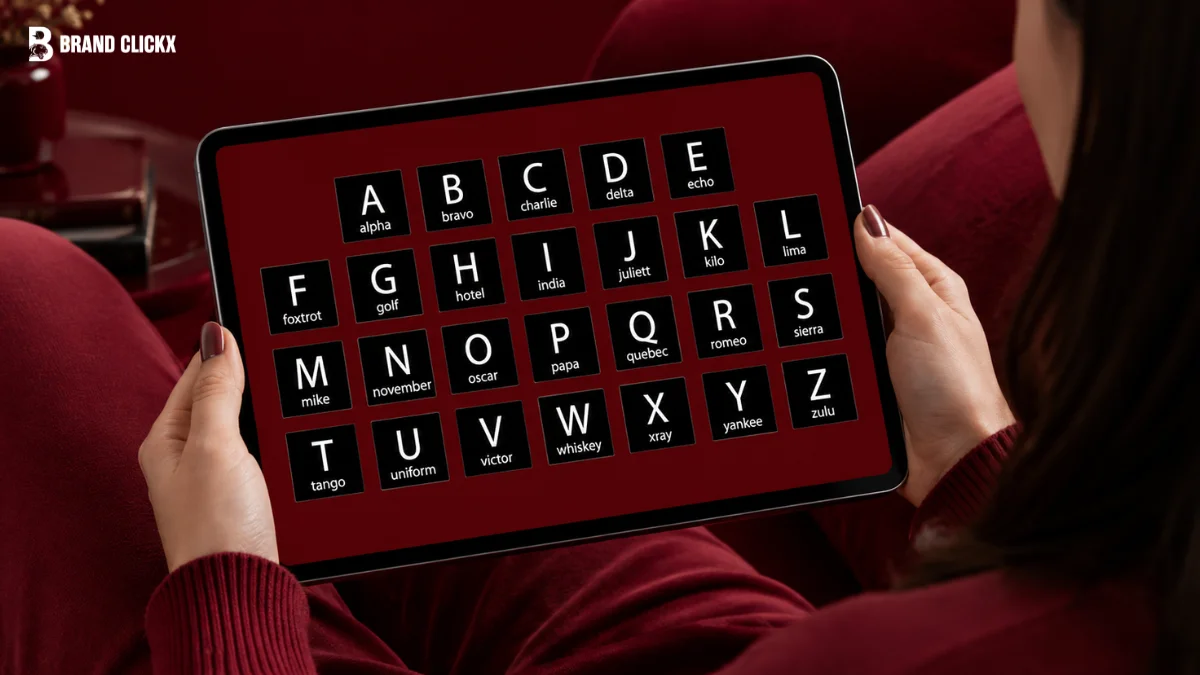
A few years ago, I watched someone struggle to spell a short code over a poor phone connection. “B or D?” came back from the other side. After repeating it twice, the conversation finally moved forward.
That small problem is exactly why a phonetic alphabet chart exists. Instead of saying a letter that can be misunderstood, you replace it with a distinctive word: Bravo for B, Delta for D, Papa for P, and Tango for T.
The system is much more than a list of memorable words. It is an international spelling standard used in aviation, military communication, radio, and other situations where getting a letter wrong can matter. Here you’ll find the complete A–Z chart, pronunciation, numbers, NATO and ICAO terminology, history, practical examples, common mistakes, and the difference between this system and the International Phonetic Alphabet.
Phonetic Alphabet Chart: Quick Answer
The phonetic alphabet chart most people mean is the NATO/ICAO radiotelephony spelling alphabet. It assigns a distinctive spoken code word to each of the 26 letters, from Alfa for A to Zulu for Z. The system helps people communicate letters clearly when radio noise, accents, poor signals, or similar-sounding letters could cause confusion. NATO says the modern alphabet became effective in 1956, while the FAA continues to publish it for aviation communications.
What Is the NATO Phonetic Alphabet?
It is a spelling alphabet, not a system for describing how speech sounds are produced.
When you spell a registration such as “PK-AZ,” you can say Papa Kilo Alfa Alfa Zulu. Each letter receives a recognizable word, making the sequence easier to distinguish than isolated letter names.
NATO explains that the system was developed to improve clear communication between people speaking different languages and dealing with noise or other communication difficulties.
NATO Phonetic Alphabet vs. International Phonetic Alphabet
These two systems are easy to confuse because both are commonly described as “phonetic.”
The NATO/ICAO alphabet uses spoken words such as Alfa, Bravo, and Charlie to spell letters. The International Phonetic Alphabet (IPA) uses symbols to represent speech sounds in linguistics.
So, if you want to spell a name over a radio, use the NATO/ICAO system. If you want to show exactly how a sound is pronounced in linguistic notation, IPA is the relevant system.
Key Takeaways
- The modern NATO/ICAO spelling alphabet contains 26 code words, one for every letter.
- The official list begins with Alfa and ends with Zulu.
- NATO made the modern alphabet effective on March 1, 1956.
- The FAA currently publishes the alphabet for aviation communications, including aircraft identification and difficult radio conditions.
- Alfa, not Alpha, is the official spelling used in the table.
- Juliett has two final Ts in the official spelling.
- The NATO alphabet is not the same thing as the International Phonetic Alphabet.
- Aviation communications also use distinctive pronunciations for digits such as Wun, Tree, Fife, and Niner.
Featured Snippet: What Is the Phonetic Alphabet?
The phonetic alphabet is a standardized spelling system that assigns a distinctive word to each letter. The NATO/ICAO version uses words such as Alfa, Bravo, Charlie and Zulu to make letters easier to understand over radio, telephone, and other difficult communication channels. The modern alphabet contains 26 letters and became effective for NATO use in 1956.
Complete NATO Phonetic Alphabet A–Z
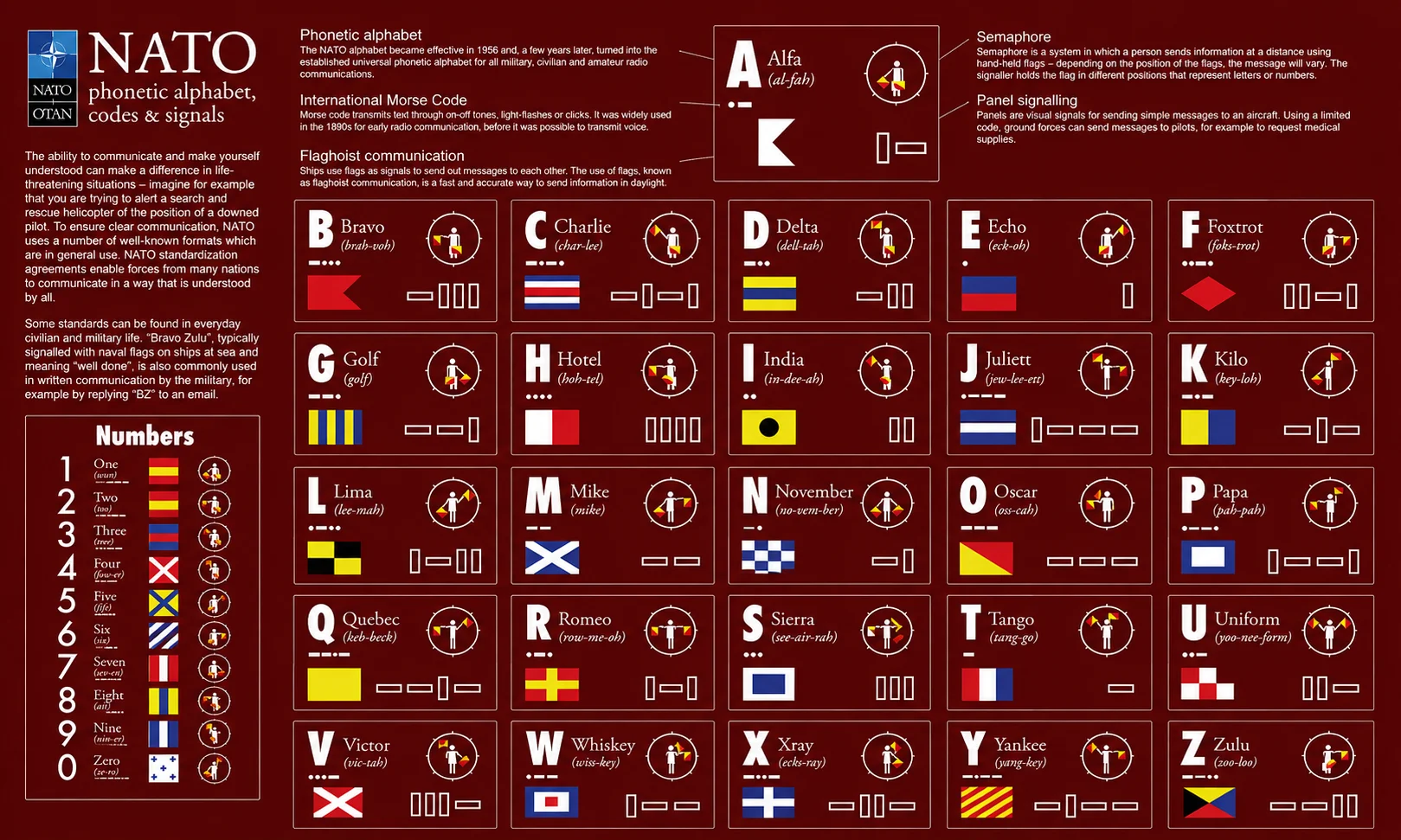
If you came here simply for the phonetic alphabet chart, this is the section to bookmark.
The current ICAO alphabet uses the following 26 code words. The FAA publishes the same spelling alphabet and pronunciation guidance for aviation communications.
| Letter | Code word | Approximate pronunciation |
|---|---|---|
| A | Alfa | AL-fah |
| B | Bravo | BRAH-voh |
| C | Charlie | CHAR-lee / SHAR-lee |
| D | Delta | DELL-tah |
| E | Echo | ECK-oh |
| F | Foxtrot | FOKS-trot |
| G | Golf | GOLF |
| H | Hotel | hoh-TELL |
| I | India | IN-dee-ah |
| J | Juliett | JEW-lee-ett |
| K | Kilo | KEY-loh |
| L | Lima | LEE-mah |
| M | Mike | MIKE |
| N | November | no-VEM-ber |
| O | Oscar | OSS-cah |
| P | Papa | pah-PAH |
| Q | Quebec | keh-BECK |
| R | Romeo | ROW-me-oh |
| S | Sierra | see-AIR-rah |
| T | Tango | TANG-go |
| U | Uniform | YOU-nee-form / OO-nee-form |
| V | Victor | VIK-tah |
| W | Whiskey | WISS-key |
| X | X-ray | ECKS-ray |
| Y | Yankee | YANG-key |
| Z | Zulu | ZOO-loo |
The pronunciation spellings above are simplified for English-speaking readers. The FAA’s official guidance gives more precise pronunciation forms and recognizes alternatives for some words, including Charlie and Uniform.
Official Spellings You Should Remember
Three entries regularly cause confusion when people compare ordinary English with the official alphabet.
The first is Alfa, not the usual English spelling “Alpha.” The second is Juliett, with two Ts at the end.
The third is X-ray, which appears with its hyphen in the FAA’s published table. These forms are intentional parts of the standardized list.
How Do You Pronounce the Phonetic Alphabet?
You do not need to reproduce a complicated linguistic transcription to use the alphabet correctly.
For example, A is spoken as Alfa, B as Bravo, and C as Charlie. The important point is to say the complete code word clearly rather than only pronouncing the original letter.
The FAA provides official pronunciation guidance such as AL-FAH for Alfa, BRAH-VOH for Bravo, and JEW-LEE-ETT for Juliett.
Code Words That Can Sound Different Across Languages
The alphabet was developed for international communication, so pronunciation matters.
For example, the FAA allows Charlie to be pronounced CHAR-LEE or SHAR-LEE. Uniform can also be pronounced YOU-NEE-FORM or OO-NEE-FORM in its published guidance.
That is one reason simply reading the words with ordinary English pronunciation is not always enough in professional radio communication.
NATO Phonetic Alphabet Numbers 0–9
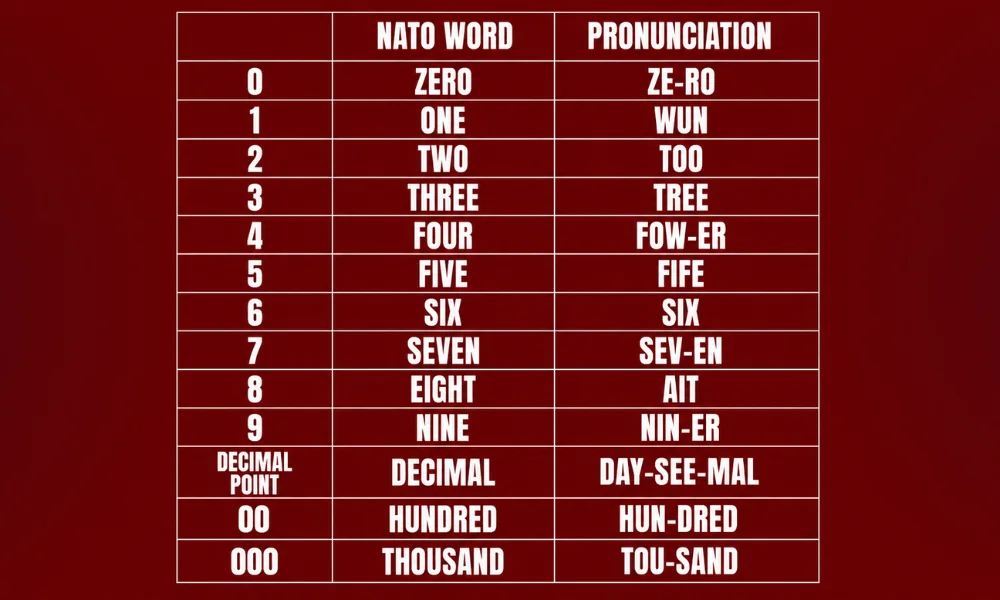
The system is primarily an alphabet for letters, but aviation communications also have standardized pronunciations for digits.
| Digit | Spoken form | Pronunciation |
|---|---|---|
| 0 | Zero | ZEE-ro |
| 1 | One | WUN |
| 2 | Two | TOO |
| 3 | Three | TREE |
| 4 | Four | FOW-er |
| 5 | Five | FIFE |
| 6 | Six | SIX |
| 7 | Seven | SEV-en |
| 8 | Eight | AIT |
| 9 | Nine | NIN-er |
The FAA’s current published guidance lists these ICAO pronunciations, including WUN, TREE, FIFE, and NIN-ER.
There is an important distinction here: numbers are not simply converted into NATO code words in the same way as letters. Instead, aviation procedures specify particular pronunciations for digits.
For example, FAA guidance says serial numbers are stated as separate digits. A number such as 11,495 can therefore be communicated as “One one four niner five.”
NATO vs. ICAO: Are They the Same Alphabet?
For practical purposes, the modern NATO and ICAO spelling alphabets refer to the same 26-word system.
The formal context is slightly more precise. NATO explains that the alphabet was reviewed during the 1950s, ICAO approved the final version with November for N, and NATO made the alphabet effective on March 1, 1956.
The ITU later adopted the alphabet, helping establish it as an international system for military, civilian, and amateur radio communications. Because NATO Allies spearheaded the final revision, it became widely known as the NATO phonetic alphabet.
What NATO Means
NATO stands for the North Atlantic Treaty Organization.
The organization played an important role in the final revision and adoption of the modern alphabet. NATO’s own history records the review, the changes proposed during the 1950s, and the eventual adoption.
What ICAO Means
ICAO is the International Civil Aviation Organization.
Its role is particularly important in aviation because the spelling alphabet became part of international radiotelephony practice. The FAA continues to refer to the system as the ICAO radiotelephony alphabet in its current communications guidance.
Why Both Names Appear Online
You may see “NATO alphabet,” “ICAO alphabet,” “aviation alphabet,” “radio alphabet,” or “International Radiotelephony Spelling Alphabet.”
These terms can point to the same modern 26-word spelling system, although their institutional contexts differ.
NATO Phonetic Alphabet vs. IPA
This is one of the most useful distinctions to understand before searching for a phonetic alphabet chart.
| Feature | NATO/ICAO alphabet | International Phonetic Alphabet |
|---|---|---|
| Main purpose | Spell letters clearly | Represent speech sounds |
| Format | Spoken code words | Phonetic symbols |
| Example | A = Alfa | Sound represented with IPA symbols |
| Main context | Radio, aviation, communication | Linguistics, pronunciation, language study |
| Represents | Letters | Sounds |
If someone asks you to spell “ABC” using the phonetic alphabet, the answer is Alfa Bravo Charlie.
If someone asks how a particular sound is represented in IPA, they are asking a completely different question.
That distinction also explains why a search for “phonetic alphabet” can sometimes produce results that appear unrelated to the NATO chart.
What Is the NATO Phonetic Alphabet Used For?
The core purpose is simple: reduce confusion when letters are difficult to hear or distinguish.
NATO describes the alphabet as a way to prevent spelling mistakes and miscommunication, particularly when people from different countries have different accents and pronunciations.
Aviation
Aviation is one of the clearest examples.
The FAA says pilots should use phonetic equivalents when identifying their aircraft during initial contact with air traffic control. Controllers may also request phonetic equivalents when aircraft with similar-sounding identifications are communicating on the same frequency.
The FAA also specifies their use for individual letters, groups of letters, or difficult words when communications conditions are adverse.
Military Communication
The system has deep military roots.
The United States adopted the Able Baker alphabet across its military branches in 1941, while the British Royal Air Force adopted it two years later. The modern international system replaced that older alphabet after the 1950s review.
Maritime and Radio Communication
The alphabet later became established for military, civilian, and amateur radio communications.
NATO says the ITU formally adopted it a few years after its 1956 introduction, giving the alphabet a much broader communications role than its name alone might suggest.
Emergency and Business Communication
Outside formal radio operations, the same principle can be useful whenever someone has to communicate a name, reference number, registration, or other string without seeing it.
However, procedures vary between organizations. A business or emergency service may use the NATO alphabet, a local alphabet, or plain-language spelling depending on its own policy.
Who Should Use a Phonetic Alphabet?
You will get the most value from it when you communicate information that another person must copy accurately without seeing it.
That includes pilots, air-traffic personnel, radio operators, military personnel, maritime communicators, emergency workers, and people who regularly spell names or codes over the telephone.
For everyday face-to-face conversation, you usually do not need it. Saying every ordinary word through code words can make a simple conversation slower rather than clearer.
How to Use the Phonetic Alphabet in Real Life
The basic process is straightforward.
- Identify the letters you need to communicate.
- Replace each letter with its corresponding code word.
- Say each word clearly and separately.
- Repeat the sequence if the other person asks for confirmation.
- Use the appropriate digit pronunciation when the communication procedure requires it.
Suppose you need to communicate LHR.
Instead of saying “L-H-R,” say:
Lima Hotel Romeo.
For AB-309, an aviation-style reading could be:
Alfa Bravo Tree Zero Niner.
The exact treatment of numbers depends on the communication procedure, so professional users should follow the rules applicable to their service. The FAA publishes specific procedures for aviation communications.
Common NATO Phonetic Alphabet Mistakes
Alfa vs. Alpha
This is probably the most familiar spelling mistake.
Alfa is the official code word in the ICAO/FAA table. “Alpha” is normal English spelling, but it is not the standardized spelling used for the A code word.
Juliett vs. Juliet
The official spelling is Juliett, with two Ts.
That small difference matters when you are reproducing the standardized chart rather than simply writing the ordinary English name.
Confusing NATO With IPA
The NATO alphabet spells letters using words.
IPA represents sounds using symbols. Treating them as interchangeable can lead you to the wrong resource entirely.
Assuming Every Police Department Uses the Same Alphabet
This is another common oversimplification.
Some police organizations may use NATO/ICAO, while others use agency-specific systems. Older and local police alphabets can contain words such as Adam, Boy, Charles, or David.
Without a specific department’s policy, you should not describe one police alphabet as universal.
Why Was the NATO Phonetic Alphabet Created?
The modern alphabet did not appear fully formed in 1956.
NATO’s historical record shows that the ITU produced an internationally recognized alphabet in 1927. It used many city and place names, including Amsterdam, Baltimore, Canada, and Denmark. The ITU revised it again in 1932.
Military communication developed along a separate path. The United States adopted the Able Baker alphabet in 1941, followed by the British Royal Air Force in 1943.
Civil aviation then received another version in 1951, when IATA introduced an alphabet incorporating sounds common to English, French, and Spanish.
The problem was obvious: civilian and military communications were using different systems.
During the mid-1950s, NATO reviewed the aviation alphabet. ICAO eventually approved the final version, including November for N, and NATO announced that it would become effective on March 1, 1956.
The result is the alphabet you recognize today.
The Overlooked Limitation: A Code Word Does Not Guarantee Clarity
It is tempting to think that using “Bravo” instead of “B” automatically solves a communication problem.
It does not.
A code word can still be rushed, mispronounced, obscured by poor equipment, or misunderstood because of surrounding communication problems.
The FAA therefore treats the alphabet as one part of a broader communication system. Its guidance separately covers phraseology, call signs, acknowledgments, pronunciation, and radio technique.
That distinction matters in safety-critical environments.
The alphabet makes letters clearer. It does not by itself tell you who is authorized to give an instruction, how the message should be structured, or how the recipient should acknowledge it.
Practical Application: Spell Any Name or Code Correctly
You can practice with a simple three-stage method.
Step 1: Write the original sequence
Start with the exact letters and numbers you need to communicate.
For example:
Q7M
Step 2: Convert each character
Q becomes Quebec.
7 uses the appropriate digit pronunciation, Seven/NIN-ER-style ICAO pronunciation as applicable.
M becomes Mike.
Step 3: Say the sequence slowly
For a general example, you could say:
Quebec Seven Mike.
In a professional aviation environment, follow the applicable operational procedure rather than relying on a casual reading.
The same method works for names. For example, Lara becomes:
Lima Alfa Romeo Alfa.
The strength of the system is its simplicity: one standardized word for each letter.
Real-World Examples
The alphabet becomes most useful when visual confirmation is unavailable.
A pilot may use phonetic equivalents when identifying an aircraft during initial communication with air traffic control. The FAA specifically instructs pilots to use them in that situation.
A controller may also request phonetic equivalents when two aircraft have similar-sounding identifications on the same frequency.
In amateur radio, the alphabet provides a standardized way to communicate callsigns and other letter sequences. NATO’s historical account also records its later ITU adoption for amateur radio communications.
For a customer-support call, you might use it to clarify a surname, email address, booking reference, or serial number. That is a practical application, although the exact procedure depends on the organization.
Closest Alternatives to the NATO Alphabet
Not every communication problem requires the NATO system.
| Alternative | Main purpose | Difference |
|---|---|---|
| International Phonetic Alphabet | Represents speech sounds | Uses symbols rather than spelling code words |
| Local police alphabet | Agency-specific radio spelling | Words vary by organization |
| Plain-language spelling | Everyday clarification | Flexible but not standardized |
| Morse code | Sends letters and numbers as signals | Uses dots and dashes rather than spoken words |
| Older military alphabets | Historical or local communication | May use words such as Able and Baker |
Morse code is particularly different. NATO describes Morse as a system that transmits text through on-off tones, light flashes, or clicks, rather than spoken code words.
Is the NATO Phonetic Alphabet Still Used Today?
Yes.
The FAA’s current published material continues to include the ICAO radiotelephony alphabet and pronunciation guidance. Its aviation procedures specify phonetic equivalents for aircraft identification and for letters or difficult words during adverse communication conditions.
NATO also continues to describe the alphabet as an established international system. Its current historical page identifies the modern list as the 26-word alphabet beginning with Alfa and ending with Zulu.
Current Status as of August 18, 2026
There is no major revision to the 26-word alphabet identified in the official material reviewed for this article.
That does not mean every local organization uses identical procedures. It means the established NATO/ICAO alphabet itself remains the familiar Alfa-to-Zulu standard reflected in current official NATO and FAA material.
What Could Change in the Future?
There is no identified official replacement for the current 26-word alphabet in the material reviewed.
A reasonable forecast is that the alphabet will remain stable because international aviation and military communication depend heavily on interoperability.
Digital voice systems, speech recognition, and automated transcription may make some routine spelling tasks easier. Even so, a standardized spoken alphabet remains useful when audio quality, accents, or safety-critical identification create a risk of confusion.
Those are forecasts, not confirmed future changes.
Frequently Asked Questions About the Phonetic Alphabet Chart
What is the phonetic alphabet?
The phonetic alphabet is a standardized spelling system that assigns a distinctive spoken word to each letter. The NATO/ICAO version uses code words such as Alfa, Bravo, Charlie, and Zulu. It is designed to make letters easier to understand during radio and other difficult communications.
What is the full phonetic alphabet from A to Z?
The 26 code words are Alfa, Bravo, Charlie, Delta, Echo, Foxtrot, Golf, Hotel, India, Juliett, Kilo, Lima, Mike, November, Oscar, Papa, Quebec, Romeo, Sierra, Tango, Uniform, Victor, Whiskey, X-ray, Yankee, Zulu. This is the current NATO/ICAO spelling alphabet published by official sources.
Is the phonetic alphabet the same as the NATO alphabet?
In common usage, “phonetic alphabet” often refers to the NATO alphabet. More precisely, the modern system is an international radiotelephony spelling alphabet used by NATO, ICAO, and other communications organizations. It should not be confused with the International Phonetic Alphabet used in linguistics.
Is Alfa or Alpha correct?
Alfa is the official spelling used in the NATO/ICAO alphabet. “Alpha” is the normal English word, but aviation and standardized radio tables use Alfa. The FAA’s published alphabet confirms the spelling.
Is Juliett or Juliet correct?
Juliett is the official code-word spelling in the NATO/ICAO alphabet. It ends with two Ts, even though “Juliet” is the normal English spelling of the name. The FAA’s current table uses Juliett.
Why does aviation use the phonetic alphabet?
Aviation communications can involve noise, similar-sounding aircraft identifications, and difficult radio conditions. The FAA instructs pilots to use phonetic equivalents during initial aircraft identification and when spelling letters or difficult words in adverse communications conditions.
What are the phonetic alphabet numbers?
ICAO aviation procedures use specific pronunciations for digits, including Zero, Wun, Too, Tree, Fow-er, Fife, Six, Sev-en, Ait, and Niner. The FAA publishes these pronunciations in its current communication guidance.
Is the NATO alphabet the same as the ICAO alphabet?
The modern NATO and ICAO spelling alphabet use the same 26 code words. NATO’s historical account explains that ICAO approved the final alphabet during the 1950s, after which NATO made it effective on March 1, 1956.
Do police use the NATO phonetic alphabet?
Police usage varies by agency. Some departments may use the NATO/ICAO alphabet, while others use local or agency-specific spelling alphabets. Therefore, you should check the policy of a particular police department rather than assume one alphabet is universal.
Can I use the phonetic alphabet to spell my name?
Yes. Replace every letter of your name with its corresponding code word. For example, Lara becomes Lima Alfa Romeo Alfa, which makes each letter easier for another person to distinguish over a phone or radio.
Conclusion
Think back to that simple phone conversation where one unclear letter created unnecessary confusion. Nothing dramatic happened, but it showed why a standardized spelling system remains useful: when you cannot rely on sight, every letter needs a clear identity.
A good phonetic alphabet chart gives each of the 26 letters a distinctive word, from Alfa to Zulu. More importantly, the system has a documented history stretching from international efforts in 1927 through the Able Baker era, the 1951 civil-aviation alphabet, and the final 1956 NATO/ICAO standard.
Today, the alphabet remains part of official aviation communication guidance. The FAA still publishes the code words and their pronunciations, while NATO continues to document the system’s international history and purpose.
The interesting thing about the alphabet is how little it has needed to change. After decades of new technology, a simple set of words such as Alfa, Bravo, Charlie, and Zulu still solves one very old problem: making sure the person on the other end heard the letter you actually said.