
A brand positioning statement can sound excellent in a meeting and become useless the moment someone asks a difficult question.
Should the agency accept a client outside its specialty? Can sales promise a service the standard package does not include? Does the product team prioritize another feature or make the existing workflow more reliable?
If the statement offers no direction, the team has polished a sentence without resolving the decisions behind it.
A brand positioning statement is an internal description of who a brand serves, the context in which customers should understand it, the value it offers and the evidence supporting that value. Its job is to record strategic choices clearly enough that other people can apply them.
The best place to start is the evidence behind those choices. The wording comes afterward.
Key Takeaways
- A positioning statement summarizes decisions; filling in a template does not make those decisions for you.
- Describe customers through a relevant buying situation, rather than flattering personality traits.
- Compare your offer with the alternatives buyers actually consider, including doing nothing.
- Separate capabilities you can demonstrate from outcomes you have not yet established.
- Add boundaries, evidence ownership and review triggers so the statement stays useful.
- Test whether different teams can apply it to the same business decision.
What Should a Brand Positioning Statement Do?
It should help people inside the company describe the same offer and make compatible decisions about it.
That does not require identical language in every sales call or advertisement. A buyer comparing technical requirements needs different detail from someone encountering the brand for the first time. Both explanations should lead back to the same underlying value.
The broader brand positioning strategy establishes the intended place of the brand relative to its alternatives. The statement records the essential choices so they can travel across the organization.
Think of a hypothetical workplace furniture company. “Beautiful spaces for ambitious teams” may be a pleasant public line. It does not explain whether the company specializes in small offices, premium executive suites or large procurement contracts.
A useful internal statement would identify the buying situation, the offer and the reason to choose it. It might also clarify that the company supports standardized office fit-outs rather than bespoke interior design.
That boundary helps sales qualify an inquiry before production has to manage an expensive exception.
Why Should You Avoid Starting With a Template?
A template can make missing decisions look finished.
It asks for an audience, so someone writes “forward-thinking businesses.” It asks for differentiation, so someone adds “innovative solutions.” The document appears complete while the business remains difficult to explain.
Positioning specialist April Dunford challenges the use of fill-in-the-blank statements as a discovery method. Her approach starts by examining actual alternatives, differentiated capabilities, customer value, best-fit buyers and market context.
HubSpot’s guidance offers a contrasting practical tool: a structured statement connecting an audience, need, benefit and reason to believe.
These approaches are useful at different moments. Investigate the position first. Use a concise statement to record the resulting choices. A sentence cannot substitute for the investigation.
What Research Do You Need Before Writing?
Build a small evidence file around recent buying decisions.
Include customer conversations, lost-deal explanations, product capabilities, service records and the alternatives that appeared in real evaluations. Mark what you know, what you infer and what remains untested.
Who experiences the problem strongly enough to act?
“Small businesses” is a broad market label. It says little about why a buyer would change providers today.
A more useful description might be independent retailers whose growing online sales have made stock reconciliation difficult. It gives the team a buying situation to investigate.
Specificity should come from patterns in evidence. One enthusiastic customer can suggest an opportunity, but cannot establish the size or consistency of demand across a market.
What would buyers use if your offer disappeared?

Ask this directly. Do not assume the answer is the competitor your team follows most closely.
The answer may be an internal employee, an existing spreadsheet, a manual process or a postponed project. Those alternatives shape the case you need to make.
A new reporting tool competing with a spreadsheet must justify setup effort and a change in habits. Listing more dashboard features may leave that concern untouched.
Which claims can you support today?
Separate a feature from its proposed effect.
A platform may generate a report automatically. That is a capability you can demonstrate. Claiming it cuts reporting time in half requires additional evidence: a defined task, a comparison, a relevant sample and an explanation of what was measured.
Keep those categories separate in the draft. Otherwise, a plausible benefit can quietly become an unsupported performance promise.
How Do You Write the Statement?
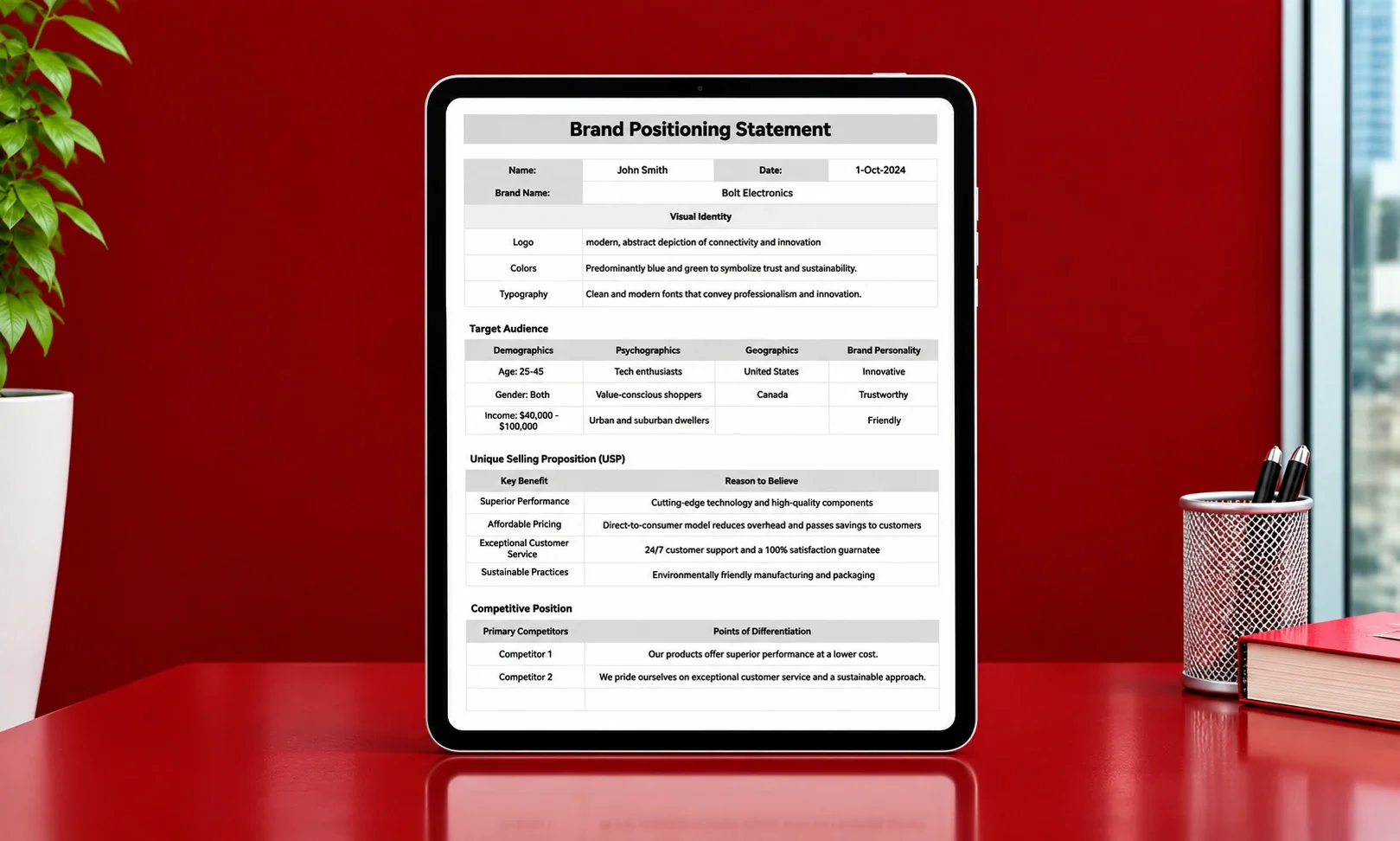
Use plain language to answer five questions:
- Who is the offer for in a relevant buying situation?
- What recognizable kind of product or service is it?
- What value does it provide?
- What alternative or limitation makes that value important?
- What evidence makes the promise credible?
A working template is:
For [customers in a defined situation], [brand] is a [recognizable category] that helps them [important outcome] through [specific capabilities or approach], supported by [relevant evidence].
This is a writing aid, not a validated formula. Change the structure if it makes your offer harder to explain.
You do not need to force every detail into a single long sentence. Two clear sentences are more useful than an elaborate paragraph nobody can remember.
The core benefit should align with the offer’s value proposition, while the positioning statement also records the competitive context and intended customer fit.
What Does a Worked Example Look Like?
Consider a fictional business called Workshop Ledger. For this illustration, assume it provides bookkeeping services to independent repair businesses, supports a defined set of payment and invoicing systems, and has documented delivery procedures.
A weak draft might read:
Workshop Ledger is an innovative financial partner empowering ambitious businesses through reliable solutions and exceptional service.
It provides almost no basis for a decision. The customer is vague, the category is unclear and the promised distinction could fit hundreds of businesses.
A more useful hypothetical draft would be:
For independent repair businesses managing invoices and payments across supported systems, Workshop Ledger is a bookkeeping service that brings those records into a consistent monthly reporting process. Its offer is supported by documented reconciliation procedures and clearly defined delivery responsibilities.
The improved version makes the offer easier to inspect. It does not claim that the fictional company is faster, cheaper or more accurate than competitors without evidence.
| Element | Weak draft | Stronger working decision |
| Customer | Ambitious businesses | Independent repair businesses using supported systems |
| Buying situation | Unspecified | Managing fragmented invoice and payment records |
| Category | Financial partner | Bookkeeping service |
| Value | Empowerment | A consistent monthly reporting process |
| Evidence | Exceptional service | Documented procedures and defined responsibilities |
| Boundary | Unspecified | Compatibility depends on the supported systems |
The example is an editorial illustration, not a case study or a claim about a real service.
What Should Sit Beside the Statement?
A short statement cannot carry the whole strategy. Add a one-page working record that makes its implications visible.
An evidence record
For each important claim, record its supporting source, limitations, owner and review date.
A response-time promise, for example, needs an explanation of working hours, channels, exclusions and the period covered by the evidence. A result observed in a limited pilot should remain identified as a pilot result.
Clear boundaries
Describe which requests fall outside the standard offer and who can approve exceptions.
For Workshop Ledger, a request involving unsupported software would trigger a compatibility review. The positioning statement does not need to list every system. The working record should point to the maintained source of that information.
Practical consequences
Ask each team to identify what the position requires from its work.
Marketing needs the right examples and claims. Sales needs qualification questions. Product or service delivery needs the promised capability. Finance needs to understand its cost.
This is also where positioning should inform a campaign brief. The distinction between strategic requirements and creative execution matters when deciding who owns the creative brief. A shared position can establish what must remain true while giving a creative team room to express it effectively.
How Can You Test Whether the Statement Is Useful?

Use a practical decision exercise before judging whether the writing sounds impressive.
Give people from different functions the same three scenarios. Ask them to decide independently, cite the statement or its supporting evidence and explain what remains unclear.
For the fictional bookkeeping service, the scenarios might be:
- A prospect uses software outside the supported list.
- Sales wants to advertise a turnaround time that has not been measured.
- An existing client requests a custom report outside the standard package.
Compare the answers. Agreement alone does not prove the strategy is right, but disagreement can expose missing boundaries, unclear ownership or competing interpretations.
This exercise is an editorial recommendation for testing internal usefulness. It is not evidence that a positioning statement will improve revenue.
Test customer understanding separately
Show prospective buyers a customer-facing explanation based on the statement. Ask what they think the offer does, who it appears to serve and what they would compare it with.
Do not treat a positive reaction as proof of demand. A buyer can understand an offer, like the language and still have no reason to purchase.
Internal consistency, customer comprehension and commercial performance require different evidence.
Should You Publish the Statement on Your Homepage?
Usually, the homepage needs a clearer public expression of the value rather than the entire internal statement.
A positioning document may include strategic detail that is useful to employees but awkward for a first-time visitor. Translate it into a headline, explanation and evidence that answer the buyer’s immediate questions.
For the fictional example, a possible headline is “Monthly bookkeeping for independent repair businesses.” The page would then explain system compatibility, deliverables, pricing and how the process works.
Those details matter more than reproducing every clause from the internal document.
When Should You Update a Positioning Statement?
Review it when the evidence or offer changes materially.
Relevant triggers include entering a different buying situation, adding a capability that changes the value of the offer, losing support for a central claim or discovering that customers consistently compare you with an unexpected alternative.
Keep a dated record of the decision and its supporting evidence. If a claim changes, identify the sales materials, campaign briefs and website pages that depend on it.
A routine review date is useful for checking accuracy. It should not become an excuse to rewrite the strategy whenever the team gets bored with familiar language.
What Is the Final Approval Checklist?
Before approving a brand positioning statement, ask:
- Does the audience description explain a relevant customer situation?
- Is the category understandable without a presentation?
- Have we investigated actual alternatives?
- Is the value important enough to deserve emphasis?
- Are claims supported by evidence we can inspect?
- Are pilot results and assumptions clearly labeled?
- Do delivery teams agree that the promise is feasible?
- Have we defined important boundaries and exception owners?
- Can different teams apply it to the same decision?
- Is there an owner responsible for reviewing the statement and its evidence?
If the answers are weak, return to the unresolved decision. Editing the sentence will not remove the uncertainty beneath it.
Frequently Asked Questions
How long should a brand positioning statement be?
There is no universal word limit. Aim for a short paragraph that communicates the essential choices clearly. Keep detailed evidence, delivery requirements and exceptions in an accompanying record.
Is a positioning statement the same as a mission statement?
No. A mission explains the organization’s purpose. A positioning statement describes the intended customer, competitive context and value of its offer. They should be compatible, but serve different decisions.
Does every product need a separate positioning statement?
Not necessarily. A separate statement is useful when a product serves a materially different buying situation, competes with different alternatives or offers a distinct kind of value. Avoid multiplying documents without a clear operational need.
Can AI write a positioning statement?
AI can help organize supplied evidence and suggest wording. It cannot establish customer preferences, competitor performance or business capabilities from invented inputs. Review every claim and keep responsibility for the strategic choices with the team.