

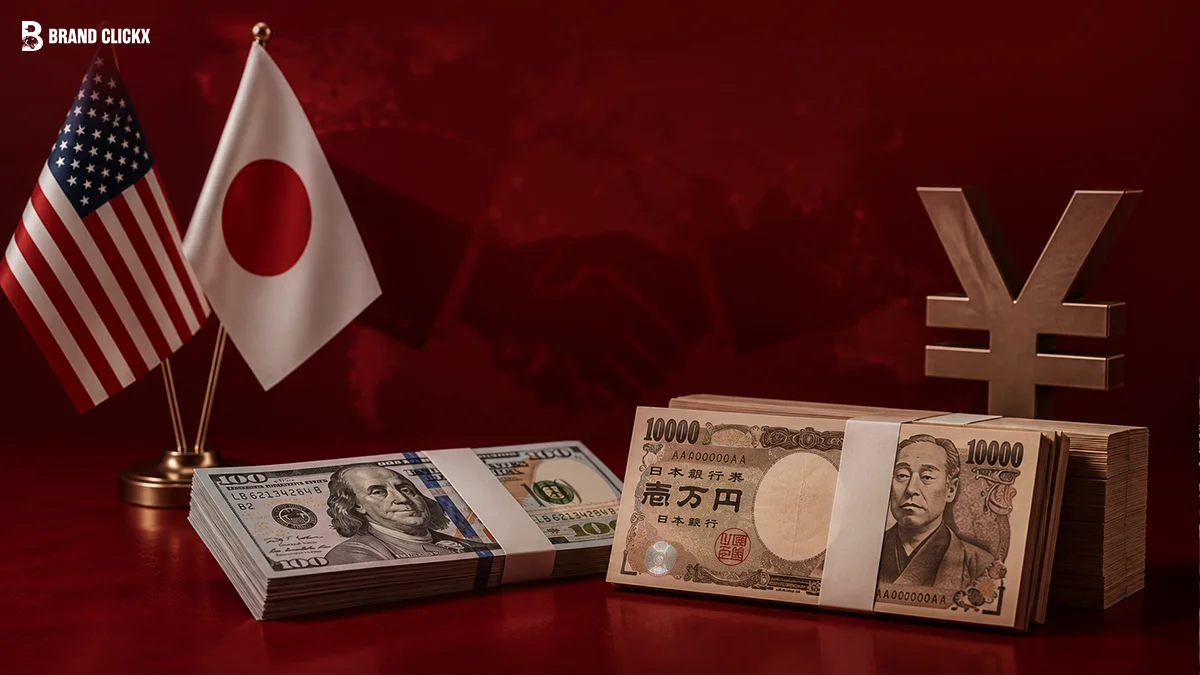
The yen hit its weakest level against the dollar since 1986. Washington and Tokyo intervened jointly on Friday, confirmed it Monday, and both finance ministers used the same phrase: they will not hesitate.
Published: Monday, 3 August 2026 | BrandClickX News Desk
This is financial news reporting, not investment advice. Currency markets move continuously and the figures here were accurate at publication. Consult a licensed financial adviser before making investment decisions.
Summary
Japan’s Ministry of Finance confirmed on Monday 3 August 2026 that it conducted coordinated yen-buying intervention with the US Treasury on Friday 31 July, after the yen fell to its weakest level against the dollar since 1986. Finance Minister Satsuki Katayama and Treasury Secretary Scott Bessent both said they would not hesitate to intervene again. The yen rose sharply on the news.
Key Takeaways
- Japan and the US conducted coordinated yen-buying intervention on Friday 31 July
- It was confirmed by both governments on Monday 3 August
- The yen had fallen to its weakest against the dollar since 1986
- It is the first joint intervention since 2011 but 2011 was to weaken the yen
- Measured as joint yen-buying, this is the first since 1998
- Bessent and Katayama both said they will not hesitate to act again
- Japan announced plans to use the Fed’s FIMA repo facility
- Trump described the action as helping an ally; officials cited disorderly markets
- Washington’s exposure runs through US Treasury yields
What Was Announced
Japan’s finance ministry said the intervention took place on Friday, jointly with the US Treasury, and was aimed at disorderly currency movements.
The ministry framed it as action against “the recent excessive volatility and disorderly movements of the yen”, carried out in accordance with the Joint Statement of the Japanese and US Finance Ministers issued in September 2025.
Treasury Secretary Scott Bessent confirmed it in parallel: “Friday’s coordinated foreign exchange actions countered disorderly yen movements.”
He added that Treasury remains attentive and in close communication with counterparts at Japan’s Ministry of Finance and the Bank of Japan, and that it “will not hesitate to participate in further joint intervention.”
Finance Minister Satsuki Katayama used near-identical language, saying Japan will not hesitate to conduct further coordinated interventions.
Japan also announced plans to use the Federal Reserve’s FIMA repo facility in future a mechanism allowing approved foreign central banks to obtain short-term dollars by temporarily exchanging US Treasury securities.
The Distinction Most Coverage Is Missing
This is being widely reported as the first joint intervention since 2011. That is true, but incomplete and the incomplete version is misleading.
The 2011 coordinated action came after the earthquake and tsunami in eastern Japan, when the yen was surging. The G7 intervened to weaken it.
Friday’s action did the opposite. Washington and Tokyo bought yen to strengthen it.
By that measure, per CNBC’s reporting, this was the first US-Japan joint operation to buy yen since 1998 a 28-year gap rather than 15.
That distinction matters. Coordinated selling of a currency and coordinated buying of it are different exercises with different mechanics and different failure modes.
How It Unfolded
| Date | Development |
| Sept 2025 | Joint Statement of Japanese and US Finance Ministers issued |
| Jan 2026 | NY Fed conducts an unusual rate check, spiking the yen |
| Jan 2026 | Katayama first flags joint intervention as an option |
| Thursday 30 July | Japan conducts yen-buying during New York trading hours |
| Friday 31 July | Coordinated intervention; Treasury tells banks to prepare |
| Sunday 2 Aug | Trump publicly confirms US support for the yen |
| Monday 3 Aug | MOF and Treasury formally confirm the joint action |
The US Treasury separately informed several banks on Friday that it could intervene, instructing them to be prepared for further action.
Market participants said authorities from both countries conducted rounds of yen buying after the currency hit its weakest level against the dollar since 1986.
Trump’s Framing
The President described it as a favour to an ally rather than a policy necessity.
Asked on Sunday why the US was helping support the yen, Trump said: “They have a weakening yen, and they wanted a little bit of help. And we’re always there for Japan.”
He characterised it as a sign of friendship and as support for the global economy.
That framing is notably different from the technical language used by both finance ministries, which described countering disorderly market movements rather than assisting a partner.
Why Washington Actually Cares
The self-interested explanation is US borrowing costs.
Analysts quoted by Reuters point to the risk that a sell-off in the yen and in Japanese government bonds spills into global markets — specifically by adding upward pressure on already rising US Treasury yields.
Japan is among the largest foreign holders of US Treasuries. Disorder in the JGB market does not stay in the JGB market.
Put simply: a disorderly yen is a problem for American borrowing costs, which makes intervention less an act of friendship than an act of self-protection. Both can be true simultaneously.
What a Stronger Yen Does
The effects run in both directions, which is why this is contested inside Japan.
Helps:
- Lower import costs, particularly energy and raw materials
- Reduced inflationary pressure on Japanese households
Hurts:
- Japanese exporters, whose overseas earnings are worth less in yen terms
- Investors holding large short-yen positions, who may be forced to unwind
Continued intervention may also increase volatility in USD/JPY rather than reduce it an outcome that would sit awkwardly with the stated goal of countering disorderly movements.
What the Analysts Say
The consistent view is that intervention buys time rather than fixing the problem.
One analyst cited by CNBC argued that if Washington believes Japan’s fiscal policies are feeding higher JGB yields and a weaker currency, coordinated intervention could buy time for the Bank of Japan until it can resume raising interest rates later this year. Her conclusion was direct: a stronger yen ultimately requires tighter Japanese monetary policy, not repeated intervention.
Jesper Koll, expert director at Monex, read the operation as reflecting a broader shift in the US-Japan relationship under President Trump and Prime Minister Sanae Takaichi.
That political reading is worth weighing. Coordinated FX intervention requires both governments to agree a currency is mispriced a rare alignment, and one that itself signals something about the state of the relationship.
The counter-argument was made in January, when analysts noted that domestic considerations in the US made coordinated dollar-selling unlikely. A weaker dollar raises import costs for American consumers. Those considerations have not disappeared; they have been outweighed.
Expert Analysis
Three things to hold in mind as this develops.
Intervention works on speed, not level. Central banks can halt a disorderly move. They cannot durably set a price against sustained interest-rate differentials. If the gap between US and Japanese rates persists, the pressure returns which is why the analyst framing around buying time for the BOJ is the most useful lens available.
The FIMA repo announcement is the underrated detail. Signalling that Japan will use the Fed’s dollar facility tells markets Tokyo has arranged dollar liquidity in advance. That is preparation for sustained operations, not a one-off.
The verbal commitment may matter more than the operation. Both ministers said they will not hesitate to act again. In FX intervention, credible threats are frequently more effective than the intervention itself, because they raise the risk of holding short-yen positions without any money being spent.
The honest uncertainty: nobody outside the two treasuries knows the scale of Friday’s operation, and neither has disclosed it.
Frequently Asked Questions
What did the US and Japan announce?
Japan’s finance ministry confirmed on 3 August that it conducted coordinated yen-buying intervention with the US Treasury on Friday 31 July, aimed at countering excessive volatility and disorderly movements in the yen.
Why did they intervene?
The yen had fallen to its weakest level against the dollar since 1986. Both governments cited disorderly market movements. Analysts point to concern that a yen and JGB sell-off could push US Treasury yields higher.
Is this the first joint intervention since 2011?
Yes for coordination, but the 2011 action was designed to weaken the yen after the earthquake. As a joint yen-buying operation, this is the first since 1998 a considerably longer gap.
Will they intervene again?
Both said they would not hesitate to. Treasury Secretary Scott Bessent said Treasury will not hesitate to participate in further joint intervention, and Finance Minister Satsuki Katayama used near-identical language.
What is the FIMA repo facility?
A Federal Reserve mechanism allowing approved foreign central banks and monetary authorities to obtain short-term dollars by temporarily exchanging US Treasury securities. Japan announced plans to use it in future.
How does a stronger yen affect Japan?
It lowers import costs, particularly for energy and raw materials, easing inflation. It also reduces the yen value of Japanese exporters’ overseas earnings, which weighs on those companies.
What did Trump say?
Asked why the US was helping, he said: “They have a weakening yen, and they wanted a little bit of help. And we’re always there for Japan,” describing it as a sign of friendship and support for the global economy.
Can intervention fix the yen’s weakness?
Analysts are sceptical. The consistent view is that it addresses speed rather than level, and that a durably stronger yen requires tighter Bank of Japan monetary policy rather than repeated market operations.
Conclusion
Two governments that rarely agree on currency levels have now agreed twice in three days once in the market on Friday, once in public on Monday.
The action was real and the yen responded. What it has not changed is the interest-rate gap driving the weakness in the first place, which is why every analyst quoted framed this as time bought for the Bank of Japan rather than a solution.
The most consequential sentence of the day was not about Friday. It was both finance ministers saying, separately and in almost identical words, that they will not hesitate to do it again.