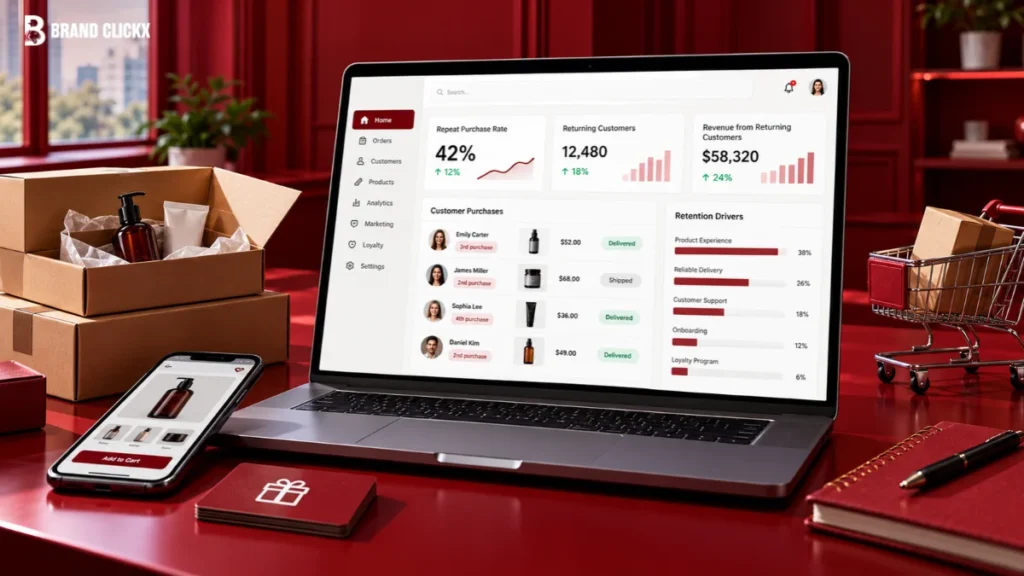
A loyalty programme can have thousands of members and still fail to change what those customers do. That is the problem with many ecommerce schemes: enrollment looks healthy, but purchase frequency, basket size, and retention barely move. In designing an Ecommerce Loyalty Programme, the important metric is not how many people joined. It is whether the reward changed a decision the customer was already likely to make.
The design question is simple: which rewards are cheap for the business to provide but highly valuable to the customer?
This article walks through six decisions: reward economics, programme structure, earn and burn rates, target customers, enrollment and reminders, and total programme cost. It then shows how to measure incremental behavior without confusing correlation with causation.
Key Takeaways
- Design rewards around business cost versus customer-perceived value, not headline discount size.
- Match the programme structure to purchase frequency.
- Model points as an economic and, where applicable, accounting obligation before launch.
- Focus incentives on customers whose behavior can still change.
- Measure active usage and incremental behavior, not enrollment alone.
- Test the programme against similar non-members before claiming it created additional sales.
What Designing an Ecommerce loyalty programme is supposed to do

A loyalty programme should do more than reward customers for purchases they were already going to make.
Imagine a customer buys skincare from your store every 3 months. You introduce a points programme, and she keeps buying every 3 months while collecting points. The programme has rewarded her behavior, but there is little evidence that it caused the behavior.
The more useful question is: Would this customer have bought anyway?
A reward becomes strategically interesting when it changes that answer. Perhaps a customer who normally buys twice a year makes a third purchase. Perhaps someone who usually spends $45 adds another item to cross a $60 threshold. Or a customer chooses your store instead of a competitor because members receive early access.
This distinction matters because loyalty programmes can look successful when measured through enrollment, member sales, or redemption alone. A member who spends $500 after joining is not automatically worth $500 of incremental revenue.
Research also shows that loyalty programme economics can be complicated. Academic research has found mixed evidence about profitability, while retailer examples show that programmes can require meaningful investment before their incremental effect becomes clear.
The goal, therefore, is not maximum participation. It is profitable behavioral change.
Decision one: Reward economics in loyalty program design ecommerce
Start with the reward, not the technology.
For every potential reward, estimate two things: what it costs you to provide and what it feels like it is worth to the customer. Those numbers can be dramatically different.
That gap is where good loyalty design becomes interesting.
| Reward | Cost to business | Perceived customer value | Margin impact | Behavior driven |
| Percentage discount | High | High | High | Immediate purchase, basket completion |
| Free shipping | Medium | High | Medium | Conversion, repeat purchase |
| Free product | Low–Medium* | High | Medium | Trial, repeat purchase |
| Early access | Low | High | Low | Faster purchase, launch engagement |
| Status/recognition | Very low | Medium–High | Very low | Retention, engagement |
| Service upgrade | Low–Medium | High | Low–Medium | Repeat purchase, premium behavior |
| Community access | Low | Medium–High | Low | Engagement, affiliation |
*Cost depends on the product’s actual contribution margin and fulfillment economics. The table is an illustrative framework, not an industry cost benchmark.
The pattern is the important part.
A 10% discount may feel valuable, but the business pays for that value directly through lost revenue. By contrast, early access may cost almost nothing to an ecommerce business while feeling exclusive to the customer. A service upgrade might have a modest operational cost but remove a meaningful source of friction.
That does not make discounts bad. Financial rewards remain important to consumers. Deloitte’s 2024 survey of more than 9,800 consumers found that financial rewards, simplicity, and ease of use were rated important or very important by 86% of respondents.
The point is to avoid assuming that the most expensive reward is automatically the most motivating.
A strong reward is inexpensive for the business but disproportionately valuable to the customer.
Contribution margin should sit beside every reward decision. If a $100 order produces $40 in contribution margin before rewards, giving away $10 does not merely reduce revenue by $10. It reduces the contribution available to cover operating costs and profit by 25%.
Before approving a reward, ask:
Customer value ÷ business cost = attractive reward economics?
The larger the gap, the more interesting the reward becomes.
Decision two: Choose the right rewards structure
The rewards structure should match how often customers naturally buy.
For high-frequency products such as coffee, pet food, supplements, or everyday consumables, points can make sense because customers have frequent opportunities to earn and redeem. A customer does not have to wait months to see progress.
For products purchased once or twice a year, the same structure can become frustrating. If a customer needs five purchases to reach the first meaningful reward, the programme may be irrelevant by the time the next purchase opportunity arrives.
Use the structure according to the behavior you want:
- Points: useful when purchases happen frequently and customers can accumulate value quickly.
- Tiers: useful when customers have meaningfully different spending levels and status can provide additional value.
- Spend thresholds: useful when you want to increase basket size or move customers toward a specific order value.
- Paid membership: useful when customers purchase frequently enough to value recurring benefits and the fee can fund those benefits.
- Simple repeat-purchase mechanics: useful when the desired behavior is straightforward, such as “buy 4, receive X.”
Status can also create value beyond monetary rewards. Research on loyalty programme structures has found that the number and design of tiers can affect consumers’ perceptions of status and exclusivity.
There is no universal best structure. The correct question is: what behavior naturally fits the customer’s purchase cycle?
Decision three: Set earn and burn rates
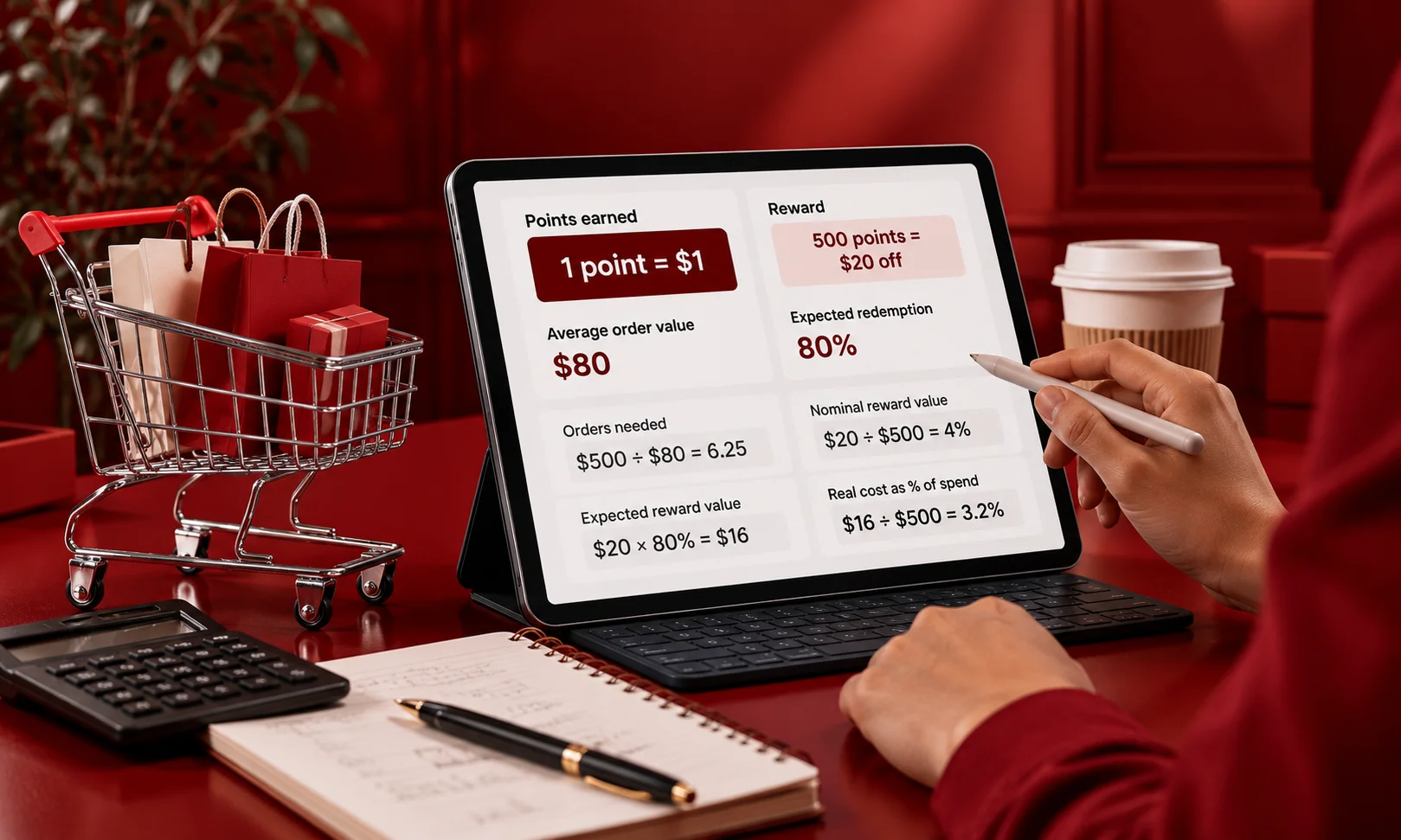
A points system needs an understandable exchange rate.
Suppose a store gives customers 1 point for every $1 spent and 100 points equals a $5 reward. The nominal reward rate is 5%.
But that is not necessarily the programme’s real cost.
You need to account for redemption, breakage, product cost, and the value of the sale on which the points were earned.
Worked example
Assume:
- Average order value: $80
- Points earned: 1 point per $1
- Reward: 500 points = $20 off
- Expected redemption: 80%
- Contribution margin before loyalty reward: 40%
A customer needs:
500 points ÷ 1 point per $1 = $500 of qualifying purchases
At an $80 average order value:
$500 ÷ $80 = 6.25 orders
The nominal reward value is:
$20 ÷ $500 = 4% of qualifying spend
If 80% of issued rewards are eventually redeemed:
$20 × 80% = $16 expected reward value
Expected reward value as a percentage of qualifying spend:
$16 ÷ $500 = 3.2%
That is only the starting point. The business still needs to consider whether the reward generates additional purchases or simply subsidizes purchases that would have happened anyway.
The other issue is liability. Under ASC 606 and IFRS 15-style revenue recognition, loyalty points can create a separate performance obligation and a contract liability because the customer has a future right to a reward. Public-company filings demonstrate how businesses estimate redemption and breakage when measuring these obligations.
Breakage is the portion of rewards customers never redeem. It should not become an excuse for an unnecessarily difficult programme. If customers routinely fail to reach the first meaningful reward, the programme may have poor behavioral economics rather than healthy breakage.
Rule of thumb: the first meaningful reward should arrive early enough that a normal customer can see a realistic path to it.
Decision four: Decide who the programme is for
Not every customer needs an incentive.
One common mistake is giving the biggest benefits to customers who already purchase frequently. If your best customers were going to remain customers anyway, an additional reward may simply transfer margin from the business to them.
The more interesting segment is often the middle.
Think about three groups:
- High-frequency customers: already buying often.
- Middle-frequency customers: buying occasionally but showing room to increase.
- Low-frequency customers: buying rarely or showing weak product fit.
The middle group can offer the clearest behavioral opportunity because there is something to change.
For example, a customer who buys every 120 days might respond to a reward that encourages a purchase around day 90. Someone who already buys every 30 days may simply collect the reward without changing their pattern.
This is where retention cohorts become useful. Divide customers by previous purchase frequency, spend, recency, and product category before they enter the programme. Then examine how each cohort behaves afterward.
The objective is not to make your highest-value customers happier at any cost. It is to identify where an incentive can produce profitable incremental behavior.
Decision five: Make the programme easy to join and remember
A customer cannot use a programme they cannot remember.
Enrollment should happen naturally during the customer journey: account creation, checkout, post-purchase communication, the customer account area, and relevant transactional messages.
But enrollment is only the first stage.
Bond’s 2025 Loyalty Report found that the average American consumer belonged to 17.4 loyalty programmes but was active in only 8.8. That gap is a useful warning: having a programme in someone’s account does not mean the programme has earned their attention.
Measure at least:
Enrolled → Active → Earned → Redeemed → Repeat behavior
A programme also needs useful reminders. Show the customer’s balance, the next reward, progress toward a threshold, and relevant opportunities to use the benefit.
This can be particularly useful for basket-building. If the customer has a $50 basket and a reward activates at $60, the message can make the threshold visible. But the economics need to work: a higher average order value is not automatically profitable if the additional discount exceeds the contribution from the extra items.
Pre-launch loyalty checklist
| Question | Pass condition |
| Is the reward valuable to customers? | Customers can explain it immediately |
| Is the reward cheap to provide? | Contribution margin remains healthy |
| Can customers reach it quickly? | First reward fits the normal purchase cycle |
| Is the target segment changeable? | Prior behavior shows room for improvement |
| Is enrollment simple? | Few steps and little information required |
| Will customers remember it? | Balance and next action are visible |
| Can finance measure the liability? | Redemption and breakage assumptions are documented |
| Can the business test incrementality? | Comparable member and non-member cohorts exist |
Decision six: Calculate what it costs before it earns
The cost of a loyalty programme is bigger than the rewards.
Your model should include:
- Initial build or implementation cost.
- Platform and administration fees.
- Customer communication costs.
- Staff and operational time.
- Reward redemption cost.
- Margin given away through discounts.
- Fulfillment or service costs created by benefits.
- Outstanding reward liability.
A programme can also change customer economics in unexpected ways. Research discussed by Wharton’s Knowledge at Wharton found that free shipping increased purchase frequency in one loyalty-programme setting but also reduced average basket size because customers had less reason to bundle items to avoid shipping costs.
That is why payback should be based on incremental contribution, not gross sales.
For example, if a programme costs $50,000 to build and operate during its first year, you need to know how much additional contribution margin it must generate to cover that investment.
If incremental contribution per additional order is $18:
$50,000 ÷ $18 = 2,778 incremental orders
That is the hurdle.
Then connect the result to customer lifetime value. If the programme increases profitable repeat behavior, the value may extend beyond the first additional order. Your customer lifetime value article can provide the broader framework.
Accounting treatment also matters. Recent SEC filings show businesses carrying loyalty-related contract liabilities and estimating redemption or breakage rather than treating every issued reward as an immediate marketing expense.
As for paid programmes, the fee should have a job. It can fund benefits that would otherwise be too expensive to provide universally, but the customer must purchase frequently enough to perceive the recurring value. Research from BCG has found particularly strong loyalty associated with paid memberships, although that does not mean a paid model is appropriate for every ecommerce category.
How to measure whether it worked

Do not compare all loyalty members with all customers and call the difference incremental revenue.
People who join loyalty programmes are often different from people who do not. They may already purchase more frequently, spend more, or have stronger brand preference.
Instead, create matched cohorts.
For example, compare newly enrolled customers with similar non-members based on:
- Previous order frequency.
- Previous spend.
- Recency.
- Product category.
- Acquisition channel.
- Geography.
- Customer tenure.
Then track changes in repeat purchase rate, contribution margin, average order value, redemption, and retention over the same period.
The key comparison is:
Change among comparable members − change among comparable non-members
You can also test the programme itself. Hold out an eligible group from a specific reward or campaign where operationally possible. That gives you a cleaner estimate of whether the incentive changed behavior.
The measurement hierarchy should be:
Enrollment → active use → behavior change → incremental contribution → payback
- A high enrollment rate is interesting.
- A high active-use rate is better.
But the number that matters financially is whether the mechanism creates enough incremental contribution to justify its full cost.
The read: Do points-based programmes have a future?
Yes, but points should not be treated as the default answer to loyalty.
The evidence suggests consumers still value financial rewards, simplicity, flexibility, and convenience. At the same time, the growing number of programmes competing for attention makes passive points balances less compelling. Bond’s 2025 research illustrates that enrollment can substantially exceed active participation, while Deloitte’s research emphasizes simplicity and flexibility as core programme attributes.
Points work when the purchase cycle supports them and the reward arrives quickly enough to matter. But the more important design question comes before points, tiers, apps, or paid membership: What customer behavior do you want to change, and what is the cheapest reward that can change it? Answer that first. Then build the programme around the economics.