Opening Story
Many English learners experience the same frustrating moment: they understand what someone says, recognize many words while reading, but struggle to create a simple sentence during a real conversation.
The problem is often not intelligence or effort; it is that they have learned random vocabulary instead of the words that people actually use every day.
Learning General English Words gives you a practical foundation for communication. These are the high-frequency words that help you understand conversations, express ideas, and build stronger language skills step by step.
In this guide, you will learn what these words are, why they matter, how they are organized, and how you can use them in daily situations. You will also discover common word categories, learning methods, limitations of vocabulary lists, and a practical approach to turning passive vocabulary into confident communication.
AI Overview:
General English words are the most frequently used vocabulary items needed for everyday communication, reading, and writing. A strong foundation of common words helps learners understand basic conversations and create meaningful sentences faster.
A useful vocabulary system focuses on high-frequency words such as verbs, nouns, adjectives, pronouns, and prepositions instead of rare terms. Research-based lists like the Oxford 3000 and frequency-based vocabulary studies help learners prioritize words that provide the greatest communication value.
Key Takeaways
- The first 500 high-frequency English words can provide approximately 60% to 65% coverage of general written and spoken texts according to corpus-based vocabulary research.
- General English vocabulary focuses on practical words used in conversations, reading, writing, work, travel, and daily activities.
- Structural words such as pronouns, prepositions, and conjunctions create the foundation that allows sentences to function correctly.
- Common verbs like “be,” “have,” “make,” “take,” “go,” and “know” are highly valuable because they appear in many different situations.
- Learning words through sentences, context, and repetition is more effective than memorizing isolated definitions.
- A 500-word foundation can help beginners achieve basic communication, but advanced fluency requires thousands of additional words.
- Modern vocabulary learning is moving toward personalized systems that adapt word lists according to learner needs and digital behavior.
What Are General English Words?
General English words are the most commonly used words in everyday English communication. They include basic verbs, nouns, adjectives, pronouns, prepositions, and common expressions needed for speaking, reading, and writing. Learning these words helps beginners build a strong vocabulary foundation and communicate more effectively.
What Are General English Words?
Definition and Meaning of General English Words
A General English Words list is a collection of high-frequency vocabulary that helps learners develop functional communication skills. Instead of focusing on specialized terms, it prioritizes words people use repeatedly in normal conversations and written content.
These words include everyday actions, objects, emotions, descriptions, and sentence-building elements. For example, words like “go,” “home,” “happy,” “because,” and “with” may look simple, but they appear constantly in real communication.
The idea behind core vocabulary is based on a simple principle: a small group of frequently used words can create a large impact on understanding.
According to research using the Oxford Corpus Collection, the first 500 commonly used words can cover approximately 60% to 65% of general written and spoken English.
This does not mean 500 words make someone fully fluent. Instead, these words create the base that allows learners to understand more language and add advanced vocabulary over time.
How General English Vocabulary Developed
The concept of a limited core vocabulary is not new. Linguists have studied for decades which words provide the highest value for language learners.
In 1930, C.K. Ogden introduced Basic English, a system built around 850 words designed to support international communication. The idea was that learners could express many basic concepts using a carefully selected vocabulary.
Later, Michael West developed the General Service List (GSL) in 1953. It identified around 2,000 frequently useful words for learners of English as a foreign language.
Modern vocabulary research became more accurate with digital language databases. Resources such as the British National Corpus (BNC) and the Corpus of Contemporary American English (COCA) allowed researchers to analyze real language usage instead of relying only on traditional dictionaries.
Today, vocabulary lists continue evolving through resources such as the Oxford 3000, Oxford 5000, and Cambridge English Vocabulary Profile.
Why Learning General English Words Is Important They Build Your Communication Foundation
When you start learning English, thousands of words can feel overwhelming. A frequency-based vocabulary approach removes that confusion by helping you focus on words that appear most often.
Words such as “need,” “want,” “make,” “go,” and “get” can be combined in many ways to create useful sentences.
For example:
- I need water.
- I want to go home.
- She makes food.
- They get ready.
These simple structures allow beginners to communicate before they know advanced vocabulary.
They Improve Speaking, Reading, Writing, and Listening
Vocabulary affects every major language skill.
When you recognize common English words quickly, your brain spends less effort searching for meanings and more effort understanding the message.
Corpus studies show that mastering high-frequency vocabulary improves reading efficiency because learners encounter fewer unknown words.
A strong foundation also improves speaking because familiar words become easier to recall during conversations.
They Reduce Learning Difficulty
Many learners make the mistake of memorizing uncommon words before mastering basic vocabulary.
Learning a rare word that appears once in a year provides less value than learning a common word used hundreds of times.
A structured vocabulary approach reduces cognitive load because common words become automatic.
For example, understanding words like “and,” “but,” “because,” “with,” and “from” helps you connect ideas naturally.
How General English Words Are Organized
Structural Words: The Foundation of Sentences
Structural words are small words that connect ideas and create sentence relationships.
Although they may seem less important than nouns or verbs, they are essential for correct communication.
Examples include:
| Category | Examples |
| Articles | a, an, the |
| Pronouns | I, you, he, she, they |
| Prepositions | in, on, at, with, under |
| Conjunctions | and, but, because, although |
Without these words, sentences become difficult to understand.
Compare:
“I go market.”
“I go to the market.”
The preposition “to” creates the relationship between the action and destination.
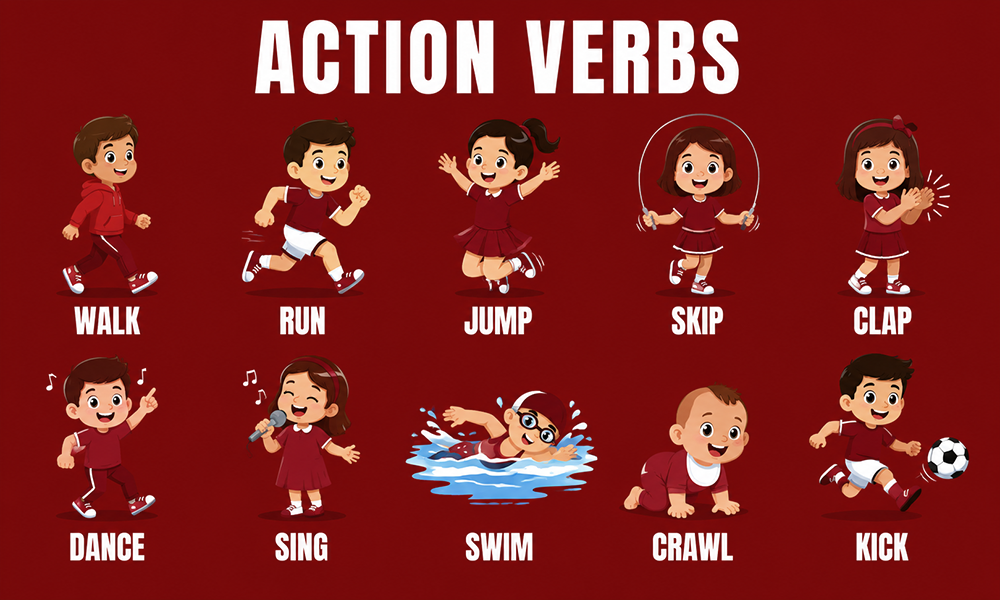
Primary Action Verbs: The Engine of English
Verbs are among the most powerful words in English because they describe actions, situations, and thoughts.
Common high-frequency verbs include:
| Verb | Example |
| Be | I am happy. |
| Have | I have a book. |
| Do | I do my work. |
| Make | She makes dinner. |
| Take | Take your phone. |
| Go | We go home. |
| Know | I know the answer. |
A small number of flexible verbs can support many conversations.
For example, the verb “get” has several meanings:
- Receive: I get a gift.
- Arrive: I get home.
- Understand: I get it.
- Become: I get angry.
This is why learning usage is more valuable than memorizing only definitions.
General English Words: 500+ Common Words, Meanings, Examples & Daily Usage Guide (2026)
Everyday Nouns: The Anchors of Communication
Nouns represent the people, places, objects, and ideas around you. They help you describe your environment and communicate specific information.
Without common nouns, even simple conversations become difficult because you cannot identify what you are talking about.
Some essential noun categories include:
| Category | Examples |
| People | friend, family, teacher, child, person |
| Places | home, school, office, city |
| Objects | book, phone, food, water |
| Time | day, night, year, week |
| Ideas | problem, idea, reason, question |
These words appear frequently because they connect directly with daily experiences.
For example:
“I read a book.”
“She works at an office.”
“We meet our friends on Sunday.”
A learner who understands common nouns can quickly create useful sentences by combining them with basic verbs.
Descriptive Words: Adding Meaning to Communication Common Adjectives
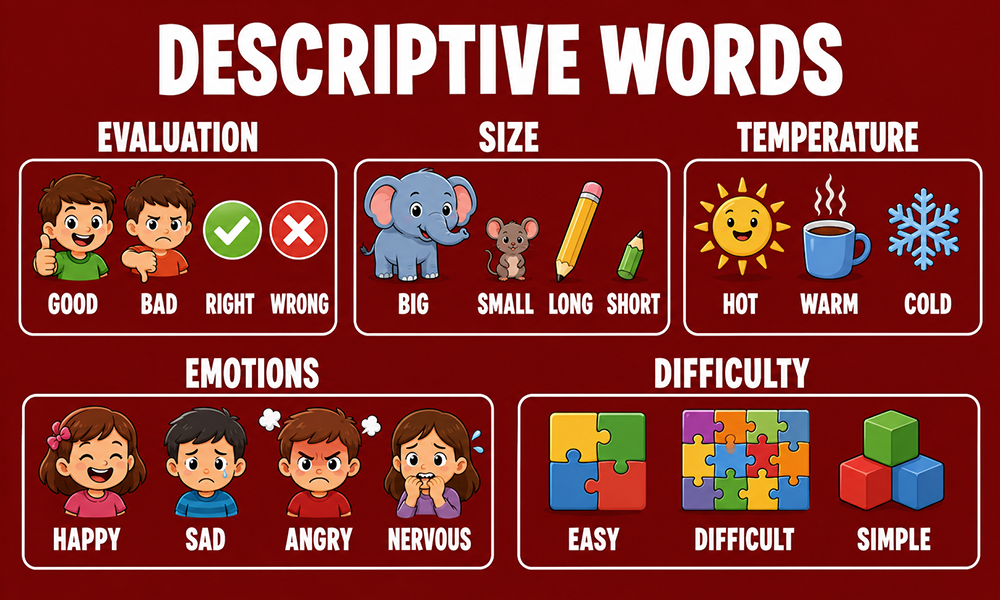
Adjectives help you explain qualities, feelings, sizes, and conditions.
They make communication clearer because they answer questions like:
- What kind?
- How big?
- How good?
- How difficult?
Common examples include:
| Category | Examples |
| Evaluation | good, bad, right, wrong |
| Size | big, small, long, short |
| Temperature | hot, cold, warm |
| Emotions | happy, sad, angry, nervous |
| Difficulty | easy, difficult, simple |
Compare these sentences:
“I bought a phone.”
“I bought a new phone.”
The adjective “new” gives extra information and creates a clearer picture.
Common Adverbs
Adverbs describe how, when, or how often something happens.
Examples:
| Adverb | Example |
| Always | I always study English. |
| Often | She often reads books. |
| Quickly | He runs quickly. |
| Usually | We usually eat together. |
These words are especially useful for conversations because they help explain habits and routines.
Social and Functional English Words
Some words are not complex, but they are extremely important because they help people interact politely.
Common examples include:
- Hello
- Please
- Thank you
- Sorry
- Excuse me
- Goodbye
- Welcome
- Maybe
These expressions are often the first words learners use when communicating in a new language.
A beginner may not know thousands of words, but knowing basic social expressions can make everyday interactions easier.
500+ General English Words With Meanings and Examples
A useful vocabulary list should not be a random collection of words. The best approach is to organize words according to how people actually use them.
The following categories represent the core vocabulary system used by many language-learning frameworks.
Everyday Action Words
| Word | Meaning | Example Sentence |
| Accept | Receive or agree with something | I accept your idea. |
| Ask | Request information | I want to ask a question. |
| Become | Start to be something | She became a teacher. |
| Begin | Start something | The class begins today. |
| Bring | Carry something to a place | Bring your book tomorrow. |
| Build | Create something | They build houses. |
| Buy | Get something by paying | I buy food every week. |
| Change | Make something different | I want to change my plan. |
| Choose | Select something | Choose the best option. |
| Come | Move toward a place | Come with me. |
| Create | Make something new | They create useful tools. |
| Decide | Choose after thinking | I decided to study English. |
| Develop | Grow or improve | She develops new skills. |
| Find | Discover something | I found my keys. |
| Give | Provide something | Give me a minute. |
| Help | Support someone | Can you help me? |
| Keep | Continue having something | Keep your book safe. |
| Learn | Gain knowledge | I learn new words daily. |
| Make | Create or do something | I make breakfast. |
| Need | Require something | I need more practice. |
| Open | Move something to access inside | Open the door. |
| Put | Place something somewhere | Put the phone here. |
| Remember | Keep information in your mind | Remember this word. |
| Take | Move or receive something | Take your bag. |
| Think | Use your mind | Think about the answer. |
| Use | Apply something | Use this sentence. |
| Want | Desire something | I want to improve. |
| Work | Perform an activity | I work every day. |
Common Feelings and Emotion Words
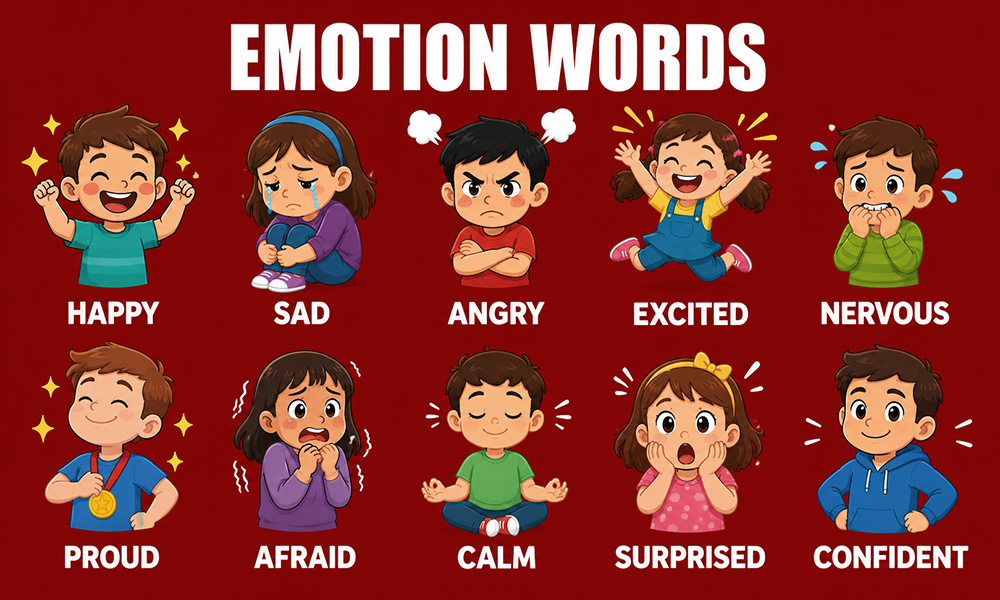
Understanding emotions helps you express yourself naturally.
| Word | Meaning | Example |
| Happy | Feeling good | I feel happy today. |
| Sad | Feeling unhappy | She looks sad. |
| Angry | Feeling upset | He is angry about the problem. |
| Excited | Feeling enthusiastic | I am excited about learning. |
| Nervous | Feeling worried | I feel nervous before speaking. |
| Proud | Feeling satisfaction | She is proud of her progress. |
| Afraid | Feeling fear | He is afraid of failure. |
| Calm | Peaceful state | Stay calm during the exam. |
| Surprised | Unexpected feeling | I was surprised by the result. |
| Confident | Believing in yourself | Practice makes you confident. |
Daily Conversation Words
These words appear frequently in normal conversations.
| Word | Example Usage |
| Hello | Hello, how are you? |
| Please | Please help me. |
| Thanks | Thanks for your support. |
| Sorry | Sorry, I was late. |
| Maybe | Maybe we can meet tomorrow. |
| Really | I really like this idea. |
| Always | I always practice English. |
| Never | I never forget my goals. |
| Enough | That is enough for today. |
| Again | Please say it again. |
Useful Descriptive Words
These words help you explain situations more clearly.
| Word | Example |
| Beautiful | The view is beautiful. |
| Important | This lesson is important. |
| Different | Everyone has different ideas. |
| Simple | Keep the explanation simple. |
| Strong | He has strong skills. |
| Weak | The signal is weak. |
| Fast | This computer is fast. |
| Slow | The internet is slow. |
| Easy | This exercise is easy. |
| Difficult | This topic is difficult. |
Why Context Matters More Than Memorization
Many learners memorize long vocabulary lists but forget words after a few days.
The reason is simple: the brain remembers information better when it connects words with situations.
For example, learning the word “prepare” alone is less effective than learning:
“I prepare my notes before class.”
The sentence creates a memory connection between the word, action, and situation.
Modern vocabulary learning methods focus on contextual clustering. Instead of studying isolated words, learners connect verbs with related nouns and situations.
A Practical Comparison: Vocabulary Learning Methods
| Method | Strength | Weakness |
| Random Word Lists | Easy to start | Words are forgotten quickly |
| 500 Common Words Approach | High daily usefulness | Limited advanced expression |
| Oxford 3000 | Strong general coverage | Requires more time |
| Academic Word List | Useful for university writing | Not focused on daily conversation |
The best approach depends on your goal.
Who Should Use a 500+ General English Word System?
Beginners
This approach is ideal if you are starting English because it focuses on words you will immediately use.
You can build sentences, understand basic conversations, and develop confidence.
Travelers
A core vocabulary helps travelers handle situations like:
- Asking directions
- Ordering food
- Booking accommodation
- Understanding signs
English Learners Preparing for Higher Levels
A strong foundation makes advanced learning easier because complex sentences are built from common words.
Who Should Avoid Depending Only on a 500-Word List?
A 500-word system should not be your only learning method if your goal is:
- Professional-level writing
- Academic research
- Complex discussions
- Native-like fluency
Research shows that an average adult native English speaker may have an active vocabulary of approximately 20,000 to 35,000 words.
A beginner vocabulary foundation is valuable, but advanced communication requires continuous expansion.
The Limitations of Learning Only General English Words
A strong foundation of common vocabulary creates progress, but it also has boundaries. Understanding these limitations helps you build a smarter learning strategy.
Many beginners believe that memorizing a fixed list of words will automatically create fluency. In reality, vocabulary is only one part of language ability.
The Polysemy Problem: One Word Can Have Many Meanings
English contains many words that change meaning depending on context.
The word “get” is one common example.
It can mean:
- Receive: I get a gift.
- Arrive: I get home at six.
- Understand: I get it.
- Become: I get angry.
A simple vocabulary list may introduce the word, but real learning requires understanding how native speakers use it in different situations.
This is why example sentences and daily practice are more valuable than memorizing definitions alone.
Vocabulary Lists Cannot Replace Listening Skills
Knowing common words helps you recognize language, but listening requires additional skills.
Native speakers often use:
- Different speaking speeds
- Connected sounds
- Informal expressions
- Idioms
A learner with 500 words may understand basic conversations, but following movies or advanced discussions usually requires a much larger vocabulary.
Research from vocabulary learning frameworks suggests that understanding movies without subtitles generally requires around 2,000 to 3,000 words.
Limited Vocabulary Can Reduce Expression
A small vocabulary allows basic communication, but it may limit how precisely you express ideas.
For example:
“This movie is good.”
A larger vocabulary allows:
“This movie is impressive.”
“This movie is meaningful.”
“This movie is entertaining.”
Advanced words provide more emotional and professional accuracy.
Unique Insights Most Vocabulary Articles Miss
Most competitor articles focus only on lists of words.
However, effective vocabulary learning depends on how you use those words after learning them.
General English Words Should Be Learned Through Sentence Patterns
A common mistake is learning:
Word → Translation → Memorization
A better approach is:
Word → Meaning → Sentence → Real Situation
For example:
Instead of memorizing:
“Need = require something”
Learn:
“I need help.”
“I need more time.”
“I need to practice English.”
This creates a reusable language pattern.
The Most Powerful Words Are Often Simple Words
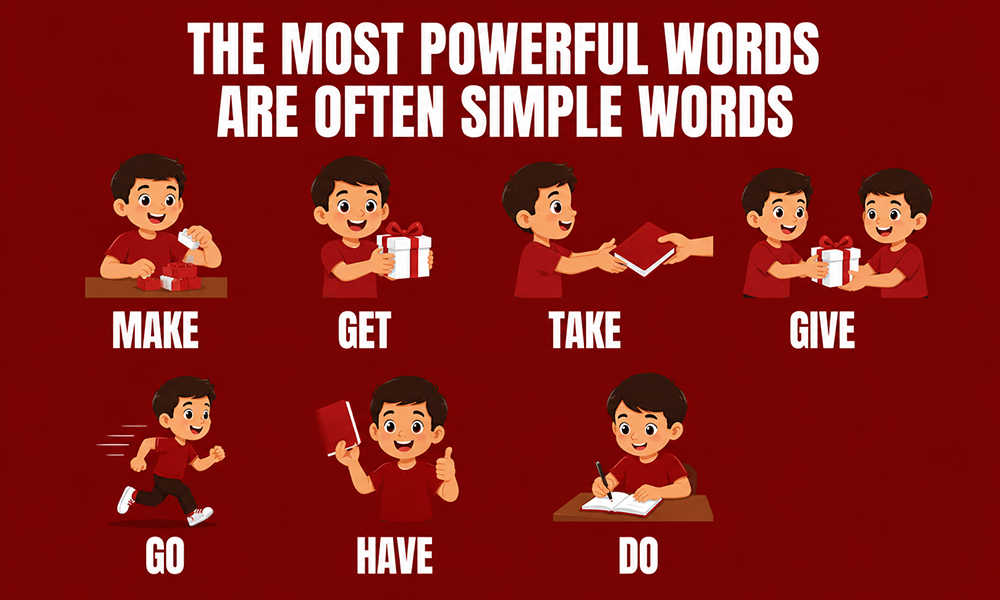
Many learners chase difficult vocabulary because advanced words appear impressive.
However, simple words often create the foundation of communication.
Words like:
- Make
- Get
- Take
- Give
- Go
- Have
- Do
appear in countless situations.
A learner who understands these flexible verbs can communicate more effectively than someone who knows hundreds of rare words but struggles with everyday sentences.
Vocabulary Learning Is Moving Toward Personalization
Traditional vocabulary lists were static.
Modern language learning is becoming more personalized through AI-powered systems and digital learning platforms.
In 2026, many learning platforms focus on situational micro-learning, where vocabulary is adapted according to a learner’s goals, profession, and digital habits.
Companies such as Duolingo use personalized learning systems and spaced repetition methods to introduce vocabulary gradually.
Platforms like Anki and Memrise also use spaced repetition systems to improve long-term memory.
Real-World Examples of Core Vocabulary Systems
Simple English Wikipedia
Simple English Wikipedia demonstrates how controlled vocabulary can make complex information easier to understand.
The project uses simplified language principles inspired by restricted vocabulary approaches, allowing learners and younger readers to access educational information.
Duolingo Beginner Curriculum
Duolingo’s beginner learning paths focus heavily on high-frequency vocabulary before introducing uncommon terms.
The idea is simple: learners first need practical words like “please,” “thank you,” and everyday verbs before specialized vocabulary.
Aviation Simplified Technical English
Aviation communication uses controlled language systems to reduce misunderstanding between international teams.
Simplified Technical English uses a limited vocabulary approach to make safety instructions clearer.
This shows that carefully selected vocabulary is useful beyond classrooms.
Thing Explainer by Randall Munroe
Randall Munroe’s book Thing Explainer demonstrates how complex ideas can be explained using very common English words.
The book uses approximately the 1,000 most common words to describe complicated systems and scientific concepts.
How General English Words Compare With Other Vocabulary Systems
| Vocabulary System | Word Count | Best For | Strength | Limitation |
| 500 Common Words List | Around 500 | Beginners and travelers | Fast practical communication | Limited expression |
| Oxford 3000 | Around 3,000 | Intermediate learners | Strong general language coverage | Requires longer study |
| Academic Word List | Around 570 word families | University learners | Helps formal writing | Less useful for daily conversation |
The right choice depends on your goal.
Someone learning English for travel needs different vocabulary from someone preparing academic research.
Practical Application: How to Learn 500+ General English Words Effectively
Learning vocabulary becomes easier when you follow a structured process.
The goal is not only to recognize words but to use them naturally.
Step 1: Start With High-Frequency Words
Begin with words that appear everywhere.
Focus on:
- Common verbs
- Basic nouns
- Pronouns
- Prepositions
- Everyday expressions
Examples:
- I
- You
- Need
- Want
- Go
- Come
- Home
- Work
- Time
These words create immediate communication ability.
Step 2: Create Simple Sentence Frames
Do not study words separately.
Build reusable sentence patterns.
Examples:
“I need ______.”
“I want to ______.”
“I have ______.”
“I like ______.”
These structures allow you to create many sentences using limited vocabulary.
Step 3: Practice Vocabulary in Daily Situations
Connect words with your routine.
Morning:
“I wake up.”
“I drink water.”
“I prepare breakfast.”
Work:
“I answer emails.”
“I complete tasks.”
“I learn new skills.”
Personal experiences create stronger memory connections.
Step 4: Review With Spaced Repetition
Memory decreases when information is not reviewed.
Tools such as Anki and Memrise use spaced repetition methods to help learners review vocabulary at effective intervals.
A practical schedule:
- Learn 10–15 new words daily.
- Review older words regularly.
- Use new words in sentences.
With consistent practice, learners can memorize 500 words within approximately 30 to 50 days using structured spaced repetition methods.
Step 5: Move From Recognition to Speaking
Recognizing a word while reading is different from using it during conversation.
Practice transforming:
“I understand the word.”
into:
“I can use the word naturally.”
Speaking practice turns passive vocabulary into active communication.
30-Day Vocabulary Improvement Plan
| Time Period | Focus |
| Days 1–7 | Learn basic verbs, nouns, and sentence structures |
| Days 8–15 | Add daily conversation words and descriptions |
| Days 16–23 | Practice speaking and writing sentences |
| Days 24–30 | Review, combine words, and create conversations |
This approach builds vocabulary gradually without overwhelming your memory.
Conclusion
Many English learners start with the same challenge: they know some words but cannot use them confidently in real conversations. The solution is not collecting thousands of random terms; it is building a strong foundation with useful vocabulary and practicing it consistently.
General English Words create that foundation by focusing on high-frequency vocabulary that appears in everyday communication. They help you understand sentences, express basic ideas, and develop the confidence needed for further learning.
The learner who once struggled to create a simple sentence can gradually build fluency by connecting words with real situations, practicing regularly, and expanding vocabulary step by step.
Language is not built from memorizing words alone. It grows when those words become part of how you think and communicate.
Frequently Asked Questions About General English Words
What are general English words?
General English words are frequently used vocabulary items for everyday speaking, reading, and writing. They include common nouns, verbs, adjectives, pronouns, and expressions that help learners build basic communication skills.
How many words do I need to speak English fluently?
There is no fixed number because fluency depends on your goals and practice. A 500-word foundation helps with basic communication, but advanced fluency requires a much larger vocabulary.
Can I be fluent in English with only 500 words?
No, 500 words are not enough for complete fluency. However, they can help you handle basic conversations and create simple sentences.
What are the most common English words?
The most common English words include structural words like “the,” “and,” “of,” “to,” and “in,” along with verbs like “be,” “have,” “do,” and “make.” These words appear frequently in everyday communication.
How can I improve my English vocabulary quickly?
Focus on high-frequency words, learn them in sentences, and practice daily. Spaced repetition tools like Anki and Memrise can help you remember new vocabulary.
What is the Oxford 3000?
The Oxford 3000 is a list of 3,000 important English words selected by Oxford University Press. It helps learners improve vocabulary for communication, reading, and writing.
Are 500 common English words enough for watching movies?
No, 500 words are usually not enough for understanding movies. Most learners need around 2,000–3,000 words to follow movies more comfortably.
How long does it take to learn 500 English words?
With consistent practice and learning 10–15 words daily, you can memorize 500 words in around 30–50 days. Regular use is needed to remember them long term.