
INTRODUCTION
Something quietly broke in small business SEO last year, and most owners still haven’t noticed.
It didn’t announce itself. There was no algorithm update headline, no industry-wide panic, no Google blog post that said: “The rules changed. Adapt or disappear.” But the shift happened anyway, steadily, structurally, and with compounding consequences for anyone still running a 2022 playbook in 2026.
Here’s what the data now confirms: when a Google search generates an AI-powered summary, users click through to a traditional website just 8% of the time, compared to 15% when no AI summary appears.
The click-through rate for organic results didn’t just drop, it nearly halved. For small businesses that built their lead generation on organic traffic, this is the kind of number that reframes an entire strategy.
And yet, the other side of this story is equally striking. AI-driven SEO campaigns are delivering a 45% boost in organic traffic and a 38% rise in e-commerce conversions for businesses that have adapted. The AI SEO tools market, valued at $1.2 billion in 2024, is projected to reach $4.5 billion by 2033, growing at a 15.2% CAGR.
Small businesses account for a significant share of that demand, with 67% of SMBs already using AI for content and SEO strategies.
What’s actually happening is a bifurcation. Small businesses that understand the new search landscape, one where ranking in Google’s blue links is only part of the battle, and where getting cited by ChatGPT, Gemini, and Perplexity is increasingly where discovery happens, are building durable competitive advantages.
The rest are watching their traffic slowly erode while wondering why their keyword-stuffed blog posts stopped performing.
This guide cuts through both the hype and the complacency. It covers the 16 best AI SEO tools built specifically for small business realities, limited budgets, small teams, no dedicated SEO headcount, and maps them against the actual challenges these businesses face in 2026’s fractured search environment.
Understanding the New Search Landscape Before Choosing Any Tool
Before you spend a dollar on AI SEO software, you need to understand the terrain you’re operating in. Because the tools that win in 2026 aren’t necessarily the same ones that dominated in 2023.
The Three Arenas of Search Visibility
Modern search visibility for a small business now exists across three distinct arenas, each requiring different content approaches and, increasingly, different tools.
Traditional organic search, Google’s standard ranked results, remains dominant by volume. But its click-through dynamics have changed. Long-tail and conversational queries are increasingly intercepted by AI Overviews before users ever scroll to the organic listings.
Queries of ten or more words trigger AI summaries roughly 53% of the time, compared to just 8% for short queries. Short-tail SEO, the bread and butter of most small business SEO strategies, is becoming less reliable as a traffic driver.
AI Overviews and featured answer positions, Google’s integrated AI responses that appear above organic results, are now the most contested real estate in search. Critically, research from BrightEdge shows that only about 17% of sources cited in AI Overviews overlap with the traditional top-10 organic results.
That means ranking well in traditional search does not automatically earn you AI Overview citations. They operate by different rules, which is why a new category of tools has emerged specifically to help businesses track and optimize for them.
Generative engine platforms, ChatGPT, Perplexity, Gemini, and Claude, are becoming primary discovery channels for a growing segment of consumers. AI tool adoption among U.S. users jumped from approximately 8% in 2023 to 38% in 2025, and the shift toward AI-first information discovery is accelerating.
For small businesses, the implication is stark: 92% of brands are currently invisible to ChatGPT, meaning most businesses have zero representation in the answers these platforms deliver to millions of users every day.
What Generative Engine Optimization (GEO) Actually Means
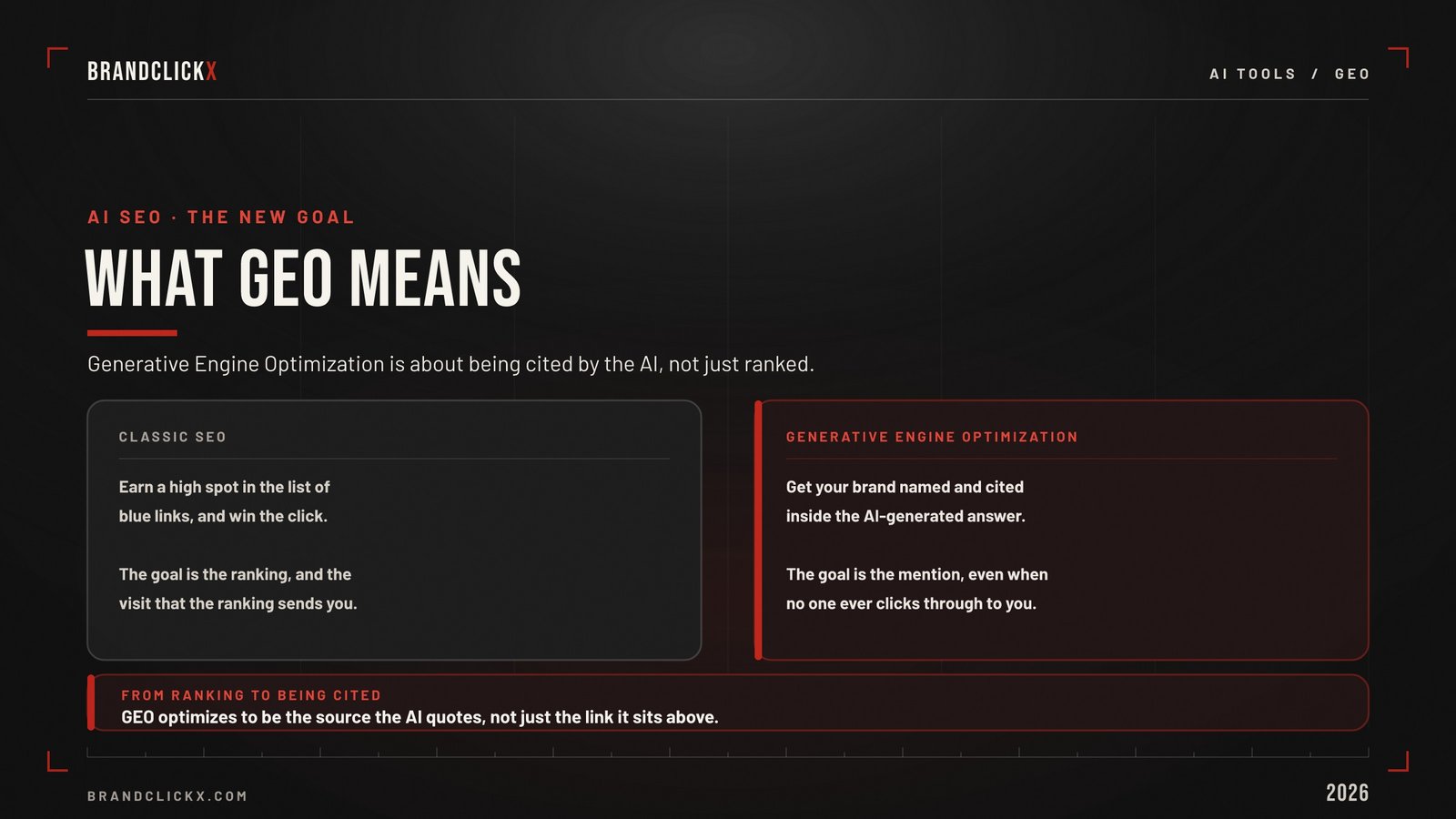
GEO, Generative Engine Optimization, is the discipline of structuring your content and digital presence so that AI-powered platforms can retrieve, cite, and recommend your brand when answering user questions.
If traditional SEO was about earning a spot among ten blue links, GEO is about earning a place among the two to seven domains a large language model typically cites in a single response.
The competition is structurally different: there are fewer “positions,” the evaluation criteria are less transparent, and the signals that matter, topical authority, structured data, credibility across the web, require sustained investment rather than technical shortcuts.
For small businesses, this creates an unusual opportunity. Many competitive queries in local and niche markets have weak GEO coverage because larger incumbents haven’t fully adapted their content either.
Early movers who structure their content for AI extraction, direct answers, clear headings, robust schema markup, and genuine topical depth, can establish AI visibility before the space consolidates.
Research shows that pages optimized for GEO see up to 40% higher AI search visibility. The principles are practical: answer questions directly at the top of each section, use clear headings that match how people ask questions, include schema markup so AI systems can parse your content accurately, and build topical depth by covering a subject comprehensively rather than superficially.
The AI SEO Tool Landscape: How to Think About Categories
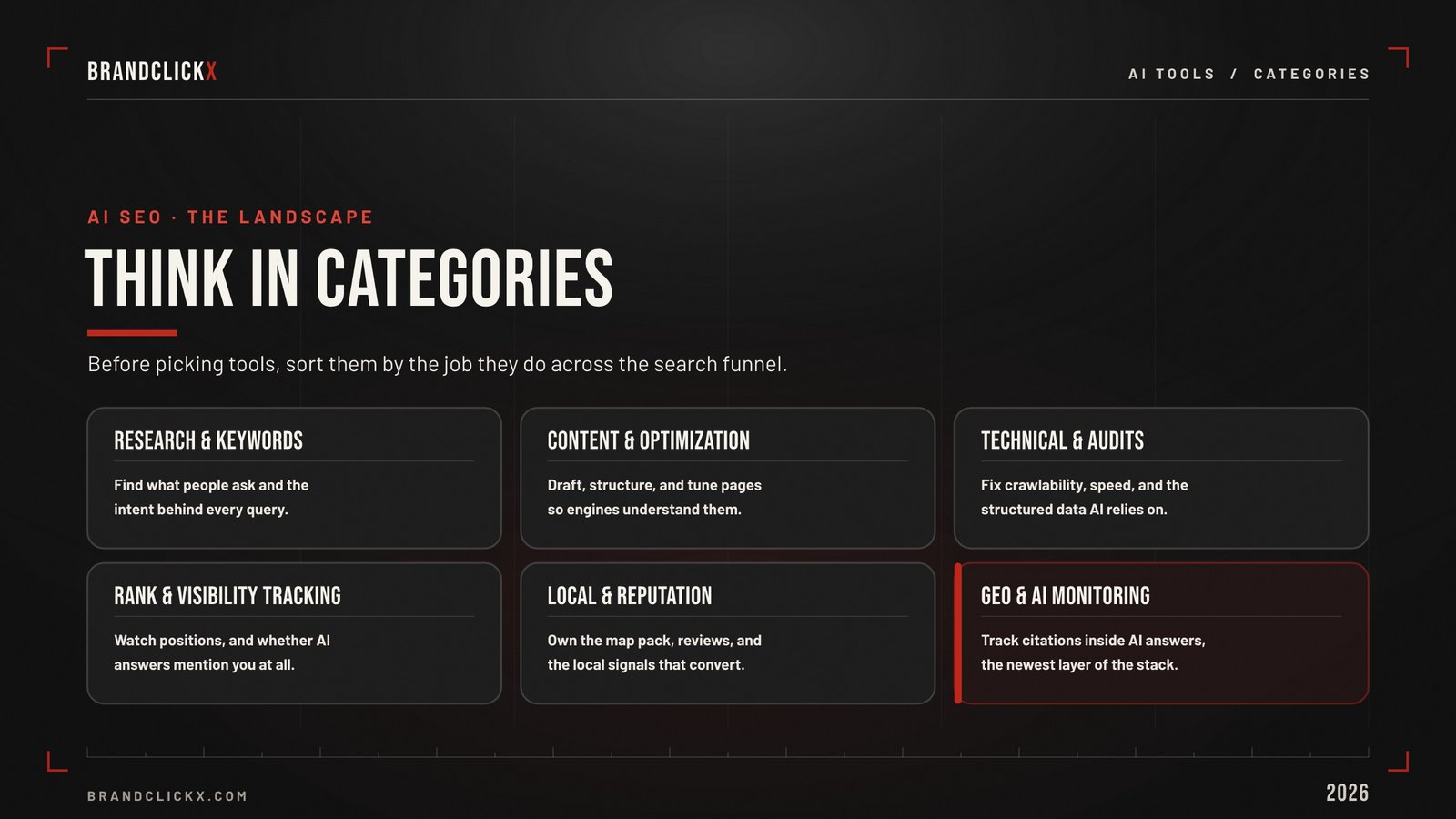
The market for AI SEO tools has splintered into distinct functional categories. Understanding these categories before evaluating specific tools prevents the single most common mistake small businesses make: paying for features they don’t need while missing the capabilities they do.
| Category | Primary Function | Best For | Price Range |
| All-in-One SEO Platforms | Keyword research, audits, backlinks, tracking | Established businesses with full SEO programs | $65–$140/month |
| Content Optimization Tools | On-page scoring, NLP optimization, brief generation | Teams producing regular editorial content | $49–$99/month |
| AI Visibility / GEO Trackers | Brand citations in ChatGPT, Perplexity, AI Overviews | Any business serious about AI search presence | $29–$295/month |
| Autonomous SEO Agents | End-to-end automated SEO execution | Time-strapped owners who want hands-off management | $295–$699+/month |
| Budget Starter Tools | Basic keyword tracking, site audits | New businesses, very limited budgets | $0–$30/month |
| Local SEO Tools | Google Business Profile, local citations, maps | Brick-and-mortar and service-area businesses | $40–$79/month |
The honest answer for most small businesses is a stack of two or three tools, not one magic solution. A research platform for demand and keyword data, a content optimization tool for the writing process, and either a GEO tracker or a local SEO platform depending on your business model covers the majority of use cases at a reasonable cost.
The 16 Best AI SEO Tools for Small Business in 2026
1. Semrush, The All-in-One Standard
Best for: Small businesses that want one platform to handle keyword research, competitive analysis, site audits, content optimization, and AI visibility tracking. Pricing: From $139.95/month
Semrush has earned its reputation as the most complete SEO platform in the market, and its 2026 iteration makes a stronger case for small business adoption than ever.
The platform now connects traditional SEO and AI visibility in a single workflow, covering keyword research, competitor analysis, rank tracking, AI Overviews monitoring, and content optimization without forcing users to stitch together multiple dashboards.
For small businesses, the Co-pilot feature is worth paying attention to. It uses machine learning to surface prioritized recommendations based on your site’s specific profile, so owners who don’t have deep SEO knowledge can act on intelligent guidance rather than drowning in raw data.
The case against: at $139.95/month for the base plan, Semrush is a meaningful budget commitment for a single-person business. And for businesses that only need content optimization or rank tracking, it’s likely more tool than they need.
Strategic fit: Use Semrush as your research and competitive intelligence layer. Pair it with Surfer SEO for content-level optimization if you’re producing editorial content at volume.
2. Ahrefs, The Data Purist’s Choice
Best for: Businesses where backlink strategy is central to growth, and teams that want the most reliable keyword and link data in the industry. Pricing: From $129/month
Ahrefs built its reputation on the industry’s most comprehensive backlink database, and that core strength hasn’t changed.
For small businesses in competitive verticals where domain authority is a genuine ranking factor, law, finance, health, e-commerce, understanding the link landscape of your competitors is essential intelligence, and Ahrefs delivers it more accurately than anyone else.
The platform’s Brand Radar feature, launched in 2025, extends Ahrefs into AI visibility territory by tracking how brands appear in AI-generated responses. It’s not as purpose-built for GEO as dedicated tools, but for teams already invested in the Ahrefs ecosystem, it reduces the need for a separate AI monitoring tool.
The case against: Ahrefs has historically been weaker on content optimization and writing workflow integration compared to Surfer SEO. Teams looking for help at the content production stage often supplement it with a dedicated writing tool.
Strategic fit: Ahrefs is the right choice for businesses where link building and domain authority are explicit growth levers. If you’re choosing between Ahrefs and Semrush, the deciding question is: do you need the most reliable link data (Ahrefs), or the most comprehensive marketing platform (Semrush)?
3. Surfer SEO, The Content Optimization Standard
Best for: Any business producing regular content that needs to compete on-page against established SERP incumbents. Pricing: From $99/month (Essential), $49/month for starter tier
Surfer SEO has become the default content optimization tool for serious editorial teams, and its position in 2026 is arguably stronger than ever. The Content Editor analyzes top-ranking pages for any keyword and provides real-time scoring on keyword usage, structure, word count, and topical coverage.
G2 reviewers rate it at 4.8 out of 5, with 93.5% of reviews coming from small business users, a signal that the platform genuinely serves this segment.
What makes Surfer strategically important in 2026 is that its NLP-based content scoring aligns well with how AI systems evaluate content quality.
Content optimized for Surfer’s entity and topical coverage metrics tends to perform well in both traditional rankings and AI Overview citations, even though Surfer isn’t explicitly a GEO tool.
The case against: Surfer has no backlink data, rank tracking, or site audit capabilities. It is a writing and optimization tool, not a research platform. The Essential plan caps at 30 articles per month, which constrains high-volume operations.
Strategic fit: Surfer is the production tool, not the research tool. It answers the question: “How do I make this piece of content competitive?” not “What should I write about?”
4. SE Ranking, Best Value All-in-One
Best for: Small to mid-sized businesses that want professional-grade SEO data without enterprise-level pricing. Pricing: From $65/month
SE Ranking has quietly become one of the most compelling options in the market for budget-conscious small businesses that don’t want to sacrifice capability.
The platform offers accurate keyword tracking across 100+ search engines, detailed site audits, backlink monitoring, and white-label reporting, all at a price point that undercuts both Semrush and Ahrefs.
Its 2026 updates added AI visibility monitoring alongside traditional SEO, making it a legitimate two-in-one for businesses entering the GEO space. Data accuracy is solid, typically within 10-15% of Google Search Console numbers, comparable to more expensive platforms.
Strategic fit: SE Ranking is the smart default for businesses that need comprehensive SEO coverage but are managing the tool budget carefully. It’s also a strong choice for small agencies managing multiple client accounts who need white-label reporting without Semrush’s price tag.
5. Surfer AI + Google Search Console (Free Combo)
Best for: Early-stage small businesses with limited budgets that need to prioritize intelligently. Pricing: Google Search Console is free; Surfer starter tier from $49/month
This combination deserves separate mention because it’s often overlooked: Google Search Console, properly configured and regularly reviewed, provides more actionable insight than many paid tools.
It tells you exactly which queries your pages are appearing for, what your average position is, and where click-through rates are underperforming, all from first-party data.
Combined with Surfer’s content optimization, a business can run a surprisingly effective SEO program at under $50/month. The limitation is competitive intelligence, you can’t see what competitors are doing, but for businesses in the earliest stages of building organic presence, this stack delivers outsized value per dollar.
6. Ubersuggest, The True Beginner’s Entry Point
Best for: Small businesses just starting with SEO who want to understand the basics without financial commitment. Pricing: From $0 (limited free version) to $29/month
Ubersuggest, built by Neil Patel, occupies the accessible entry point in the AI SEO market. The platform offers keyword research, basic site audits, content ideas, and a Chrome extension for quick SERP analysis.
Its AI features are more basic than enterprise tools, but for a business that has never done systematic SEO, Ubersuggest teaches the fundamentals while delivering real data.
The honest assessment: Ubersuggest’s data depth doesn’t match Semrush or Ahrefs. But for a business spending $0–30/month on SEO tools, it provides genuine value and a legitimate starting point for building SEO literacy.
7. Mangools / KWFinder, The Low-Competition Keyword Specialist
Best for: Small businesses in niche markets looking to find realistic keyword opportunities they can actually rank for. Pricing: From $29/month (entry tier)
Mangools bundles five SEO tools, KWFinder, SERPChecker, SERPWatcher, LinkMiner, and SiteProfiler, in a clean interface designed for ease of use rather than overwhelming power users.
KWFinder in particular excels at surfacing low-competition keyword opportunities that small businesses can realistically rank for, without requiring an advanced understanding of SEO metrics to interpret the results.
For businesses in specific niches where the mainstream tools surface primarily high-competition terms, Mangools often finds the gaps that others miss. It’s not a complete SEO suite, but it punches well above its price on keyword discovery for emerging content programs.
8. Search Atlas + OTTO SEO, The Autonomous Recommendation Engine
Best for: Small businesses and agencies that want automated, continuous site monitoring with actionable recommendations. Pricing: Competitive with mid-tier platforms
Search Atlas has gained meaningful traction as a powerful alternative to legacy platforms at a lower cost. Its differentiator is OTTO SEO, an AI assistant that monitors your website automatically and delivers recommendations without requiring manual intervention.
Add a tracking pixel, and OTTO continuously analyzes technical issues, content opportunities, and ranking changes, surfacing prioritized action items rather than raw dashboards.
For small business owners who understand that SEO work needs to happen continuously but lack the time to do it consistently, OTTO’s proactive alert model is more practical than a platform that requires regular manual audits to surface insights.
9. Surfer + Jasper AI, The Content Production Stack
Best for: Businesses that need to produce content at scale with consistent quality and brand voice. Pricing: Surfer from $99/month + Jasper from $49/month
When content volume is the bottleneck, the Surfer-Jasper combination is the most battle-tested stack in the market. Surfer provides the strategic brief and optimization targets; Jasper handles drafting with brand-governed parameters.
Together they allow teams producing 8–10 articles per month to operate with the efficiency previously available only to agencies.
The important caveat: AI-generated content at scale requires rigorous human editing and fact-checking before publication. Google’s Helpful Content system is specifically designed to detect and penalize content that lacks genuine expertise and original contribution. The tools accelerate production; they don’t replace editorial judgment.
10. HubSpot AEO, The AI Visibility Specialist
Best for: B2B businesses and SaaS companies that need structured tracking of brand presence in AI answer engines. Pricing: From $50/month
HubSpot AEO represents a new category of tool built specifically for the GEO era. Rather than traditional SEO metrics, it focuses on how your brand appears across AI answer engines, ChatGPT, Gemini, Perplexity, Claude, and helps identify the gaps that prevent citation.
For businesses where brand authority and category leadership matter, professional services, B2B SaaS, consulting, understanding your AI Share of Voice is increasingly as important as your organic rank position. HubSpot AEO does this better than any tool that treats AI visibility as an add-on feature.
11. Otterly, Budget GEO Tracking
Best for: Small businesses that want essential AI visibility monitoring without enterprise pricing. Pricing: From $29/month
Otterly provides entry-level AI visibility tracking at a price point accessible to most small businesses. It monitors brand citations across major AI platforms and surfaces basic optimization recommendations. It lacks the depth of HubSpot AEO or Scrunch AI, but for a business spending under $100/month on tools, it provides a meaningful window into AI search performance.
12. BrightLocal, Local SEO and GBP Management
Best for: Brick-and-mortar businesses, service-area businesses, and any company where local search visibility drives customer acquisition. Pricing: From $39/month
BrightLocal remains the standard platform for local SEO management, covering Google Business Profile optimization, local citation building, review monitoring, and local rank tracking.
In 2026, its importance has grown because local queries are among the most likely to trigger AI-powered search responses, and AI systems rely heavily on structured local data when constructing location-specific answers.
For a plumber, restaurant, retailer, or any business dependent on local discovery, BrightLocal should be considered foundational infrastructure rather than an optional add-on.
13. Localo, GBP Optimization Specialist
Best for: Small businesses that want focused, AI-assisted Google Business Profile optimization. Pricing: From $24/month
Localo is a purpose-built platform for Google Business Profile optimization, using AI to identify gaps in GBP listings and surface recommendations for improving local search visibility. For businesses in competitive local markets where the GBP listing often determines whether a customer calls or scrolls past, Localo’s focused approach delivers targeted value that generalist platforms often miss.
14. RankMath (WordPress), On-Page Optimization for Content Sites
Best for: WordPress-powered small business sites that need comprehensive on-page SEO guidance baked into the publishing workflow. Pricing: Free (core) / From $69/year (Pro)
RankMath is the leading SEO plugin for WordPress, offering schema markup generation, on-page optimization scoring, internal linking suggestions, and AI-powered content analysis directly within the WordPress editor.
For content-driven small businesses on WordPress, blogs, media brands, local service sites, RankMath eliminates the need for a separate on-page optimization tool by integrating those capabilities into the writing workflow itself.
The free tier is genuinely useful; the Pro version adds content AI features, advanced schema, and keyword rank tracking.
15. Clearscope, Enterprise Content Intelligence for Content-Heavy SMBs
Best for: Businesses where content is the primary growth channel and content quality benchmarks need to be consistently high. Pricing: From $189/month
Clearscope competes directly with Surfer SEO in the content optimization category but takes a slightly different approach, prioritizing semantic richness and content grading over real-time word count targets.
For businesses producing editorial content at high volume where content quality benchmarking matters, Clearscope’s grading system provides a consistent quality standard across writers.
The price point puts it above many small business budgets, but for content-first businesses where organic traffic drives meaningful revenue, the investment is defensibl
16. MEGA SEO Agent, Autonomous End-to-End Execution
Best for: Small business owners who want comprehensive SEO execution without any hands-on involvement. Pricing: From $699/month
MEGA SEO Agent represents the autonomous end of the AI SEO spectrum. Rather than providing data for a human to act on, it operates as an AI agent that handles technical SEO auditing, content optimization, internal linking, rank monitoring, and performance reporting, continuously and without manual prompting.
For small business owners who understand that SEO is essential but genuinely cannot dedicate time to it, MEGA’s model removes the execution burden entirely. The trade-off is cost and control: at $699/month, it’s a significant commitment, and delegating execution to an AI agent requires trust in the platform’s strategic judgment.
The Strategic Framework: Building a Stack That Fits Your Business
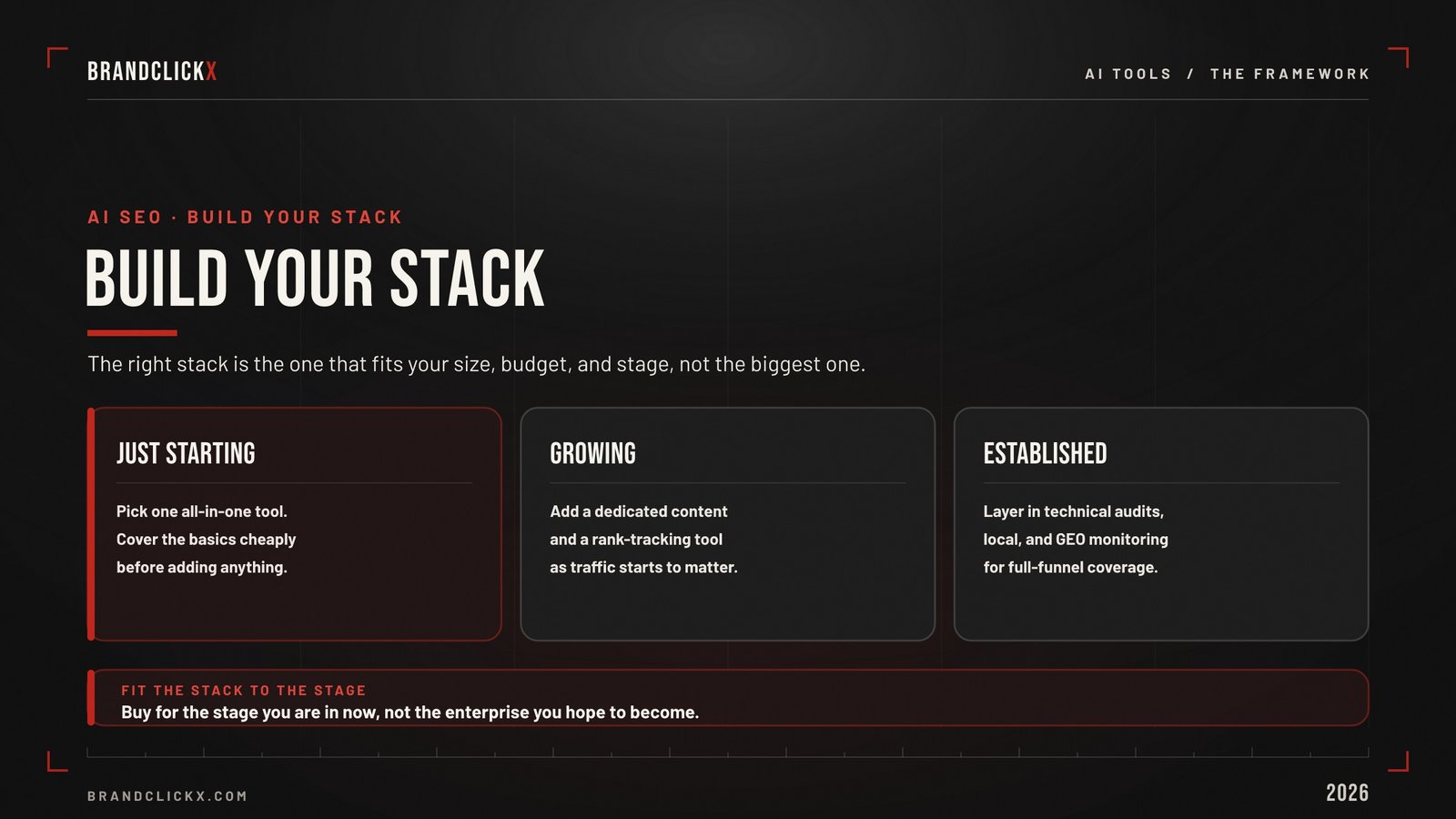
The most common mistake small businesses make with AI SEO tools is trying to solve the wrong problem.
A business with no existing content program doesn’t need an advanced AI visibility tracker, it needs a keyword research tool and a content optimization platform.
A local restaurant doesn’t need Clearscope’s semantic richness scoring, it needs an optimized Google Business Profile and a system for generating and responding to reviews. A B2B SaaS startup doesn’t need BrightLocal, it needs to understand its AI Share of Voice.
The Budget-Stage Framework
Under $50/month: Start with Google Search Console (free) and SE Ranking or Ubersuggest for keyword data. Add RankMath if you’re on WordPress. This covers keyword discovery, technical health monitoring, and on-page optimization fundamentals.
$50–$150/month: Add Surfer SEO for content optimization and Otterly for basic GEO tracking. At this budget level, you have research, content production guidance, and a window into AI search visibility.
$150–$300/month: Move to Semrush or Ahrefs as your primary research and analytics platform, retain Surfer for content, and add either HubSpot AEO for AI visibility or BrightLocal for local SEO depending on your business model.
$300+/month: Layer in autonomous tools like Search Atlas’s OTTO or MEGA SEO Agent if execution time is genuinely constrained. At this level, you’re buying back hours as much as you’re buying data.
The Business-Type Framework
| Business Type | Priority Tools | Secondary Tools |
| Local Service Business | BrightLocal, Localo | SE Ranking, Surfer |
| E-commerce Brand | Semrush, Surfer SEO | Ahrefs, HubSpot AEO |
| Content / Media Brand | Surfer, Clearscope | Ahrefs, Search Console |
| B2B SaaS / Professional Services | HubSpot AEO, Semrush | Ahrefs, Surfer |
| Early-Stage / Solo Founder | SE Ranking or Ubersuggest | RankMath, Google Search Console |
Common Mistakes Small Businesses Make with AI SEO Tools
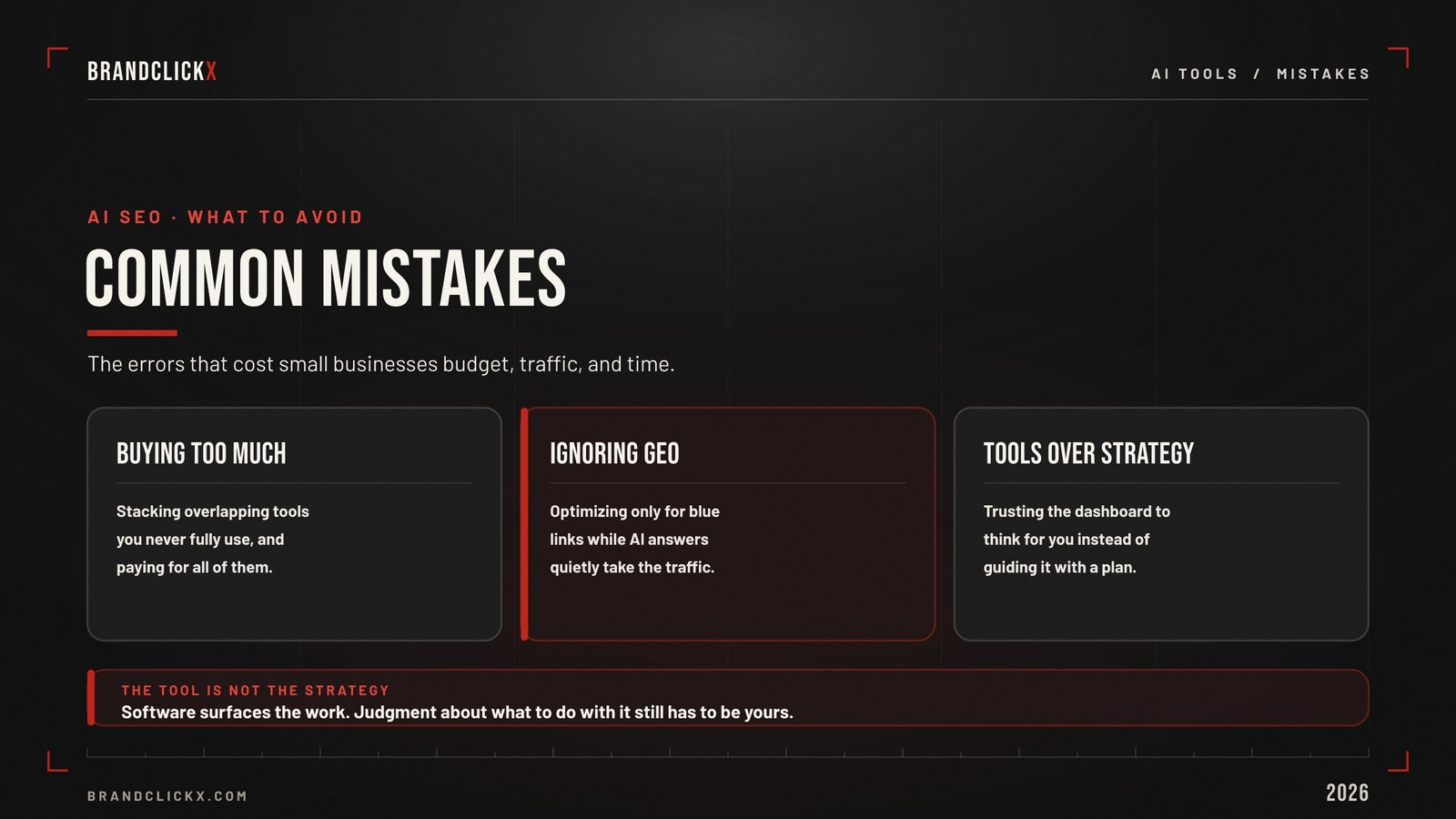
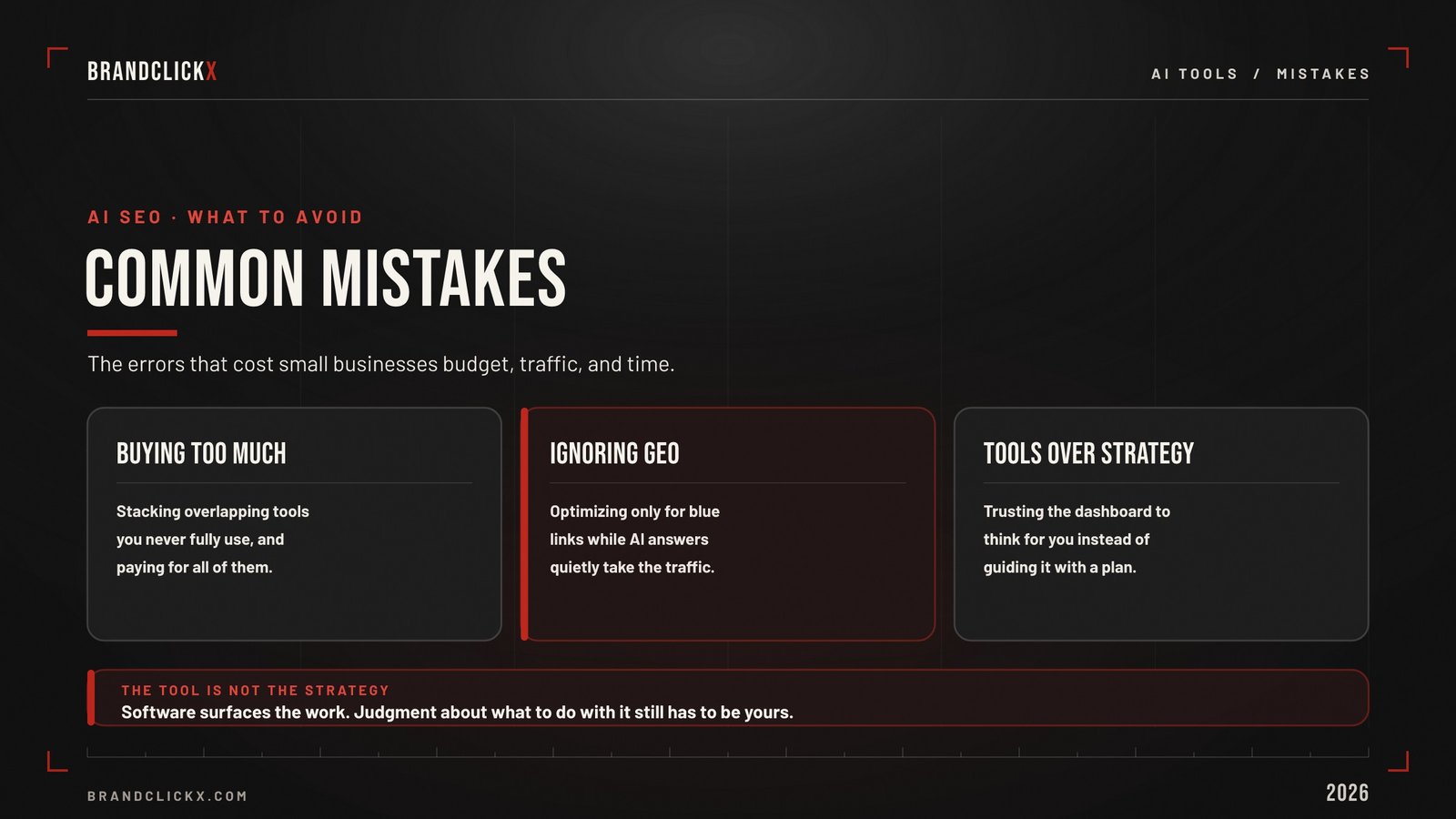
The proliferation of AI SEO tools has created a new category of failure mode: businesses that have the tools but use them wrong. These patterns are consistent enough across the market to be worth naming directly.
Publishing AI content without editorial review. Numerous sites that initially saw gains from AI-generated content have experienced dramatic traffic collapses after Google’s quality updates targeted mass-produced, low-value content.
AI tools accelerate content production; they don’t replace the judgment that makes content genuinely useful. Every piece needs a human edit for accuracy, original perspective, and on-brand voice.
Optimizing for 2022 keywords in a 2026 search environment. People no longer type “plumber Birmingham” into search. They ask “who is the best emergency plumber near me that is open on Sundays and takes Apple Pay.”
That conversational phrasing is how AI assistants invite queries, and it’s what gets rewarded when a model selects a source. Businesses still targeting three-word keywords are missing the questions their customers are actually asking.
Treating GEO as optional. AI Overview citations on competitive queries can deliver visibility that previously required months of link building. The businesses establishing AI search authority now, while coverage in most niches is still sparse, are building advantages that will compound as AI search matures.
Buying more tools than the team can operationalize. A $500/month tool stack that nobody uses consistently delivers worse ROI than a $65/month platform that gets reviewed every week. The marginal value of additional tools drops sharply when the fundamentals, consistent content, clean technical health, basic link building, aren’t yet in place.
Ignoring structured data and schema markup. AI systems are significantly more likely to cite content that uses proper schema markup because it makes content machine-readable in a structured, reliable way. RankMath on WordPress handles much of this automatically, but businesses without it often miss the infrastructure that enables AI citation.
The GEO Imperative: What Small Businesses Need to Do Now
GEO isn’t a separate strategy from SEO, it’s an extension of the same underlying discipline. Businesses that have built genuine topical authority, published content that answers real questions directly, and maintained clean technical infrastructure are already well-positioned for GEO. The specific additions that move the needle in AI search are practical and implementable.
Answer questions directly at the top of each content section. Large language models extract answers from structured, clearly organized content. Pages that bury their main point in paragraph five perform poorly in AI Overview citation even when they rank well traditionally.
Build topical clusters, not isolated pages. AI systems evaluate domain authority in part through the breadth and coherence of a site’s topical coverage. A business with twenty well-connected pieces on a single topic signals more authority than one with a single long page trying to cover everything at once.
Establish presence beyond your own website. AI platforms pull information from across the web, industry publications, review platforms, social media, partner sites. A business that appears only on its own domain has a structurally limited AI search footprint.
Monitor your AI visibility actively. Without tracking tools like HubSpot AEO or Otterly, you have no visibility into how AI systems are representing, or misrepresenting, your brand. The businesses that will own AI search in their categories are the ones monitoring it now, when the signals are still forming.
Frequently Asked Questions
What is the best AI SEO tool for small businesses with limited budgets?
For budgets under $50/month, SE Ranking offers the strongest combination of keyword tracking, site auditing, and AI visibility features at an accessible price. Google Search Console, which is free, should be configured and monitored as a complement regardless of which paid tool you choose.
How is AI SEO different from traditional SEO?
Traditional SEO focuses on ranking in Google’s blue-link results by optimizing for keywords, backlinks, and page experience. AI SEO includes all of that, but adds Generative Engine Optimization (GEO), structuring content so that AI platforms like ChatGPT, Perplexity, and Google AI Overviews can retrieve, cite, and recommend your brand when answering user questions. A page can rank well in traditional search and still be invisible in AI-generated answers.
Do I need to use multiple AI SEO tools, or can one platform do everything?
Most small businesses benefit from two to three complementary tools rather than a single platform. A typical high-value stack combines a research tool (Semrush, Ahrefs, or SE Ranking), a content optimization tool (Surfer SEO or Clearscope), and either a GEO tracker or a local SEO platform depending on your business model.
Is Surfer SEO worth the cost for small businesses?
For businesses producing regular editorial content, at least four to six articles per month, Surfer SEO delivers measurable improvement in content competitiveness and is generally worth the cost. For businesses publishing occasional updates without a deliberate content strategy, it’s less likely to justify the investment.
What is Generative Engine Optimization (GEO)?
GEO is the practice of structuring your content and digital presence so that AI-powered search platforms, ChatGPT, Google AI Overviews, Perplexity, Claude, cite and recommend your brand in their generated answers. Unlike traditional SEO, GEO prioritizes direct answer structures, clear topical authority, robust schema markup, and credibility signals across the broader web.
How do small businesses track their AI search visibility?
Dedicated tools including HubSpot AEO, Otterly, Scrunch AI, and Profound track brand mentions and citations across major AI platforms. SE Ranking and Semrush have also added AI visibility dashboards in their 2025-2026 updates. Google Search Console tracks AI Overview impressions for queries where your pages appear in Google’s AI-generated summaries.
Can AI-generated content hurt my SEO?
Yes, if published without proper human review and editorial quality control. Google’s Helpful Content system actively identifies and penalizes content that lacks original expertise and genuine value, regardless of how it was produced. AI tools should be used to accelerate production, not to replace the editorial judgment that makes content worth ranking.
How much should a small business spend on AI SEO tools?
A realistic range for a functional AI SEO stack is $65–$300/month depending on business size and content volume. Businesses just starting out can build a meaningful program for $65–$100/month. Businesses with active content operations and competitive markets should budget $150–$300/month for a capable stack. Fully managed autonomous solutions start around $699/month.
What’s the biggest mistake small businesses make with AI SEO tools?
Publishing AI-generated content without human editing is the most consistently damaging mistake. The second most common is buying tools they don’t consistently operationalize. The third is continuing to target short, generic keywords rather than adapting to the conversational, long-form queries that AI search systems prioritize.
Is local SEO affected by the AI search shift?
Significantly. Local queries are among the most commonly intercepted by AI Overviews and AI assistant responses. Google’s AI systems draw heavily on structured local data, Google Business Profile listings, local citations, and review content, when constructing location-specific answers. Local businesses that maintain accurate, comprehensive local data across platforms have a structural advantage in local AI search.
How long does it take to see results from AI SEO?
Traditional SEO results typically manifest between six and twelve months for new content investments. AI Overview citations can appear faster for well-structured content on queries where AI coverage is still thin. Local GBP improvements can impact local visibility within weeks. The compounding nature of SEO means early investments continue generating returns for years, B2B companies average a 748% three-year ROI from consistent SEO investment, according to First Page Sage research.
Do free AI SEO tools provide real value for small businesses?
Google Search Console is genuinely powerful and completely free. RankMath’s free WordPress plugin provides substantial on-page optimization capability. Ubersuggest’s free tier offers limited but real keyword data. These free tools are starting points, not long-term solutions, but for a business building its first SEO program, they’re a legitimate foundation.
What makes content AI Overview-worthy?
Content that earns AI Overview citations typically features direct answers at the top of relevant sections, clear and descriptive heading structures, robust schema markup, comprehensive topical coverage on its subject, and strong credibility signals, including authoritative backlinks and consistent brand presence across the web.
Should small businesses invest in autonomous AI SEO agents?
Autonomous SEO agents like MEGA SEO Agent are worth evaluating for businesses where owner time is genuinely the binding constraint on SEO execution. For businesses with capacity to implement recommendations manually, starting with a research and content optimization stack is more cost-effective and preserves strategic control.
How will AI SEO tools evolve through the rest of 2026?
The trend toward agentic SEO, where AI tools handle full workflow execution from keyword research to publication and tracking, will accelerate. GEO tracking will become a standard feature of all major platforms rather than a specialty add-on. Real-time content optimization that adapts to AI search behavior patterns as they emerge will become the baseline expectation for premium tools.
Closing Perspective
The AI search revolution hasn’t made SEO harder, it’s made the gap between businesses that understand it and businesses that don’t significantly wider.
The fundamentals haven’t changed. Produce content that genuinely answers the questions your audience is asking. Build authority through consistency and credibility. Maintain the technical hygiene that lets search systems read and trust your site. What has changed is the number of arenas where that content needs to perform, and the specificity of the signals that each arena rewards.
Small businesses that treat GEO as an extension of their existing content discipline, rather than a separate, intimidating new system, will adapt faster than those waiting for a single tool to solve it for them. The tools covered in this guide are the infrastructure. The strategy is still yours to build.