Show Image
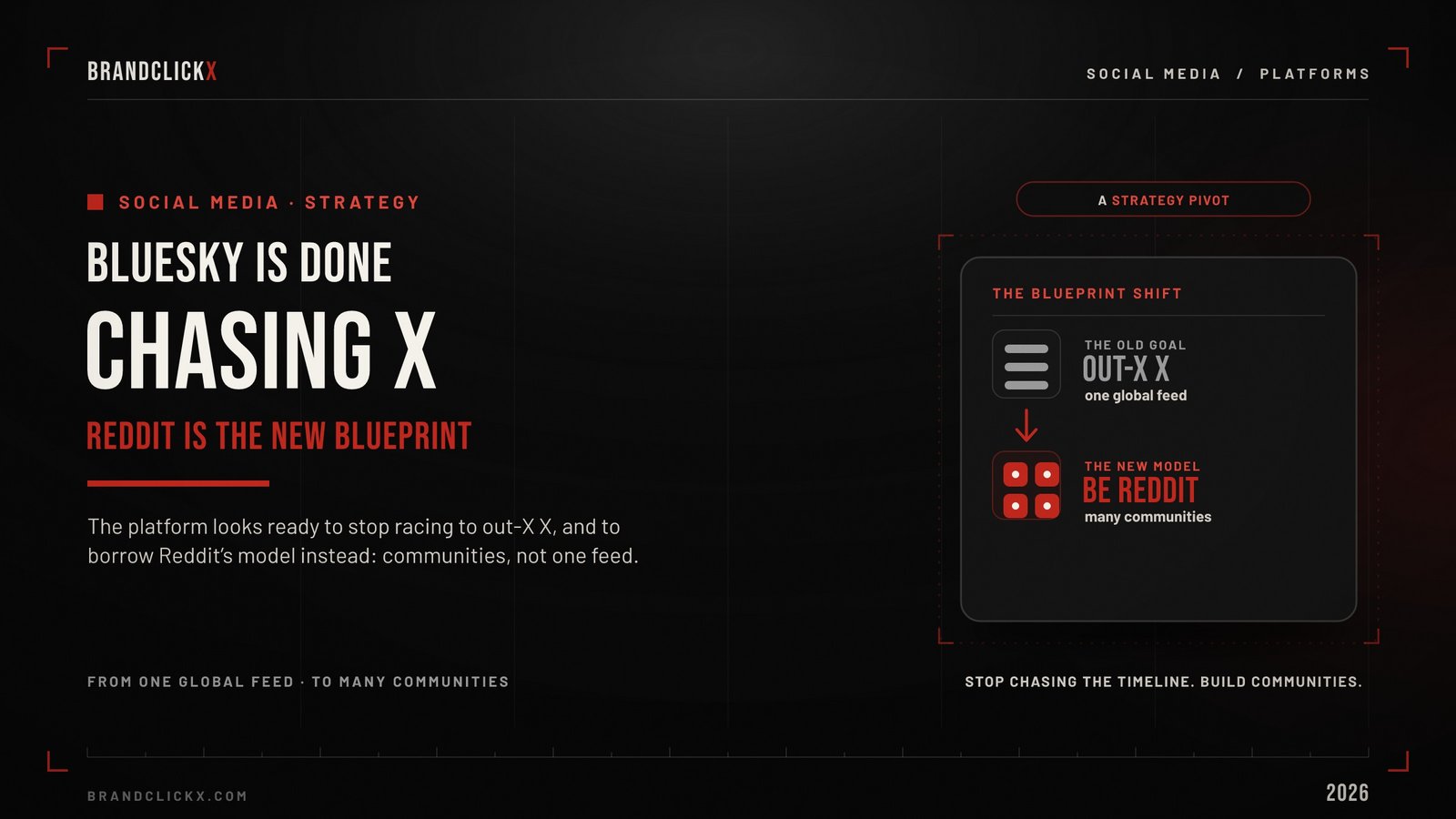
For two years, everyone asked the same question about Bluesky: can it beat X?
It cannot. And it has finally stopped pretending otherwise.
In an interview at SXSW London on Wednesday, Bluesky’s chief operating officer Rose Wang told CNBC the company’s future lies not in chasing Elon Musk’s platform but in taking inspiration from Reddit.
The company is stepping away from the “public square” model, where everyone shouts into the same feed, and betting instead on something quieter, smaller, and, if the Reddit analogy holds, potentially more durable.
It is the most honest thing a social media executive has said in public this year.
And it raises a question that the cheerful pivot framing does not quite answer: can Bluesky actually build what it is describing, fast enough, with enough money, against competitors who already have a decade’s head start?
The Numbers Behind the Pivot
Before exploring the strategy, the reality deserves a clear look.
Show Image
Bluesky has roughly 43 million global users as of March 2026. X has an estimated 450 million. Threads, Meta’s Instagram-linked rival that launched in 2023, surpassed 400 million monthly active users last year.
Bluesky has about 10% of X’s user base. A fraction of Threads.
The engagement numbers are starker. A former Bluesky engineering lead who tracks platform statistics reported that daily active posters fell from a peak of 1.4 million in late 2024 to around 600,000 today.
That peak was driven by a surge of users fleeing X after Musk’s acquisition and various controversies. The surge did not stick.
Show Image
Wang framed this as normal retention behavior: big outside events drive spikes, and what matters is the floor being higher than before. She is not wrong about the pattern. Social platforms routinely see event-driven surges that partially retract.
But a floor of 600,000 daily posters across 43 million registered users is a very low ratio. It means most people who joined Bluesky are not coming back on a given day.
That engagement gap is exactly what the Reddit pivot is designed to address. Interest-based communities are stickier than broadcast feeds, because people return to the spaces where their conversations live, not just to a firehose of everything from everyone.
Market observation: The retention math on broadcast social is brutal. You need a reason for someone to open the app daily, and “seeing what the world is saying” stops being a reason once the novelty of a new platform fades. Reddit’s model works because people return for specific conversations. Bluesky is betting the same mechanism can be rebuilt on an open protocol.
What the Reddit Bet Actually Means
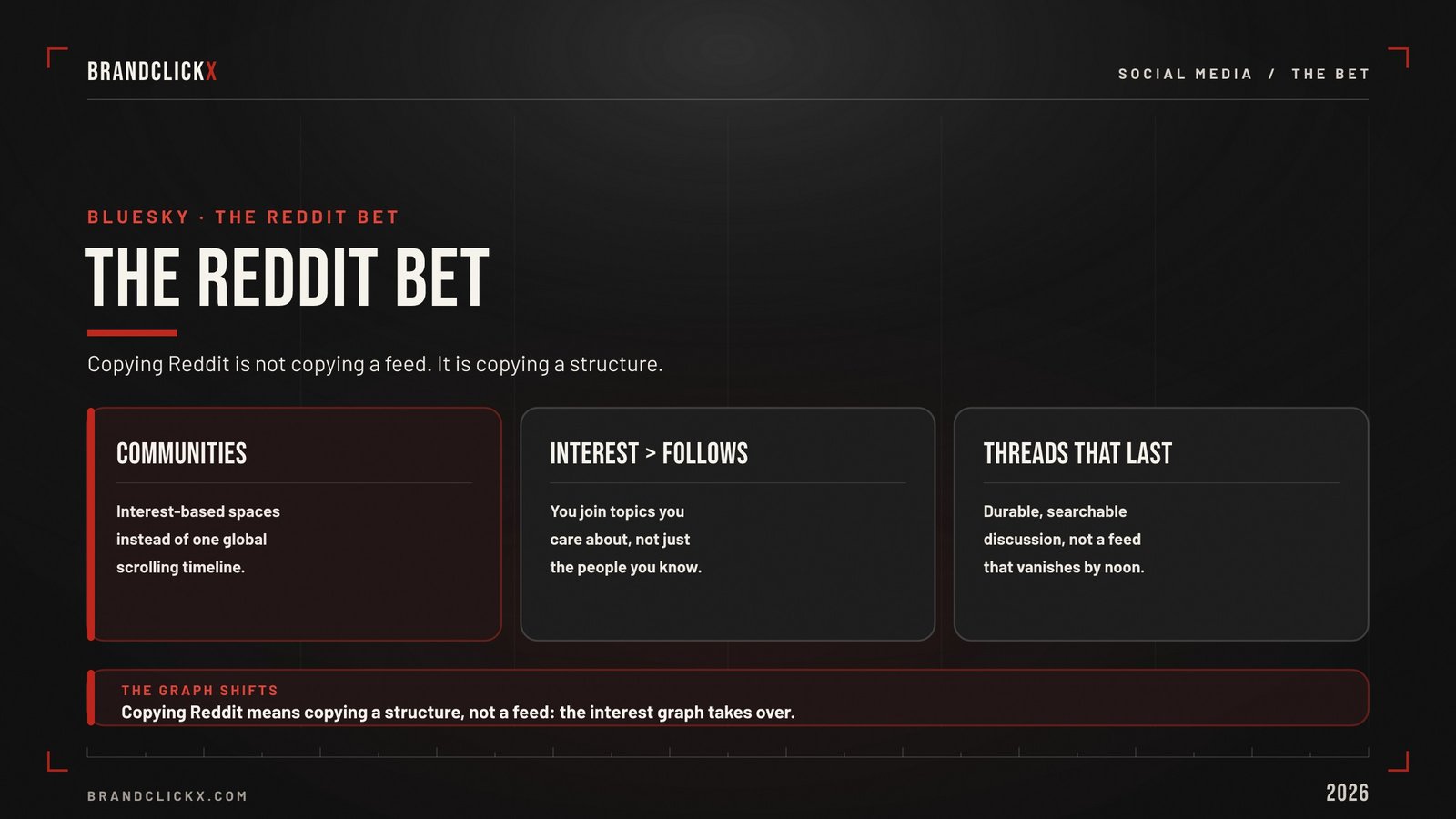
Wang said Bluesky is “very inspired by companies like Reddit,” and wants to be useful as a discovery mechanism rather than a public stage.
Reddit launched in 2005 and built its model on topic-specific subreddits, distinct communities organized around shared interests rather than social graphs. It was not a broadcast medium where celebrities and politicians performed for audiences.
It was a collection of rooms, each with its own culture and rules, loosely connected by a common login.
That model proved remarkably durable. Reddit survived the rise of Twitter, Facebook, Instagram, TikTok, and the rest of them. It went public in 2024 and trades at roughly $170 a share, a validation that the community model has real financial substance.
Show Image
The difference Bluesky could offer is structural.
Reddit’s communities are owned by Reddit. The platform controls the data, the moderation infrastructure, and ultimately the commercial relationship with those communities.
Bluesky is built on the AT Protocol, an open-source system that lets developers build their own apps, services, and communities with genuine ownership over their content and data.
In theory, this means communities on Bluesky are portable and interoperable in a way Reddit communities are not. A subreddit cannot migrate to a different platform while keeping its history, identity, and membership. A Bluesky community built on AT Protocol, in theory, could.
That is a genuinely interesting technical and social proposition. The challenge is that most users do not choose platforms based on protocol architecture. They go where the people they want to talk to already are.
Why it matters: The AT Protocol is Bluesky’s actual long-term differentiator, and the pivot toward community makes it more relevant, not less. Open communities that users actually own are a different product from Reddit’s centralized model.
The question is whether that difference is legible enough to attract builders and users before a better-resourced competitor copies the surface features without the underlying architecture.
The Business Model Gap Nobody Is Solving
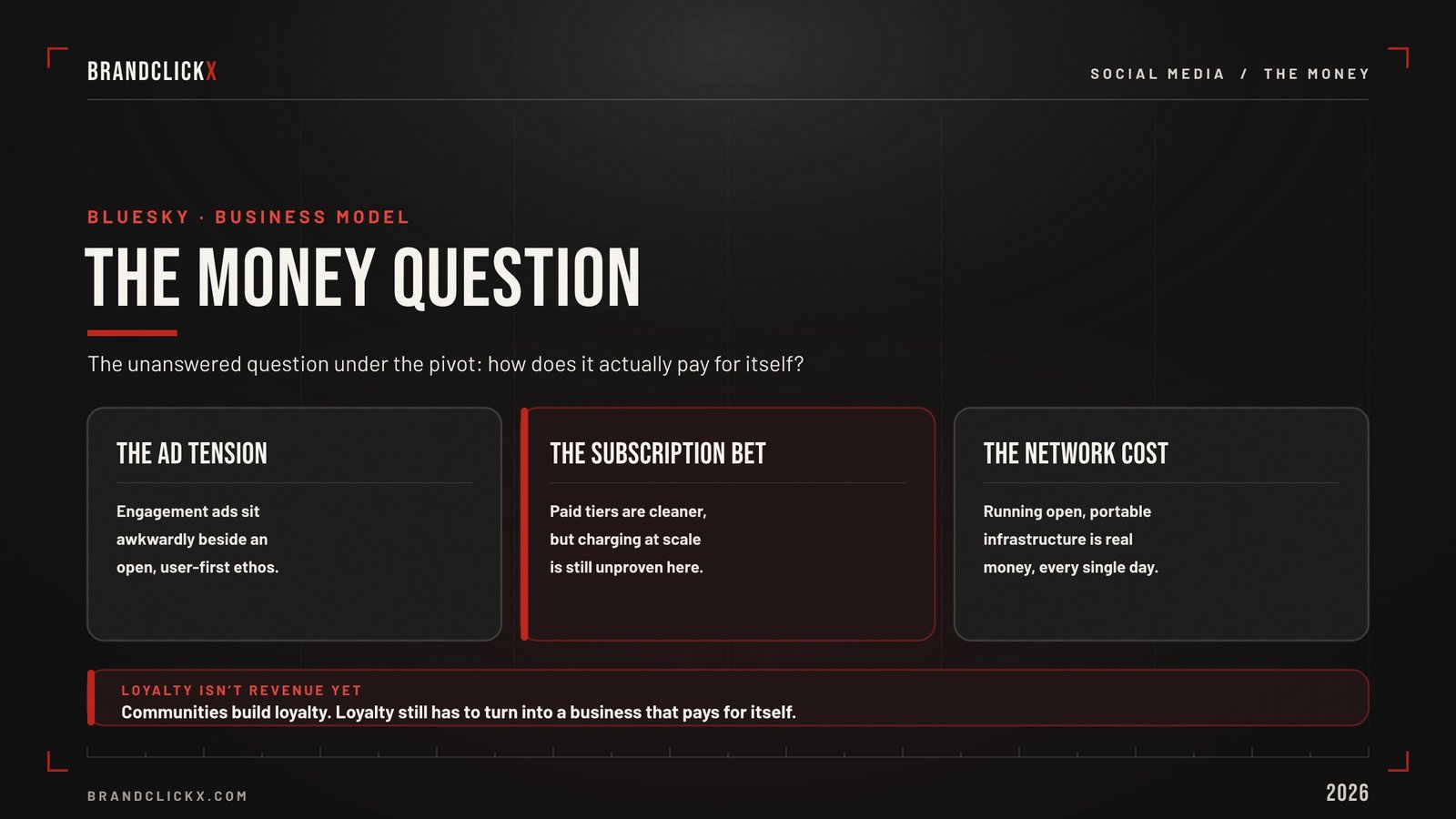
Bluesky raised $100 million in a Series B in April 2025. For context, that is roughly what Instagram spent on marketing in a week at its peak.
The company has not ruled out advertising. But Wang’s framing of how other companies have treated ad revenue, treating it as if they had discovered oil, suggests a principled desire to do things differently.
That same framing could also be a polite way of saying Bluesky has not yet figured out how to make advertising work on a decentralized, open platform.
Reddit’s advertising model works because Reddit controls the communities, can sell targeted ad placements in specific subreddits, and can guarantee brand safety through centralized moderation. On an open protocol where communities are owned by their participants, that control is deliberately absent.
The trade-off is the point. Bluesky wants to give communities ownership precisely because centralized control is what produces the “posters on a stage” dynamic Wang said she wants to avoid.
But ownership without revenue creates a different problem. If Bluesky cannot monetize effectively, it cannot invest in the infrastructure, tooling, and moderation support that make community platforms actually work.
Reddit spent years building the systems that allow moderators to run communities at scale. It does not give those away for free.
Enterprise perspective: For advertisers and platform investors, the decentralized model is both the pitch and the concern. An open protocol means no one owns the audience. No one owning the audience means no one can reliably sell against it.
Bluesky will need a compelling answer to this before its $100 million runs out, because the next fundraise will require a monetization story, not just a vision one.
The Video Problem Is Real
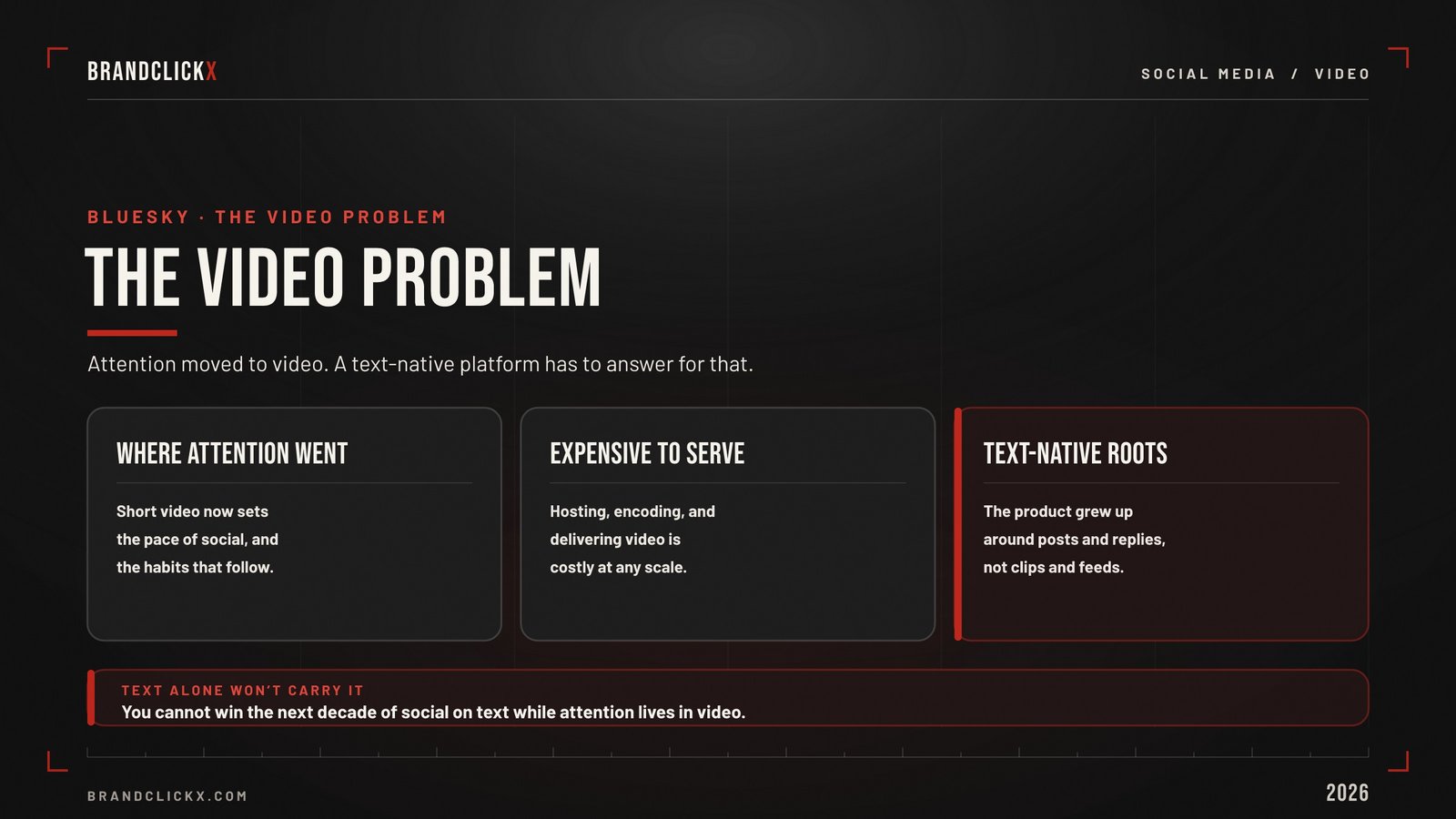
Wang was direct about Bluesky’s biggest product weakness: video.
Upload speeds are slow. The maximum video length is limited. In a media landscape where short-form video is the dominant engagement format for anyone under 35, that is not a gap. It is a structural constraint on user acquisition.
TikTok, Instagram Reels, and YouTube Shorts have conditioned an entire generation to expect video-first feeds. Even X, which is primarily a text and image platform, has invested aggressively in video to capture that attention. Threads has integrated video deeply since launch.
Wang called it “our biggest challenge” and, with admirable optimism, “our biggest opportunity.” The reframe is reasonable. Platforms that improve video capabilities dramatically often see outsized engagement gains because the bar they are clearing is low and the reward is high.
But the timeline matters. Bluesky’s community pivot requires engagement depth, and engagement depth in 2026 increasingly requires video.
Launching community features while the video infrastructure is still underpowered may attract the wrong profile of early adopter: text-heavy, high-information users who skew older and are not necessarily the communities that attract advertisers or viral growth.
This is the version of Bluesky that risks becoming very good for the people who already love it, and not much of a reason to join for everyone else.
The Competitive Landscape Has No Room for Slow
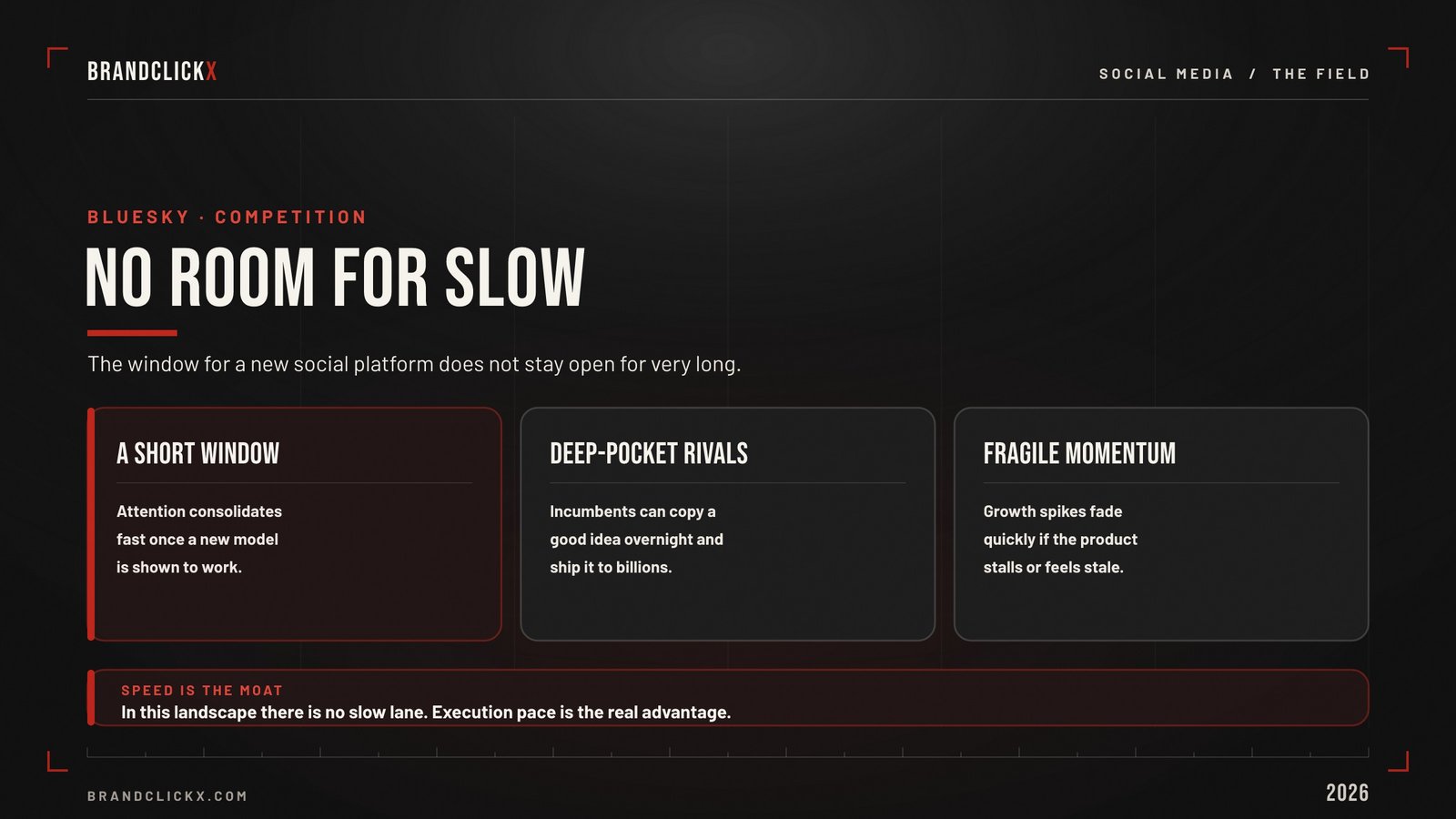
The window for a new social platform to establish itself is not infinite.
X remains dominant in certain categories, particularly news, financial commentary, political discourse, and sports. Its dysfunction has not meaningfully eroded those use cases, because there is nowhere else with equivalent network density.
Threads has 400 million monthly active users and Meta’s full distribution infrastructure behind it. It has not yet found its identity, but it has the resources to keep trying.
Reddit has proven the community model works and has the brand recognition, the SEO footprint, and the institutional knowledge to defend it. Bluesky would not be competing with Reddit’s current product as much as with Reddit’s established position in search results and user habits.
The realistic opportunity for Bluesky is the white space between these players. It is probably not breaking news. It is probably not entertainment and celebrity culture.
It is more likely the space for interest-driven communities where users care about data ownership and platform values, developers who want to build on open protocols, and the kind of engaged, niche communities that have always been underserved by mass-market social.
That is a real market. It is probably not a $50 billion market. But it could sustain a durable, community-owned, open-web platform that matters to the people who use it.
And that, honestly, might be the win Bluesky is actually describing when Wang says they are not trying to build “what social used to be.”
The bigger shift: The public square was always a metaphor for something that social media never quite delivered. It promised everyone a voice but amplified the loudest. It promised community but built audiences.
Bluesky’s pivot is a tacit admission that the metaphor was wrong, and a bet that the internet is ready for something less theatrical and more genuinely communal. Reddit proved that audience exists. Now Bluesky has to build the room.
What to Watch
Three things will tell you how this pivot plays out over the next 18 months.
First, developer activity on the AT Protocol. If the open community vision is real, builders will start creating interest-specific apps and communities on the protocol. That ecosystem activity is the earliest leading indicator. If it stays quiet, the community pivot is mostly a product reframe without structural change.
Second, the video roadmap. The speed and ambition of Bluesky’s video improvements will reveal how seriously leadership is treating the engagement gap. Incremental improvement is not enough. They need a reason for a 22-year-old to choose Bluesky over Reels.
Third, the monetization announcement. Wang did not rule out ads. She signaled discomfort with the pure advertising model. At some point, Bluesky will need to tell investors and users what the revenue engine actually is. That announcement will be more consequential than any product release.
Key Takeaways
- Bluesky is no longer chasing X. The COO said publicly that the company does not want to be the next X or Threads. Reddit’s community model is the stated inspiration, not the broadcast public square.
- The engagement decline is real but not fatal. Daily active posters fell 57% from their late-2024 peak to around 600,000. Wang’s retention-curve framing is reasonable, but the gap between 43 million registered users and 600,000 daily posters signals a product problem that a community pivot alone cannot fix.
- AT Protocol is the genuine differentiator. Unlike Reddit, Bluesky’s communities would be open and portable. That is a structural difference that matters, even if most users will not immediately understand why.
- Video is the critical gap. In a video-first social landscape, Bluesky’s limited upload capabilities and speeds are a real barrier to mainstream adoption. Closing this gap is as important as the community pivot.
- The business model question is unresolved. A $100 million Series B does not last forever. Decentralized community platforms are genuinely hard to monetize. Bluesky needs an answer before its next fundraise requires one.
- The market opportunity is smaller but real. Bluesky is unlikely to threaten X, Threads, or Reddit at scale. But the open-protocol community space is underserved, and a durable platform built for that audience would be worth building.
Frequently Asked Questions
Why is Bluesky pivoting to be more like Reddit?
Bluesky’s COO Rose Wang said the company believes the “public square” broadcast model of X and Threads is not the future of social media. Interest-based community spaces, similar to Reddit’s subreddits, are stickier, more engaging, and better suited to how people actually want to interact online. Bluesky is also built on the AT Protocol, which makes open, portable communities technically feasible in a way Reddit’s centralized platform does not allow.
How many users does Bluesky have?
As of March 2026, Bluesky had approximately 43 million global users. For comparison, X has an estimated 450 million users and Threads surpassed 400 million monthly active users. Daily active posters on Bluesky have declined from a peak of about 1.4 million in late 2024 to around 600,000 today.
Is Bluesky going to add ads?
Bluesky’s COO said the company has not definitively ruled out advertising but wants to approach it differently from platforms that treated it as a primary business model. The revenue strategy has not been fully disclosed. The company raised $100 million in Series B funding in April 2025.
What is the AT Protocol and why does it matter?
The AT Protocol is the open-source infrastructure Bluesky is built on. It allows developers to build their own apps, services, and communities with genuine data portability and ownership, rather than being locked into a single platform. This is the key technical difference from Reddit, where communities are owned and controlled by the central platform.
How does Bluesky compare to X and Threads?
Bluesky has significantly fewer users than both: roughly 43 million compared to X’s estimated 450 million and Threads’ 400 million plus monthly active users. Bluesky’s platform identity is now explicitly community-focused rather than broadcast, distinguishing it from both rivals. Its open-source architecture also sets it apart, though that difference is largely invisible to casual users.
The Bottom Line
The public square always had a marketing problem.
It sold itself as a space where everyone could speak and be heard. What it actually built was a stage with a handful of performers and an audience that mostly scrolled. The engagement data on every major broadcast platform tells the same story: a small percentage of users generate nearly all the content, and the rest consume passively, disengage, and eventually drift away.
Bluesky just called that model what it is.
The question is not whether the community model is better. It is. Reddit proved it, and so did Discord, and Substack, and every Slack group and private group chat that replaced the feeds people stopped trusting.
The question is whether Bluesky can execute the transition without running out of time or money, build video infrastructure fast enough to matter to the next generation of users, and solve a monetization equation that its own open architecture makes genuinely hard.
Wang said they are in “the medieval stages of the online world.”
That is an honest, evocative frame. The medieval period eventually gave way to something more sophisticated. It took a few hundred years. Bluesky does not have that long.