

Ask any hiring manager about the last role they filled, and you will usually hear some version of the same story.
Hundreds of resumes. Most of them blur together. The same buzzwords, the same inflated titles, the same suspiciously perfect bullet points. Somewhere in that pile sits the right person. Good luck finding them with your eyes.
That is the problem skills assessment exists to solve.
Not as a corporate buzzword, but as a practical answer to a question that keeps getting harder: how do you tell who can actually do the work?
Because the old signals have stopped working.
A degree used to be a shortcut for “this person is capable.” A long resume used to mean “this person is experienced.” Both are now easy to game, easy to inflate, and increasingly disconnected from whether someone will be good at the job in front of them.
The market noticed. Loudly.
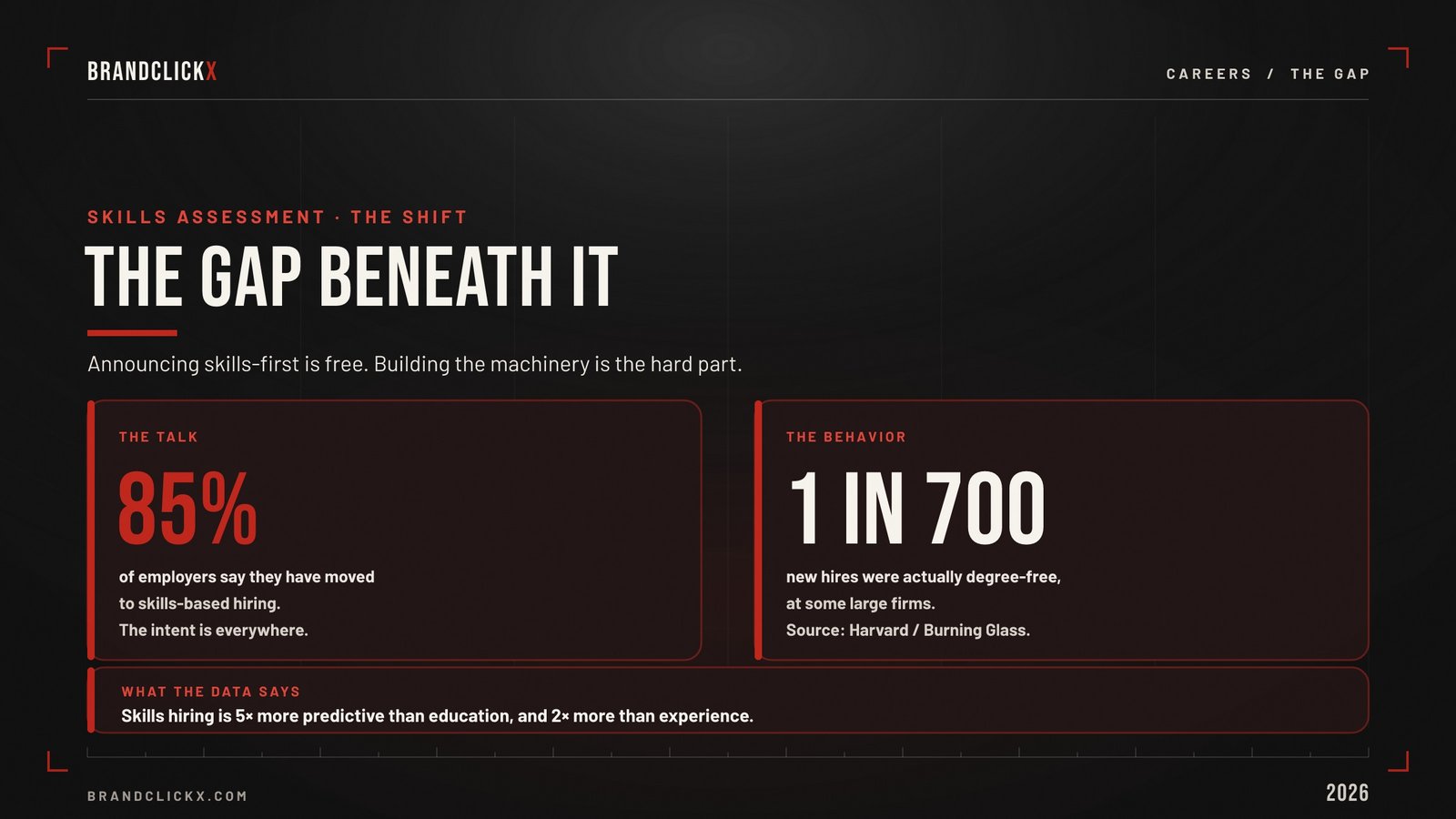
Today roughly 85% of employers say they have moved toward skills-based hiring. It is the talk of every HR conference, every LinkedIn thread, every recruiting deck. The intent is everywhere.
And here is where it gets interesting.
The behavior is not. Research from Harvard Business School and the Burning Glass Institute looked at companies that publicly dropped degree requirements and found that at some large firms, fewer than 1 in 700 new hires were actually people without a bachelor’s degree. The policy lived on the website. The hiring stayed exactly the same.
That gap is the whole story.
The talk is real. The infrastructure to back it up is what most companies are missing. And the missing piece, more than any slogan, is a credible way to measure skill. That is what this guide is about.
Why Skills Assessment Suddenly Matters
Step back and the timing makes sense.
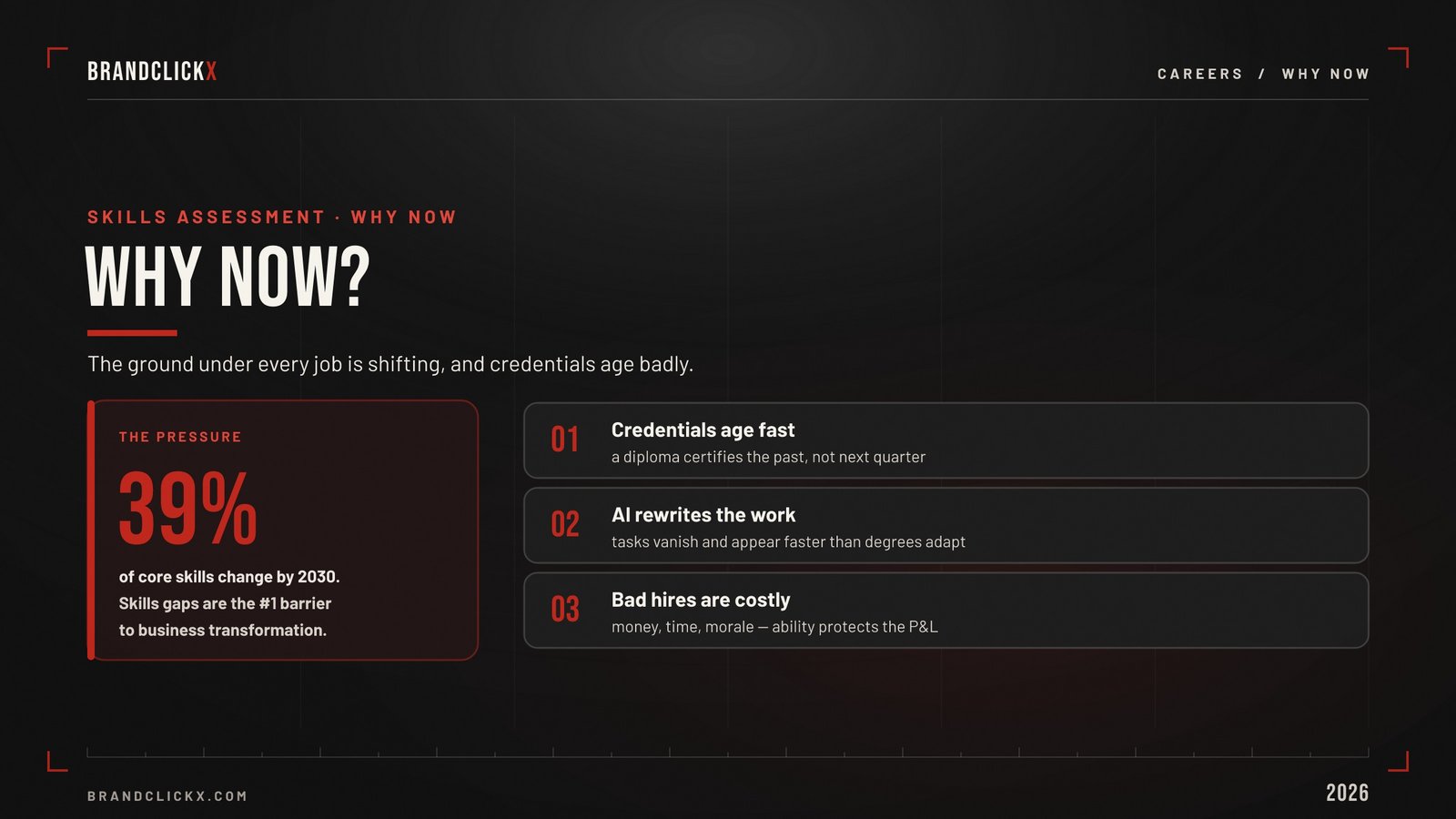
The ground under every job is shifting. The World Economic Forum estimates that 39% of workers’ core skills will change by 2030, and that skills gaps are now the single biggest barrier companies face when they try to transform.
Read that twice.
Nearly four in ten skills, rewritten inside a decade. AI is accelerating it, dissolving some tasks and inventing others faster than any degree program can keep up. The half-life of “qualified” is shrinking.
When skills change that fast, credentials age badly.
A diploma certifies what someone learned years ago. A job title describes a room they used to sit in. Neither tells you whether they can do the thing you need done next quarter. Skills assessment does, because it tests the present, not the past.
There is a cost angle too, and it is brutal.
A bad hire is expensive in money, time, and team morale. When the usual filters keep producing mismatches, measuring actual ability stops being a nice idea and starts being a budget line. Companies that get hiring right are not being virtuous. They are protecting the P&L.
Why It Matters: In a labor market where skills expire fast, the resume describes a person who no longer exists. Skills assessment is how you hire the person standing in front of you, not the one frozen on paper.
What a Skills Assessment Actually Is
Strip away the jargon and the definition is simple.
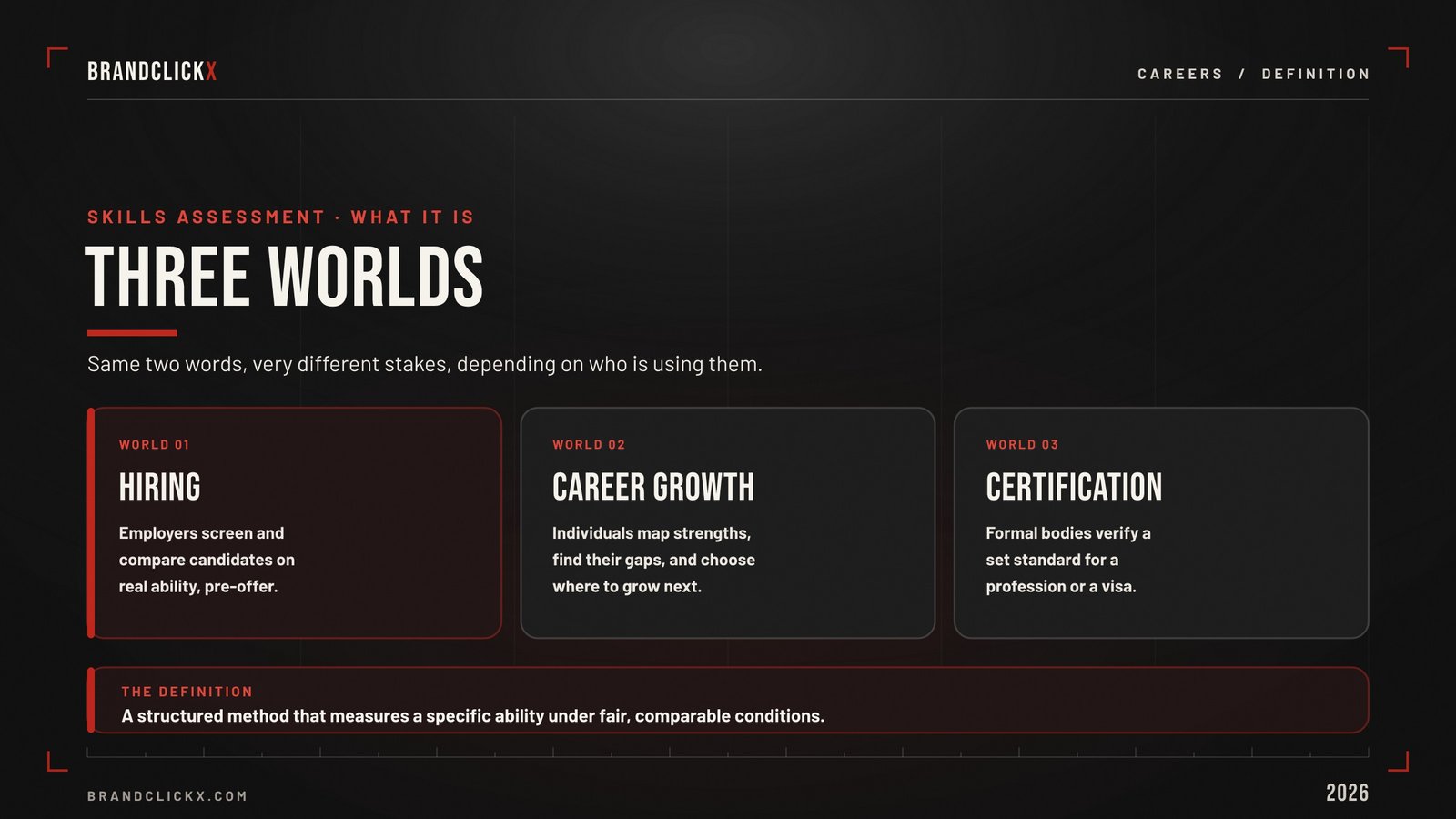
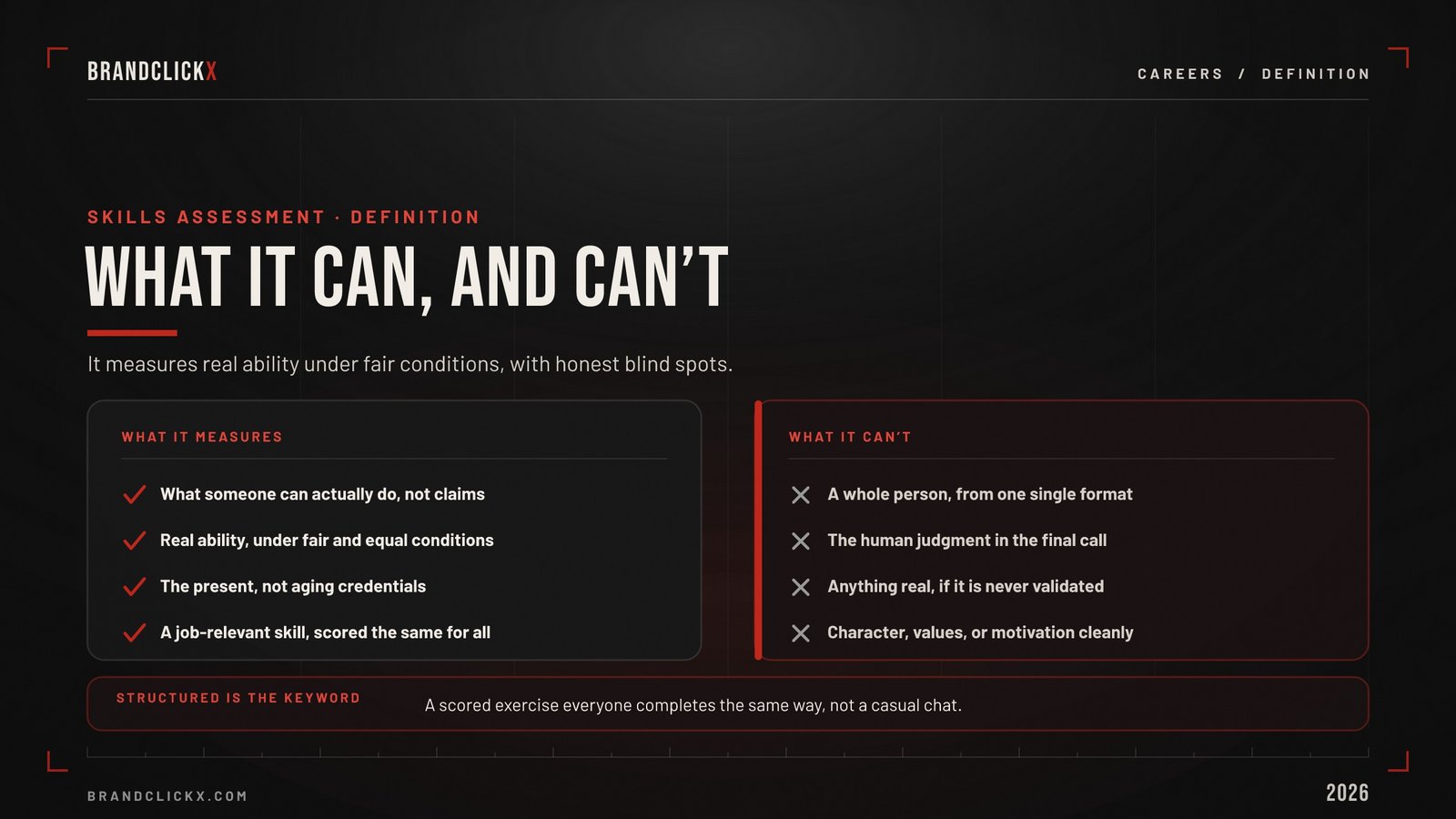
A skills assessment is any structured method that measures a specific ability under fair, comparable conditions. The keyword is structured. A casual “tell me about a time you led a team” is not an assessment. A scored, consistent exercise everyone completes the same way is.
It shows up in three different worlds, which is exactly why the term confuses people.
In hiring, employers use assessments to screen and compare candidates on real ability before making an offer. In career development, individuals use them to map their own strengths, spot gaps, and choose where to grow. And in certification or migration, formal bodies use them to verify that someone meets a defined standard for a profession or a visa.
Same two words. Very different stakes.
This guide lives mostly in the first two worlds, hiring and personal growth, because that is where most people meet the term and where the choices actually change outcomes.
The Main Types of Skills Assessment
Here is where most articles dump a list and run. We will go a layer deeper, because the type you choose decides what you actually learn.
| Assessment type | What it measures | Best for | Watch out for |
| Cognitive aptitude | Reasoning, problem-solving, learning speed | Predicting how fast someone ramps up | Can feel abstract, may disadvantage test-anxious candidates |
| Job-specific / technical | Concrete role skills (coding, Excel, design) | Verifying hard skills directly | Tests the skill, not the judgment around it |
| Work sample / simulation | Real tasks from the actual job | The strongest signal of real performance | Takes time to build and to grade |
| Situational judgment | Decisions in realistic scenarios | Roles where judgment beats raw skill | Answers can reward “textbook” over honest |
| Soft skills / behavioral | Communication, collaboration, resilience | Team fit and people-facing roles | Harder to score objectively |
| Personality / traits | Work style and tendencies | Context, never as a pass/fail gate | Misused as a hiring filter, which invites bias |
| Self-assessment inventory | Your own view of your strengths | Career planning and self-discovery | People overrate themselves, by a lot |
Notice the pattern in that last column.
Every type has a blind spot. Which is the single most important thing to understand about skills assessment, and the thing most companies ignore.
Why Work Samples Quietly Win
If you only take one tactical idea from this piece, take this one.
The closer an assessment is to the actual job, the better it predicts performance. A writer should write something. A developer should ship a small feature. A sales rep should handle a mock objection. Decades of research keep landing on work samples as among the most predictive tools available.
It sounds obvious. It is rarely done.
Most processes still lean on interviews and gut feel, which are some of the weakest predictors we have. The fix is not exotic. It is asking people to do a slice of the real work and watching closely.
Expert Insight: The best assessment is not the cleverest one. It is the one that looks most like a Tuesday on the job. If your test could be passed by someone who would fail in the role, the test is measuring the wrong thing.
The Skills-Based Hiring Shift, and the Gap Beneath It
Let us go back to that 85% number, because it is more revealing than it looks.
On paper, the case for skills-first hiring is overwhelming. McKinsey research found that hiring for skills is roughly five times more predictive of job performance than hiring for education, and more than twice as predictive as hiring for experience. The same body of work found that workers hired without degrees tend to stay in their roles meaningfully longer.
The benefits stack up fast.
Wider talent pools. Lower mis-hire rates. Better retention. The cost of a single bad hire alone, in salary, lost time, and disruption, is enough to justify the effort, as Fast Company has detailed in its coverage of the shift.
So why the gap between 85% and almost nothing?
Because announcing skills-based hiring is free, and actually doing it is hard. You have to redesign job postings, build or buy validated assessments, retrain managers who still secretly trust the fancy school, and rewire the systems that screen people out before a human ever looks.
Most companies did the press release and skipped the plumbing.
This is the uncomfortable truth underneath the trend. Skills-based hiring is not a value you declare. It is an operating system you install. And skills assessment is the core component most companies never bothered to plug in.
Market Observation: The winners of the next decade will not be the companies that talk about skills the loudest. They will be the ones that quietly built the machinery to measure them, while everyone else updated their careers page and called it transformation.
How to Run a Skills Assessment That Actually Works
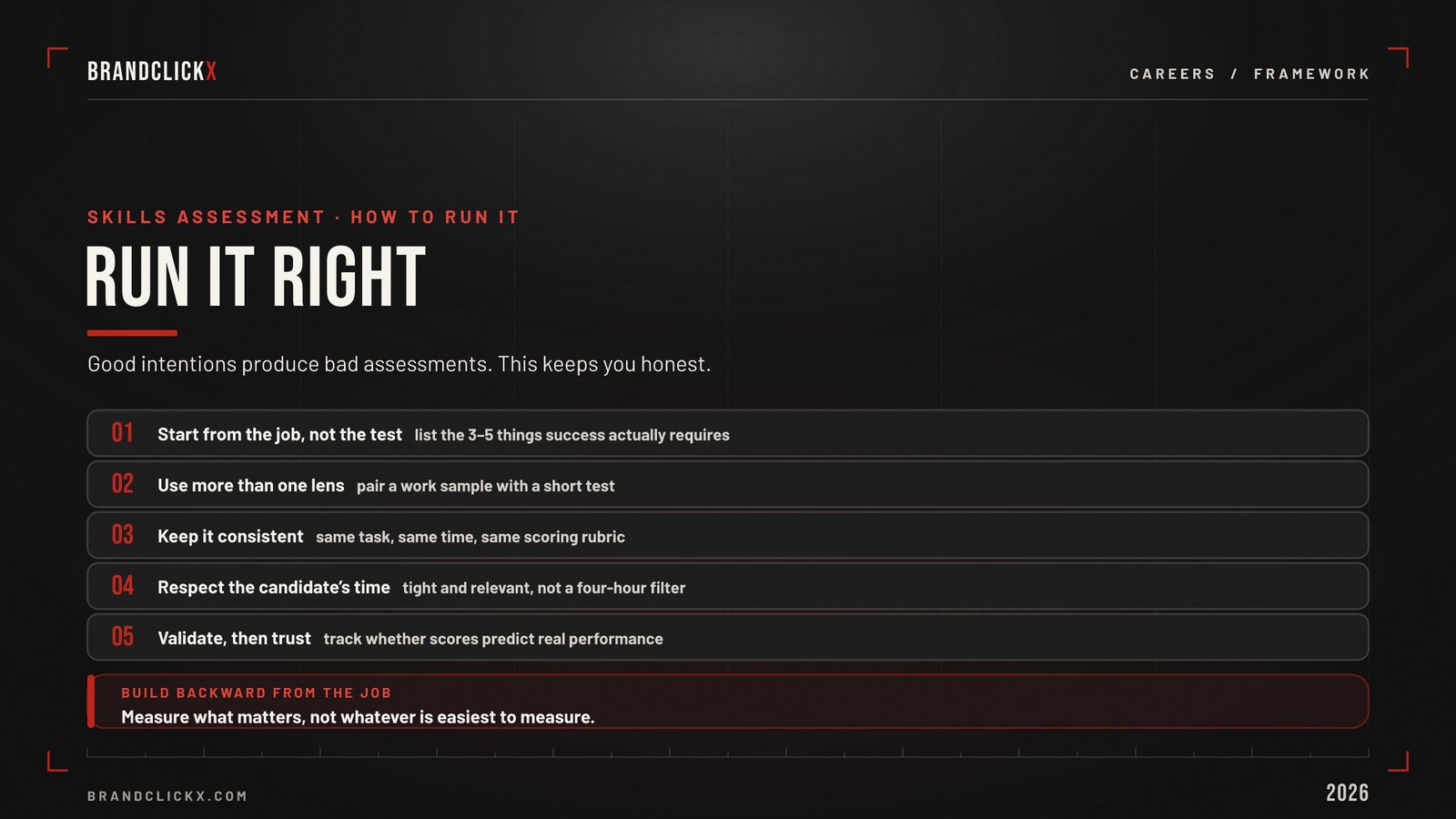
Good intentions produce bad assessments all the time. Here is a framework that keeps you honest.
1. Start From the Job, Not the Test
Do not begin by picking a shiny assessment tool.
Begin by listing the three to five things someone must be able to do to succeed in the role. Real tasks, not vague traits. Build the assessment backward from that list, and you will measure what matters instead of what is easy to measure.
2. Use More Than One Lens
No single assessment captures a whole person.
Pair a work sample with a short cognitive or situational piece. Two or three angles give you a fuller picture and catch the candidate who aces one format but would struggle in the actual job.
3. Keep It Consistent
The whole point of assessment is fairness through comparison.
Everyone gets the same task, the same time, the same scoring rubric. The moment you start improvising per candidate, you reintroduce exactly the bias you were trying to remove.
4. Respect the Candidate’s Time
A four-hour unpaid assessment is not rigorous. It is a filter for people with nothing else going on.
The best companies keep assessments tight, relevant, and respectful, and they are honest about how the results will be used. Treat the assessment as the candidate’s first taste of working with you, because it is.
5. Validate, Then Trust
An assessment only earns its place if it predicts something real.
Track how your assessed hires actually perform over time. If the test scores have nothing to do with on-the-job success, the test is theater, and you should change it. Validation is what separates a real assessment from an expensive vibe check.
How AI Is Rewriting Skills Assessment
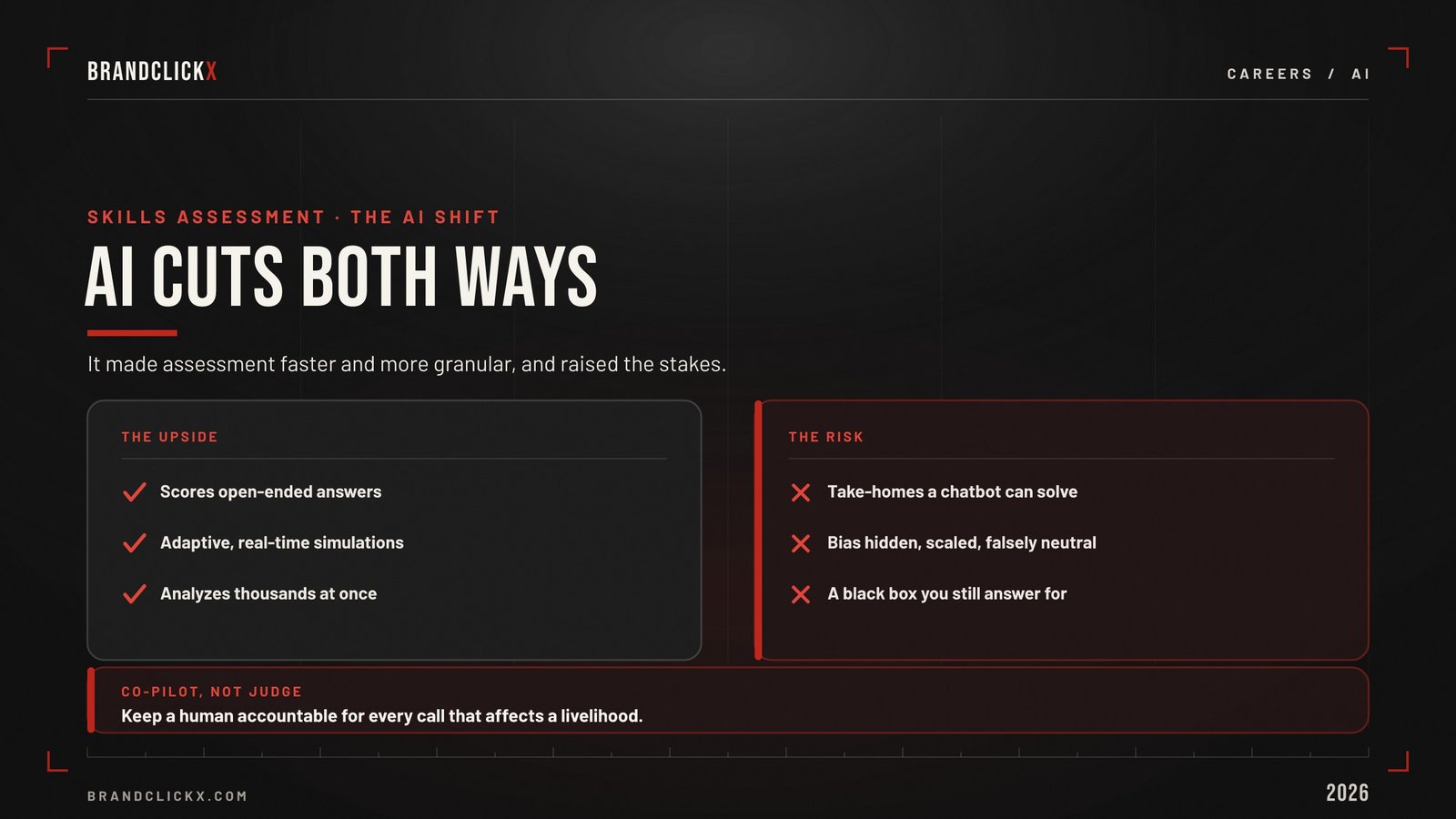
This is the part changing fastest, and it cuts both ways.
On the upside, AI has made assessment dramatically more scalable. Models can score open-ended responses, run adaptive simulations that adjust to a candidate in real time, and analyze skills across thousands of applicants in the time a human reviews ten. Granular skill data that used to be a fantasy is now a dashboard.
That is genuinely powerful. It is also genuinely risky.
The first risk is the candidate’s AI. When a take-home test can be solved by a chatbot in thirty seconds, the test stops measuring the candidate and starts measuring their tool. Smart teams have responded by moving toward live, interactive, or proctored exercises where thinking has to happen in the room.
The second risk is the company’s AI.
An assessment scored by a model is only as fair as the data behind it. Bias does not disappear when you automate. It hides, scales, and gets a veneer of objectivity it has not earned. The companies handling this well treat AI as a co-pilot, not a judge, and keep a human accountable for every decision that affects someone’s livelihood.
Industry Impact: AI did not make skills assessment obsolete. It raised the stakes. The tools got faster, the shortcuts got easier, and the burden of designing fair, cheat-resistant, validated assessments landed squarely back on the humans running them.
Skills Assessment for Individuals, Not Just Employers
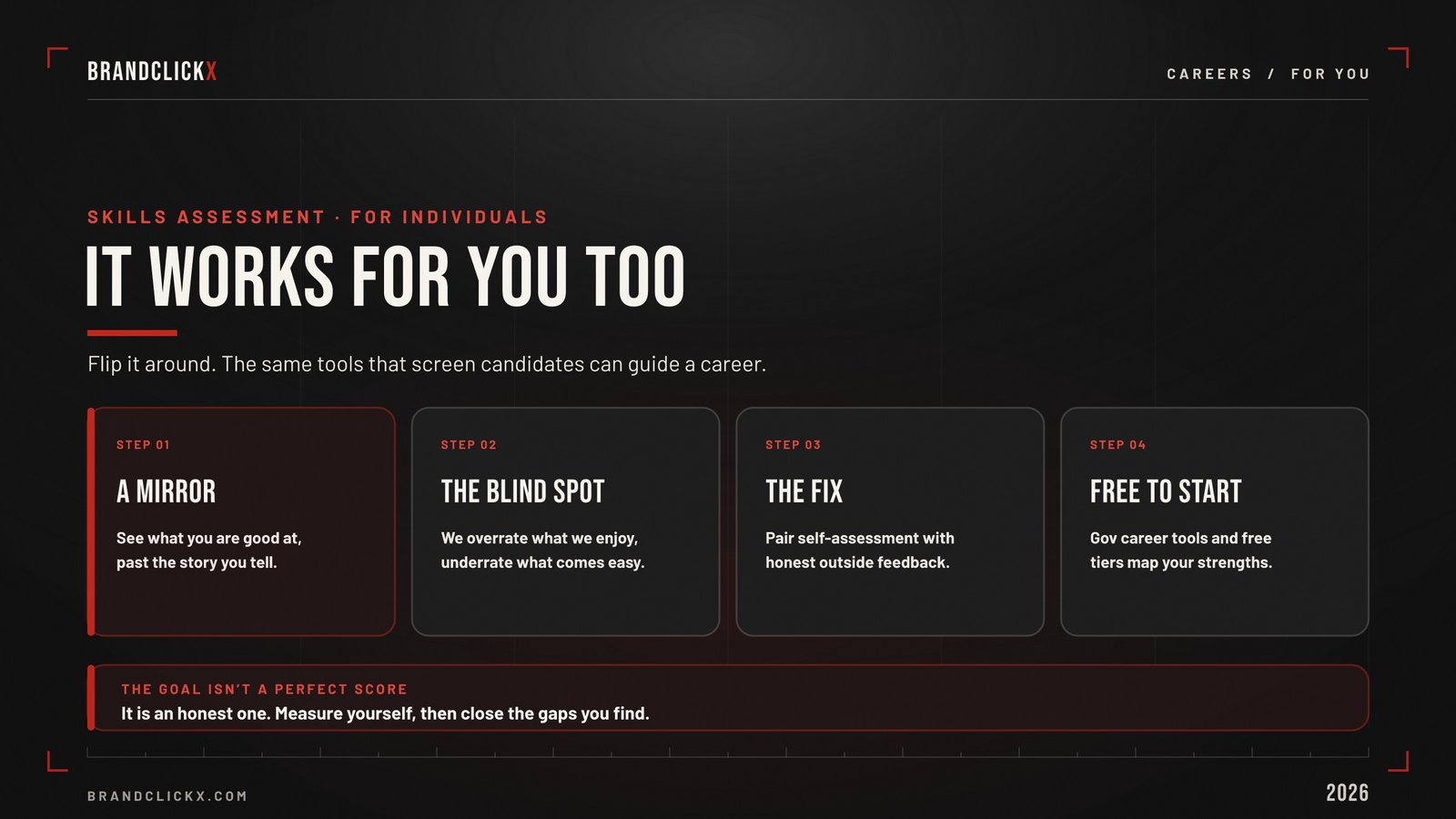
So far this has been a hiring story. Flip it around, because the same tools work for you.
If you are trying to figure out your own next move, a skills assessment is a mirror. It shows you what you are actually good at, separate from the story you tell yourself, and where your gaps quietly live.
The honest catch is self-perception.
People are famously bad at rating their own abilities. We overrate what we enjoy and underrate what comes so easily we assume it is nothing. A structured self-assessment, paired with feedback from people who have seen you work, cuts through that fog.
You do not need to pay for this to start.
Free, government-backed career tools and the free tiers of major assessment platforms are enough to map your strengths and test a few hypotheses about where to grow. The paid, validated stuff is mostly built for employers making consequential decisions at scale. For personal direction, free is a perfectly good on-ramp.
The goal is not a perfect score. It is an honest one.
Common Skills Assessment Mistakes to Avoid
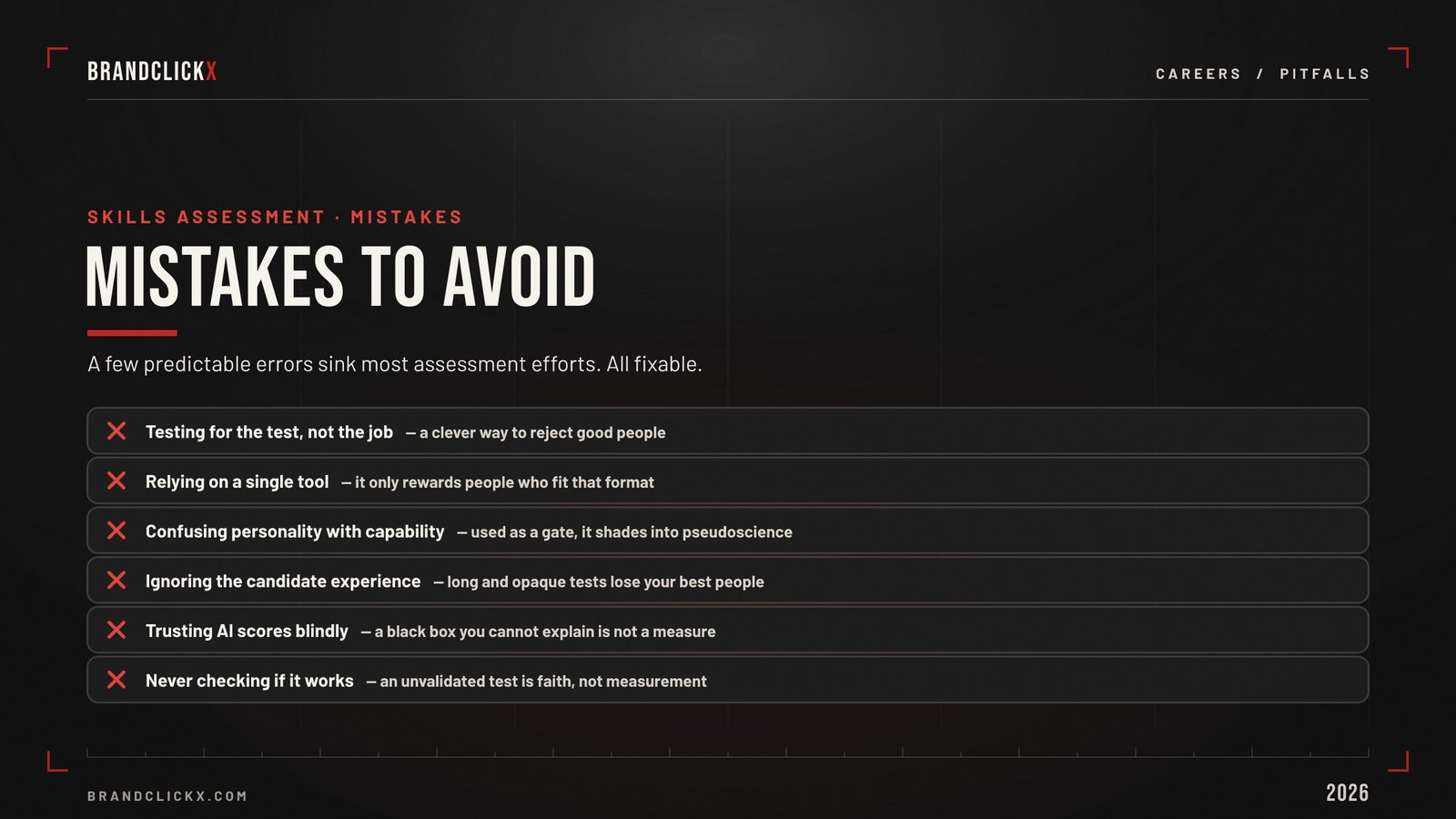
A few predictable errors sink most assessment efforts. They are all fixable.
Testing for the test, not the job. A beautiful aptitude quiz that has nothing to do with the actual work is just a clever way to reject good people.
Relying on one tool. Single-format assessments reward people who happen to fit that format. Real ability shows up across angles.
Confusing personality with capability. Personality tools add context. Used as a pass/fail hiring gate, they shade into pseudoscience and legal risk.
Ignoring the candidate experience. Long, disrespectful, or opaque assessments cost you exactly the high-demand candidates you most want.
Trusting AI scores blindly. If you cannot explain why the model rated someone the way it did, you do not have an assessment. You have a black box making decisions you are responsible for.
Never checking if it works. An assessment you never validate against real performance is faith, not measurement.
Key Takeaways
- Skills assessment measures what someone can do, not what they claim. It is the antidote to resumes and titles that no longer predict performance.
- The skills-based hiring gap is real. Most companies talk skills-first but never built the assessment infrastructure to back it up, which is why so little actually changed.
- Work samples win. The closer an assessment looks to the real job, the better it predicts success. Interviews and gut feel are among the weakest signals.
- Combine formats and validate them. Use two or three lenses, apply them consistently, and check that scores actually track on-the-job performance.
- AI cuts both ways. It makes assessment scalable and granular, but it also enables cheating and hidden bias, so human oversight is non-negotiable.
- Individuals benefit too. A structured self-assessment, paired with honest feedback, is one of the cheapest, clearest ways to plan a career.
Frequently Asked Questions
What is a skills assessment?
A skills assessment is a structured way to measure what a person can actually do, rather than what their resume claims. It uses tools like work samples, cognitive tests, situational judgment questions, and technical challenges to evaluate real ability. Employers use it to hire more accurately, and individuals use it to understand their own strengths and gaps.
What are the main types of skills assessments?
The main types are cognitive aptitude tests, job-specific or technical tests, work-sample and simulation exercises, situational judgment tests, soft-skill and behavioral assessments, and self-assessment inventories. Most strong hiring processes combine two or three rather than relying on a single format.
Are skills assessments accurate predictors of job performance?
Well-designed ones are. Work samples and structured assessments are among the strongest predictors of job performance, and McKinsey research found that hiring for skills is roughly five times more predictive of performance than hiring for education. Accuracy depends on whether the assessment is validated, job-relevant, and applied the same way for everyone.
Are there free skills assessment tools?
Yes. Free options exist for individuals, including government-backed career tools and the free tiers of many assessment platforms. They are useful for self-discovery and practice. Employers, however, typically use paid, validated assessments built for fair and consistent hiring decisions at scale.
How is AI changing skills assessment?
AI now scores open responses, runs adaptive simulations, and analyzes skills across thousands of candidates quickly, which makes assessment faster and more granular. It also introduces new risks, including AI-generated candidate answers and potential bias in automated scoring, so human oversight and ongoing validation matter more than ever.
The Bigger Shift
For a century, hiring ran on proxies.
Where you went to school. Who you used to work for. How polished your resume looked. These were shortcuts for a question nobody could answer cheaply: can this person actually do the job? The proxies were never the point. They were just the best guess available.
Skills assessment removes the guesswork.
That is the real shift underneath all the skills-first slogans. We are watching the slow death of the proxy and the slow rise of the demonstration. Not “where did you learn this,” but “show me.” Not credentials, but capability.
The companies still updating their careers page and calling it transformation will keep wondering why their hiring did not improve.
The ones who build the quiet machinery, the validated assessments, the work samples, the human judgment layered over smart tools, will keep pulling ahead. They will hire from a wider pool, miss fewer great people, and waste less on the wrong ones.
And for everyone navigating a career, the lesson is the same one in reverse.
The market is learning to look past the label and ask what you can do. The smartest response is to stop polishing the label and start being able to prove the skill. Measure it honestly, close the gaps you find, and let the work speak.
The resume described who you were. The assessment asks who you are now. In a world this fast, only one of those questions still matters.