
Google AI Overview Summary
The fundamentals of marketing remain anchored in five core ideas: understanding the customer, positioning the product, pricing it accurately, distributing it effectively, and communicating its value.
In 2026, the playbook around these fundamentals has been rewritten by AI, zero-click search, the maturing creator economy, and a measurement environment where attention is the scarcest resource. The principles still win. The execution layer has been rebuilt from the ground up.
For seventy years, the fundamentals of marketing held steady while everything around them changed. Television gave way to digital. Digital gave way to social. Social gave way to creator-led, algorithm-mediated, AI-assisted everything.
Through every shift, the underlying logic stayed intact: know your customer, position your product, price it right, get it in front of the right audience, and communicate value better than the next brand on the shelf.
What 2026 has done is something subtler. The principles didn’t move. The ground beneath them did.
Gartner’s 2026 CMO Spend Survey clocked martech budgets at 27.8 percent of total marketing investment, the highest share in a decade. That’s not a tooling story. It’s a confession. CMOs are spending more than a quarter of every marketing dollar trying to keep up with how execution has changed. The fundamentals are the same. Operationalizing them is what’s different.
And the gap between brands that understand this and brands that don’t is becoming the defining story of the year.
Why the Fundamentals Refuse to Die
There’s a reason every business school still opens its first marketing lecture with the 4Ps. The framework, introduced by E. Jerome McCarthy in 1960, holds because it describes a permanent set of business questions, not a temporary set of tactics.
Product. Price. Place. Promotion.
You can swap channels, platforms, and tools forever. The questions underneath don’t move. What are you selling? What’s it worth? Where do customers find it? Why should they care?
What changed is the surface area each question now covers.
“Place” used to mean retail shelves and a few digital storefronts. Now it means TikTok Shop, Amazon, DTC sites, marketplaces in fifteen countries, AI shopping agents, and recommendation surfaces inside ChatGPT and Perplexity.
“Promotion” used to mean ad buys and PR. Now it includes creator partnerships, owned media, community-led growth, and SEO content optimized for both Google and large language models.
The fundamentals expanded without breaking. That’s the part most coverage gets wrong.
Key Takeaway: The fundamentals of marketing are not a list of tactics. They’re a set of permanent questions every brand has to answer, regardless of what tools or platforms dominate that cycle.

The 4Ps, Audited for 2026
Here’s how the classic framework looks under modern conditions.
| Pillar | Traditional Meaning | 2026 Reality |
| Product | Physical goods or services | Products, subscriptions, communities, content, AI-augmented experiences |
| Price | Fixed retail pricing | Dynamic pricing, usage-based models, value-based tiers, AI-optimized bundles |
| Place | Retail and basic e-commerce | Omnichannel including TikTok Shop, AI shopping agents, marketplaces, DTC, retail media |
| Promotion | Advertising and PR | Paid, earned, owned, shared, creator-led, plus AI search visibility |
Every pillar grew. None disappeared. The brands winning right now are the ones treating each P as a system to operate, not a box to check.
The Customer Was Always the Center. Now the Data Proves It.
Customer centricity has been preached for decades. For most of that time, it was an aspiration. The data infrastructure didn’t exist to make it real.
That’s no longer the case.
Modern customer data platforms, first-party data strategies built around the death of third-party cookies, and AI-powered segmentation have made true one-to-one marketing operationally viable for the first time.
According to Salesforce’s State of Marketing report, marketers now use an average of 11 distinct data sources to build customer profiles, up from four in 2020.
That number is doing a lot of work. It means the modern marketing function isn’t a creative team with data support. It’s a data operation with creative output.
Segmentation theory, originally developed when production cost limited how many audiences a brand could realistically serve, is being rebuilt under different economics.
When generative AI can spin up tailored landing pages, ad variants, and email flows for each segment at near-zero marginal cost, the question shifts. It’s no longer “how many segments can we afford?” It’s “how many segments actually matter to our growth?”
That’s a strategic question. Not a production one. The fundamentals are reasserting themselves at exactly the moment the tools made them executable.
Expert Insight
“The marketers we see scaling fastest aren’t the ones obsessed with the newest tool. They’re the ones who can articulate their positioning in one sentence and have a customer insight layer that updates weekly. Everything else compounds from that.”
— Paraphrased synthesis from multiple CMO interviews published across Marketing Brew, Adweek, and HubSpot’s State of Marketing report, Q1 2026
The Bigger Shift: From Funnels to Ecosystems
The marketing funnel had a good run. Awareness, consideration, decision, retention. Clean. Linear. Easy to draw on a whiteboard.
It also stopped describing reality somewhere around 2018.
Modern customer journeys are non-linear, multi-touch, and frequently start and end inside platforms marketers don’t fully control.
A customer might first encounter a brand through a YouTube creator, research it via ChatGPT, compare it on Reddit, see retargeting on Instagram, and finally convert through a Google search for the brand name. That’s not a funnel. That’s an ecosystem.
The fundamentals still apply. Awareness still matters. Consideration still happens. Conversion still requires friction reduction. What’s changed is that these stages now happen in parallel, across surfaces the brand doesn’t own, in an order the brand can’t predict.
This is why frameworks like the messy middle, popularized by Google’s consumer research team, now describe how customers actually behave more accurately than traditional funnel models. The journey isn’t broken. It’s expanded into a web.
Why It Matters: Brands still operating with a 2010-era funnel mentality consistently underweight investment in the messy middle, where most modern purchase decisions actually crystallize. That misallocation is the single biggest source of wasted marketing spend in mid-market companies right now.

The Search Layer Just Got Rewritten
For two decades, SEO was a relatively stable game. Optimize for Google. Build authority. Earn rankings.
Then AI Overviews arrived, click-through rates on traditional organic results dropped significantly across queries triggering AI summaries, and a parallel ecosystem of LLM-driven discovery exploded. ChatGPT crossed 700 million weekly users.
Perplexity, Claude, and Gemini built dedicated answer products. The search box stopped being a single point of distribution.
Generative Engine Optimization, AEO, and traditional SEO now coexist as distinct disciplines. The fundamentals translate. Quality content, structured data, and clear authority still win. The targets just multiplied.
What this means for the fundamentals of marketing is significant: the “promotion” pillar now includes visibility inside AI systems, not just search engines.
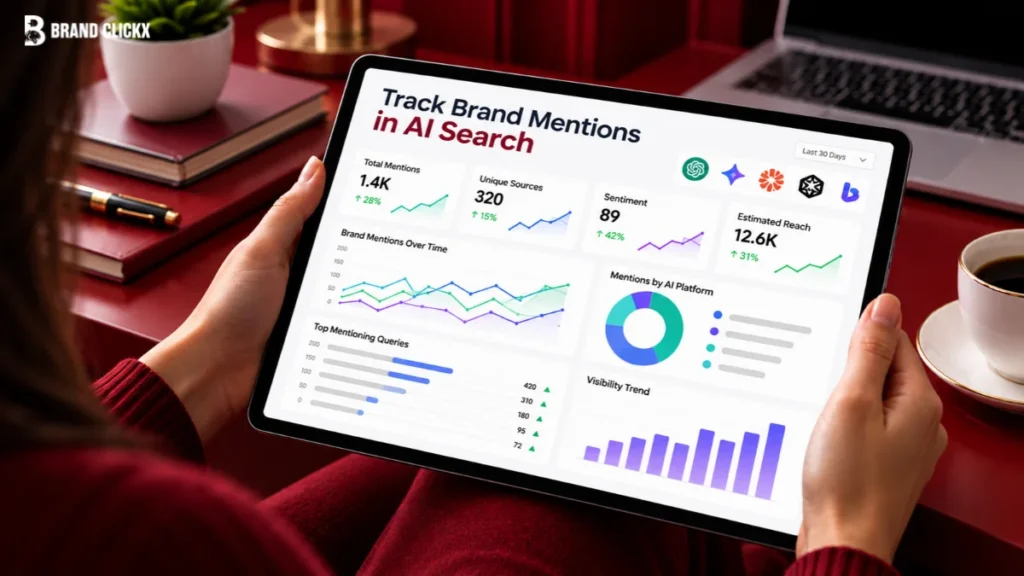
A brand mentioned consistently across high-quality sources gets surfaced in LLM answers. A brand absent from those sources effectively disappears from a growing slice of customer research.
The brands that built strong content ecosystems and earned legitimate citations over the past five years are now collecting compounding visibility inside AI answers.
The brands that relied on thin, keyword-stuffed content are watching their organic visibility erode from two directions simultaneously.
Industry Impact: What Agencies and In-House Teams Are Actually Doing
The agency model is restructuring fast. Independent shops are folding AI production capabilities into their service lines. Mid-market agencies are losing volume work to in-house teams equipped with modern tooling.
Performance-led shops are seeing the opposite: clients want them to ship more variations, faster, across more channels.
In-house, the shape of the marketing org is changing too. New roles are appearing on org charts:
- Brand systems lead. Owns the codified brand, including voice, visual identity, and content rules.
- AI operations manager. Manages the generative tooling stack, fine-tunes models, sets governance.
- GEO and AEO specialist. Optimizes brand presence inside large language model outputs and AI search.
- Community lead. Owns the relationship layer that paid media can’t replicate.
- Creator partnerships manager. Distinct from influencer marketing, focused on long-term collaborative relationships.
None of these were standard roles three years ago. Most enterprise marketing teams will have at least three of them by the end of 2026.
A Modern Framework: The Five Layers of an AI-Era Marketing Operation

For teams trying to map the new shape, here’s a model that holds up across most enterprise environments.
Layer 1: Strategy. Positioning, brand architecture, audience definition. Highest leverage, fully human-owned.
Layer 2: Insight. Customer research, data infrastructure, first-party data systems, attribution models.
Layer 3: Creative System. Brand guidelines codified as data. Design tokens, voice rules, content patterns that AI tools can read.
Layer 4: Production and Distribution. Generative tooling, omnichannel deployment, ad platforms, CMS, CRM.
Layer 5: Measurement and Optimization. Analytics, incrementality testing, mixed-media modeling, AI-driven attribution.
The mistake most teams make is over-investing in Layer 4 while neglecting Layers 1 and 3. The result is high-volume output with weak strategic anchoring. The teams pulling ahead are doing the opposite: investing first in strategy and creative systems, then turning on the production layer at scale.
What Happens Next

A few patterns worth watching as the rest of 2026 plays out:
The creator economy will keep eating brand budgets. Goldman Sachs projects the creator economy will reach roughly $480 billion by 2027. Brands that still treat creators as media buys will lose to brands treating them as long-term partners and channel-builders.
Zero-click search will keep climbing. More queries will be answered inside the search interface itself. Brand visibility will increasingly depend on being referenced in answers, not just ranking for queries.
Retail media will keep growing. Amazon, Walmart Connect, and the wave of retail media networks will continue capturing a larger share of ad spend. The “place” pillar of the 4Ps is becoming inseparable from the “promotion” pillar inside these ecosystems.
Owned media will outperform rented attention. Email lists, communities, podcasts, and proprietary research will become more valuable as paid acquisition costs rise across every platform.
AI-native brands will emerge. A new category of companies is being built from day one with AI in the marketing stack, lean teams, and product-led growth motions. They will set the pace.
Brand will reassert itself as a moat. When everyone has access to the same AI tools, the brands with the sharpest distinctive voice, clearest values, and most loyal communities will pull ahead. Mid-voice generic brands will struggle.
Tactical Takeaways for CMOs and Marketing Leads
For teams looking to translate the shift into action this quarter:
- Audit the fundamentals of marketing inside your organization. Can every member of your team articulate the brand’s positioning in one sentence? If not, fix that before anything else.
- Codify the brand as structured data, not a PDF. AI tools need machine-readable inputs.
- Build a first-party data strategy if you haven’t already. The third-party data window is closing.
- Treat GEO and AEO as distinct disciplines from traditional SEO. Resource them accordingly.
- Invest in owned media. Newsletters, communities, and proprietary content compound in ways paid never will.
- Move performance reporting from last-click to incrementality. Most attribution models are still measuring the wrong thing.
- Reorganize around customer journey stages, not channels. The funnel is dead. The web of touchpoints isn’t.
The Strategic Takeaway
The discourse around AI in marketing is going to keep generating noise. New tools will launch every week. Frameworks will trend on LinkedIn for a few days and disappear.
Underneath the noise, the fundamentals of marketing are doing what they’ve always done: rewarding the brands that know their customer better than the competition, position themselves more clearly, price with intent, distribute with reach, and communicate with conviction.
The execution layer has changed. The principles haven’t. The brands that internalize that distinction will outpace the ones still chasing every new tool as if the basics are optional.
They’re not. They never were.
Frequently Asked Questions
What are the fundamentals of marketing in 2026?
The fundamentals of marketing still revolve around the 4Ps framework, product, price, place, and promotion, expanded to include customer-centric pillars like positioning, segmentation, brand identity, distribution, and communication.
In 2026, these fundamentals are being executed through AI-powered tools, first-party data systems, creator partnerships, and omnichannel ecosystems that didn’t exist in their current form even five years ago. The principles haven’t changed. The infrastructure to execute them has.
Are the 4Ps of marketing still relevant?
Yes. The 4Ps remain the most durable framework in marketing because they describe permanent business questions rather than tactics. Every brand has to decide what it sells, what it charges, where it sells it, and how it communicates value.
The framework has been expanded by some theorists to include people, process, and physical evidence for service businesses, but the core four still anchor most strategic marketing conversations.
How is AI changing the fundamentals of marketing?
AI is not replacing the fundamentals. It’s making them executable at a scale that was previously impossible. Generative tools allow brands to produce personalized creative for hundreds of audience segments, AI-powered analytics surface customer insights in real time, and large language models are creating new visibility channels alongside traditional search.
The brands with strong strategic foundations are seeing AI amplify their advantages. Brands without strong foundations are seeing AI amplify their weaknesses.
What’s the difference between SEO, GEO, and AEO?
SEO optimizes for traditional search engine rankings, primarily Google. GEO, or Generative Engine Optimization, focuses on visibility inside AI-generated answers from systems like ChatGPT, Perplexity, and Google’s AI Overviews.
AEO, or Answer Engine Optimization, targets featured snippets, voice search results, and structured answer formats. All three disciplines share fundamentals around quality content, structured data, and authority, but each has distinct tactical requirements.
What marketing roles will grow in the next two years?
Roles centered on AI operations, brand systems management, GEO and AEO specialization, community building, and creator partnerships are growing fastest. Traditional execution-focused roles in basic content production and template-based design work are contracting.
The shift is toward marketers who can manage systems, judgment, and strategy rather than execute repetitive production tasks manually.
How should small businesses approach the fundamentals of marketing?
Small businesses should resist the urge to chase every new tool. The fundamentals of marketing work the same regardless of company size.
Clear positioning, deep customer understanding, consistent brand identity, and disciplined channel selection consistently outperform scattered tactics. Smaller teams have an advantage in agility and can often execute the basics more effectively than larger organizations weighed down by legacy processes.
Final Read
The most underrated insight about modern marketing is also the simplest: the fundamentals didn’t go anywhere. They got buried under tooling debates, channel proliferation, and a decade of distractions that promised to replace strategy with hacks.
The brands cutting through the noise in 2026 are doing it by returning to basics, sharpened by modern infrastructure. They know who they serve. They know what they stand for. They’ve built systems that let them act on that knowledge at speed.
At BrandClickX, we cover these shifts across the full marketing stack, from positioning frameworks to AI-native production systems, from search visibility to creator-driven distribution. The strategies that will compound through the rest of the decade belong to teams that pair sharp fundamentals with infrastructure built for what’s next.
The fundamentals still win. The execution layer just got rewritten.