


Last quarter, I was reviewing funding announcements with a venture analyst friend who covers emerging tech. She pulled up her tracking spreadsheet and pointed to something that stopped us both mid-conversation.
Three AI infrastructure startups had each raised over $150 million in the same six-week window , all from different investor groups, all at valuations that would have seemed impossible eighteen months earlier.
“The money is moving faster than anyone expected,” she said. “And it is moving toward very specific bets.”
That conversation made me want to look deeper at exactly where the capital is flowing in Q2 2026. not just which startups raised the most, but why investors are choosing these specific companies over hundreds of others competing for the same dollars.
The fastest-growing tech startups by funding in Q2 2026 are not simply the ones with the best pitch decks. They share specific characteristics that sophisticated investors are now prioritizing above almost everything else.
This guide covers the ten startups that raised the most significant rounds in Q2 2026, what each one is building, why the money followed them specifically, and what patterns their funding reveals about where the entire technology sector is heading next.
AI Overview
The second quarter of 2026 marked one of the most significant periods in venture capital history. According to Crunchbase, startups raised $205 billion globally during Q2, with more than half of that capital flowing into just 16 companies.
Most of these companies operate in artificial intelligence, advanced computing, robotics, and specialized infrastructure. Rather than funding rapid customer acquisition alone, investors are financing massive computing capacity, custom hardware, and foundational AI systems expected to shape the next decade of enterprise technology.
The startups featured in this article represent the companies that attracted the largest funding rounds during Q2 2026 and illustrate where global venture capital is placing its biggest bets.
Key Takeaways
- Global startup funding reached $205 billion in Q2 2026, according to Crunchbase.
- The first half of 2026 set a record with $510 billion invested worldwide.
- Just 16 startups captured $108.6 billion, representing 53% of all Q2 funding (Crunchbase).
- AI-focused companies received more than 70% of global venture investment during the quarter.
- Anthropic secured the largest funding round at $65 billion.
- China and Europe continued strengthening their own sovereign AI ecosystems alongside the United States.
- Capital is increasingly concentrated around companies building AI infrastructure rather than traditional software.
What are the fastest-growing tech startups in 2026?
The fastest-growing tech startups in 2026 are privately held technology companies attracting the largest venture capital investments to accelerate AI research, custom hardware, robotics, and enterprise infrastructure. In Q2 2026, companies such as Anthropic, DeepSeek, Cerebras Systems, and SambaNova Systems led the global rankings through record-breaking funding rounds.
Why Startup Funding Matters in 2026
Many people associate startup growth with rising revenue or millions of new customers. While those indicators still matter, they no longer tell the full story for frontier technology companies.
Today’s leading AI laboratories and infrastructure startups require enormous amounts of computing power before they can generate meaningful commercial returns. That changes how growth is measured.
Instead of gradually progressing through traditional funding stages, many companies now raise multi-billion-dollar rounds much earlier to secure graphics processors, specialized chips, cloud infrastructure, and engineering talent.
According to Crunchbase, global startup investment reached $205 billion across more than 5,000 deals during Q2 2026. Even more remarkable, total funding for the first half of the year climbed to $510 billion, surpassing the entire amount raised during 2025.
Another trend stands out even more clearly.
Only 16 companies accounted for $108.6 billion, absorbing 53% of all venture capital invested during the quarter, according to Crunchbase. This level of capital concentration is unlike previous technology cycles.
The result is a market where a relatively small number of companies are advancing at extraordinary speed while competition for funding becomes increasingly intense elsewhere.
Why Investors Are Concentrating Capital
Building frontier AI systems is fundamentally different from launching a traditional SaaS startup.
Modern AI companies need enormous computing clusters, access to advanced semiconductor technology, long-term cloud contracts, and specialized research teams. Those requirements demand billions of dollars before products can be deployed at global scale.
Rather than spreading investments across thousands of smaller businesses, venture firms are focusing on companies they believe can become foundational infrastructure providers for the AI economy.
This explains why venture capital tech startups developing foundational models, AI hardware, and robotics dominated funding activity throughout Q2.
AI Is Driving the Funding Boom
Artificial intelligence has become the defining investment theme of 2026.
Crunchbase reports that AI startups captured more than 70% of all global venture funding during Q2, compared with roughly half the market only a year earlier.
That surge reflects growing confidence that AI will influence nearly every major industry, from finance and healthcare to software development and manufacturing.
Investors are no longer funding AI simply because it is popular. They are investing because they expect these technologies to become core business infrastructure over the coming decade.
How We Ranked These Startups
Many lists simply sort companies by headline funding numbers.
This article takes a broader view while still emphasizing the highest funded startups Q2 2026.
Each company was evaluated using information from the research report across several consistent factors.
Funding Raised
The size of each financing round remains the primary ranking factor because this article focuses on funding-driven growth.
Companies that secured billion-dollar investments naturally moved higher in the rankings.
Investor Quality
Not every funding round carries the same significance.
Backing from globally respected venture firms, institutional investors, and strategic technology companies signals stronger confidence in a startup’s long-term potential.
Market Position
Companies leading foundational technologies receive additional attention because they influence entire industries rather than serving niche markets.
Examples include AI foundation models, custom silicon, enterprise infrastructure, and robotics.
Technology Innovation
Many startups featured here are building technologies that require years of research before reaching commercial maturity.
That includes frontier AI laboratories, neuromorphic computing, custom inference chips, and sovereign AI platforms.
Long-Term Growth Potential
Funding alone does not guarantee future success.
The companies included in this ranking demonstrate clear expansion strategies involving enterprise adoption, infrastructure scaling, or major technological breakthroughs supported by institutional investment.
Top 10 Fastest-Growing Tech Startups by Funding in Q2 2026
1. Anthropic

Anthropic dominated the quarter with what became the largest funding event in the global startup ecosystem.
The company secured a historic $65 billion multi-tranche funding round, lifting its valuation to approximately $965 billion. According to the research data, the financing included a $50 billion consortium investment led by Altimeter Capital, Dragoneer, Greenoaks, and Sequoia, alongside $10 billion from Google and $5 billion from Amazon.
The scale of this investment reflects more than investor enthusiasm.
Anthropic develops foundational AI models that require massive computing infrastructure, making capital a strategic necessity rather than simply growth financing.
Its deep integration with enterprise cloud ecosystems also strengthens its long-term commercial position.
As a result, Anthropic currently represents the clearest example of how tech startup investment 2026 has shifted toward infrastructure-heavy AI companies.
2. DeepSeek
DeepSeek emerged as one of the most influential AI companies outside the United States.
Based in China, the company completed a multi-billion-dollar funding round during Q2 2026 while gaining worldwide recognition for developing efficient open-source AI models.
Instead of competing through larger computing clusters alone, DeepSeek focused on improving algorithmic efficiency.
Its approach demonstrated that carefully optimized architectures could rival much larger systems while using significantly fewer computational resources.
That strategy attracted substantial investor confidence and established DeepSeek among the top funded tech startups 2026.
3. Cerebras Systems
Cerebras Systems occupies a different position within the AI ecosystem.
Rather than building language models directly, the company develops specialized wafer-scale processors designed specifically for AI training and inference.
Its strong private-market momentum culminated in a $5.6 billion IPO during May 2026, highlighting investor confidence built during its late-stage funding period.
The company’s success illustrates how hardware has become just as valuable as software within the modern AI economy.
4. SambaNova Systems
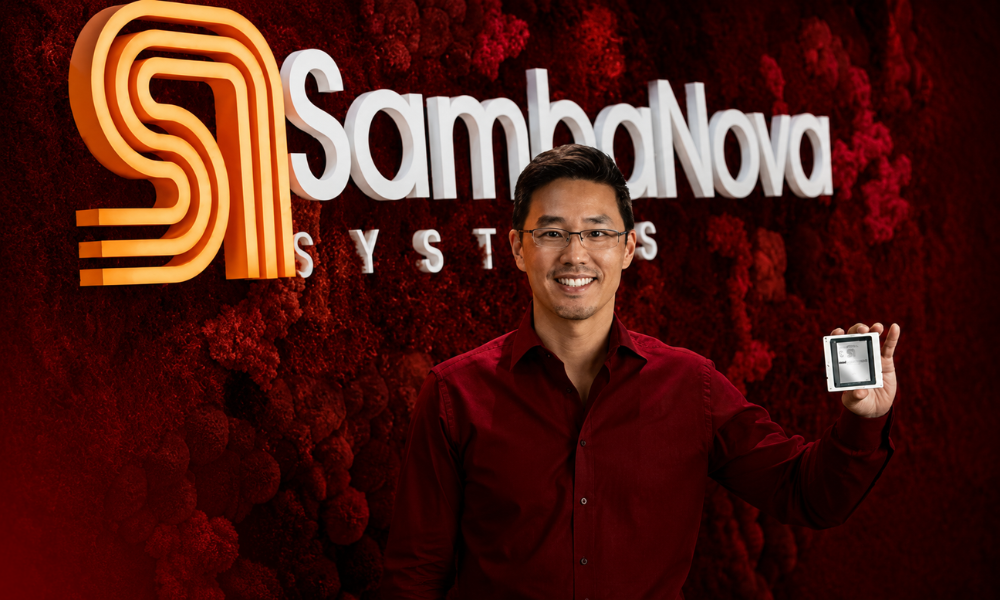
SambaNova Systems continued strengthening its position as one of the world’s leading AI infrastructure companies.
The company completed a $1 billion Series F funding round, reaching an estimated valuation of $11 billion.
According to the research report, major investors included BlackRock, Intel Capital, and the Qatar Investment Authority.
One of the company’s most significant commercial achievements was its partnership with JPMorgan Chase, where SambaNova deployed its SN40 and SN50 AI infrastructure to support enterprise-scale financial analysis.
Unlike many software-focused startups, SambaNova demonstrates how specialized hardware and integrated AI platforms have become central to the next generation of enterprise computing.
5. StepFun
StepFun has quickly become one of China’s most closely watched AI companies.
During Q2 2026, it secured a funding round exceeding $1 billion, giving it the resources to expand local compute infrastructure and accelerate research into multimodal reasoning systems.
The company focuses on step-by-step reasoning rather than simple text generation.
That approach makes its models suitable for complex enterprise tasks that require structured decision-making instead of conversational responses alone.
As one of China’s “New Tigers” of AI, StepFun also represents the growing importance of emerging tech startups 2026 outside Silicon Valley.
6. Moonshot AI
Moonshot AI is another Chinese frontier AI lab that attracted major investor attention during the quarter.
Its late-stage funding round surpassed $1 billion, reflecting confidence in the company’s work on ultra-long context AI models and consumer-focused intelligent agents.
Long-context processing allows AI systems to understand significantly larger amounts of information within a single interaction.
That capability is becoming increasingly valuable for research, coding, enterprise knowledge management, and productivity software.
Moonshot’s funding highlights how investors are backing specialized AI capabilities instead of general-purpose models alone.
7. Hark
Hark represents one of the most impressive early-stage funding stories of Q2 2026.
The North American startup raised an extraordinary $700 million despite being much earlier in its development than many companies on this list.
Its focus is personalized intelligence, an area that combines AI with individualized user experiences.
Large early-stage rounds of this size remain rare, making Hark one of the strongest examples of fastest-growing startups funding during the quarter.
The company’s success also reflects growing investor willingness to fund promising technology before commercial maturity when the underlying innovation appears compelling.
8. Ineffable Intelligence
Europe produced one of its biggest AI success stories through the United Kingdom’s Ineffable Intelligence.
The company completed a multi-billion-dollar funding round backed by institutional investors and sovereign capital committed to building European AI infrastructure.
Unlike many competitors, Ineffable focuses heavily on regulatory compliance.
Its foundational models are designed around European governance requirements, including strict data privacy and regulatory frameworks.
That positioning gives European enterprises an alternative to relying exclusively on US-based AI providers.
9. Flourish
Flourish approaches artificial intelligence from an entirely different direction.
Instead of improving existing AI architectures, the company develops neuromorphic computing systems inspired by the structure of the human brain.
During Q2 2026, Flourish secured $500 million in early-stage funding.
Investors believe these alternative architectures may dramatically reduce the enormous energy requirements associated with modern AI computing.
Although still early in its commercial journey, Flourish demonstrates how innovation extends well beyond large language models.
10. NinjaOne
NinjaOne rounds out the list by representing the growing intersection between enterprise IT operations and intelligent automation.
The company raised a $400 million Series C extension led by Wellington Management and Washington Harbour Partners.
Rather than focusing on consumer AI, NinjaOne develops automated endpoint management and security platforms.
Its funding is being used to expand systems capable of detecting vulnerabilities and deploying software updates across enterprise networks with minimal manual intervention.
The company’s growth also contributed to the recovery of the FinTech and enterprise infrastructure segments during Q2 2026.
Startup Comparison Table
| Startup | Sector | Funding | Primary Strength | Growth Driver |
|---|---|---|---|---|
| Anthropic | Frontier AI | $65B | Foundation models | Enterprise AI infrastructure |
| DeepSeek | Frontier AI | $1B+ | Efficient open-source AI | Algorithm optimization |
| Cerebras Systems | AI Hardware | Pre-IPO growth / $5.6B IPO | Wafer-scale chips | AI compute |
| SambaNova Systems | AI Infrastructure | $1B | Enterprise AI hardware | Banking partnerships |
| StepFun | Frontier AI | $1B+ | Multimodal reasoning | Compute expansion |
| Moonshot AI | Frontier AI | $1B+ | Long-context AI | Consumer agents |
| Hark | Personalized AI | $700M | Early-stage intelligence | Personalized AI |
| Ineffable Intelligence | Sovereign AI | Multi-billion | Compliant enterprise AI | European market |
| Flourish | Neuromorphic Computing | $500M | Brain-inspired chips | Energy-efficient AI |
| NinjaOne | Enterprise Automation | $400M | Endpoint management | Enterprise security |
Funding Trends Behind the Fastest Growing Tech Startups 2026
The funding landscape of Q2 2026 tells a much larger story than individual investment rounds.
It reveals how venture capital priorities have shifted toward infrastructure-heavy technologies that require substantial capital before they generate significant revenue.
According to Crunchbase, total startup investment reached $205 billion during Q2 2026.
Combined with Q1, the first half of the year reached a record $510 billion, surpassing the total amount raised during all of 2025.
Another important statistic shows just how concentrated this capital became.
Crunchbase reports that 16 startups absorbed $108.6 billion, representing 53% of all venture funding during the quarter.
AI Continues to Dominate Investment
Artificial intelligence remains the clear winner.
According to Crunchbase, more than 70% of global venture capital flowed into AI-focused companies during Q2.
Investors are no longer funding AI applications alone.
They are financing the infrastructure that powers future generations of intelligent software, including data centers, chips, foundational models, and enterprise deployment platforms.
This explains why nearly every company among the top funded tech startups 2026 operates somewhere within the AI ecosystem.
Late-Stage Funding Accelerated Rapidly
The strongest growth occurred among mature companies preparing for large-scale expansion.
Crunchbase reported $134 billion in late-stage funding during Q2 2026.
That represents a remarkable 141% year-over-year increase, illustrating renewed confidence among institutional investors.
Instead of focusing on rapid customer acquisition, these companies are investing in compute infrastructure, proprietary hardware, and global deployment.
Early-Stage Investment Also Improved
Although mega-rounds dominated headlines, early-stage companies also experienced significant growth.
Crunchbase found that Series A and Series B funding reached $58.9 billion, more than doubling compared with Q2 2025.
The report also identified 91 startups that raised early-stage rounds worth $100 million or more.
This suggests investors continue supporting promising innovation despite concentrating larger sums among established AI leaders.
FinTech Regained Momentum
Artificial intelligence attracted the majority of capital, but financial technology also rebounded.
According to FinTech Global, US FinTech investment increased 44% quarter over quarter, reaching $16 billion across 445 deals.
The improvement was driven partly by a 23% increase in deals valued above $100 million.
Companies such as NinjaOne demonstrate how automation and intelligent infrastructure continue expanding beyond traditional AI laboratories.
What Venture Capital Firms Are Looking for in 2026
Funding decisions today differ dramatically from those made during previous technology cycles.
Investors now prioritize long-term infrastructure advantages rather than rapid user growth alone.
Several consistent themes appear throughout the companies leading this year’s funding rankings.
AI-First Products
Every major funding round reflects confidence in artificial intelligence as foundational technology rather than a standalone feature.
Companies building core AI infrastructure continue to receive the strongest investor interest.
Compute Infrastructure
Large language models require enormous computational resources.
Businesses capable of designing chips, securing cloud capacity, or improving inference efficiency enjoy significant competitive advantages.
Enterprise Adoption
Investors increasingly value technologies that solve large organizational problems instead of consumer experimentation.
Anthropic’s cloud integrations and SambaNova’s partnership with JPMorgan Chase illustrate this trend clearly.
Strong Research Teams
Funding follows technical credibility.
Many startups attracting billion-dollar rounds are led by highly specialized engineering and research teams capable of tackling complex scientific challenges.
Emerging Startup Sectors Beyond AI
Artificial intelligence remains the largest investment category, but several adjacent industries are gaining momentum.
AI Hardware
Custom processors, wafer-scale chips, and inference optimization are becoming essential parts of the AI ecosystem.
Companies like Cerebras Systems and SambaNova Systems illustrate this shift.
Neuromorphic Computing
Startups such as Flourish are developing computing systems inspired by biological neural networks.
If successful, these technologies could significantly reduce energy consumption while improving AI efficiency.
Robotics and Intelligent Physical Systems
Investors are increasingly supporting companies that combine AI software with physical machines.
Humanoid robotics, autonomous logistics, and defense technologies represent growing areas of interest.
Sovereign AI
Countries are investing heavily in domestic AI ecosystems.
DeepSeek, StepFun, Moonshot AI, and Ineffable Intelligence all reflect a broader movement toward regional AI independence supported by local investors and regulatory priorities.
Expert Analysis: Beyond the Funding Headlines
Large funding rounds naturally attract attention.
However, capital alone does not guarantee long-term success.
The defining characteristic of 2026 is not simply record investment but the concentration of resources into companies expected to build the infrastructure of the future.
That concentration creates opportunities while also increasing pressure on these startups to convert enormous investments into sustainable enterprise businesses.
Unlike earlier technology booms driven largely by marketing and software expansion, today’s companies must demonstrate they can transform billions of dollars in capital into practical AI platforms, specialized hardware, and commercially successful enterprise solutions.
Risks Behind the Funding Boom
The remarkable growth of Q2 2026 also introduces meaningful challenges.
Extreme Capital Concentration
More than half of global venture funding flowed into just 16 companies.
This leaves many promising startups competing for a much smaller pool of available investment.
High Burn Rates
Building frontier AI requires substantial spending on chips, electricity, cloud infrastructure, and engineering talent.
Many companies must spend hundreds of millions before generating sustainable profits.
Geopolitical Uncertainty
Several leading startups operate within regions affected by semiconductor export restrictions and evolving international regulations.
Changes in trade policy could significantly affect future growth plans.
Bubble Concerns
Some investors remain cautious.
Record valuations create expectations that companies will eventually deliver corresponding enterprise revenue.
Failure to meet those expectations could result in funding corrections during future investment cycles.
Practical Application: How to Use These Funding Trends
Reading about billion-dollar funding rounds is interesting, but the real value comes from understanding what those investments signal. Whether you’re building a startup, investing, searching for a job, or working in marketing, these trends can help you make more informed decisions.
The fastest growing tech startups 2026 reveal where investors believe long-term technological value is being created. Looking beyond the headlines helps you recognize opportunities before they become obvious to everyone else.
For Startup Founders
If you’re building a startup, don’t focus only on how much money companies raised.
Instead, pay attention to why investors wrote those checks.
Anthropic, DeepSeek, SambaNova Systems, and StepFun all attracted funding because they solve infrastructure-level problems rather than incremental software challenges.
Ask yourself:
- Does your product solve a problem large enterprises will pay to solve?
- Can your technology scale internationally?
- Is your competitive advantage difficult to copy?
- Are you building long-term intellectual property instead of short-term features?
The research also shows another important lesson.
Capital is increasingly flowing toward companies with clear technical differentiation, experienced teams, and scalable platforms, not simply those with fast customer growth.
For Investors
Funding data can reveal market direction long before broader technology trends become obvious.
Instead of looking only at the largest funding rounds, examine where multiple investors are concentrating capital.
During Q2 2026, several patterns became clear:
- Frontier AI laboratories
- AI infrastructure
- Custom silicon
- Enterprise automation
- Sovereign AI
- Robotics
When multiple independent venture firms invest heavily in the same categories, it often reflects long-term confidence rather than short-term excitement.
However, avoid assuming that larger funding automatically means lower investment risk.
Many companies featured in this article still face significant technical, commercial, and regulatory challenges.
For Job Seekers
Funding often translates into hiring.
Companies that secure major investment usually expand engineering, research, product development, security, operations, and enterprise sales teams over the following months.
That makes this ranking useful if you’re planning your next career move.
Rather than searching only for established technology giants, monitor well-funded startups entering rapid expansion phases.
These organizations frequently offer opportunities to work on cutting-edge technologies while growing alongside the company.
For Marketing Teams
Marketing strategies also change when industries receive significant investment.
The sectors attracting the largest funding today often become tomorrow’s fastest-growing advertising markets.
AI infrastructure, enterprise software, cybersecurity, automation, and intelligent hardware are likely to increase spending on brand awareness, content marketing, developer relations, and enterprise sales enablement.
Understanding these shifts allows marketers to prepare before competition intensifies.
Who Should Use This Information?
This article is especially valuable for readers who want to understand where technology investment is heading rather than simply following headlines.
It is particularly useful for:
- Startup founders preparing for fundraising.
- Venture capital analysts tracking market trends.
- Angel investors researching emerging sectors.
- Technology professionals evaluating career opportunities.
- Marketing leaders targeting high-growth industries.
- Business students studying venture capital.
- Enterprise decision-makers monitoring AI innovation.
Who May Find It Less Useful?
Not every reader needs to follow quarterly venture funding closely.
If you’re looking for consumer technology reviews, software buying guides, or stock market analysis, this article won’t answer those questions.
Likewise, startup funding should never be treated as proof that a company will become profitable.
Funding reflects investor confidence, not guaranteed commercial success.
Common Mistakes When Interpreting Startup Funding
Funding headlines are exciting, but they can also create misleading impressions.
Here are some common mistakes worth avoiding.
Assuming Bigger Funding Means Better Products
Large investments indicate confidence from investors.
They do not automatically prove that a company’s products outperform competitors.
Execution still matters.
Ignoring Infrastructure Costs
Many frontier AI startups require enormous computing resources before generating significant revenue.
High funding often reflects high operating costs rather than immediate profitability.
Looking Only at AI
Artificial intelligence dominates headlines, but adjacent industries continue attracting meaningful investment.
Enterprise automation, robotics, semiconductor design, and financial infrastructure all experienced strong growth during Q2 2026.
Diversification remains important.
Confusing Valuation with Revenue
Valuation represents what investors believe a company may become.
Revenue measures current business performance.
Those two numbers can differ dramatically, especially in frontier technology markets.
Looking Ahead: What Could Shape the Rest of 2026?
The first half of 2026 has already rewritten venture capital records, but the coming months may prove just as significant.
Several trends emerging during Q2 are likely to influence investment decisions throughout the remainder of the year.
Autonomous AI Agents
Research highlighted a growing shift from AI systems that generate text toward systems capable of completing complex tasks independently.
Future funding is expected to prioritize autonomous financial management, software engineering, logistics, and enterprise operations.
Greater Enterprise Adoption
The next stage of competition will depend less on research demonstrations and more on commercial deployment.
Companies able to integrate AI safely into enterprise environments may attract continued investor confidence.
Examples such as Anthropic’s cloud integrations and SambaNova Systems’ deployment within JPMorgan Chase illustrate this transition.
Stronger Regulation
Governments around the world are preparing updated frameworks covering advanced AI models, large-scale computing infrastructure, and data governance.
European startups such as Ineffable Intelligence already position regulatory compliance as a competitive advantage.
Meanwhile, Asian companies continue emphasizing algorithmic efficiency to navigate hardware restrictions.
Continued Global Competition
Q2 demonstrated that frontier AI is no longer concentrated within Silicon Valley.
China’s DeepSeek, StepFun, and Moonshot AI strengthened Asia’s position through efficient AI architectures.
Europe expanded its sovereign AI ecosystem through companies such as Ineffable Intelligence while also investing heavily in deep technology, biotechnology, and advanced logistics.
The competition for leadership has become truly global.
Conclusion
When I first started following the funding announcements that inspired this article, it seemed like every week brought another headline announcing billions of dollars flowing into a single startup.
Looking at the complete picture now, those announcements weren’t isolated events. They were signs of a broader transformation in how venture capital views technological progress.
The fastest growing tech startups 2026 aren’t simply raising larger funding rounds than previous generations. They are building the computing infrastructure, AI models, specialized hardware, and enterprise platforms that many investors believe will define the next decade of innovation.
At the same time, the research reminds us to keep expectations balanced. According to Crunchbase, more than half of Q2 venture capital was concentrated in just 16 companies, while AI attracted over 70% of total investment. Those figures show remarkable confidence, but they also highlight the challenges of capital concentration, high operating costs, and increasing regulatory scrutiny.
That brings me back to the moment that started this journey.
Those funding headlines weren’t really about money.
They were signals pointing toward where technology is heading next, and understanding those signals is often more valuable than the numbers themselves.
Frequently Asked Questions (FAQ)
1. What are the fastest growing tech startups 2026?
The fastest growing tech startups 2026 are privately held technology companies that secured the largest funding rounds during the second quarter of the year. In this article’s ranking, companies such as Anthropic, DeepSeek, Cerebras Systems, SambaNova Systems, StepFun, Moonshot AI, Hark, Ineffable Intelligence, Flourish, and NinjaOne stand out because they attracted exceptional venture capital investment. Their growth is measured primarily by capital acceleration, valuation expansion, and their ability to build next-generation AI, hardware, and enterprise infrastructure.
2. Which startup raised the largest funding round in Q2 2026?
Anthropic secured the largest funding round of Q2 2026. According to the research data, the company raised $65 billion through a multi-tranche financing that included a $50 billion consortium led by Altimeter Capital, Dragoneer, Greenoaks, and Sequoia, along with strategic investments of $10 billion from Google and $5 billion from Amazon. The funding increased Anthropic’s valuation to approximately $965 billion, making it the world’s most valuable private startup.
3. How much global startup funding was raised during Q2 2026?
According to Crunchbase, global startup funding reached $205 billion across more than 5,000 funding deals during Q2 2026. Combined with the first quarter, startup investment reached a record $510 billion during the first half of 2026. These figures surpassed the total amount raised throughout all of 2025, highlighting one of the strongest venture capital environments on record.
4. Why is venture capital so heavily concentrated in 2026?
The research shows that modern AI companies require extraordinary amounts of capital before they can commercialize their technology. Instead of spending primarily on marketing or hiring, many startups invest heavily in GPUs, specialized AI chips, cloud infrastructure, data centers, and advanced research. According to Crunchbase, 16 companies absorbed $108.6 billion, representing 53% of all global venture funding during Q2 2026, illustrating how investors are concentrating capital into a relatively small number of infrastructure-focused businesses.
5. Which industries attracted the most investment during Q2 2026?
Artificial intelligence dominated global investment activity throughout the quarter. Crunchbase reports that more than 70% of all venture capital invested during Q2 2026 flowed into AI-focused startups. Beyond AI, investors also showed strong interest in AI hardware, enterprise infrastructure, robotics, neuromorphic computing, cybersecurity, and financial technology automation.
6. Are early-stage startups still receiving investment?
Yes. Although billion-dollar funding rounds attracted the most attention, early-stage companies also experienced significant growth during Q2 2026. According to Crunchbase, Series A and Series B funding reached $58.9 billion, more than doubling compared with the same period in 2025. The report also noted that 91 startups completed early-stage rounds worth $100 million or more, demonstrating continued investor confidence in promising young companies.
7. Why are AI startups attracting record levels of funding?
Building frontier AI systems requires massive investments in computing infrastructure long before companies generate significant revenue. Investors believe these technologies will become foundational platforms used across industries including finance, healthcare, software development, manufacturing, and scientific research. Because of these expectations, venture firms are providing historic levels of funding to companies capable of building the underlying infrastructure rather than simply developing AI applications.
8. Is the current startup funding market considered an AI bubble?
The research presents a balanced perspective rather than a definitive answer. Many investors remain optimistic because AI adoption continues expanding rapidly across enterprise markets, while others warn that unusually high valuations and significant operating expenses could create future financial pressure. The long-term success of today’s highly funded startups will ultimately depend on their ability to convert enormous infrastructure investments into sustainable enterprise revenue.
9. What role do Europe and Asia play in the 2026 startup ecosystem?
Europe and Asia have become increasingly important contributors to the global venture capital landscape. Chinese companies such as DeepSeek, StepFun, and Moonshot AI are advancing efficient frontier AI models, while the United Kingdom’s Ineffable Intelligence is building highly compliant enterprise AI systems aligned with European regulatory requirements. These developments demonstrate that innovation is becoming more geographically distributed rather than remaining concentrated in a single region.
10. What trends are expected to shape startup funding after Q2 2026?
The research suggests that funding will increasingly shift toward autonomous AI agents capable of performing complex tasks independently rather than simply generating text or code. Investors are also expected to prioritize enterprise adoption, AI infrastructure, custom silicon, robotics, and regulatory-compliant AI platforms. At the same time, governments are likely to introduce stronger oversight of advanced AI systems, making compliance and sustainable commercial execution just as important as technological innovation.