

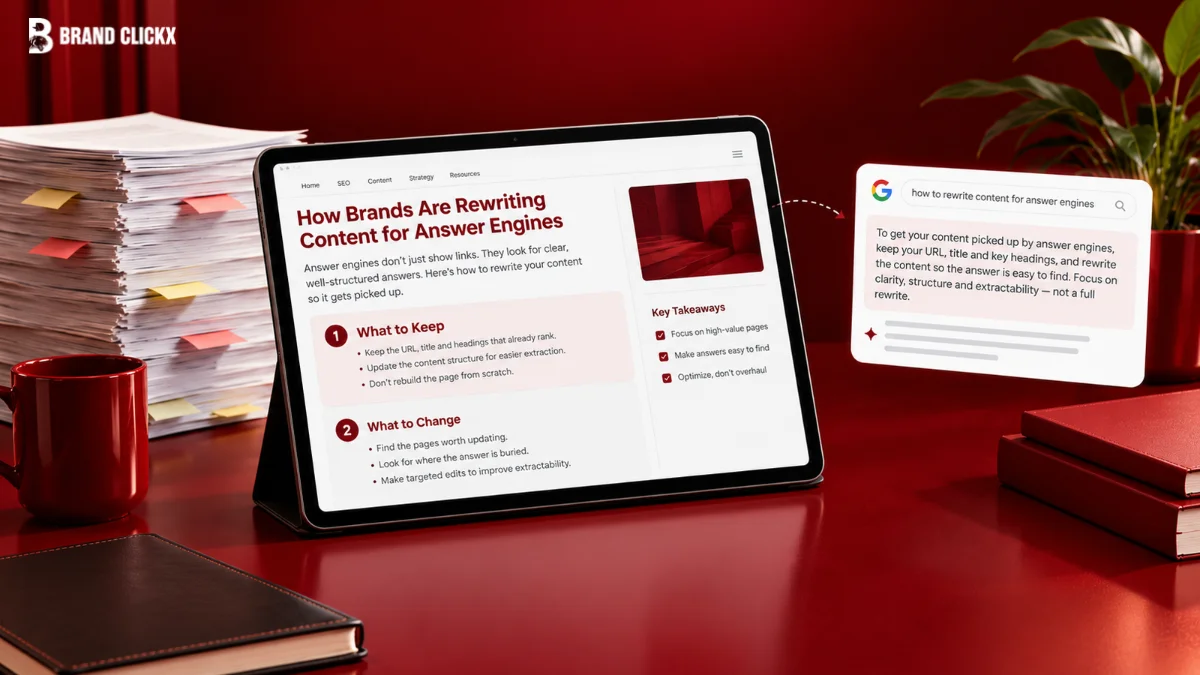
You’ve got 400 pages and no idea where to start. Rewrite them all and you’ll spend a quarter on pages that never needed it. Rewrite none and AI answers keep quoting someone else.
Content rewriting for AEO means editing a page that already exists so answer engines can lift a clean answer from it. You keep the URL, the title and the headings that carry its rankings. You change how the page is built so the answer is easier to find. You don’t rebuild it from scratch.
The right approach isn’t to rewrite everything. It’s to identify the pages worth changing, find where the answer is buried and make targeted edits that improve extractability without throwing away what already works.
Why Retrofitting Is a Different Job
A new page starts empty. An old page already has rankings, links and a history you can wreck in an afternoon. That’s why this job needs its own rules. The URL, title and ranking headings are assets. You can change what sits inside them but unnecessary structural changes create risk without necessarily improving visibility.
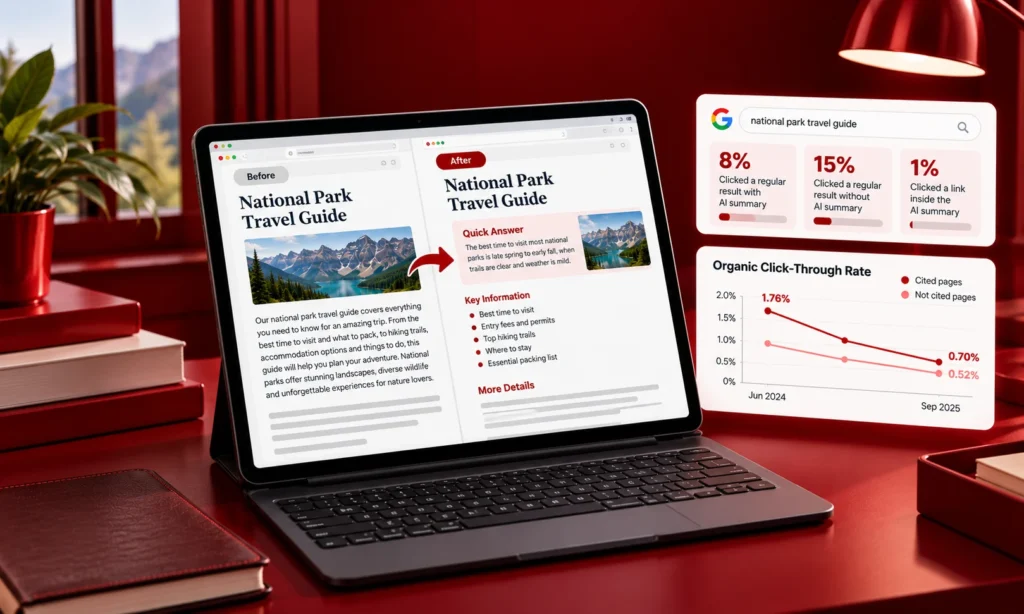
The reason to care is simple. AI-generated answers are changing what happens after a search. Research tracking around 900 US adults found that when Google showed an AI summary, people clicked a regular result link in 8% of visits. Without an AI summary, they clicked in 15%. Links inside the AI summary received clicks in just 1% of visits.
A separate analysis of more than 3,000 informational queries across 42 organisations found a similar direction. Organic click-through rate on queries with an AI Overview fell from 1.76% in June 2024 to 0.61% in September 2025. Pages that were cited had a higher click-through rate at 0.70% compared with 0.52% for pages that weren’t cited.
Neither study predicts what will happen to your site. They show why being visible inside the answer matters even when fewer people click through. So should you rewrite existing content for AI search?
Yes, but only on pages that justify the work. The goal isn’t to make every page look like it was written for an AI. The goal is to make useful information easier for both people and answer engines to identify.
Step 1: Choose Which Pages
This is where most of the value sits. Instead of opening your content library and rewriting whatever looks old, score each candidate page from 0 to 2 across four signals. That gives you a total score out of 8.
| Signal | 0 | 1 | 2 |
| It already ranks | Average position beyond 20 or no impressions | Position 11 to 20 | Position 1 to 10 with steady impressions |
| It answers a question people ask | Nobody phrases it as a question | Related questions only | The main topic is a full question |
| The answer is buried | Answer sits at the top | Answer follows a long intro | Answer sits below paragraph 4 or under a heading that asks nothing |
| It’s good but cited by nobody | Cited consistently | Cited occasionally | Accurate and current but rarely or never cited |
Pull the first signal from Search Console impressions and average position. For the citation signal, take 5 to 10 questions the page should answer and run them through the answer engines your audience uses. Record whether your page appears as a cited source.
Question-based searches deserve particular attention. One large search study found that 60% of searches beginning with who, what, when or why produced an AI summary. Only 8% of one- or two-word searches did compared with 53% of searches containing 10 words or more. Use the score as a prioritisation system rather than a prediction model.
- 6 to 8: Rewrite now.
- 3 to 5: Review manually.
- 0 to 2: Usually skip the rewrite.
There are two groups you should usually leave alone. The first is a page that already performs well and already gives a clean answer. If the page is doing its job, rewriting it simply because AI search exists can introduce unnecessary risk. The second is a thin page that has little useful information to improve. That page may need to be merged, redirected or rebuilt rather than retrofitted.
Step 2: Find Where the Answer Is Buried
The common problem with old content isn’t always that the answer is missing. Often, the answer exists but sits in paragraph seven under a heading that doesn’t tell the reader what they’ll find.
Start with a simple audit.
Copy the page’s headings into a blank document and read them without the body copy. Ask three questions:
- Does any heading reflect a question the reader would actually ask?
- Can you tell where the answer to that question lives?
- Do two headings cover the same idea?
If you can’t answer those questions quickly, the page probably needs structural editing. Next, run the lift test. Take the first paragraph under each important heading and paste it into a blank document. Read it without the rest of the article.
A strong answer should still make sense on its own. If it depends on phrases such as “this”, “as mentioned above” or a definition introduced three sections earlier, it needs work. This matters because answer engines don’t necessarily reproduce an entire page. They assemble answers from passages across multiple sources.
In one analysis, 88% of AI summaries cited three or more sources and the median summary was 67 words. Your paragraph may have to compete with several other passages inside the same answer. Make it understandable without the surrounding article.
Step 3: Make the Changes That Matter
Five changes cover most of what a useful retrofit needs.
1. Move the answer under the heading
Don’t make readers work through a long introduction before they get the answer. Lead with a concise answer of roughly 40 to 60 words where the topic allows it. Name the subject in the first sentence and answer the question directly.
This also makes the passage easier to understand when it is extracted from the surrounding page.
2. Turn useful statements into questions
A heading such as “Pricing” tells the reader very little. If the section answers a genuine user question, make that clear.
- “Pricing” can become “How much does it cost?”
- “Implementation” can become “How long does implementation take?”
But don’t force every heading into a question. “Our story” doesn’t become better simply because you turn it into “What is our story?” The question should reflect how someone actually searches or asks.
3. Give each paragraph one job
Long paragraphs often contain several answers. Break them apart so each paragraph handles one idea. This improves readability and gives each passage a clearer meaning when it is considered independently.
The goal isn’t to make every paragraph short. The goal is to stop different ideas competing inside the same block of text.
4. Define important terms directly
Don’t assume the reader already knows the terminology. When an important term first appears, explain it in one clear sentence.
For example: Entity salience is the practice of making the main subject of a page explicit and consistent throughout the content.
You don’t need a 500-word definition. You need enough context for the reader to understand what the term means and why it matters.
5. Use tables for genuine comparisons
If the page compares several things across the same criteria, a table is often clearer than five paragraphs. Use it for things such as:
| Comparison | Option A | Option B | Option C |
| Cost | Lower | Medium | Higher |
| Setup | Simple | Moderate | Complex |
| Best for | Small teams | Growing teams | Enterprise |
| Main limitation | Fewer features | More setup | Higher cost |
Don’t add a table simply because tables look structured. If there are no meaningful comparison points, normal prose is better.
There is also evidence that content changes can influence visibility in generative answers. A 2024 research benchmark covering 10,000 queries found that changes such as adding citations, quotations and statistics could increase visibility by as much as 40%.
That’s a benchmark result, not a guarantee for your site. The practical lesson is simpler: when you have a strong source for a claim, use the evidence instead of replacing it with vague language.
Step 4: Know Which Changes to Avoid

The most valuable AEO work isn’t always another edit. Sometimes the right decision is to leave the page alone.
Don’t rewrite a page that already works
If a page ranks well, answers the question clearly and already receives citations, don’t change it just to make it look more “AI-friendly.” Every edit creates some possibility of changing search performance.
Don’t add schema as your first fix
Structured data can help search engines understand a page, but it won’t rescue an answer buried in paragraph seven.
Fix the content structure first. Then decide whether additional structured data has a clear purpose.
Don’t restructure navigation unnecessarily
Changing menus, internal architecture and page relationships can affect far more than the page you’re trying to improve. If the problem is that the answer is buried in the content, fix the content first.
Don’t change the URL just because you’re rewriting
An existing URL can have rankings, links and accumulated history. A content retrofit doesn’t require a new URL. If there is no separate strategic reason to change the address, keep it.
Don’t turn the retrofit into a technical project
Check that answer engines can access the page. If the page loads without a login and isn’t blocked from crawling, move on. Technical crawling and indexation problems deserve their own audit. They shouldn’t turn a straightforward content rewrite into a six-week project.
What to Do With Pages You Shouldn’t Rewrite
Not every page belongs in the retrofit queue.
Some should stay exactly where they are. Others should be combined or removed.
| Situation | Best action |
| The page already wins a SERP feature or its answer appears directly in search | Leave it alone |
| The page performs well and already reads cleanly | Leave it alone |
| Two thin pages answer the same question | Merge into the stronger page and redirect the other |
| The page has no unique value and earns nothing | Redirect to the closest relevant page |
Zero-click search also changes how you evaluate content. A page can contribute value even when it produces fewer clicks because its information may appear directly inside an AI-generated answer.
Research found that links inside an AI summary received clicks in just 1% of visits. That means click data alone can make a useful page look weaker than it really is. This is why citation visibility should sit alongside traditional SEO metrics rather than replacing them.
How to Measure the Rewrite
Record the page’s starting position before changing anything. At minimum, capture:
- Average position
- Impressions
- Clicks
- Main queries
- Existing SERP features
- Whether answer engines cite the page
Then make the changes. Don’t judge the result after two days. Search performance changes over time and answer-engine visibility can fluctuate as systems update. Compare meaningful measurement periods rather than individual days.
The goal isn’t simply to increase impressions. A successful retrofit should make the page more useful, make the answer easier to extract and protect the organic value the page already has.
Conclusion for Content rewriting for AEO
Content rewriting for AEO is worth doing at scale only on the pages that matter. If you have 400 existing pages, you don’t have 400 rewriting projects. You have a prioritisation problem.
Start by scoring the pages. Take the highest-value candidates and find where their answers are buried. Move those answers closer to the questions, make important passages stand alone and remove unnecessary complexity.
- Leave strong pages alone.
- Merge thin duplicates.
- Redirect pages that have no unique value.
The best AEO retrofit isn’t the biggest rewrite. It’s the smallest set of changes that makes an already valuable page easier for both people and answer engines to understand.