A freelancer sends you an article.
It looks good. The facts check out. The sources are there. It follows the brief. Then someone runs it through an AI detector and gets an 82% AI score.
Now what?
Do you ask the freelancer to explain themselves? Do you reject the article? Do you run it through another detector and hope that one gives you a different answer?
This is where ai content detection tools get tricky. They give you a number that looks very certain, even though the tool cannot actually see who wrote the words or how the piece was produced. Research has also found that some kinds of human writing are more likely to be flagged than others.
So, are ai content detection tools accurate?
That question matters. But honestly, it is not the most useful question for a marketing team.
The accuracy question is short. The policy question is the useful one.
The real issue is what your team should do when an AI detection tool gives you a score.
Key Takeaways
- AI content detection tools estimate whether text resembles AI-generated writing. They do not prove who wrote it.
- Research shows detection performance can change significantly depending on the model, dataset, writer, and type of content being tested.
- Second-language writers and highly predictable or formulaic writing can face higher false-positive risks.
- A detector score should never be treated as proof when judging an individual writer.
- Marketing teams need clear AI disclosure and quality rules more than they need an AI percentage.
How AI Content Detection Tools Actually Work
The basic idea sounds pretty simple.
AI content detection tools look for patterns that appear more common in machine-generated writing. One of those patterns is predictability: how easy it is for a language model to predict the words that come next.
Another is how much the writing varies. Do sentences have noticeably different structures? Does vocabulary change naturally? Or does the text follow a fairly predictable rhythm?
These signals can be useful. But there is an important catch.
They are signals, not fingerprints.
An AI content detection tool sees the final text. It does not see the writer sitting at their desk. It does not know whether someone wrote the first draft themselves, used a large language model to brainstorm, rewrote every paragraph manually, or ran the finished piece through several editing tools.
And human writing can be predictable too.
Think about a product description:
“Made from lightweight material, this jacket is designed for everyday comfort.”
There is nothing particularly surprising about that sentence. In fact, that is the point. Marketing copy often uses familiar structures because readers understand them quickly.
So when ai content detection tools say a piece “looks like AI,” what they really mean is that the text contains patterns associated with text generated by language models.
That is a much smaller claim than “AI wrote this.”
What Do AI Content Detection Tools Actually Tell You About Accuracy?
There is no single accuracy number you can safely apply to every piece of content.
And the research makes that pretty clear.
In a 2023 study published in Patterns, Liang, Yuksekgonul, Mao, Wu, and Zou tested 7 GPT detectors on 91 TOEFL essays written by non-native English speakers and 88 essays written by U.S. eighth-grade students from the Hewlett Foundation’s ASAP dataset. Across the TOEFL essays, the researchers reported an average false-positive rate of 61.3%.
That is a serious warning sign.
But it is also important not to take that one result and conclude that every AI content detection tool performs that badly in every situation.
A 2024 study by Jiang, Hao, Fauss, and Li used large-scale GRE writing assessment data and a different detection methodology. Their results showed very high detection performance in that particular testing environment, with no observed disadvantage for non-native English writers in their dataset.
Then there is the question of robustness.
The 2024 RAID benchmark tested 12 detectors using more than 6 million generated texts, covering 11 language models, 8 domains, 11 adversarial attacks, and 4 decoding strategies. The researchers found that detector performance could deteriorate when the generated text or conditions changed.
So the honest answer to “Are ai content detection tools accurate?” is:
Sometimes, under particular testing conditions. Not reliably enough to treat the result as proof about an individual document.
And that distinction matters.
An AI content detection tool can perform well on a benchmark and still give you a misleading answer about one freelancer’s article on a Tuesday afternoon.
Why Do AI Content Detection Tools Flag Non-Native English Writers?
This is probably the part marketing teams should pay the most attention to.
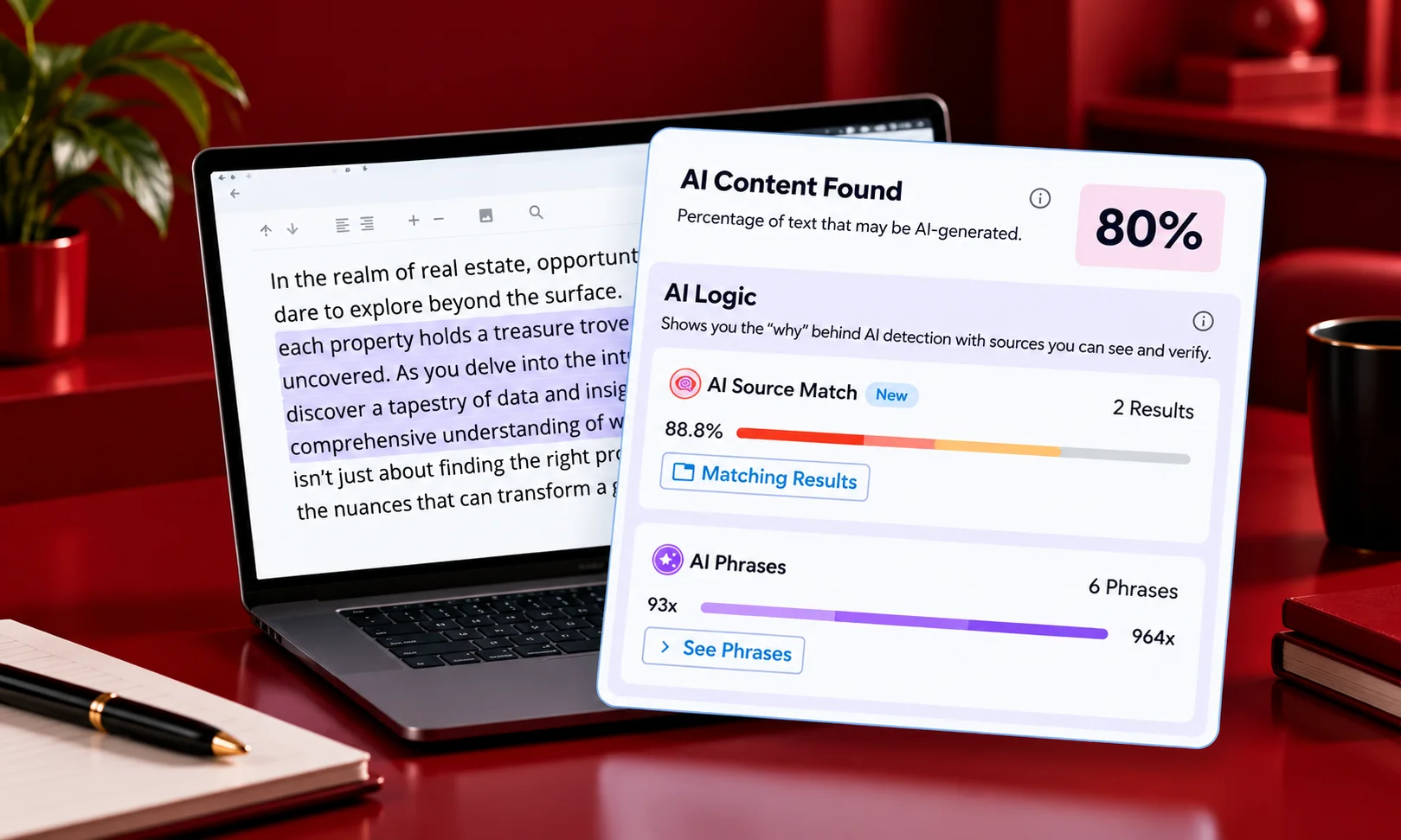
The 2023 Liang et al. study found that the detectors they tested were much more likely to classify the TOEFL essays from non-native English writers as AI-generated. The sample contained 91 TOEFL essays, and the researchers reported an average false-positive rate of 61.3% across the 7 detectors.
Why might that happen?
One explanation is predictability.
Someone writing in a second language may deliberately choose safer vocabulary. They may use simpler sentence structures. They may avoid unusual expressions because they are trying to be clear and grammatically correct.
Ironically, those choices can make the writing more statistically predictable.
And predictable writing is one of the things ai content detection tools can pick up.
The same problem can show up with plain, conventional writing. A writer does not have to be a second-language speaker for this to happen.
Formulaic content can have the same issue.
Think about product descriptions, technical documentation, financial explainers, compliance content, or highly structured SEO pages. The format itself encourages repetition and predictable language.
A 2026 review in AI and Ethics discusses these risks around predictable and formulaic language, including additional-language writing.
That is why a detector score should not become a judgment about a person.
If an AI content detection tool has known situations in which it can misclassify human writing, you cannot reasonably turn its percentage into a verdict about whether a particular freelancer or employee used AI.
Why Is AI Detection the Wrong Question Anyway?
Here is where the conversation gets more useful.
There are actually two different questions here:
How was this content produced?
And:
Is this content any good?
Those are not the same thing.
Call the first one provenance.
Call the second one quality.
A good article can be produced with AI assistance.
A terrible article can be written entirely by hand.
Neither statement is particularly controversial. But somehow, AI discussions often mix the two together.
If your marketing problem is bad content, then investigate the content.
Is it inaccurate?
Are the sources weak?
Is it generic?
Does it actually answer the reader’s question?
Does it say anything useful?
Does it sound like 15 other articles already ranking for the same keyword?
Those are editorial problems. They can exist regardless of whether a human typed every sentence.
This is also why the growing use of marketing ops automation makes the old human-versus-AI distinction harder to maintain.
A modern content workflow might involve a human researcher, an LLM for brainstorming, an editor, a transcription tool, an SEO platform, and automated publishing. So where exactly would you draw the line?
More importantly, does that line tell you whether the finished article is worth publishing?
What Should Marketing Teams Do Instead?
This is the part I’d actually put into a marketing team’s operating process.
Judge the work first.
If you care about factual accuracy, check the facts.
If you care about sources, check the sources.
If you care about originality, review the content for originality.
If you care about usefulness, ask whether the piece actually solves the reader’s problem.
And if you care about AI use, create a clear disclosure rule.
That last one is important.
Instead of quietly running every freelancer’s article through ai content detection tools, put the expectation in the brief or contract.
For example:
AI use: Generative AI may be used for research, brainstorming, or editing, but contributors must disclose material AI assistance in final content.
Or perhaps your company has a stricter rule.
That’s fine too.
The important thing is that everyone knows the rule before the work starts.
A practical ai written content policy should answer a few basic questions:
- Is AI use allowed?
- If yes, what types of use are allowed?
- When does a contributor need to disclose it?
- Who reviews the work?
- What quality standards apply?
- What happens if the content does not meet those standards?
- What evidence is considered if someone is suspected of breaking the policy?
Notice what is missing:
“Run the article through an AI detector and trust the percentage.”
That should not be your enforcement system.
Even Turnitin, which operates one of the better-known AI-writing detection systems, says its AI writing model may misidentify human and AI-generated text and should not be used as the sole basis for adverse action.
That is a useful principle for marketing teams too.
Your process should be able to answer what happens when content is bad regardless of how it was produced.
A Simple Content Review Checklist
| Check | What to look for |
| Accuracy | Are the claims, numbers, names, and dates correct? |
| Sources | Are important claims supported by credible sources? |
| Usefulness | Does the piece actually help the intended reader? |
| Originality | Does it offer something beyond generic information? |
| Brief | Does it meet the audience, intent, tone, and structure requirements? |
| AI policy | Does it follow the agreed disclosure and usage rules? |
This is much more actionable than “The detector says 73%.”
And it becomes even more useful as a company’s AI adoption maturity increases.
A team using AI for the occasional outline needs basic rules.
A team using multiple models, automated workflows, and agent orchestration needs clearer ownership, disclosure requirements, review stages, and escalation processes.
The more automated the operation becomes, the more important the process becomes.
Should Agencies Run AI Content Detection Tools on Freelancer Work?
I would not make that a standard pass-or-fail step.
There is a difference between reviewing content and investigating a possible policy breach.
Every freelancer’s work should go through the first process.
Only specific situations should trigger the second.
If an agency’s contract says AI use is prohibited, the agency should have a clear process for handling suspected breaches. But an AI detection score alone is weak evidence because the underlying system is making a probabilistic classification, not observing the writer’s workflow.
This is especially important for agencies working with international freelancers.
If ai content detection tools are more likely to flag certain linguistic styles or predictable writing, using those scores as routine screening can create an uneven standard for different writers.
A better agency process is:
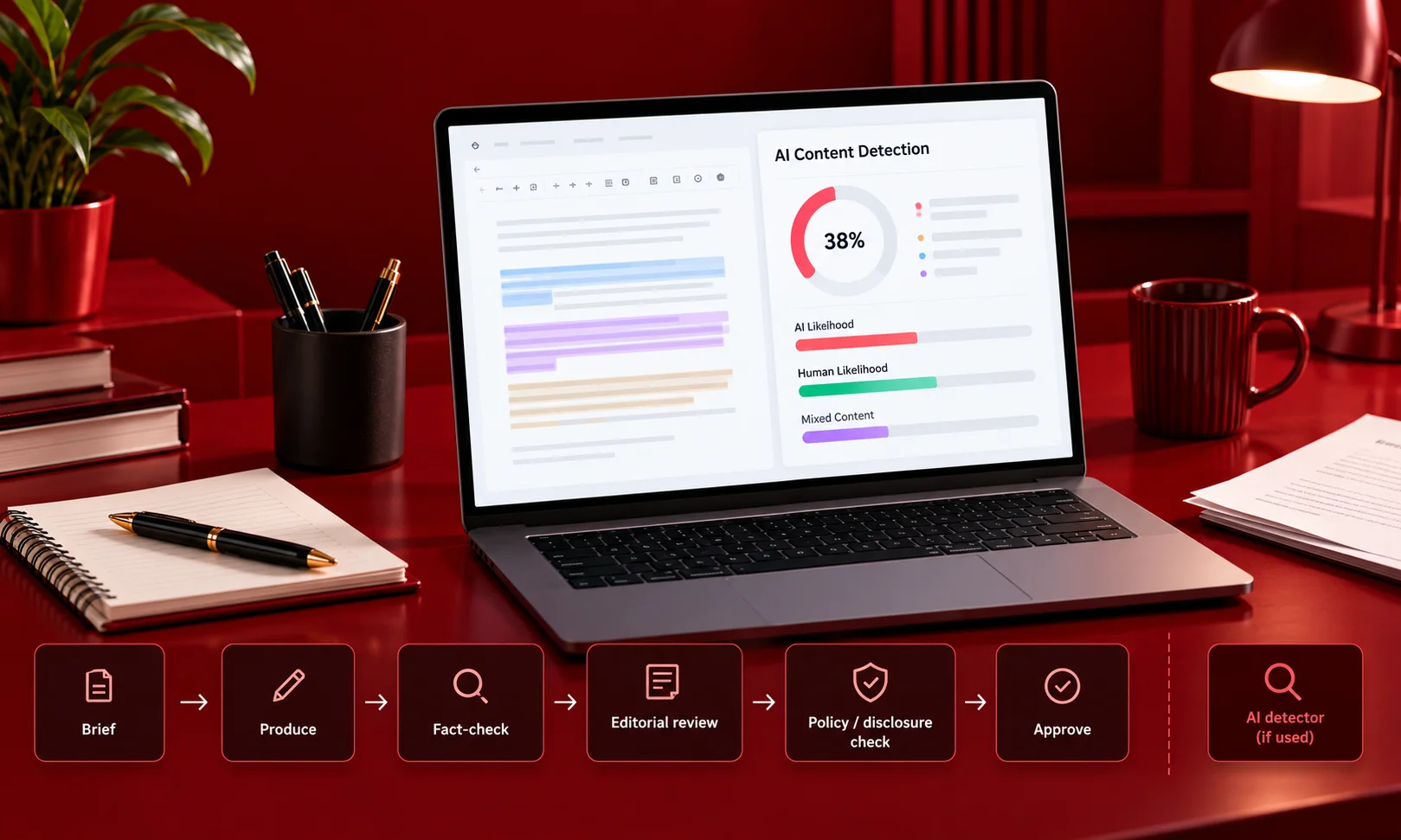
Brief → Produce → Fact-check → Editorial review → Policy/disclosure check → Approve
The AI detector, if used at all, should sit outside that normal approval chain.
Is There Any Legitimate Use for AI Content Detection Tools?
Yes, but the use case is much narrower than many teams assume.
An AI content detection tool might be useful as a signal for investigation at scale.
For example, imagine a company has thousands of pieces of content coming from multiple suppliers. It notices a sudden change in production patterns, content quality, disclosure behavior, and detection scores.
That might be worth investigating.
But notice the difference.
The detector is one signal among several.
It is not:
“This article scored 81%, so the writer definitely used AI.”
It is closer to:
“Something changed in this content operation. Let’s investigate what happened.”
That distinction is important for model governance.
If your team does use ai content detection tools, keep the guardrails fairly strict:
- Use detection for patterns and triage, not individual verdicts.
- Test the system on your own content types and writer populations.
- Track false positives as well as apparent detections.
- Keep a human reviewer involved.
- Never take disciplinary or contractual action from a detector score alone.
- Re-evaluate the process as language models and detection methods change.
The last point matters because the technology is moving quickly.
The RAID benchmark is a good example. Its researchers tested detectors across different models, domains, decoding strategies, and adversarial attacks, showing that performance can change when the conditions change.
So even if an AI content detection tool works well today, that does not mean its result will remain equally meaningful as models and content workflows evolve.
The Read
I don’t think ai content detection tools are going to vanish overnight.
There will always be companies that want a quick way to estimate whether content looks machine-generated. And as more marketing teams adopt AI, that demand probably will not disappear.
But I also don’t think the future of content governance should be built around a percentage next to every article.
Marketing teams have more useful questions to answer.
Was the content accurate?
Was it useful?
Was it properly sourced?
Did the contributor follow the agreed AI rules?
And if the content was weak, can we explain exactly why it was weak?
Those questions lead to a process you can actually manage.
So, if you are updating your content briefs this week, add this line:
AI detection scores may inform review, but they do not constitute proof of authorship or replace editorial judgment.
That one sentence is probably more useful to your content operation than another dashboard full of AI percentages.