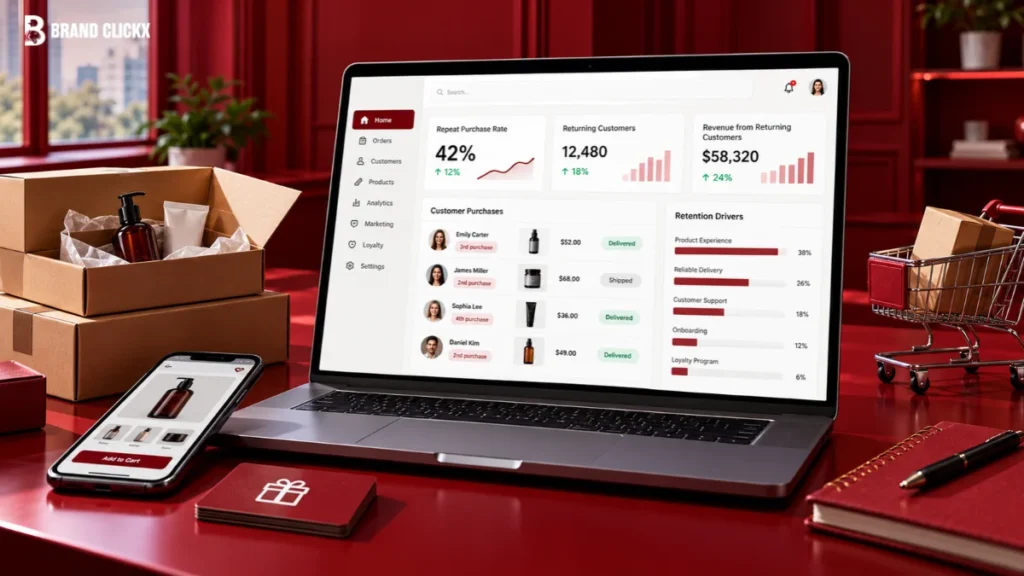
A DTC brand can have a healthy repeat purchase rate and still have a retention problem. Imagine customers coming back regularly, but mostly because every second order comes with 20% off. The dashboard looks healthy. Revenue is moving. The retention marketing strategy appears to be working.
Then finance looks at the margin.
The problem is not that customers are returning. It is that the business is paying them to return when some of them would have bought anyway.
Discounts became the default retention lever because they are easy to launch, measure and attribute. But the strongest reasons customers return often sit elsewhere: the product works, delivery is reliable, onboarding is clear, or a support problem gets fixed quickly.
That changes the question. Instead of asking, “What campaign should we send?” businesses should ask, “What is stopping this customer from buying again, and which team controls that problem?”
Key Takeaways
- Discounts can lift repeat purchases while simultaneously reducing contribution margin.
- Frequent promotions can influence customers’ expectations about the price they should pay.
- Product, operations and service often control retention levers that marketing cannot fix with messaging.
- Retention should be measured by cohort, purchase timing and margin, not repeat revenue alone.
- Marketing can influence non-marketing retention problems by bringing customer evidence and financial impact to the right team.
Why discounting became the default

Discounts became popular because they solve four problems for marketers at once.
First, they are instrumented. A team can create a 15% offer, identify who received it, and track purchases. Second, they are immediate. A customer who has not bought for 90 days can receive an offer today.
Third, they are attributable. The campaign can usually be tied to orders through a coupon, link or customer segment. Fourth, they are controlled by marketing. No product roadmap or warehouse change is required.
That makes discounting unusually attractive inside a company.
The problem is that measurable does not mean economically attractive.
A discount comes directly out of the money left after the sale. If a product has a 50% contribution margin before promotion, a 20% discount does not simply reduce revenue by 20%. It cuts contribution per order from $50 to $30 in a simple $100-order example.
There is also a behavioral cost. Research has found that both the frequency and depth of promotions can affect consumers’ price expectations. Other research has found evidence that consumers anticipate promotions and may delay purchases while waiting for lower prices.
So the question is not whether discounts can produce another order. They can.
The better question is whether the order was incremental enough to justify the margin you gave away.
What a discount actually costs you
Consider a customer who places 3 orders at $100 each.
Assume the product costs $50 per order to produce, fulfill and serve. Without a discount, each order therefore creates $50 in contribution margin.
Now give that customer a 20% discount on every order.
| No discount | 20% discount | |
| Revenue per order | $100 | $80 |
| Variable cost | $50 | $50 |
| Contribution per order | $50 | $30 |
| 3-order revenue | $300 | $240 |
| 3-order contribution | $150 | $90 |
| Contribution lost | — | $60 |
The customer still generated $240 in revenue. On a revenue dashboard, that can look like a successful retention program.
But contribution margin fell from $150 to $90, a 40% reduction.
The harder problem is incrementality. If the customer would have made those 3 purchases without the offer, the entire $60 is effectively money the business surrendered for behavior it did not create.
Even when the discount does cause an otherwise unlikely purchase, the business should compare the incremental contribution against the cost of the incentive. This is where conversion rate optimization and retention start to intersect with unit economics: getting another conversion is not automatically valuable if the economics of that conversion are weak.
The long-term effect matters too. Research on price promotions suggests repeated exposure can shape consumers’ reference prices and expectations.
A customer who learns that the brand regularly offers 20% off has a reason to question the $100 price.
That is not necessarily a reason to stop discounting. It is a reason to stop treating discounts as the default answer to every retention problem.
The levers, grouped by who owns them
A useful retention marketing strategy starts by assigning the problem to the team that can actually change it.
| Retention lever | Primary owner | What it changes | Evidence | Time to affect behavior |
| Replenishment messaging | Marketing | Reminds customers when a repeat purchase makes sense | High for timing/relevance; context-dependent | Days to weeks |
| Education and usage content | Marketing/Product | Helps customers get more value from what they bought | Moderate; stronger when tied to actual usage friction | Weeks |
| Product quality and usability | Product | Gives customers a reason to return | High conceptually; category-dependent | Weeks to months |
| Availability and delivery | Operations | Removes friction between purchase intent and fulfillment | Strong evidence for delivery/repurchase relationship | Weeks |
| Returns and refunds | Operations/Service | Reduces post-purchase risk and frustration | Strong | Days to weeks |
| Issue resolution | Customer service | Restores trust after failure | Strong | Days |
| Community and customer connection | Marketing/Product | Creates reasons to engage beyond transactions | Moderate; highly category-dependent | Months |
The table reveals the uncomfortable part of retention: marketing does not own most of the customer experience.
Research on online retail found that post-delivery services such as exchanges, returns and refunds influence satisfaction and trust, which in turn affect repurchase intention.
A 2025–2026 retail report from Amazon Shipping and Retail Economics also found that 81% of surveyed consumers across the UK, France, Italy and Spain said good delivery experiences influence repeat purchases. That figure comes from 6,000 consumers across those four markets, not ecommerce globally.
The implication for a repeat purchase strategy is straightforward: if customers are not returning because deliveries are late, sending more emails is not the root-cause solution.
The same principle applies to product adoption, returns, quality and customer service.
Retention is an outcome created by several functions. Marketing can influence it, but cannot message its way around a broken experience.
Marketing-owned levers that are not discounts
Marketing still has plenty of levers. The important shift is to use them to make the product easier to adopt and the next purchase more relevant rather than simply cheaper.
Onboarding and expectation setting should answer the customer’s immediate question: “What happens now?” Good onboarding confirms what the customer bought, explains what to do next and sets realistic expectations about delivery, setup or first use.
For digital products, onboarding should move customers toward a meaningful first value moment rather than simply sending a welcome email. Research on customer onboarding has linked delays, confusion and poor visibility during the early experience with churn risk.
Replenishment timing is another obvious opportunity. A customer who buys a product every 45 days does not need the same message on day 7 and day 44. The useful trigger is the likely consumption window, not the marketer’s campaign calendar.
Education and usage content can also create retention without changing the price. Show customers how to use the product better, solve common problems and get more value from what they already purchased.
Community can work when the category naturally supports shared identity, learning or participation. But it should not become a vague “build community” project. The useful question is what customer behavior the community makes easier or more rewarding.
This is where loyalty without discounts becomes practical. Recognition, useful education, early access, better service and genuinely relevant communication can give customers reasons to stay without constantly lowering the price.
A loyalty program may support these mechanics, but it is not the subject here.
How to influence the levers you do not own

The easiest way for marketing to lose a retention argument is to say, “Customers are leaving because operations is bad.”
The better approach is to bring evidence.
Start with the cohort. Show that customers who experienced a particular delivery delay, product issue or support interaction reorder at a different rate from comparable customers.
Then quantify the commercial effect.
If customers affected by late delivery have a 12% second-order rate while unaffected customers have a 24% rate, the conversation is no longer about whether marketing needs another campaign. It is about the number of customers and contribution margin being lost after the first purchase.
Bring customer evidence too. Support tickets, return reasons, reviews and survey responses can explain why the cohort difference exists.
Then involve the owner of the lever.
Product should see product friction. Operations should see delivery and availability problems. Customer service should see unresolved issues and recovery rates. Marketing should bring the customer pattern, connect it to revenue and help communicate the solution.
That is how marketing can influence retention without pretending it controls everything.
Operators have documented similar cross-functional approaches. One Customer Success Association case study describes a customer experience leader who created a formal RACI across Sales, Implementation and Success, then established collaboration with Product and Marketing; the reported case reduced attrition from 12% to 3%.
The result is a single case study, not a universal benchmark, but it illustrates the organizational principle: retention problems can require structural ownership beyond marketing.
A practical retention marketing strategy therefore needs an escalation path, not just a campaign calendar.
What to measure
Measure retention by cohort and economics, not by the amount of repeat revenue generated in a month.
Start with repeat rate by cohort. Take everyone who made their first purchase in January and measure how many purchased again within a defined period. Do the same for February, March and subsequent cohorts.
This matters because category behavior varies dramatically. A 2026 Shopify report citing a 156,110-customer DTC analysis found second-order rates ranging from roughly 30%–40% for consumables to 12%–17% for fashion and 10%–15% for durable goods. Those figures are category-specific, not a universal retention target.
Next, measure time between orders. A rising repeat rate is useful, but a customer who returns after 30 days is economically different from one who returns after 180 days.
Then measure margin per retained customer.
This is where customer lifetime value becomes more useful than raw revenue. A customer who generates $500 in sales at strong contribution margin may be more valuable than one generating $700 through repeated discounts.
The same logic applies to acquisition payback. If a customer costs $100 to acquire, the business needs to know how quickly the contribution generated by that customer recovers the $100, not simply how quickly the customer produces another order.
A simple measurement stack is:
- Cohort repeat rate: What percentage of first-time customers return?
- Time to second order: How long does the return take?
- Contribution margin per retained customer: How profitable is the repeat behavior?
- Discount dependency: What percentage of repeat orders required an incentive?
- Acquisition payback: How long until customer contribution covers acquisition cost?
This lets a business distinguish between genuine retention and purchased retention.
The read
Retention should not sit entirely within marketing because marketing does not create the entire customer experience.
Marketing should own the levers it can control: relevance, timing, education, onboarding communications and customer engagement. But product should own product value. Operations should own fulfillment. Service should own recovery. Leadership should make sure those functions are measured against a shared retention outcome.
That is the more useful retention marketing strategy: not finding a better discount, but finding the reason customers need one.
This week, pick your last 3 customer cohorts and compare customers who received a discount with those who did not. Then compare their repeat rate, time to second order and contribution margin.
If the discounted group is only marginally more likely to return, you may have found a retention cost disguised as a retention strategy.