
Pitch decks are sent to media planning teams on a regular basis that essentially merge two completely different categories of advertising. Not only do the different types of apps, services, and businesses sell access to intent-driven audiences, but their data infrastructure differs greatly. A formal commerce media definition is all digital advertising networks that use commercial signals or commercial intention to target consumers and measure results in non-owned or owned channels.
It’s critical to grasp this fundamental difference because media networks are monetized, measured and powered by vastly different data quality. Vendors often confuse the lines between these and sell contextual inventory at performance prices, but testing a network’s underlying transaction engine will help you understand if it’s closed-loop attribution or just simple behavioral inference.
Key Takeaways
- The category hierarchy is Commerce media as the umbrella category of all intent / transactional data ad channels, with Retail media as a specific subset, created on top of the direct purchase data available at SKU level.
- Data Verification: True retail media offers SKU level attribution in closed loop manner whereas non-retail commerce media uses intent signals, modeled conversions or panel data.
- Funding dynamics: Retail media is a big portion of trade and shopper marketing budgets, while larger commerce media campaigns are usually from general digital performance or brand awareness budgets.
- Evaluation Rule: An ad network doesn’t have offline or online sales data for your particular SKUs, it’s not a retail media network, it’s a commerce media network.
What is commerce media? A working definition

Commerce media is a broad category of advertising networks that focus on commerce transaction data, shopping intent, or financial behaviors to target users and measure ad performance on both on-site and off-site properties.
Media buyers need to take three structural pillars to analyze what is really commerce media:
- Audience Ownership: The publisher or platform has a direct relationship with the audience via a digital platform, app or account, or financial service platform.
- Instead of simply using general users or context signals, the network profiles users according to their commercial activities, like booking flights, spending on credit cards, ordering food or rides.
- Ad Placements: Ads appear within the native consumer app (on-site), or span the open web, social, and connected TV (off-site) in a platform matched fashion.
Commerce media is a type of media that connects media impressions with commercial actions, allowing brands to reach consumer at high-intent moments outside of the traditional search engine and open display exchanges.
Where retail media sits inside it
Retail media represents a specific, highly optimized subset nested inside the broader commerce media ecosystem. Is retail media part of commerce media? Yes, it is the foundational segment where a merchant or retailer monetizes its own digital properties and first-party shopper data.
In a classic retail environment, the media network sits directly on top of SKU-level point-of-sale (POS) systems and loyalty programs. When comparing retail media vs commerce media, the critical differentiator is the direct point of sale. Retail media places advertisements such as sponsored products, display banners, and brand zones directly where the purchase transaction takes place or off-site to drive users back to that specific store.
For a complete breakdown of major retail networks, coverage footprints, and merchant ecosystems, explore our comprehensive Retail Media Network Landscape Guide.
Side by side, commerce media and retail media
Understanding what is the difference between commerce media and retail media requires evaluating how each channel handles inventory, targeting, funding, and performance tracking.
| Metric / Dimension | Retail Media Networks (RMNs) | Broader Commerce Media Networks |
| Who owns the inventory? | Retailers operating physical or e-commerce storefronts | Non-retail commercial platforms (travel, fintech, ride-share, delivery) |
| What data sits behind it? | SKU-level transaction history, basket contents, loyalty records | Category-level intent, booking details, location activity, payment trends |
| Where do the ads run? | Digital storefronts, retail apps, physical stores, off-site programmatic extensions | Native mobile apps, partner publisher sites, connected TV, web display |
| What can it prove? | Deterministic closed-loop omnichannel sales lift by SKU | Brand lift, cross-channel conversions, category affinity, modeled incremental sales |
| Who funds it? | Trade budget shift, shopper marketing, co-op funds, brand performance media | Digital performance budgets, brand awareness funds, growth marketing |
| Typical measurement method | Closed-loop sales attribution, incrementality testing, POS match | Multi-touch attribution (MTA), brand lift studies, panel inference |
The Two Rows That Matter Most to Buyers
While all six dimensions influence campaign planning, what data sits behind it and what can it prove determine campaign value. A true retail media network leverages deterministic first party data tied directly to stock-keeping units (SKUs). This lets brands prove exact return on ad spend (ROAS) down to the specific product bought.
In contrast, non-retail commerce channels frequently rely on category-level intent signals, requiring buyers to rely on modeled attribution or panel validation.
The other networks now calling themselves commerce media
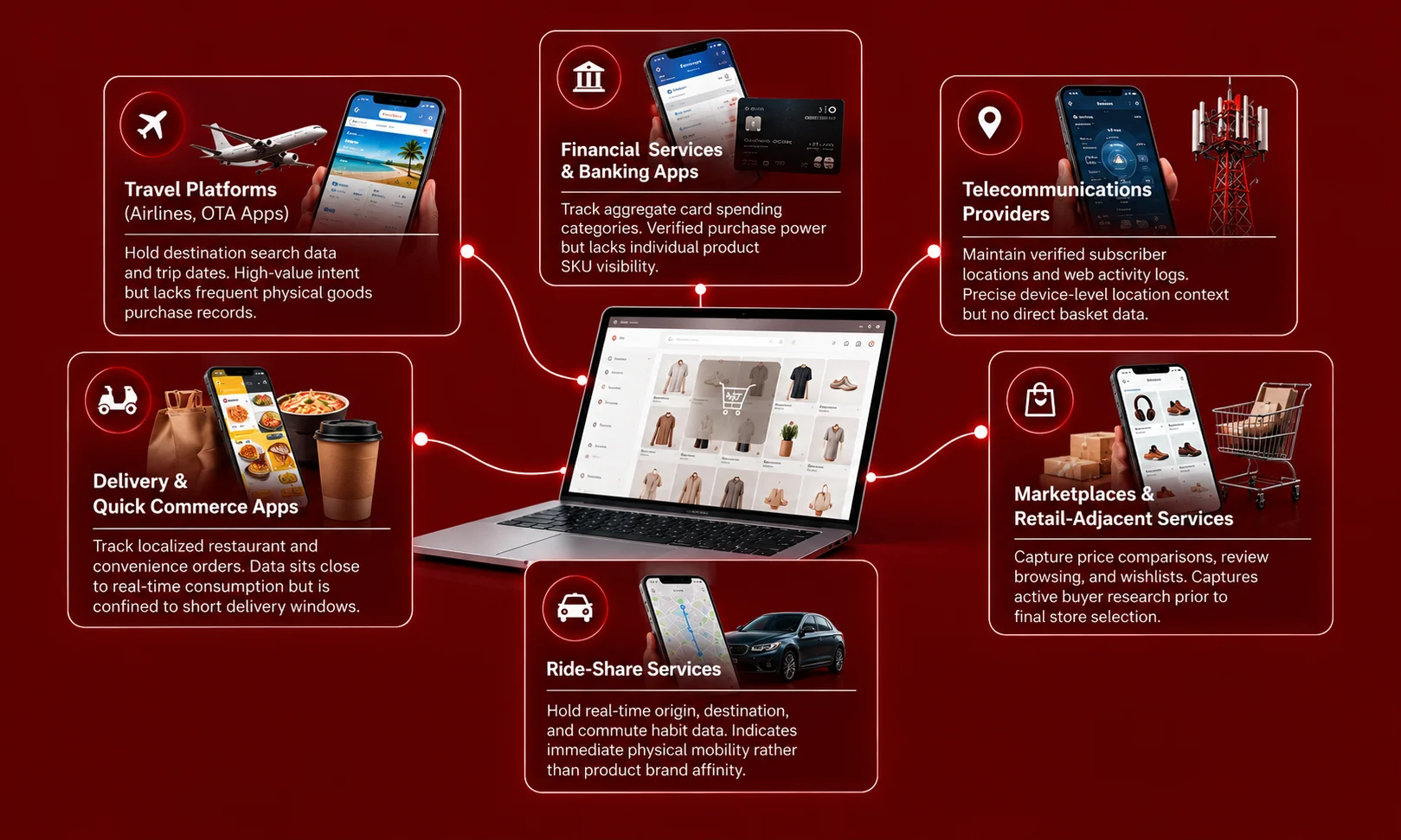
As third-party cookies decline, non-retail platforms with high-frequency user engagement have launched advertising operations. To understand what is a commerce network today, buyers must examine the underlying data held by these expanding categories:
- Travel Platforms (Airlines, OTA Apps): Hold destination search data and trip dates. Data reflects high-value intent but lacks frequent physical goods purchase records.
- Financial Services & Banking Apps: Track aggregate credit or debit card spending categories. Data reflects verified purchase power but lacks individual product SKU visibility.
- Telecommunications Providers: Maintain verified subscriber locations and web activity logs. Data provides precise device-level location context but no direct basket data.
- Delivery & Quick Commerce Apps: Track localized restaurant and convenience orders. Data sits close to real-time consumption but is confined to short delivery windows.
- Ride-Share Services: Hold real-time origin, destination, and commute habit data. Data indicates immediate physical mobility rather than product brand affinity.
- Marketplaces & Retail-Adjacent Services: Capture price comparisons, review browsing, and wishlists. Data captures active buyer research prior to final store selection.
These platforms expanded the definition of commerce media because they monetize logged-in users with active commercial intent, even when they do not process retail checkout baskets themselves.
What each one can honestly prove
Measurement credibility across commerce channels follows a strict hierarchy of evidence. Buyers should evaluate vendor pitch decks against three distinct validation levels:
| Level | Evidence Type | Methodology & Description | Credibility Level |
| Level 1 | Deterministic Closed-Loop | Direct match to POS & SKU checkout | Highest |
| Level 2 | Modelled Attribution | Pixel matching & multi-touch math | Moderate |
| Level 3 | Panel/Survey Inference | Sample groups & brand lift studies | Baseline |
Level 1: Deterministic Closed-Loop Evidence (Highest Credibility)
Who sits here: Traditional retail media networks with physical and digital checkout systems.
What it proves: Direct linkage between an ad view/click and an actual store transaction down to the exact SKU and dollar value.
Level 2: Modelled Attribution (Moderate Credibility)
Who sits here: Quick-commerce, travel networks, and off-site programmatic extensions.
What it proves: Probabilistic connections using user IDs, IP matching, or multi-touch attribution formulas to link ad exposure to platform conversion events.
Level 3: Panel & Survey-Based Inference (Baseline Credibility)
Who sits here: Financial apps, telcos, and broad media networks lacking native e-commerce checkouts.
What it proves: Category-level spend lift or audience brand awareness, calculated by sampling small user panels or running post-campaign surveys.
The test to run before you believe the deck
To determine how do you evaluate a commerce media network during vendor discovery, media buyers should use this six-question audit:
- Is there transaction data behind this audience segment, or is it based on pageviews?
- Objective: Distinguish between verified past buyers and passive content viewers.
- Is the transaction data collected firsthand (first-party), or acquired from external data brokers?
- Objective: Ensure identity resolution relies on deterministic account IDs rather than probabilistic third-party graphs.
- Will you support a randomized control group (holdout) incrementality test?
- Objective: Prove that ad exposures generated sales that would not have occurred organically.
- What is your deterministic match rate against our brand’s customer database?
- Objective: Measure actual usable reach across targeted audience segments.
- How is the attribution windowed, and how do you split lookback credit between view-through and click-through?
- Objective: Prevent inflated ROAS metrics caused by over-crediting passive visual impressions.
- Who audits your measurement data—an independent third party or your internal reporting engine?
- Objective: Verify performance metrics against industry reporting standards.
Which to buy, by objective
Selecting between channels depends on your growth goals and measurement requirements:
Scenario 1: Driving trial for a new product in an established category
- Selection: Retail Media Networks
- Why: Reaches shoppers at the precise digital point of purchase when purchase intent is at its peak.
- What to Buy: In-grid sponsored products and digital shelf placement within category search results.
- Measurement Requirement: Insist on closed-loop SKU sales lift comparison against a baseline control group.
Scenario 2: Defending share in a category where you already sell well
- Selection: Retail Media Networks (On-site & Off-site)
- Why: Protects branded search queries from competitor conquesting while retargeting existing buyers.
- What to Buy: Branded search terms, homepage display banners, and off-site retargeting using retailer first party data.
- Measurement Requirement: Require incremental sales lift metrics alongside customer lifetime value (LTV) retention tracking.
Scenario 3: Reaching a new audience with no purchase history with you
- Selection: Broader Commerce Media Networks (Travel, Fintech, Mobility)
- Why: Expands top-of-funnel reach by targeting high-income or high-mobility audiences based on lifestyle commerce signals.
- What to Buy: Native app sponsorships, push notifications, and targeted CTV placements built on category spending triggers.
- Measurement Requirement: Require geo-matched control testing combined with third-party brand lift measurement.
The verdict, and the sentence to remember
Choosing between advertising options requires matching your commercial strategy with the right network capability:
- For immediate conversion and verified SKU-level sales, buy retail media.
- For broad category discovery and high-intent audience expansion, buy commerce media.
- For defending retail share, buy on-site search and sponsored placements.
If a network cannot show you deterministic transaction data for the product being advertised, it is commerce media not retail media, regardless of what the pitch deck claims.
Frequently Asked Questions
What is commerce media?
Commerce media is an advertising umbrella encompassing any media network that uses commercial intent, transactional data, or shopping behavior to target consumers and measure ad performance across digital channels.
What is the difference between commerce media and retail media?
Retail media requires a retailer’s direct point of sale and SKU-level transaction data. Commerce media is a broader category that includes travel, fintech, and delivery platforms using category-level intent or payment data without owning a retail store.
Is retail media part of commerce media?
Yes, retail media is a specific subset of commerce media. It specifically refers to ad inventory owned and operated by product retailers who monetise their own shopper data and physical or e-commerce storefronts.
What is a commerce network?
A commerce network is any non-retail platform such as a ride-share app, airline booking engine, food delivery service, or bank that packages its first-party user intent data to sell targeted ad placements.
Which has better measurement, commerce media or retail media?
Retail media generally offers superior measurement because it provides closed-loop attribution linked directly to actual POS and SKU checkout data. Commerce media often relies on modeled attribution, location data, or panel inference.
Who funds commerce media budgets?
Retail media is frequently funded by trade marketing and co-op budgets shifted from traditional trade promotions. Broader commerce media campaigns are typically funded by digital performance, brand marketing, or growth media budgets.