


A great product doesn’t automatically turn into a great brand positioning that trips up more businesses than you’d think. Customers these days are buried in options, and most companies are scrapping for the same narrow sliver of attention. So what actually tips things in one brand’s favor over another? Nine times out of ten, it comes down to positioning.
Positioning, at its core, is about deciding how you want people to see you next to everyone else fighting for that same attention. It pulls together your audience, your value, your personality, your benefits, whatever actually sets you apart and folds all of that into one clear idea. The American Marketing Association puts it this way: it’s about defining where an organization sits in the market relative to its competitors, then using that position to actually communicate value to the people you’re trying to reach.
The simplest way to think about it: positioning is the spot your brand actually earns inside someone’s head not the spot you’re hoping to have.
So What Actually Is Brand Positioning?

Brand positioning is the strategy a business uses to claim a clear, meaningful spot inside its target customers’ heads. It’s really just answering one question, even if it sounds simple: why would someone pick you over the option sitting right next to you on the shelf?
Saying your product’s “high quality” or your service is “the best” doesn’t get you there. Every single company says that it’s basically background noise at this point, nobody hears it anymore. What actually works is explaining what makes your brand useful, different, relevant, and something people still think about days later.
Look at a coffee shop as an example. It could go cheap and everyday, lean hard into premium specialty beans, promise speed for people rushing off to work, or just be the relaxed spot where the neighborhood gathers. Coffee’s coffee either way but why someone actually chooses to walk in changes completely depending on which direction you take. That’s the whole power of positioning right there.
Key Takeaways
- Positioning, at the end of the day, is how you want your brand seen against everything else fighting for the same attention.
- Nail your audience before anything else who they actually are, what they need, what they genuinely care about.
- Calling yourself “better” or “unique” doesn’t mean much without a real reason sitting behind it.
- Your website, ads, social, and customer experience should all be telling the same story — that’s what a clear positioning statement gets you.
- Identity and positioning aren’t the same thing, even though they work closely together.
- Whatever you claim about your brand needs backup real experience, feedback, actual results, something people can point to.
- And keep it simple. The faster someone gets it, the more likely it sticks and the more likely it actually does its job.
Why Brand Positioning Actually Matters

Without clear positioning, a brand can easily start sounding like every other option out there. One campaign leans on price, another pushes quality, another goes for luxury and customers walk away genuinely unsure what the business even stands for.
More than anything, positioning helps customers understand your value faster. When people already know what your brand stands for, they’ve got an easier reason to remember you and think of you the next time they actually need what you sell.
The Main Pieces of Strong Brand Positioning
Effective positioning was never built around one clever slogan. It usually comes together from several different pieces working in sync.
1. Figure Out Who You’re Actually Building This For
Start with the actual people you’re trying to reach not some vague idea of “customers.” What are they dealing with day to day? What’s frustrating them? When they’re weighing options, what tips the scale? What makes them trust one company over another?
Trying to be everything to everyone just doesn’t hold up stretch a brand that thin and it stops meaning anything to anyone. Pick a real audience, and suddenly your positioning has somewhere solid to stand. The whole message gets easier to write.
So skip the “we sell to everyone” line. Pick a lane first-time buyers, busy professionals, small business owners, luxury shoppers, parents, whoever actually fits. The sharper that picture is in your head, the easier it gets to explain why your brand should matter to them at all.
2. Actually Pay Attention to What You’re Up Against
This means knowing what everyone else in your space is already telling customers. Their products, pricing, how they market themselves, what people are saying about them in reviews, where they’re winning, where they’re falling short.
None of this is about copying what works for them. It’s about spotting the gap the place where you can offer something that actually matters, that they’re not already covering.
HubSpot’s guidance on this basically comes down to studying the difference between how a brand wants to be seen and how it’s actually being seen. And before you even start building a framework, you need a real handle on your audience, your competitors, your value, and your personality.
3. Nail Down the Thing That Actually Sets You Apart
There’s one question your value proposition needs to answer, and answer well: what can you genuinely give people that they can’t get from somewhere else?
That doesn’t mean reinventing the wheel. Sometimes it’s something as simple as easier convenience, a smoother process, deeper expertise, better service, sharper design, a lower price, more speed, or just a different feel to the whole experience.
The thing that actually matters is specificity. “Great service” says basically nothing. “Same-day support for small business owners” — now that’s something a person can actually picture and remember.
4. Give the Brand an Actual Personality
People don’t connect with a business purely because of what’s on the spec sheet. They also respond to how it feels to actually deal with.
Your brand could come across friendly, bold, professional, playful, premium, practical, adventurous, calm — whatever fits. But whatever you land on has to match your audience and stay steady across everything you put out into the world.
A financial services company is probably going to need a very different personality than a sportswear brand — and neither one’s inherently better. It just comes down to who you’re trying to reach and what position you actually want to claim.
5. Back Up What You’re Claiming With Real Proof
Strong positioning needs actual evidence, not just confidence. Claiming expertise? Show the experience behind it. Promising quality? Explain what’s actually backing that up. Customers love what you do? Let their reviews and real stories carry that weight instead of just saying it yourself.
This is exactly where E-E-A-T earns its keep in content and brand communication. Showing genuine experience, real expertise, trustworthy information, and credible backup gives people actual reasons to believe what you’re telling them instead of just taking your word for it.
How to Actually Build a Brand Positioning Strategy
Creating brand positioning doesn’t have to turn into some massive, drawn-out project. Start with research, then turn what you learn into one focused message.
Step 1: Research Where You Currently Stand
Ask real customers how they’d describe your brand — without feeding them the answer first. Read through reviews, look at the questions customers keep asking, dig into feedback, and study your existing marketing.
You might find customers see your brand pretty differently than your own team does internally. That gap’s actually worth something it shows you where your reputation genuinely stands right now, not where you assume it sits.
Step 2: Spot What Your Competitors Are Getting Wrong
Look at whatever your competitors are ignoring or just doing badly. Maybe their pricing’s too high, their product’s a pain to use, they come across as too stiff and formal, they take forever to respond, or they’re spreading themselves thin trying to please everyone.
Usually, the real opportunity shows up right where a customer’s actual need overlaps with something you’re genuinely good at.
Step 3: Settle on One Core Benefit
Pick the single main thing you want customers to think of when they think of your brand. Don’t try to squeeze ten different selling points into one message it just doesn’t work that way.
If everything gets equal weight, none of it actually lands.
You can still mention supporting benefits elsewhere in your marketing, but there needs to be one central idea tying it all back together.
Step 4: Write the Actual Positioning Statement
This is usually something you keep internal a strategic tool for your team, not a slogan you’d ever put on your homepage. A framework that tends to work well:
For [target audience] who [need or problem], [brand] is the [category] that [main benefit], unlike [alternative], because [reason to believe].
Filling that in forces you to actually commit to your audience, your category, your benefit, your difference, and your proof. HubSpot’s current guidance points to these same pieces as the foundation behind any solid positioning statement.
Step 5: Make Sure It Shows Up Everywhere, Consistently
Positioning can’t just sit buried in some strategy doc that nobody looks at again. Your website, your ads, social media, the actual product experience, customer support, packaging, even how your sales team talks all of it needs to reinforce the same core idea.
The moment your message shifts dramatically from one place to another, customers start losing track of what your brand actually stands for.
Common Types of Brand Positioning
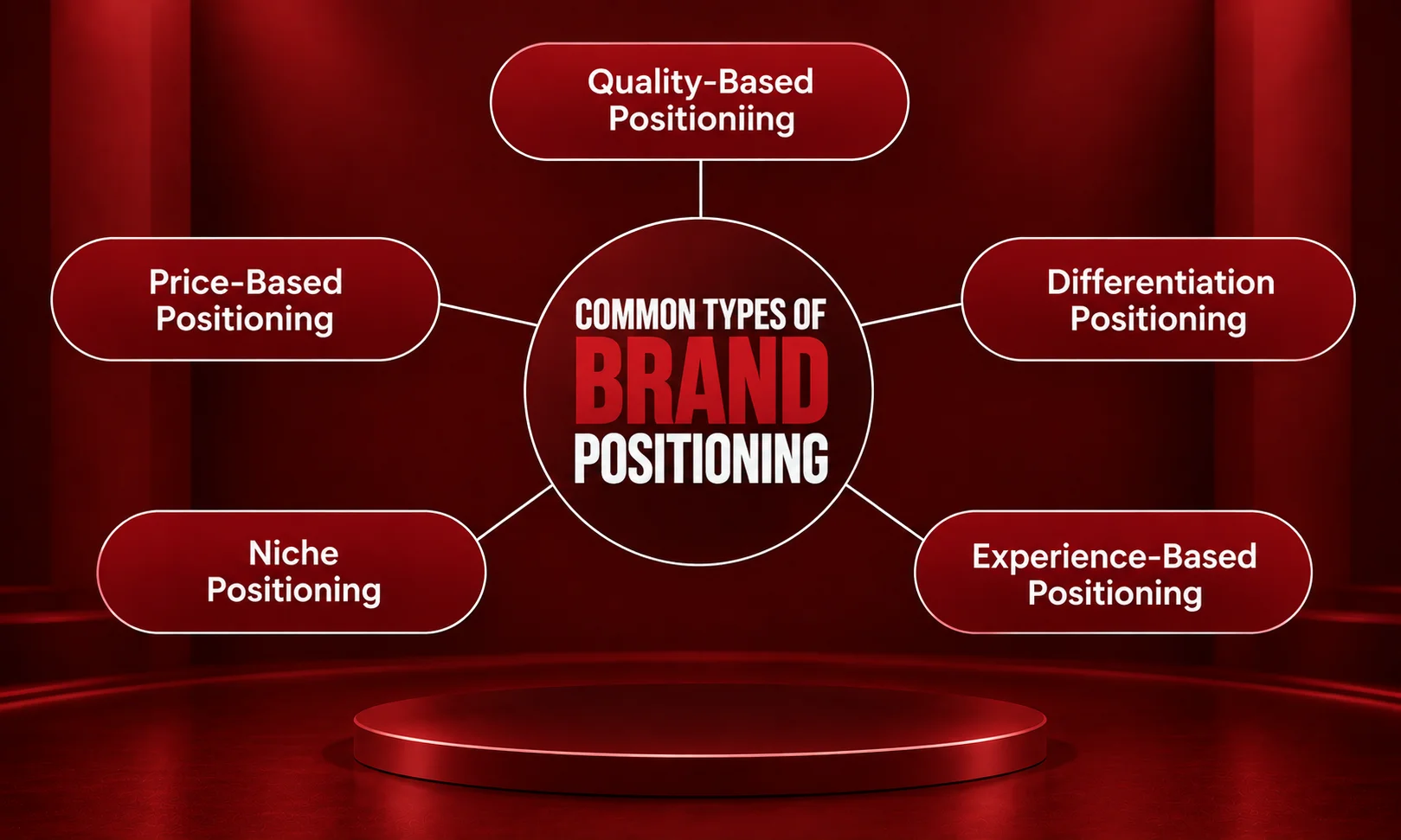
There’s no one-size-fits-all approach here. Different businesses lean on different strategies depending on their market and where their actual strengths lie.
Quality-Based Positioning
This leans on craftsmanship, reliability, performance, materials — whatever signals “this is genuinely well-made.” Works especially well when customers are already willing to pay a bit more for something dependable or premium.
Price-Based Positioning
Some brands just compete on being cheaper or offering better value for money. It’s effective for pulling in price-conscious shoppers, but there’s a real risk if price is the only reason someone picks you, they’ll leave the second something cheaper shows up.
Differentiation Positioning
This one’s about being meaningfully different in some way competitors aren’t could be the technology, the design, the service, how convenient it is, how specialized it is, or just an experience that feels completely different from everyone else’s.
Niche Positioning
Instead of chasing everyone, a brand goes narrow — one specific audience, one specific problem. It’s actually a strength for smaller businesses, because it makes them feel deeply relevant to exactly the people they’re built for, instead of vaguely relevant to a huge crowd.
Experience-Based Positioning
Here the product itself might look pretty similar to what competitors offer, but the whole experience around it buying it, using it, interacting with the brand — feels distinctly different. That difference is the actual competitive edge.
Brand Positioning vs. Brand Identity
People mix these two up all the time, but they’re really not the same thing. Positioning is about the spot you want to claim in a customer’s head, and what actually makes you different from everyone else fighting for that same attention.
And honestly, they need each other. A stunning visual identity can’t save positioning that’s muddled or unclear, and even sharp positioning falls flat if it gets communicated differently every place someone runs into your brand.
Mistakes That Quietly Weaken Brand Positioning
One trap businesses keep falling into: trying to talk to literally everyone at once. That kind of broad messaging almost always ends up generic, because it never actually commits to a real choice.
Another one echoing whatever competitors are already saying. If your message reads almost identical to five other companies in the same space, why would anyone specifically remember you over the rest?
There’s also this habit of leaning on words like “best,” “innovative,” “premium,” “world-class” without ever explaining what any of that actually means for the person reading it. Real, specific benefits backed by actual proof will beat a fancy adjective every single time.
And one last thing positioning isn’t a “write it once and forget it” exercise. Markets shift. Competitors change their game. Customer expectations move around constantly. Go back and revisit yours whenever your audience, product, category, or the competitive landscape genuinely shifts underneath you.
Final Thoughts
Brand positioning was never really about crafting one clever line and pinning it to your homepage. It’s about actually deciding who you’re serving, what you’re offering, what sets you apart, and why anyone should take your word for it.
The brands that get this right make it obvious in everything they touch. Nothing feels random about their marketing, because there’s a real idea sitting underneath all of it. Customers know exactly what they’re going to get from them, and suddenly the competition doesn’t all blur together anymore.
That’s really the whole point here positioning is what pulls a business out of the pile of “just another option” and turns it into something people actually recognize when they see it, and remember later when it counts.
FAQs
So what does brand positioning actually mean, in plain terms?
Basically, it’s the spot you want your brand sitting in someone’s head. What you offer, who it’s actually meant for, why they’d pick you over the guy next door that’s really all positioning is trying to answer.
Okay but why does any of this matter?
Because without it, you just blend in. Good positioning gives people an actual reason to remember you and reach for you again later. It also quietly shapes everything else your marketing, how you talk to customers, product calls, even what the whole experience feels like.
Can you give a real example of this?
Sure take a clothing brand. It could go the affordable-everyday-wear route, or lean fully into premium fashion, or build itself around sustainability for people who actually care about that stuff. Same industry, completely different customer walking through the door each time, and completely different expectations too.
What separates good positioning from mediocre positioning?
Honestly, it comes down to a few things is it clear, does it actually matter to the audience, is it different from the next brand, do people believe it, and does it stay consistent everywhere they encounter you. At the end of the day it just needs to tie something a customer genuinely needs to something your brand can actually deliver not just say it can.
Is brand positioning the same thing as branding?
No, not quite. Branding is the broader, ongoing process of building and managing how a business gets perceived overall. Brand positioning is more specific it’s about the exact spot the brand wants to own inside its target customer’s mind relative to competitors.
Can brand positioning change over time?
Yes, definitely. A brand may need to reposition itself when its audience, products, competitors, market conditions, or customer expectations shift. That said, any change should be purposeful and deliberate not just chasing whatever trend happens to be popular that month.